Hello boys and girls!
              Welcome to . . .


A Water Cycle Adventure
        Click HERE to begin!

          Kimberly Grant
  EDT 530 Professor Gail Garthwait
            March 2011
We are going to have so much
       fun learning about the water
      cycle! You will learn cool new                         For Teachers:
        words like evaporation and
               precipitation!


                                                             Student Goals
For Students
The Water Cycle                         Click on the topic     Resources
                                        you want to start
                                               with.
          Clouds
                                                             Photo Credits
The Water Cycle and ME

       Water Cycle Review
Take this challenge to see how much you learned!

                                                              Back to the beginning
Clouds
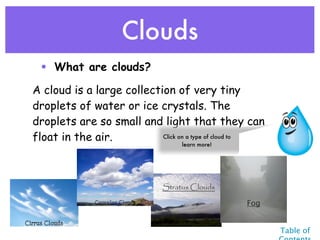
 • What are clouds?

A cloud is a large collection of very tiny
droplets of water or ice crystals. The
droplets are so small and light that they can
float in the air.          Click on a type of cloud to
                                   learn more!


                              Stratus Clouds

                                                 Fog


                                                         Table of
Cumulus Clouds


•     Cumulus Clouds              are white, puffy clouds that look like
    pieces of floating cotton. Cumulus clouds are often called "fair-
    weather clouds". The base of each cloud is flat and the top of
    each cloud has rounded towers. When the top of the cumulus
    clouds resemble the head of a cauliflower, it is called cumulus
    congestus or towering cumulus. These clouds grow upward and
    they can develop into giant cumulonimbus clouds, which are
    thunderstorm clouds.


                                                                           Back to
Stratus Clouds

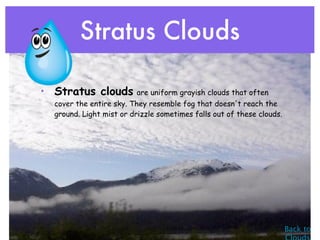
• Stratus clouds are uniform grayish clouds that often
   cover the entire sky. They resemble fog that doesn't reach the
   ground. Light mist or drizzle sometimes falls out of these clouds.


                                                                        Back to
Cirrus Clouds

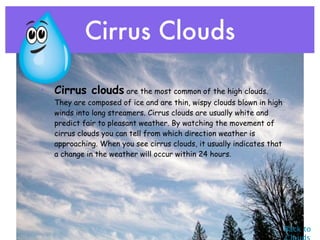
• Cirrus clouds are the most common of the high clouds.
   They are composed of ice and are thin, wispy clouds blown in high
   winds into long streamers. Cirrus clouds are usually white and
   predict fair to pleasant weather. By watching the movement of
   cirrus clouds you can tell from which direction weather is
   approaching. When you see cirrus clouds, it usually indicates that
   a change in the weather will occur within 24 hours.


                                                                        Back to
Fog
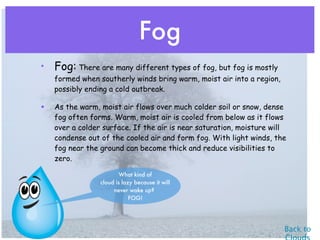
• Fog: There are many different types of fog, but fog is mostly
    formed when southerly winds bring warm, moist air into a region,
    possibly ending a cold outbreak.

•   As the warm, moist air flows over much colder soil or snow, dense
    fog often forms. Warm, moist air is cooled from below as it flows
    over a colder surface. If the air is near saturation, moisture will
    condense out of the cooled air and form fog. With light winds, the
    fog near the ground can become thick and reduce visibilities to
    zero.

                         What kind of
                 cloud is lazy because it will
                      never wake up?
                             FOG!


                                                                       Back to
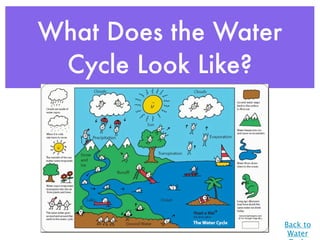
The Water Cycle
    •   The earth has a limited amount of water.  That water
        keeps going around and around and around and around
        and in what we call the "Water Cycle".

    •   Water Cycle Song
This cycle is made up of a few main parts:
•   evaporation (and transpiration)
•   condensation                            Click to learn more
                                           about each part of the
•   precipitation
                                                water cycle.
•   collection
•   What does the water cycle look like?


                                                                    Table of
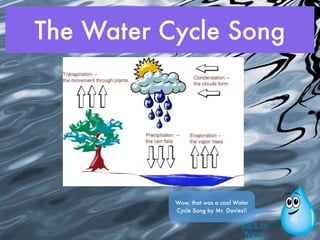
The Water Cycle Song


           Wow, that was a cool Water
           Cycle Song by Mr. Davies!!

                                  Back to
                                   Water
What Does the Water
 Cycle Look Like?


                      Back to
                       Water
Condensation
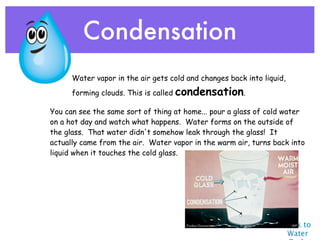
  •   Water vapor in the air gets cold and changes back into liquid,
      forming clouds. This is called condensation.

You can see the same sort of thing at home... pour a glass of cold water
on a hot day and watch what happens.  Water forms on the outside of
the glass.  That water didn't somehow leak through the glass!  It
actually came from the air.  Water vapor in the warm air, turns back into
liquid when it touches the cold glass.


                                                                   Back to
                                                                    Water
Precipitation
                                What happens when it rains
                                     cats and dogs?

                               YOU HAVE TO BE CAREFUL
                               NOT TO STEP IN A POODLE!


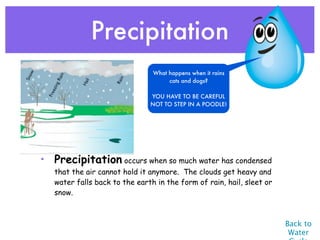
• Precipitation occurs when so much water has condensed
   that the air cannot hold it anymore.  The clouds get heavy and
   water falls back to the earth in the form of rain, hail, sleet or
   snow.


                                                                       Back to
                                                                        Water
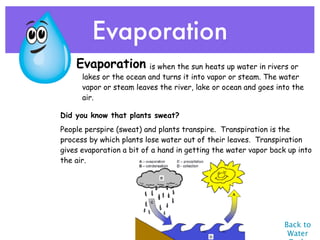
Evaporation
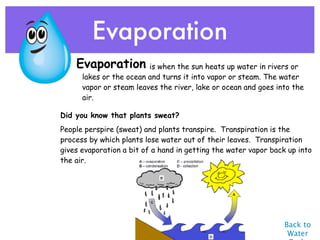
  •   Evaporation is when the sun heats up water in rivers or
       lakes or the ocean and turns it into vapor or steam. The water
       vapor or steam leaves the river, lake or ocean and goes into the
       air.

Did you know that plants sweat?
People perspire (sweat) and plants transpire.  Transpiration is the
process by which plants lose water out of their leaves.  Transpiration
gives evaporation a bit of a hand in getting the water vapor back up into
the air.


                                                                 Back to
                                                                  Water
Evaporation
  •   Evaporation is when the sun heats up water in rivers or
       lakes or the ocean and turns it into vapor or steam. The water
       vapor or steam leaves the river, lake or ocean and goes into the
       air.

Did you know that plants sweat?
People perspire (sweat) and plants transpire.  Transpiration is the
process by which plants lose water out of their leaves.  Transpiration
gives evaporation a bit of a hand in getting the water vapor back up into
the air.


                                                                 Back to
                                                                  Water
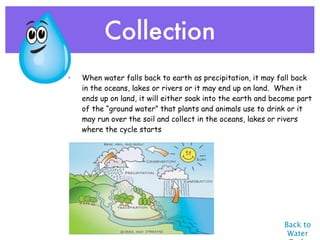
Collection
•   When water falls back to earth as precipitation, it may fall back
    in the oceans, lakes or rivers or it may end up on land.  When it
    ends up on land, it will either soak into the earth and become part
    of the “ground water” that plants and animals use to drink or it
    may run over the soil and collect in the oceans, lakes or rivers
    where the cycle starts


                                                               Back to
                                                                Water
Water Cycle Review

What is a cloud
  made of?
A. snow
B. cotton
C. water droplets & ice crystals


                                   Home
Water Cycle Review


What happens when
water evaporates?
A. Heat turns the water into steam and
          it goes into the air.

B. the water disappears

C. the water dries up


                                         Home
Water Cycle Review

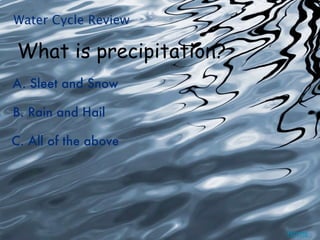
 What is precipitation?
A. Sleet and Snow

B. Rain and Hail

C. All of the above


                          Home
Sorry,
WRONG
answer!
  Try Again
Right!

Super Job!
              Next
             Question
Sorry,
WRONG
answer!
  Try Again
Right!

Super Job!
              Next
             Question
Right!

Super Job!
             Home
Sorry,
WRONG
answer!
  Try Again
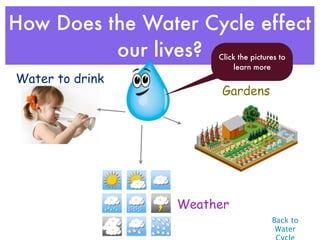
How Does the Water Cycle effect
          our lives?  Click the pictures to
                           learn more
Water to drink
                       Gardens


                 Weather
                                      Back to
                                       Water
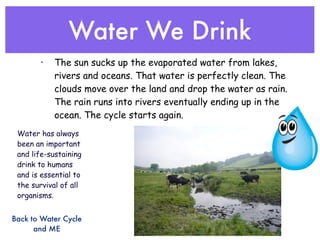
Water We Drink
       •   The sun sucks up the evaporated water from lakes,
           rivers and oceans. That water is perfectly clean. The
           clouds move over the land and drop the water as rain.
           The rain runs into rivers eventually ending up in the
           ocean. The cycle starts again.
 Water has always
 been an important
 and life-sustaining
 drink to humans
 and is essential to
 the survival of all
 organisms.


Back to Water Cycle
      and ME
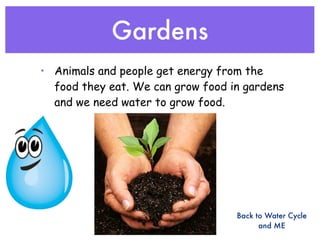
Gardens
• Animals and people get energy from the
  food they eat. We can grow food in gardens
  and we need water to grow food.


                                   Back to Water Cycle
                                         and ME
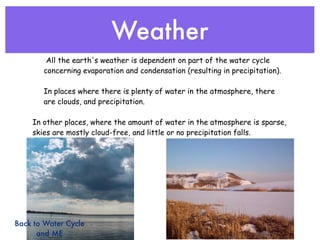
Weather
        All the earth's weather is dependent on part of the water cycle
       concerning evaporation and condensation (resulting in precipitation).

       In places where there is plenty of water in the atmosphere, there
       are clouds, and precipitation.

    In other places, where the amount of water in the atmosphere is sparse,
    skies are mostly cloud-free, and little or no precipitation falls.


Back to Water Cycle
      and ME
Student Goals
  Students will:
       •     Be able to name and explain the stages of the water cycle; including 4 types
             of clouds

       •     understand that the water cycle is continuous

       •     understand that we need the water cycle in order to survive

           Maine Parameters for Essential Insruction
                     Science & Technology
A3 Constancy and Change
Students observe that in the physical setting, the living environment, and the technological world some
things change over time and some things stay the same.

D2 Earth
Students describe Earth’s weather and surface materials and the different ways they change.

E2 Ecosystems
Students understand how plants
and animals depend on each other and the environment in which they live.

                                                                                                     Table of
                                                                                                     Contents
Resources
Games:

   •     http://www.teacherplanet.com/links/redirect.php?url=http://www.quia.com/jg/62.html

   •     http://kids.earth.nasa.gov/droplet.html

   •     http://apps.southeastwater.com.au/games/education_kidsroom_wcactivity.asp


Books:


http://www2.scholastic.com/browse/article.jsp?id=3170


Resources:

http://geology.com/teacher/water.shtml


                                                                                              Table of
                                                                                              Contents
Teachers
•   Grade level: 2nd-4th

•   This project was designed for a class; Introduction to Hypermedia. I created this
    presentation as an interactive addition to a unit on the water cycle appropriate for
    young students.

•   Teacher background: Water on earth is used over and over. The water cycle, the
    continuous movement of water from ocean to air and land then back to the ocean in a
    cyclic pattern, is a central concept in meteorology. In the water cycle, the sun heats the
    Earth's surface water, causing that surface water to evaporate (gas). This water vapor
    then rises into the earth's atmosphere where it cools and condenses into liquid droplets.
    These droplets combine and grow until they become too heavy and fall to the earth as
    precipitation (liquid if rain, solid if snow). Water is temporarily stored in lakes, glaciers,
    underground, or living organisms. The water can move from these places by streams and
    rivers, returns to the oceans, is used by plants or animals or is evaporated directly back
    into the atmosphere.


                                                                                              Table of
                                                                                              Contents
Photo Credits

•   “stratus clouds.” Destination of Marvel. 31 Jan. 2011 [http://destinationofmarvel.blogspot.com/2011/01/
    clouds.html]

•   “cirrus clouds”, “cumulus clouds.” Blessed Family of Flowers. 24 Feb. 2010 [http://
    blessedfamilyofflowers.wordpress.com/2010/02/]

•   “driving in fog.” Florida Department of Highway Safety and Motor Vehicles. 2008 [http://www.flhsmv.gov/safetytips/
    Fog.htm]

•   “condensation.” Bjorn Tore Kieding. The First Kieding Watercooling Project. [http://bt.kieding.org/projects/
    watercooling/?page=2]

•   “fair weather cumulus clouds.” Joshua. The Fun Times Guide. [http://weather.thefuntimesguide.com/2009/12/
    cumulus_clouds.php]


                                                                                                     Table of
                                                                                          More Credits
                                                                                                     Contents
Photo Credits
•   “water cycle.” Western Water. 2010 [http://www.westernwater.com.au/commedu/Pages/Schoolresources.aspx]

•   “evaporation.” Fremont Magnet Elementary. Feb. 2011 [http://schools.bcsd.com/fremont/
    5th_Sci_weather_maps_severe_weather.htm]

•   “precipitation.” Fondriest Environmental. 2011 [http://www.fondriest.com/science_library-htm/precipitation.htm]

•   “cloud chart.” Christen Leigh Maxwell. How Are Clouds and Precipitation Connected. 2006 [http://
    www.valdosta.edu/~clmaxwell/topic.html]

•   “stratus cloud.” Clouds and How They Got Their Names. 7 Dec. 2010. [http://blog.justcheaphotel.com]

•   “fog.” National Weather Service Weather Forecast Office. 18 Apr. 2007 [http://www.crh.noaa.gov/jkl/?n=fog_types]

•   “cirrus cloud.” Thunda Funda. [http://thundafunda.com/wallpaper-blog/nature-pictures/clouds/pictures-of-
    clouds/]

•   “drinking water.” Hoover Ng. Water Replenishment District of Southern California. [http://www.wrd.org/
    water_quality/drinking-water-standards-california.php]

•   “garden.” Urban Farmer. 2011 [http://www.ufseeds.com/Planting-a-Garden-Urban-Farmers1.html]           More
                                                                                                         Credits
•   “weather.” Lumpenprofessoriat. Attendance Forecast. 3 Feb. 2011 [http://lumpenprofessoriat.blogspot.com]
                                                                                                       Table of
•   4 seasons. Vxside. 4 Seasons. [http://vxside.deviantart.com/art/4-seasons-81436429]
                                                                                                       Contents
Photo Credits

•   “cows.” The Carmarthenshire Rivers Trust. 2010 [http://carmsriverstrust.com/Problems.aspx]

•   “gardening.” Patricia Meyer. Happy Living Magazine. 2010 [http://www.happynews.com/
    living/gardening/beginner-gardening.htm]

•   “cloudy sky.” Redman 20732. Southern Maryland Online. 1 Apr. 2009 [http://
    photos.somd.com/showphoto.php/photo/7237]

•   “cloudless sky.” Nature Photography. 9 Mar. 2011 [http://nitrophoto.wordpress.com/]

•   “water cycle.” The Water Cycle. 1998 [http://www.mbgnet.net/fresh/cycle/cycle.htm]


                                                                                            Table of
                                                                                            Contents
Sources

• http://www.weatherwizkids.com/
  weather-clouds.htm
• http://www.life123.com/home-
  garden/kids-gardening/plant-science/
  six-things-kids-should-know-about-the-
  water-cycle.shtml


                                      Table of
                                      Contents

Water Cycle interactive presentation

  • 1.
    Hello boys andgirls! Welcome to . . . A Water Cycle Adventure Click HERE to begin! Kimberly Grant EDT 530 Professor Gail Garthwait March 2011
  • 2.
    We are goingto have so much fun learning about the water cycle! You will learn cool new For Teachers: words like evaporation and precipitation! Student Goals For Students The Water Cycle Click on the topic Resources you want to start with. Clouds Photo Credits The Water Cycle and ME Water Cycle Review Take this challenge to see how much you learned! Back to the beginning
  • 3.
    Clouds • Whatare clouds? A cloud is a large collection of very tiny droplets of water or ice crystals. The droplets are so small and light that they can float in the air. Click on a type of cloud to learn more! Stratus Clouds Fog Table of
  • 4.
    Cumulus Clouds • Cumulus Clouds are white, puffy clouds that look like pieces of floating cotton. Cumulus clouds are often called "fair- weather clouds". The base of each cloud is flat and the top of each cloud has rounded towers. When the top of the cumulus clouds resemble the head of a cauliflower, it is called cumulus congestus or towering cumulus. These clouds grow upward and they can develop into giant cumulonimbus clouds, which are thunderstorm clouds. Back to
  • 5.
    Stratus Clouds • Stratusclouds are uniform grayish clouds that often cover the entire sky. They resemble fog that doesn't reach the ground. Light mist or drizzle sometimes falls out of these clouds. Back to
  • 6.
    Cirrus Clouds • Cirrusclouds are the most common of the high clouds. They are composed of ice and are thin, wispy clouds blown in high winds into long streamers. Cirrus clouds are usually white and predict fair to pleasant weather. By watching the movement of cirrus clouds you can tell from which direction weather is approaching. When you see cirrus clouds, it usually indicates that a change in the weather will occur within 24 hours. Back to
  • 7.
    Fog • Fog: Thereare many different types of fog, but fog is mostly formed when southerly winds bring warm, moist air into a region, possibly ending a cold outbreak. • As the warm, moist air flows over much colder soil or snow, dense fog often forms. Warm, moist air is cooled from below as it flows over a colder surface. If the air is near saturation, moisture will condense out of the cooled air and form fog. With light winds, the fog near the ground can become thick and reduce visibilities to zero. What kind of cloud is lazy because it will never wake up? FOG! Back to
  • 8.
    The Water Cycle • The earth has a limited amount of water.  That water keeps going around and around and around and around and in what we call the "Water Cycle". • Water Cycle Song This cycle is made up of a few main parts: • evaporation (and transpiration) • condensation Click to learn more about each part of the • precipitation water cycle. • collection • What does the water cycle look like? Table of
  • 9.
    The Water CycleSong Wow, that was a cool Water Cycle Song by Mr. Davies!! Back to Water
  • 10.
    What Does theWater Cycle Look Like? Back to Water
  • 11.
    Condensation • Water vapor in the air gets cold and changes back into liquid, forming clouds. This is called condensation. You can see the same sort of thing at home... pour a glass of cold water on a hot day and watch what happens.  Water forms on the outside of the glass.  That water didn't somehow leak through the glass!  It actually came from the air.  Water vapor in the warm air, turns back into liquid when it touches the cold glass. Back to Water
  • 12.
    Precipitation What happens when it rains cats and dogs? YOU HAVE TO BE CAREFUL NOT TO STEP IN A POODLE! • Precipitation occurs when so much water has condensed that the air cannot hold it anymore.  The clouds get heavy and water falls back to the earth in the form of rain, hail, sleet or snow. Back to Water
  • 13.
    Evaporation • Evaporation is when the sun heats up water in rivers or lakes or the ocean and turns it into vapor or steam. The water vapor or steam leaves the river, lake or ocean and goes into the air. Did you know that plants sweat? People perspire (sweat) and plants transpire.  Transpiration is the process by which plants lose water out of their leaves.  Transpiration gives evaporation a bit of a hand in getting the water vapor back up into the air. Back to Water
  • 14.
    Evaporation • Evaporation is when the sun heats up water in rivers or lakes or the ocean and turns it into vapor or steam. The water vapor or steam leaves the river, lake or ocean and goes into the air. Did you know that plants sweat? People perspire (sweat) and plants transpire.  Transpiration is the process by which plants lose water out of their leaves.  Transpiration gives evaporation a bit of a hand in getting the water vapor back up into the air. Back to Water
  • 15.
    Collection • When water falls back to earth as precipitation, it may fall back in the oceans, lakes or rivers or it may end up on land.  When it ends up on land, it will either soak into the earth and become part of the “ground water” that plants and animals use to drink or it may run over the soil and collect in the oceans, lakes or rivers where the cycle starts Back to Water
  • 17.
    Water Cycle Review Whatis a cloud made of? A. snow B. cotton C. water droplets & ice crystals Home
  • 18.
    Water Cycle Review Whathappens when water evaporates? A. Heat turns the water into steam and it goes into the air. B. the water disappears C. the water dries up Home
  • 19.
    Water Cycle Review What is precipitation? A. Sleet and Snow B. Rain and Hail C. All of the above Home
  • 20.
  • 21.
    Right! Super Job! Next Question
  • 22.
  • 23.
    Right! Super Job! Next Question
  • 24.
  • 25.
  • 26.
    How Does theWater Cycle effect our lives? Click the pictures to learn more Water to drink Gardens Weather Back to Water
  • 27.
    Water We Drink • The sun sucks up the evaporated water from lakes, rivers and oceans. That water is perfectly clean. The clouds move over the land and drop the water as rain. The rain runs into rivers eventually ending up in the ocean. The cycle starts again. Water has always been an important and life-sustaining drink to humans and is essential to the survival of all organisms. Back to Water Cycle and ME
  • 28.
    Gardens • Animals andpeople get energy from the food they eat. We can grow food in gardens and we need water to grow food. Back to Water Cycle and ME
  • 29.
    Weather All the earth's weather is dependent on part of the water cycle concerning evaporation and condensation (resulting in precipitation). In places where there is plenty of water in the atmosphere, there are clouds, and precipitation. In other places, where the amount of water in the atmosphere is sparse, skies are mostly cloud-free, and little or no precipitation falls. Back to Water Cycle and ME
  • 30.
    Student Goals Students will: • Be able to name and explain the stages of the water cycle; including 4 types of clouds • understand that the water cycle is continuous • understand that we need the water cycle in order to survive Maine Parameters for Essential Insruction Science & Technology A3 Constancy and Change Students observe that in the physical setting, the living environment, and the technological world some things change over time and some things stay the same. D2 Earth Students describe Earth’s weather and surface materials and the different ways they change. E2 Ecosystems Students understand how plants and animals depend on each other and the environment in which they live. Table of Contents
  • 31.
    Resources Games: • http://www.teacherplanet.com/links/redirect.php?url=http://www.quia.com/jg/62.html • http://kids.earth.nasa.gov/droplet.html • http://apps.southeastwater.com.au/games/education_kidsroom_wcactivity.asp Books: http://www2.scholastic.com/browse/article.jsp?id=3170 Resources: http://geology.com/teacher/water.shtml Table of Contents
  • 32.
    Teachers • Grade level: 2nd-4th • This project was designed for a class; Introduction to Hypermedia. I created this presentation as an interactive addition to a unit on the water cycle appropriate for young students. • Teacher background: Water on earth is used over and over. The water cycle, the continuous movement of water from ocean to air and land then back to the ocean in a cyclic pattern, is a central concept in meteorology. In the water cycle, the sun heats the Earth's surface water, causing that surface water to evaporate (gas). This water vapor then rises into the earth's atmosphere where it cools and condenses into liquid droplets. These droplets combine and grow until they become too heavy and fall to the earth as precipitation (liquid if rain, solid if snow). Water is temporarily stored in lakes, glaciers, underground, or living organisms. The water can move from these places by streams and rivers, returns to the oceans, is used by plants or animals or is evaporated directly back into the atmosphere. Table of Contents
  • 33.
    Photo Credits • “stratus clouds.” Destination of Marvel. 31 Jan. 2011 [http://destinationofmarvel.blogspot.com/2011/01/ clouds.html] • “cirrus clouds”, “cumulus clouds.” Blessed Family of Flowers. 24 Feb. 2010 [http:// blessedfamilyofflowers.wordpress.com/2010/02/] • “driving in fog.” Florida Department of Highway Safety and Motor Vehicles. 2008 [http://www.flhsmv.gov/safetytips/ Fog.htm] • “condensation.” Bjorn Tore Kieding. The First Kieding Watercooling Project. [http://bt.kieding.org/projects/ watercooling/?page=2] • “fair weather cumulus clouds.” Joshua. The Fun Times Guide. [http://weather.thefuntimesguide.com/2009/12/ cumulus_clouds.php] Table of More Credits Contents
  • 34.
    Photo Credits • “water cycle.” Western Water. 2010 [http://www.westernwater.com.au/commedu/Pages/Schoolresources.aspx] • “evaporation.” Fremont Magnet Elementary. Feb. 2011 [http://schools.bcsd.com/fremont/ 5th_Sci_weather_maps_severe_weather.htm] • “precipitation.” Fondriest Environmental. 2011 [http://www.fondriest.com/science_library-htm/precipitation.htm] • “cloud chart.” Christen Leigh Maxwell. How Are Clouds and Precipitation Connected. 2006 [http:// www.valdosta.edu/~clmaxwell/topic.html] • “stratus cloud.” Clouds and How They Got Their Names. 7 Dec. 2010. [http://blog.justcheaphotel.com] • “fog.” National Weather Service Weather Forecast Office. 18 Apr. 2007 [http://www.crh.noaa.gov/jkl/?n=fog_types] • “cirrus cloud.” Thunda Funda. [http://thundafunda.com/wallpaper-blog/nature-pictures/clouds/pictures-of- clouds/] • “drinking water.” Hoover Ng. Water Replenishment District of Southern California. [http://www.wrd.org/ water_quality/drinking-water-standards-california.php] • “garden.” Urban Farmer. 2011 [http://www.ufseeds.com/Planting-a-Garden-Urban-Farmers1.html] More Credits • “weather.” Lumpenprofessoriat. Attendance Forecast. 3 Feb. 2011 [http://lumpenprofessoriat.blogspot.com] Table of • 4 seasons. Vxside. 4 Seasons. [http://vxside.deviantart.com/art/4-seasons-81436429] Contents
  • 35.
    Photo Credits • “cows.” The Carmarthenshire Rivers Trust. 2010 [http://carmsriverstrust.com/Problems.aspx] • “gardening.” Patricia Meyer. Happy Living Magazine. 2010 [http://www.happynews.com/ living/gardening/beginner-gardening.htm] • “cloudy sky.” Redman 20732. Southern Maryland Online. 1 Apr. 2009 [http:// photos.somd.com/showphoto.php/photo/7237] • “cloudless sky.” Nature Photography. 9 Mar. 2011 [http://nitrophoto.wordpress.com/] • “water cycle.” The Water Cycle. 1998 [http://www.mbgnet.net/fresh/cycle/cycle.htm] Table of Contents
  • 36.
    Sources • http://www.weatherwizkids.com/ weather-clouds.htm • http://www.life123.com/home- garden/kids-gardening/plant-science/ six-things-kids-should-know-about-the- water-cycle.shtml Table of Contents