THE
PRECIPITATION
THEORY
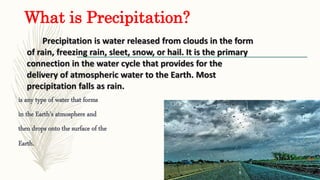
What is Precipitation?
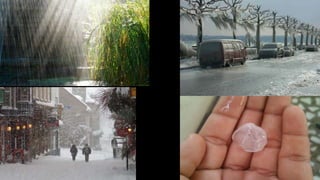
Precipitation is water released from clouds in the form
of rain, freezing rain, sleet, snow, or hail. It is the primary
connection in the water cycle that provides for the
delivery of atmospheric water to the Earth. Most
precipitation falls as rain.
is any type of water that forms
in the Earth's atmosphere and
then drops onto the surface of the
Earth.
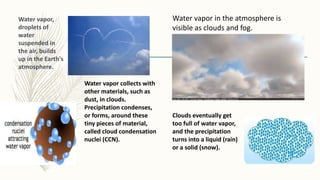
Water vapor,
droplets of
water
suspended in
the air, builds
up in the Earth's
atmosphere.
Water vapor in the atmosphere is
visible as clouds and fog.
Water vapor collects with
other materials, such as
dust, in clouds.
Precipitation condenses,
or forms, around these
tiny pieces of material,
called cloud condensation
nuclei (CCN).
Clouds eventually get
too full of water vapor,
and the precipitation
turns into a liquid (rain)
or a solid (snow).
PRECIPITATION THEORY
Several valid theories have been formulated in regard to the
growth of raindrops. The theories most widely accepted today are
treated here in combined form. Raindrops grow in size primarily
because water exists in all three phases in the atmosphere and
because the air is supersaturated at times (especially with respect to
ice) because of adiabatic expansion and radiation cooling.
This means that ice crystals coexist with liquid water droplets in
the same cloud. The difference in the vapor pressure between the
water droplets and the ice crystals causes water droplets to evaporate
and then to sublimate directly onto the ice crystals. Sublimation is
the process whereby water vapor changes into ice without passing
through the liquid stage.
PRECIPITATION THEORY
Condensation alone does not cause droplets of water to grow in
size. The turbulence in cloud permits and aids this droplet growth
processes. After the droplets become larger, they start to descend and
are tossed up again in turbulent updrafts within the cloud. The
repetition of ascension and dissension causes the ice crystals to grow
larger (by water vapor sublimating onto the ice crystals) until finally
they are heavy enough to fall out of the cloud as some form of
precipitation.
It is believed that most precipitation in the mid-latitudes starts as
ice crystals and that most liquid precipitation results from melting
during descent through a stratum of warmer air. It is generally
believed that most rain in the tropics forms without going through the
ice phase.
WHAT ARE THE
FORMS OF
PRECIPITATION?
Forms of Precipitation
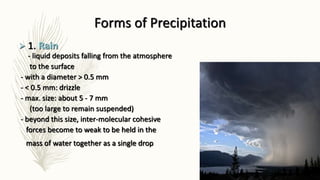
 1. Rain
- liquid deposits falling from the atmosphere
to the surface
- with a diameter > 0.5 mm
- < 0.5 mm: drizzle
- max. size: about 5 - 7 mm
(too large to remain suspended)
- beyond this size, inter-molecular cohesive
forces become to weak to be held in the
mass of water together as a single drop
Forms of Precipitation
 2. Freezing rain
- when falling liquid water
droplets reaches a surface
with a temperature below
freezing point
- so, the rain droplets quickly turn
into ice
- another * condition: where the
rain develops, the
temperature of rain develops must be above
freezing
Forms of Precipitation
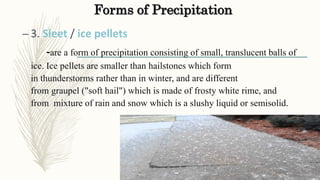
– 3. Sleet / ice pellets
-are a form of precipitation consisting of small, translucent balls of
ice. Ice pellets are smaller than hailstones which form
in thunderstorms rather than in winter, and are different
from graupel ("soft hail") which is made of frosty white rime, and
from mixture of rain and snow which is a slushy liquid or semisolid.
Forms of Precipitation
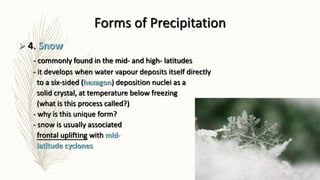
 4. Snow
- commonly found in the mid- and high- latitudes
- it develops when water vapour deposits itself directly
to a six-sided (hexagon) deposition nuclei as a
solid crystal, at temperature below freezing
(what is this process called?)
- why is this unique form?
- snow is usually associated
frontal uplifting with mid-
latitude cyclones
Forms of Precipitation
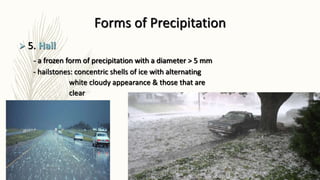
 5. Hail
- a frozen form of precipitation with a diameter > 5 mm
- hailstones: concentric shells of ice with alternating
white cloudy appearance & those that are
clear
Tabefranca,BryanM.

Precipitation

  • 1.
  • 2.
    What is Precipitation? Precipitationis water released from clouds in the form of rain, freezing rain, sleet, snow, or hail. It is the primary connection in the water cycle that provides for the delivery of atmospheric water to the Earth. Most precipitation falls as rain. is any type of water that forms in the Earth's atmosphere and then drops onto the surface of the Earth.
  • 3.
    Water vapor, droplets of water suspendedin the air, builds up in the Earth's atmosphere. Water vapor in the atmosphere is visible as clouds and fog. Water vapor collects with other materials, such as dust, in clouds. Precipitation condenses, or forms, around these tiny pieces of material, called cloud condensation nuclei (CCN). Clouds eventually get too full of water vapor, and the precipitation turns into a liquid (rain) or a solid (snow).
  • 4.
    PRECIPITATION THEORY Several validtheories have been formulated in regard to the growth of raindrops. The theories most widely accepted today are treated here in combined form. Raindrops grow in size primarily because water exists in all three phases in the atmosphere and because the air is supersaturated at times (especially with respect to ice) because of adiabatic expansion and radiation cooling. This means that ice crystals coexist with liquid water droplets in the same cloud. The difference in the vapor pressure between the water droplets and the ice crystals causes water droplets to evaporate and then to sublimate directly onto the ice crystals. Sublimation is the process whereby water vapor changes into ice without passing through the liquid stage.
  • 5.
    PRECIPITATION THEORY Condensation alonedoes not cause droplets of water to grow in size. The turbulence in cloud permits and aids this droplet growth processes. After the droplets become larger, they start to descend and are tossed up again in turbulent updrafts within the cloud. The repetition of ascension and dissension causes the ice crystals to grow larger (by water vapor sublimating onto the ice crystals) until finally they are heavy enough to fall out of the cloud as some form of precipitation. It is believed that most precipitation in the mid-latitudes starts as ice crystals and that most liquid precipitation results from melting during descent through a stratum of warmer air. It is generally believed that most rain in the tropics forms without going through the ice phase.
  • 6.
    WHAT ARE THE FORMSOF PRECIPITATION?
  • 7.
    Forms of Precipitation 1. Rain - liquid deposits falling from the atmosphere to the surface - with a diameter > 0.5 mm - < 0.5 mm: drizzle - max. size: about 5 - 7 mm (too large to remain suspended) - beyond this size, inter-molecular cohesive forces become to weak to be held in the mass of water together as a single drop
  • 8.
    Forms of Precipitation 2. Freezing rain - when falling liquid water droplets reaches a surface with a temperature below freezing point - so, the rain droplets quickly turn into ice - another * condition: where the rain develops, the temperature of rain develops must be above freezing
  • 9.
    Forms of Precipitation –3. Sleet / ice pellets -are a form of precipitation consisting of small, translucent balls of ice. Ice pellets are smaller than hailstones which form in thunderstorms rather than in winter, and are different from graupel ("soft hail") which is made of frosty white rime, and from mixture of rain and snow which is a slushy liquid or semisolid.
  • 10.
    Forms of Precipitation 4. Snow - commonly found in the mid- and high- latitudes - it develops when water vapour deposits itself directly to a six-sided (hexagon) deposition nuclei as a solid crystal, at temperature below freezing (what is this process called?) - why is this unique form? - snow is usually associated frontal uplifting with mid- latitude cyclones
  • 11.
    Forms of Precipitation 5. Hail - a frozen form of precipitation with a diameter > 5 mm - hailstones: concentric shells of ice with alternating white cloudy appearance & those that are clear
  • 13.

Editor's Notes

  • #3 Adiabatic - process is one in which there is no loss or gain of heat
  • #6 Adiabatic - process is one in which there is no loss or gain of heat
  • #7 Adiabatic - process is one in which there is no loss or gain of heat