Waste Management
and
Waste Minimization
Jastinder Pal Singh
MBA – I (15421163)
School of Management Studies, Punjabi University Patiala
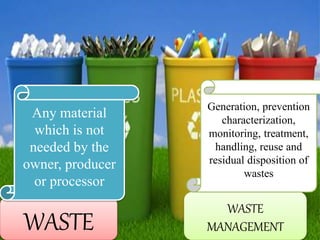
WASTE
WASTE
MANAGEMENT
Generation, prevention
characterization,
monitoring, treatment,
handling, reuse and
residual disposition of
wastes
Any material
which is not
needed by the
owner, producer
or processor
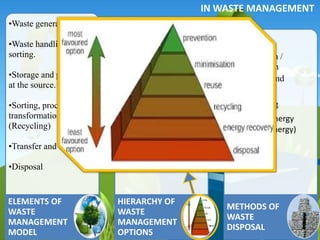
IN WASTE MANAGEMENT
•Waste generation.
•Waste handling and
sorting.
•Storage and processing
at the source.
•Sorting, processing and
transformation
(Recycling)
•Transfer and transport.
•Disposal
ELEMENTS OF
WASTE
MANAGEMENT
MODEL
• Prevention
• Minimization
• Reuse
• Recycling
• Energy Recovery
• Disposal
HIERARCHY OF
WASTE
MANAGEMENT
OPTIONS
• Landfill
• Incineration /
Combustion
• Recovery and
Recycling
• Composting
• Waste to Energy
(Recover Energy)
METHODS OF
WASTE
DISPOSAL
What is Minimization ?
The act of reducing something to the least possible
amount or degree or position
Waste Minimization
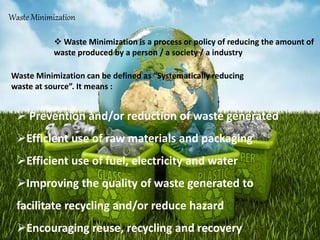
 Waste Minimization is a process or policy of reducing the amount of
waste produced by a person / a society / a industry
Waste Minimization can be defined as “Systematically reducing
waste at source”. It means :
 Prevention and/or reduction of waste generated
Efficient use of raw materials and packaging
Efficient use of fuel, electricity and water
Improving the quality of waste generated to
facilitate recycling and/or reduce hazard
Encouraging reuse, recycling and recovery
Modern Technology and Waste Management
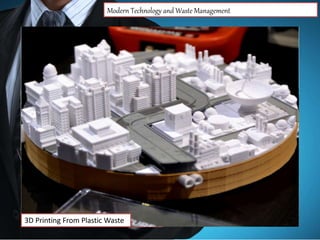
Bricks From Fly AshCompact Waste For Easy HandlingBio Fuel From Food & Plant WastePlastic To OilBricks From Plastic Waste3D Printing From Plastic Waste
Electronic Waste (E-Waste)
Electronic products nearing
the end of their "useful life."
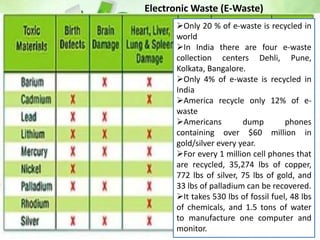
Only 20 % of e-waste is recycled in
world
In India there are four e-waste
collection centers Dehli, Pune,
Kolkata, Bangalore.
Only 4% of e-waste is recycled in
India
America recycle only 12% of e-
waste
Americans dump phones
containing over $60 million in
gold/silver every year.
For every 1 million cell phones that
are recycled, 35,274 lbs of copper,
772 lbs of silver, 75 lbs of gold, and
33 lbs of palladium can be recovered.
It takes 530 lbs of fossil fuel, 48 lbs
of chemicals, and 1.5 tons of water
to manufacture one computer and
monitor.
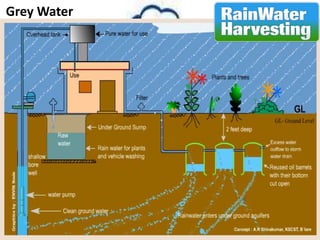
Grey Water
Grey Water Includes:
Rain Water
Sinks
Showers
Baths
Washing Machines
Dish Washers etc.
Uses of Grey Water:
Irrigation
In Toilet Flush Tank etc.
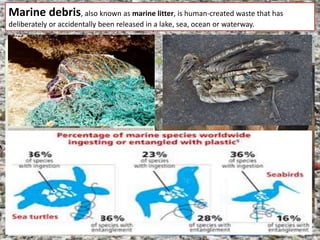
Marine debris, also known as marine litter, is human-created waste that has
deliberately or accidentally been released in a lake, sea, ocean or waterway.
Ship Demolition
AS A Social Being What Is Our Duty ?
To give sorrows to other living beings?
To care about nature and its precious gift?
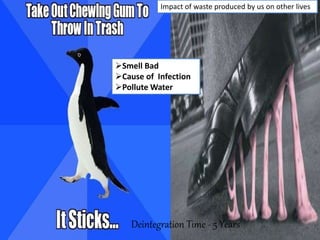
Smell Bad
Cause of Infection
Pollute Water
Deintegration Time - 5 Years
Impact of waste produced by us on other lives
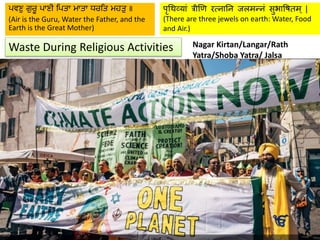
Waste During Religious Activities
पृथिव्यां त्रीणि रत्नयनन जलमन्नां सुभयषितम् |
(There are three jewels on earth: Water, Food
and Air.)
ਪਵਣੁ ਗੁਰੂ ਪਾਣੀ ਪਪਤਾ ਮਾਤਾ ਧਰਪਤ ਮਹਤੁ ॥
(Air is the Guru, Water the Father, and the
Earth is the Great Mother)
Distribution of Kachhi Lassi/Chhabeel or
sweetened milk in steel or re-usable glasses.
Distribution of street side langar food in
pattals or leaf plates.
Install waste bins in strategic locations
through the entire length of the nagar kirtan
procession and create awareness for using
bins.
Collection of used leaf plates near the
food counter.
Youth groups or sewa team to clean up
litter before and after nagar kirtan.
Distribution of reusable jute bags or other
ecofriendly bags for awareness.
Distribution of seasonal plants for
devotees to carry home and plant where
they live.
Carry environment friendly banners or
quotes from gurbani that reminds others
to care for the earth
Serve organic langar or fresh ingredients
on this special day.
Respect the langar and do not waste
food.
Celebrate our Sikh occasions in a way
that encourages all to protect and care for
the world around us.
Nagar Kirtan/Langar/Rath
Yatra/Shoba Yatra/ Jalsa
• overproduction
• spoilage, contamination and exceeding expiry dates
• products not meeting the demands of the food
retailing and wholesaling sectors e.g. size and
aesthetic specifications
• food preparation e.g. over trimming.
Pre-
consumer
food waste
(74%)
• customer plate waste from restaurants, cafés .
• any food purchased from a retail store that has
been purchased but then not eaten.
Post-
consumer
food waste
(24%)
Waste In Parties, Restaurants,
Cafe etc.
Lack in storage and transportation
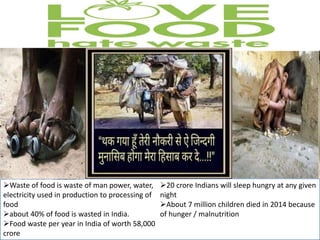
Waste of food is waste of man power, water,
electricity used in production to processing of
food
about 40% of food is wasted in India.
Food waste per year in India of worth 58,000
crore
20 crore Indians will sleep hungry at any given
night
About 7 million children died in 2014 because
of hunger / malnutrition
Conclusion
We should concentrate on prevention & Waste minimization before
we think about waste management
We are failing in waste management concepts, because
we don’t consider this during any work planning
Lack in awareness about Modern concepts in waste management
& Tequniques of Waste to Energy technology
THANK YOU

Waste Management and Waste Minimization

  • 1.
    Waste Management and Waste Minimization JastinderPal Singh MBA – I (15421163) School of Management Studies, Punjabi University Patiala
  • 2.
    WASTE WASTE MANAGEMENT Generation, prevention characterization, monitoring, treatment, handling,reuse and residual disposition of wastes Any material which is not needed by the owner, producer or processor
  • 3.
    IN WASTE MANAGEMENT •Wastegeneration. •Waste handling and sorting. •Storage and processing at the source. •Sorting, processing and transformation (Recycling) •Transfer and transport. •Disposal ELEMENTS OF WASTE MANAGEMENT MODEL • Prevention • Minimization • Reuse • Recycling • Energy Recovery • Disposal HIERARCHY OF WASTE MANAGEMENT OPTIONS • Landfill • Incineration / Combustion • Recovery and Recycling • Composting • Waste to Energy (Recover Energy) METHODS OF WASTE DISPOSAL
  • 4.
    What is Minimization? The act of reducing something to the least possible amount or degree or position
  • 5.
    Waste Minimization  WasteMinimization is a process or policy of reducing the amount of waste produced by a person / a society / a industry Waste Minimization can be defined as “Systematically reducing waste at source”. It means :  Prevention and/or reduction of waste generated Efficient use of raw materials and packaging Efficient use of fuel, electricity and water Improving the quality of waste generated to facilitate recycling and/or reduce hazard Encouraging reuse, recycling and recovery
  • 6.
    Modern Technology andWaste Management Bricks From Fly AshCompact Waste For Easy HandlingBio Fuel From Food & Plant WastePlastic To OilBricks From Plastic Waste3D Printing From Plastic Waste
  • 8.
    Electronic Waste (E-Waste) Electronicproducts nearing the end of their "useful life." Only 20 % of e-waste is recycled in world In India there are four e-waste collection centers Dehli, Pune, Kolkata, Bangalore. Only 4% of e-waste is recycled in India America recycle only 12% of e- waste Americans dump phones containing over $60 million in gold/silver every year. For every 1 million cell phones that are recycled, 35,274 lbs of copper, 772 lbs of silver, 75 lbs of gold, and 33 lbs of palladium can be recovered. It takes 530 lbs of fossil fuel, 48 lbs of chemicals, and 1.5 tons of water to manufacture one computer and monitor.
  • 9.
    Grey Water Grey WaterIncludes: Rain Water Sinks Showers Baths Washing Machines Dish Washers etc. Uses of Grey Water: Irrigation In Toilet Flush Tank etc.
  • 10.
    Marine debris, alsoknown as marine litter, is human-created waste that has deliberately or accidentally been released in a lake, sea, ocean or waterway. Ship Demolition
  • 11.
    AS A SocialBeing What Is Our Duty ? To give sorrows to other living beings? To care about nature and its precious gift? Smell Bad Cause of Infection Pollute Water Deintegration Time - 5 Years Impact of waste produced by us on other lives
  • 12.
    Waste During ReligiousActivities पृथिव्यां त्रीणि रत्नयनन जलमन्नां सुभयषितम् | (There are three jewels on earth: Water, Food and Air.) ਪਵਣੁ ਗੁਰੂ ਪਾਣੀ ਪਪਤਾ ਮਾਤਾ ਧਰਪਤ ਮਹਤੁ ॥ (Air is the Guru, Water the Father, and the Earth is the Great Mother) Distribution of Kachhi Lassi/Chhabeel or sweetened milk in steel or re-usable glasses. Distribution of street side langar food in pattals or leaf plates. Install waste bins in strategic locations through the entire length of the nagar kirtan procession and create awareness for using bins. Collection of used leaf plates near the food counter. Youth groups or sewa team to clean up litter before and after nagar kirtan. Distribution of reusable jute bags or other ecofriendly bags for awareness. Distribution of seasonal plants for devotees to carry home and plant where they live. Carry environment friendly banners or quotes from gurbani that reminds others to care for the earth Serve organic langar or fresh ingredients on this special day. Respect the langar and do not waste food. Celebrate our Sikh occasions in a way that encourages all to protect and care for the world around us. Nagar Kirtan/Langar/Rath Yatra/Shoba Yatra/ Jalsa
  • 13.
    • overproduction • spoilage,contamination and exceeding expiry dates • products not meeting the demands of the food retailing and wholesaling sectors e.g. size and aesthetic specifications • food preparation e.g. over trimming. Pre- consumer food waste (74%) • customer plate waste from restaurants, cafés . • any food purchased from a retail store that has been purchased but then not eaten. Post- consumer food waste (24%) Waste In Parties, Restaurants, Cafe etc. Lack in storage and transportation Waste of food is waste of man power, water, electricity used in production to processing of food about 40% of food is wasted in India. Food waste per year in India of worth 58,000 crore 20 crore Indians will sleep hungry at any given night About 7 million children died in 2014 because of hunger / malnutrition
  • 14.
    Conclusion We should concentrateon prevention & Waste minimization before we think about waste management We are failing in waste management concepts, because we don’t consider this during any work planning Lack in awareness about Modern concepts in waste management & Tequniques of Waste to Energy technology
  • 15.