BY
MD. MIZANUR RAHMAN
QA INCHARGE
CONTENTS
 INTRODUCTION
 WHAT IS WAREHOUSE MANAGEMENT
 VARIOUS AREAS OF WAREHOUSING
 DESIGN
 SECURITY
 TEMPERATURE AND HUMIDITY CONTROL
 FLOWCHART OF INCOMING GOODS
 RULES FOR WAREHOUSING
 CHARACTERS OF GOOD WAREHOUSE
 THE WAREHOUSE STAFF
 STORAGE CONDITION
 SAFETY MEASURES
 HANDLING AND ISSUE
 STOCK MANAGEMENT
1. Introduction
Maintaining proper storage condition for pharmaceutical products. Factory stores will invariably
be receiving duly approved raw materials and packaging materials from the approved vendor. A
suitable space is provided to handling and storage of raw & packaging materials required
for manufacturing. This space is known as Warehouse.
GOOD WAREHOUSING PRACTICE
2. WHAT IS WAREHOUSE MANAGEMENT
Warehouse management is the act of organizing and controlling everything within
your warehouse and making sure it all runs in the most optimal way possible .
This includes :-
 Arranging the warehouse and its inventory
 Having and maintaining the appropriate equipment
 Managing new stock coming in facility
 Picking , packaging and shipping
 Storing of Pharmaceutical Products in appropriate storage area.
 Tracking and improving overall warehouse performance
GOOD WAREHOUSING PRACTICE
3. Various Areas Of Warehousing
 Receiving Area -includes initial inspection , cleaning & weight checking
 Quarantine Area-A quarantine area is an area for storing goods that have not yet been inspected
or tested.
 Sampling Area- Sampling area is a area where collection of small portion of a material with
adequate facilities to prevent cross contamination.
 Storage Area - Including specific storage like air condition rooms , cold rooms , hazardous
chemical room .
 Dispensing Area – With adequate facilities to minimize cross contamination during dispensing .
 Rejected Area – Destroy or retented unsuitable or expired materials.
GOOD WAREHOUSING PRACTICE
 General : The layout and design of premises must aim
to minimize the risk of errors and permit effective
cleaning and maintenance in order to avoid cross
contamination, build-up of dust or dirt.
 Where dust is generated (e.g. During Receiving,
during sampling, weighing), measures should be taken
to avoid cross contamination and facilitate cleaning .
GOOD WAREHOUSING PRACTICE
4. DESIGN:
 Principle : Premises must be Located , Designed , Constructed, Adapted, and maintained
to suit the Operations to be carried out .
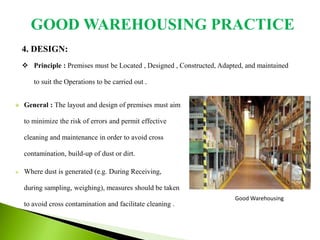
Good Warehousing
Continued…..
 Premises should be cleaned and , where applicable , disinfected according to detailed written
procedure . Record should be maintained.
 Premises should be designed to ensure the logical flow of materials and personnel
 Premises should be designed and equipped so as to afford maximum protection against the
entry of birds , insects , or other animals
 There should be standard procedure to prevent from rodent and pest control.
GOOD WAREHOUSING PRACTICE
5. SECURITY
 Storage areas should be provided with security to prevent theft or unauthorized entry
 Maintain a control of who may enter the facilities
 Establish system for controlling access to the facility (including all entrances and exits)
GOOD WAREHOUSING PRACTICE
6. TEMPERATURE AND HUMIDITY CONTROL
 All materials must be stored at appropriate conditions as stated on the label of the material
 The temperature of all storage areas should be regularly monitored and recorded
 Controlled temperature storage areas should be equipped with recorders and devices which
indicate when the specific temperature range has not been maintained
 A written procedure must specify the action to be taken when this occurs
 Control should be adequate to ensure that all parts of the storage area are kept within the
specified temperature range
 Should always be a back up system in case main system fails
GOOD WAREHOUSING PRACTICE
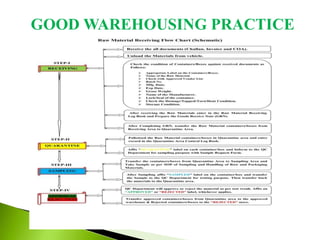
7. Flowchart of Incoming Goods
RECEIPT OF INCOMING GOODS
 It should be carried out according to approved SOP:
 Visually examine delivery documents of the consignment
 delivery challan/Invoice
 COA
 Name of material
 Name of manufacturer
 Batch no
 Manufacturing date
 Expiry date
 Quantity
 Gross Weight
GOOD WAREHOUSING PRACTICE
Continued……
 Visually examine physical condition & verification of consignment for damage.
 Check the cleanliness
 Check the storage condition of materials
 Cross verify container labels with documents
If any discrepancies is observed in doc, material, packing, vehicle condition, then warehouse
officer should bring notice this to head warehouse & QA.
GOOD WAREHOUSING PRACTICE
Quarantine of Received Goods
 Palletized the Raw Material containers/boxes in Quarantine area and enter record in the Quarantine
Area Control Log Book.
 Affix “QUARANTINE” label on each container/box
 Inform to the QC Department for sampling purpose with Sample Request Form.
Sampling of Quarantined Goods
 Transfer the containers/boxes from Quarantine Area to Sampling Area and Take Sample as per SOP
of Sampling and Handling of Raw and Packaging Materials.
 After Sampling affix “SAMPLED” label on the container/box and transfer the Sample to the QC
Department for testing purpose. Then transfer back the materials to the Quarantine area.
GOOD WAREHOUSING PRACTICE
Approval or Rejection of Sampled Goods
 QC Department will approve or reject the material as per test result. Affix an “APPROVED”
or “REJECTED” label, whichever applies.
 Transfer approved containers/boxes from Quarantine area to the APPROVED warehouse &
Rejected containers/boxes to the REJECTED store.
GOOD WAREHOUSING PRACTICE
8. Rules For Warehousing
 Systematic storage of the delivered goods .
 Providing each products have only one specific place .
 On shelves clear labeling of products should be there .
 Adequate space should be provided for each goods .
 Provide separate BIN CARD for each products .
 All boxes in stock should be closed in air tight .
 Warehouse Mapping should be carried out.
 Flammable products should stored in separate place.
GOOD WAREHOUSING PRACTICE
9. Characters of Good Warehouse
 Properly cleaned .
 Good preservation of drugs and equipment.
 Provide safety for staff and stocked goods .
 Control of air, light, humidity and temperature.
 Products to be purchased according to needs.
 Order the destruction of unsuitable products.
 Use of pharmaceutical products with FIFO/FEFO.
GOOD WAREHOUSING PRACTICE
10. The Warehouse Staff
1. The responsible Incharge
His duties
 Good management of the stock of the warehouse.
 Good preservation of drugs and equipment's.
 Safety of stored goods.
2. The warehouse keeper
His duties
 Reception of supplies.
 Storage of stocks of goods.
 Recording of every IN and OUT movement of the products in the BIN CARD.
 Issue of products during manufacturing.
GOOD WAREHOUSING PRACTICE
Continued….
3. The warehouse worker
His duties
 Handling operations includes the carrying and moving of goods which are intended for storage,
shipment and sale.
 The warehouse staff helps in receives and issue goods and maintain inventory.
4. The cleaner
His duty
 Appropriate cleaning by given procedure.
 Ensure cleanliness of premises and equipment.
 use air curtains and air tunnels.
GOOD WAREHOUSING PRACTICE
11. Storage Condition
There are several types of storage conditions:
 Controlled Condition (15ºC – 25ºC)
 Cool Condition (8ºC – 15ºC)
 Cold Condition(2ºC – 8ºC)
 Freezer Condition (Bellow –18ºC)
Note: Temperature Mapping must be performed in the storage area and the Temperature Mapping should
be performed in Two seasons (Summer and Winter). Refrigerator and Freezer must be validated for
storing.
GOOD WAREHOUSING PRACTICE
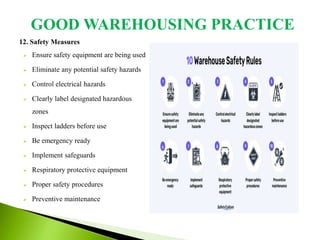
12. Safety Measures
 Ensure safety equipment are being used
 Eliminate any potential safety hazards
 Control electrical hazards
 Clearly label designated hazardous
zones
 Inspect ladders before use
 Be emergency ready
 Implement safeguards
 Respiratory protective equipment
 Proper safety procedures
 Preventive maintenance
GOOD WAREHOUSING PRACTICE
13. Handling and Issue
 Raw Materials
 Attention to be made for – prevent cross contamination, health of personal handling material,
containers should be closed properly.
 Materials issued only against authorized person .
 Personnel protective devices like gloves, facemask etc. should be used to avoid health
hazards.
 Adequate dust extraction system should be provided to suck away fine dust as to prevent
cross contamination.
GOOD WAREHOUSING PRACTICE
Packaging Materials
 Packaging materials issued to production only against packaging materials order.
 Care should made to check for only right packaging materials to be issued.
 Unlike raw materials , exact quantity of packaging materials to be issued.
 Unused packaging materials returned to the warehouse and will accompanied by authorized
documents .
GOOD WAREHOUSING PRACTICE
Finished Products
 Safe, orderly and dispatch of all products
 cold storage area have temperature monitoring and recording device
 racking and shelving system should have good mechanical strength
 Stock received from factory with proper documentation [name, batch number, batch size etc.]
 Stock should be stored product wise to enable quick identification and controlled stock
movement
 Store rotation should be on –FIFO/FEFO.
GOOD WAREHOUSING PRACTICE
Returned Goods
 Stock should be carry out only consultation with Quality Assurance Incharge.
 Returned goods must be isolated on receipt , clearly identified and records regarding reason
for the return .
 QC personnel separately sampling the returned product for analysis.
 QC Incharge should examine whether these goods are reprocessed or destroyed.
 Reprocessing of returned should be done according the instruction of QA Incharge.
GOOD WAREHOUSING PRACTICE
14. Stock Management
 Objectives :-
 To ensure continuity of supplies
 To avoid over stocking
 Monitor stock levels
 Monitor consumption
 Issuing of Materials :-
 Store should issue raw and packaging materials on the basis of FIFO (first In, first out) or FEFO
(First Expired, First Out) basis. Entry and exist of every consignment of materials should be entered
on the BIN CARD.
 Issuing of materials should do on the basis of raw and packaging materials required in
manufacturing process . While issuing hazardous and explosive materials . The operation should be
supervised to prevent any mistake.
GOOD WAREHOUSING PRACTICE
You learn from experience
You learn better from bad
experience

Good Warehouse Practice.pptx

  • 2.
  • 3.
    CONTENTS  INTRODUCTION  WHATIS WAREHOUSE MANAGEMENT  VARIOUS AREAS OF WAREHOUSING  DESIGN  SECURITY  TEMPERATURE AND HUMIDITY CONTROL  FLOWCHART OF INCOMING GOODS  RULES FOR WAREHOUSING  CHARACTERS OF GOOD WAREHOUSE  THE WAREHOUSE STAFF  STORAGE CONDITION  SAFETY MEASURES  HANDLING AND ISSUE  STOCK MANAGEMENT
  • 4.
    1. Introduction Maintaining properstorage condition for pharmaceutical products. Factory stores will invariably be receiving duly approved raw materials and packaging materials from the approved vendor. A suitable space is provided to handling and storage of raw & packaging materials required for manufacturing. This space is known as Warehouse. GOOD WAREHOUSING PRACTICE
  • 5.
    2. WHAT ISWAREHOUSE MANAGEMENT Warehouse management is the act of organizing and controlling everything within your warehouse and making sure it all runs in the most optimal way possible . This includes :-  Arranging the warehouse and its inventory  Having and maintaining the appropriate equipment  Managing new stock coming in facility  Picking , packaging and shipping  Storing of Pharmaceutical Products in appropriate storage area.  Tracking and improving overall warehouse performance GOOD WAREHOUSING PRACTICE
  • 6.
    3. Various AreasOf Warehousing  Receiving Area -includes initial inspection , cleaning & weight checking  Quarantine Area-A quarantine area is an area for storing goods that have not yet been inspected or tested.  Sampling Area- Sampling area is a area where collection of small portion of a material with adequate facilities to prevent cross contamination.  Storage Area - Including specific storage like air condition rooms , cold rooms , hazardous chemical room .  Dispensing Area – With adequate facilities to minimize cross contamination during dispensing .  Rejected Area – Destroy or retented unsuitable or expired materials. GOOD WAREHOUSING PRACTICE
  • 7.
     General :The layout and design of premises must aim to minimize the risk of errors and permit effective cleaning and maintenance in order to avoid cross contamination, build-up of dust or dirt.  Where dust is generated (e.g. During Receiving, during sampling, weighing), measures should be taken to avoid cross contamination and facilitate cleaning . GOOD WAREHOUSING PRACTICE 4. DESIGN:  Principle : Premises must be Located , Designed , Constructed, Adapted, and maintained to suit the Operations to be carried out . Good Warehousing
  • 8.
    Continued…..  Premises shouldbe cleaned and , where applicable , disinfected according to detailed written procedure . Record should be maintained.  Premises should be designed to ensure the logical flow of materials and personnel  Premises should be designed and equipped so as to afford maximum protection against the entry of birds , insects , or other animals  There should be standard procedure to prevent from rodent and pest control. GOOD WAREHOUSING PRACTICE
  • 9.
    5. SECURITY  Storageareas should be provided with security to prevent theft or unauthorized entry  Maintain a control of who may enter the facilities  Establish system for controlling access to the facility (including all entrances and exits) GOOD WAREHOUSING PRACTICE
  • 10.
    6. TEMPERATURE ANDHUMIDITY CONTROL  All materials must be stored at appropriate conditions as stated on the label of the material  The temperature of all storage areas should be regularly monitored and recorded  Controlled temperature storage areas should be equipped with recorders and devices which indicate when the specific temperature range has not been maintained  A written procedure must specify the action to be taken when this occurs  Control should be adequate to ensure that all parts of the storage area are kept within the specified temperature range  Should always be a back up system in case main system fails GOOD WAREHOUSING PRACTICE
  • 11.
  • 12.
    7. Flowchart ofIncoming Goods RECEIPT OF INCOMING GOODS  It should be carried out according to approved SOP:  Visually examine delivery documents of the consignment  delivery challan/Invoice  COA  Name of material  Name of manufacturer  Batch no  Manufacturing date  Expiry date  Quantity  Gross Weight GOOD WAREHOUSING PRACTICE
  • 13.
    Continued……  Visually examinephysical condition & verification of consignment for damage.  Check the cleanliness  Check the storage condition of materials  Cross verify container labels with documents If any discrepancies is observed in doc, material, packing, vehicle condition, then warehouse officer should bring notice this to head warehouse & QA. GOOD WAREHOUSING PRACTICE
  • 14.
    Quarantine of ReceivedGoods  Palletized the Raw Material containers/boxes in Quarantine area and enter record in the Quarantine Area Control Log Book.  Affix “QUARANTINE” label on each container/box  Inform to the QC Department for sampling purpose with Sample Request Form. Sampling of Quarantined Goods  Transfer the containers/boxes from Quarantine Area to Sampling Area and Take Sample as per SOP of Sampling and Handling of Raw and Packaging Materials.  After Sampling affix “SAMPLED” label on the container/box and transfer the Sample to the QC Department for testing purpose. Then transfer back the materials to the Quarantine area. GOOD WAREHOUSING PRACTICE
  • 15.
    Approval or Rejectionof Sampled Goods  QC Department will approve or reject the material as per test result. Affix an “APPROVED” or “REJECTED” label, whichever applies.  Transfer approved containers/boxes from Quarantine area to the APPROVED warehouse & Rejected containers/boxes to the REJECTED store. GOOD WAREHOUSING PRACTICE
  • 16.
    8. Rules ForWarehousing  Systematic storage of the delivered goods .  Providing each products have only one specific place .  On shelves clear labeling of products should be there .  Adequate space should be provided for each goods .  Provide separate BIN CARD for each products .  All boxes in stock should be closed in air tight .  Warehouse Mapping should be carried out.  Flammable products should stored in separate place. GOOD WAREHOUSING PRACTICE
  • 17.
    9. Characters ofGood Warehouse  Properly cleaned .  Good preservation of drugs and equipment.  Provide safety for staff and stocked goods .  Control of air, light, humidity and temperature.  Products to be purchased according to needs.  Order the destruction of unsuitable products.  Use of pharmaceutical products with FIFO/FEFO. GOOD WAREHOUSING PRACTICE
  • 18.
    10. The WarehouseStaff 1. The responsible Incharge His duties  Good management of the stock of the warehouse.  Good preservation of drugs and equipment's.  Safety of stored goods. 2. The warehouse keeper His duties  Reception of supplies.  Storage of stocks of goods.  Recording of every IN and OUT movement of the products in the BIN CARD.  Issue of products during manufacturing. GOOD WAREHOUSING PRACTICE
  • 19.
    Continued…. 3. The warehouseworker His duties  Handling operations includes the carrying and moving of goods which are intended for storage, shipment and sale.  The warehouse staff helps in receives and issue goods and maintain inventory. 4. The cleaner His duty  Appropriate cleaning by given procedure.  Ensure cleanliness of premises and equipment.  use air curtains and air tunnels. GOOD WAREHOUSING PRACTICE
  • 20.
    11. Storage Condition Thereare several types of storage conditions:  Controlled Condition (15ºC – 25ºC)  Cool Condition (8ºC – 15ºC)  Cold Condition(2ºC – 8ºC)  Freezer Condition (Bellow –18ºC) Note: Temperature Mapping must be performed in the storage area and the Temperature Mapping should be performed in Two seasons (Summer and Winter). Refrigerator and Freezer must be validated for storing. GOOD WAREHOUSING PRACTICE
  • 21.
    12. Safety Measures Ensure safety equipment are being used  Eliminate any potential safety hazards  Control electrical hazards  Clearly label designated hazardous zones  Inspect ladders before use  Be emergency ready  Implement safeguards  Respiratory protective equipment  Proper safety procedures  Preventive maintenance GOOD WAREHOUSING PRACTICE
  • 22.
    13. Handling andIssue  Raw Materials  Attention to be made for – prevent cross contamination, health of personal handling material, containers should be closed properly.  Materials issued only against authorized person .  Personnel protective devices like gloves, facemask etc. should be used to avoid health hazards.  Adequate dust extraction system should be provided to suck away fine dust as to prevent cross contamination. GOOD WAREHOUSING PRACTICE
  • 23.
    Packaging Materials  Packagingmaterials issued to production only against packaging materials order.  Care should made to check for only right packaging materials to be issued.  Unlike raw materials , exact quantity of packaging materials to be issued.  Unused packaging materials returned to the warehouse and will accompanied by authorized documents . GOOD WAREHOUSING PRACTICE
  • 24.
    Finished Products  Safe,orderly and dispatch of all products  cold storage area have temperature monitoring and recording device  racking and shelving system should have good mechanical strength  Stock received from factory with proper documentation [name, batch number, batch size etc.]  Stock should be stored product wise to enable quick identification and controlled stock movement  Store rotation should be on –FIFO/FEFO. GOOD WAREHOUSING PRACTICE
  • 25.
    Returned Goods  Stockshould be carry out only consultation with Quality Assurance Incharge.  Returned goods must be isolated on receipt , clearly identified and records regarding reason for the return .  QC personnel separately sampling the returned product for analysis.  QC Incharge should examine whether these goods are reprocessed or destroyed.  Reprocessing of returned should be done according the instruction of QA Incharge. GOOD WAREHOUSING PRACTICE
  • 26.
    14. Stock Management Objectives :-  To ensure continuity of supplies  To avoid over stocking  Monitor stock levels  Monitor consumption  Issuing of Materials :-  Store should issue raw and packaging materials on the basis of FIFO (first In, first out) or FEFO (First Expired, First Out) basis. Entry and exist of every consignment of materials should be entered on the BIN CARD.  Issuing of materials should do on the basis of raw and packaging materials required in manufacturing process . While issuing hazardous and explosive materials . The operation should be supervised to prevent any mistake. GOOD WAREHOUSING PRACTICE
  • 27.
    You learn fromexperience You learn better from bad experience