





A Seminar On
Pharmaceutical Warehousing


  Prepared By: Ravi Akhani
                  (M.Pharm (Q.A.), Semester-1)
  Guided By: (1) Mr. Rajesh Parmar
Contents:
1. Objective
2. A pharmaceutical warehouse: for what?
3. Premises
4. Storage condition
5. Shelf life of the product
6. General requirement for warehousing
7. Stock management
8. Documentation
9. Inventories
10. Reception of goods
11. The warehouse staff
12. Quality assurance
13. Audits
1. Objective:-

   - Factory stores will invariably be receiving duly
   approved raw materials and packaging materials
   from third party.

  - A suitable space is provided to raw material and
   packaging materials for each contract
   manufacturer.
   This space is known as Warehouse.
2. A pharmaceutical warehouse: for what?

- To enable the fastest and cheapest   transport   of
  drugs and medical equipment from     suppliers   to
  beneficiaries.

 - There are mainly 3 stages:
    (1) Purchase of pharmaceutical products
    (2) Storage of ordered products
    (3) Distribution of stocked products
PHARMACEUTICAL
WAREHOUSE
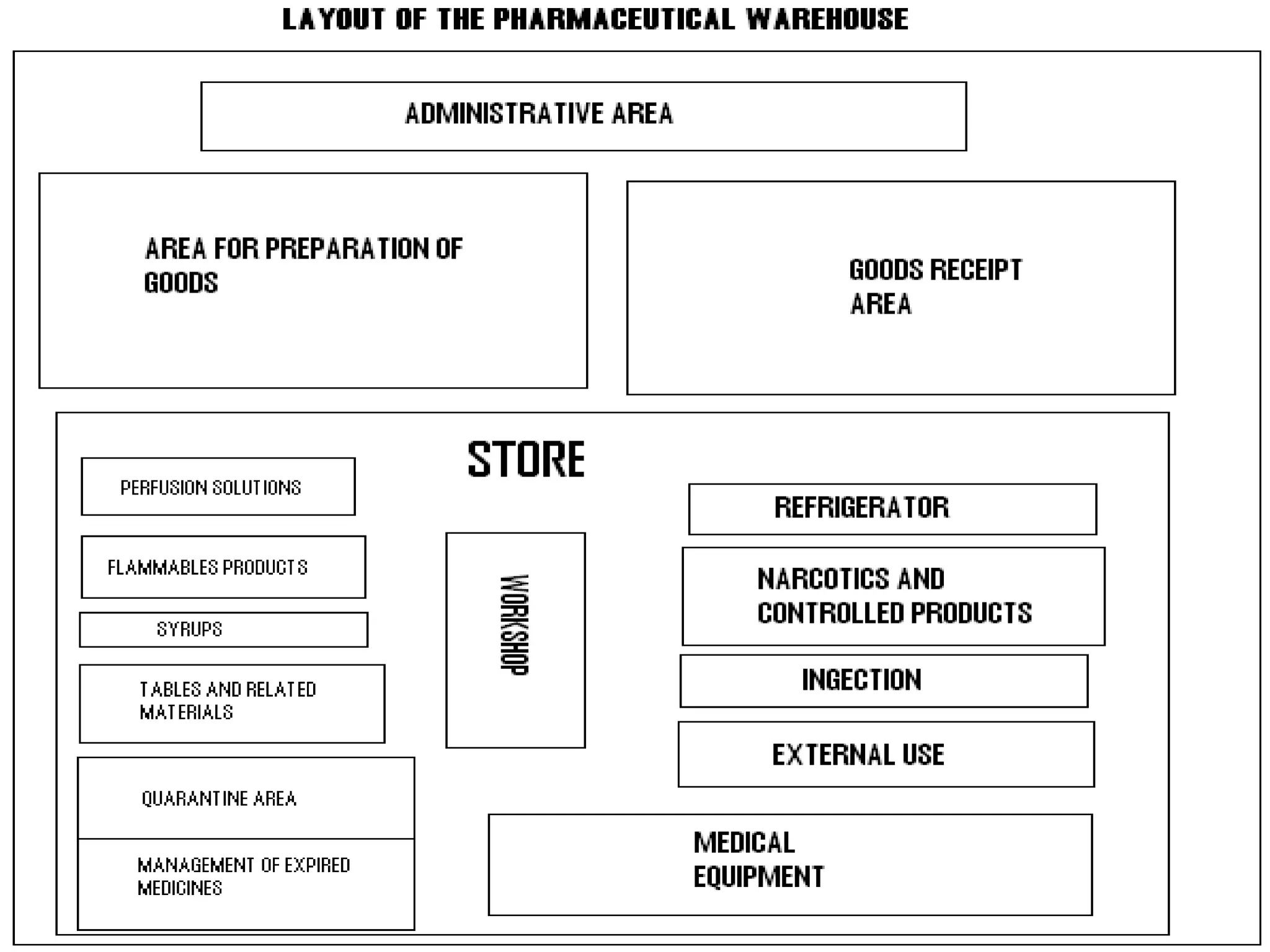
3. Premises:-

   - Principle: Premises must be locked, designed,
 constructed, adapted, and maintained to suit the
 operations to be carried out.
4. Storage condition:-

 A. Temperature
  - Daily monitoring and recorded every house.
  - Temp. in warehouse must not exceed 25-30oC.

 B. Air
   - All containers should be hermetically closed.
   - Avoid prolonged unpack age material.
   - Premises should be ventilated.

 C. Light
   - Many API should be stored in dark room.
   - API should not be directly exposed to sunlight and not to
 be issued until and unless it is required in manufacturing.
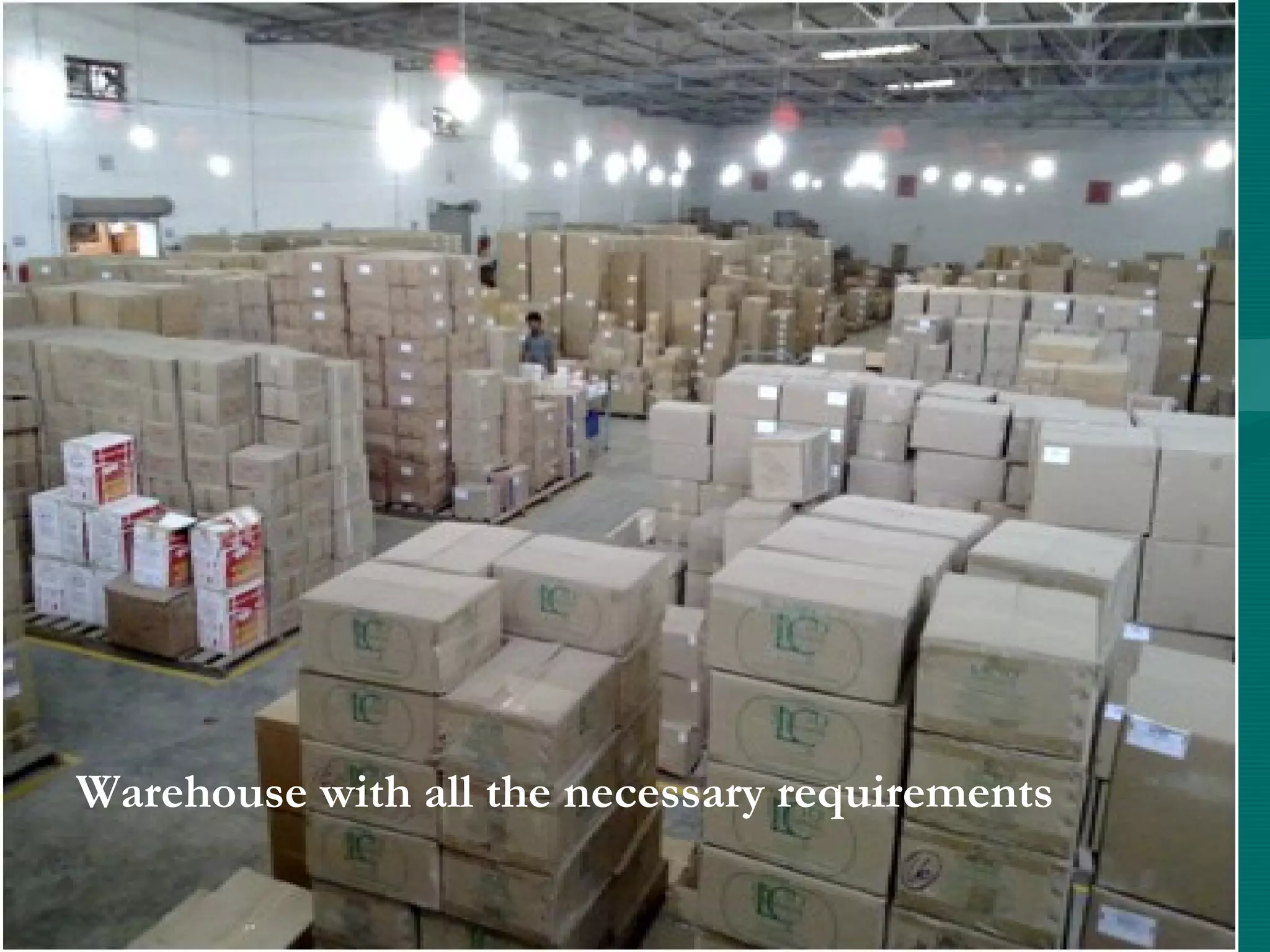
Warehouse with all the necessary requirements
PHARMACEUTICAL
WAREHOUSE
PHARMACEUTICAL
WAREHOUSE
5. Shelf life of the product:-

  A. Expiry Date
   - It must appear on the package and/or on the product.
    - The expiration date applies to a drug in its original closed
  and undamaged package or container.

  B. Management of outdated products
     - First, the expired products must be removed from the
  stock of the products. Stored in a locked area.
      - Secondly, these products are stored by form to be
  destroyed in compliance with law and regulations.
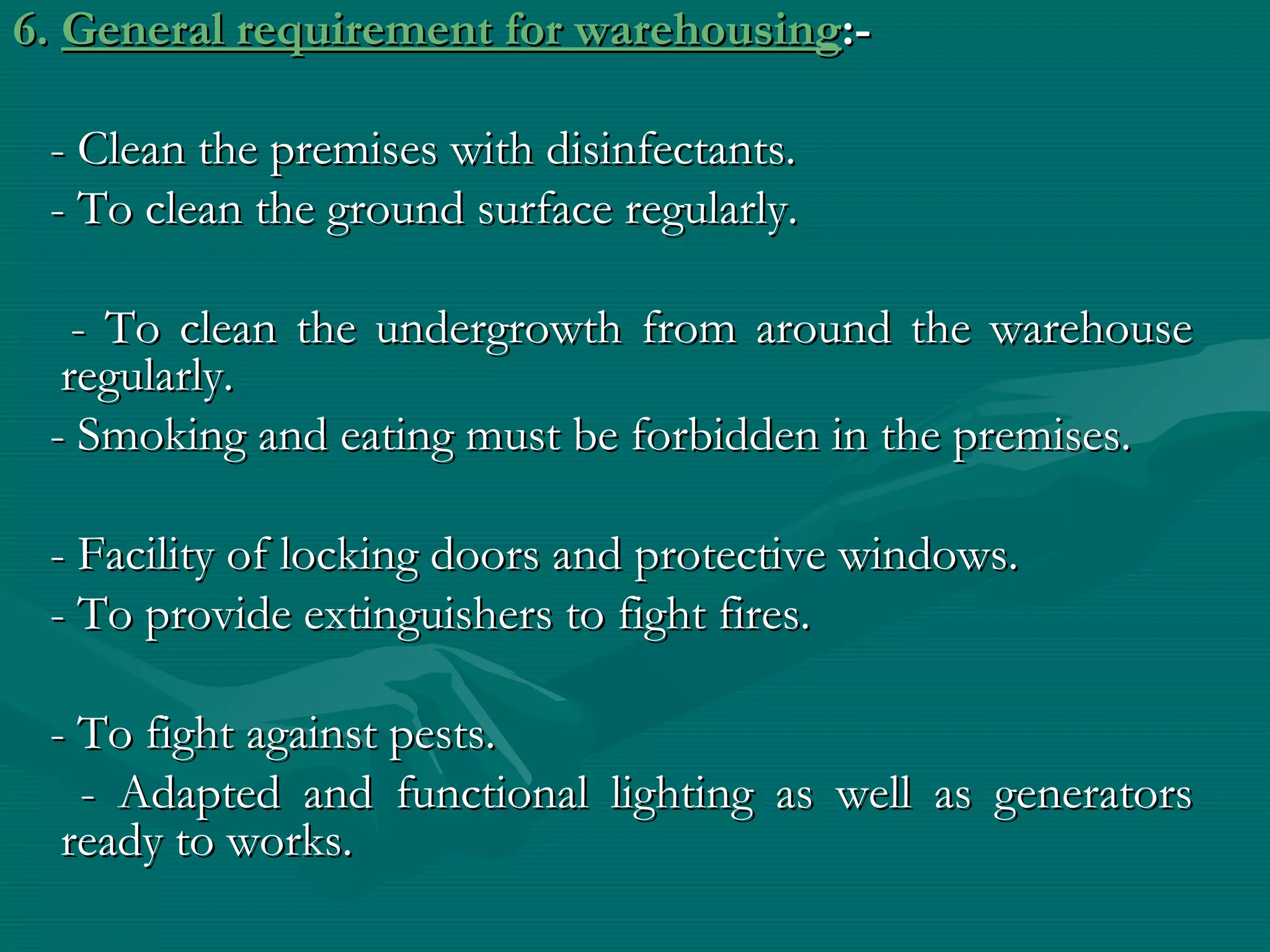
6. General requirement for warehousing:-

 - Clean the premises with disinfectants.
 - To clean the ground surface regularly.

   - To clean the undergrowth from around the warehouse
  regularly.
 - Smoking and eating must be forbidden in the premises.

 - Facility of locking doors and protective windows.
 - To provide extinguishers to fight fires.

 - To fight against pests.
   - Adapted and functional lighting as well as generators
  ready to works.
7. Stock management:-

 - Objectives
  (1) To ensure continuity of supplies
  (2) To avoid over stocking

 - Stock management will set out to;
   (1) Monitor stock levels
   (2) Monitor consumption
   (3) Anticipate delivery time for order activation.
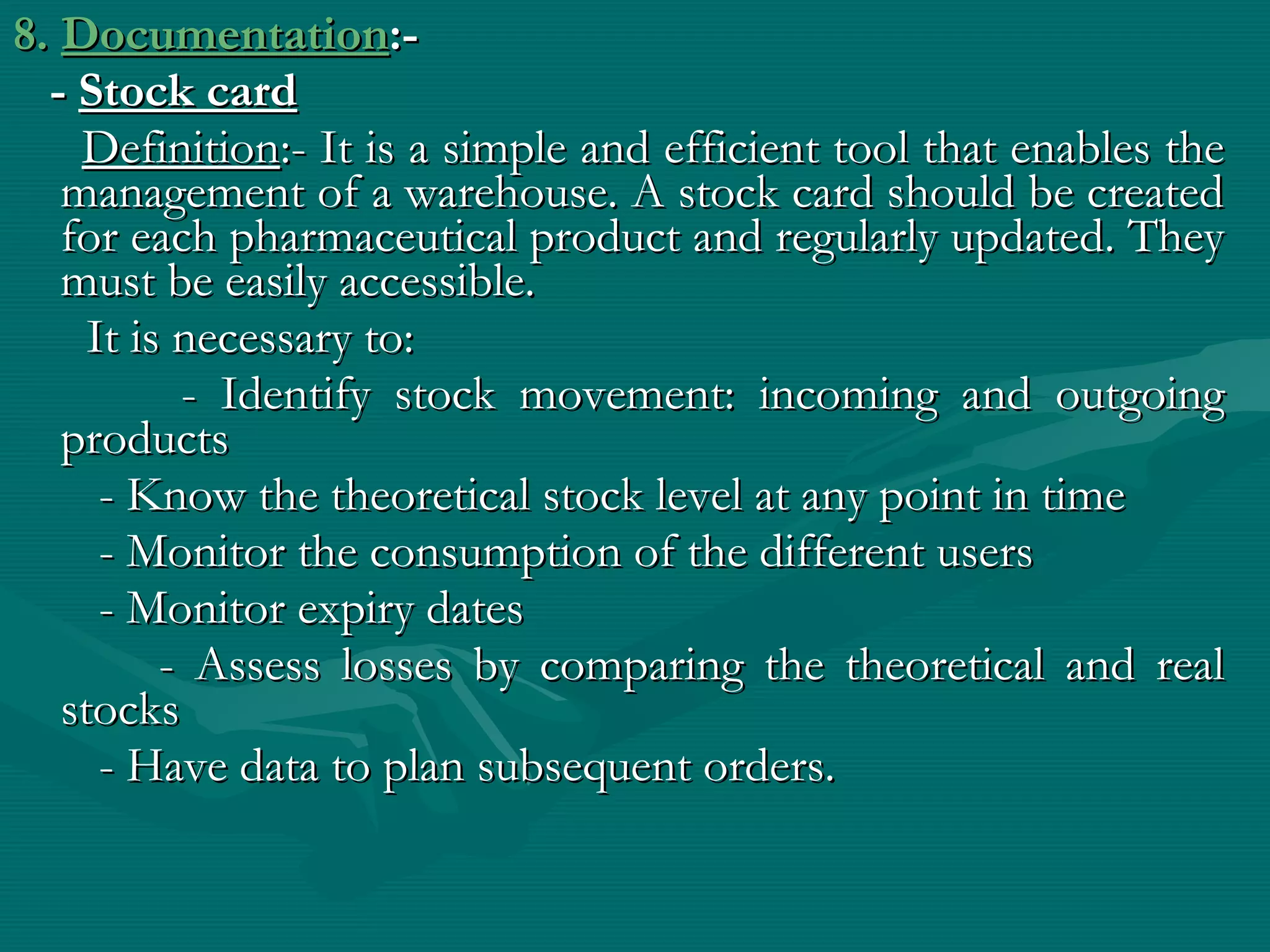
8. Documentation:-
  - Stock card
    Definition:- It is a simple and efficient tool that enables the
   management of a warehouse. A stock card should be created
   for each pharmaceutical product and regularly updated. They
   must be easily accessible.
     It is necessary to:
           - Identify stock movement: incoming and outgoing
   products
      - Know the theoretical stock level at any point in time
      - Monitor the consumption of the different users
      - Monitor expiry dates
          - Assess losses by comparing the theoretical and real
   stocks
      - Have data to plan subsequent orders.
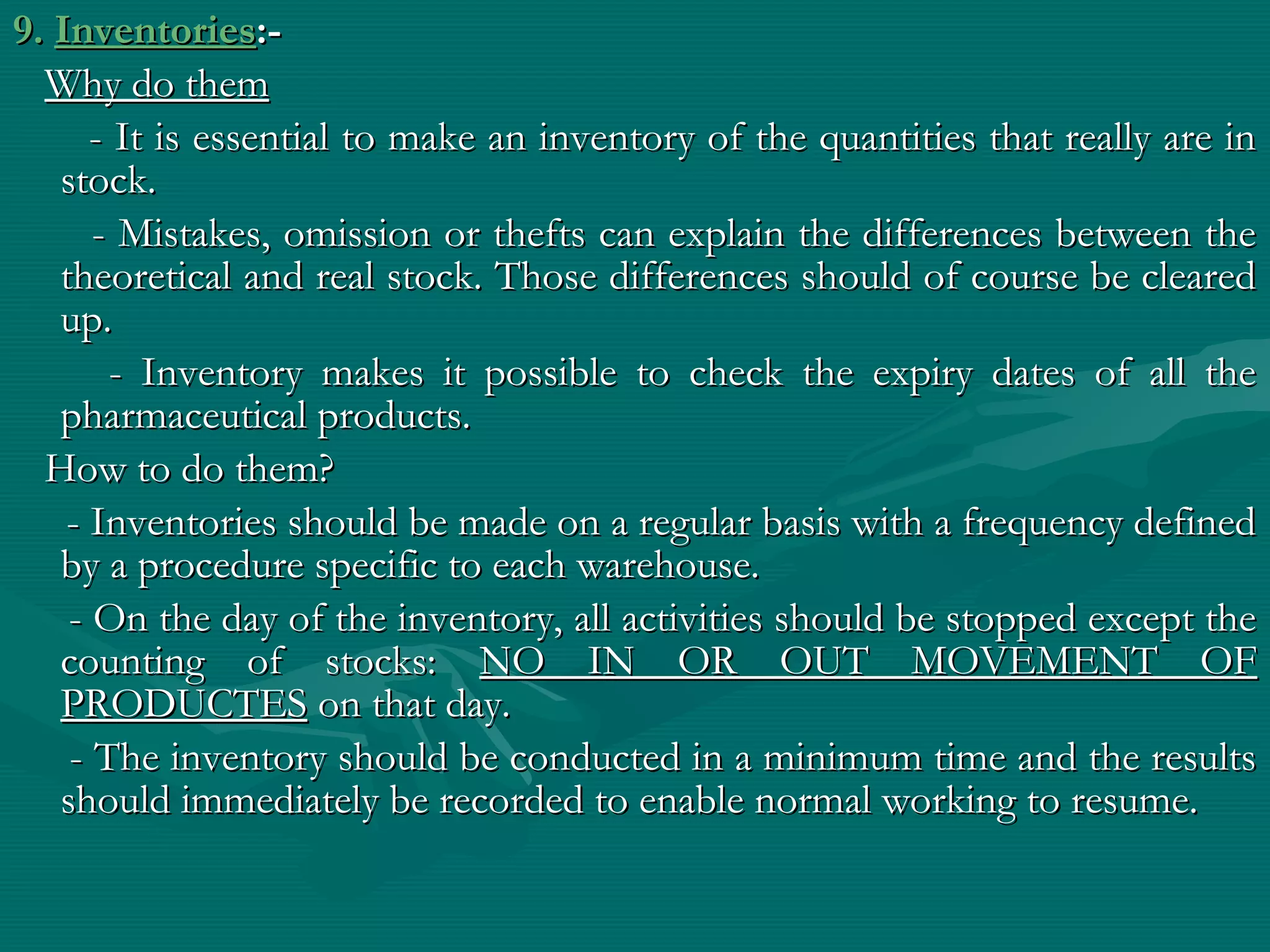
9. Inventories:-
  Why do them
      - It is essential to make an inventory of the quantities that really are in
   stock.
      - Mistakes, omission or thefts can explain the differences between the
   theoretical and real stock. Those differences should of course be cleared
   up.
        - Inventory makes it possible to check the expiry dates of all the
   pharmaceutical products.
  How to do them?
    - Inventories should be made on a regular basis with a frequency defined
   by a procedure specific to each warehouse.
    - On the day of the inventory, all activities should be stopped except the
   counting of stocks: NO IN OR OUT MOVEMENT OF
   PRODUCTES on that day.
    - The inventory should be conducted in a minimum time and the results
   should immediately be recorded to enable normal working to resume.
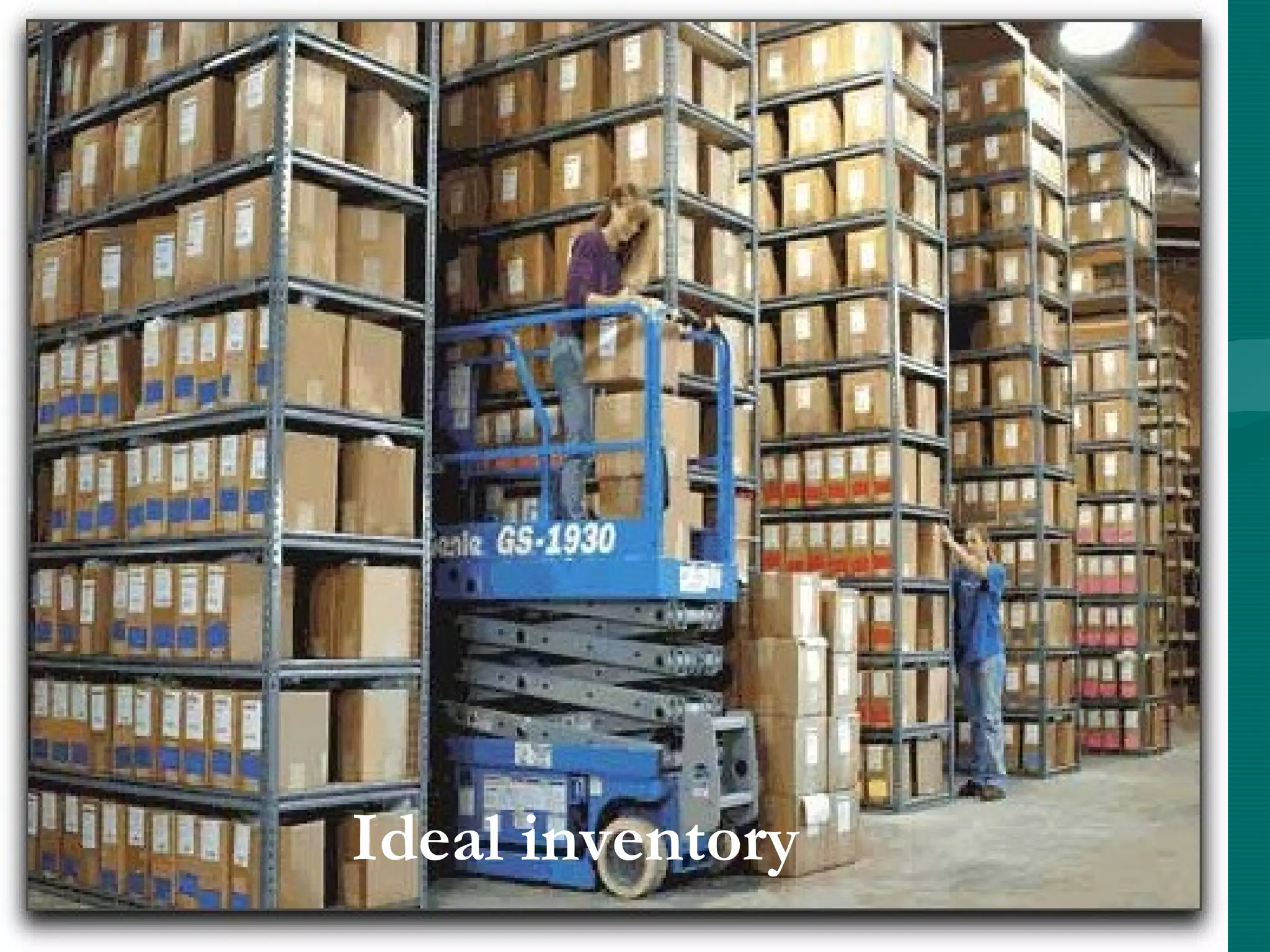
Ideal inventory
Automatic conveyer in the warehouse
10. Reception of goods:-

  Inspection of an order
      - A separate rack should be provided to store
 approved raw and packaging materials. Materials
 that are waiting for approval should be kept in
 “Quarantine area”.

    - After receiving approval, it should be taken into
 stock. Quarantine materials should be labeled
 “Under Test” till it released by Quality control
 division.
11. The warehouse staff:-

  (1) The responsible pharmacist

  (2) The warehouse keeper

  (3) The warehouse worker

  (4) The cleaner

  (5) The security guard
12. Quality Assurance:-
   SOPs
          Each warehouse will have to establish operating
  procedures.
    They must be clearly defined for each stage activities
     - Direct purchase from raw materials manufactures
     - Purchase via Head quarters
     - Reception of local and imported orders
     - Unpacking, labeling and storage of products
     - Computerized stock managements
     - Preparations of an order for delivery
     - Returns of drugs
     - Managements of outdated drugs
     - Safety and cleanliness of premises.
13. Audits:-

        Audits aim at assessing the activities and
  organization of the warehouse. Their aim at
  answering key questions such likes

     - Have initially set of activities & quality objectives
  been reached?
        - Are procedures correctly written respected,
  reviewed?
         - Does the warehouse guarantee for safety
  standards?
-:REFERENCES:-

1. Good manufacturing Practices For Pharmaceutics, 1st
   edition, Sidney H. Willing, 173-175.
2. PSF-CI PHARMACEUTICAL GUIDE; How better to
   manage pharmaceutical warehouses, March 2003, 2-21, 27-
   31.
3. Quality Assurance of Pharmaceuticals; GMP & Inspection;
   vol.-2. WHO Publication, Pharma book Syndicate; 28-32.
4. SOP GUIDELINES, D.H.Shah, business Horizons,
   Pharmaceutical Publishers, 2nd reprint edition, 2004, 410.
THANK   YOU

Warehouse 112070804002

  • 1.
    A Seminar On PharmaceuticalWarehousing Prepared By: Ravi Akhani (M.Pharm (Q.A.), Semester-1) Guided By: (1) Mr. Rajesh Parmar
  • 2.
    Contents: 1. Objective 2. Apharmaceutical warehouse: for what? 3. Premises 4. Storage condition 5. Shelf life of the product 6. General requirement for warehousing 7. Stock management 8. Documentation 9. Inventories 10. Reception of goods 11. The warehouse staff 12. Quality assurance 13. Audits
  • 3.
    1. Objective:- - Factory stores will invariably be receiving duly approved raw materials and packaging materials from third party. - A suitable space is provided to raw material and packaging materials for each contract manufacturer. This space is known as Warehouse.
  • 4.
    2. A pharmaceuticalwarehouse: for what? - To enable the fastest and cheapest transport of drugs and medical equipment from suppliers to beneficiaries. - There are mainly 3 stages: (1) Purchase of pharmaceutical products (2) Storage of ordered products (3) Distribution of stocked products
  • 5.
  • 6.
    3. Premises:- - Principle: Premises must be locked, designed, constructed, adapted, and maintained to suit the operations to be carried out.
  • 7.
    4. Storage condition:- A. Temperature - Daily monitoring and recorded every house. - Temp. in warehouse must not exceed 25-30oC. B. Air - All containers should be hermetically closed. - Avoid prolonged unpack age material. - Premises should be ventilated. C. Light - Many API should be stored in dark room. - API should not be directly exposed to sunlight and not to be issued until and unless it is required in manufacturing.
  • 8.
    Warehouse with allthe necessary requirements
  • 9.
  • 10.
  • 11.
    5. Shelf lifeof the product:- A. Expiry Date - It must appear on the package and/or on the product. - The expiration date applies to a drug in its original closed and undamaged package or container. B. Management of outdated products - First, the expired products must be removed from the stock of the products. Stored in a locked area. - Secondly, these products are stored by form to be destroyed in compliance with law and regulations.
  • 12.
    6. General requirementfor warehousing:- - Clean the premises with disinfectants. - To clean the ground surface regularly. - To clean the undergrowth from around the warehouse regularly. - Smoking and eating must be forbidden in the premises. - Facility of locking doors and protective windows. - To provide extinguishers to fight fires. - To fight against pests. - Adapted and functional lighting as well as generators ready to works.
  • 14.
    7. Stock management:- - Objectives (1) To ensure continuity of supplies (2) To avoid over stocking - Stock management will set out to; (1) Monitor stock levels (2) Monitor consumption (3) Anticipate delivery time for order activation.
  • 15.
    8. Documentation:- - Stock card Definition:- It is a simple and efficient tool that enables the management of a warehouse. A stock card should be created for each pharmaceutical product and regularly updated. They must be easily accessible. It is necessary to: - Identify stock movement: incoming and outgoing products - Know the theoretical stock level at any point in time - Monitor the consumption of the different users - Monitor expiry dates - Assess losses by comparing the theoretical and real stocks - Have data to plan subsequent orders.
  • 16.
    9. Inventories:- Why do them - It is essential to make an inventory of the quantities that really are in stock. - Mistakes, omission or thefts can explain the differences between the theoretical and real stock. Those differences should of course be cleared up. - Inventory makes it possible to check the expiry dates of all the pharmaceutical products. How to do them? - Inventories should be made on a regular basis with a frequency defined by a procedure specific to each warehouse. - On the day of the inventory, all activities should be stopped except the counting of stocks: NO IN OR OUT MOVEMENT OF PRODUCTES on that day. - The inventory should be conducted in a minimum time and the results should immediately be recorded to enable normal working to resume.
  • 17.
  • 18.
    Automatic conveyer inthe warehouse
  • 19.
    10. Reception ofgoods:- Inspection of an order - A separate rack should be provided to store approved raw and packaging materials. Materials that are waiting for approval should be kept in “Quarantine area”. - After receiving approval, it should be taken into stock. Quarantine materials should be labeled “Under Test” till it released by Quality control division.
  • 20.
    11. The warehousestaff:- (1) The responsible pharmacist (2) The warehouse keeper (3) The warehouse worker (4) The cleaner (5) The security guard
  • 21.
    12. Quality Assurance:- SOPs Each warehouse will have to establish operating procedures. They must be clearly defined for each stage activities - Direct purchase from raw materials manufactures - Purchase via Head quarters - Reception of local and imported orders - Unpacking, labeling and storage of products - Computerized stock managements - Preparations of an order for delivery - Returns of drugs - Managements of outdated drugs - Safety and cleanliness of premises.
  • 22.
    13. Audits:- Audits aim at assessing the activities and organization of the warehouse. Their aim at answering key questions such likes - Have initially set of activities & quality objectives been reached? - Are procedures correctly written respected, reviewed? - Does the warehouse guarantee for safety standards?
  • 23.
    -:REFERENCES:- 1. Good manufacturingPractices For Pharmaceutics, 1st edition, Sidney H. Willing, 173-175. 2. PSF-CI PHARMACEUTICAL GUIDE; How better to manage pharmaceutical warehouses, March 2003, 2-21, 27- 31. 3. Quality Assurance of Pharmaceuticals; GMP & Inspection; vol.-2. WHO Publication, Pharma book Syndicate; 28-32. 4. SOP GUIDELINES, D.H.Shah, business Horizons, Pharmaceutical Publishers, 2nd reprint edition, 2004, 410.
  • 24.
    THANK YOU