STI601
Warehouse and
Storage
KK: Production Engineering and Supply Chain Management
Industrial Engineering
Faculty of Industrial Technology
Universitas Islam Indonesia
Learning Objective(s)
Understand the
concept of warehouse
Understand the
warehouse
management system
Understand the
concept of storage
Recognize type of
facility storages
Contents
• Warehouse
• Challenges
• Warehouse in Industry 4.0
• Warehouse Management System
• Storage
• Function of storage
• Type of storage equipment
Warehouse
• According to Logistics Bureau [1], Warehouse can be defined as
planned space for the efficient storage and handling of goods and
materials
• A warehouse is a dynamic operation and can deliver a more
profitable return on investment than many people realise.
• Only 26% of company managers view warehouses and distribution
centers as an asset which can drive growth for their business [2]
• 34% of businesses ship late because products are sold which are not
actually in stock [3]
1. https://www.logisticsbureau.com/about-warehousing/
2. https://www.zebra.com/content/dam/zebra_new_ia/en-us/solutions-verticals/vertical-solutions/warehouse-management/vision-study/2024/warehouse-vision-study-
en-us.pdf
3. https://www.peoplevox.com/hubfs/Fulfilment%20Survey%202017/2017%20Peoplevox%20E-Commerce%20Fulfilment%20Report.pdf
Why do Companies Need Warehouses?
• Protection and Preservation of goods
• Regular flow of goods
• Continuity in production
• Convenient location
• Easy handling
• Useful for small businessmen
• Facilitates sale of goods
• Availability of finance
• Reduces risk of loss
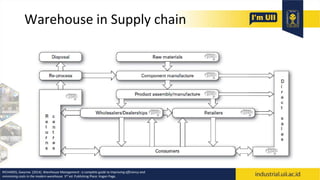
Warehouse in Supply chain
RICHARDS, Gwynne. (2014). Warehouse Management : a complete guide to improving efficiency and
minimizing costs in the modern warehouse 3rd ed. Publishing Place: Kogan Page.
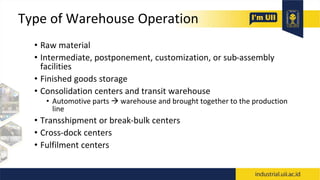
Type of Warehouse Operation
• Raw material
• Intermediate, postponement, customization, or sub-assembly
facilities
• Finished goods storage
• Consolidation centers and transit warehouse
• Automotive parts  warehouse and brought together to the production
line
• Transshipment or break-bulk centers
• Cross-dock centers
• Fulfilment centers
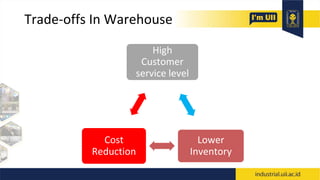
Trade-offs In Warehouse
High
Customer
service level
Lower
Inventory
Cost
Reduction
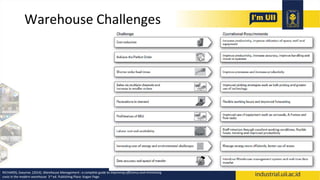
Warehouse Challenges
RICHARDS, Gwynne. (2014). Warehouse Management : a complete guide to improving efficiency and minimizing
costs in the modern warehouse 3rd ed. Publishing Place: Kogan Page.
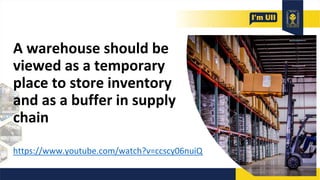
https://www.youtube.com/watch?v=ccscy06nuiQ
A warehouse should be
viewed as a temporary
place to store inventory
and as a buffer in supply
chain
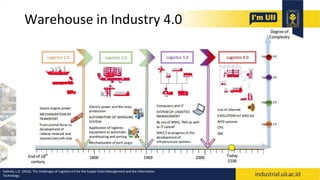
Warehouse in Industry 4.0
Galindo, L.D. (2016). The Challenges of Logistics 4.0 for the Supply Chain Management and the Information
Technology.
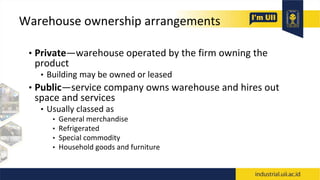
Warehouse ownership arrangements
• Private—warehouse operated by the firm owning the
product
• Building may be owned or leased
• Public—service company owns warehouse and hires out
space and services
• Usually classed as
• General merchandise
• Refrigerated
• Special commodity
• Household goods and furniture
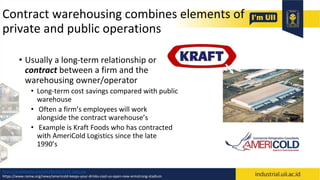
Contract warehousing combines elements of
private and public operations
• Usually a long-term relationship or
contract between a firm and the
warehousing owner/operator
• Long-term cost savings compared with public
warehouse
• Often a firm’s employees will work
alongside the contract warehouse’s
• Example is Kraft Foods who has contracted
with AmeriCold Logistics since the late
1990’s
https://id.wikipedia.org/wiki/Berkas:Kraft_logo.svg
https://www.ramw.org/news/americold-keeps-your-drinks-cool-us-open-new-armstrong-stadium
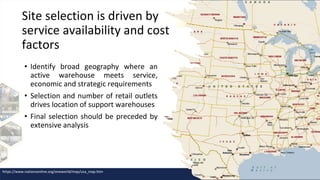
Site selection is driven by
service availability and cost
factors
• Identify broad geography where an
active warehouse meets service,
economic and strategic requirements
• Selection and number of retail outlets
drives location of support warehouses
• Final selection should be preceded by
extensive analysis
https://www.nationsonline.org/oneworld/map/usa_map.htm
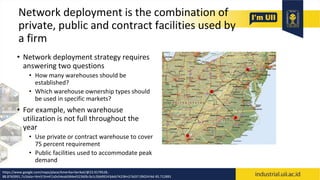
Network deployment is the combination of
private, public and contract facilities used by
a firm
• Network deployment strategy requires
answering two questions
• How many warehouses should be
established?
• Which warehouse ownership types should
be used in specific markets?
• For example, when warehouse
utilization is not full throughout the
year
• Use private or contract warehouse to cover
75 percent requirement
• Public facilities used to accommodate peak
demand
https://www.google.com/maps/place/Amerika+Serikat/@23.9179528,-
88.8760991,7z/data=!4m5!3m4!1s0x54eab584e432360b:0x1c3bb99243deb742!8m2!3d37.09024!4d-95.712891
Warehouse Management Systems
• Warehouse management systems (WMS) integrate procedures and
software support to standardize storage and handling work
procedures
• WMS encourage best practices
• One main use of WMS is to coordinate order selection
• Discrete selection is when a specific customer’s order is selected and
prepared for shipment as a single work assignment
• Wave or batch selection is when orders are processed through zones of the
warehouse assigned to specific employees
Warehouse Planning Issues
• Inventory accuracy is typically maintained by annual physical counts
or counting portions of inventory on a planned basis
• Cycle counting is the audit of selected inventory on a cyclic schedule
• Audits are common to maintain safety, assure compliance to
regulations and help improve procedures
• Security issues involve protection from pilferage and damage
Safety and Maintenance Issues
• Accident prevention
• Comprehensive safety programs and training, accident investigation and
follow up
• Environmental protection
• Spill ( leak ) kits and spill plans
• Maintenance
• Scheduled maintenance of building, material handling equipment, and
collision damage prevention
Basic Warehouse Problems
1. Redundant Processes
• Handle a product several times
2. Poor Facility Layout
• Narrow aisles
• High-elevation situations
3. Seasonality in Demand
• Layout and picking
4. High Labor Costs
• 65% of the operating budgets of most
warehouses
5. Inaccurate Inventory
• Improper stock levels and buildups of
obsolete
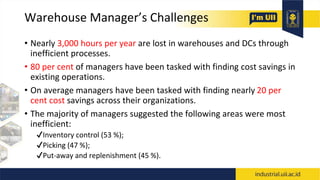
Warehouse Manager’s Challenges
• Nearly 3,000 hours per year are lost in warehouses and DCs through
inefficient processes.
• 80 per cent of managers have been tasked with finding cost savings in
existing operations.
• On average managers have been tasked with finding nearly 20 per
cent cost savings across their organizations.
• The majority of managers suggested the following areas were most
inefficient:
✔Inventory control (53 %);
✔Picking (47 %);
✔Put-away and replenishment (45 %).
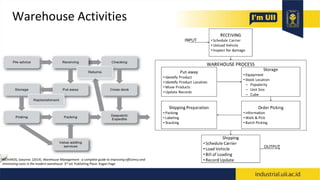
RICHARDS, Gwynne. (2014). Warehouse Management : a complete guide to improving efficiency and
minimizing costs in the modern warehouse 3rd ed. Publishing Place: Kogan Page.
Warehouse Activities
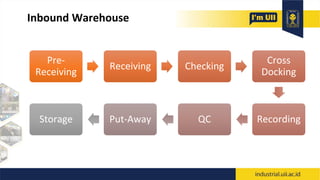
Pre-
Receiving
Receiving Checking
Cross
Docking
Recording
QC
Put-Away
Storage
Inbound Warehouse
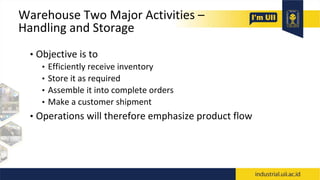
Warehouse Two Major Activities –
Handling and Storage
• Objective is to
• Efficiently receive inventory
• Store it as required
• Assemble it into complete orders
• Make a customer shipment
• Operations will therefore emphasize product flow
Warehouse decisions that determine
handling and storage efficiency
• Site Selection
• Design
• Product-Mix Analysis
• Expansion
• Materials Handling
• Safety and maintenance
• Layout
• Sizing
• Warehouse management system
• Accuracy and audit
• Security
Handling
• Handling must optimize movement continuity and
efficiency
• Receiving—Unloading the arriving vehicles
• In-Storage—moving goods for storage (transfer) or order
selection (picking)

• Shipping—verifying the order and loading the departing
vehicles
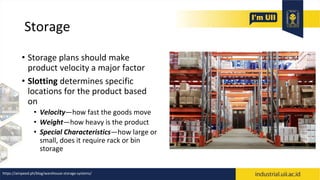
Storage
• Storage plans should make
product velocity a major factor
• Slotting determines specific
locations for the product based
on
• Velocity—how fast the goods move
• Weight—how heavy is the product
• Special Characteristics—how large or
small, does it require rack or bin
storage
https://airspeed.ph/blog/warehouse-storage-systems/
Two Classes of Storage
• Active Storage—storage for basic inventory replenishment
• Focuses on quick movement
• Includes flow-through or cross-dock distribution
• Extended Storage—storage for inventory held in excess of
period for normal replenishment
• E.g. seasonal, speculative, or even commodities
Pre-Receiving
Challenge:
To ensure that the supplier
presents the products to the
warehouse in the most
appropriate way.
Thinking Point:
• Size and type of cartons;
• Type of transit packaging – cardboard, plastic, totes, metal stillages,
• Roll cages, pallets;
• Palletized or non-palletized delivery of product;
• Size (length, width and height) and type of pallets
• Specific labelling such as product description, barcode and quantities;
• Position of label on carton and pallet;
• Carton quantities (inner and outer carton quantities, for example); and
• Mode of transport, delivery quantity and frequency of delivery
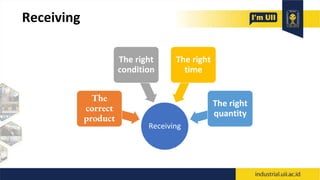
Receiving
The
correct
product
The right
condition
The right
time
The right
quantity
Receiving
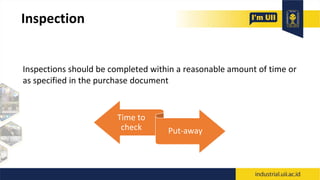
Inspection
Inspections should be completed within a reasonable amount of time or
as specified in the purchase document
Time to
check Put-away
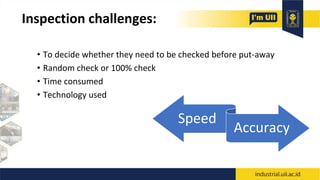
Inspection challenges:
• To decide whether they need to be checked before put-away
• Random check or 100% check
• Time consumed
• Technology used
Speed
Accuracy
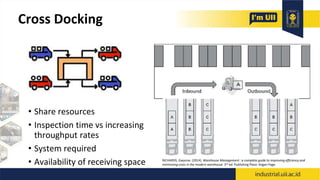
Cross Docking
• Share resources
• Inspection time vs increasing
throughput rates
• System required
• Availability of receiving space RICHARDS, Gwynne. (2014). Warehouse Management : a complete guide to improving efficiency and
minimizing costs in the modern warehouse 3rd ed. Publishing Place: Kogan Page.
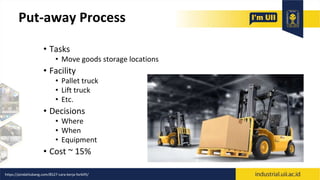
Put-away Process
• Tasks
• Move goods storage locations
• Facility
• Pallet truck
• Lift truck
• Etc.
• Decisions
• Where
• When
• Equipment
• Cost ~ 15%
https://pindahlubang.com/8527-cara-kerja-forklift/
Thinking Point:
• Size, weight and height of palletized goods;
• Results of an ABC analysis or slotting, where fast-moving goods
are placed closest to the dispatch area;
• Current order data;
• Family product groups;
• Actual sales combinations;
• Current status of pick face for each product;
• Size of pallet locations; and
• Weight capacity of racking.
Thinking Point:
Distance of the locations from the receiving and
dispatch areas
https://www.pressebox.de/pressemitteilung/witron-logistik-informatik-gmbh/Sobeys-Kanada-
Vollautomatische-Kommissionierung-im-Frische-und-Tiefkuehlbereich/boxid/788662
Storage Purpose:
“Storing and Assorting the finished goods
at maximum time utility at minimum
cost”
“Storage involves proper management for preserving
goods from the time of their production or purchase till
actual use”
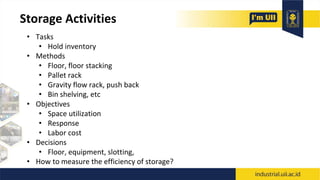
Storage Activities
• Tasks
• Hold inventory
• Methods
• Floor, floor stacking
• Pallet rack
• Gravity flow rack, push back
• Bin shelving, etc
• Objectives
• Space utilization
• Response
• Labor cost
• Decisions
• Floor, equipment, slotting,
• How to measure the efficiency of storage?
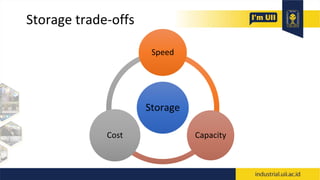
Storage trade-offs
Storage
Speed
Capacity
Cost
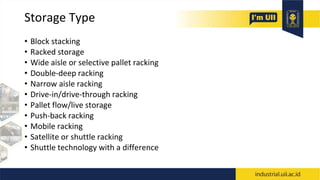
Storage Type
• Block stacking
• Racked storage
• Wide aisle or selective pallet racking
• Double-deep racking
• Narrow aisle racking
• Drive-in/drive-through racking
• Pallet flow/live storage
• Push-back racking
• Mobile racking
• Satellite or shuttle racking
• Shuttle technology with a difference
Which One is Better ?
Depend on:
• The configuration of the building,
• The type of MHE currently in use
• The budget available
Storage Option
• Block stacking
• Racked storage
• Wide aisle or selective pallet racking
• Double-deep racking
• Narrow aisle racking
• Drive-in/drive-through racking
• Pallet flow/live storage
• Push-back racking
• Mobile racking
• Satellite or shuttle racking
• Shuttle technology with a difference
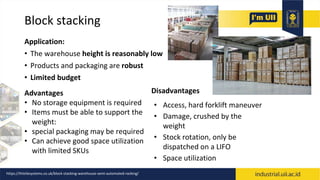
Block stacking
Application:
• The warehouse height is reasonably low
• Products and packaging are robust
• Limited budget
Disadvantages
• Access, hard forklift maneuver
• Damage, crushed by the
weight
• Stock rotation, only be
dispatched on a LIFO
• Space utilization
Advantages
• No storage equipment is required
• Items must be able to support the
weight:
• special packaging may be required
• Can achieve good space utilization
with limited SKUs
https://thistlesystems.co.uk/block-stacking-warehouse-semi-automated-racking/
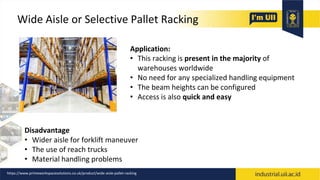
Wide Aisle or Selective Pallet Racking
Application:
• This racking is present in the majority of
warehouses worldwide
• No need for any specialized handling equipment
• The beam heights can be configured
• Access is also quick and easy
Disadvantage
• Wider aisle for forklift maneuver
• The use of reach trucks
• Material handling problems
https://www.primeworkspacesolutions.co.uk/product/wide-aisle-pallet-racking
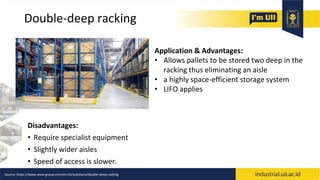
Double-deep racking
Disadvantages:
• Require specialist equipment
• Slightly wider aisles
• Speed of access is slower.
Application & Advantages:
• Allows pallets to be stored two deep in the
racking thus eliminating an aisle
• a highly space-efficient storage system
• LIFO applies
Source: https://www.stow-group.com/en-US/solutions/double-deep-racking
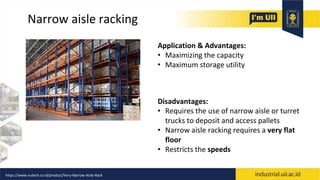
Narrow aisle racking
Application & Advantages:
• Maximizing the capacity
• Maximum storage utility
Disadvantages:
• Requires the use of narrow aisle or turret
trucks to deposit and access pallets
• Narrow aisle racking requires a very flat
floor
• Restricts the speeds
https://www.nutech.co.id/product/Very-Narrow-Aisle-Rack
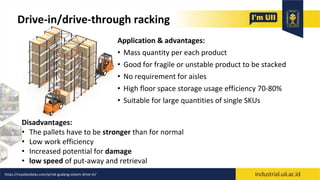
Drive-in/drive-through racking
Application & advantages:
• Mass quantity per each product
• Good for fragile or unstable product to be stacked
• No requirement for aisles
• High floor space storage usage efficiency 70-80%
• Suitable for large quantities of single SKUs
Disadvantages:
• The pallets have to be stronger than for normal
• Low work efficiency
• Increased potential for damage
• low speed of put-away and retrieval
https://royalandalas.com/p/rak-gudang-sistem-drive-in/
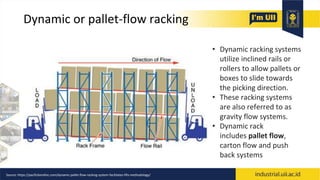
Dynamic or pallet-flow racking
• Dynamic racking systems
utilize inclined rails or
rollers to allow pallets or
boxes to slide towards
the picking direction.
• These racking systems
are also referred to as
gravity flow systems.
• Dynamic rack
includes pallet flow,
carton flow and push
back systems
Source: https://pacificbendinc.com/dynamic-pallet-flow-racking-system-facilitates-fifo-methodology/
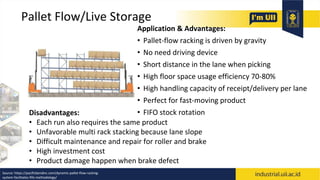
Pallet Flow/Live Storage
Application & Advantages:
• Pallet-flow racking is driven by gravity
• No need driving device
• Short distance in the lane when picking
• High floor space usage efficiency 70-80%
• High handling capacity of receipt/delivery per lane
• Perfect for fast-moving product
• FIFO stock rotation
Disadvantages:
• Each run also requires the same product
• Unfavorable multi rack stacking because lane slope
• Difficult maintenance and repair for roller and brake
• High investment cost
• Product damage happen when brake defect
Source: https://pacificbendinc.com/dynamic-pallet-flow-racking-
system-facilitates-fifo-methodology/
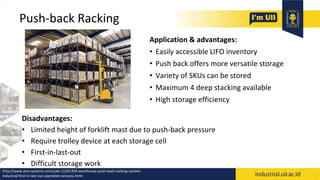
Push-back Racking
Application & advantages:
• Easily accessible LIFO inventory
• Push back offers more versatile storage
• Variety of SKUs can be stored
• Maximum 4 deep stacking available
• High storage efficiency
Disadvantages:
• Limited height of forklift mast due to push-back pressure
• Require trolley device at each storage cell
• First-in-last-out
• Difficult storage work
http://www.asrs-systems.com/sale-11241359-warehouse-push-back-racking-system-
industrial-first-in-last-out-operation-process.html
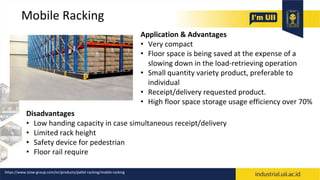
Mobile Racking
Application & Advantages
• Very compact
• Floor space is being saved at the expense of a
slowing down in the load-retrieving operation
• Small quantity variety product, preferable to
individual
• Receipt/delivery requested product.
• High floor space storage usage efficiency over 70%
Disadvantages
• Low handing capacity in case simultaneous receipt/delivery
• Limited rack height
• Safety device for pedestrian
• Floor rail require
https://www.stow-group.com/en/products/pallet-racking/mobile-racking
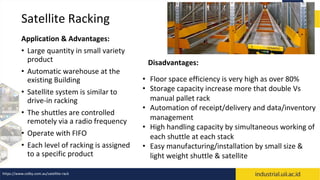
Satellite Racking
Application & Advantages:
• Large quantity in small variety
product
• Automatic warehouse at the
existing Building
• Satellite system is similar to
drive-in racking
• The shuttles are controlled
remotely via a radio frequency
• Operate with FIFO
• Each level of racking is assigned
to a specific product
• Floor space efficiency is very high as over 80%
• Storage capacity increase more that double Vs
manual pallet rack
• Automation of receipt/delivery and data/inventory
management
• High handling capacity by simultaneous working of
each shuttle at each stack
• Easy manufacturing/installation by small size &
light weight shuttle & satellite
Disadvantages:
https://www.colby.com.au/satellite-rack
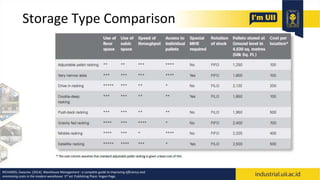
Storage Type Comparison
RICHARDS, Gwynne. (2014). Warehouse Management : a complete guide to improving efficiency and
minimizing costs in the modern warehouse 3rd ed. Publishing Place: Kogan Page.
Thinking point:
❑ Ensure that you have booked arrival slots for the majority of your
suppliers.
❑ Reduce the amount of checking required on inbound deliveries.
❑ Have a system in place to prioritize inbound goods, e.g. prioritize
low-stock items and promotional items.
❑ Plan your put-away meticulously and ensure product is located
accurately and efficiently.
❑ Cross dock as much as possible
Individual Assignment
• Find journal paper and make a summary/discussion regarding:
• Warehouse
• Warehouse Management
• IoT application in Warehouse
Lessons Learned
Understand the
concept of warehouse
Understand the
warehouse
management system
Understand the
concept of storage
Recognize type of
facility storages
References
• Gwynne Richards, 2014, Warehouse Management: A Complete Guide to
Improving Efficiency and Minimizing Costs in the Modern Warehouse, Kogan
Page
• Stuart Emmett, 2005, Excellence in Warehouse Management_ How to
Minimise Costs and Maximise Value, Wiley and Sons
• Tompkins, J. A. White, Y. A. Bozer, E. H. Frazelle, J. M. A. Tanchoco, and J.
Trevino, , 2003, Facilities Planning 4th Ed., Wiley
• Galindo, L.D. (2016). The Challenges of Logistics 4.0 for the Supply Chain
Management and the Information Technology.
• https://www.logisticsbureau.com/about-warehousing/
• https://www.zebra.com/content/dam/zebra_new_ia/en-us/solutions-
verticals/vertical-solutions/warehouse-management/vision-
study/2024/warehouse-vision-study-en-us.pdf
• https://www.peoplevox.com/hubfs/Fulfilment%20Survey%202017/2017%20Pe
oplevox%20E-Commerce%20Fulfilment%20Report.pdf
Thank You.

PTLF_7 Warehouse and Storage.pptx

  • 1.
    STI601 Warehouse and Storage KK: ProductionEngineering and Supply Chain Management Industrial Engineering Faculty of Industrial Technology Universitas Islam Indonesia
  • 2.
    Learning Objective(s) Understand the conceptof warehouse Understand the warehouse management system Understand the concept of storage Recognize type of facility storages
  • 3.
    Contents • Warehouse • Challenges •Warehouse in Industry 4.0 • Warehouse Management System • Storage • Function of storage • Type of storage equipment
  • 4.
    Warehouse • According toLogistics Bureau [1], Warehouse can be defined as planned space for the efficient storage and handling of goods and materials • A warehouse is a dynamic operation and can deliver a more profitable return on investment than many people realise. • Only 26% of company managers view warehouses and distribution centers as an asset which can drive growth for their business [2] • 34% of businesses ship late because products are sold which are not actually in stock [3] 1. https://www.logisticsbureau.com/about-warehousing/ 2. https://www.zebra.com/content/dam/zebra_new_ia/en-us/solutions-verticals/vertical-solutions/warehouse-management/vision-study/2024/warehouse-vision-study- en-us.pdf 3. https://www.peoplevox.com/hubfs/Fulfilment%20Survey%202017/2017%20Peoplevox%20E-Commerce%20Fulfilment%20Report.pdf
  • 5.
    Why do CompaniesNeed Warehouses? • Protection and Preservation of goods • Regular flow of goods • Continuity in production • Convenient location • Easy handling • Useful for small businessmen • Facilitates sale of goods • Availability of finance • Reduces risk of loss
  • 6.
    Warehouse in Supplychain RICHARDS, Gwynne. (2014). Warehouse Management : a complete guide to improving efficiency and minimizing costs in the modern warehouse 3rd ed. Publishing Place: Kogan Page.
  • 7.
    Type of WarehouseOperation • Raw material • Intermediate, postponement, customization, or sub-assembly facilities • Finished goods storage • Consolidation centers and transit warehouse • Automotive parts  warehouse and brought together to the production line • Transshipment or break-bulk centers • Cross-dock centers • Fulfilment centers
  • 8.
    Trade-offs In Warehouse High Customer servicelevel Lower Inventory Cost Reduction
  • 9.
    Warehouse Challenges RICHARDS, Gwynne.(2014). Warehouse Management : a complete guide to improving efficiency and minimizing costs in the modern warehouse 3rd ed. Publishing Place: Kogan Page.
  • 10.
    https://www.youtube.com/watch?v=ccscy06nuiQ A warehouse shouldbe viewed as a temporary place to store inventory and as a buffer in supply chain
  • 11.
    Warehouse in Industry4.0 Galindo, L.D. (2016). The Challenges of Logistics 4.0 for the Supply Chain Management and the Information Technology.
  • 12.
    Warehouse ownership arrangements •Private—warehouse operated by the firm owning the product • Building may be owned or leased • Public—service company owns warehouse and hires out space and services • Usually classed as • General merchandise • Refrigerated • Special commodity • Household goods and furniture
  • 13.
    Contract warehousing combineselements of private and public operations • Usually a long-term relationship or contract between a firm and the warehousing owner/operator • Long-term cost savings compared with public warehouse • Often a firm’s employees will work alongside the contract warehouse’s • Example is Kraft Foods who has contracted with AmeriCold Logistics since the late 1990’s https://id.wikipedia.org/wiki/Berkas:Kraft_logo.svg https://www.ramw.org/news/americold-keeps-your-drinks-cool-us-open-new-armstrong-stadium
  • 14.
    Site selection isdriven by service availability and cost factors • Identify broad geography where an active warehouse meets service, economic and strategic requirements • Selection and number of retail outlets drives location of support warehouses • Final selection should be preceded by extensive analysis https://www.nationsonline.org/oneworld/map/usa_map.htm
  • 15.
    Network deployment isthe combination of private, public and contract facilities used by a firm • Network deployment strategy requires answering two questions • How many warehouses should be established? • Which warehouse ownership types should be used in specific markets? • For example, when warehouse utilization is not full throughout the year • Use private or contract warehouse to cover 75 percent requirement • Public facilities used to accommodate peak demand https://www.google.com/maps/place/Amerika+Serikat/@23.9179528,- 88.8760991,7z/data=!4m5!3m4!1s0x54eab584e432360b:0x1c3bb99243deb742!8m2!3d37.09024!4d-95.712891
  • 16.
    Warehouse Management Systems •Warehouse management systems (WMS) integrate procedures and software support to standardize storage and handling work procedures • WMS encourage best practices • One main use of WMS is to coordinate order selection • Discrete selection is when a specific customer’s order is selected and prepared for shipment as a single work assignment • Wave or batch selection is when orders are processed through zones of the warehouse assigned to specific employees
  • 17.
    Warehouse Planning Issues •Inventory accuracy is typically maintained by annual physical counts or counting portions of inventory on a planned basis • Cycle counting is the audit of selected inventory on a cyclic schedule • Audits are common to maintain safety, assure compliance to regulations and help improve procedures • Security issues involve protection from pilferage and damage
  • 18.
    Safety and MaintenanceIssues • Accident prevention • Comprehensive safety programs and training, accident investigation and follow up • Environmental protection • Spill ( leak ) kits and spill plans • Maintenance • Scheduled maintenance of building, material handling equipment, and collision damage prevention
  • 19.
    Basic Warehouse Problems 1.Redundant Processes • Handle a product several times 2. Poor Facility Layout • Narrow aisles • High-elevation situations 3. Seasonality in Demand • Layout and picking 4. High Labor Costs • 65% of the operating budgets of most warehouses 5. Inaccurate Inventory • Improper stock levels and buildups of obsolete
  • 20.
    Warehouse Manager’s Challenges •Nearly 3,000 hours per year are lost in warehouses and DCs through inefficient processes. • 80 per cent of managers have been tasked with finding cost savings in existing operations. • On average managers have been tasked with finding nearly 20 per cent cost savings across their organizations. • The majority of managers suggested the following areas were most inefficient: ✔Inventory control (53 %); ✔Picking (47 %); ✔Put-away and replenishment (45 %).
  • 21.
    RICHARDS, Gwynne. (2014).Warehouse Management : a complete guide to improving efficiency and minimizing costs in the modern warehouse 3rd ed. Publishing Place: Kogan Page. Warehouse Activities
  • 22.
  • 23.
    Warehouse Two MajorActivities – Handling and Storage • Objective is to • Efficiently receive inventory • Store it as required • Assemble it into complete orders • Make a customer shipment • Operations will therefore emphasize product flow
  • 24.
    Warehouse decisions thatdetermine handling and storage efficiency • Site Selection • Design • Product-Mix Analysis • Expansion • Materials Handling • Safety and maintenance • Layout • Sizing • Warehouse management system • Accuracy and audit • Security
  • 25.
    Handling • Handling mustoptimize movement continuity and efficiency • Receiving—Unloading the arriving vehicles • In-Storage—moving goods for storage (transfer) or order selection (picking) • Shipping—verifying the order and loading the departing vehicles
  • 26.
    Storage • Storage plansshould make product velocity a major factor • Slotting determines specific locations for the product based on • Velocity—how fast the goods move • Weight—how heavy is the product • Special Characteristics—how large or small, does it require rack or bin storage https://airspeed.ph/blog/warehouse-storage-systems/
  • 27.
    Two Classes ofStorage • Active Storage—storage for basic inventory replenishment • Focuses on quick movement • Includes flow-through or cross-dock distribution • Extended Storage—storage for inventory held in excess of period for normal replenishment • E.g. seasonal, speculative, or even commodities
  • 28.
    Pre-Receiving Challenge: To ensure thatthe supplier presents the products to the warehouse in the most appropriate way.
  • 29.
    Thinking Point: • Sizeand type of cartons; • Type of transit packaging – cardboard, plastic, totes, metal stillages, • Roll cages, pallets; • Palletized or non-palletized delivery of product; • Size (length, width and height) and type of pallets • Specific labelling such as product description, barcode and quantities; • Position of label on carton and pallet; • Carton quantities (inner and outer carton quantities, for example); and • Mode of transport, delivery quantity and frequency of delivery
  • 30.
  • 31.
    Inspection Inspections should becompleted within a reasonable amount of time or as specified in the purchase document Time to check Put-away
  • 32.
    Inspection challenges: • Todecide whether they need to be checked before put-away • Random check or 100% check • Time consumed • Technology used Speed Accuracy
  • 33.
    Cross Docking • Shareresources • Inspection time vs increasing throughput rates • System required • Availability of receiving space RICHARDS, Gwynne. (2014). Warehouse Management : a complete guide to improving efficiency and minimizing costs in the modern warehouse 3rd ed. Publishing Place: Kogan Page.
  • 34.
    Put-away Process • Tasks •Move goods storage locations • Facility • Pallet truck • Lift truck • Etc. • Decisions • Where • When • Equipment • Cost ~ 15% https://pindahlubang.com/8527-cara-kerja-forklift/
  • 35.
    Thinking Point: • Size,weight and height of palletized goods; • Results of an ABC analysis or slotting, where fast-moving goods are placed closest to the dispatch area; • Current order data; • Family product groups; • Actual sales combinations; • Current status of pick face for each product; • Size of pallet locations; and • Weight capacity of racking.
  • 36.
    Thinking Point: Distance ofthe locations from the receiving and dispatch areas https://www.pressebox.de/pressemitteilung/witron-logistik-informatik-gmbh/Sobeys-Kanada- Vollautomatische-Kommissionierung-im-Frische-und-Tiefkuehlbereich/boxid/788662
  • 37.
    Storage Purpose: “Storing andAssorting the finished goods at maximum time utility at minimum cost”
  • 38.
    “Storage involves propermanagement for preserving goods from the time of their production or purchase till actual use”
  • 39.
    Storage Activities • Tasks •Hold inventory • Methods • Floor, floor stacking • Pallet rack • Gravity flow rack, push back • Bin shelving, etc • Objectives • Space utilization • Response • Labor cost • Decisions • Floor, equipment, slotting, • How to measure the efficiency of storage?
  • 40.
  • 41.
    Storage Type • Blockstacking • Racked storage • Wide aisle or selective pallet racking • Double-deep racking • Narrow aisle racking • Drive-in/drive-through racking • Pallet flow/live storage • Push-back racking • Mobile racking • Satellite or shuttle racking • Shuttle technology with a difference
  • 42.
    Which One isBetter ? Depend on: • The configuration of the building, • The type of MHE currently in use • The budget available
  • 43.
    Storage Option • Blockstacking • Racked storage • Wide aisle or selective pallet racking • Double-deep racking • Narrow aisle racking • Drive-in/drive-through racking • Pallet flow/live storage • Push-back racking • Mobile racking • Satellite or shuttle racking • Shuttle technology with a difference
  • 44.
    Block stacking Application: • Thewarehouse height is reasonably low • Products and packaging are robust • Limited budget Disadvantages • Access, hard forklift maneuver • Damage, crushed by the weight • Stock rotation, only be dispatched on a LIFO • Space utilization Advantages • No storage equipment is required • Items must be able to support the weight: • special packaging may be required • Can achieve good space utilization with limited SKUs https://thistlesystems.co.uk/block-stacking-warehouse-semi-automated-racking/
  • 45.
    Wide Aisle orSelective Pallet Racking Application: • This racking is present in the majority of warehouses worldwide • No need for any specialized handling equipment • The beam heights can be configured • Access is also quick and easy Disadvantage • Wider aisle for forklift maneuver • The use of reach trucks • Material handling problems https://www.primeworkspacesolutions.co.uk/product/wide-aisle-pallet-racking
  • 46.
    Double-deep racking Disadvantages: • Requirespecialist equipment • Slightly wider aisles • Speed of access is slower. Application & Advantages: • Allows pallets to be stored two deep in the racking thus eliminating an aisle • a highly space-efficient storage system • LIFO applies Source: https://www.stow-group.com/en-US/solutions/double-deep-racking
  • 47.
    Narrow aisle racking Application& Advantages: • Maximizing the capacity • Maximum storage utility Disadvantages: • Requires the use of narrow aisle or turret trucks to deposit and access pallets • Narrow aisle racking requires a very flat floor • Restricts the speeds https://www.nutech.co.id/product/Very-Narrow-Aisle-Rack
  • 48.
    Drive-in/drive-through racking Application &advantages: • Mass quantity per each product • Good for fragile or unstable product to be stacked • No requirement for aisles • High floor space storage usage efficiency 70-80% • Suitable for large quantities of single SKUs Disadvantages: • The pallets have to be stronger than for normal • Low work efficiency • Increased potential for damage • low speed of put-away and retrieval https://royalandalas.com/p/rak-gudang-sistem-drive-in/
  • 49.
    Dynamic or pallet-flowracking • Dynamic racking systems utilize inclined rails or rollers to allow pallets or boxes to slide towards the picking direction. • These racking systems are also referred to as gravity flow systems. • Dynamic rack includes pallet flow, carton flow and push back systems Source: https://pacificbendinc.com/dynamic-pallet-flow-racking-system-facilitates-fifo-methodology/
  • 50.
    Pallet Flow/Live Storage Application& Advantages: • Pallet-flow racking is driven by gravity • No need driving device • Short distance in the lane when picking • High floor space usage efficiency 70-80% • High handling capacity of receipt/delivery per lane • Perfect for fast-moving product • FIFO stock rotation Disadvantages: • Each run also requires the same product • Unfavorable multi rack stacking because lane slope • Difficult maintenance and repair for roller and brake • High investment cost • Product damage happen when brake defect Source: https://pacificbendinc.com/dynamic-pallet-flow-racking- system-facilitates-fifo-methodology/
  • 51.
    Push-back Racking Application &advantages: • Easily accessible LIFO inventory • Push back offers more versatile storage • Variety of SKUs can be stored • Maximum 4 deep stacking available • High storage efficiency Disadvantages: • Limited height of forklift mast due to push-back pressure • Require trolley device at each storage cell • First-in-last-out • Difficult storage work http://www.asrs-systems.com/sale-11241359-warehouse-push-back-racking-system- industrial-first-in-last-out-operation-process.html
  • 52.
    Mobile Racking Application &Advantages • Very compact • Floor space is being saved at the expense of a slowing down in the load-retrieving operation • Small quantity variety product, preferable to individual • Receipt/delivery requested product. • High floor space storage usage efficiency over 70% Disadvantages • Low handing capacity in case simultaneous receipt/delivery • Limited rack height • Safety device for pedestrian • Floor rail require https://www.stow-group.com/en/products/pallet-racking/mobile-racking
  • 53.
    Satellite Racking Application &Advantages: • Large quantity in small variety product • Automatic warehouse at the existing Building • Satellite system is similar to drive-in racking • The shuttles are controlled remotely via a radio frequency • Operate with FIFO • Each level of racking is assigned to a specific product • Floor space efficiency is very high as over 80% • Storage capacity increase more that double Vs manual pallet rack • Automation of receipt/delivery and data/inventory management • High handling capacity by simultaneous working of each shuttle at each stack • Easy manufacturing/installation by small size & light weight shuttle & satellite Disadvantages: https://www.colby.com.au/satellite-rack
  • 54.
    Storage Type Comparison RICHARDS,Gwynne. (2014). Warehouse Management : a complete guide to improving efficiency and minimizing costs in the modern warehouse 3rd ed. Publishing Place: Kogan Page.
  • 55.
    Thinking point: ❑ Ensurethat you have booked arrival slots for the majority of your suppliers. ❑ Reduce the amount of checking required on inbound deliveries. ❑ Have a system in place to prioritize inbound goods, e.g. prioritize low-stock items and promotional items. ❑ Plan your put-away meticulously and ensure product is located accurately and efficiently. ❑ Cross dock as much as possible
  • 56.
    Individual Assignment • Findjournal paper and make a summary/discussion regarding: • Warehouse • Warehouse Management • IoT application in Warehouse
  • 57.
    Lessons Learned Understand the conceptof warehouse Understand the warehouse management system Understand the concept of storage Recognize type of facility storages
  • 58.
    References • Gwynne Richards,2014, Warehouse Management: A Complete Guide to Improving Efficiency and Minimizing Costs in the Modern Warehouse, Kogan Page • Stuart Emmett, 2005, Excellence in Warehouse Management_ How to Minimise Costs and Maximise Value, Wiley and Sons • Tompkins, J. A. White, Y. A. Bozer, E. H. Frazelle, J. M. A. Tanchoco, and J. Trevino, , 2003, Facilities Planning 4th Ed., Wiley • Galindo, L.D. (2016). The Challenges of Logistics 4.0 for the Supply Chain Management and the Information Technology. • https://www.logisticsbureau.com/about-warehousing/ • https://www.zebra.com/content/dam/zebra_new_ia/en-us/solutions- verticals/vertical-solutions/warehouse-management/vision- study/2024/warehouse-vision-study-en-us.pdf • https://www.peoplevox.com/hubfs/Fulfilment%20Survey%202017/2017%20Pe oplevox%20E-Commerce%20Fulfilment%20Report.pdf
  • 59.