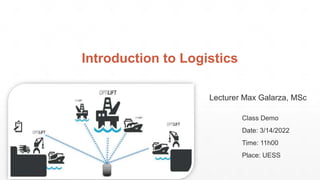
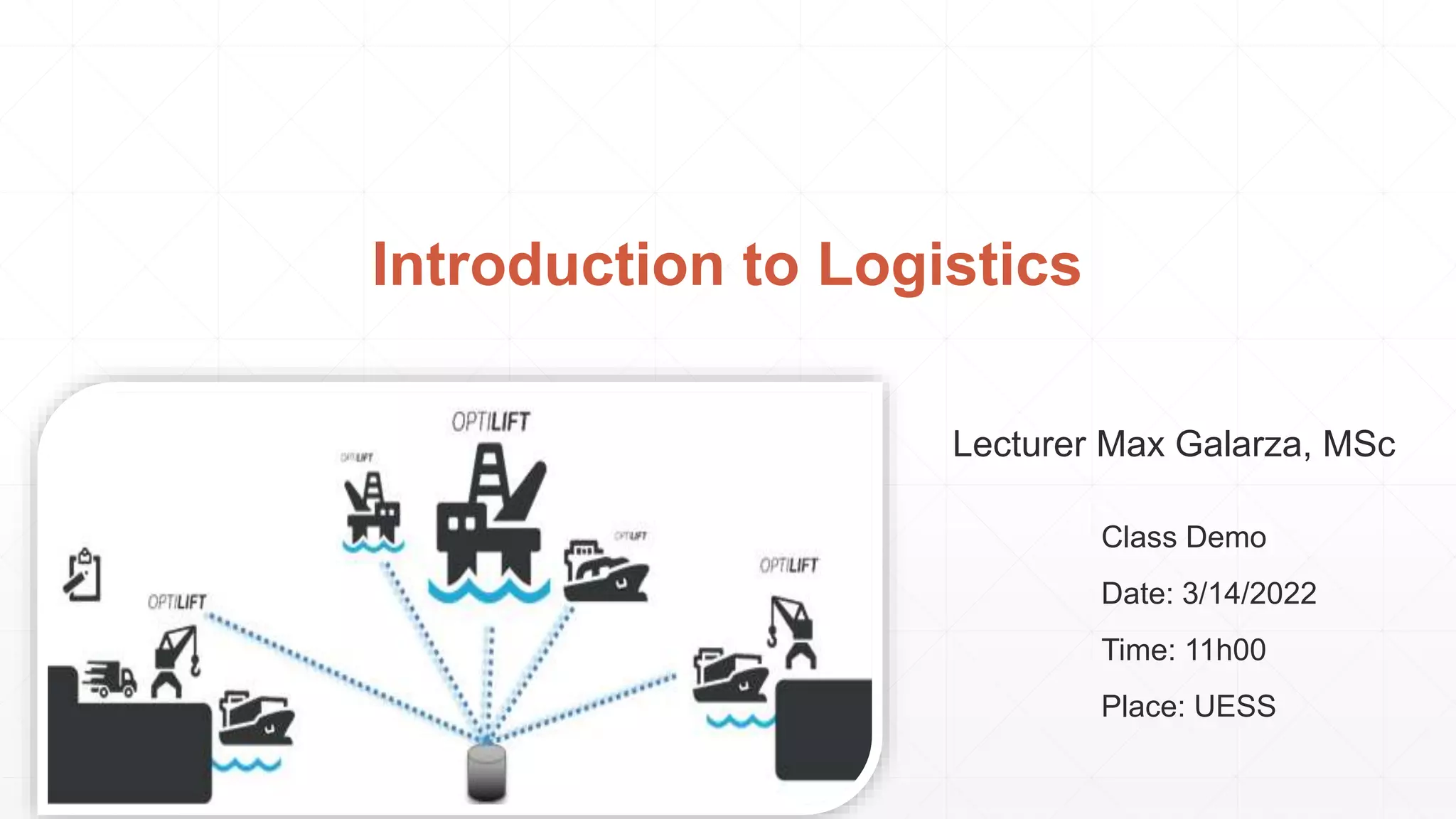
Introduction to Logistics
Class Demo
Date: 3/14/2022
Time: 11h00
Place: UESS
Lecturer Max Galarza, MSc
Dear reader
Thank you for attending this lecture. Please consider the following to understand
what you are going to be able to do after completing this lesson.
Why study Logistics?
Logistics is defined as the movement and storage of goods, services, and related
information. Therefore, the study of logistics is essential in today's global
interconnected supply chains, where companies come together through three main
pillars: 1) transportation 2) warehousing, and 3) inventory management.
An Introduction to Logistics
This introductory logistics lecture will take you on a journey to this fascinating world
of global trade. The idea for today lesson is to introduce you to logistics. It was
designed in a comprehensive manner to cover one of above mentioned pillars of
the logistics network: transportation.
Content
1) Objective of the lecture 5) Multimodal transport
2) Logistics definitions 6) Conclusions
3) Logistics and transport 7) Netgraphy
4) Means of transport
Air
Land
Road transport
Railway transport
Pipeline transport
Water
Sea/Ocean transport
Objective of the lecture
Port congestion, capacity shortages, increasing ocean freight rates,
and an ongoing pandemic have challenged shippers, ports, carriers
and logistics providers during 2021.
Furthermore, looking ahead in 2022, experts estimate that the
pressure on global supply chains will continue and the light at the end
of the tunnel is not to be expected until the second half of the year at
the earliest and worst with the Russia-Ukrania war ongoing.
The objective of this lecture is to assist learners in defining and
comprehending the basic views of logistics and its various applications
and the relationships between logistics and transportation, you will be
able to differentiate the advantages and disadvantages of different
modes of transportation.
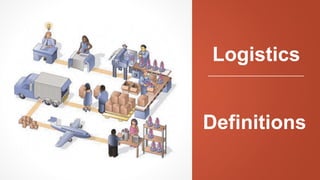
Logistics
Definitions
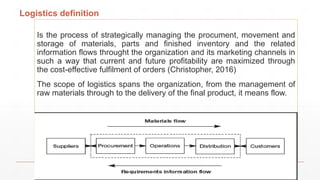
Logistics definition
Is the process of strategically managing the procument, movement and
storage of materials, parts and finished inventory and the related
information flows throught the organization and its marketing channels in
such a way that current and future profitability are maximized through
the cost-effective fulfilment of orders (Christopher, 2016)
The scope of logistics spans the organization, from the management of
raw materials through to the delivery of the final product, it means flow.
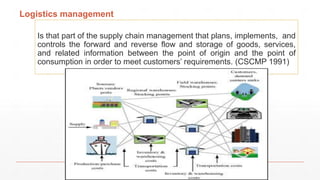
Logistics management
Is that part of the supply chain management that plans, implements, and
controls the forward and reverse flow and storage of goods, services,
and related information between the point of origin and the point of
consumption in order to meet customers’ requirements. (CSCMP 1991)
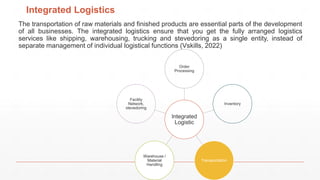
Integrated Logistics
The transportation of raw materials and finished products are essential parts of the development
of all businesses. The integrated logistics ensure that you get the fully arranged logistics
services like shipping, warehousing, trucking and stevedoring as a single entity, instead of
separate management of individual logistical functions (Vskills, 2022)
Integrated
Logistic
Order
Processing
Inventory
Transportation
Warehouse /
Material
Handling
Facility
Network,
stevedoring
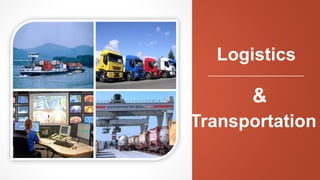
Logistics
Transportation
&
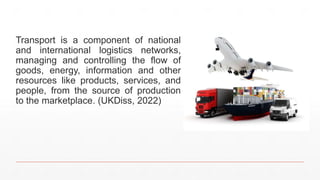
Transport is a component of national
and international logistics networks,
managing and controlling the flow of
goods, energy, information and other
resources like products, services, and
people, from the source of production
to the marketplace. (UKDiss, 2022)
 Transportation system joints the separated activities (required in the whole
production procedures, from manufacturing to final consumers and returns.)
 Companies will be able to collaborate effectively with suppliers.
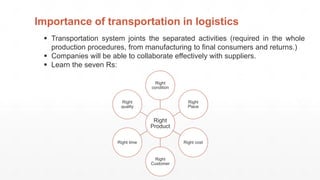
 Learn the seven Rs:
Importance of transportation in logistics
Right
Product
Right
condition
Right
Place
Right cost
Right
Customer
Right time
Right
quality
Factors to be considered to choose means of transport
▪ Ports available to load and discharge the merchandise.
▪ Goods characteristics: weight, volume, shape, size, special requirements.
▪ Costs related to charge, discharge and sorting
▪ Distance that can separate a firm from its customers
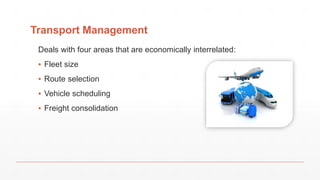
Transport Management
Deals with four areas that are economically interrelated:
▪ Fleet size
▪ Route selection
▪ Vehicle scheduling
▪ Freight consolidation
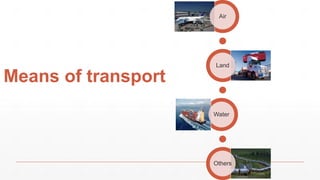
Means of transport
Air
Land
Water
Others
Air transport
▪ The advantages of air freight logistics are:
▪ (1) airplanes and airports are separated. Therefore, the industries only
need to prepare planes for operation
▪ (2) it allows to speed delivery at far destinations
▪ (3) air freight transport is not affected by landforms (earth´s surface)
Air freight logistics is necessary for many industries and services to
complete their supply chain and functions. It provides the delivery with
speed, lower risk of damage, security, flexibility, accessibility and good
frequency for regular destinations, yet the disadvantage is high delivery
fees. Reynolds-Feighan (2001)
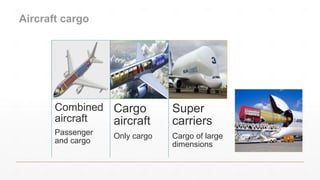
Combined
aircraft
Passenger
and cargo
Cargo
aircraft
Only cargo
Super
carriers
Cargo of large
dimensions
Aircraft cargo
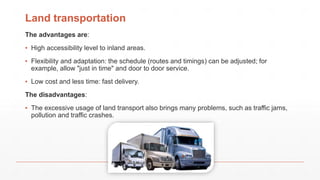
Land transportation
The advantages are:
▪ High accessibility level to inland areas.
▪ Flexibility and adaptation: the schedule (routes and timings) can be adjusted; for
example, allow "just in time" and door to door service.
▪ Low cost and less time: fast delivery.
The disadvantages:
▪ The excessive usage of land transport also brings many problems, such as traffic jams,
pollution and traffic crashes.
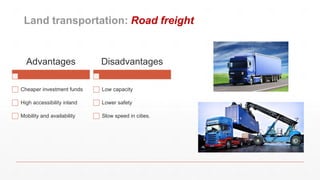
Land transportation: Road freight
Advantages
Cheaper investment funds
High accessibility inland
Mobility and availability
Disadvantages
Low capacity
Lower safety
Slow speed in cities.
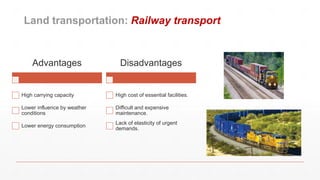
Land transportation: Railway transport
Advantages
High carrying capacity
Lower influence by weather
conditions
Lower energy consumption
Disadvantages
High cost of essential facilities.
Difficult and expensive
maintenance.
Lack of elasticity of urgent
demands.
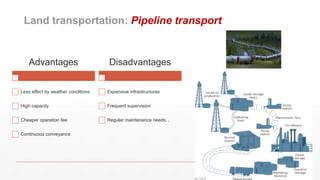
Land transportation: Pipeline transport
Advantages
Less effect by weather conditions
High capacity
Cheaper operation fee
Continuous conveyance
Disadvantages
Expensive infrastructures
Frequent supervision
Regular maintenance needs. .
Water transportation (sea/maritime)
▪ It can generally provide a cheap and high carrying capacity conveyance for
consumers.
▪ Its disadvantage is that it needs longer transport time and its schedule is strongly
affected by the weather factors.
▪ Maritime transport industry divides into three main types:
▪ 1. Liner Shipping: The business is based on the same ships, routes, price, and
regular voyages.
▪ 2. Tramp Shipping: irregular transport price, unsteady transport routes, and
schedule. It usually delivers particular goods, such as dry bulk cargo and crude
oil.
▪ 3. Industry Shipping is to ensure the supply of raw materials. It sometimes needs
specialized containers, such as high-pressure containers for natural gas.
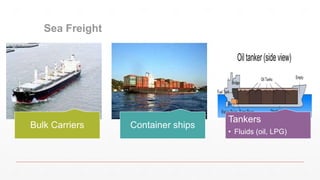
Bulk Carriers Container ships
Tankers
• Fluids (oil, LPG)
Sea Freight
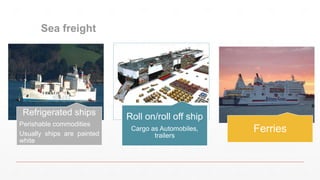
Refrigerated ships
Perishable commodities
Usually ships are painted
white
Roll on/roll off ship
Cargo as Automobiles,
trailers
Ferries
Sea freight
Multimodal Transport
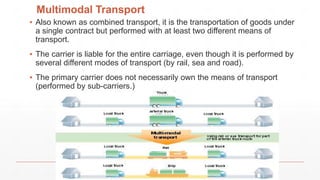
▪ Also known as combined transport, it is the transportation of goods under
a single contract but performed with at least two different means of
transport.
▪ The carrier is liable for the entire carriage, even though it is performed by
several different modes of transport (by rail, sea and road).
▪ The primary carrier does not necessarily own the means of transport
(performed by sub-carriers.)
Advantages
▪ Allows handling and faster movement of cargo, including
transhipment operations
▪ Ensures more excellent protection to the cargo, reducing the
risk of damage.
▪ Reduce transportation costs from the unitization and
consolidation of cargo
▪ Stimulate competitiveness in international trade where the
practice is widespread among developed countries
▪ Improve service quality by using operators responsible and
efficient transport services
Disadvantages
▪ High economic costs
▪ Unfamiliarity with new technology
▪ Presence of legal and operational constraints in
implementing international standards with new technology
▪ Safety requirements: inspections by different authorities in
terminals and roads remain a limit in a time frame.
Conclusions
▪ Transportation is the basis of efficiency and economy in business. It
expands other functions of the logistics system.
▪ A well-operated logistics system could increase the company's
competitiveness and service quality.
▪ The seven Rs in logistics are the right product, in the right condition, at the
right place, at the right cost, to the right customer, at the right time with the
right quality conforming to customers' conditions.
▪ The scope of logistics expands the organization from managing raw
materials to delivering final products.
Source
and
Netgraphy
Business dictionary. Integrated Logistic: Definition. Retrieved March 13, 2022 from http://www.businessdictionary.com/definition/integrated-logistics.html
Christopher, M. (2016). Logistics & supply chain management. Pearson Uk.
CSCMP/Educate/SCM_Definitions_and_Glossary_of_Terms retrieved March 13, 2022 from
http://aspx#:~:text=Logistics%20management%20is%20that%20part,order%20to%20meet%20customers'%20requirements.
Gómez, G (2013). Transportation. Retrieved February 7, 2016, from http://es.slideshare.net/co-marca/transporte-aereo-20940150
Internacionalmente.com. (2013). International transport. Retrieved from http://internacionalmente.com/transporte-carretera/
Kurman, G. Transportation The Key Player In Logistics Management. Retrieved March 13,2022 from
http://www.borjournals.com/a/index.php/jbmssr/article/download/357/974
Martín, D. (n.d.). Means of Transport for international cargo. Retrieved from http://es.slideshare.net/daniloricle/medios-de-transporte-para-cargas-
internacionales
Oxford Dictionaries. (n.d.). Transportation. Retrieved from http://www.oxforddictionaries.com/definition/english/transportation?q=transportation
Reynolds-Feighan, A.J. (2001) Air freight logistics. In A.M. Brewer, K.J. Button and D.A. Hensher (eds.), Handbook of Logistics and Supply-Chain
Management. Elsevier Science Ltd., UK, 431-439.
Robinson, A. (2013). What is transportation and logistics?. Retrieved from http://cerasis.com/2013/08/13/transportation-and-logistics-management/
Sánchez, C. Characteristics of road freight. Retrieved February 7, 2016, from http://extralinelogistic.blogspot.com/2014/02/characteristics-of-road-
freight.html
Sudalimuthu,S.& Raj,S (2009). Logistics Management for International Business: Text and Cases. PHI Learning Pvt. Ltd.
Tatum, M. (2022) What is freight transport? Retrieved March 13, 2022 from http://www.wisegeek.com/what-is-freight-transport.htm
UKDISS (2022) Retrieved March 13, 2022 from https://ukdiss.com/examples/art-and-science-of-managing.php
VSKills (2022) Retried March 13, 2022 from https://www.vskills.in/certification/tutorial/what-is-integrated-logistics/
Assignment for next class
Any questions/doubts?
Please prepare a PPT containing ten slides with other
modes of transportation not mentioned in this lecture that
you may find in the web.
First slide is for title page, last one is for source & netgraphy

Introduction to Logistics Demo class

  • 1.
    Introduction to Logistics ClassDemo Date: 3/14/2022 Time: 11h00 Place: UESS Lecturer Max Galarza, MSc
  • 2.
    Dear reader Thank youfor attending this lecture. Please consider the following to understand what you are going to be able to do after completing this lesson. Why study Logistics? Logistics is defined as the movement and storage of goods, services, and related information. Therefore, the study of logistics is essential in today's global interconnected supply chains, where companies come together through three main pillars: 1) transportation 2) warehousing, and 3) inventory management. An Introduction to Logistics This introductory logistics lecture will take you on a journey to this fascinating world of global trade. The idea for today lesson is to introduce you to logistics. It was designed in a comprehensive manner to cover one of above mentioned pillars of the logistics network: transportation.
  • 3.
    Content 1) Objective ofthe lecture 5) Multimodal transport 2) Logistics definitions 6) Conclusions 3) Logistics and transport 7) Netgraphy 4) Means of transport Air Land Road transport Railway transport Pipeline transport Water Sea/Ocean transport
  • 4.
    Objective of thelecture Port congestion, capacity shortages, increasing ocean freight rates, and an ongoing pandemic have challenged shippers, ports, carriers and logistics providers during 2021. Furthermore, looking ahead in 2022, experts estimate that the pressure on global supply chains will continue and the light at the end of the tunnel is not to be expected until the second half of the year at the earliest and worst with the Russia-Ukrania war ongoing. The objective of this lecture is to assist learners in defining and comprehending the basic views of logistics and its various applications and the relationships between logistics and transportation, you will be able to differentiate the advantages and disadvantages of different modes of transportation.
  • 5.
  • 6.
    Logistics definition Is theprocess of strategically managing the procument, movement and storage of materials, parts and finished inventory and the related information flows throught the organization and its marketing channels in such a way that current and future profitability are maximized through the cost-effective fulfilment of orders (Christopher, 2016) The scope of logistics spans the organization, from the management of raw materials through to the delivery of the final product, it means flow.
  • 7.
    Logistics management Is thatpart of the supply chain management that plans, implements, and controls the forward and reverse flow and storage of goods, services, and related information between the point of origin and the point of consumption in order to meet customers’ requirements. (CSCMP 1991)
  • 8.
    Integrated Logistics The transportationof raw materials and finished products are essential parts of the development of all businesses. The integrated logistics ensure that you get the fully arranged logistics services like shipping, warehousing, trucking and stevedoring as a single entity, instead of separate management of individual logistical functions (Vskills, 2022) Integrated Logistic Order Processing Inventory Transportation Warehouse / Material Handling Facility Network, stevedoring
  • 9.
  • 10.
    Transport is acomponent of national and international logistics networks, managing and controlling the flow of goods, energy, information and other resources like products, services, and people, from the source of production to the marketplace. (UKDiss, 2022)
  • 11.
     Transportation systemjoints the separated activities (required in the whole production procedures, from manufacturing to final consumers and returns.)  Companies will be able to collaborate effectively with suppliers.  Learn the seven Rs: Importance of transportation in logistics Right Product Right condition Right Place Right cost Right Customer Right time Right quality
  • 12.
    Factors to beconsidered to choose means of transport ▪ Ports available to load and discharge the merchandise. ▪ Goods characteristics: weight, volume, shape, size, special requirements. ▪ Costs related to charge, discharge and sorting ▪ Distance that can separate a firm from its customers
  • 13.
    Transport Management Deals withfour areas that are economically interrelated: ▪ Fleet size ▪ Route selection ▪ Vehicle scheduling ▪ Freight consolidation
  • 14.
  • 15.
    Air transport ▪ Theadvantages of air freight logistics are: ▪ (1) airplanes and airports are separated. Therefore, the industries only need to prepare planes for operation ▪ (2) it allows to speed delivery at far destinations ▪ (3) air freight transport is not affected by landforms (earth´s surface) Air freight logistics is necessary for many industries and services to complete their supply chain and functions. It provides the delivery with speed, lower risk of damage, security, flexibility, accessibility and good frequency for regular destinations, yet the disadvantage is high delivery fees. Reynolds-Feighan (2001)
  • 16.
  • 17.
    Land transportation The advantagesare: ▪ High accessibility level to inland areas. ▪ Flexibility and adaptation: the schedule (routes and timings) can be adjusted; for example, allow "just in time" and door to door service. ▪ Low cost and less time: fast delivery. The disadvantages: ▪ The excessive usage of land transport also brings many problems, such as traffic jams, pollution and traffic crashes.
  • 18.
    Land transportation: Roadfreight Advantages Cheaper investment funds High accessibility inland Mobility and availability Disadvantages Low capacity Lower safety Slow speed in cities.
  • 19.
    Land transportation: Railwaytransport Advantages High carrying capacity Lower influence by weather conditions Lower energy consumption Disadvantages High cost of essential facilities. Difficult and expensive maintenance. Lack of elasticity of urgent demands.
  • 20.
    Land transportation: Pipelinetransport Advantages Less effect by weather conditions High capacity Cheaper operation fee Continuous conveyance Disadvantages Expensive infrastructures Frequent supervision Regular maintenance needs. .
  • 21.
    Water transportation (sea/maritime) ▪It can generally provide a cheap and high carrying capacity conveyance for consumers. ▪ Its disadvantage is that it needs longer transport time and its schedule is strongly affected by the weather factors. ▪ Maritime transport industry divides into three main types: ▪ 1. Liner Shipping: The business is based on the same ships, routes, price, and regular voyages. ▪ 2. Tramp Shipping: irregular transport price, unsteady transport routes, and schedule. It usually delivers particular goods, such as dry bulk cargo and crude oil. ▪ 3. Industry Shipping is to ensure the supply of raw materials. It sometimes needs specialized containers, such as high-pressure containers for natural gas.
  • 22.
    Bulk Carriers Containerships Tankers • Fluids (oil, LPG) Sea Freight
  • 23.
    Refrigerated ships Perishable commodities Usuallyships are painted white Roll on/roll off ship Cargo as Automobiles, trailers Ferries Sea freight
  • 24.
    Multimodal Transport ▪ Alsoknown as combined transport, it is the transportation of goods under a single contract but performed with at least two different means of transport. ▪ The carrier is liable for the entire carriage, even though it is performed by several different modes of transport (by rail, sea and road). ▪ The primary carrier does not necessarily own the means of transport (performed by sub-carriers.)
  • 25.
    Advantages ▪ Allows handlingand faster movement of cargo, including transhipment operations ▪ Ensures more excellent protection to the cargo, reducing the risk of damage. ▪ Reduce transportation costs from the unitization and consolidation of cargo ▪ Stimulate competitiveness in international trade where the practice is widespread among developed countries ▪ Improve service quality by using operators responsible and efficient transport services
  • 26.
    Disadvantages ▪ High economiccosts ▪ Unfamiliarity with new technology ▪ Presence of legal and operational constraints in implementing international standards with new technology ▪ Safety requirements: inspections by different authorities in terminals and roads remain a limit in a time frame.
  • 27.
    Conclusions ▪ Transportation isthe basis of efficiency and economy in business. It expands other functions of the logistics system. ▪ A well-operated logistics system could increase the company's competitiveness and service quality. ▪ The seven Rs in logistics are the right product, in the right condition, at the right place, at the right cost, to the right customer, at the right time with the right quality conforming to customers' conditions. ▪ The scope of logistics expands the organization from managing raw materials to delivering final products.
  • 28.
  • 29.
    Business dictionary. IntegratedLogistic: Definition. Retrieved March 13, 2022 from http://www.businessdictionary.com/definition/integrated-logistics.html Christopher, M. (2016). Logistics & supply chain management. Pearson Uk. CSCMP/Educate/SCM_Definitions_and_Glossary_of_Terms retrieved March 13, 2022 from http://aspx#:~:text=Logistics%20management%20is%20that%20part,order%20to%20meet%20customers'%20requirements. Gómez, G (2013). Transportation. Retrieved February 7, 2016, from http://es.slideshare.net/co-marca/transporte-aereo-20940150 Internacionalmente.com. (2013). International transport. Retrieved from http://internacionalmente.com/transporte-carretera/ Kurman, G. Transportation The Key Player In Logistics Management. Retrieved March 13,2022 from http://www.borjournals.com/a/index.php/jbmssr/article/download/357/974 Martín, D. (n.d.). Means of Transport for international cargo. Retrieved from http://es.slideshare.net/daniloricle/medios-de-transporte-para-cargas- internacionales Oxford Dictionaries. (n.d.). Transportation. Retrieved from http://www.oxforddictionaries.com/definition/english/transportation?q=transportation Reynolds-Feighan, A.J. (2001) Air freight logistics. In A.M. Brewer, K.J. Button and D.A. Hensher (eds.), Handbook of Logistics and Supply-Chain Management. Elsevier Science Ltd., UK, 431-439. Robinson, A. (2013). What is transportation and logistics?. Retrieved from http://cerasis.com/2013/08/13/transportation-and-logistics-management/ Sánchez, C. Characteristics of road freight. Retrieved February 7, 2016, from http://extralinelogistic.blogspot.com/2014/02/characteristics-of-road- freight.html Sudalimuthu,S.& Raj,S (2009). Logistics Management for International Business: Text and Cases. PHI Learning Pvt. Ltd. Tatum, M. (2022) What is freight transport? Retrieved March 13, 2022 from http://www.wisegeek.com/what-is-freight-transport.htm UKDISS (2022) Retrieved March 13, 2022 from https://ukdiss.com/examples/art-and-science-of-managing.php VSKills (2022) Retried March 13, 2022 from https://www.vskills.in/certification/tutorial/what-is-integrated-logistics/
  • 30.
    Assignment for nextclass Any questions/doubts? Please prepare a PPT containing ten slides with other modes of transportation not mentioned in this lecture that you may find in the web. First slide is for title page, last one is for source & netgraphy