Warehousing
Copyright © 2010 by The McGraw-Hill Companies, Inc. All rights reserved.
McGraw-Hill/Irwin
10-2
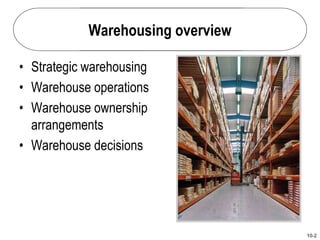
Warehousing overview
• Strategic warehousing
• Warehouse operations
• Warehouse ownership
arrangements
• Warehouse decisions
10-3
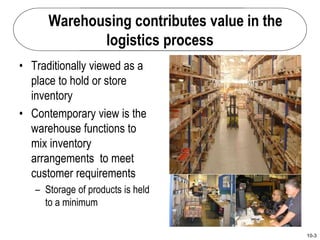
Warehousing contributes value in the
logistics process
• Traditionally viewed as a
place to hold or store
inventory
• Contemporary view is the
warehouse functions to
mix inventory
arrangements to meet
customer requirements
– Storage of products is held
to a minimum
10-4
Evolution of strategic warehousing
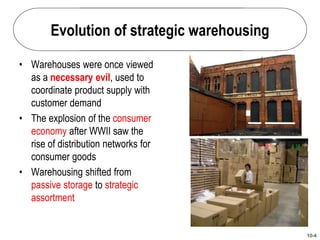
• Warehouses were once viewed
as a necessary evil, used to
coordinate product supply with
customer demand
• The explosion of the consumer
economy after WWII saw the
rise of distribution networks for
consumer goods
• Warehousing shifted from
passive storage to strategic
assortment
10-5
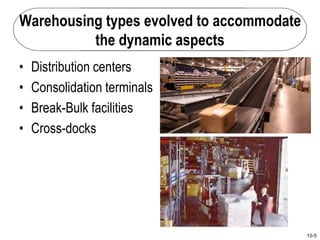
Warehousing types evolved to accommodate
the dynamic aspects
• Distribution centers
• Consolidation terminals
• Break-Bulk facilities
• Cross-docks
10-6
Strategic warehousing offers manufacturers a way
to reduce dwell time of parts and materials
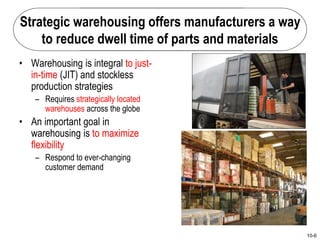
• Warehousing is integral to just-
in-time (JIT) and stockless
production strategies
– Requires strategically located
warehouses across the globe
• An important goal in
warehousing is to maximize
flexibility
– Respond to ever-changing
customer demand
10-7
Strategic warehousing can provide both
economic and service benefits
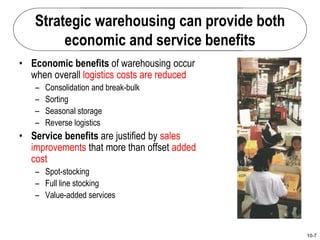
• Economic benefits of warehousing occur
when overall logistics costs are reduced
– Consolidation and break-bulk
– Sorting
– Seasonal storage
– Reverse logistics
• Service benefits are justified by sales
improvements that more than offset added
cost
– Spot-stocking
– Full line stocking
– Value-added services
10-8
Consolidation and break-bulk reduce
transportation cost
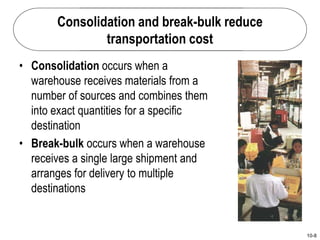
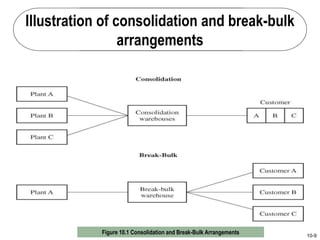
• Consolidation occurs when a
warehouse receives materials from a
number of sources and combines them
into exact quantities for a specific
destination
• Break-bulk occurs when a warehouse
receives a single large shipment and
arranges for delivery to multiple
destinations
10-9
Illustration of consolidation and break-bulk
arrangements
Figure 10.1 Consolidation and Break-Bulk Arrangements
10-10
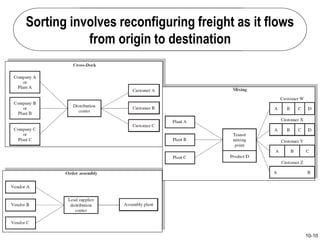
Sorting involves reconfiguring freight as it flows
from origin to destination
10-11
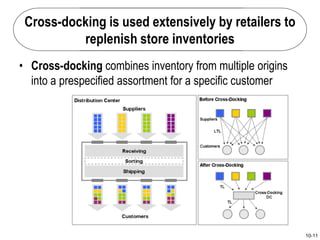
Cross-docking is used extensively by retailers to
replenish store inventories
• Cross-docking combines inventory from multiple origins
into a prespecified assortment for a specific customer
10-12
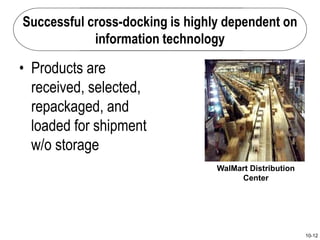
Successful cross-docking is highly dependent on
information technology
WalMart Distribution
Center
• Products are
received, selected,
repackaged, and
loaded for shipment
w/o storage
10-13
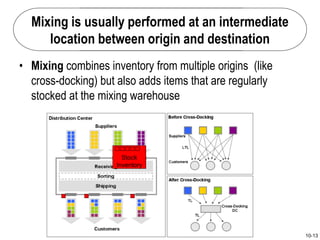
Mixing is usually performed at an intermediate
location between origin and destination
• Mixing combines inventory from multiple origins (like
cross-docking) but also adds items that are regularly
stocked at the mixing warehouse
Stock
Inventory
10-14
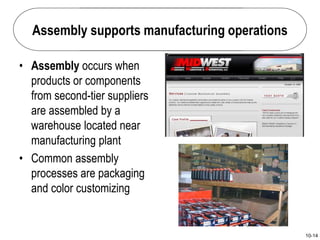
Assembly supports manufacturing operations
• Assembly occurs when
products or components
from second-tier suppliers
are assembled by a
warehouse located near
manufacturing plant
• Common assembly
processes are packaging
and color customizing
10-15
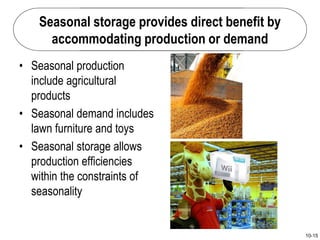
Seasonal storage provides direct benefit by
accommodating production or demand
• Seasonal production
include agricultural
products
• Seasonal demand includes
lawn furniture and toys
• Seasonal storage allows
production efficiencies
within the constraints of
seasonality
10-16
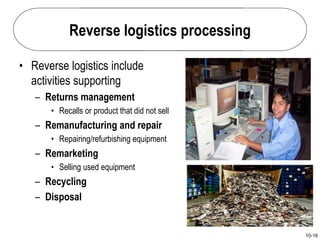
Reverse logistics processing
• Reverse logistics include
activities supporting
– Returns management
• Recalls or product that did not sell
– Remanufacturing and repair
• Repairing/refurbishing equipment
– Remarketing
• Selling used equipment
– Recycling
– Disposal
10-17
Service benefits of warehousing
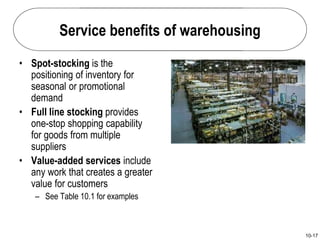
Full Line Stocking at
United Electric’s
Distribution Center
• Spot-stocking is the
positioning of inventory for
seasonal or promotional
demand
• Full line stocking provides
one-stop shopping capability
for goods from multiple
suppliers
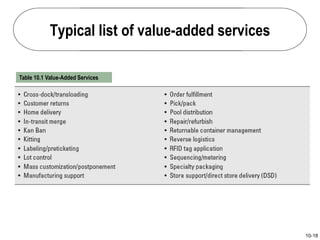
• Value-added services include
any work that creates a greater
value for customers
– See Table 10.1 for examples
10-18
Typical list of value-added services
Table 10.1 Value-Added Services
10-19
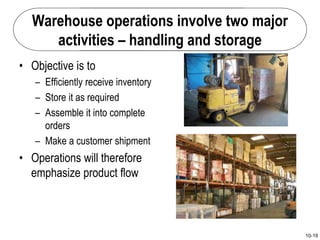
Warehouse operations involve two major
activities – handling and storage
• Objective is to
– Efficiently receive inventory
– Store it as required
– Assemble it into complete
orders
– Make a customer shipment
• Operations will therefore
emphasize product flow
10-20
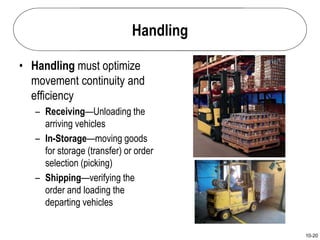
Handling
• Handling must optimize
movement continuity and
efficiency
– Receiving—Unloading the
arriving vehicles
– In-Storage—moving goods
for storage (transfer) or order
selection (picking)
– Shipping—verifying the
order and loading the
departing vehicles
10-21
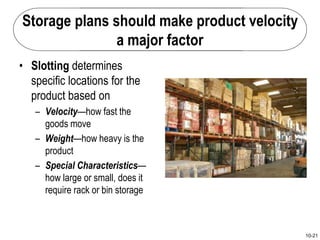
Storage plans should make product velocity
a major factor
• Slotting determines
specific locations for the
product based on
– Velocity—how fast the
goods move
– Weight—how heavy is the
product
– Special Characteristics—
how large or small, does it
require rack or bin storage
10-22
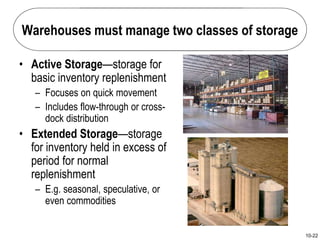
Warehouses must manage two classes of storage
• Active Storage—storage for
basic inventory replenishment
– Focuses on quick movement
– Includes flow-through or cross-
dock distribution
• Extended Storage—storage
for inventory held in excess of
period for normal
replenishment
– E.g. seasonal, speculative, or
even commodities
10-23
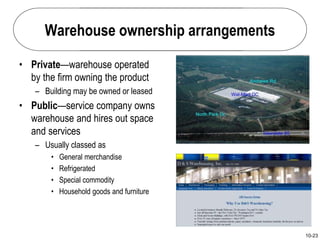
Warehouse ownership arrangements
• Private—warehouse operated
by the firm owning the product
– Building may be owned or leased
• Public—service company owns
warehouse and hires out space
and services
– Usually classed as
• General merchandise
• Refrigerated
• Special commodity
• Household goods and furniture
10-24
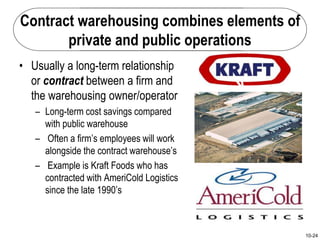
Contract warehousing combines elements of
private and public operations
• Usually a long-term relationship
or contract between a firm and
the warehousing owner/operator
– Long-term cost savings compared
with public warehouse
– Often a firm’s employees will work
alongside the contract warehouse’s
– Example is Kraft Foods who has
contracted with AmeriCold Logistics
since the late 1990’s
10-25
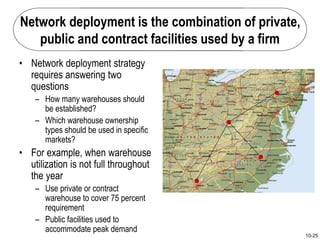
Network deployment is the combination of private,
public and contract facilities used by a firm
• Network deployment strategy
requires answering two
questions
– How many warehouses should
be established?
– Which warehouse ownership
types should be used in specific
markets?
• For example, when warehouse
utilization is not full throughout
the year
– Use private or contract
warehouse to cover 75 percent
requirement
– Public facilities used to
accommodate peak demand
10-26
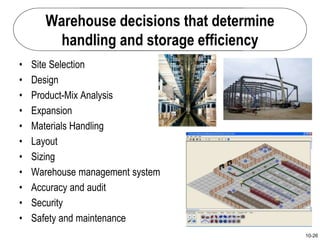
Warehouse decisions that determine
handling and storage efficiency
• Site Selection
• Design
• Product-Mix Analysis
• Expansion
• Materials Handling
• Layout
• Sizing
• Warehouse management system
• Accuracy and audit
• Security
• Safety and maintenance
10-27
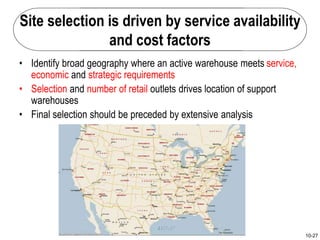
Site selection is driven by service availability
and cost factors
• Identify broad geography where an active warehouse meets service,
economic and strategic requirements
• Selection and number of retail outlets drives location of support
warehouses
• Final selection should be preceded by extensive analysis
10-28
Warehouse management systems encourage
best practices
• Warehouse management systems (WMS) integrate
procedures and software support to standardize storage
and handling work procedures
• One main use of WMS is to coordinate order selection
– Discrete selection is when a specific customer’s order is
selected and prepared for shipment as a single work assignment
– Wave or batch selection is when orders are processed through
zones of the warehouse assigned to specific employees
10-29
Other warehouse planning issues
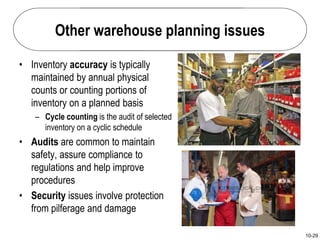
• Inventory accuracy is typically
maintained by annual physical
counts or counting portions of
inventory on a planned basis
– Cycle counting is the audit of selected
inventory on a cyclic schedule
• Audits are common to maintain
safety, assure compliance to
regulations and help improve
procedures
• Security issues involve protection
from pilferage and damage
10-30
Safety and maintenance issues must also be
considered when planning warehouse designs
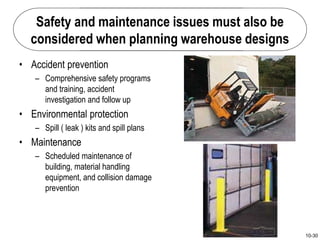
• Accident prevention
– Comprehensive safety programs
and training, accident
investigation and follow up
• Environmental protection
– Spill ( leak ) kits and spill plans
• Maintenance
– Scheduled maintenance of
building, material handling
equipment, and collision damage
prevention

157_50425_EA322_2013_1__2_1_Warehousing.ppt

  • 1.
    Warehousing Copyright © 2010by The McGraw-Hill Companies, Inc. All rights reserved. McGraw-Hill/Irwin
  • 2.
    10-2 Warehousing overview • Strategicwarehousing • Warehouse operations • Warehouse ownership arrangements • Warehouse decisions
  • 3.
    10-3 Warehousing contributes valuein the logistics process • Traditionally viewed as a place to hold or store inventory • Contemporary view is the warehouse functions to mix inventory arrangements to meet customer requirements – Storage of products is held to a minimum
  • 4.
    10-4 Evolution of strategicwarehousing • Warehouses were once viewed as a necessary evil, used to coordinate product supply with customer demand • The explosion of the consumer economy after WWII saw the rise of distribution networks for consumer goods • Warehousing shifted from passive storage to strategic assortment
  • 5.
    10-5 Warehousing types evolvedto accommodate the dynamic aspects • Distribution centers • Consolidation terminals • Break-Bulk facilities • Cross-docks
  • 6.
    10-6 Strategic warehousing offersmanufacturers a way to reduce dwell time of parts and materials • Warehousing is integral to just- in-time (JIT) and stockless production strategies – Requires strategically located warehouses across the globe • An important goal in warehousing is to maximize flexibility – Respond to ever-changing customer demand
  • 7.
    10-7 Strategic warehousing canprovide both economic and service benefits • Economic benefits of warehousing occur when overall logistics costs are reduced – Consolidation and break-bulk – Sorting – Seasonal storage – Reverse logistics • Service benefits are justified by sales improvements that more than offset added cost – Spot-stocking – Full line stocking – Value-added services
  • 8.
    10-8 Consolidation and break-bulkreduce transportation cost • Consolidation occurs when a warehouse receives materials from a number of sources and combines them into exact quantities for a specific destination • Break-bulk occurs when a warehouse receives a single large shipment and arranges for delivery to multiple destinations
  • 9.
    10-9 Illustration of consolidationand break-bulk arrangements Figure 10.1 Consolidation and Break-Bulk Arrangements
  • 10.
    10-10 Sorting involves reconfiguringfreight as it flows from origin to destination
  • 11.
    10-11 Cross-docking is usedextensively by retailers to replenish store inventories • Cross-docking combines inventory from multiple origins into a prespecified assortment for a specific customer
  • 12.
    10-12 Successful cross-docking ishighly dependent on information technology WalMart Distribution Center • Products are received, selected, repackaged, and loaded for shipment w/o storage
  • 13.
    10-13 Mixing is usuallyperformed at an intermediate location between origin and destination • Mixing combines inventory from multiple origins (like cross-docking) but also adds items that are regularly stocked at the mixing warehouse Stock Inventory
  • 14.
    10-14 Assembly supports manufacturingoperations • Assembly occurs when products or components from second-tier suppliers are assembled by a warehouse located near manufacturing plant • Common assembly processes are packaging and color customizing
  • 15.
    10-15 Seasonal storage providesdirect benefit by accommodating production or demand • Seasonal production include agricultural products • Seasonal demand includes lawn furniture and toys • Seasonal storage allows production efficiencies within the constraints of seasonality
  • 16.
    10-16 Reverse logistics processing •Reverse logistics include activities supporting – Returns management • Recalls or product that did not sell – Remanufacturing and repair • Repairing/refurbishing equipment – Remarketing • Selling used equipment – Recycling – Disposal
  • 17.
    10-17 Service benefits ofwarehousing Full Line Stocking at United Electric’s Distribution Center • Spot-stocking is the positioning of inventory for seasonal or promotional demand • Full line stocking provides one-stop shopping capability for goods from multiple suppliers • Value-added services include any work that creates a greater value for customers – See Table 10.1 for examples
  • 18.
    10-18 Typical list ofvalue-added services Table 10.1 Value-Added Services
  • 19.
    10-19 Warehouse operations involvetwo major activities – handling and storage • Objective is to – Efficiently receive inventory – Store it as required – Assemble it into complete orders – Make a customer shipment • Operations will therefore emphasize product flow
  • 20.
    10-20 Handling • Handling mustoptimize movement continuity and efficiency – Receiving—Unloading the arriving vehicles – In-Storage—moving goods for storage (transfer) or order selection (picking) – Shipping—verifying the order and loading the departing vehicles
  • 21.
    10-21 Storage plans shouldmake product velocity a major factor • Slotting determines specific locations for the product based on – Velocity—how fast the goods move – Weight—how heavy is the product – Special Characteristics— how large or small, does it require rack or bin storage
  • 22.
    10-22 Warehouses must managetwo classes of storage • Active Storage—storage for basic inventory replenishment – Focuses on quick movement – Includes flow-through or cross- dock distribution • Extended Storage—storage for inventory held in excess of period for normal replenishment – E.g. seasonal, speculative, or even commodities
  • 23.
    10-23 Warehouse ownership arrangements •Private—warehouse operated by the firm owning the product – Building may be owned or leased • Public—service company owns warehouse and hires out space and services – Usually classed as • General merchandise • Refrigerated • Special commodity • Household goods and furniture
  • 24.
    10-24 Contract warehousing combineselements of private and public operations • Usually a long-term relationship or contract between a firm and the warehousing owner/operator – Long-term cost savings compared with public warehouse – Often a firm’s employees will work alongside the contract warehouse’s – Example is Kraft Foods who has contracted with AmeriCold Logistics since the late 1990’s
  • 25.
    10-25 Network deployment isthe combination of private, public and contract facilities used by a firm • Network deployment strategy requires answering two questions – How many warehouses should be established? – Which warehouse ownership types should be used in specific markets? • For example, when warehouse utilization is not full throughout the year – Use private or contract warehouse to cover 75 percent requirement – Public facilities used to accommodate peak demand
  • 26.
    10-26 Warehouse decisions thatdetermine handling and storage efficiency • Site Selection • Design • Product-Mix Analysis • Expansion • Materials Handling • Layout • Sizing • Warehouse management system • Accuracy and audit • Security • Safety and maintenance
  • 27.
    10-27 Site selection isdriven by service availability and cost factors • Identify broad geography where an active warehouse meets service, economic and strategic requirements • Selection and number of retail outlets drives location of support warehouses • Final selection should be preceded by extensive analysis
  • 28.
    10-28 Warehouse management systemsencourage best practices • Warehouse management systems (WMS) integrate procedures and software support to standardize storage and handling work procedures • One main use of WMS is to coordinate order selection – Discrete selection is when a specific customer’s order is selected and prepared for shipment as a single work assignment – Wave or batch selection is when orders are processed through zones of the warehouse assigned to specific employees
  • 29.
    10-29 Other warehouse planningissues • Inventory accuracy is typically maintained by annual physical counts or counting portions of inventory on a planned basis – Cycle counting is the audit of selected inventory on a cyclic schedule • Audits are common to maintain safety, assure compliance to regulations and help improve procedures • Security issues involve protection from pilferage and damage
  • 30.
    10-30 Safety and maintenanceissues must also be considered when planning warehouse designs • Accident prevention – Comprehensive safety programs and training, accident investigation and follow up • Environmental protection – Spill ( leak ) kits and spill plans • Maintenance – Scheduled maintenance of building, material handling equipment, and collision damage prevention