FRINGE BENEFITS BY:- Ihsan Ali
CONTENTS Employee Benefits  Introduction of fringe benefits  Needs for Fringe Benefits Objectives Types of Fringe Benefits Administration of Fringe Benefits Principles of Fringe Benefits Conclusion
Employee benefits are various non-wage compensations provided to employees in addition to their normal wages or salaries.
Fringe Benefits Extra benefits provided to employees. They are paid to all employees based on their membership. The term fringe benefits refers to the extra benefits provided to employees
Main features They are paid to all employees. They are indirect compensation. They help raise the living conditions. They may be voluntary.
Need For Fringe Benefits Employee demands Trade Union Demands Employer’s preference As a social security To improve human relations
Objectives of Fringe Benefits To create and improve sound industrial relations. To motivate the employees. To provide security to employees. To promote employees’ welfare. To protect the health of employees.
Types of Fringe Benefits Payment for time not worked Employee security Retrenchment compensation  lay off compensation. Personal identification and participation  Health protection  Old age and retirement benefits
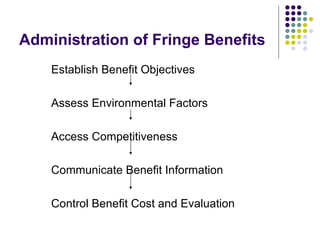
Administration of Fringe Benefits Establish Benefit Objectives Assess Environmental Factors Access Competitiveness Communicate Benefit Information Control Benefit Cost and Evaluation
Principles of Fringe Benefits Cost effective Must satisfy a real need Sound planning Wishes of employees must be considered Devise new ways to involve workers and their representatives at all levels of planning and implementation.
CONCLUSION Basically, a fringe benefit is a benefit provided to an employee or an associate (for example- family, spouse and children) because of his employment. Fringe benefits provide output in terms of employee loyalty and cooperation, employee welfare and create organizational image.
THANKXXXX

Presentation

  • 1.
  • 2.
    CONTENTS Employee Benefits Introduction of fringe benefits Needs for Fringe Benefits Objectives Types of Fringe Benefits Administration of Fringe Benefits Principles of Fringe Benefits Conclusion
  • 3.
    Employee benefits arevarious non-wage compensations provided to employees in addition to their normal wages or salaries.
  • 4.
    Fringe Benefits Extrabenefits provided to employees. They are paid to all employees based on their membership. The term fringe benefits refers to the extra benefits provided to employees
  • 5.
    Main features Theyare paid to all employees. They are indirect compensation. They help raise the living conditions. They may be voluntary.
  • 6.
    Need For FringeBenefits Employee demands Trade Union Demands Employer’s preference As a social security To improve human relations
  • 7.
    Objectives of FringeBenefits To create and improve sound industrial relations. To motivate the employees. To provide security to employees. To promote employees’ welfare. To protect the health of employees.
  • 8.
    Types of FringeBenefits Payment for time not worked Employee security Retrenchment compensation lay off compensation. Personal identification and participation Health protection Old age and retirement benefits
  • 9.
    Administration of FringeBenefits Establish Benefit Objectives Assess Environmental Factors Access Competitiveness Communicate Benefit Information Control Benefit Cost and Evaluation
  • 10.
    Principles of FringeBenefits Cost effective Must satisfy a real need Sound planning Wishes of employees must be considered Devise new ways to involve workers and their representatives at all levels of planning and implementation.
  • 11.
    CONCLUSION Basically, afringe benefit is a benefit provided to an employee or an associate (for example- family, spouse and children) because of his employment. Fringe benefits provide output in terms of employee loyalty and cooperation, employee welfare and create organizational image.
  • 12.