Presented By:
AKANKSHA TARAI
SIMRANJEET KAUR
MBA-HRM
 Wage board is a triplicate body, having
representation of employers and labor besides,
independent members.
 The representatives of the former two interests
are nominated by their central organizations;
others are nominated by the government.
 It is a tripartite representing the interests of
labour, management and the public.
 Labour and management representatives are
maintained in equal numbers by the
government.
 These board are chaired by government
nominated members representing the public
 1950s-1960s :- Government constituted various
wage boards for wage fixation
 1957 :- first wage board was setup for cotton
textile industries.
 30 wages board was setup so far by
government.
 2000 :- Fifth wage board was setup for working
journalist and other newspaper employees
under the working journalist and other
newspaper employees and miscellaneous
provision act, 1955
 Improve condition for better industrial relation
in the country
 Standardized wages structure uniformily
across a given industry
 Pave the way for wages settlements in relation
of social-economic policies of the government
 It passes award on majority opinion and is
signed by the member and the chairman of
board from the date as may be specified in its
written award
 The award remains valid for the period of three
years from the date of passing and may be
extended by mutual agreement between
parties.
 Wage board for journalist are statutory and all
other wage board are non statutory in nature.
 Recommendation made by these wage board
are not enforceable under law.
 The importance of non-statutory wage board
has declined over a period of time
 No non-statutory board has been setup after
1966 expect for sugar industries where last
wage board was setup in 1985.
 Pay Commission is set up intermittently
by Government of India , and gives its
recommendation to regarding changes in
salary structure of its employees.
 Headquartered in Delhi, the Commission is
given 18 months from date of its constitution to
make its recommendations.
 It is an administrative system /mechanism to
determine the salaries of government
employees.
Government of India have so far setup Six pay
commissions: -
1. First pay commission was established on
January , 1946 and its submitted its report on
May, 1947 to the interim Government of India.
 Government employees should be paid a living
wages
 Also recommended for payment of dearness
allowances .
2. The second pay commission was set up in August
1957, 10 years after independence and it gave its
report after two years.
 The recommendations of the second pay
commission had a financial impact of Rs 396
million. The chairman of the second pay
commission was Jagannath Das.
 The second pay commission reiterated the principle
on which the salaries have to be determined.
 It stated that the pay structure and the working
conditions of the government employee should be
crafted in a way so as to ensure efficient functioning
of the system by recruiting persons with a
minimum qualification.
 The third pay commission set up in April 1970
gave its report in March 1973 i.e. it took almost
3 years to submit the report, and created
proposals that cost the government Rs. 1.44
billion.
 The chairman was Raghubir Dayal.
 Appointment of temporary employees, equal
payment should be made for equal work,
externally competitive compensation to prevent
misbalances with other employees.
 Dearness allowances should be treated as part
and parcel of compensation structure.
 Fourth pay commision : Constituted in June
1983, its report was given in three phases within
four years and the financial burden to the
government was Rs.12.82 billion. This
commission has been set up on dated 18.3.1987.
 The chairman of fourth pay commission was P
N Singhal.
 Market comparison cannot be relied upon for
determing pay system
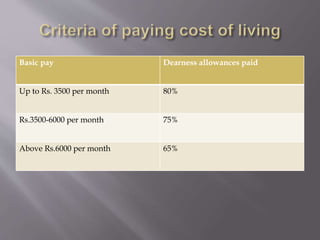
 It recommended that Dearness allowance
should be paid:
Basic pay Dearness allowances paid
Up to Rs. 3500 per month 80%
Rs.3500-6000 per month 75%
Above Rs.6000 per month 65%
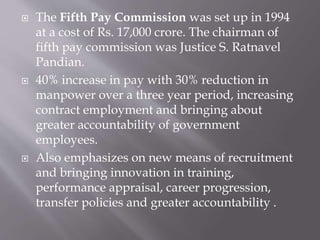
 The Fifth Pay Commission was set up in 1994
at a cost of Rs. 17,000 crore. The chairman of
fifth pay commission was Justice S. Ratnavel
Pandian.
 40% increase in pay with 30% reduction in
manpower over a three year period, increasing
contract employment and bringing about
greater accountability of government
employees.
 Also emphasizes on new means of recruitment
and bringing innovation in training,
performance appraisal, career progression,
transfer policies and greater accountability .
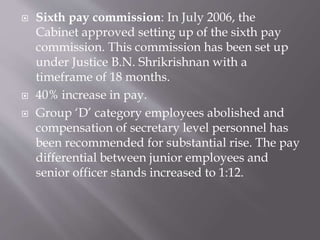
 Sixth pay commission: In July 2006, the
Cabinet approved setting up of the sixth pay
commission. This commission has been set up
under Justice B.N. Shrikrishnan with a
timeframe of 18 months.
 40% increase in pay.
 Group ‘D’ category employees abolished and
compensation of secretary level personnel has
been recommended for substantial rise. The pay
differential between junior employees and
senior officer stands increased to 1:12.
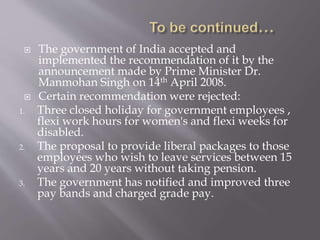
 The government of India accepted and
implemented the recommendation of it by the
announcement made by Prime Minister Dr.
Manmohan Singh on 14th April 2008.
 Certain recommendation were rejected:
1. Three closed holiday for government employees ,
flexi work hours for women's and flexi weeks for
disabled.
2. The proposal to provide liberal packages to those
employees who wish to leave services between 15
years and 20 years without taking pension.
3. The government has notified and improved three
pay bands and charged grade pay.
Wageboard & pay comission

Wageboard & pay comission

  • 1.
  • 2.
     Wage boardis a triplicate body, having representation of employers and labor besides, independent members.  The representatives of the former two interests are nominated by their central organizations; others are nominated by the government.
  • 3.
     It isa tripartite representing the interests of labour, management and the public.  Labour and management representatives are maintained in equal numbers by the government.  These board are chaired by government nominated members representing the public
  • 4.
     1950s-1960s :-Government constituted various wage boards for wage fixation  1957 :- first wage board was setup for cotton textile industries.  30 wages board was setup so far by government.
  • 5.
     2000 :-Fifth wage board was setup for working journalist and other newspaper employees under the working journalist and other newspaper employees and miscellaneous provision act, 1955
  • 6.
     Improve conditionfor better industrial relation in the country  Standardized wages structure uniformily across a given industry  Pave the way for wages settlements in relation of social-economic policies of the government
  • 7.
     It passesaward on majority opinion and is signed by the member and the chairman of board from the date as may be specified in its written award  The award remains valid for the period of three years from the date of passing and may be extended by mutual agreement between parties.
  • 8.
     Wage boardfor journalist are statutory and all other wage board are non statutory in nature.  Recommendation made by these wage board are not enforceable under law.  The importance of non-statutory wage board has declined over a period of time  No non-statutory board has been setup after 1966 expect for sugar industries where last wage board was setup in 1985.
  • 9.
     Pay Commissionis set up intermittently by Government of India , and gives its recommendation to regarding changes in salary structure of its employees.  Headquartered in Delhi, the Commission is given 18 months from date of its constitution to make its recommendations.  It is an administrative system /mechanism to determine the salaries of government employees.
  • 10.
    Government of Indiahave so far setup Six pay commissions: - 1. First pay commission was established on January , 1946 and its submitted its report on May, 1947 to the interim Government of India.  Government employees should be paid a living wages  Also recommended for payment of dearness allowances .
  • 11.
    2. The secondpay commission was set up in August 1957, 10 years after independence and it gave its report after two years.  The recommendations of the second pay commission had a financial impact of Rs 396 million. The chairman of the second pay commission was Jagannath Das.  The second pay commission reiterated the principle on which the salaries have to be determined.  It stated that the pay structure and the working conditions of the government employee should be crafted in a way so as to ensure efficient functioning of the system by recruiting persons with a minimum qualification.
  • 12.
     The thirdpay commission set up in April 1970 gave its report in March 1973 i.e. it took almost 3 years to submit the report, and created proposals that cost the government Rs. 1.44 billion.  The chairman was Raghubir Dayal.  Appointment of temporary employees, equal payment should be made for equal work, externally competitive compensation to prevent misbalances with other employees.  Dearness allowances should be treated as part and parcel of compensation structure.
  • 13.
     Fourth paycommision : Constituted in June 1983, its report was given in three phases within four years and the financial burden to the government was Rs.12.82 billion. This commission has been set up on dated 18.3.1987.  The chairman of fourth pay commission was P N Singhal.  Market comparison cannot be relied upon for determing pay system  It recommended that Dearness allowance should be paid:
  • 14.
    Basic pay Dearnessallowances paid Up to Rs. 3500 per month 80% Rs.3500-6000 per month 75% Above Rs.6000 per month 65%
  • 15.
     The FifthPay Commission was set up in 1994 at a cost of Rs. 17,000 crore. The chairman of fifth pay commission was Justice S. Ratnavel Pandian.  40% increase in pay with 30% reduction in manpower over a three year period, increasing contract employment and bringing about greater accountability of government employees.  Also emphasizes on new means of recruitment and bringing innovation in training, performance appraisal, career progression, transfer policies and greater accountability .
  • 16.
     Sixth paycommission: In July 2006, the Cabinet approved setting up of the sixth pay commission. This commission has been set up under Justice B.N. Shrikrishnan with a timeframe of 18 months.  40% increase in pay.  Group ‘D’ category employees abolished and compensation of secretary level personnel has been recommended for substantial rise. The pay differential between junior employees and senior officer stands increased to 1:12.
  • 17.
     The governmentof India accepted and implemented the recommendation of it by the announcement made by Prime Minister Dr. Manmohan Singh on 14th April 2008.  Certain recommendation were rejected: 1. Three closed holiday for government employees , flexi work hours for women's and flexi weeks for disabled. 2. The proposal to provide liberal packages to those employees who wish to leave services between 15 years and 20 years without taking pension. 3. The government has notified and improved three pay bands and charged grade pay.