1
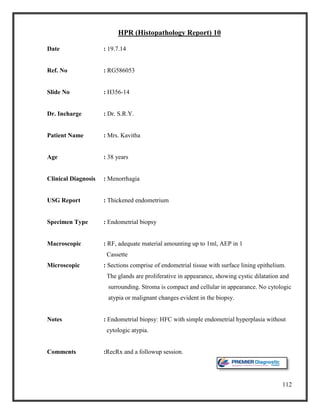
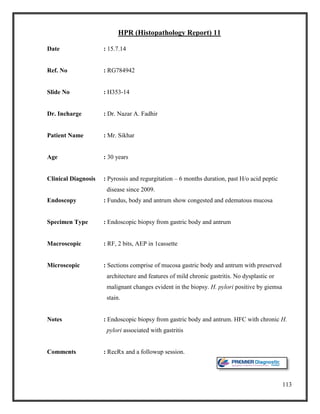
A REPORT
ON
THE MICROBIOLOGY AND HISTOPATHOLOGY DEPARTMENTS OF
PREMIER DIAGNOSTIC CENTER
BY
Ms. Alisha Annie Maben 2012A9PS024U BIOTECHNOLOGY
AT
Premier Diagnostic Center
Salahuddin Road, Deira
Dubai, U.A.E
A Practice School – I Station of
BITS Pilani, Dubai Campus
Dubai International Academic City (DIAC)
Dubai, U.A.E
(JUNE 2014 - AUGUST 2014)
2
A REPORT
ON
THE MICROBIOLOGY AND HISTOPATHOLOGY DEPARTMENTS OF
PREMIER DIAGNOSTIC CENTER
BY
Ms. Alisha Annie Maben 2012A9PS024U BIOTECHNOLOGY
Prepared in Partial Fulfillment of the
Practice School – I Course
AT
Premier Diagnostic Center
Salahuddin Road, Deira
Dubai, U.A.E
A Practice School – I Station of
BITS Pilani, Dubai Campus
Dubai International Academic City (DIAC)
Dubai, U.A.E
(JUNE 2014 - AUGUST 2014)
3
BITS Pilani, Dubai Campus
Dubai International Academic City (DIAC)
Dubai, U.A.E
Station : Premier Diagnostic Center
Location : Dubai
Duration : 8th
June 2014 to 4th
August 2014
Date of Start : 08/06/2014
Date of Submission : 04th
August 2014
Title of the Project : The Microbiology and Histopathology Departments of
Premier Diagnostic Center.
Student Name : Ms. Alisha Annie Maben
Student ID : 2012A9PS024U
Discipline of Student : Biotechnology Engineering
Name and Designation of Experts : 1. Dr. Antony Thomas - Pathologist & Medical Director
2. Dr. Syeda Nusheen – Microbiologist
3. Dr. Kavita - Histopathologist
Name of the Faculty : Dr. D.V. Prasad
Key Words : Specimens, Culture media, Manual and Automated
Techniques, Grossing, Paraffinization, Frozen section,
Pathology report
Project Areas : Clinical Microbiology and Histopathology
Abstract:
This report is a detailed study on the routine activities conducted within the Microbiology and
Histopathology Areas of Premier Diagnostic Center. The workflow of the labs, that is from
specimen collection, transportation and processing are specified. The microbiology laboratory
functions as an amalgamation of the basic manual techniques along with state of art
instrumentation. The histopathology department mainly deals with gross examination and
microscopic slide evaluation. Reports are generated within a reasonable period of time and
effective diagnosis and treatment is offered to the patient.
Signature of the Student Signature of PS Faculty
Date: Date:
4
ACKNOWLEDGEMENTS
Firstly, I would like to express my heartfelt gratitude to Prof. R. N. Saha, Director BPD who has
given us an opportunity to apply and understand our engineering concepts in a practical
atmosphere.
I am grateful to Dr. Antony Thomas – Medical Director & Pathologist for assisting me by
providing the required information about the organization.
Also, I would like to thank Dr. Syeda Nusheen – Microbiologist and Dr. Kavita – Histopathologist
for helping and guiding me throughout our project.
I would also like to thank Prof. B. Muralidharan, Dean - Placement & Practice School, for giving
us this opportunity to work and apply our knowledge in the technical field and gain firsthand
experience.
My sincere gratitude to Dr. D.V. Prasad, our PS Faculty, for providing me with all the assistance
required for successful completion of this report
5
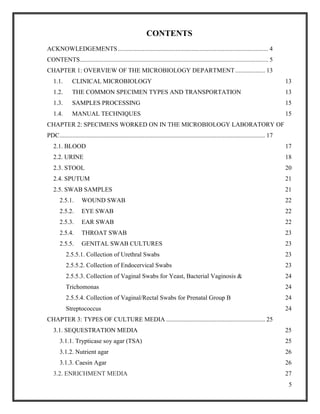
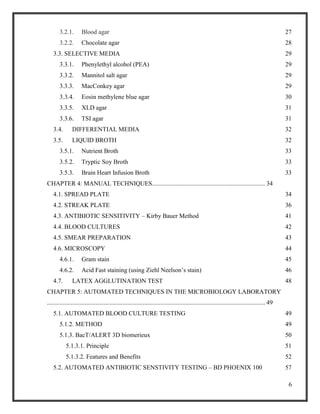
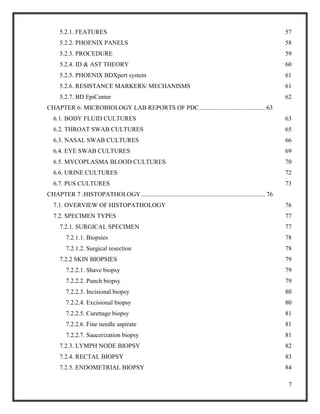
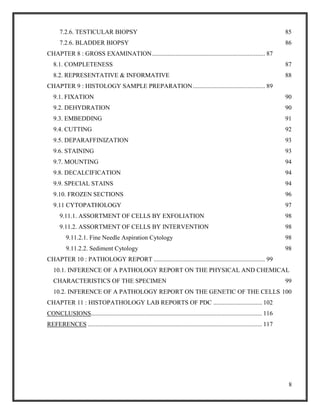
CONTENTS
ACKNOWLEDGEMENTS................................................................................................ 4
CONTENTS........................................................................................................................ 5
CHAPTER 1: OVERVIEW OF THE MICROBIOLOGY DEPARTMENT................... 13
1.1. CLINICAL MICROBIOLOGY 13
1.2. THE COMMON SPECIMEN TYPES AND TRANSPORTATION 13
1.3. SAMPLES PROCESSING 15
1.4. MANUAL TECHNIQUES 15
CHAPTER 2: SPECIMENS WORKED ON IN THE MICROBIOLOGY LABORATORY OF
PDC................................................................................................................................... 17
2.1. BLOOD 17
2.2. URINE 18
2.3. STOOL 20
2.4. SPUTUM 21
2.5. SWAB SAMPLES 21
2.5.1. WOUND SWAB 22
2.5.2. EYE SWAB 22
2.5.3. EAR SWAB 22
2.5.4. THROAT SWAB 23
2.5.5. GENITAL SWAB CULTURES 23
2.5.5.1. Collection of Urethral Swabs 23
2.5.5.2. Collection of Endocervical Swabs 23
2.5.5.3. Collection of Vaginal Swabs for Yeast, Bacterial Vaginosis & 24
Trichomonas 24
2.5.5.4. Collection of Vaginal/Rectal Swabs for Prenatal Group B 24
Streptococcus 24
CHAPTER 3: TYPES OF CULTURE MEDIA ............................................................... 25
3.1. SEQUESTRATION MEDIA 25
3.1.1. Trypticase soy agar (TSA) 25
3.1.2. Nutrient agar 26
3.1.3. Caesin Agar 26
3.2. ENRICHMENT MEDIA 27
6
3.2.1. Blood agar 27
3.2.2. Chocolate agar 28
3.3. SELECTIVE MEDIA 29
3.3.1. Phenylethyl alcohol (PEA) 29
3.3.2. Mannitol salt agar 29
3.3.3. MacConkey agar 29
3.3.4. Eosin methylene blue agar 30
3.3.5. XLD agar 31
3.3.6. TSI agar 31
3.4. DIFFERENTIAL MEDIA 32
3.5. LIQUID BROTH 32
3.5.1. Nutrient Broth 33
3.5.2. Tryptic Soy Broth 33
3.5.3. Brain Heart Infusion Broth 33
CHAPTER 4: MANUAL TECHNIQUES........................................................................ 34
4.1. SPREAD PLATE 34
4.2. STREAK PLATE 36
4.3. ANTIBIOTIC SENSITIVITY – Kirby Bauer Method 41
4.4. BLOOD CULTURES 42
4.5. SMEAR PREPARATION 43
4.6. MICROSCOPY 44
4.6.1. Gram stain 45
4.6.2. Acid Fast staining (using Ziehl Neelson’s stain) 46
4.7. LATEX AGGLUTINATION TEST 48
CHAPTER 5: AUTOMATED TECHNIQUES IN THE MICROBIOLOGY LABORATORY
........................................................................................................................................... 49
5.1. AUTOMATED BLOOD CULTURE TESTING 49
5.1.2. METHOD 49
5.1.3. BacT/ALERT 3D biomerieux 50
5.1.3.1. Principle 51
5.1.3.2. Features and Benefits 52
5.2. AUTOMATED ANTIBIOTIC SENSTIVITY TESTING – BD PHOENIX 100 57
7
5.2.1. FEATURES 57
5.2.2. PHOENIX PANELS 58
5.2.3. PROCEDURE 59
5.2.4. ID & AST THEORY 60
5.2.5. PHOENIX BDXpert system 61
5.2.6. RESISTANCE MARKERS/ MECHANISMS 61
5.2.7. BD EpiCenter 62
CHAPTER 6: MICROBIOLOGY LAB REPORTS OF PDC.......................................... 63
6.1. BODY FLUID CULTURES 63
6.2. THROAT SWAB CULTURES 65
6.3. NASAL SWAB CULTURES 66
6.4. EYE SWAB CULTURES 69
6.5. MYCOPLASMA BLOOD CULTURES 70
6.6. URINE CULTURES 72
6.7. PUS CULTURES 73
CHAPTER 7 :HISTOPATHOLOGY............................................................................... 76
7.1. OVERVIEW OF HISTOPATHOLOGY 76
7.2. SPECIMEN TYPES 77
7.2.1. SURGICAL SPECIMEN 77
7.2.1.1. Biopsies 78
7.2.1.2. Surgical resection 78
7.2.2 SKIN BIOPSIES 79
7.2.2.1. Shave biopsy 79
7.2.2.2. Punch biopsy 79
7.2.2.3. Incisional biopsy 80
7.2.2.4. Excisional biopsy 80
7.2.2.5. Curettage biopsy 81
7.2.2.6. Fine needle aspirate 81
7.2.2.7. Saucerization biopsy 81
7.2.3. LYMPH NODE BIOPSY 82
7.2.4. RECTAL BIOPSY 83
7.2.5. ENDOMETRIAL BIOPSY 84
8
7.2.6. TESTICULAR BIOPSY 85
7.2.6. BLADDER BIOPSY 86
CHAPTER 8 : GROSS EXAMINATION........................................................................ 87
8.1. COMPLETENESS 87
8.2. REPRESENTATIVE & INFORMATIVE 88
CHAPTER 9 : HISTOLOGY SAMPLE PREPARATION.............................................. 89
9.1. FIXATION 90
9.2. DEHYDRATION 90
9.3. EMBEDDING 91
9.4. CUTTING 92
9.5. DEPARAFFINIZATION 93
9.6. STAINING 93
9.7. MOUNTING 94
9.8. DECALCIFICATION 94
9.9. SPECIAL STAINS 94
9.10. FROZEN SECTIONS 96
9.11 CYTOPATHOLOGY 97
9.11.1. ASSORTMENT OF CELLS BY EXFOLIATION 98
9.11.2. ASSORTMENT OF CELLS BY INTERVENTION 98
9.11.2.1. Fine Needle Aspiration Cytology 98
9.11.2.2. Sediment Cytology 98
CHAPTER 10 : PATHOLOGY REPORT ....................................................................... 99
10.1. INFERENCE OF A PATHOLOGY REPORT ON THE PHYSICAL AND CHEMICAL
CHARACTERISTICS OF THE SPECIMEN 99
10.2. INFERENCE OF A PATHOLOGY REPORT ON THE GENETIC OF THE CELLS 100
CHAPTER 11 : HISTOPATHOLOGY LAB REPORTS OF PDC ............................... 102
CONCLUSIONS............................................................................................................. 116
REFERENCES ............................................................................................................... 117
9
LIST OF FIGURES
Fig.2.1. Blood sample collected in the tube with an identification number attached 18
Fig.2.2. Sterile Mid-stream urine collection kit. 19
Fig.2.3. Mid-stream catch urine specimen 19
Fig.2.4. Stool collection procedure 20
Fig.2.5. A sputum sample 21
Fig.2.6. Swabs C & S - Amies Transport Medium Charcoal or Clear gel 22
Fig.3.1. Serratia marcescens on Trypticase Soy Agar 25
Fig.3.2. Growth of Klebsiella on nutrient agar plate 26
Fig.3.3. Casein Hydrolysis by Bacillus subtilis on Skim Milk Agar 26
Fig.3.4. Three types of Hemolysis seen in Blood agar plates 28
Fig.3.5. Haemophilus influenzae on Chocolate Agar 28
Fig.3.6. Staphylococcus aureus growing on Mannitol salt agar plate 29
Fig.3.7.Escherichia coli isolated from a patient with diarrhea on MacConkey Agar. 30
Fig.3.8. E. coli showing metallic green sheen on EMB agar plate 30
Fig.3.9. Salmonella sp. after 24 hours growth on XLD agar. 31
Fig.3.10. Inoculation of TSI agar slant 32
Fig.4.1. Picture of spread plates showing bacterial growth (E.coli, 40 hours, room temperature)
on five plates prepared from a ten-fold dilution series 35
Fig.4.2. Quadrant method of streaking plates 37
Fig.4.3. Antibiotic Disk Diffusion Method 42
Fig.4.4. Smear preparation and simple staining 44
Fig.4.5. Microscopic observation of Gram negative and positive bacteria 46
Fig.4.6. Microscopic examination of Mycobacterium stained with Ziehl Nielson's stain 47
Fig.4.7. Cryptococcal Antigen Latex Agglutination System 48
Fig.5.2. Description of the Working Principle of BacT/ALERT 3D 52
Fig.5.3. A view cell status screen depicting the automation in the operations 54
Fig.5.5. BacT/ALERT 3D 240 55
Fig.5.6. BacT/ALERT 3D 120 Combo 56
Fig.5.7. BacT/ALERT 3D 60 56
10
Fig.5.8. BD Phoenix 100 57
Fig.5.8. Combined ID and AST panel 59
Fig.5.9. BD Phoenix workflow 60
Fig.5.10. BD EpiCentre workflow 63
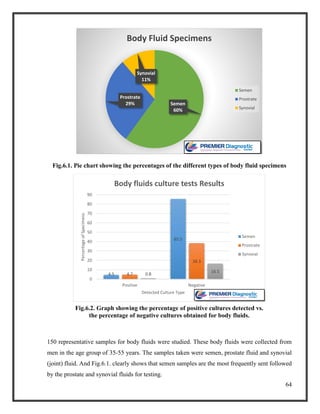
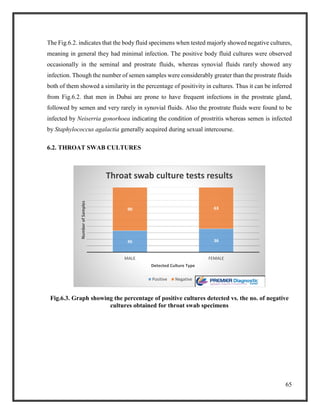
Fig.6.1. Pie chart showing the percentages of the different types of body fluid specimens 64
Fig.6.2. Graph showing the percentage of positive cultures detected vs. the percentage of
negative cultures obtained for body fluids. 64
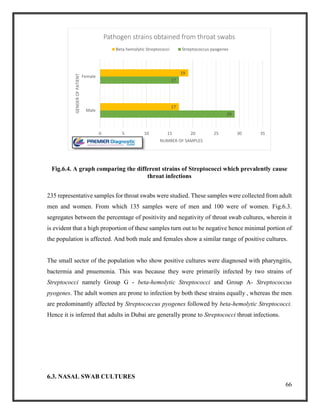
Fig.6.3. Graph showing the percentage of positive cultures detected vs. the no. of negative
cultures obtained for throat swab specimens 65
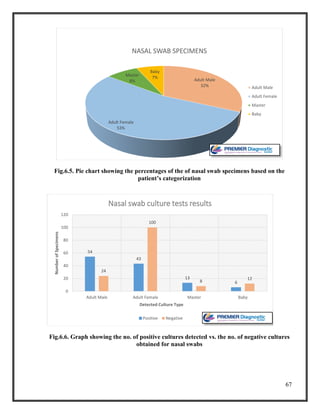
Fig.6.4. A graph comparing the different strains of Streptococci which prevalently cause throat
infections 66
Fig.6.5. Pie chart showing the percentages of the of nasal swab specimens based on the patient’s
categorization 67
Fig.6.6. Graph showing the no. of positive cultures detected vs. the no. of negative cultures
obtained for nasal swabs 67
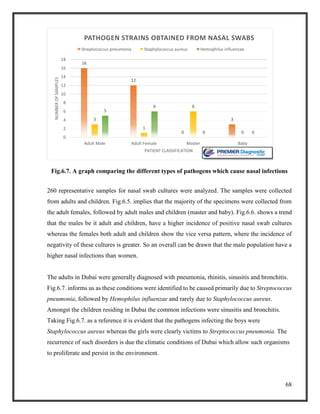
Fig.6.7. A graph comparing the different types of pathogens which cause nasal infections 68
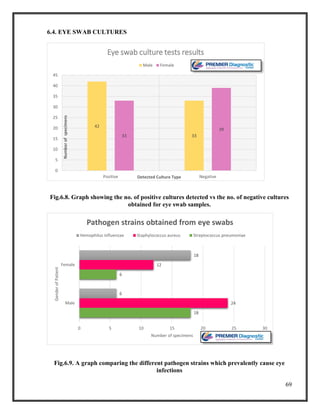
Fig.6.8. Graph showing the no. of positive cultures detected vs the no. of negative cultures
obtained for eye swab samples. 69
Fig.6.9. A graph comparing the different pathogen strains which prevalently cause eye infections
69
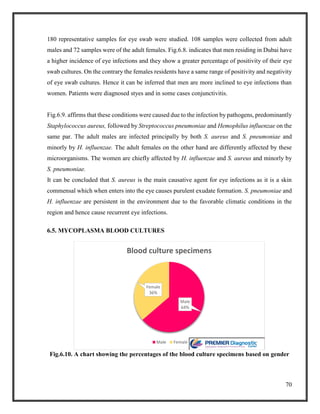
Fig.6.10. A chart showing the percentages of the blood culture specimens based on gender 70
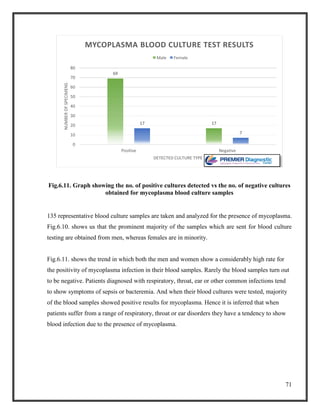
Fig.6.11. Graph showing the no. of positive cultures detected vs the no. of negative cultures
obtained for mycoplasma blood culture samples 71
Fig.6.12. Graph showing the no. of positive cultures detected vs the no. of negative cultures
obtained for urine culture samples. 72
Fig.6.13. A graph comparing the different types of pathogens which cause urinary tract
infections 72
Fig.6.14. A chart showing the varying percentages of the pus culture samples based on gender of
the patients 73
11
Fig.6.15. Graph showing the no. of positive cultures detected vs the no. of negative cultures
obtained for pus culture samples. 74
Fig. 6.16. A graph comparing the different types of pathogens which cause purulent exudates in
wounds 74
Fig.7.1. Surgical Resection of a Colorectal Tumor (Left) with the Resulting Ostomy (Right) 79
Fig.7.2. Methods of Skin Biopsy 82
Fig.7.3. Fine needle aspirate of Lymph node biopsy 83
Fig.7.4. Sentinel lymph node biopsy 83
Fig.7.5. Rectal biopsy via a catheter. 84
Fig.7.6. Endometrial biopsy via speculum 85
Fig.7.7. Open biopsy of Testicle 86
Fig.7.8. Cystoscopy with bladder biopsy 86
Fig.8.1. Gross examination being done by a Pathologists Assistant 88
Fig.9.1. Histology Sample Preparation Workflow 89
Fig.9.2. Varied types of Tissue fixatives 90
Fig.9.3. Automated Tissue Processor for Dehydration 91
Fig.9.4. Tissue specimen orientation in molten paraffin 91
Fig.9.5. Solidified Tissue paraffin block 92
Fig.9.6. Rotatory Microtome Section 92
Fig.9.7. Automated Microtome Sectioning 93
Fig.9.8. Hematoxylin and eosin staining of Nocardia crassostreae 94
Fig.9.9. PAS staining of Kidney section 95
Fig.9.10. Corpus hemorrhagicum, dromedary camel; Prussian blue stain 95
Fig.9.11. Appearance of H. pylori on the gastric mucosal surface with Giemsa stain 96
Fig.9.12. Gordon and Sweet method for reticular fibers 96
Fig.9.13. The Microscopy Core's Leica CM-3050-S cryostat is located in the Histology room 97
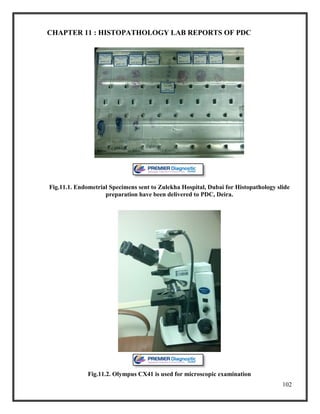
Fig.11.1. Endometrial Specimens sent to Zulekha Hospital, Dubai for Histopathology slide
preparation have been delivered to PDC, Deira. 102
Fig.11.2. Olympus CX41 is used for microscopic examination 102
Fig.11.3. Pie chart showing the prevalence of endometrial disorders 114
12
LIST OF TABLES
Table 1.1.: Common Specimen Types used in Microbiology Laboratory [6] 14
Table 2.1. : Genital Swab Cultures [16] 23
Table 4.1. A descriptive table of different agar types, its composition and the microorganisms
cultivated 38
13
CHAPTER 1: OVERVIEW OF THE MICROBIOLOGY DEPARTMENT
The premises of any Diagnostic Center inevitably requires a conventional clinical microbiology
laboratory are they are considered to be the first lines of defense [1] wherein they encompass
recognition, sequestration, categorization and susceptibility testing of disease causing
microorganisms. The clinical appearance of a transmittable disease demonstrates the
communication between the host and infectious microorganism. Diagnosis necessitates an
amalgamation of material, incorporating history, physical inspection, radiographic examination
and laboratory documents [2].The routine functioning of these labs incorporates a variety of
manual techniques which are dependent on the nature of the patient’s sample.
1.1. CLINICAL MICROBIOLOGY
Microbiology (derived from Greek, mīkros – small; bios – life; logia – study) is an investigation
of microscopic organisms (unicellular/multicellular – colonies /acellular) [3]. Microbiology
comprises of several sub-categories inclusive of virology (study of viruses), mycology (study of
fungi), parasitology (study of parasites) and bacteriology (study of bacteria).
A practice of microbiology is medical/clinical microbiology which is frequently presented with
clinical doctrines of immunology as microbiology and immunology. Clinical microbiology is a
precise combination of knowledge, outlook and training designed towards clinical association in
transmittable disease management using core principles of medical microbiology and clinical
medicine [4].
Clinical microbiology deals with the comparison and correlation of microorganisms under normal
and pathological conditions. It analyses the realms of the pathological processes with a description
of treatment till the medical and comprehensive salvage is attained [5].
1.2. THE COMMON SPECIMEN TYPES AND TRANSPORTATION
For accurate diagnosis, further treatment and for the alleviation from the disease; the physician
would require the patient to provide an appropriate sample for testing and analysis. The physician
will determine the type of the sample to be provided based on the symptoms and physical
examination of the patient.
14
Table 1.1.: Common Specimen Types used in Microbiology Laboratory [6]
Specimen Type Transport Device
Cervix Suitable for GC (Neisseria gonorrhea) culture only. Exudates are expressed and
transported via swab.
Cerebrospinal fluid Collected in special CSF sterile screw capped plastic tube provided in kit.
Drainages Use anaerobic transport tube/ sterile tube /Culturette swab according to the micro-
organisms characteristics.
Exudates Culturette swabs are utilized. For liquid and anaerobes analysis, use anaerobic
transport tube.
Fluids Body /joint fluids are injected in a maximum of 10 mL into an aerobic blood culture
bottle. Transport additional fluid in a sterile tube and in an anaerobic transport tube
if anaerobic culture is requested.
Fungus Aspirate, biopsy, blood, body fluid, bronchoalveolar lavage, hair, nails, sinus, skin,
sputum stool, urine or genital. Tissues are collected in sterile containers; body
fluids and aspirates in blood culture tubes.
Pus For anaerobic cultures, inject aspirated pus into anaerobic transport tube. And
culturette swabs are used for aerobic cultures.
Skin scrapings Place in sterile Petri dish.
Sputum, Routine The specimen is obtained when the cough is productive (early morning). Collect
in a sterile plastic container and refrigerate.
Stool for culture C&S Vial are used to collect the bloody or mucous portions of the stool. Place
sufficient volume into the Cary/Blair transport media to match the fill line.
Urethral swab Culturette charcoal swab is preferred.
Urine Collect as clean catch in a sterile plastic container and aliquot into special
Vacutainer Urine Culture transport tube with growth inhibitor (gray top).
Refrigerate specimen if urine culture transport tube is not used. For urinalysis
aliquot into a yellow top urine preservative transport tube.
15
Vaginal swab For yeast culture. Collect in a culturette and send to the laboratory immediately. If
bacterial vaginosis studies are requested, use a second swab to prepare slide or send
second swab to laboratory.
Wound Collect on sterile aerobic swab using a culturette and transport promptly. For gram
stain analysis collect 2 culturettes. Only tissue or aspirated material is acceptable
for anaerobic cultures. For anaerobic cultures, use an anaerobic transport device.
1.3. SAMPLES PROCESSING
Once the patients have provided their samples, processing is conducted on the test requirement
mentioned in the request form. The samples will arrive in vacutainer tubes consisting of body
fluids (like blood, urine, semen etc.) or sterilized containers (like stool, sputum, biopsies etc.) along
with a plastic bag and a request form. The specimen container has a barcoded number for
identification of the patient; and once the sample is barcoded it’s then sent for sample processing
and testing. Samples require processing so that their components can be efficiently separated and
tested individually. This is vital for the accurate identification and diagnosis of the disease.
Blood samples can be used as a whole blood or can be centrifuged to separate the serum or the
plasma components. Urine samples can be directly plated out for microbial culture analysis or it
can be centrifuged, wherein sediments are utilized for microscopic determination. Stool samples
depending upon its characteristics are treated with appropriate broths or can be used as it is. Apart
from body fluids and samples transported in containers we also have cotton swab cultures, they
have transport media to keep the bacteria in an active form and they are then they are accordingly
plated out, incubated and cultured for further analysis.
1.4. MANUAL TECHNIQUES
Manual techniques are the procedures conducted physically by hand in the laboratory for the
further investigation of the specimens. It is essential to establish that in today’s fast paced world
automated techniques are on high demand, as they provide quick and accurate results. But manual
techniques still hold prime importance as they are were the building stones of the laboratory
diagnosis. It is the manual procedures methodology and parameters that are used to design the
16
automated techniques. The manual processes are also known to provide us with the standard test
parameters which facilitate comparison with known samples and calibration for the unknown
samples. Through training in these techniques our hands on skills get improved and we also gain
the ability to analyze, in depth the theoretical aspects of microbiology (growth, maintenance,
morphology, resistance, sensitivity etc.). Also these manual techniques are used as an adjunct for
verification of the automated techniques results and are conducted at a lower cost with efficient
results.
Basic laboratory techniques are involved in isolation, cultivation, and cultural characterization of
microorganisms. There are different culture media and lab equipment required for the growth and
maintenance of pure cultures. Microorganisms have to be sub-cultured in sterilized surroundings.
A mixed microbial population can be segregated from the sample by streak plate and spread plate
inoculations techniques [7]. And further in addition to this pure cultures can be isolated and the
infection’s causative organism can be recognized. Microscopic examination of the cultures is also
conducted. An interesting aspect is that these techniques are also used to check for any bacterial
or fungal contamination (due to spillage of body fluids) within the instruments which give us
automated results.
Drawbacks of manual testing would be that they are time consuming and the technicians
performing the procedures have to be proficient in their hand skills, well versed in the protocol,
and should perform the testing in appropriate conditions for accurate results. Any slight deviation
on the protocols would mean a delayed diagnosis which could prove fatal for the patient.
17
CHAPTER 2: SPECIMENS WORKED ON IN THE MICROBIOLOGY
LABORATORY OF PDC
These specimens have been collected from the patients and transported to the sample collection
area within diagnostic center. These samples are collected in special sterilized containers with
barcodes for the patient’s identification and laboratory record. The samples are processed
according to the tests requested for.
2.1. BLOOD
For collection of blood sample in PDC, an elastic support is circled around the upper arm to inhibit
the flow of blood. The site intended for the needle puncture is sterilized with alcohol to prevent
the blood samples contamination with the skin commensals. Once the vein is identified the needle
is inserted into it – this process is called venipuncture [8]. A tube is fixed onto the needle for the
accumulation of the sample of blood. After 10 ml of blood has been provided by the patient the
elastic support is unwound and the venipuncture site is cleansed with alcohol and a bandage is
applied to the site [9]. Various sets of blood cultures can be called for – this is ideally performed
to ensure that the diagnostic yield of the blood cultures is increased significantly. The patients are
requested to provide samples 30 minutes apart. Samples must be taken from different locations at
different times. Manifold sets of these cultures maximize the probability of sequestering an
infectious organism contaminating the blood [10]. It has also proven to reduce the possibility of a
positive culture which could have occurred due to adulteration of sample by skin commensals [11].
It is recommended that whole blood samples refrigeration at 4°C should follow instantly after
collection – this ensures that its quality is preserved. These samples can be transported in
refrigerated packages at 4°C via ships. This temperature ensures its stability for a week. If sample
investigation is unlikely to happen within a week, then the samples are frozen promptly at 70°C (-
20°C is insufficient).
Blood plasma is the liquid component of the blood providing it fluidity and giving a medium for
the suspension of all the blood cells. The protocol for the blood plasma preparation would comprise
18
of mixing the blood with anticoagulant. After which the samples are promptly centrifuged and the
supernatant obtained would be the plasma.
Blood plasma deficient in fibrinogen and the other clotting factors is said to be blood serum. The
serum has more clarity in comparison to plasma cause of the decreased quantity of proteins. The
protocol for serum separation from the whole blood would include transferring the blood into a
vacutainer tube without anticoagulant. It’s allowed to rest in the upright position to ensure clotting
of blood after which it’s centrifuged. The supernatant thus obtained is the serum [12].
After all serum/plasma is segregated to appropriate transfer/storage tubes the tubes should be
accurately marked with sticker, marker or other method with an identification code. Blood cultures
or microscopy is employed for sample investigation [13].
[9]
© Copyright the Finnish National Public Health Institute 2002.
Fig.2.1. Blood sample collected in the tube with an identification number attached
2.2. URINE
Urine samples can be collected by different methods and they are accordingly named as random
specimen, first morning specimen, midstream clean catch specimen, timed collection specimen,
catheter collection specimen, suprapubic aspiration specimen and pediatric specimen.
19
In PDC we usually work with Midstream clean catch specimen. The patients are provided with a
cleansing towelette and a sterile specimen container. Patients are instructed to clean the urethral
site with a towelette (castile soap). The initial portion of the urine flow should be discarded into
the washroom by the patient [14]. These beginning steps are vital as they considerably lessen the
incidences of adulterants to contaminate the urine stream. The urine midstream is the accumulated
in the storage container. Discard the excess urine into the toilet. Utilizing this process, collection
can be done during the day or night according to the patient’s convenience [15]. This is the favored
specimen type as it eases the culturing process and is apt for susceptibility testing due to the
decreased occurrence contamination caused by cells or microorganisms [16]. Urine samples is
cultured else after centrifugation the sediments are microscopically analyzed.
[15]
© Copyright 2014, Saddleback College, Mission Viejo, California
Fig.2.2. Sterile Mid-stream urine collection kit.
[16]
© Copyright 2014,Gilson Inc. Clinical/Forensics
Fig.2.3. Mid-stream catch urine specimen
20
2.3. STOOL
For stool sample collection, patients are provided with a plastic disposable bowl (composed of
margarine). The stool has to be transferred straight into the clean, dry, wide mouth bowl. Avoid
sample contamination due to urine, toilet water or toilet paper. Areas of the specimen which seem
to have blood, mucous, pus or any watery discharge must be taken in small quantities from the
ends and the middle [17].
Certain collection cups are devoid of the preservative. In such case the tongue depressor is
recommended or an alternative plastic spoon is catered to facilitate the specimen transfer. A walnut
size specimen would suffice for testing. Leakage must be prevented as this may cause sample
rejection. Thus ensure that the lid of the vial is tightened and also refrigerate it to maintain its
quality [18].
In PDC we provide vials with preservative (blue, green, pink, orange). These vials contain an
inbuilt spoon fixed onto the lid, used for sampling. The specimen is sufficiently transferred into
the vial and the additives level is expected to reach the fill line [19]. The formed stool is mashed
against the vials walls with the spoon. Once the lid is tightly affixed, the specimen is shaken until
it is homogenously mixed [20]. Stool samples are inoculated into culture plates for further analysis.
[19]
© 2000-2012 All Rights Reserved, Diagnos-Techs™, Inc.
Fig.2.4. Stool collection procedure
21
2.4. SPUTUM
For collection of the appropriate sputum sample, the patients are advised to breathe deeply at least
three times and then expel a deep cough [21]. Breathing deeply ensures that the tenacious
secretions are loosened and causes it to accumulate at the rear portion of the throat. When the
sample is collected ensure that the thin mouth secretions – saliva don’t contaminate the sample.
Accentuate the importance of expectorating the viscous lung secretions – the sputum into the
container. In case of emergency always keep a 10% sodium chloride spray or sterilized water by
your side to be rendered to the patient via nebulizer at times of discomfort. This helps in releasing
the thickened secretions. Sputum samples are cultured and colonies can be taken for microscopic
analysis via gram staining or AFB (Acid Fast Bacteria) stain [22].
[21]
© 2011 Copyright, TB Online
Fig.2.5. A sputum sample
2.5. SWAB SAMPLES
In PDC, Becton Dickson swabs are used to take samples from the genital tract, throat, eye, ear,
nose, and superficial wounds (e.g. sores, boils, and rashes). The transport medium generally
provided with these swabs are charcoal or clear gel. The samples must be sent to the laboratory
within 24 hours. These swabs are processed with an expiration date which necessitates the rotation
of stock for quality assurance. Dry swabs sent for culture have to be transported within 1 hour of
collection else they will be rejected and remain unprocessed.
22
[23]
© Copyright Lifelabs
Fig.2.6. Swabs C & S - Amies Transport Medium Charcoal or Clear gel
2.5.1. WOUND SWAB
The wounded skin (boils, rashes, burns etc.) have to be mildly cleansed prior to sample collection.
The physicians prefer this as it reduces the incidences of contamination due to floral commensals.
The pus discharges are passed onto these swabs, they are then transferred into the medium for
transportation. Maintenance of swabs at room temperature is vital. Submission of the specimens
must be completed within 24 hours of accumulation. Aspirates are considered ideal for the
cavernous wounds as the prognostic assessment of surface swabs is reduced in this case.
2.5.2. EYE SWAB
The purulent expulsion is expressed onto the swabs and is obtained from the upturned lower eyelid.
This collection is done prior to the application of anesthetics. The swabs are placed in the medium
of transport. They need to be maintained at room temperature and submission to the lab has to be
done prior to the completion of 24 hours of sample collection [23]. Else the sample gets rejected
and hence remains unprocessed.
2.5.3. EAR SWAB
For sample collection the exterior ear canal is swabbed. The swab is then transferred into transport
media. These specimens require refrigeration at 2-8 ºC for maintenance. Sample have to be sent to
the laboratory by 24 hours of collection.
23
2.5.4. THROAT SWAB
The physicians take the sample by swabbing the tonsillar region and/or rear portion of the pharynx.
The swabs are placed into the appropriate medium for transportation and maintained at room
temperature. Submit the specimens by the same day to the lab [24].
2.5.5. GENITAL SWAB CULTURES
Table 2.1. : Genital Swab Cultures [25]
Organism / Syndrome
investigated
Source of specimen Collection
Neisseria gonorrhea Endocervical, Urethral Amies transport Swab
(Charcoal or clear gel)
Yeast, Bacterial vaginosis,
Trichomonas
Post vaginal vault Amies transport Swab
(Charcoal or clear gel)
Prenatal screening for Group
B Streptococcus at 35-37
weeks gestation
Combined Vaginal/Rectal Amies transport Swab
(Charcoal or clear gel)
2.5.5.1. Collection of Urethral Swabs
The purulent discharges are expelled from the urethra onto the swab for sample collection. If
exudates aren’t available, then it’s recommended to introduce the swab in the urethrogenital tract
about 2cm deep into the urethra. The swab is calmly moved in rotatory motion and gently removed.
The swab is shifted into the media for transport and is submitted to the lab on the same day.
2.5.5.2. Collection of Endocervical Swabs
A speculum is utilized for sample collection in this process. It is moistened with warm water. If
the patient is infected by Neisseria gonorrhea, lubricants are avoided as they are toxins to these
microorganisms and the testing will fail in the organism’s apt identification. Emphasis is given to
clear of any mucous or vaginal substance as they can adulterate the sample. Using the speculum’s
blades the walls of the cervix is gently converged. The purulent exudates are passed on the swab
24
or else the swab is embedded into the cervix. The swab is inserted into the transport media for
storage. They are preserved at room temperature and sent to the laboratory within the same day.
2.5.5.3. Collection of Vaginal Swabs for Yeast, Bacterial Vaginosis &
Trichomonas
The disproportionate secretions are cleansed. The swab is swirled around the mucosal membrane
to take the discharges from that region. The swabs are conserved in the transport media and kept
at room temperature. They are then sent to laboratory for testing by the same day.
2.5.5.4. Collection of Vaginal/Rectal Swabs for Prenatal Group B
Streptococcus
Screening is done at 35-37 weeks of incubation. Speculum must be avoided for specimen
collection in this case. The vaginal introitus, ie the bottom region of the vagina is swabbed.
Continuing with the initial swab, or taking another swab, infix the swab into the anal sphincter to
facilitate the swabbing of the rectum. The swab(s) are conserved in the transportation medium at
room temperature. Specimen must be sent for processing to the laboratory within the same day.
Ensure that the application form clearly mentions that these swab samples are meant for Group B
Streptococcal culture. Also if the patient is allergic to penicillin it is a must that the request form
should have that documented.
25
CHAPTER 3: TYPES OF CULTURE MEDIA
To be able to investigate the microorganisms adequately, it is essential to culture them. To
achieve this, it is vital to move the specimens into a habitat replicating the suitable environment
enhancing their development. Nutritional necessities are wide ranging from one species of a
microorganism to another. There are situations where their requirements are blatantly unknown.
Ample research has been conducted with regard to their proliferation conditions required to
cultivate these organisms. In present day and age, most of the microbes are successfully grown
on or in the artificial media. The constituents of the media are prepared keeping in mind the
nutritional and growth conditions of the microbes. The media are made in accordance to
supplement the development of these organisms. Emphasize is made on this aspect as the
cultures now studied will be in correlation to the organisms characteristics which are observable
in the species that occur in nature.
3.1. SEQUESTRATION MEDIA
Media whose function is for the sequestration of bacterial isolates or the inoculum is called
sequestration media. This is generally made in Petridishes to ease the streaking of the organism.
And hence we can attain sequestered colonies of the microbe under study.
3.1.1. Trypticase soy agar (TSA)
Trypticase soy agar is a nutrient media which facilitates primarily in seclusion of microbes. It
allows the development of a variety of bacteria including gram positive and negative bacteria.
[26]
Fig.3.1. Serratia marcescens on Trypticase Soy Agar
26
3.1.2. Nutrient agar
Nutrient agar is a broad spectrum media which supports the growth of a wide array of non-
fastidious organisms [26].
[26]
© 2011 Copyright, Gilson Inc.
Fig.3.2. Growth of Klebsiella on nutrient agar plate
3.1.3. Caesin Agar
Casein Nutrient agar is a media for growth used to develop isolates of lactic acid bacteria
like Streptococcus thermophilus and Lactobacillus bulgaricus. It’s comprises of the typical
nutrient agar in addition to skim milk powder (the casein ingredient). Casein is precipitated out of
the agar by the lactic acid bacteria by reducing the pH. This results in a cloudy appearance which
surrounds the colonies that perform this activity. This isn’t a selective media as it is considered as
a media for growth of a broad spectrum of organisms [27].
[27]
© 2011 Copyright, Missouri Academic Inc.
Fig.3.3. Casein Hydrolysis by Bacillus subtilis on Skim Milk Agar
27
3.2. ENRICHMENT MEDIA
Media which is formulated by the increasing the constituents for enrichment and development
of microorganisms with high nutritional demand.
3.2.1. Blood agar
When defibrinated blood (blood without its clotting proteins) is incorporated into agar we get a
blood agar which would enhance the growth of medically vital fastidious bacteria. This media is
opaque and has a prominent bright red color. Such media’s are classified as complex media
(chemical recreation isn’t a possibility) and enhanced (comprising a uniquely rich selection of
nutrients).
Alpha hemolysis: Bacteria cultured on blood agar are segregated based on their interaction with
the red blood cells which are integrated into the medium. Hemolysins (hemo – blood, lysin – to
split), enzymes which degrade the red blood cells by lysing them, are produced by certain
bacteria. Hemolysins disrupt the cells resulting in the release of the internal hemoglobin
molecule into the agar medium. The chemicals in the agar react with the hemoglobin and cause
change in coloration of the media, its typical red color is transformed. This phenomenon is
classified as alpha hemolysis, as the medium beneath the bacterial colonies is prominently
brown – green. Eg: Streptococcus pneumonia
Beta hemolysis: Some strains of bacteria have the capability of consuming the released
hemoglobin molecule simultaneously with degradation of the red blood cells. This results in
complete hemolysis, classified as beta hemolysis. Here clearing of the media beneath the
bacterial colonies is observed. The opaque medium is transformed into a transparent one.
Eg: Streptococcus pyogenes
Gamma hemolysis: Some other bacteria do not react with the red blood cells, significantly
leaving them untouched. The medium shows no discoloration or clearance due to growth.
These bacteria are classified as gamma hemolytic bacteria [28]. Eg: Enterococcus faecalis
28
[28]
© Copyright Collin Education
Fig.3.4. Three types of Hemolysis seen in Blood agar plates
3.2.2. Chocolate agar
Chocolate agar (CHOC) or chocolate blood agar (CBA) is an enhanced growth medium and is
essentially non selective [29]. It is an alternative of the blood agar petriplate, comprising of lysed
red blood cells. This is achieved by gradually heating the plate to 80 °C. Fastidious respiratory
bacteria like Hemophilus influenzae and Neisseria meningitidis require chocolate agar for their
proper growth. In addition to this certain bacteria, remarkably H. influenzae, require growth factors
like NAD (factor V) and hemin (factor X) which are present within red blood cells. Hence an
essential criterion for such bacterial development is dependent on the lysis of the red blood
corpuscles [29]. Degradation of NAD is prevented by the inactivation of the enzymes due to the
high temperature. The agar medium is named due to its color and comprises of no authentic
chocolate.
[29]
© 2014 Medical Laboratories.
Fig.3.5. Haemophilus influenzae on Chocolate Agar
29
3.3. SELECTIVE MEDIA
Media utilized to grow one specific bacterial strain from a diverse microbial culture by
constraining the development of the remaining bacteria.
3.3.1. Phenylethyl alcohol (PEA)
PEA is involved in destruction of the lipid structure on the gram negative membrane and hence it
impedes the growth of these organisms [30].
3.3.2. Mannitol salt agar
Mannitol salt agar (MSA) is a frequently used medium required for growth in microbiology. It
supports the growth of specific type of bacteria while constraining the progress of the others. This
medium has a vital role in medical laboratories by differentiating infectious microorganisms in a
limited time frame [31]. MSA is selective for Staphylococci.
[31]
Fig.3.6. Staphylococcus aureus growing on Mannitol salt agar plate
3.3.3. MacConkey agar
MacConkey agar is a growth media structured to culture gram negative bacteria and distinguish
them according to their lactose fermentation potentials [32]. The media consists of lactose,
peptone, bile salts and neutral red dye. The proliferation of the gram positive bacteria is impeded
due to the presence of bile salts and crystal violet in the media. And the neutral red dye functions
in staining the lactose fermenting microorganisms.
30
[32]
© Copyright, 2014 American Society for Microbiology
Fig.3.7.Escherichia coli isolated from a patient with diarrhea on MacConkey Agar.
3.3.4. Eosin methylene blue agar
Eosin Methylene Blue (EMB / Levine’s formulation) is a stain that is marginally selective
for Gram-negative bacteria. EMB is a combination of two stains, namely eosin and methylene blue
mixed in the ratio of 6:1. This stain is widely used in the constitution of EMB agar which is a
differential medium used in microbiology. This medium is slightly inclined towards the culture of
gram positive bacteria and has a color indicator to differentiate among the microbes that ferment
lactose (eg E.coli) and those that are incapable of doing that phenomenon (eg Salmonella, Shigella)
[33]. The lactose fermenters exhibit colonies with prominent dark nucleated centers.
[33]
© Copyright, 2014 Lacity College Education
Fig.3.8. E. coli showing metallic green sheen on EMB agar plate
31
3.3.5. XLD agar
Xylose lysine deoxycholate agar (XLD agar) is a growth medium which is selective in nature. It’s
specifically used in the sequestration of Salmonella and Shigella strains obtained from medical
specimens and from food samples. The pH of the agar is maintained approximately a 7.4 due to
which it possesses a bright pink or red coloration as it contains the phenol red indicator. The
evident change of color from yellow to red is observed due to lowering of the pH value due to the
sugar fermentation that occurred [34].
[34]
© Copyright, 2014 Textbook of Bacteriology
Fig.3.9. Salmonella sp. after 24 hours growth on XLD agar.
3.3.6. TSI agar
The Triple Sugar Iron or TSI test is used in microbiological assessments as it is adept in generating
hydrogen sulfide due to the microbe’s capacity of fermenting the sugar present in the medium
[35]. It is commonly used for the selective categorization of the enteric bacteria inclusive of
Salmonella and Shigella but not specifically limited to that alone. This medium is prepared in
slants. The slanted surface of this agar offers a range of areas that are either vulnerable to air
comprising of oxygen in a range of fluctuating degrees (an aerobic atmosphere) or not exposed to
air (an aerobic atmosphere).
32
[35]
© Copyright, ASM Microbe Library
Fig.3.10. Inoculation of TSI agar slant
3.4. DIFFERENTIAL MEDIA
Media which helps in differentiating among bacterial strains that have likeness in appearance or
appear to have similarity when they are subjected to differential dyes or plated on Tryptic Soy
Agar.
Egs: MacConkey agar – functions as a differentiator amongst the lactose metabolizers and
non-lactose metabolizers.
Mannitol salt agar – segregates amid Staphylococcus aureus and the other
Staphylococcus species.
Eosin methylene blue – separates the E.coli from the other enteric bacilli.
3.5. LIQUID BROTH
Liquid media are transported for use in test tubes, bottles or flasks. Within the liquid medium
the colonies of bacteria develop homogenously thus creating overall turbidity. Liquid media is
preferred when a large bacterial quantities have to be grown. This media is known to sustain a
low inoculum and proliferate the bacteria in adept conditions.
An added on advantage is that the presence of the bacterial inhibitors in the medium will not
dominate as they get diluted out in this medium. This is very reason this is considered as a
33
reliable media for blood cultures. Also it is noted that viable counts (by dilution methods) can
be inferred from culturing in liquid mediums.
3.5.1. Nutrient Broth
The liquid bacterial growth media comprising of powdered beef extract and small chains of amino
acids liquefied in water is called Nutrient Broth. It is appropriate to use this liquid medium in test
tubes for culture of the bacteria. This helps in providing us information on the oxygen necessities
of bacteria. Aerobic bacteria are see growing at or near to the upper surface of water (higher oxygen
content) whereas on the contrary, Anaerobic bacteria would be seen at the bottom surface of the
tube (minimal or no oxygen content) [36].
3.5.2. Tryptic Soy Broth
Tryptic Soy Broth (Soybean-Casein Digest Medium) is a liquid enhancement medium for overall
use in qualitative processes for the sterility testing and for the augmentation and development of
aerobic microbes that are not disproportionately fastidious. In clinical microbiology, it may be
used for the suspension, enrichment and cultivation of strains isolated on other media.
3.5.3. Brain Heart Infusion Broth
Brain Heart Infusion Broth (BHI) is an enriched non-selective medium intended for the cultivation
of most anaerobic bacteria and other fastidious microorganisms. This medium is used in the
inoculum preparation for antimicrobial susceptibility testing, is especially useful as a base for
blood cultures and is also used in the broth-disc antimicrobial test procedure as described by
Wilkins and Theil. BHI is an enriched non-selective broth medium that is useful in the cultivating
of fastidious and non-fastidious microorganisms.
This medium will also support the growth of aerobic microorganisms from a variety of clinical
and non-clinical specimens. The basal medium is infusion from brains and beef heart
and supplemented with vitamin K1 and hemin as growth factors for most anaerobes. This medium
is prepared, dispensed, stored and packaged under oxygen-free conditions to prevent the formation
of oxidized products prior to use. This medium contains resazurin as a redox indicator which turns
pink upon significant oxygen exposure.
34
CHAPTER 4: MANUAL TECHNIQUES
Manual techniques are the main essence of the Microbiology laboratory. In PDC, a
conglomeration of these techniques by the professionals leads to the accurate diagnosis of the
infectious microorganism.
4.1. SPREAD PLATE
Spread plating is a common technique wherein the bacteria is evenly distributed over the
superficial agar medium plate. Conventionally a minimal quantity of bacterial suspension is well
spread over the agar plate with the help of a sterilized bent glass rod as the spreading tool. The aim
is to achieve equivalent distribution ensuring the bacterial suspension will further permit the
proliferation of only those colonies that be eventually be counted and/or tested after culturing.
Each plate is covered with a single inoculum of the suspension of bacteria.
The recyclable glass or metal spreader has to be sterilized with a flame by immersing it in alcohol
(such as 70% isopropyl or ethanol), the extra alcohol should be shaken off and the residue should
be ignited. The spreading tool is allowed to cool. The spreading tool is positioned so as to be in
contact with the inoculum on the plate’s surface and is placed such that the inoculum can be
efficiently spread throughout the length of this device. The plate is rotated on a turntable or by
hand while pressure is applied onto the spreader. Or else the device can be rotated over the surface
of the agar. Care must be taken to ensure that the inoculum shouldn’t be spread till the edges of
the agar surface. Our aim is mainly too consistently dispense the inoculum and to allow it to be
absorbed into the agar. Also ensure that the suspension doesn’t pool along the spreading tool once
the spreader or plate rotation is stopped. The plates mustn’t be disturbed for 10 to 20 minutes after
the spreading has been conducted. The time taken for drying of the plates is dependent on the room
temperature and humidity.
Once the inocula has been absorbed into the spread plates after 10 to 20 minutes of drying they
can be inverted and incubated as anticipated. Continuous monitoring of the plates is required
before the colonies have had the time too sufficiently grow. The closely located colonies may be
a hassle to resolve as different colonies later. The incubation is continued as required and if
35
necessary. When we have colonies with slow development, incubators with closed and humidified
containers are preferred as they help to overcome problems with the drying out of the spread plates.
Once the suitable incubation is completed the plates must be crosschecked. If we plate a dilution
series, the development on the plates should depict the expectable decline in CFUs/plate as
demonstrated in this picture of a 10-fold dilution series made from an overnight broth culture
of Escherichia coli. Duplicate or triplicate plates with 30 to 300 CFUs/plate are utilized to
enumerate CFUs/ml. Spread plates with sufficiently sequestered colonies may be examined and
if preferred, these colonies are used to initiate original cultures [37].
[37]
Fig.4.1. Picture of spread plates showing bacterial growth (E.coli, 40 hours, room
temperature) on five plates prepared from a ten-fold dilution series
36
4.2. STREAK PLATE
The streak plate technique is a prompt qualitative sequestration technique. The methods frequently
used for segregation of distinct colonies primarily required that the amount of microbes in the
inoculums had to be decreased. It is considered to be a dilution procedure that involves distributing
a loop full of inocula covering the area of an agar plate. The outcome of this is the attenuation of
the population size which confirms that after inoculation, the separate cells will be adequately
distanced on the region of the agar medium to facilitate the segregation of the variety of the species
available. There are many measures that can be performed but streaking by quadrant method is the
most frequently conducted.
The human body is a site of proliferation of billions of bacteria which comprise the normal flora
or commensals which are hostile against the infectious pathogens. It’s a cumbersome process to
separate a specific strain of bacteria from a medical specimen. The streak plate procedure is
performed to enable us to culture bacteria on a growth agar medium surface so as to ensure that
distinct bacterial colonies are secluded and tested. The derivatives from an individual precursor
cell imply a clone of cells or secluded colonies.
When the required culture medium is inoculated with the help of an individual sequestered colony,
the final culture that develops would be a derivative of that particular distinct clone. The
contemporary streak plate technique has emerged due to the meticulous hard work of Robert Koch
and other microbiologists. They attained an unadulterated culture of bacteria for the purpose of
investigation.
The dilution or sequestration technique was invented by Loeffler and Gaffky in Koch’s laboratory.
It encompasses diluting the bacteria by methodically streaking the microbes over the agar surface
in a petri dish to acquire secluded colonies which would gradually proliferate into a cluster of cells
or isolates of bacteria. If the progeny of the microbes is genetically identical, the bacterial culture
is defined as a pure culture.
The petri plates of frequent use are of 100mm in diameter. The surface of the agar plate needs to
moisture free and completely dry without any water droplets. The source of inoculums can be
medical sample, ecological swab, sediments of urine, broth or solid culture [38].
37
The streaking technique is performed using a sterilized inoculation loop or a cotton swab to attain
an unadulterated microbial culture. This procedure is done to pick colonies when it is done from
the surface of the agar with secluded colonies and is relocated to a fresh agar or gelatinous plate
with the help of an inoculation needle or loop. The bacterial suspension is now patterned over the
agar surface.
On the initial region of the streak, many microorganisms are deposited resulting in confluent
growth or the growth of culture over the entire surface of the streaked area. The loop is sterilized
by heating the loop in the blue flame of the Bunsen burner, between streaking different sections,
or zones and thus lesser microorganisms are deposited as the streaking progresses. The streaking
process will dilutes out the sample that was placed in the initial region of the agar surface. There
are two most commonly used streak patterns, a three sector "T streak" and a four quadrant streak
methods.
[38]
Fig.4.2. Quadrant method of streaking plates
38
Table 4.1. A descriptive table of different agar types, its composition and the
microorganisms cultivated
Agar Medium Organisms isolated by Streaking Contents
TSA Agar Cultivate: Aspergillis niger, Bacillus subtilis,
Candida albicans, Pseudomonas aeruginosa,
Staphylococcus aureus.
Isolate: Aspergillis niger,
Bacillus subtilis, Candida albicans,Pseudomonas
aeruginosa, Staphylococcus aureus
Enzymatic Digest of
Casein,
Enzymatic Digest of
Soybean Meal,
Sodium Chloride,
Agar.
Required pH 7.2 ± 0.3 at
25°C. [39]
Nutrient Agar Cultivate: Bacillus subtilis,
Escherichia coli.
Salmonella typhimurium, Staphylococcus aureus,
Streptococcus pneumoniae , Streptococcus pyogenes
Enzymatic Digest of
Gelatin,
Beef Extract,
Agar,
Required pH: 6.9 ± 0.3 at
25°C
Blood Agar Cultivate: Escherichia coli - Beta hemolysis,
Staphylococcus aureus - Beta hemolysis,
Streptococcus pneumoniae - Alpha hemolysis
Streptococcus pyogenes – Beta hemolysis.
Enzymatic Digest of
Casein,
Enzymatic Digest of
Animal Tissue,
Yeast Extract,
Corn Starch,
Sodium Chloride,
Agar.
Required pH: 7.1 ± 0.3 at
25°C [40]
39
Chocolate
Agar
Cultivate: Hemophilus influenzae, Neisseria
gonorrhea, Neisseria meningitides, Streptococcus
agalactiae, Streptococcus pneumonia.
Enzymatic Digest of
Casein, Enzymatic Digest
of Animal Tissue,
Corn Starch, Dipotassium
Phosphate,
Monopotassium
Phosphate,
Sodium Chloride,
Agar
Required pH: 7.3 ± 0.3 at
25°C
PEA Agar Culivate: Enterococcus faecalis, Escherichia coli,
Pseudomonas aeruginosa, Staphylococcus aureus.
Beef Extract,
Acid Hydrolysate of
Casein
Starch,
Agar.
Required pH 7.2 ± 0.2 at
25°C
[41]
Mannitol-Salt
Agar
Cultivate: Staphylococcus aureus, Staphylococcus
epidermidis, Escherichia coli
Enzymatic Digest of
Casein, Enzymatic Digest
of Animal Tissue, Beef
Extract, D-Mannitol,
Sodium Chloride, Phenol
Red, Agar .
Required pH: 7.3 ± 0.3 at
25°C
MacConkey’s
Agar
Cultivate: Enterococcus faecalis,
Escherichia coli, Proteus mirabilis, Salmonella
typhimurium, Staphylococcus aureus.
Enzymatic Digest of
Gelatin, Enzymatic Digest
of Casein, Enzymatic
Digest of Animal Tissue,
Lactose, Bile Salts
40
Mixture, Sodium Chloride
,Neutral Red, Crystal
Violet, Agar.
Required pH: 7.3 ± 0.3at
25°C [42]
EMB Agar Cultivate: Enterococcus faecalis, Escherichia coli,
Pseudomonas aeruginosa
Enzymatic Digest of
Gelatin, Lactose ,
Dipotassium Phosphate,
Eosin Y,
Methylene Blue, Agar.
Required pH: 7.2±0.3 at
25°C
XLD Agar Culivate: Enterococcus faecalis, Escherichia coli,
Salmonella typhimurium, Shigella Flexner
Yeast Extract,
Lactose, Sucrose, Xylose,
L-Lysine, Ferric
Ammonium Citrate,
Phenol Red, Sodium
Chloride, Sodium
Deoxycholate, Sodium
Thiosulfate, Agar.
Required pH: 7.2 ± 0.3 at
25°C [43]
TSI Agar Cultivate: Escherichia coli, Proteus mirabilis,
Pseudomonas aeruginosa, Salmonella typhimurium,
Shigella flexner.
Enzymatic Digest of
Casein,
Enzymatic Digest of
Animal Tissue, Yeast
Enriched Peptone,
Dextrose, Lactose,
Sucrose, Ferric
Ammonium Citrate,
Sodium Chloride, Sodium
41
Thiosulfate, Phenol Red ,
Agar.
Required pH: 7.2 ± 0.3 at
25°C [44]
4.3. ANTIBIOTIC SENSITIVITY – Kirby Bauer Method
Disk diffusion is one of the oldest approaches to antimicrobial susceptibility testing and remains
one of the most widely used antimicrobial susceptibility testing methods in routine clinical
laboratories. It is suitable for testing the majority of bacterial pathogens, including the more
common fastidious bacteria, is versatile in the range of antimicrobial agents that can be tested
and requires no special equipment.
MH agar is used as the medium, onto which the microbe in question is inoculated and through
spread plate medium the colonies are evenly spread throughout the medium. Apply disks firmly
to the surface of the inoculated and dried agar plate. Disks must not be moved once they have
been applied to plates as diffusion of antimicrobial agents from disks is very rapid. The number
of disks on a plate should be limited to avoid overlapping of zones and interference between
agents. It is important that zone diameters can be reliably measured. The maximum number of
disks depends on the organism and the selection of disks. Normally 6 and 12 disks are the
maximum possible number on a 90 and 150 mm circular plate, respectively. Plates are incubated
for 24 hours. Measure the diameters of zones of inhibition to the nearest mm with a ruler, Caliper
or an automated zone reader. And compare with a standard to interpret results [45].
42
[45]
© 2000 - 2014. 5m Publishing, Benchmark House, 8 Smithy Wood Drive, Sheffield, S35 1QN, England.
Fig.4.3. Antibiotic Disk Diffusion Method
4.4. BLOOD CULTURES
A blood culture is a test to find an infection in the blood. The blood does not normally have any
bacteria or fungi in it. A blood culture can show what bacteria or fungi are in the blood.
A bacterial infection in the blood, called bacteremia, can be serious because the blood can spread
the bacteria to any part of the body. A blood infection most often occurs with other serious
infections, such as those affecting the lungs, kidneys, bowel, gallbladder, or heart valves. A
blood infection may also develop when the immune system is weak. This can occur in infants
and older adults, and from disease (such as cancer or AIDS) or from medicines (such
as corticosteroids or chemotherapy) that change how well your body can fight infections
(immunity).
Manual blood culture systems that used basal culture media, and except for incubation time [46],
they have not been studied for recently developed automated blood culturing systems that use
specialized media. The organisms are transferred from the culture bottle to the basal medium
(soybean casein digested broth). Blind subculture is done. Changes like turbidity, froth, deposits,
pellicles and hemolysis are observed in the positive culture plates [47].
43
If there is any delay in submission, bottles should be maintained at room temperature (or 37°C if
available). They should not be refrigerated or kept on top of radiators etc. Examine the bottles
prior to use and do not use if the broth shows any sign of turbidity; it should be crystal clear.
Unused bottles have an expiration date of 12 months from date of supply when are stored at room
temperature. To maximize the diagnostic yield of blood cultures multiple sets of cultures may be
ordered. Cultures are incubated for 7 days, sub-culturing several times within this period. Positive
results are reported immediately, along with appropriate antimicrobial susceptibilities.
4.5. SMEAR PREPARATION
To create an accurate smear, a small water droplet and a minor quantity of bacteria is taken. The
bacterial isolate is blended with the water droplet perfectly with the sterilized inoculation needle
and is uniformly and thinly spread. A thickened smear causes problems in accurate staining and is
also cumbersome to microscopically identify the separated bacterial cells.
Using the sterilization processes (flame incineration of the inoculation needle) the moderate sized
water droplet is positioned on the center region on the glass slide with the help of inoculation loop
or sterilized pipette. A minor portion of the individual, distinct and sequestered colony is
transferred from the petriplate to the sterilized water droplet at the center of the glass slide. A
sterilized inoculation needle is preferred over an inoculation loop while you take a secluded colony
from the streak plate. This inoculation needle is touched to the center of a distinctly secluded
colony. A glass slide is suitably labeled and the bacterial isolate is antiseptically relocated from
the streak plate onto the center of the glass slide where it is systematically mixed with the droplet
of sterilized water. Every smear is permitted sufficient time to air dry and then fixation by heat is
conducted by using a slide warmer or the flame produced by a Bunsen burner. The slide is gently
passed over the flame 4-5 times. Ensure that the smear side is on the upper slide of the slide during
the heat fixation process. Care must be taken so that the slide doesn’t overheat this will lead to the
destruction in cell shape and loss of cell morphology. This is an inevitable step in the protocol as
it will assure that the smear will not get washed away during the slide staining procedure.
44
[48]
© jiandanransefa course
Fig.4.4. Smear preparation and simple staining
4.6. MICROSCOPY
The prepared stained smear is placed side up on the stage of the microscope for observation. First
the slide is positioned on the stage ensuring that stained smear is on top of the opening. Revolve
the lowest objective of power 10X into its place. Primarily the large knob is rotated for coarse
adjustment and this is for the initial adjustment. The smaller knob is altered according for finer
adjustment and the perfect focusing is achieved. The smear is evaluated in the 10X objective. After
this the nosepiece is alternated with the higher objective the dry 40X. A minor relocation is done
with the smaller fine adjustment knob. The amplified size of the bacterial cells and the reduced
amount of cells visible in the microscopic field are recorded. While using the 100X objective, that
is the oil immersion nosepiece for focusing, a droplet of immersion oil has to be placed on the
slide, covering the smear. And the 100X nosepiece is lowered gradually such that it touches the
droplet.
45
The specimen will be in a hazy appearance hence the coarse adjustment knob is gradually focused
and the finer adjustment knob is used for intricate detailing. During this process the microscopic
field fluctuates in and out of the view rapidly. Draw a descriptive image of the characteristic
appearance of the cells and note it in a book.
4.6.1. Gram stain
Gram stain is a dye used to differentiate among different bacterial isolates depending on their
morphology. It also permits the distinction of the varied bacterial strains as the diverse species
show various reactions with the stain. Gram’s stain helps us analyze whether the microorganism
is gram positive or gram negative. Conventionally the gram positive strain take the color of the
primary stain that is the crystal violet stain and hence appear purple. On the contrary the gram
negative strain will take the color of the counterstain that is the safranin and hence appear pinkish
red. This stain is utilized primarily for the categorization of the bacterial isolates as it exposes dual
information on the gram reaction as well as the morphology of the bacteria. The bacteria displays
varied shapes, like coccus or cocci meaning spherical; bacillus or bacilli indicating rod shaped;
spirillum or spirilli referring to curved or spiral shape. The cells can undertake a descriptive
organization like they appear in seclusion or in pairs called diplo, in chain formation called strepto
or clusters arrangement called staphylo.
Gram positive bacteria are – Actinomyces, Bacillus, Clostridium, Cornyebacterium, Enterococcus,
Staphylococcus, Streptococcus, Mycobacterium, Mycoplasma etc.
Gram negative bacteria are – Acetobacter, Borrelia, Bortadella, Campylobacter, Chlamydia,
Vibrio, Shigella, Serr atia, E.coli, Helicobacter, Hemophilus, Neiserria, Klebsiella etc.
The heat fixed smear is entirely covered with the crystal violet primary stain for one whole minue.
Avoid drainage of the slide prior to rinsing as the crystal violet stain has a tendency to produce
crystals on the surface of the slide. The crystal violet dye is washed of the slide using a gradual
and smooth flowing water from the wash bottle. After this the slide is tipped and the excess stain
is drained off, rinsing is carried until the entire purple stain hasn’t completely cleaned off the slide.
Now the surplus water is also allowed to flow down the slide. Now if the slide is microscopically
examined the cells of the bacteria will look purple. Now the slide is flooded for with Gram’s iodine
solution for a whole minute. This step is essential as it will not alter the cell color instead the iodine
complexes with the primary stain and a crystal violet-iodine complex forms in the cell wall. The
46
wash bottle is used for rinsing the slide. De-colorization of the smear is conducted by allowing
95% ethanol to flow down over the surface of the slide. The slide is maintained at an angle, held
against light, and this step is performed until the primary stain is no longer seen from the slide.
This procedure requires a few seconds after which the slide is promptly rinsed with water. Now if
we microscopically analyze the slide, the gram positive species will still remain purple whereas
the gram negative species will be colorless. The slide is flooded with the counterstain safranin and
kept for 2 minutes. Now at this point if we investigate the slide microscopically, the gram positive
strain will still remain purple and the gram negative bacteria will show the appearance of the
pinkish red counterstain. Rinsing with water is done and the slide is left to air dry. The slide can
be gently blotted, not rubbed with bibulous sheet. The surface of the slide needs to be free from
moisture before addition of immersion oil for examination under the 100X oil immersion objective
[49].
[48]
© Copyright, Adapted from Jenkins et.al
Fig.4.5. Microscopic observation of Gram negative and positive bacteria
4.6.2. Acid Fast staining (using Ziehl Neelson’s stain)
The Ziehl–Neelsen stain, is a special bacteriological stain used to identify acid-fast organisms,
mainly Mycobacteria [50]. Mycobacterium tuberculosis is the most important of this group
because it is responsible for tuberculosis (TB). Acid fast organisms like Mycobacterium contain
large amounts of lipid substances within their cell walls called mycolic acids. These acids resist
staining by ordinary methods such as a Gram stain. It can also be used to stain a few other bacteria,
such as Nocardia. The reagents used are Ziehl–Neelsen carbol fuchsin, acid alcohol,
and methylene blue. Acid-fast bacilli will be bright red after staining.
47
A typical AFB stain procedure involves dropping the cells in suspension onto a slide, then air
drying the liquid and heat fixing the cells. The slide is flooded with Carbol Fuchsin, which is then
heated to dry and rinsed off in tap water. The slide is then flooded with a mild solution of
hydrochloric acid in isopropyl alcohol to destain the Carbol Fuchsin, thus removing the stain from
cells that are unprotected by a waxy lipid layer. Thereafter, the cells are stained in methylene blue
and viewed on a microscope under oil immersion.
Initially, Carbol Fuchsin stains every cell. When they are destained with acid-alcohol, only non-
acid-fast bacteria get destained since they don't have a thick, waxy lipid layer like acid-fast bacteria
[51]. When counter stain is applied, non-acid-fast bacteria pick it up and become blue when viewed
under the microscope. Acid-fast bacteria retains Carbol Fuchsin so they appear red.
The stain is the gold standard procedure for diagnosis of tuberculosis and leprosy. Being
unassociated with the human flora (except Mycobacterium smegmatis found in human smegma),
finding of acid-fast bacilli in human specimens such as sputum and nasal scrapings is strongly
indicative of an active infectious process, namely of tuberculosis and leprosy. Acid-fast pathogens
other than mycobacteria include very few genera such as the bacterium Nocardia and the
fungus Cryptosporidium. Ziehl-Neelson stain can also be used for the primary identification of
these other acid-fast pathogens [52].
[50]
© Copyright, Centers for Disease Control and Prevention
Fig.4.6. Microscopic examination of Mycobacterium stained with Ziehl Nielson's stain
48
4.7. LATEX AGGLUTINATION TEST
The latex agglutination test is a laboratory method to check for certain antibodies or antigens in a
variety of bodily fluids including saliva, urine, cerebrospinal fluid, or blood.
The test depends on what type of sample is needed. For a urine sample, see urine collection - clean
catch or urine collection (infants) [53]. For a blood sample, see venipuncture. For a cerebrospinal
fluid sample, see CSF collection.
The test card will contain circles onto to which one to two drops of latex antiserum is added. A
plastic or wood stirring device is taken and an approximate of 3- colonies of the suspected microbe
is thoroughly blended in the latex antiserum to obtain a uniform and thick suspension. The stick is
disposed of in the sterilizer. The stirring is conducted with this stick for a minimum of 30 seconds
and clumping is checked for. The agglutination process utilizing the latex antiserum is done for
the rapid identification of Staphylococcus aureus / Streptococcus aureus utilizing the detection of
protein A in the cell wall [54].
[52]
CALAS® - Cryptococcal Antigen Latex Agglutination System
Fig.4.7. Cryptococcal Antigen Latex Agglutination System
49
CHAPTER 5: AUTOMATED TECHNIQUES IN THE MICROBIOLOGY
LABORATORY
The Microbiology laboratory of PDC also comprises of automated techniques which it utilizes
for blood culturing and automated antibiotic sensitivity testing.
5.1. AUTOMATED BLOOD CULTURE TESTING
A doctor orders for a blood culture test to be done when the patient’s symptoms (chills, nausea,
fever, reduced urine, faster breathing and heart rate) depict the possibilities of a systemic disease
or sepsis. The varying outcomes helps in analyzing the different pathogens that could be infecting
the blood like bacteria, fungi etc. these microbes cause the infection by discharging their toxins
into the bloodstream and hence cause devastating effects. This test facilitates in the diagnosis of
pneumonia, neonatal epiglottis, puerperal fever, pelvic inflammations, and fever of unknown
origin or sepsis [55].
5.1.2. METHOD
The collection of blood is done by aseptic procedure of venipuncture. Here the blood is withdrawn
from the veins specifically positioned at the inner side of the elbow or the posterior region of the
hand. Once the vein is selected the site of venipuncture is sterilized with antiseptic or 70%
isopropyl alcohol. And the region of the arm is held taut with an elastic support. As the pressure
is increased the blood is easily collected into the vial fixed to the syringe. The elastic support is
detached and it relieves the pressure after which bandage is put on the area to prevent bleeding
[56]. 10ml of blood is obtained from the venipuncture process and is inserted into the blood culture
50
bottles containing 30 – 50ml of liquid broth. The commonly used broth for anaerobes would be
thioglycollate, where a more general purpose medium would be brain heart infusion broth.
Multiple sets of blood cultures can be requested for in order to minimize the incidences of
contamination of the culture due to the commensals. Once the blood culture bottles have been
inoculated the bottles are swirled gently to ensure homogeneity and then they are incubated in a
blood culture machine at body temperature. After 5 days of observation the negative cultures are
removed. If a vial is found to be positive, gram stain is performed on the blood sample to identify
the bacteria. The blood can be sub-cultured in order to seclude the infectious microbe for culture
and sensitivity sampling which will reveal the species of the microorganism [57]. Antibiotic
sensitivities are also determined on the sample to inform the physicians on the apt antibiotics to be
prescribed for treatment [58].
5.1.3. BacT/ALERT 3D biomerieux
The BacT/ALERT 3D is a state of art appliance which facilitates in the mechanized microbial
detection system. It is beneficial due to its contemporary design which reduces the space
consumption, a simplified touch screen facility with lithe data administration features ensuring
that any size of a laboratory can accommodate this instrument and perform microbial detection
with ease [59]. This is an automated non-radiometric and non-invasive culture system that
provides unremitted monitoring for the culture of the bacteria (aerobic and anaerobic), fungi and
mycobacteria. The main uses are microbial recognition, sepsis testing, quality control testing,
checking for the presence/absence of microbes, data management/ assimilation and
instrumentation interfacing [60].
51
[57]
© Copyright, 1996- 2014 bioMerieux SA
Fig.5.1. BacT/ALERT® 3D DUAL-T Microbial Detection System
5.1.3.1. Principle
This closed system functions on the colorimetric principle of carbon dioxide recognition
produced by the microbes. The carbon dioxide is released due to the metabolic activities of the
microbes proliferating in the media, which results in the reduction in pH of the medium. The
decrease in pH causes a color change on the sensor affixed to the carbon dioxide sensitive bases
of the culture bottles. As the level of carbon dioxide becomes higher the sensor in the bottle
changes into a lighter shade. An LED directs light onto the base of the bottle (at the region of the
sensor) and a photodiode placed at right angles to the reflected light to measure the amount of
the reflected light. Thus BacT/ALERT 3D can monitor and detect the color changes in the
sensor. The bottles are continually agitated and are read at 10 minute intervals. The data is sent
to a computer compiler which generates the results. Algorithms examine the readings to establish
positivity in cultures if any, and if so the laboratory is alerted promptly with visual and audible
aids [61].
52
[60]
© Copyright, bioMerieux Australia Pt. Ltd. 2009
Fig.5.2. Description of the Working Principle of BacT/ALERT 3D
5.1.3.2. Features and Benefits
This instrument has a simplified operation system hence it proves to be a time saver, ensures cross
training and avoids errors. The system offers prompt bottle identification, putting the user in
control of the virtual bottle loading and unloading and hence alleviates the bottle handling errors
during the microbial testing. The appliance also has an automatic, inbuilt quality control along
with a low false positive rate and quick response time ensuring that larger amounts of work is
completed with accuracy in lesser amounts of time. The BacT/ALERT 3D systems provides
advanced, state of the art microbial growth and prompt detection technology of pathogens in blood
samples of patients suffering from septicemia, bacterial endocarditis, enteric fevers and different
pyrexias of other bacterial origin.
More than 89% is reported within a day and a range of 97% would take an approximate of 2 days.
The presence of activated charcoal functions as a neutralizer for the antimicrobials and toxins
53
which improve the early pathogen recovery process. Even at low concentrations the positives are
rapidly reported in blood and bodily fluids like cerebrospinal fluid, CT guided aspirates etc. This
instrument has the capacity to retrieve more microbes than the resins. Also any transportation delay
will not deteriorate the culture results. The appliance is proficient in supplying a suitable
environment for the salvage of a variety of infectious microorganisms like bacteria, yeasts and
mycobacteria with the usage of patented plastic culture bottles which offers additional user safety.
To meet the needs of your laboratory, the instrument can be configured according to every
laboratory requirements as it has a flexible data management facilities.
[54]
© Copyright, bioMerieux Operate Pt. Ltd. 2009
54
Fig.5.3. A view cell status screen depicting the automation in the operations
The efficiency of an automated system for microbial testing depend on the safety concerns with
the instrument. The BacT/ALERT 3D bottles are composed of unbreakable plastic to prevent their
damage or breakage. Since they are lightweight the biohazard disposal and shipping costs are
highly reduced.
These light weight bottles can be sent through pneumatic tube systems without any additional
holders. The bottles have an ergonomic design and it helps in lesser space consumption for storage.
It also has a multilayer gas impermeable design which makes the bottles sturdier from within. For
specimen collection a range of safety adapters (bells shaped, luer lock and subculture adapters) are
available with multiple options to fit various protocols [62].
[61]
© Copyright, bioMerieux Operate Pt. Ltd. 2009
Fig.5.4. BacT/ALERT 3D culture media bottles
BacT/ALERT 3D 240: Volume and competence combined [63]
 Comprises of 4 incubator drawers with 60 cells per drawer and thus offering a 240 cell
capacity.
 A control unit to manage up to 6 incubator modules and thus accommodating up to 1440
cells.
 A sophisticated horizontal and vertical modular design to reduce the bodily strain.
 Left / right handed sample stacking holders to increase flexibility.
55
 Special compartments configured only for the use of blood / mycobacterium cultures.
[62]
© Copyright, bioMerieux SA
Fig.5.5. BacT/ALERT 3D 240
BacT/ALERT 3D 120 Combo: Compacted and comprehensive
 A control and incubator modules is conglomerated into a single appliance
 Two compartments with a 120 cell volume
 3 incubators modules are attached to the combo instrument
 Left / right handed sample stacking holders to increase flexibility.
 Special compartments configured only for the use of blood / mycobacterium cultures.
56
[62]
© Copyright, bioMerieux SA 2014
Fig.5.6. BacT/ALERT 3D 120 Combo
BacT/ALERT 3D 60: Smaller and simplified (used in PDC)
 A volume of 60 cells (3600 blood/ body fluids yearly)
 Elevated space saving and highly feasible design
 Special compartments configured only for the use of blood / mycobacterium cultures.
[62]
© Copyright, bioMerieux
Fig.5.7. BacT/ALERT 3D 60
57
5.2. AUTOMATED ANTIBIOTIC SENSTIVITY TESTING – BD PHOENIX 100
BD Phoenix 100 is the automated system utilized for recognition and susceptibility testing of
medically pertinent bacteria. It possesses a single panel design and pour and cap process which
ensures that the Phoenix systems preparation for recognition and sensitivity testing is simplified.
The instrument eliminates the requirement of offline tests, handwritten labels or reagent additions
as it has a specifically barcoded and seal panel, which has a compartment for its positioning within
the instrument. This instrument comprises of a state of art instrumentation, a comprehensive and
direct LIS (Laboratory Information Systems) connection and an optional EpiCenter data
management system which ensures that the information can be assimilated via integration with
various BD diagnostic appliances [64].
The Phoenix system allows the user to concurrently perform 1- 100 ID/AST tests. It has features
of an arbitrary entry on request loading, customized antibiotic panels and single/bulk inoculation.
The benefits of using Phoenix is that it give quick results with reduced biohazard waste disposal,
allows for continual observation, and ID / Susceptibility to be conducted individually or in group.
[63]
Becton Dickinson and Company. © 2014 BD
Fig.5.8. BD Phoenix 100
5.2.1. FEATURES
Phoenix has a random panel entry facility with a single rotor as the only locomotory part. It
doesn’t require maintenance, pipetting of liquids, relocation of samples or calibration. This
instrument is capable of conducting its own self check. The softkeys are independent of language
and are easy to handle. The barcode reader provides rapid and streamlined scanning of the
58
patients ID and ensures reduced transcription faults. The software offers less cumbersome
assimilation of information. With a 100 panel capacity, 200 tests (ID and AST) are conducted
simultaneously. The panels are incubated and read every 20 minutes. Also it has a
comprehensive documentation of database and a BDXpert system. The software uses up to date
standards like DIN 2000, CLSI 2007 (NCCLS) and SFM 2004. The customization of varying
standards allows for the increased range of drug testing. It also has 4 independent readers, 2 UV
lamps (1 as backup), no fluid flow and one rotating movement.
5.2.2. PHOENIX PANELS
Panels are seperately available for identification (ID) and susceptibility testing (AST). In addition
to combined panels for both ID and AST testing to take place simultaneously. This increases
reproducibility, reduces labor and errors. It has a self inoculating leak resistant design for optimum
safety. There are 51 ID wells (45 substrates) and 85 AST wells (doubling dilutions) in the
combined panels. The panels are manufactured with a pre labeled design to allow for barcode
reading and are to be maintained at room temperature.
The panel specificity is based on gram negative (Enterobacteriaceae – non fermenters), gram
positive (Staphylococci / Enterococci) and Streptococci organisms. The only prerequisite being
gram staining. Neither additional testing of oxidase, calatlase or coagulase is required nor are there
any extra reagent costs. These panels offer flexiblity in drug choices due to varying formats XXGN
– gram negative, XXGP – gram positive and 2STREP – Streptococci.
[63]
© Copyright, bioMerieux SA 2014
59
Fig.5.8. Combined ID and AST panel
5.2.3. PROCEDURE
Once the panel is opened inoculation has to be conducted within 2 hours of opening.
To prepare the ID broth first the organism is inoculated into it and vortexed. After which its density
is checked in the nephelometer to ensure that its lies between 0.50-0.60 McFarland for standard
inoculum / 0.20-0.30 McFarland for low inoculum / 2.00- 2.40 McFarland for yeast inoculum.
Once the appropriate ID broth is made the panel is inoculated within 60 minutes.
To prepare the AST / AST –S broth one free falling drop of the AST/ AST –S indicator is added
into the AST / AST- S broth respectively. This tube can be used within two hours if maintained in
the light else it can be used within 8 hours if maintained in the dark. The tube is vortexed
thoroughly and the solution is mixed. To this tube 25 microliter of the prepared ID broth is added
for standard inoculum or 50 microliter of ID broth is added for low inoculum. The panels are
inoculated with the AST/AST-S broth within 30 minutes of the broths preparation. After panel
inoculation has been conducted, position the closures firmly on the panel for the purpose of sealing.
The panels are loaded into the Phoenix within 30 minutes of its inoculation. Ensure that the panel
sequence number is scanned and the accession number and isolate number is entered before the
panel is placed within the instrument.
To make a purity agar plate, a sterile inoculating loop is used to retrieve a small drop from the
inoculum fluid (before/after panel inoculation). A suitable agar medium plate is then inoculated
with this drop for the purpose of a purity check. These plates are incubated for 18-24 hours or 18-
48 hours (yeast), at 35°C under suitable conditions [65].
60
[64]
© Copyright, bioMerieux SA 2014
Fig.5.9. BD Phoenix workflow
5.2.4. ID & AST THEORY
The reading of every individual well is taken and calculated every 20 minutes. The ID panel uses
red, green, blue and UV light source whereas the AST measures the turbidity and color change.
The ID (Identification) side contains 45 wells with dried biochemical substrates (fluorogenic,
chromogenic, carbohydrates, carbon sources, esculin or conventional) and 2 fluorescent control
wells. For ID the instrument includes 5 time dependent databases which includes over 300
medically important species (>160 gram negative, >140 gram positive and 30 Strep). On an
average 3 hours would be required to get ID results. Sufficient primary media is supplied and there
is no need of offline testing or a backup system.
The AST (Antimicrobial Susceptibility Testing) side potentially contains up to 84 wells with dried
antimicrobial agents and 1 growth well control. The Phoenix MIC is determined in a manner
similar to conventional testing. Each panel contains multiple wells with varying antibiotics at
doubling concentrations. The amount of growth in in differing wells will determine an MIC. The
Phoenix growth detection includes turbidity (bacterial cell division or increasing cell mass) and
redox reaction (reduction of redox dye) due to bacterial metabolism.
61
Real MIC determination does a minimum of 3 dilutions per drug allowing for detection of delayed
resistance. It also offers a dual reading technology where a color reaction is evident due to the
redox indicator and the turbidity as a result of growth. Phoenix measures the turbidity and redox
change using 3 light sources (red, green and blue). The raw red, green and blue data is analyzed
through neutral nets. The quantitative turbidity and redox values is determined. And kinetic
measurement is conducted every 20 minutes.
5.2.5. PHOENIX BDXpert system
The selection guidelines for antibiotics is CLSI performance standards for antimicrobial disk
susceptibility. It comprises of 5 groups namely ; Group A (primary testing and reporting), Group
B (Primary testing and reporting selectively), Group C (Supplemental test, reporting selectively
eg – nosocomial infections), Group U (Supplemental test for Urine only) and Group N
(Investigational drug).
The BDXpert system comprises of 2 interrelated systems, the MIC interpretive criteria (S-
susceptible, I- interpretive, R-resistant) and Rules data base ( IF…. THEN rules). Cross validation
reviews all results associated to an actual isolate and looks for inconsistencies like Intrinsic (R/S)
and cross resistance rules. Informational messages are also conveyed in the panel inventory report
on the inferred antibiotic results and the explanation of test implications [66].
5.2.6. RESISTANCE MARKERS/ MECHANISMS
Included in the Phoenix BDXpert system are [67]
 ESBL (Extended Spectrum Beta Lactamase): Composed of 5 wells each with different
antibiotics namely; cefpodoxime, ceftazidime, ceftriaxone, cefotaxime and ceftazidime.
 Beta lactamase : Staphylococci Penicillinase
 MRS : Methicillin (Oxacillin) resistant Staph
 VRE : Vancomycin resisitant Enterococci
 HLAR : High level Aminoglycoside resistance ( Gentamicin HLR or Streptomycin HLSR)
62
 Macrolide resistance in Streptococci (Efflux/MLSb) and in Staphylococci
(inducible/MLSb)
 High level penicillin resistance in S. pneumonia
 Low level penicillin resistance in S. pneumonia
 High level Mupricon
5.2.7. BD EpiCenter
BD EpiCenter is an optional data management system. This handles and assesses complex data
management generated in the clinical microbiology lab. It simplifies the assimilation of
information, provides an accurate identification and susceptibility results, makes statistics,
controls nosocomial infections and detects emerging resistances.
Enhanced patient care is provided by various features like; extensive patient demographic
capabilities which can be completed with user defined data fields, information completed by
manual test results and technological comments, accurate representation of patient results and
antibiograms, instant access to patient results and alert generated to resistant markers when
detected.
Enhanced control and result validation is ensured due to facilities like automatic notification of
nosocomial infection suspicions, validation rules along with a BDXpert to insure accuracy of the
data being saved, statistics and epidemiology reports based on organism incidence, contamination
rates, phenotype analysis etc. Some predefined filter examples would be patient history report,
organism incidence report and trending graph, isolate with resistance mechanisms, MRSA, percent
susceptibility report, nosocomial infections reports, percent susceptible trending graph, MIC X
and trending, isolate with multiple resistant drugs, organism with the same resistance pattern and
phenotype. EpiCenter V5, Surveillance and epidemiology packages helps control infectious
diseases within the institution, detects potential outbreaks, controls eventual spread of infection,
monitors temporal trends in resistance to antimicrobial agents, generates outputs to share with
local, regional and national surveillance networks and full access in real time to these statistics
also epidemiology and active surveillances from any EpiCenter workstation [68].
63
[67]
© Copyright, bioMerieux SA 2014
Fig.5.10. BD EpiCentre workflow
CHAPTER 6: MICROBIOLOGY LAB REPORTS OF PDC
6.1. BODY FLUID CULTURES
64
Fig.6.1. Pie chart showing the percentages of the different types of body fluid specimens
150 representative samples for body fluids were studied. These body fluids were collected from
men in the age group of 35-55 years. The samples taken were semen, prostate fluid and synovial
(joint) fluid. And Fig.6.1. clearly shows that semen samples are the most frequently sent followed
by the prostate and synovial fluids for testing.
Semen
60%
Prostrate
29%
Synovial
11%
Body Fluid Specimens
Semen
Prostrate
Synovial
4.5
85.5
4.7
38.3
0.8
16.5
0
10
20
30
40
50
60
70
80
90
Positive Negative
PercentageofSpecimens
Detected Culture Type
Body fluids culture tests Results
Semen
Prostrate
Synovial
Fig.6.2. Graph showing the percentage of positive cultures detected vs.
the percentage of negative cultures obtained for body fluids.
65
The Fig.6.2. indicates that the body fluid specimens when tested majorly showed negative cultures,
meaning in general they had minimal infection. The positive body fluid cultures were observed
occasionally in the seminal and prostrate fluids, whereas synovial fluids rarely showed any
infection. Though the number of semen samples were considerably greater than the prostrate fluids
both of them showed a similarity in the percentage of positivity in cultures. Thus it can be inferred
from Fig.6.2. that men in Dubai are prone to have frequent infections in the prostrate gland,
followed by semen and very rarely in synovial fluids. Also the prostrate fluids were found to be
infected by Neiserria gonorhoea indicating the condition of prostritis whereas semen is infected
by Staphylococcus agalactia generally acquired during sexual intercourse.
6.2. THROAT SWAB CULTURES
Fig.6.3. Graph showing the percentage of positive cultures detected vs. the no. of negative
cultures obtained for throat swab specimens
45 36
90 63
MALE FEMALE
NumberofSamples
Detected Culture Type
Throat swab culture tests results
Positive Negative
66
Fig.6.4. A graph comparing the different strains of Streptococci which prevalently cause
throat infections
235 representative samples for throat swabs were studied. These samples were collected from adult
men and women. From which 135 samples were of men and 100 were of women. Fig.6.3.
segregates between the percentage of positivity and negativity of throat swab cultures, wherein it
is evident that a high proportion of these samples turn out to be negative hence minimal portion of
the population is affected. And both male and females show a similar range of positive cultures.
The small sector of the population who show positive cultures were diagnosed with pharyngitis,
bactermia and pnuemonia. This was because they were primarily infected by two strains of
Streptococci namely Group G - beta-hemolytic Streptococci and Group A- Streptococcus
pyogenes. The adult women are prone to infection by both these strains equally , whereas the men
are predominantly affected by Streptococcus pyogenes followed by beta-hemolytic Streptococci.
Hence it is inferred that adults in Dubai are generally prone to Streptococci throat infections.
6.3. NASAL SWAB CULTURES
29
17
17
19
0 5 10 15 20 25 30 35
Male
Female
NUMBER OF SAMPLES
GENDEROFPATIENT
Pathogen strains obtained from throat swabs
Beta hemolytic Streptococci Streptococcus pyogenes
67
Fig.6.5. Pie chart showing the percentages of the of nasal swab specimens based on the
patient’s categorization
Fig.6.6. Graph showing the no. of positive cultures detected vs. the no. of negative cultures
obtained for nasal swabs
Adult Male
32%
Adult Female
53%
Master
8%
Baby
7%
NASAL SWAB SPECIMENS
Adult Male
Adult Female
Master
Baby
54
43
13
6
24
100
8
12
0
20
40
60
80
100
120
Adult Male Adult Female Master Baby
NumberofSpecimens
Detected Culture Type
Nasal swab culture tests results
Positive Negative
68
Fig.6.7. A graph comparing the different types of pathogens which cause nasal infections
260 representative samples for nasal swab cultures were analyzed. The samples were collected
from adults and children. Fig.6.5. implies that the majority of the specimens were collected from
the adult females, followed by adult males and children (master and baby). Fig.6.6. shows a trend
that the males be it adult and children, have a higher incidence of positive nasal swab cultures
whereas the females both adult and children show the vice versa pattern, where the incidence of
negativity of these cultures is greater. So an overall can be drawn that the male population have a
higher nasal infections than women.
The adults in Dubai were generally diagnosed with pneumonia, rhinitis, sinusitis and bronchitis.
Fig.6.7. informs us as these conditions were identified to be caused primarily due to Streptococcus
pneumonia, followed by Hemophilus influenzae and rarely due to Staphylococcus aureus.
Amongst the children residing in Dubai the common infections were sinusitis and bronchitis.
Taking Fig.6.7. as a reference it is evident that the pathogens infecting the boys were
Staphylococcus aureus whereas the girls were clearly victims to Streptococcus pneumonia. The
recurrence of such disorders is due the climatic conditions of Dubai which allow such organisms
to proliferate and persist in the environment.
16
12
0
33
1
6
0
5
6
0 0
0
2
4
6
8
10
12
14
16
18
Adult Male Adult Female Master Baby
NUMBEROFSAMPLES
PATIENT CLASSIFICATION
PATHOGEN STRAINS OBTAINED FROM NASAL SWABS
Streptococcus pneumonia Staphylococcus aureus Hemophilus influenzae
69
6.4. EYE SWAB CULTURES
Fig.6.8. Graph showing the no. of positive cultures detected vs the no. of negative cultures
obtained for eye swab samples.
Fig.6.9. A graph comparing the different pathogen strains which prevalently cause eye
infections
42
3333
39
0
5
10
15
20
25
30
35
40
45
Positive Negative
Numberofspecimens
Detected Culture Type
Eye swab culture tests results
Male Female
18
6
24
12
6
18
0 5 10 15 20 25 30
Male
Female
Number of specimens
GenderofPatient
Pathogen strains obtained from eye swabs
Hemophilus influenzae Staphylococcus aureus Streptococcus pneumoniae
70
180 representative samples for eye swab were studied. 108 samples were collected from adult
males and 72 samples were of the adult females. Fig.6.8. indicates that men residing in Dubai have
a higher incidence of eye infections and they show a greater percentage of positivity of their eye
swab cultures. On the contrary the females residents have a same range of positivity and negativity
of eye swab cultures. Hence it can be inferred that men are more inclined to eye infections than
women. Patients were diagnosed styes and in some cases conjunctivitis.
Fig.6.9. affirms that these conditions were caused due to the infection by pathogens, predominantly
Staphylococcus aureus, followed by Streptococcus pneumoniae and Hemophilus influenzae on the
same par. The adult males are infected principally by both S. aureus and S. pneumoniae and
minorly by H. influenzae. The adult females on the other hand are differently affected by these
microorganisms. The women are chiefly affected by H. influenzae and S. aureus and minorly by
S. pneumoniae.
It can be concluded that S. aureus is the main causative agent for eye infections as it is a skin
commensal which when enters into the eye causes purulent exudate formation. S. pneumoniae and
H. influenzae are persistent in the environment due to the favorable climatic conditions in the
region and hence cause recurrent eye infections.
6.5. MYCOPLASMA BLOOD CULTURES
Fig.6.10. A chart showing the percentages of the blood culture specimens based on gender
Male
64%
Female
36%
Blood culture specimens
Male Female
71
Fig.6.11. Graph showing the no. of positive cultures detected vs the no. of negative cultures
obtained for mycoplasma blood culture samples
135 representative blood culture samples are taken and analyzed for the presence of mycoplasma.
Fig.6.10. shows us that the prominent majority of the samples which are sent for blood culture
testing are obtained from men, whereas females are in minority.
Fig.6.11. shows the trend in which both the men and women show a considerably high rate for
the positivity of mycoplasma infection in their blood samples. Rarely the blood samples turn out
to be negative. Patients diagnosed with respiratory, throat, ear or other common infections tend
to show symptoms of sepsis or bacteremia. And when their blood cultures were tested, majority
of the blood samples showed positive results for mycoplasma. Hence it is inferred that when
patients suffer from a range of respiratory, throat or ear disorders they have a tendency to show
blood infection due to the presence of mycoplasma.
69
1717
7
0
10
20
30
40
50
60
70
80
Positive Negative
NUMBEROFSPECIMENS
DETECTED CULTURE TYPE
MYCOPLASMA BLOOD CULTURE TEST RESULTS
Male Female
72
6.6. URINE CULTURES
Fig.6.12. Graph showing the no. of positive cultures detected vs the no. of negative cultures
obtained for urine culture samples.
Fig.6.13. A graph comparing the different types of pathogens which cause urinary tract
infections
79
24
156
41
0
20
40
60
80
100
120
140
160
180
Positive Negative
Numberofsamples
Detected Culture Type
Urine culture tests results
Male Female
20
0
59
106
0
13
0
19
0
6
0 30 30 3
0
20
40
60
80
100
120
Male Female
Numberofsamples
Patient's Gender
Pathogen strains obtained from the urine cultures
Neiserria gonorhoeae Escherichia coli Klebsiella pneumoniae
Streptococcus agalactia Citrobacter kosemi Staphylococcus saprophyticus
Proteus mirabilis Streptococcus pyogenes
73
300 representative urine culture samples were examined, out of which the specimens were
primarily obtained from women. 103 samples were from men whereas 197 samples were of
women, hence it is evident that women are affected twice as much as men are by urinary tract
infections Dubai. From Fig.6.12. a trend is observed that positivity in urine cultures is prominent
in both the sets of specimens.
Fig.6.13. implies that the patients suffering from urinary tract disorders are prone to get infected
from a wide range of pathogenic microorganisms, where Escherichia coli is common to both
genders as the prime pathogen in Dubai. Apart from E.coli men are moderately infected by
Neiserria gonorhoea. On the contrary it is seen that after E.coli, women are moderately affected
by Streptococcus agalactia and Klebsiella pneumoniae. A few rare cases of infection are seen by
Citrobacter kosemi, Staphylococcus saprophyticus, Proteus mirabilis and Streptococcus
pyogenes.
6.7. PUS CULTURES
Fig.6.14. A chart showing the varying percentages of the pus culture samples based on
gender of the patients
Male
71%
Female
29%
Pus Cultures
Male
Female
74
Fig.6.15. Graph showing the no. of positive cultures detected vs the no. of negative cultures
obtained for pus culture samples.
152
6261
24
0
20
40
60
80
100
120
140
160
Positive Negative
NumberofSpecimens
Detected Culture Type
Pus culture tests results
Male Female
4
0
13
0
4
0
4
0
4
0
4
0
4
0
4
0
74
43
21
8
0
4
0
4
0
10
20
30
40
50
60
70
80
Male Female
NumberofSpecimens
Patient's Gender
Pathogen strains obtained from pus cultures
Klebsiella pneumoniae Escherichia coli Serratia mascerens Streptococcus agalactia
Streptococcus pyogenes Enterobacter aerogenes Enterococcus faecalis Neisseria gonorhoea
Staphylococcus aureus MRSA Pseudomonas aeruginosa Proteus vulgaris
Fig. 6.16. A graph comparing the different types of pathogens which cause purulent exudates in
wounds
75
300 representative pus sample cultures were analyzed. From Fig.6.14. it is evident that adult men
are more prone to getting wounds with purulent exudates than adult women in Dubai. Hence 214
pus specimens were of men and 86 were of women. Fig.6.15. displays a trend wherein three
quarters of the specimens sent for culturing came out to be positive whereas a only a minimal
quarter of the samples gave negative results. Hence it is evident that all the adults in general have
high incidence rates of positivity in the pus cultures.
The Fig.6.16. implies that patients who suffer from septic pus wounds are prone to get infected
from a wide range of pathogenic microorganisms, where Staphylococcus aureus and MRSA
(Methillin resistant Staphylococcus aureus) are common to both genders as the prime pathogen in
Dubai. Apart from S. aureus and MRSA, Escherichia coli also shows a moderate range of infection.
Rare cases are also caused due to Klebsiella pneumoniae, Serratia mascarens, Streptococcus
agalactia, Streptococcus pyogenes, Enterobacter aerogenes, Enterococcus faecalis and Neiserria
gonorhoea in men. On the contrary it is seen that after S. aureus and MRSA, Proteus vulgaris and
Pseudomonas aeruginosa cause rare infections in women.
76
CHAPTER 7 :HISTOPATHOLOGY
A diagnostic center requires a diagnostic histopathology department for the examination of tissues
of the human body which may be having abnormalities like tumorous growths, or certain
suspicious rashes, skin lesions which could be the symptoms of an underlying disease. This area
basically aims to detect tumors or cancerous growth, warts or papillary growth, skin allergies and
any cysts or fibroids in the uterus which causes endometrium dysfunctionality.
7.1. OVERVIEW OF HISTOPATHOLOGY
The microscopic anatomy or examination of cells or tissues of plants and/or animals is referred to
as Histology where histos in Greek means tissue and logia implies science. This procedure is
usually conducted by investigation of cells and tissues by sectioning then staining, after which they
are analyzed under a light or electron microscope. Histological evaluations can be performed via
culturing of tissues wherein live cells are secluded and preserved in a suitable environment outside
the human body for a variety of research oriented projects. The capacity to envisage or differentiate
and recognize microscopic structures is commonly improved with the usage of specific
histological stains. The field of histology is an inevitable tool for biology and in medicine.
A substantial constituent of the of the fundamental investigation of a disease and an upcoming
arena in contemporary medical practice and diagnosis is referred to as pathology ( pathos means
suffering and logia implies an account of). Pathology encompasses the analysis of disease in
general, integrating a vast range of bioscience research fields and clinical practices or more
precisely to define work within the modern medical genre of general pathology which comprises
of unique but correlated medical specialties which detect the infection by the examination of tissue
cell and bodily fluid samples. A physician working in the pathology discipline is addressed as a
pathologist. As an arena of overall review and research, pathology covers four mechanisms of a
disease namely etiology (the cause), pathogenesis (mechanisms of proliferation), morphologic
variations (structural amendments of cells) and medical manifestations (consequences of the
fluctuations) [69]. In general medicine, the overall pathology typically centers the investigation of
medical aberrations that are markers or precursors for transmittable and non-transmittable
infections and is performed by professionals in specialties like anatomical and clinical pathology.
Further categories in this forte are based on the specimen types (for eg: cytopathology,
hematopathology and histopathology), organs (like renal pathology) and physiological structures
(like oral pathology) as well as on the grounds of investigation (as in forensic pathology). The
77
word pathology has other connotations in healthcare which signify it as a synonym of a disease or
pathosis.
Histopathology (histos means tissue and pathos refers to suffering) is the microscopic examination
of a diseased or infected tissue, which serves as an effective aid in anatomical pathology, as the
efficient diagnosis of cancer and other disorders frequently needs a histopathological investigation
of specimens. Qualified physicians usually those pathologists with a board certification are the
personnel who conduct the histopathological investigations and offer a diagnostic evidence on the
basis of their inferences. In clinical diagnostics histopathology implies to the analysis of a biopsy
or a surgical sample by a pathologist, after the sample has been processed and histological sections
are positioned onto glass slides, stained appropriately and examined under the microscope for
diagnosis of the patient.
7.2. SPECIMEN TYPES
The main types of specimens that we encounter in the lab generally are surgical, biopsy, autopsy
or urgent specimens (in emergency cases). These specimens are collected usually in surgical
theatres or in specified clinical areas as the case maybe. After which the collected tissue specimen
is placed in sterilized container, immersed in 10% buffered formalin solution or normal saline for
fixation. This container has a unique accession number which is the same number mentioned on
the patients requisition form. These containers are transported at normal room temperature to the
Diagnostic center for gross examination. Delay in transportation will not cause any
misinterpretation of results.
7.2.1. SURGICAL SPECIMEN
Anatomical pathologists fundamentally practice and shell out a lot of time in performing surgical
pathology which encompasses gross and microscopic analysis of surgical specimens, biopsies
(brought in by surgeons/non-surgeons such as clinical subspecialists, intervening radiologists and
dermatologists). This forte of medicine permits an assured detection of the disease in any situation
wherein the tissue is retrieved from the patient’s body via surgical intervention. This procedure is
an amalgamation of the macroscopic (gross) and microscopic (histological) examination of the
tissue. This may also include assessments of molecular characteristics of the tissues in accordance
with immunohistochemistry principles or different lab tests. The most important material sent for
surgical pathological analysis are
78
7.2.1.1. Biopsies
A small region of tissue is obtained mainly with the intention of surgical pathology analysis and
with a purpose of offering an assured diagnosis. Here core biopsies are taken with the help of large
bore needles in assistance with techniques like ultrasound, CT scan or magnetic resonance
imaging. These biopsies are known to maintain the structure and architecture of the tissue.
Incisional biopsies are acquired through medical processes that retrieve a portion of any suspicious
lesion on the contrary the excisional biopsy deals with the removal of the entire lesion surface and
resemble the therapeutic surgical resections. Excisional biopsies of skin lesions and GI tract polyps
are usually seen. The interpretation by a specialist, regarding a biopsy is crucial in understanding
the nature of a tumor whether it is benign or malignant. It also facilitates in differentiation between
the various types and degrees of cancer and helps the doctor evaluate the patient’s prognosis.
Biopsies are also beneficial in determining disorders like inflammation, idiopathic diseases of skin/
GI tract etc. Open biopsies are conducted for lymph nodes suspected with tumorous growth.
7.2.1.2. Surgical resection
Surgical resection material is acquired by the therapeutic surgical retrieval of an entire infected
region or organ. These processes are conducted with an intention of certain surgical therapy of a
disease in which the identification is either completed or is affirmably known or suspected. Such
specimens need to be investigated to establish the whether the prior diagnosis conducted was
accurate, evaluating the degree of malignancy, affirming whether the infected region was removed
(by the procedure called determination of surgical margin utilizing frozen section or bread loafing
technique), recognition of the presence of potential concurrent infections, and gaining information
required for postoperative treatment for example adjuvant chemotherapy in the case of cancer.
The diagnostic center obtains sample taken from all chief surgical and clinical fields and overall
practice surgeries. Renal biopsies {need to be processed with an off-site electron microscopy
accommodation), muscle biopsies, paediatric neoplasm specimens are types of surgical specimens.
All specimen types are to be fixed and preserved in a sufficient amount of a10% buffered formalin
solution and transported to the lab. If inadequate volume of formalin solution is used it will result
in the latent damage to the morphology of the cells, which may cause lack of diagnostic
information obtained from the specimen and also create obstacles in conducting distinct staining
procedures that are needed for the investigation of the disease [70].
79
[69]
Fig.7.1. Surgical Resection of a Colorectal Tumor (Left) with the Resulting Ostomy (Right)
7.2.2 SKIN BIOPSIES
Skin biopsy is a procedure in which a skin lesion is extracted to be sent to pathologist for a
microscopic investigation. It is normally conducted with local anesthetic by a
physcians/dermatologists and the reports arrive within 4 – 10 days. The common types of skin
biopsies are :
7.2.2.1. Shave biopsy
Performed with a scalpel blade or a razor blade (curved). The razor will shave only a minor region
of the tumors proturberance and the surface of the dermis would remain flat after the removal of
the biopsy. The efficieny of the surgeons will ensure that only a negligible blemish remains on the
skin which can be easily cured. Hemostasis (stoppage of bleeding – first step in wound healing
process) is achieved by the utilization of electrocautery, Monsel’solution, astringent (for patients
taking anticoagulants) or aluminium chloride [71]. This technique helps us in determining basal
cell cancer – squamous cell carcinoma and melanoma in-situ but if not performed accurately can
lead to false negative results thus incisional and punch biopsies are preffered over this.
7.2.2.2. Punch biopsy
80
Punch biopsy is conducted by using a circular blade (1mm-8mm). It is affixed to a handle
(resembling a pencil) and is revolved down the epidermis, then dermis and finally through the
subcutaneous fat layer, generating a core of tissue in the cylindrical shape [72]. Some punches also
produce elliptical core of tissues. The 1mm – 1.5mm punch is done on the cosmetically reveable
areas and these wounds are allowed to self heal as they have very little bleeding. The slightly wider
punches are provided with stitches to increase the recuperation pace (seen in inflammatory skin
issues around 3.5mm-5mm).
7.2.2.3. Incisional biopsy
For an incisional biopsy a slit is made across the entire dermal region till the subcutaneous fat
portion with the help of a scalpel. These encompasses portion of the lesion, or a region of the
infected skin alongwith the normal skin (to compare their interfaces). Used for the detection of
pannicular skin disorders. The long, thin and deep incisional biopsies are best for the posterior
extremities as they permit a huge quantity of tissue to be samples with reduced stress on the wound.
Hence due to effective visualization, the hemostatis is done more quickly.
7.2.2.4. Excisional biopsy
An excisional biopsy differs from incisional as here the entire lesion or tumor region is included
for diagnosis. The small melanomas are identified best through this method and can be submitted
for testing with cosmetic and transportational safety. Here the surgical margin is constricted to
ensure the deepest width of the melanoma is submitted prior to the decision of prognosis. In the
case of melanoma-in-situs physician generally performs many minor punch biopsies before
resorting to an excisional biopsy to ensure that the false positive can be eliminated.
81
7.2.2.5. Curettage biopsy
The curettage biopsy is conducted on the superficial layer of tumors / epidermal lacerations with
minimal (liquid nitogen / cryotherapy) or no local anesthetic with the help of a round curette blade.
Morphology of the tumor interrupted hence the basal cell cancer is predictable but to an extent.
7.2.2.6. Fine needle aspirate
Needle aspiration biopsy is performed by doing a rapid piercing motion of the hand in which a
needle fixed to a syringe is guided and made to extract the tissue in this process. This technique
helps in detection of tumors present in the lymph nodes beneath the skin. Aspirate will be obtained
and is sent for apt staining and is sent to the lab for diagnosis. For fine needle aspirate (1cc) a
minor bore needle with syringe to create quick fluctuations in the suction force. Helps us to
distinguish between a cystic lesion and a lipoma.
7.2.2.7. Saucerization biopsy
A saucerization biopsy is referred to as scoop or scallop biopsy [73]. Here deep excision is made
into a colored lesion. The advantages would of this procedure would be reduction in time, better
excision yield, saves the recuperation / hemostasis time as well as the suture expense. The
drawback is that this excision doesn’t infiltrate the dermis/ subcutaneous fat sufficiently enough
to incorporate the entire pigmented (melanocytic) lesion causing the regeneration of the
melanocytes in the scar due to the lingering residues. The combined action of scarring, edema and
unusual pigmented lines visible in the recurrent melanocyte, results in a dermatoscopic detection,
hence the physician is bound to insist on re-excision of the scar [74]. It can also lead to outward
herniation of skin, itching sensation, pain or hypertrophic scarring.
82
[70]
Fig.7.2. Methods of Skin Biopsy
7.2.3. LYMPH NODE BIOPSY
Lymph node (small organs that produce WBCs to combat infections and kill the pathogens) biopsy
involves removal of tissue from the lymph node for microscopic examination generally done to
detect cancers.
Open biopsy is a surgical method to extract a portion of tissue or the entire lymph node. Local or
general anesthetic is administered to the patient and, the site of biopsy is cleansed and a minor cut
is formed to excise sufficient tissue. The area is sutured and bandaged. This procedure takes 30-
45 minutes [75]. Fine needle aspirate biopsy can also be conducted for the lymph node tumors.
Sentinel lymph node biopsy would involve using a radioactive tracer/ blue dye which is injected
into the tumor region and its penetration is traced and the sample is removed from those locations
[76]. It helps in diagnosis of cancer, tuberculosis, sarcoidosis, HIV etc.
83
[74]
Fig.7.3. Fine needle aspirate of Lymph node biopsy
[75]
Fig.7.4. Sentinel lymph node biopsy
7.2.4. RECTAL BIOPSY
The rectal biopsy is conducted to retrieve a minor portion of rectal tissue for investigation. A visual
examination is done after which an anoscope/ proctoscope (a lubricated instrument) is inserted few
inches within the anus to inspect the anal canal and reports issues like hemorrhoids, anal fissures
(tears in the lining of the anus), and cancer. Proctoscopy is performed with a lubricated proctoscope
and is used to evaluate anal cavity, rectum or sigmoid colon. It diagnoses rectal polyps and
amyloidosis.
84
Such a biopsy is performed as a part of anoscopy or sigmoidoscopy (where they use a flexible
endoscope to inspect from the anal region upto the sigmoid). Study of such biopsies helps in
detecting conditions like colitis, colorectal polyps, inflammation, abscesses or tumors [77].
[76]
Fig.7.5. Rectal biopsy via a catheter.
7.2.5. ENDOMETRIAL BIOPSY
Endometrial biopsy refers to the excision of a small portion of tissue from the endometrium – the
inner lining of the uterus; for investigation. The pipelle is the instrument utilized in the process,
wherein the speculum is passed through the vagina into the cervix for the evaluation of the cervix,
after which the cervix is held firmly to position the uterus.
The pipelle is a flexible tube made of plastic where the tip has a side opening. The internal piston
from within the pipelle is pulled back to generate a suction. Side by side the pipelle is revolved
and brought outwards to take small portions of the tissue lining the endometrium [78]. The
collected specimen is transported into the lab. The test is conducted to establish the reasons for
irregular menstrual periods, bleeding after menopause or due to hormonal medication, a thickened
uterine wall identified in an ultrasound, uterine fibroids, polyps or cancer [79].
85
[78]
Fig.7.6. Endometrial biopsy via speculum
7.2.6. TESTICULAR BIOPSY
When surgery is performed to extract a tissue piece from the testicles for microscopic evaluation
it is called a testicular biopsy. Open biopsy is performed wherein the external region of the testicle
is sterilized with an antiseptic, topical anesthetic is administered to numb that region, a surgical
slit is made to open up the skin and the testicular tissue is extracted and the wound is sutured.
Needle biopsy is wherein a needle aspirate of the tissue is collected without cutting through the
skin. The test is performed to analyze semen, establish male infertility causes, cysts, orchitis or
cancer [80].
86
[79]
Fig.7.7. Open biopsy of Testicle
7.2.6. BLADDER BIOPSY
Bladder biopsy is a process conducted wherein a minor region of the bladder’s tissue is extracted
for microscopic evaluation. Here a lighted instrument called cystoscope is inserted via the urethra
into the bladder. A burning perception is felt when the blood vessels are cauterized to prevent
bleeding. It is conducted to check for bladder/ urethral cancers, cysts or ulcers [81].
[80]
Fig.7.8. Cystoscopy with bladder biopsy
87
CHAPTER 8 : GROSS EXAMINATION
A biopsy refers to the removal of a tissue edifice from the living body for histological evaluation
and clinical reasons. Gross examination starts with the specimen handling, that is identification
with a specific accession number and then grossing according to triage features like the specimens
category, priority and preservation. Preservation via fixation (preservation in 10% buffered
formalin solution) has a dual function, that is maintaining the morphology and hardening of the
tissue - for immobilization during the sectioning process of grossing. The grossing technique has
few prerequisites ; complete – implying that the specimen should be sent after all techniques of
grossing has been implied , representative – the submitted specimen should have the rightly
sampled regions of the biopsy required for the pathologists examination, informative – the material
must have a blatant and unambiguous processing protocol for the further embedding and
microtomy methods [82].
When the specimen arrives to the diagnostic center, it will be sent in a sterilized container with the
preservative. The patient’s unique accession number is noted done on the pathologist gross
description form. To start with the procedure a sterilized work board, sterilized knifes/ blade and
forceps, fresh 10% buffered formalin solution, filter/tissue paper and fenestrated cassettes are
required. The fenestrated cassette should also have the patient’s unique accession number written
on it for cross examination of sectioned specimen.
8.1. COMPLETENESS
To ensure completeness the specimen is wrapped in appropriate cassette size lens/filter paper after
it has been wetted properly, and then placed in the cassette. This needs to be done with utmost care
as the specimen could be lost if performed incorrectly as the cassettes used are the fenestrated
mesh design which have cause it to float in the preservative and allow for filtration. Artifacts can
generate due to inadequate fixation. The transfer devices used here are forceps. In endometrial,
cervical biopsies or bone marrow aspirates the material is directly filtered from the storage
container onto the cassette to ensure completeness. Also superfluous tissues or floaters produced
due to the grossing technique needs to be eliminated from the specimen before submission for
which accurate cleaning/ moving of the processing board, devices and gloves have to strictly be
employed. This is extremely crucial because grossing is the part of sample processing which can
cause adulteration of sample and create errors in diagnosis.
88
8.2. REPRESENTATIVE & INFORMATIVE
These techniques go hand in hand. Inking is done to demarcate the margins of the specimen, any
regions of suspicion or to indicate the method of embedding. It’s generally avoided as the ink has
the potential of diffusion from the desired area and thus contaminating the other regions and
causing obstructions in visualizing the specimen for the pathologist. Knifing is employed to cut
sections of the specimen before submission. Uniformity of sections is essential and requires certain
devices. Representative sections is desired for evaluation of any pathological concerns and to avail
the pathologist with the diagnostically apt section. Avoid this technique in cases where the
specimen is less than 0.2cm or the region inevitable for diagnosis is too small, also if the sample
is inadequately fixed (<0.4cm) in the cases of adipose tissue. Informative sectioning is necessary
from the point of view of embedding. The aim is to provide the pathologist with the apt material
for representation and slide processing. The person involved in the embedding procedure can be
rest assured of handling the specimen as this informative section has been prepared in a manner
where it can be molded without loss of important material. Finally the gross examination is crucial
because after sectioning of the sample has been done the gross description of the specimen cannot
be retrieved. Hence before sectioning, the macroscopic results are recorded, the specimen is also
weighed/measured and could be photographed or X-rayed accordingly [83].
[82]
© Copyright, American Association of Pathologists Assistant
Fig.8.1. Gross examination being done by a Pathologists Assistant
89
CHAPTER 9 : HISTOLOGY SAMPLE PREPARATION
This procedure involves preparing the tissue specimens for microtome sectioning, followed by
staining and diagnosis. The conventional method of paraffinization is employed wherein the tissue
is conditioned via movement thorough sequenced steps so that the soft tissue is hardened in a
medium that permits sectioning. The steps followed are fixing – to preserve tissue morphology
and primary hardening; processing – this dehydrates, clears and causes wax to penetrate into the
tissue cavities; embedding – wherein the specimen is positioned appropriately into a block which
is sent for sectioning and facilitates in simplified storage and maintenance of the specimen;
sectioning- via microtome to generate extremely thin see through slices of specimen that are kept
on slides for staining. Frozen sectioning is a substitute method that will rapidly freeze the specimen
for preservation and offer adequate hardness so that it can be sectioned via cryostat – performed
during surgical interventions wherein the surgeon is in need to position the margin of the tumorous
growth to assure the whole growth is extracted [84].
[83]
© Copyright, American Mastertech Inc.
Fig.9.1. Histology Sample Preparation Workflow
90
9.1. FIXATION
The specimens wrapped in filter paper, placed in fenestrated cassettes are allowed to be fixed by
immersing them in a container with 10% buffered formalin for few hours to allow the denaturation
of proteins to take place and increase the rigidity of the sample. The cells bolism is detained and
the further deterioration of the specimen is prevented. Certain specimens are fixated overnight,
before the gross examination to facilitate efficient sectioning and ease in specimen handling.
[85]
© Copyright, American Mastertech Inc.
Fig.9.2. Varied types of Tissue fixatives
9.2. DEHYDRATION
The specimens are dehydrated prior to their infiltration with paraffin wax. An automated tissue
processor is utilized in this process. Here the sectioned specimen is immersed in a range of varying
alcohol baths to remove all the water content it possesses. Other efficient dehydrating agents would
be turpentine, but alcohol is frequently used. Then clearing is conducted wherein the alcohol is
replaced by a clearing agent like xylene or toluol. The clearing agent is choosen such that paraffin
is miscible with it. This procedure is done overnight to ensure that the tissue can be embedded
with the wax in the morning.
91
[86]
© Copyright, Leica Biosystems Ltd.
Fig.9.3. Automated Tissue Processor for Dehydration
9.3. EMBEDDING
The tissue is positioned in molten paraffin wax, for quite some time at 52-56°C. Once the wax
cools the tissue will be embedded into the block and will be adequately rigid for sectioning. The
specimens shape is the deciding factor on the orientation of the tissue in the paraffin block. For
example, any tubular material is placed such that when it is cross- sectioned the region
encompassing the entire lumen is visible.
[87]
© Copyright, Protocols Online
Fig.9.4. Tissue specimen orientation in molten paraffin
92
[87]
© Copyright, Protocols Online
Fig.9.5. Solidified Tissue paraffin block
9.4. CUTTING
The paraffin block with the embedded tissue are sectioned via microtome in order to generate 5µm
sections. A microtome a proficient instrument, with an inbuilt mechanism to progress the block
across an extremely sharp knife. The sections would be floating on the surface of the waterbath to
eliminate wrinkles and then move them by hand to the glass slides.
[88]
Fig.9.6. Rotatory Microtome Section
93
[88]
© Copyright, Leica Biosystems Inc.
Fig.9.7. Automated Microtome Sectioning
9.5. DEPARAFFINIZATION
This procedure involves the removal paraffin via xylene or toluol, after which the specimen is
subjected to a range of alcohol washings to rehydrate the specimen. Now the specimen is capable
of being stained with water soluble dyes. This is the main purpose of rehydration.
9.6. STAINING
The slides are appropriately stained to ensure differentiation of the nuclei from the connective
tissue and the remaining region of the tissue. Hematoxylin – phloxine – saffron (HPS) stain is
preffered over the commonly used hematoxylin-eosin (H&E) stain. With the HPS stain the nuclear
material is dyed blue, the cytoplasm, muscle and myelin is stained red and the connective tissue is
colored yellow. Whereas the H&E stain, first hematoxylin is used to stain the nuclei blue after
which eosin is applied to dye the cytoplasm red.
94
[89]
Fig.9.8. Hematoxylin and eosin staining of Nocardia crassostreae
9.7. MOUNTING
For indefinite preservation of the tissue it is dehydrated yet again with alcohol and toluol. An
automated machine will fix the glass cover slip over the stained specimen. And these prepared
slides are sent for microscopic visualization and diagnosis by the pathologist.
9.8. DECALCIFICATION
In cases where we receive specimens from the bone or bone marrow which possess calcium, a
procedure called decalcification has to be conducted prior to the specimens sectioning. After the
dissection of the specimen (into small portions), it is kept in plastic cassettes and immersed in
RDO for decalcification for an approximate of 4 hours.
9.9. SPECIAL STAINS
There are cases where the pathologist requires the different characteristics of the specimen or the
chemicals present to be distinctly visible and hence they request for special staining of the samples
which will highlight these areas.
95
For example –
 Carbohydrate stains – PAS (Periodic Acid Schiff ) stain
[90]
© Copyright, Path BioResource Inc.
Fig.9.9. PAS staining of Kidney section
 Pigment stains – Prussian blue stain for iron
[90]
© Copyright, Suez Canal University
Fig.9.10. Corpus hemorrhagicum, dromedary camel; Prussian blue stain
96
 Microorganism stain – Giemsa stain for Helicobacter pylori bacterium
[90]
Copyright © 2014 BMJ Publishing Group Ltd & Royal College of Paediatrics and Child health
Fig.9.11. Appearance of H. pylori on the gastric mucosal surface with Giemsa stain
 Connective tissue stains – Gordon and Sweet stain or reticulum
[90]
Copyright © 2014 BMJ Publishing Group Ltd & Histonet
Fig.9.12. Gordon and Sweet method for reticular fibers
9.10. FROZEN SECTIONS
A frozen section laboratory is often located nearing to the operation theatre, so that the tissue
removed during the surgery is promptly processed without any delay. The specimen is accepted
with a unique accession number for patient’s identification purpose. The gross examination of the
sample is recorded after which a section of the tissue will be sampled. The sampled portion of the
tissue is placed in an isopentane containing histobath, maintained at -50°C for the purpose of
freezing. The frozen specimen is now transferred to a cryostat (a refrigerated instrument) box
having an attached microtome which facilitates in simplified sectioning the tissues into a 5µm
97
sections. The sections are placed on slides and stained differentially to distinguish the nuclear
region from the remaining tissue. The tissue fixation in acidified alcohol is done, in addition to
staining with hematoxylin and eosin, followed by ethanol dehydration and finally clearing in
toluol. This procedure takes 10 minutes for completion and then the pathologist can conduct a
rapid microscopic examination and report a prompt and accurate diagnosis to the surgeon [91].
[92]
Copyright © 2014 Leica Biosystems Ltd.
Fig.9.13. The Microscopy Core's Leica CM-3050-S cryostat is located in the Histology room
9.11 CYTOPATHOLOGY
Cytopathology is a subdivision of histopathology, wherein it helps in the analysis and medical
diagnosis of diseases at a cellular stage [93]. Pap smear is one of the usual expansions of
cytopathology. This method is useful is the early detection of cervical cancer lesions, thyroid
lesions [94] or the infections within the aseptic body cavities like, peritoneal, cerebrospinal and
pleural regions of the body. This technique primarily functions in the sphere of cancer detection
but also has the capacity to identify other inflammatory body conditions. Its main distinctive
feature would be that it utilizes mobile cells or fragmented tissue sections. The tests conducted in
cytopathology are connoted to as smear tests as the simplest way of microscopic slide
preparation would be to spread or smear the cells over a selected surface of the glass slide to ease
staining, visualization and diagnosis of the specimen.
98
9.11.1. ASSORTMENT OF CELLS BY EXFOLIATION
In this exfoliation cytology, the cells which are lost extemporaneously by the body are used. If
such samples are unavailable then the cells can be attained by scraping them off the dermal
surface manually with the help of certain brushes. Exfoliation by spontaneity is observed in a
situation where the cells of the body cavities accidentally shed off into their respective body
fluids. Then these pleural or peritoneal fluids (as the case maybe) have to be aseptically collected
via different methods and further examined. Exfoliation by physical procedures would be using a
bronchoscope to obtain scraps from the tracheal site or from the lesion in the bronchial region.
9.11.2. ASSORTMENT OF CELLS BY INTERVENTION
This procedure gets its name as, a pathologist’s interference into the diseased region of the body
is required for specimen collection.
9.11.2.1. Fine Needle Aspiration Cytology
Needle aspirates are obtained by using a syringe affixed with a needle for sample collection. It is
a feasible and non-traumatic procedure for recognition of any infected sites [95]. Whenever a
patient is found to have any anomalous lumps or atypical masses of tissues beneath the dermis
then this procedure is performed [96]. It is generally done in regions of the breast, thyroid, lymph
nodes or armpits. A process called micro-coring is performed, the needle is made to apply a
negative suction force at the region of the abnormality and the sample is collected [97]. Ultra
sound and CAT scanning is additionally employed for deep seated tumors [98].
9.11.2.2. Sediment Cytology
Sediment cytology is another alternative process [99]. For this the cell residues are obtained from
the fixative which was used to preserve the specific autopsy or biopsy specimen [100]. After
subjecting it to micro-centrifugation, the sediments are then used for slide preparation.
99
CHAPTER 10 : PATHOLOGY REPORT
A pathology report is a documentation, comprising of the diagnosis which has been acquired by
an microscopic investigation of cells and tissues. In certain cases it contains the gross description
of the specimen, which is the macroscopic evaluation of the specimen on the basis of the
specimens size, shape, color and appearance. A pathologist the doctor incharge of conducting the
diagnosis and formulating the pathology report. Such reports are vital in cancer diagnosis and
staging – the description on the degree of cancer, the level of malignancy within the body or if the
tumor is benign also establsihes the treatment which has to be administered to the patient [101].
The pathologist takes an approximate of 10 days to provide a report after the biopsy or surgery is
performed. These documents are written in typical medical terminology and patients are provided
with this report and the doctor gives them an explanation of it.
A pathology report must contain the following:
 An accurate demographic details of the patient along with the biopsy date.
 It has the gross description of the specimen, that is information on the color, weight, size
and appearance of the tissue as visualised by the naked eye.
 A microscopic evaluation of mentioning if any notable differences are seen in these cells
in comparison to the normal cells.
 A diagnosis on the kind of cancer and the degree of the spread of the cancer – the level of
abnormality of the cells and the pace at which the tumor is to proliferate and metastasize.
 Tumor size given in centimeters
 Tumor margins : Positive margins – indicating that cancerous cells were obtained from the
edges of the specimen; negative margins – indicating clear/ free margins with no cancerous
cells seen at specimen margins; close margins – neither negative nor positive
 Additonal information on the specimens that have been submitted for different tests or a
second opinion.
 Pathologist signature alongwith the name and address of the lab.
10.1. INFERENCE OF A PATHOLOGY REPORT ON THE PHYSICAL AND
CHEMICAL CHARACTERISTICS OF THE SPECIMEN
After confirming the specimen as cancerous, the pathologist would now prefer to conduct extra
tests to attain more information on the tumor that cannot be obtained by mere microscopic
visualization of the tissue with the usual H&E stains. Along with these usual reports the pathology
100
report will also incorporate the findings of the immunohistochemical stains (IHC) which utilizes
antibodies to detect particular antigens on the superficial layer of cancerous cells. IHC helps in
determing the route of the cancer’s origin, to differentiate among the kinds of cancer like
carcinoma, lymphoma, melanoma etc., in detection and categorization of leukemias and
lymphomas.
A pathology report also integrates the findings of flow cytometry – a technique of measuring the
cell properties of the submitted specimen, that is the number of cells, cells shape and size,
percentage of living cells, existence of tumor markers (specific molecules produced by the tumor
cells or other somatic cells in response to cancer/ certain non cancerous situations) on the cells
surface. Flow cytometry proves beneficial in detection, categorization and supervision of cancers
like acute leukemia, non Hodgkin lymphoma and chronic lympho proliferative disorders.
Finally a pathology report can also have the outcomes of molecular diagnostic and cytogenetic
studies which examine the existence or absence of malignant cells, also their genetic and molecular
anomalies in the samples [102].
10.2. INFERENCE OF A PATHOLOGY REPORT ON THE GENETIC OF THE CELLS
Cytogenetics utilizes specialised techniques along with tissue culturing to attain genetic
information on cells, like genetic abberrations in specific. Genetic modifications are markers
which indicate a particular cancer type [103].
For example : chronic myelogeous leukemia (CML) which is linked to the Philadelphia
chromosome. Any alterations in this can offer valuable prognosis data which helps the doctor
provide recommendations about the treatment to the patient’s.
Some of the additional tests conducted on the tissue specimen are:
 Fluorescence in situ hybridization (FISH) - Defines the locations of specific genes. It can
be utilized to classify chromosomal aberrations and to map genes.
 Polymerase chain reaction (PCR) - A technique of creating multiple copies of precise DNA
sequences of significance to the diagnosis.
 Real-time PCR/ quantitative PCR - A process of assessing the number of copies of a
specific DNA sequences which are existent in the sample.
101
 Reverse-transcriptase polymerase chain reaction (RT-PCR) - A procedure of generating
numerous copies of an explicit RNA sequence.
 Southern blot hybridization - Identifies definite DNA pieces.
 Western blot hybridization - Categorizes and evaluates proteins /peptides.
For a second opinion on pathology report, the patient will need to acquire the slides/paraffin block
from the pathologist who investigated the specimen or the hospital from where the surgery/biopsy
was conducted. Prior information should be given to the doctor if the patient has such intentions.
NCI- designated cancer centers/ academic institutions are reliable institutions to be contacted for
such services.
102
CHAPTER 11 : HISTOPATHOLOGY LAB REPORTS OF PDC
Fig.11.1. Endometrial Specimens sent to Zulekha Hospital, Dubai for Histopathology slide
preparation have been delivered to PDC, Deira.
Fig.11.2. Olympus CX41 is used for microscopic examination
103
HPR (Histopathology Report) 1
Date : 13.7.14
Ref. No : RG530816
Slide No : H345-14
Dr. Incharge : Dr. S.R.Y.
Patient Name : Mrs. Majidha Sheikh
Age : 50 years
Clinical Diagnosis : Abnormal uterine bleeding for 2 months
USG Report : Thick Endometrium
Specimen Type : Endometrial biopsy
Macroscopic : RF, moderate curettings amounting upto 1ml, AEP in 1 cassette
Microscopic : Sections comprise with endometrial tissue with surface lining epithelium.
The glands are proliferative in appearance, show cystic dilation and
overcrowding in focal areas. Stroma is compact and cellular in
appearance. No cytologic atypia or malignant changes evident in the
biopsy.
Notes : Endometrial biopsy, HFC with simple endometrial hyperplasia without
cytologic atypia.
Comments : RecRx and a followup session
104
HPR (Histopathology Report) 2
Date : 14.7.14
Ref. No : RG541789
Slide No : H346-14
Dr. Incharge : Dr. S.R.Y.
Patient Name : Mrs. Raji Subramaniam
Age : 47 years
Clinical Diagnosis : Continuous uterine bleeding for 10 months, treated with Primolut N for 4
months.
USG Report : Thickened Endometrium
Specimen Type : Endometrial biopsy
Macroscopic : RF, moderate curettings amounting upto 1ml, AEP in 1 cassette
Microscopic : Sections comprise with endometrial tissue with surface lining epithelium.
The glands are proliferative in appearance, show cystic dilation and
overcrowding with increased glands to stroma ratio and intra luminal
infoldings of epithelium seen in many glands. No cytologic atypia or
malignant changes evident in biopsy.
Notes : Endometrial biopsy, HFC with complex endometrial hyperplasia without
cytologic atypia.
Comments : RecRx and a followup session
105
HPR (Histopathology Report) 3
Date : 15.7.14
Ref. No : RG587895
Slide No : H347-14
Dr. Incharge : Dr. S.R.Y.
Patient Name : Mrs. Tasneem Begum
Age : 49 years
Clinical Diagnosis : Metrorrhagia, DUB
USG Report : Thickened Endometrium
Specimen Type : Endometrial tissue
Macroscopic : RF, moderate curettings amounting upto 1ml, AEP in 1 cassette
Microscopic : Sections comprise of endometrial tissue with surface lining epithelium.
The glands are proliferative in appearance, show cystic dilation and
overcrowding with increased glands to stroma ratio and intra luminal
infoldings of epithelium seen in many glands. Stroma is abundant and
cellular in appearance. No cytologic atypia or malignant changes evident
in biopsy.
Notes : Endometrial biopsy, HFC with complex endometrial hyperplasia without
cytologic atypia.
Comments : RecRx and a followup session
106
HPR (Histopathology Report) 4
Date : 15.7.14
Ref. No : RG4771650
Slide No : H348-14
Dr. Incharge : Dr. S.R.Y.
Patient Name : Ms. Ayesha
Age : 29 years
Clinical Diagnosis : Bleeding since 1 month - Metrorrhagia
USG Report : Thickened Endometrium
Specimen Type : Endometrial tissue
Macroscopic : RF, moderate curettings amounting upto 1ml, AEP in 1 cassette
Microscopic : Sections comprise of endometrial tissue with surface lining epithelium.
The glands are proliferative in appearance, show cystic dilation and
overcrowding with increased glands to stroma ratio and intra luminal
infoldings of epithelium seen in many glands. Stroma is abundant and
cellular in appearance. No cytologic atypia or malignant changes evident
in biopsy.
Notes : Endometrial biopsy, HFC with complex endometrial hyperplasia without
cytologic atypia.
Comments : PCC to rule out hyperestrogenic condition such as PCOD as etiology
RecRx and a followup session
107
HPR (Histopathology Report) 5
Date : 16.7.14
Ref. No : RG215668
Slide No : H349-14
Dr. Incharge : Dr. Manju
Patient Name : Mrs. Aliya
Age : 38 years
Clinical Diagnosis : Bleeding past 2 months
USG Report : Conducted 6 months ago - Normal
Specimen Type : Cervical polypectomy
Macroscopic : RF, polyp measuring 14x8x3 mm, mucous in appearance, AEP in 1
cassette
Microscopic : Sections comprise of endocervical polyp lined by columnar epithelium
with areas of surface ulceration, underlying edematous stroma showing
benign endocervical glands and chronic inflammation infiltrate. No
dysplastic or malignant changes evident in the lesion.
Notes : Cervical polypectomy: HFC with chronically inflamed benign
endocervical polyp
Comments : RecRx and a followup session
108
HPR (Histopathology Report) 6
Date : 16.7.14
Ref. No : RG528621
Slide No : H350-14
Dr. Incharge : Dr. N.V.P.
Patient Name : Mrs. Miranda
Age : 49 years
Clinical Diagnosis : H/o postmenopausal bleeding since 3 years.
USG Report : Conducted 6 months ago - Normal
Specimen Type : Endometrial biopsy
Macroscopic : RF, scanty material amounting to 0.5ml polyp measuring, AEP in 1
Cassette
Microscopic : Sections comprise of scanty fragmentation benign endocervical glands
and mucous material. No preserved endometrial tissue seen.
Notes : Endometrial biopsy refer to above mentioned description
Comments : In view of scanty material and prolonged H/o abnormal bleeding, RecRx
and a followup session
109
HPR (Histopathology Report) 7
Date : 18.7.14
Ref. No : RG43557
Slide No : H352-14
Dr. Incharge : Dr. Raani
Patient Name : Ms. Daryl
Age : 36 years
Clinical Diagnosis : Cervical polyp
USG Report : Conducted 2 months ago - Normal
Specimen Type : Cervical polypectomy
Macroscopic : RF, 2 grey brown mucous bits together measure 2x1x1cm, AEP in 1
cassette
Microscopic : Sections comprise of a polyp lined by endocervical columnar epithelium,
with underlying cystically dilated benign endocervical glands surrounded
by edematous stroma and chronic inflammation infiltrate. No dysplastic
or malignant changes seen in the lesion.
Notes : Cervical polypectomy: HFC with chronically inflamed benign
endocervical polyp
Comments : RecRx and a followup session
110
HPR (Histopathology Report) 8
Date : 18.7.14
Ref. No : RG783834
Slide No : H354-14
Dr. Incharge : Dr. Raani
Patient Name : Mrs. Vijayalakshmi
Age : 49 years
Clinical Diagnosis : Perimenopausal bleeding
USG Report : Thickened endometrium
Specimen Type : Endometrial biopsy
Macroscopic : RF, adequate material amounting up to 2ml, AEP in 1
cassette
Microscopic : Sections comprise of endometrial tissue with surface lining epithelium.
The glands are proliferative in appearance. Show cystic dilation and
surrounding with increased gland to stroma ratio and intraluminal
infoldings and epithelium seen in many glands. Stroma is compact and
cellular in appearance. No cytologic atypia or malignant changes
evident in the biopsy.
Notes : Endometrial biopsy: HFC with complex endometrial hyperplasia without
cytologic atypia
Comments : RecRx and a followup session
111
HPR (Histopathology Report) 9
Date : 19.7.14
Ref. No : RG781317
Slide No : H355-14
Dr. Incharge : Dr. S.R.Y.
Patient Name : Mrs. Maryln
Age : 46 years
Clinical Diagnosis : Abnormal uterine bleeding since 3 months. - Hyperplasia
USG Report : Thickened endometrium
Specimen Type : Endometrial biopsy
Macroscopic : RF, moderate curettings amounting up to 1ml, AEP in 1
cassette
Microscopic : Sections comprise of endometrial tissue with surface lining epithelium.
The glands are secretory in appearance, tortuous, lined by low columnar
epithelium, with the presence of intraluminal secretions. Stroma is
edematous in appearance. No definitive evidence of endometrial
hyperplasia seen. No cytologic atypia or malignant changes evident in
the biopsy.
Notes : Endometrial biopsy: HFC with complex secretory endometrium. No
definitive features of endometrial hyperplasia seen.
Comments : PCC with LMP if known and to rule out possibility of dysfunctional
uterine bleeding. RecRx and a followup session.
112
HPR (Histopathology Report) 10
Date : 19.7.14
Ref. No : RG586053
Slide No : H356-14
Dr. Incharge : Dr. S.R.Y.
Patient Name : Mrs. Kavitha
Age : 38 years
Clinical Diagnosis : Menorrhagia
USG Report : Thickened endometrium
Specimen Type : Endometrial biopsy
Macroscopic : RF, adequate material amounting up to 1ml, AEP in 1
Cassette
Microscopic : Sections comprise of endometrial tissue with surface lining epithelium.
The glands are proliferative in appearance, showing cystic dilatation and
surrounding. Stroma is compact and cellular in appearance. No cytologic
atypia or malignant changes evident in the biopsy.
Notes : Endometrial biopsy: HFC with simple endometrial hyperplasia without
cytologic atypia.
Comments :RecRx and a followup session.
113
HPR (Histopathology Report) 11
Date : 15.7.14
Ref. No : RG784942
Slide No : H353-14
Dr. Incharge : Dr. Nazar A. Fadhir
Patient Name : Mr. Sikhar
Age : 30 years
Clinical Diagnosis : Pyrossis and regurgitation – 6 months duration, past H/o acid peptic
disease since 2009.
Endoscopy : Fundus, body and antrum show congested and edematous mucosa
Specimen Type : Endoscopic biopsy from gastric body and antrum
Macroscopic : RF, 2 bits, AEP in 1cassette
Microscopic : Sections comprise of mucosa gastric body and antrum with preserved
architecture and features of mild chronic gastritis. No dysplastic or
malignant changes evident in the biopsy. H. pylori positive by giemsa
stain.
Notes : Endoscopic biopsy from gastric body and antrum. HFC with chronic H.
pylori associated with gastritis
Comments : RecRx and a followup session.
114
Above listed are 11 Histopathology reports obtained in the span of 6 days, that is from 13 to 19
July 2014. It is observed that out of the 11 prepared slides, 8 of them were of the endometial
biopsy, 2 of them were of cervical polypectomy and one was of the gastric and antrum endoscopy.
Inferences:
 Gastric and Antrum endoscopy
The patient had symptoms of frequent vomitting and heart burns due to which this biopsy
was conducted. And the slide prepared with Giemsa stain confirmed the presence of
Helicobacter pylori as the causative agent for the gastritis condition.
 Cervical Polypectomy
Two women of the age group 36-38 had undergone a pelvic scan in which polyps were
observed to be the cause of their abnormal bleeding. A polypectomy was conducted and
microscopy confirmed that chronic inflammation caused the generation of these benign
endocervical polyps.
It was inferred that benign endocervical polyps are a common site in women aged above
30 who have conceived a few times. These polyps are a general occurrence and remain
benign and harmless. Its removal is conducted only in the above mentioned cases wherein
they cause abnormal bleeding and be fatal for the patient.
 Endometrial biopsy
Fig.11.3. Pie chart showing the prevalence of endometrial disorders
Simple
Endometrial
Hyperplasia
25%
Complex
Endometrial
Hyperplasia
63%
Benign Endocervical glands
12%
Prevalent Medical Diagnoses inferred from Endometrial biopsies
Simple Endometrial Hyperplasia
Complex Endometrial Hyperplasia
Benign Endocervical glands
115
8 women of the age group 30 – 50 underwent this procedure, as all of them showed unusual
menstural bleeding for prolonged periods of time and the USG report showed the presence of a
thickened uterine wall.
There are three medical conditions observed in these patients, simple endometrial hyperplasia,
complex endometrial hyperplasia and benign endocervical glands. The notable factor is that these
conditions are actual severity gradients of hyperplasia which means excess proliferation of the
cells in the endometrium. Simple hyperplasia is the preliminary stage where the cells show an
irregular appearance and have the proliferation of cystic glands. If this conditions worsens it leads
complex endometrium hyperplasia which shows clustering of cells with growing glands. If this
condition goes unchecked it leads to the formation of benign endocervical glands which can further
lead to cervical cancer.
The trend observed from Fig.11.3. is that in Dubai majority of the women have complex
endometrial hyperplasia followed by simple endometrial hyperplasia and an individual case of
benign endocervical glands is seen. The main cause of hyperplasia in this region is due the
extensive stress conditions and obesity issues that women face. The most effective preventive
measure would be to incorporate leisure activities in the lives of individuals combating from stress
and strict dietary discipline in the lives of those who are victims of obesity.
116
CONCLUSIONS
A comprehensive study of the Microbiology and Histopathology Departments of PDC was made.
Here the routine activities of both the sections were analyzed with an intention to understand the
workflow of the laboratories. Patient reports have also been taken into consideration to understand
the quality assurance of the practices of the laboratories along with the prevelant pathogens and
medical conditions across the region.
The microbiology laboratory is an amalgamation of the golden standard manual techniques in
addition to the state of art automated instruments. The specimen types, transportation methods,
processing techniques have been examined. Furthermore the essential growth media types, manual
procedures like Microscopy, Gram staining, Ziehl Neelson’s staining, Kirby Bauer Disk Diffusion,
Latex agglutination tests have proven to distinguish amongst the disease causing microorganisms.
The BacT/ALERT 3D is utilized for automated microbial testing mainly used for bodily fluids and
the BD Phoenix 100 offers the mechanized antibiotic susceptbility testing. Also from patients
records it is evident that the pathogens causing widespread infections across the region are majorly
Streptococcus sp., Staphylococcus sp., Escherichia coli and Hemophilus influenzae strains of
bacteria. Other noted organisms were the Enterobacter sp., Neisseria gonorhoae, Proteus vulgaris
and Klebsiella sp.
The histopathology department deals majorly with the macroscopic gross examination of the tissue
specimen, the microscopic evaluation of prepared slides and formulation of the pathology report.
The variety of samples, their preservation and transportation, gross sectioning was studied. The
histopathology slide preparation takes place outside the premises of the diagnsotic center and
reaches to the lab within a span of 5-10 days. Fixing, processing, embedding, sectioning and
staining is done and sent to the lab for visualization. Frozen section is an alternative method to this
process and mainly conducted for cancer patients who require immediate diagnosis. The specimens
received in the lab for a span of 6 days were analyzed, were endometrial biopsies, cervical
polypectomy and gastric-antrum endoscopy samples were seen. The patients were seen suffering
from conditions like endometrium hyperplasia/benign endocervical glands, endocervical polyps
and gastritis respectively. The fast paced, stressfull conditions and unhealthy regime is the major
cause of such conditions which can be altered by subtle changes in people’s lifestyles.
117
REFERENCES
[1] L. Barth Reller, M. Weinstein, L. Peterson, J. Hamilton, E. Baron, L. Tompkins, J.
Miller, C. Wilfert, F. Tenover and B. Thomson, "Role of Clinical Microbiology
Laboratories in the Management and Control of Infectious Diseases and the Delivery
of Health Care," OXFORD JOURNAL - Clinical Infectious Disease, vol. 32, no. 4, pp.
605-610, 2001.
[2] S. Baron, Medical Microbiology, Galveston, Texas: University of Texas Medical
Branch at Galveston, 1996.
[3] M. Madigan and J. Martinko, Brock Biology of Microorganisms, 13th edition: Pearson
Education, 2006.
[4] S. Bhattacharya, "Clinical microbiology : Should microbiology be a clinical or
laboratory speciality?," Indian Journal of Pathology and Microbiology, vol. 53, no. 2,
pp. 217-222, 2010.
[5] "Clinical MIcrobiology : Open Access," in International Conference on Clinical
Microbiology and Microbial Genomics, Valencia, Spain, 2013.
[6] S. U. M. Center, "Stanford Hospital : Specimen collection - Microbiology," Stanford
Clinical Laboratories, [Online]. Available:
http://www.stanfordlab.com/pages/microbiology.htm#toc1. [Accessed 28 June 2014].
[7] D. Fox, L. Fogel, C. Brassert, W. Earl and D. Novak, Microbiology : A Laboratory
Manual, California: Benjamin/Cummings Science Publishing, 1999.
[8] "Routine venipuncture guidelines," University of Arkansas for medical laboratory, 17
October 2011. [Online]. Available: http://www.uams.edu/clinlab/venipuncture.htm.
[Accessed 12 July 2014].
[9] E. Gregory Thompson and J. O'Donnell, "WebMD Medical Reference," Healthwise, 6
August 2012. [Online]. Available: http://www.webmd.com/a-to-z-guides/blood-
culture?page=3. [Accessed 5 June 2014].
[10] "Procedure for the Collection of Diagnostic Blood Specimens by Venipuncture,"
NCCLS, vol. 27, no. 6, p. 26, 2007.
[11] A. V. Services, "Abbey Clinical Pathology," TQ12 2BG , New Abbot.
[12] "Protocols for the preparation of blood plasma and serum.," Proimmune, March 2009.
[Online]. Available: http://www.proimmune.com/ecommerce/pdf_files/PR31.pdf.
[Accessed 3 June 2014].
[13] K. Melissa, D. Tuck, W. Chan and E. Dean, "Standard Operating Procedures for
Serum and Plasma Collection: Early Detection Research Network Consensus
Statement Standard Operating Procedure Integration Working Group," Journal of
Proteome search, vol. 8, no. 1, pp. 113-117, 2009.
[14] K. Sanford, " Rosen's Emergency Medicine: Concepts and Clinical Practice.," in
MCPherson RA Preanalysis, Philadelphia, Mosby Elsevier, 2011, p. 7 ed. chap 3.
[15] S. Norrby, "Approach to the patient with urinary tract infection.," in Cecil Medicine,
Philadelphia , Saunders Elsevier, 2011, p. 24 ed. chap 292.
[16] C. Skobe, "The basics of specimen collection and handling of urine testing.," BD
Worldwide, vol. 14, no. 2, 2004.
118
[17] C. Semrad, "Approach to the patient with diarrhea and malabsorption.," in Cecil
Medicine, Philadelphia, Saunders Elsevier, 2011, p. 24 ed. chap 142.
[18] A. Croft and G. Wood, "Specimen collection and handling for diagnosis of infectious
diseases," in Henry's Clinical Diagnosis and Management by Laboratory Methods,
Philadelphia, Saunders Elsevier, 2011, p. 22 ed. chap 63.
[19] W. Bowne, F. Gress, H. Siddiqi and M. Salwen, " Laboratory diagnosis of
gastrointestinal and pancreatic disorders.," in Henry's Clinical Diagnosis and
Management by Laboratory Methods. , Philadelphia, Saunders Elsevier, p. 22 ed..
[20] "Stool Collection," Mc Farl and Clinic, [Online]. Available:
https://www.mcfarlandclinic.com/file.cfm/media/specialtyresources/stool_collection_5
8AA6252A6A20.pdf. [Accessed 7 June 2014].
[21] A. Limper, "Overview of pneumonia.," in Cecil Medicine, Philadelphia, Saunders
Elsevier, 2011, p. 24 ed. chap 97.
[22] C. David Dugdale, D. Hadjiliadis and D. Zieve, "Routine sputum culture : Medline
Plus Encyclopedia," Medline Plus, 11 November 2011. [Online]. Available:
http://www.nlm.nih.gov/medlineplus/ency/article/003723.htm. [Accessed 12 June
2014].
[23] M. Yanoff and D. Cameron, " Diseases of the visual system.," in Cecil Medicine,
Philadelphia, Saunders Elsevier, 2011, p. 24 ed. chap 431.
[24] B. Nussenbaum and C. Bradford, " Pharyngitis in adults.," in Cummings
Otolaryngology: Head & Neck Surgery., Philadelphia, Mosby Elsevier, 2010, p. 5 ed
chap 13.
[25] "Microbiology Specimen Handling and Collection Instructions," Lifelabs, [Online].
Available: http://www.lifelabs.com/files/Ontario_QRA_files/Specimen_Handling-
Collection/06_MICROBIOLOGY_-
_SPECIMEN_HANDLING___COLLECTION_INSTRUCTIONS.pdf. [Accessed 7
June 2014].
[26] Standard Methods for the examination of water and sewage, Association of Official
Agricultural Chemists: American Public Health Association, 1920.
[27] "Biology of Microorganisms Laboratory Manual.," University of Minnesota, Medical
School, Minnesota, 2006.
[28] "Blood Agar," Virtual Unknown Microbiology, [Online]. Available:
http://www.vumicro.com/vumie/help/VUMICRO/Blood_Agar.htm. [Accessed 12 June
2014].
[29] B. ,. A. Gunn, "Chocolate agar, a differential medium for gram-positive cocci.,"
Journal of Clinical Microbiology, vol. 20, no. 4, pp. 822-823, 1984.
[30] W. M. University, Microbiology Lab Procedures.
[31] D. S. Bachoon and W. A. Dustman, "Exercise 8: Selective and Differential Media for
Isolation," in Microbiology Laboratory Manual. , OH: Cengage Learning., 2008.
[32] M. E. Allen, "MacConkey Agar Plates Protocol," ASM MicrobesLibrary, 30
September 2005. [Online]. Available:
http://www.microbelibrary.org/index.php/component/resource/laboratory-test/2855-
macconkey-agar-plates-protocols. [Accessed 14 June 2014].
119
[33] U. W. Madison, "Differential Media - EMB Agar," Department of Bacteriology - U.W.
Madison, 23 March 2004. [Online]. Available:
http://www.jlindquist.net/generalmicro/dfemb.html. [Accessed 23 June 2014].
[34] Z.-S. J. and G. A. Z., "Xylose lysine deoxycholate agar for the isolation of Salmonella
and Shigella from clinical specimens," Zentralbl Bakteriol , Vols. 2-3, pp. 196 - 200,
1977.
[35] "TSI Reactions," University of Maryland, 17 November 2008. [Online]. Available:
http://www.life.umd.edu/classroom/bsci424/LabMaterialsMethods/TSI.htm. [Accessed
22 June 2014].
[36] "Use of Liquid Nutrient Broth Media for Growing Bacteria," Science Prof Online,
[Online]. Available: http://www.scienceprofonline.com/microbiology/use-of-liquid-
nutrient-broth-media-for-growing-bacteria.html. [Accessed 24 June 2014].
[37] K. Wise, "Spread plate," ASM MicrobeLibrary, 8 October 2008. [Online]. Available:
http://www.microbelibrary.org/component/resource/laboratory-test/3085-preparing-
spread-plates-protocols. [Accessed 23 June 2014].
[38] N. Sherwood, P. Billings and B. Clawson, " Laboratory exercises in bacteriology and
diagnostic methods," KS., The World Co., 1992, p. 7 ed..
[39] "Tryptic Soy Agar," acumedia, 2010 November 2010. [Online]. Available:
http://www.neogen.com/Acumedia/pdf/ProdInfo/7100_PI.pdf. [Accessed 4 June
2014].
[40] "Blood Agar Base," acumedia, 4 April 2009. [Online]. Available:
http://www.neogen.com/Acumedia/pdf/ProdInfo/7268_PI.pdf. [Accessed 25 June
2014].
[41] "Mueller Hinton Agar," acumedia, 3 June 2011. [Online]. Available:
http://www.neogen.com/Acumedia/pdf/ProdInfo/7101_PI.pdf. [Accessed 6 June
2014].
[42] "MacConkey's Agar," acumedia, 5 March 2011. [Online]. Available:
http://www.neogen.com/Acumedia/pdf/ProdInfo/7102_PI.pdf. [Accessed 14 June
2014].
[43] "XLD Agar," acumedia, 5 December 2008. [Online]. Available:
http://www.neogen.com/Acumedia/pdf/ProdInfo/7166_PI.pdf. [Accessed 17 June
2014].
[44] "TSI Agar," acumedia, 2 November 2010. [Online]. Available:
https://www.spectrumchemical.com/OA_HTML/PRODUCTDOCS/7162.pdf.
[Accessed 28 June 2014].
[45] "Antimicrobial susceptibility testing," EUCAST, April 2013. [Online]. Available:
http://www.eucast.org/fileadmin/src/media/PDFs/EUCAST_files/Disk_test_document
s/Manual_v_3.0_EUCAST_Disk_Test.pdf. [Accessed 5 June 2014].
[46] F. Cockerhill, J. Wilson, E. Vetter, K. Goodman, C. Torgerson, W. S. Harmsen, C. D.
Schleck, D. M. Ilstrup, J. A. Washington and W. R. Wilson, "Optimal Testing
Parameters for Blood Cultures," OXFORD JOURNALS : Clincal infectous Disease,
vol. 38, no. 12, pp. 1724-1730, 2004.
[47] "Septicemia and blood culture," slideshare, 16 January 2013. [Online]. Available:
http://www.slideshare.net/MahenKothalawala/septiceamia-and-blood-culture.
[Accessed 25 June 2014].
120
[48] "Smear preparation and simple staining," [Online]. Available:
http://202.116.160.98:8000/course/weishengwx/huanongen/shiyanjishu/jiandanransefa
(y).asp. [Accessed 3 July 2014].
[49] Z. Monica, "Gram staining," Microbial Life educational sources, 29 May 2012.
[Online]. Available:
http://serc.carleton.edu/microbelife/research_methods/microscopy/gramstain.html.
[Accessed 2014 June 2014].
[50] J. B. W. Truant and W. Thomas, " Fluorescence microscopy of tubercle bacilli stained
with auramine and rhodamine.," Henry Ford Hosp. Med. Bull. , vol. 10, pp. 287-289,
1962.
[51] P. Gerhardt, W. Murray, A. Wood and R. Krieg, Methods for general and molecular
bacteriology., Washington, DC.: ASM Press, 1994.
[52] "Acid Fast (Ziehl Neelson) Stain," ASM Microbelibrary, [Online]. Available:
http://www.microbelibrary.org/library/laboratory%20test/2834-acid-fast-(ziehl-
neelsen)-stain. [Accessed 2 June 2014].
[53] L. Chandler, B. Reisner, G. Woods and K. Jafri, "Comparison of four methods for
identifying Streptococcus pneumoniae.," Microbiol. Infect. Dis, vol. 37, pp. 285-587,
2000.
[54] H. Slotved and M. Kaltoft, "Simple, Rapid Latex Agglutination Test for Serotyping of
Pneumococci (Pneumotest-Latex)," Journal of Clinical Microbiology, vol. 42, no. 6,
pp. 2518-2522, 2004.
[55] B. Kans, "Blood culture : Purpose, Procedures and Risks.," Healthline, July 2012.
[Online]. Available: http://www.healthline.com/health/blood-culture#Overview1.
[Accessed 23 July 2014].
[56] D. Dugale, D. Zieve and B. Black, "Venipuncture : Medline Plus Medical
Encyclopedia," A.D.A.M. , 24 April 2013. [Online]. Available:
http://www.nlm.nih.gov/medlineplus/ency/article/003423.htm. [Accessed 23 June
2014].
[57] A. Croft and G. L. Woods, "Specimen collection and handling for diagnosis of
infectious diseases," in Henry's Clinical Diagnosis and Management by Laboratory
Methods, Philadelphia, Saunders Elsevier, 2006, p. chap 63.
[58] P. Murray and F. Witebsky, "The clinician and the microbiology laboratory," in
Principles and Practices of Infectious Diseases, Philadelphia, Elsevier Churchill
Livingstone, 2006, p. chap17.
[59] "BacT/ALERT 3D : Healthcare," Biomerieux, 2009. [Online]. Available:
http://www.biomerieux-
usa.com/servlet/srt/bio/usa/dynPage?doc=USA_PRD_LST_G_PRD_USA_6.
[Accessed 11 July 2014].
[60] "BacT/ALERT 3D | Microbial detection, identification | biomerieux," Biomerieux,
2009. [Online]. Available: http://www.biomerieux-
usa.com/servlet/srt/bio/usa/dynPage?open=USA_PRD_LST&doc=USA_PRD_LST_G
_PRD_USA_6&pubparams.sform=1&lang=en. [Accessed 12 June 2014].
[61] D. T. V. Rao, "Automation in Microbiology," BacT/ALERT 3D, 28 October 2013.
[Online]. Available:
121
http://www.slideshare.net/shamsudinGez/automationinmicrobiology-
100416000026phpapp01?related=1. [Accessed 3 July 2014].
[62] "BacT ALERT collection bottles," Biomerieux, [Online]. Available:
http://www.biomerieux-usa.com/upload/BacTALERT-Collection-Bottles-1.pdf.
[Accessed 15 June 2014].
[63] "BacT/ALERT® 3D Microbial Detection Systems," Biomerieux, [Online]. Available:
http://www.biomerieux-diagnostics.com/bact-alert-3d-microbial-detection-systems-
overview. [Accessed 4 June 2014].
[64] "BD Phoenix™ Automated Microbiology System," Becton Dickson, [Online].
Available: http://www.bd.com/ds/productcenter/is-phoenix.asp. [Accessed 12 June
2014].
[65] "BD Phoenix™ ID/AST Manual Panel Inoculation," BD Phoenix, [Online]. Available:
http://www.bd.com/ds/technicalCenter/charts/ch_2_222341.pdf. [Accessed 4 July
2014].
[66] "European Society of Clinical Microbiolgy and Infectious diseases," ESCMID,
[Online]. Available:
http://www.blackwellpublishing.com/eccmid14/abstract.asp?id=15263. [Accessed 12
June 2014].
[67] B. Turning, J. Sinha, M. Deal, J. Pollitt, D. Callihan, B. Brasso, T. Wiles and J.
Reuben, "Detection and Interpretation of Macrolide-Lincosamide-Streptogramin
Resistance among Staphylococcus with Phoenix Automated Microbiology System and
BDXpert™ System," BD Diagnostics, 2005.
[68] "BD EpiCenter™ Microbiology Data Management System," BD EpiCenter, [Online].
Available: http://www.bd.com/ds/learningcenter/labo/nl_labo_222762.pdf. [Accessed
13 June 2014].
[69] R. Stanley, Robins and Cotran pathological basis of disease, Philadelphia: Saunders
Elsevier, 2010.
[70] "Histopathology specimen," Epsom and Saint Helier University Hospitals NHS Trust,
[Online]. Available: http://www.epsom-sthelier.nhs.uk/our-services/a-to-z-of-
services/clinical-services/pathology/histopathology/specimen-information/. [Accessed
5 June 2014].
[71] Marieb, E. Nicpon and K. Hoehn, Human Anatomy & Physiology, San Fransisco:
Benjamin Cummings, 2010.
[72] Zuber and J. Thomas, " Punch biopsy of the skin," American Family Physician , vol.
65, no. 6, pp. 1155-1158, 2002.
[73] J. Ho, R. Brodell and S. Helms, "Saucerization biopsy of pigmented lesions," Clinics
in Dermatology, vol. 6, no. 23, pp. 631-635, 2005.
[74] S. Peter, A. Guiseppe, H. Wellenhof, Rainer and H. Johr, Color Atlas of Melanocytic
Lesions of the Skin, Recurrent Nevus, Berlin: Springer Berlin Heidelberg, 2007.
[75] K. Hunt, M. Green and T. Buchholz, "Diseases of the Breast," in Sabiston Textbook of
Surgery , Philadelphia, Saunders Elsevier, 2012, p. 19 edition chap 36.
[76] K. McMasters and M. Urist, "Melanoma and cutaneous malignancies," in Sabiston
Textbook of Surgery, Philadelphia, Sauners Elsevier, 2012, p. 19 edition chap 32.
[77] A. Robert, Z. David, R. Daid and S. Stephanie, "Rectal biopsy," Medline Plus Medical
Encyclopedia, 12 October 2012. [Online]. Available:
122
http://www.nlm.nih.gov/medlineplus/ency/article/003891.htm. [Accessed 3 July
2014].
[78] " Endometrial Biopsy, A Review of Sampling Techniques," CooperSurgical, 2012.
[79] A. Choby, "Endometrial biopsy," in Pfenninger's and Fowler's Procedures for
Primary care, Philadelphia, Elsevier Mosby, 2010, p. 3 ed. chap 143.
[80] J. Elder, "Disorders and anomalies of the scrotal contents," in Nelson Textbook of
Pediatrics., Philadelphia, Saunders Elsevier, 2011, p. 19 ed. chap 539.
[81] M. Coburn, "Urologic surgery," in Sabiston Textbook of Surgery., Philadelphia,
Saunders Elsevier, 2012, p. 19 ed. chap 73.
[82] "Annals of Diagnostic Pathology," in Grossing in Dermapathology manual, 2009, pp.
106-113.
[83] B. Izak, "Grossing technology in surgical pathology," Mantra and Wordpress, 2013.
[Online]. Available: http://grossing-technology.com/newsite/home/grossing-
techniques/introduction-in-biopsy-grossing-techniques/. [Accessed 14 June 2014].
[84] "Histology sample preparation," Leica biosystems, 23 October 2012. [Online].
Available: http://www.leicabiosystems.com/pathologyleaders/topics/histology-sample-
preparation/. [Accessed 4 July 2014].
[85] "Bouin's fixative," American MasterTech, [Online]. Available:
http://www.americanmastertech.com/bouins_fluid.htm. [Accessed 3 June 2014].
[86] "Tissue processor for dehydration," Leica BioSystems, [Online]. Available:
http://www.mikrol.ru/products/histology-systems/tissue-
processing/details/product/leica-tp1020/index.php. [Accessed 3 July 2014].
[87] "Histology Supplies: Staining, Specimen Preparation, Staining, Archiving," PODC
Scientific, 20 March 2013. [Online]. Available:
http://www.pocdscientific.com.au/histology.php. [Accessed 7 June 2014].
[88] "Rotatory Microtomes," Leica BioSystems, 10 January 2011. [Online]. Available:
http://www.leicabiosystems.com/specimen-preparation/sectioning/rotary-
microtomes/details/product/leica-rm2125-rts-1/application/. [Accessed 23 July 2014].
[89] "Hematoxylin and eosin staining," IHC World, [Online]. Available:
http://www.ihcworld.com/imagegallery/he-stain.htm. [Accessed 6 June 2014].
[90] "Special Staining," PathologyOutlines, [Online]. Available:
http://www.ihcworld.com/imagegallery/he-stain.htm. [Accessed 2 June 2014].
[91] "Histopathological techniques," Marietta education, [Online]. Available:
http://www.marietta.edu/~spilatrs/biol309/labexercises/Histolgy.pdf. [Accessed 17
July 2014].
[92] "Cryostat," Leica BioSystems, [Online]. Available:
http://www.noble.org/corefacilities/cellular-imaging/. [Accessed 27 July 2014].
[93] Kirkpatrick, The Cassell Concise English Dictionary, London: p.324, 1989.
[94] Mitchell, S. Richard, V. Kumar, K. Abbas and N. Fausto, "Robbins Basic Pathology,"
in Section of squamous cell carcinomas, Philadelphia, Saunders, p. 8 ed. chap 13.
[95] J. Lever, P. Trott and A. Webb, "Fine needle aspiration cytology," Journal of Clinical
Pathology, vol. 38, no. 1, pp. 1-11, 1985.
123
[96] T. David, "Fine needle aspiration," WebMD, 12 May 2012. [Online]. Available:
http://www.webmd.com/a-to-z-guides/fine-needle-aspiration?page=2. [Accessed 16
June 2014].
[97] "Fine needle aspiration," American Academy of Otolarynglogy - head and neck
surgery, 3 October 2011. [Online]. Available: http://www.entnet.org/content/fine-
needle-aspiration. [Accessed 12 June 2014].
[98] S. Orell, Fine needle aspiration cytology, Philadelphia: Saunders, 2005.
[99] N. Pai, P. Patil and S. Nagalotimath, "Sediment cytology in bone biopsies," PubMed,
vol. 34, no. 3, pp. 409-412, 1990.
[100] S. Shah, K. Rahman, K. Akthar and S. Zaheer, "Bone lesions - role of sediment
cytology," PubMed, vol. 37, no. 6, pp. 397-401, 2009.
[101] M. Morra and E. Potts, Choices, New York: Harper Resource, 2003.
[102] M. Borowitz, W. Westra and L. Cooley, " Pathology and laboratory medicine.," in
Clinical Oncology, London, Churchill Livingstone, 2004, p. 3 ed..
[103] J. Connolly, S. Schnitt and H. Wang, " Principles of cancer pathology.," in Cancer
Medicine, Ontario, BC Decker Inc., 2003, p. 6 ed..

ALISHA PS 1 FINAL REPORT - Copy

  • 1.
    1 A REPORT ON THE MICROBIOLOGYAND HISTOPATHOLOGY DEPARTMENTS OF PREMIER DIAGNOSTIC CENTER BY Ms. Alisha Annie Maben 2012A9PS024U BIOTECHNOLOGY AT Premier Diagnostic Center Salahuddin Road, Deira Dubai, U.A.E A Practice School – I Station of BITS Pilani, Dubai Campus Dubai International Academic City (DIAC) Dubai, U.A.E (JUNE 2014 - AUGUST 2014)
  • 2.
    2 A REPORT ON THE MICROBIOLOGYAND HISTOPATHOLOGY DEPARTMENTS OF PREMIER DIAGNOSTIC CENTER BY Ms. Alisha Annie Maben 2012A9PS024U BIOTECHNOLOGY Prepared in Partial Fulfillment of the Practice School – I Course AT Premier Diagnostic Center Salahuddin Road, Deira Dubai, U.A.E A Practice School – I Station of BITS Pilani, Dubai Campus Dubai International Academic City (DIAC) Dubai, U.A.E (JUNE 2014 - AUGUST 2014)
  • 3.
    3 BITS Pilani, DubaiCampus Dubai International Academic City (DIAC) Dubai, U.A.E Station : Premier Diagnostic Center Location : Dubai Duration : 8th June 2014 to 4th August 2014 Date of Start : 08/06/2014 Date of Submission : 04th August 2014 Title of the Project : The Microbiology and Histopathology Departments of Premier Diagnostic Center. Student Name : Ms. Alisha Annie Maben Student ID : 2012A9PS024U Discipline of Student : Biotechnology Engineering Name and Designation of Experts : 1. Dr. Antony Thomas - Pathologist & Medical Director 2. Dr. Syeda Nusheen – Microbiologist 3. Dr. Kavita - Histopathologist Name of the Faculty : Dr. D.V. Prasad Key Words : Specimens, Culture media, Manual and Automated Techniques, Grossing, Paraffinization, Frozen section, Pathology report Project Areas : Clinical Microbiology and Histopathology Abstract: This report is a detailed study on the routine activities conducted within the Microbiology and Histopathology Areas of Premier Diagnostic Center. The workflow of the labs, that is from specimen collection, transportation and processing are specified. The microbiology laboratory functions as an amalgamation of the basic manual techniques along with state of art instrumentation. The histopathology department mainly deals with gross examination and microscopic slide evaluation. Reports are generated within a reasonable period of time and effective diagnosis and treatment is offered to the patient. Signature of the Student Signature of PS Faculty Date: Date:
  • 4.
    4 ACKNOWLEDGEMENTS Firstly, I wouldlike to express my heartfelt gratitude to Prof. R. N. Saha, Director BPD who has given us an opportunity to apply and understand our engineering concepts in a practical atmosphere. I am grateful to Dr. Antony Thomas – Medical Director & Pathologist for assisting me by providing the required information about the organization. Also, I would like to thank Dr. Syeda Nusheen – Microbiologist and Dr. Kavita – Histopathologist for helping and guiding me throughout our project. I would also like to thank Prof. B. Muralidharan, Dean - Placement & Practice School, for giving us this opportunity to work and apply our knowledge in the technical field and gain firsthand experience. My sincere gratitude to Dr. D.V. Prasad, our PS Faculty, for providing me with all the assistance required for successful completion of this report
  • 5.
    5 CONTENTS ACKNOWLEDGEMENTS................................................................................................ 4 CONTENTS........................................................................................................................ 5 CHAPTER1: OVERVIEW OF THE MICROBIOLOGY DEPARTMENT................... 13 1.1. CLINICAL MICROBIOLOGY 13 1.2. THE COMMON SPECIMEN TYPES AND TRANSPORTATION 13 1.3. SAMPLES PROCESSING 15 1.4. MANUAL TECHNIQUES 15 CHAPTER 2: SPECIMENS WORKED ON IN THE MICROBIOLOGY LABORATORY OF PDC................................................................................................................................... 17 2.1. BLOOD 17 2.2. URINE 18 2.3. STOOL 20 2.4. SPUTUM 21 2.5. SWAB SAMPLES 21 2.5.1. WOUND SWAB 22 2.5.2. EYE SWAB 22 2.5.3. EAR SWAB 22 2.5.4. THROAT SWAB 23 2.5.5. GENITAL SWAB CULTURES 23 2.5.5.1. Collection of Urethral Swabs 23 2.5.5.2. Collection of Endocervical Swabs 23 2.5.5.3. Collection of Vaginal Swabs for Yeast, Bacterial Vaginosis & 24 Trichomonas 24 2.5.5.4. Collection of Vaginal/Rectal Swabs for Prenatal Group B 24 Streptococcus 24 CHAPTER 3: TYPES OF CULTURE MEDIA ............................................................... 25 3.1. SEQUESTRATION MEDIA 25 3.1.1. Trypticase soy agar (TSA) 25 3.1.2. Nutrient agar 26 3.1.3. Caesin Agar 26 3.2. ENRICHMENT MEDIA 27
  • 6.
    6 3.2.1. Blood agar27 3.2.2. Chocolate agar 28 3.3. SELECTIVE MEDIA 29 3.3.1. Phenylethyl alcohol (PEA) 29 3.3.2. Mannitol salt agar 29 3.3.3. MacConkey agar 29 3.3.4. Eosin methylene blue agar 30 3.3.5. XLD agar 31 3.3.6. TSI agar 31 3.4. DIFFERENTIAL MEDIA 32 3.5. LIQUID BROTH 32 3.5.1. Nutrient Broth 33 3.5.2. Tryptic Soy Broth 33 3.5.3. Brain Heart Infusion Broth 33 CHAPTER 4: MANUAL TECHNIQUES........................................................................ 34 4.1. SPREAD PLATE 34 4.2. STREAK PLATE 36 4.3. ANTIBIOTIC SENSITIVITY – Kirby Bauer Method 41 4.4. BLOOD CULTURES 42 4.5. SMEAR PREPARATION 43 4.6. MICROSCOPY 44 4.6.1. Gram stain 45 4.6.2. Acid Fast staining (using Ziehl Neelson’s stain) 46 4.7. LATEX AGGLUTINATION TEST 48 CHAPTER 5: AUTOMATED TECHNIQUES IN THE MICROBIOLOGY LABORATORY ........................................................................................................................................... 49 5.1. AUTOMATED BLOOD CULTURE TESTING 49 5.1.2. METHOD 49 5.1.3. BacT/ALERT 3D biomerieux 50 5.1.3.1. Principle 51 5.1.3.2. Features and Benefits 52 5.2. AUTOMATED ANTIBIOTIC SENSTIVITY TESTING – BD PHOENIX 100 57
  • 7.
    7 5.2.1. FEATURES 57 5.2.2.PHOENIX PANELS 58 5.2.3. PROCEDURE 59 5.2.4. ID & AST THEORY 60 5.2.5. PHOENIX BDXpert system 61 5.2.6. RESISTANCE MARKERS/ MECHANISMS 61 5.2.7. BD EpiCenter 62 CHAPTER 6: MICROBIOLOGY LAB REPORTS OF PDC.......................................... 63 6.1. BODY FLUID CULTURES 63 6.2. THROAT SWAB CULTURES 65 6.3. NASAL SWAB CULTURES 66 6.4. EYE SWAB CULTURES 69 6.5. MYCOPLASMA BLOOD CULTURES 70 6.6. URINE CULTURES 72 6.7. PUS CULTURES 73 CHAPTER 7 :HISTOPATHOLOGY............................................................................... 76 7.1. OVERVIEW OF HISTOPATHOLOGY 76 7.2. SPECIMEN TYPES 77 7.2.1. SURGICAL SPECIMEN 77 7.2.1.1. Biopsies 78 7.2.1.2. Surgical resection 78 7.2.2 SKIN BIOPSIES 79 7.2.2.1. Shave biopsy 79 7.2.2.2. Punch biopsy 79 7.2.2.3. Incisional biopsy 80 7.2.2.4. Excisional biopsy 80 7.2.2.5. Curettage biopsy 81 7.2.2.6. Fine needle aspirate 81 7.2.2.7. Saucerization biopsy 81 7.2.3. LYMPH NODE BIOPSY 82 7.2.4. RECTAL BIOPSY 83 7.2.5. ENDOMETRIAL BIOPSY 84
  • 8.
    8 7.2.6. TESTICULAR BIOPSY85 7.2.6. BLADDER BIOPSY 86 CHAPTER 8 : GROSS EXAMINATION........................................................................ 87 8.1. COMPLETENESS 87 8.2. REPRESENTATIVE & INFORMATIVE 88 CHAPTER 9 : HISTOLOGY SAMPLE PREPARATION.............................................. 89 9.1. FIXATION 90 9.2. DEHYDRATION 90 9.3. EMBEDDING 91 9.4. CUTTING 92 9.5. DEPARAFFINIZATION 93 9.6. STAINING 93 9.7. MOUNTING 94 9.8. DECALCIFICATION 94 9.9. SPECIAL STAINS 94 9.10. FROZEN SECTIONS 96 9.11 CYTOPATHOLOGY 97 9.11.1. ASSORTMENT OF CELLS BY EXFOLIATION 98 9.11.2. ASSORTMENT OF CELLS BY INTERVENTION 98 9.11.2.1. Fine Needle Aspiration Cytology 98 9.11.2.2. Sediment Cytology 98 CHAPTER 10 : PATHOLOGY REPORT ....................................................................... 99 10.1. INFERENCE OF A PATHOLOGY REPORT ON THE PHYSICAL AND CHEMICAL CHARACTERISTICS OF THE SPECIMEN 99 10.2. INFERENCE OF A PATHOLOGY REPORT ON THE GENETIC OF THE CELLS 100 CHAPTER 11 : HISTOPATHOLOGY LAB REPORTS OF PDC ............................... 102 CONCLUSIONS............................................................................................................. 116 REFERENCES ............................................................................................................... 117
  • 9.
    9 LIST OF FIGURES Fig.2.1.Blood sample collected in the tube with an identification number attached 18 Fig.2.2. Sterile Mid-stream urine collection kit. 19 Fig.2.3. Mid-stream catch urine specimen 19 Fig.2.4. Stool collection procedure 20 Fig.2.5. A sputum sample 21 Fig.2.6. Swabs C & S - Amies Transport Medium Charcoal or Clear gel 22 Fig.3.1. Serratia marcescens on Trypticase Soy Agar 25 Fig.3.2. Growth of Klebsiella on nutrient agar plate 26 Fig.3.3. Casein Hydrolysis by Bacillus subtilis on Skim Milk Agar 26 Fig.3.4. Three types of Hemolysis seen in Blood agar plates 28 Fig.3.5. Haemophilus influenzae on Chocolate Agar 28 Fig.3.6. Staphylococcus aureus growing on Mannitol salt agar plate 29 Fig.3.7.Escherichia coli isolated from a patient with diarrhea on MacConkey Agar. 30 Fig.3.8. E. coli showing metallic green sheen on EMB agar plate 30 Fig.3.9. Salmonella sp. after 24 hours growth on XLD agar. 31 Fig.3.10. Inoculation of TSI agar slant 32 Fig.4.1. Picture of spread plates showing bacterial growth (E.coli, 40 hours, room temperature) on five plates prepared from a ten-fold dilution series 35 Fig.4.2. Quadrant method of streaking plates 37 Fig.4.3. Antibiotic Disk Diffusion Method 42 Fig.4.4. Smear preparation and simple staining 44 Fig.4.5. Microscopic observation of Gram negative and positive bacteria 46 Fig.4.6. Microscopic examination of Mycobacterium stained with Ziehl Nielson's stain 47 Fig.4.7. Cryptococcal Antigen Latex Agglutination System 48 Fig.5.2. Description of the Working Principle of BacT/ALERT 3D 52 Fig.5.3. A view cell status screen depicting the automation in the operations 54 Fig.5.5. BacT/ALERT 3D 240 55 Fig.5.6. BacT/ALERT 3D 120 Combo 56 Fig.5.7. BacT/ALERT 3D 60 56
  • 10.
    10 Fig.5.8. BD Phoenix100 57 Fig.5.8. Combined ID and AST panel 59 Fig.5.9. BD Phoenix workflow 60 Fig.5.10. BD EpiCentre workflow 63 Fig.6.1. Pie chart showing the percentages of the different types of body fluid specimens 64 Fig.6.2. Graph showing the percentage of positive cultures detected vs. the percentage of negative cultures obtained for body fluids. 64 Fig.6.3. Graph showing the percentage of positive cultures detected vs. the no. of negative cultures obtained for throat swab specimens 65 Fig.6.4. A graph comparing the different strains of Streptococci which prevalently cause throat infections 66 Fig.6.5. Pie chart showing the percentages of the of nasal swab specimens based on the patient’s categorization 67 Fig.6.6. Graph showing the no. of positive cultures detected vs. the no. of negative cultures obtained for nasal swabs 67 Fig.6.7. A graph comparing the different types of pathogens which cause nasal infections 68 Fig.6.8. Graph showing the no. of positive cultures detected vs the no. of negative cultures obtained for eye swab samples. 69 Fig.6.9. A graph comparing the different pathogen strains which prevalently cause eye infections 69 Fig.6.10. A chart showing the percentages of the blood culture specimens based on gender 70 Fig.6.11. Graph showing the no. of positive cultures detected vs the no. of negative cultures obtained for mycoplasma blood culture samples 71 Fig.6.12. Graph showing the no. of positive cultures detected vs the no. of negative cultures obtained for urine culture samples. 72 Fig.6.13. A graph comparing the different types of pathogens which cause urinary tract infections 72 Fig.6.14. A chart showing the varying percentages of the pus culture samples based on gender of the patients 73
  • 11.
    11 Fig.6.15. Graph showingthe no. of positive cultures detected vs the no. of negative cultures obtained for pus culture samples. 74 Fig. 6.16. A graph comparing the different types of pathogens which cause purulent exudates in wounds 74 Fig.7.1. Surgical Resection of a Colorectal Tumor (Left) with the Resulting Ostomy (Right) 79 Fig.7.2. Methods of Skin Biopsy 82 Fig.7.3. Fine needle aspirate of Lymph node biopsy 83 Fig.7.4. Sentinel lymph node biopsy 83 Fig.7.5. Rectal biopsy via a catheter. 84 Fig.7.6. Endometrial biopsy via speculum 85 Fig.7.7. Open biopsy of Testicle 86 Fig.7.8. Cystoscopy with bladder biopsy 86 Fig.8.1. Gross examination being done by a Pathologists Assistant 88 Fig.9.1. Histology Sample Preparation Workflow 89 Fig.9.2. Varied types of Tissue fixatives 90 Fig.9.3. Automated Tissue Processor for Dehydration 91 Fig.9.4. Tissue specimen orientation in molten paraffin 91 Fig.9.5. Solidified Tissue paraffin block 92 Fig.9.6. Rotatory Microtome Section 92 Fig.9.7. Automated Microtome Sectioning 93 Fig.9.8. Hematoxylin and eosin staining of Nocardia crassostreae 94 Fig.9.9. PAS staining of Kidney section 95 Fig.9.10. Corpus hemorrhagicum, dromedary camel; Prussian blue stain 95 Fig.9.11. Appearance of H. pylori on the gastric mucosal surface with Giemsa stain 96 Fig.9.12. Gordon and Sweet method for reticular fibers 96 Fig.9.13. The Microscopy Core's Leica CM-3050-S cryostat is located in the Histology room 97 Fig.11.1. Endometrial Specimens sent to Zulekha Hospital, Dubai for Histopathology slide preparation have been delivered to PDC, Deira. 102 Fig.11.2. Olympus CX41 is used for microscopic examination 102 Fig.11.3. Pie chart showing the prevalence of endometrial disorders 114
  • 12.
    12 LIST OF TABLES Table1.1.: Common Specimen Types used in Microbiology Laboratory [6] 14 Table 2.1. : Genital Swab Cultures [16] 23 Table 4.1. A descriptive table of different agar types, its composition and the microorganisms cultivated 38
  • 13.
    13 CHAPTER 1: OVERVIEWOF THE MICROBIOLOGY DEPARTMENT The premises of any Diagnostic Center inevitably requires a conventional clinical microbiology laboratory are they are considered to be the first lines of defense [1] wherein they encompass recognition, sequestration, categorization and susceptibility testing of disease causing microorganisms. The clinical appearance of a transmittable disease demonstrates the communication between the host and infectious microorganism. Diagnosis necessitates an amalgamation of material, incorporating history, physical inspection, radiographic examination and laboratory documents [2].The routine functioning of these labs incorporates a variety of manual techniques which are dependent on the nature of the patient’s sample. 1.1. CLINICAL MICROBIOLOGY Microbiology (derived from Greek, mīkros – small; bios – life; logia – study) is an investigation of microscopic organisms (unicellular/multicellular – colonies /acellular) [3]. Microbiology comprises of several sub-categories inclusive of virology (study of viruses), mycology (study of fungi), parasitology (study of parasites) and bacteriology (study of bacteria). A practice of microbiology is medical/clinical microbiology which is frequently presented with clinical doctrines of immunology as microbiology and immunology. Clinical microbiology is a precise combination of knowledge, outlook and training designed towards clinical association in transmittable disease management using core principles of medical microbiology and clinical medicine [4]. Clinical microbiology deals with the comparison and correlation of microorganisms under normal and pathological conditions. It analyses the realms of the pathological processes with a description of treatment till the medical and comprehensive salvage is attained [5]. 1.2. THE COMMON SPECIMEN TYPES AND TRANSPORTATION For accurate diagnosis, further treatment and for the alleviation from the disease; the physician would require the patient to provide an appropriate sample for testing and analysis. The physician will determine the type of the sample to be provided based on the symptoms and physical examination of the patient.
  • 14.
    14 Table 1.1.: CommonSpecimen Types used in Microbiology Laboratory [6] Specimen Type Transport Device Cervix Suitable for GC (Neisseria gonorrhea) culture only. Exudates are expressed and transported via swab. Cerebrospinal fluid Collected in special CSF sterile screw capped plastic tube provided in kit. Drainages Use anaerobic transport tube/ sterile tube /Culturette swab according to the micro- organisms characteristics. Exudates Culturette swabs are utilized. For liquid and anaerobes analysis, use anaerobic transport tube. Fluids Body /joint fluids are injected in a maximum of 10 mL into an aerobic blood culture bottle. Transport additional fluid in a sterile tube and in an anaerobic transport tube if anaerobic culture is requested. Fungus Aspirate, biopsy, blood, body fluid, bronchoalveolar lavage, hair, nails, sinus, skin, sputum stool, urine or genital. Tissues are collected in sterile containers; body fluids and aspirates in blood culture tubes. Pus For anaerobic cultures, inject aspirated pus into anaerobic transport tube. And culturette swabs are used for aerobic cultures. Skin scrapings Place in sterile Petri dish. Sputum, Routine The specimen is obtained when the cough is productive (early morning). Collect in a sterile plastic container and refrigerate. Stool for culture C&S Vial are used to collect the bloody or mucous portions of the stool. Place sufficient volume into the Cary/Blair transport media to match the fill line. Urethral swab Culturette charcoal swab is preferred. Urine Collect as clean catch in a sterile plastic container and aliquot into special Vacutainer Urine Culture transport tube with growth inhibitor (gray top). Refrigerate specimen if urine culture transport tube is not used. For urinalysis aliquot into a yellow top urine preservative transport tube.
  • 15.
    15 Vaginal swab Foryeast culture. Collect in a culturette and send to the laboratory immediately. If bacterial vaginosis studies are requested, use a second swab to prepare slide or send second swab to laboratory. Wound Collect on sterile aerobic swab using a culturette and transport promptly. For gram stain analysis collect 2 culturettes. Only tissue or aspirated material is acceptable for anaerobic cultures. For anaerobic cultures, use an anaerobic transport device. 1.3. SAMPLES PROCESSING Once the patients have provided their samples, processing is conducted on the test requirement mentioned in the request form. The samples will arrive in vacutainer tubes consisting of body fluids (like blood, urine, semen etc.) or sterilized containers (like stool, sputum, biopsies etc.) along with a plastic bag and a request form. The specimen container has a barcoded number for identification of the patient; and once the sample is barcoded it’s then sent for sample processing and testing. Samples require processing so that their components can be efficiently separated and tested individually. This is vital for the accurate identification and diagnosis of the disease. Blood samples can be used as a whole blood or can be centrifuged to separate the serum or the plasma components. Urine samples can be directly plated out for microbial culture analysis or it can be centrifuged, wherein sediments are utilized for microscopic determination. Stool samples depending upon its characteristics are treated with appropriate broths or can be used as it is. Apart from body fluids and samples transported in containers we also have cotton swab cultures, they have transport media to keep the bacteria in an active form and they are then they are accordingly plated out, incubated and cultured for further analysis. 1.4. MANUAL TECHNIQUES Manual techniques are the procedures conducted physically by hand in the laboratory for the further investigation of the specimens. It is essential to establish that in today’s fast paced world automated techniques are on high demand, as they provide quick and accurate results. But manual techniques still hold prime importance as they are were the building stones of the laboratory diagnosis. It is the manual procedures methodology and parameters that are used to design the
  • 16.
    16 automated techniques. Themanual processes are also known to provide us with the standard test parameters which facilitate comparison with known samples and calibration for the unknown samples. Through training in these techniques our hands on skills get improved and we also gain the ability to analyze, in depth the theoretical aspects of microbiology (growth, maintenance, morphology, resistance, sensitivity etc.). Also these manual techniques are used as an adjunct for verification of the automated techniques results and are conducted at a lower cost with efficient results. Basic laboratory techniques are involved in isolation, cultivation, and cultural characterization of microorganisms. There are different culture media and lab equipment required for the growth and maintenance of pure cultures. Microorganisms have to be sub-cultured in sterilized surroundings. A mixed microbial population can be segregated from the sample by streak plate and spread plate inoculations techniques [7]. And further in addition to this pure cultures can be isolated and the infection’s causative organism can be recognized. Microscopic examination of the cultures is also conducted. An interesting aspect is that these techniques are also used to check for any bacterial or fungal contamination (due to spillage of body fluids) within the instruments which give us automated results. Drawbacks of manual testing would be that they are time consuming and the technicians performing the procedures have to be proficient in their hand skills, well versed in the protocol, and should perform the testing in appropriate conditions for accurate results. Any slight deviation on the protocols would mean a delayed diagnosis which could prove fatal for the patient.
  • 17.
    17 CHAPTER 2: SPECIMENSWORKED ON IN THE MICROBIOLOGY LABORATORY OF PDC These specimens have been collected from the patients and transported to the sample collection area within diagnostic center. These samples are collected in special sterilized containers with barcodes for the patient’s identification and laboratory record. The samples are processed according to the tests requested for. 2.1. BLOOD For collection of blood sample in PDC, an elastic support is circled around the upper arm to inhibit the flow of blood. The site intended for the needle puncture is sterilized with alcohol to prevent the blood samples contamination with the skin commensals. Once the vein is identified the needle is inserted into it – this process is called venipuncture [8]. A tube is fixed onto the needle for the accumulation of the sample of blood. After 10 ml of blood has been provided by the patient the elastic support is unwound and the venipuncture site is cleansed with alcohol and a bandage is applied to the site [9]. Various sets of blood cultures can be called for – this is ideally performed to ensure that the diagnostic yield of the blood cultures is increased significantly. The patients are requested to provide samples 30 minutes apart. Samples must be taken from different locations at different times. Manifold sets of these cultures maximize the probability of sequestering an infectious organism contaminating the blood [10]. It has also proven to reduce the possibility of a positive culture which could have occurred due to adulteration of sample by skin commensals [11]. It is recommended that whole blood samples refrigeration at 4°C should follow instantly after collection – this ensures that its quality is preserved. These samples can be transported in refrigerated packages at 4°C via ships. This temperature ensures its stability for a week. If sample investigation is unlikely to happen within a week, then the samples are frozen promptly at 70°C (- 20°C is insufficient). Blood plasma is the liquid component of the blood providing it fluidity and giving a medium for the suspension of all the blood cells. The protocol for the blood plasma preparation would comprise
  • 18.
    18 of mixing theblood with anticoagulant. After which the samples are promptly centrifuged and the supernatant obtained would be the plasma. Blood plasma deficient in fibrinogen and the other clotting factors is said to be blood serum. The serum has more clarity in comparison to plasma cause of the decreased quantity of proteins. The protocol for serum separation from the whole blood would include transferring the blood into a vacutainer tube without anticoagulant. It’s allowed to rest in the upright position to ensure clotting of blood after which it’s centrifuged. The supernatant thus obtained is the serum [12]. After all serum/plasma is segregated to appropriate transfer/storage tubes the tubes should be accurately marked with sticker, marker or other method with an identification code. Blood cultures or microscopy is employed for sample investigation [13]. [9] © Copyright the Finnish National Public Health Institute 2002. Fig.2.1. Blood sample collected in the tube with an identification number attached 2.2. URINE Urine samples can be collected by different methods and they are accordingly named as random specimen, first morning specimen, midstream clean catch specimen, timed collection specimen, catheter collection specimen, suprapubic aspiration specimen and pediatric specimen.
  • 19.
    19 In PDC weusually work with Midstream clean catch specimen. The patients are provided with a cleansing towelette and a sterile specimen container. Patients are instructed to clean the urethral site with a towelette (castile soap). The initial portion of the urine flow should be discarded into the washroom by the patient [14]. These beginning steps are vital as they considerably lessen the incidences of adulterants to contaminate the urine stream. The urine midstream is the accumulated in the storage container. Discard the excess urine into the toilet. Utilizing this process, collection can be done during the day or night according to the patient’s convenience [15]. This is the favored specimen type as it eases the culturing process and is apt for susceptibility testing due to the decreased occurrence contamination caused by cells or microorganisms [16]. Urine samples is cultured else after centrifugation the sediments are microscopically analyzed. [15] © Copyright 2014, Saddleback College, Mission Viejo, California Fig.2.2. Sterile Mid-stream urine collection kit. [16] © Copyright 2014,Gilson Inc. Clinical/Forensics Fig.2.3. Mid-stream catch urine specimen
  • 20.
    20 2.3. STOOL For stoolsample collection, patients are provided with a plastic disposable bowl (composed of margarine). The stool has to be transferred straight into the clean, dry, wide mouth bowl. Avoid sample contamination due to urine, toilet water or toilet paper. Areas of the specimen which seem to have blood, mucous, pus or any watery discharge must be taken in small quantities from the ends and the middle [17]. Certain collection cups are devoid of the preservative. In such case the tongue depressor is recommended or an alternative plastic spoon is catered to facilitate the specimen transfer. A walnut size specimen would suffice for testing. Leakage must be prevented as this may cause sample rejection. Thus ensure that the lid of the vial is tightened and also refrigerate it to maintain its quality [18]. In PDC we provide vials with preservative (blue, green, pink, orange). These vials contain an inbuilt spoon fixed onto the lid, used for sampling. The specimen is sufficiently transferred into the vial and the additives level is expected to reach the fill line [19]. The formed stool is mashed against the vials walls with the spoon. Once the lid is tightly affixed, the specimen is shaken until it is homogenously mixed [20]. Stool samples are inoculated into culture plates for further analysis. [19] © 2000-2012 All Rights Reserved, Diagnos-Techs™, Inc. Fig.2.4. Stool collection procedure
  • 21.
    21 2.4. SPUTUM For collectionof the appropriate sputum sample, the patients are advised to breathe deeply at least three times and then expel a deep cough [21]. Breathing deeply ensures that the tenacious secretions are loosened and causes it to accumulate at the rear portion of the throat. When the sample is collected ensure that the thin mouth secretions – saliva don’t contaminate the sample. Accentuate the importance of expectorating the viscous lung secretions – the sputum into the container. In case of emergency always keep a 10% sodium chloride spray or sterilized water by your side to be rendered to the patient via nebulizer at times of discomfort. This helps in releasing the thickened secretions. Sputum samples are cultured and colonies can be taken for microscopic analysis via gram staining or AFB (Acid Fast Bacteria) stain [22]. [21] © 2011 Copyright, TB Online Fig.2.5. A sputum sample 2.5. SWAB SAMPLES In PDC, Becton Dickson swabs are used to take samples from the genital tract, throat, eye, ear, nose, and superficial wounds (e.g. sores, boils, and rashes). The transport medium generally provided with these swabs are charcoal or clear gel. The samples must be sent to the laboratory within 24 hours. These swabs are processed with an expiration date which necessitates the rotation of stock for quality assurance. Dry swabs sent for culture have to be transported within 1 hour of collection else they will be rejected and remain unprocessed.
  • 22.
    22 [23] © Copyright Lifelabs Fig.2.6.Swabs C & S - Amies Transport Medium Charcoal or Clear gel 2.5.1. WOUND SWAB The wounded skin (boils, rashes, burns etc.) have to be mildly cleansed prior to sample collection. The physicians prefer this as it reduces the incidences of contamination due to floral commensals. The pus discharges are passed onto these swabs, they are then transferred into the medium for transportation. Maintenance of swabs at room temperature is vital. Submission of the specimens must be completed within 24 hours of accumulation. Aspirates are considered ideal for the cavernous wounds as the prognostic assessment of surface swabs is reduced in this case. 2.5.2. EYE SWAB The purulent expulsion is expressed onto the swabs and is obtained from the upturned lower eyelid. This collection is done prior to the application of anesthetics. The swabs are placed in the medium of transport. They need to be maintained at room temperature and submission to the lab has to be done prior to the completion of 24 hours of sample collection [23]. Else the sample gets rejected and hence remains unprocessed. 2.5.3. EAR SWAB For sample collection the exterior ear canal is swabbed. The swab is then transferred into transport media. These specimens require refrigeration at 2-8 ºC for maintenance. Sample have to be sent to the laboratory by 24 hours of collection.
  • 23.
    23 2.5.4. THROAT SWAB Thephysicians take the sample by swabbing the tonsillar region and/or rear portion of the pharynx. The swabs are placed into the appropriate medium for transportation and maintained at room temperature. Submit the specimens by the same day to the lab [24]. 2.5.5. GENITAL SWAB CULTURES Table 2.1. : Genital Swab Cultures [25] Organism / Syndrome investigated Source of specimen Collection Neisseria gonorrhea Endocervical, Urethral Amies transport Swab (Charcoal or clear gel) Yeast, Bacterial vaginosis, Trichomonas Post vaginal vault Amies transport Swab (Charcoal or clear gel) Prenatal screening for Group B Streptococcus at 35-37 weeks gestation Combined Vaginal/Rectal Amies transport Swab (Charcoal or clear gel) 2.5.5.1. Collection of Urethral Swabs The purulent discharges are expelled from the urethra onto the swab for sample collection. If exudates aren’t available, then it’s recommended to introduce the swab in the urethrogenital tract about 2cm deep into the urethra. The swab is calmly moved in rotatory motion and gently removed. The swab is shifted into the media for transport and is submitted to the lab on the same day. 2.5.5.2. Collection of Endocervical Swabs A speculum is utilized for sample collection in this process. It is moistened with warm water. If the patient is infected by Neisseria gonorrhea, lubricants are avoided as they are toxins to these microorganisms and the testing will fail in the organism’s apt identification. Emphasis is given to clear of any mucous or vaginal substance as they can adulterate the sample. Using the speculum’s blades the walls of the cervix is gently converged. The purulent exudates are passed on the swab
  • 24.
    24 or else theswab is embedded into the cervix. The swab is inserted into the transport media for storage. They are preserved at room temperature and sent to the laboratory within the same day. 2.5.5.3. Collection of Vaginal Swabs for Yeast, Bacterial Vaginosis & Trichomonas The disproportionate secretions are cleansed. The swab is swirled around the mucosal membrane to take the discharges from that region. The swabs are conserved in the transport media and kept at room temperature. They are then sent to laboratory for testing by the same day. 2.5.5.4. Collection of Vaginal/Rectal Swabs for Prenatal Group B Streptococcus Screening is done at 35-37 weeks of incubation. Speculum must be avoided for specimen collection in this case. The vaginal introitus, ie the bottom region of the vagina is swabbed. Continuing with the initial swab, or taking another swab, infix the swab into the anal sphincter to facilitate the swabbing of the rectum. The swab(s) are conserved in the transportation medium at room temperature. Specimen must be sent for processing to the laboratory within the same day. Ensure that the application form clearly mentions that these swab samples are meant for Group B Streptococcal culture. Also if the patient is allergic to penicillin it is a must that the request form should have that documented.
  • 25.
    25 CHAPTER 3: TYPESOF CULTURE MEDIA To be able to investigate the microorganisms adequately, it is essential to culture them. To achieve this, it is vital to move the specimens into a habitat replicating the suitable environment enhancing their development. Nutritional necessities are wide ranging from one species of a microorganism to another. There are situations where their requirements are blatantly unknown. Ample research has been conducted with regard to their proliferation conditions required to cultivate these organisms. In present day and age, most of the microbes are successfully grown on or in the artificial media. The constituents of the media are prepared keeping in mind the nutritional and growth conditions of the microbes. The media are made in accordance to supplement the development of these organisms. Emphasize is made on this aspect as the cultures now studied will be in correlation to the organisms characteristics which are observable in the species that occur in nature. 3.1. SEQUESTRATION MEDIA Media whose function is for the sequestration of bacterial isolates or the inoculum is called sequestration media. This is generally made in Petridishes to ease the streaking of the organism. And hence we can attain sequestered colonies of the microbe under study. 3.1.1. Trypticase soy agar (TSA) Trypticase soy agar is a nutrient media which facilitates primarily in seclusion of microbes. It allows the development of a variety of bacteria including gram positive and negative bacteria. [26] Fig.3.1. Serratia marcescens on Trypticase Soy Agar
  • 26.
    26 3.1.2. Nutrient agar Nutrientagar is a broad spectrum media which supports the growth of a wide array of non- fastidious organisms [26]. [26] © 2011 Copyright, Gilson Inc. Fig.3.2. Growth of Klebsiella on nutrient agar plate 3.1.3. Caesin Agar Casein Nutrient agar is a media for growth used to develop isolates of lactic acid bacteria like Streptococcus thermophilus and Lactobacillus bulgaricus. It’s comprises of the typical nutrient agar in addition to skim milk powder (the casein ingredient). Casein is precipitated out of the agar by the lactic acid bacteria by reducing the pH. This results in a cloudy appearance which surrounds the colonies that perform this activity. This isn’t a selective media as it is considered as a media for growth of a broad spectrum of organisms [27]. [27] © 2011 Copyright, Missouri Academic Inc. Fig.3.3. Casein Hydrolysis by Bacillus subtilis on Skim Milk Agar
  • 27.
    27 3.2. ENRICHMENT MEDIA Mediawhich is formulated by the increasing the constituents for enrichment and development of microorganisms with high nutritional demand. 3.2.1. Blood agar When defibrinated blood (blood without its clotting proteins) is incorporated into agar we get a blood agar which would enhance the growth of medically vital fastidious bacteria. This media is opaque and has a prominent bright red color. Such media’s are classified as complex media (chemical recreation isn’t a possibility) and enhanced (comprising a uniquely rich selection of nutrients). Alpha hemolysis: Bacteria cultured on blood agar are segregated based on their interaction with the red blood cells which are integrated into the medium. Hemolysins (hemo – blood, lysin – to split), enzymes which degrade the red blood cells by lysing them, are produced by certain bacteria. Hemolysins disrupt the cells resulting in the release of the internal hemoglobin molecule into the agar medium. The chemicals in the agar react with the hemoglobin and cause change in coloration of the media, its typical red color is transformed. This phenomenon is classified as alpha hemolysis, as the medium beneath the bacterial colonies is prominently brown – green. Eg: Streptococcus pneumonia Beta hemolysis: Some strains of bacteria have the capability of consuming the released hemoglobin molecule simultaneously with degradation of the red blood cells. This results in complete hemolysis, classified as beta hemolysis. Here clearing of the media beneath the bacterial colonies is observed. The opaque medium is transformed into a transparent one. Eg: Streptococcus pyogenes Gamma hemolysis: Some other bacteria do not react with the red blood cells, significantly leaving them untouched. The medium shows no discoloration or clearance due to growth. These bacteria are classified as gamma hemolytic bacteria [28]. Eg: Enterococcus faecalis
  • 28.
    28 [28] © Copyright CollinEducation Fig.3.4. Three types of Hemolysis seen in Blood agar plates 3.2.2. Chocolate agar Chocolate agar (CHOC) or chocolate blood agar (CBA) is an enhanced growth medium and is essentially non selective [29]. It is an alternative of the blood agar petriplate, comprising of lysed red blood cells. This is achieved by gradually heating the plate to 80 °C. Fastidious respiratory bacteria like Hemophilus influenzae and Neisseria meningitidis require chocolate agar for their proper growth. In addition to this certain bacteria, remarkably H. influenzae, require growth factors like NAD (factor V) and hemin (factor X) which are present within red blood cells. Hence an essential criterion for such bacterial development is dependent on the lysis of the red blood corpuscles [29]. Degradation of NAD is prevented by the inactivation of the enzymes due to the high temperature. The agar medium is named due to its color and comprises of no authentic chocolate. [29] © 2014 Medical Laboratories. Fig.3.5. Haemophilus influenzae on Chocolate Agar
  • 29.
    29 3.3. SELECTIVE MEDIA Mediautilized to grow one specific bacterial strain from a diverse microbial culture by constraining the development of the remaining bacteria. 3.3.1. Phenylethyl alcohol (PEA) PEA is involved in destruction of the lipid structure on the gram negative membrane and hence it impedes the growth of these organisms [30]. 3.3.2. Mannitol salt agar Mannitol salt agar (MSA) is a frequently used medium required for growth in microbiology. It supports the growth of specific type of bacteria while constraining the progress of the others. This medium has a vital role in medical laboratories by differentiating infectious microorganisms in a limited time frame [31]. MSA is selective for Staphylococci. [31] Fig.3.6. Staphylococcus aureus growing on Mannitol salt agar plate 3.3.3. MacConkey agar MacConkey agar is a growth media structured to culture gram negative bacteria and distinguish them according to their lactose fermentation potentials [32]. The media consists of lactose, peptone, bile salts and neutral red dye. The proliferation of the gram positive bacteria is impeded due to the presence of bile salts and crystal violet in the media. And the neutral red dye functions in staining the lactose fermenting microorganisms.
  • 30.
    30 [32] © Copyright, 2014American Society for Microbiology Fig.3.7.Escherichia coli isolated from a patient with diarrhea on MacConkey Agar. 3.3.4. Eosin methylene blue agar Eosin Methylene Blue (EMB / Levine’s formulation) is a stain that is marginally selective for Gram-negative bacteria. EMB is a combination of two stains, namely eosin and methylene blue mixed in the ratio of 6:1. This stain is widely used in the constitution of EMB agar which is a differential medium used in microbiology. This medium is slightly inclined towards the culture of gram positive bacteria and has a color indicator to differentiate among the microbes that ferment lactose (eg E.coli) and those that are incapable of doing that phenomenon (eg Salmonella, Shigella) [33]. The lactose fermenters exhibit colonies with prominent dark nucleated centers. [33] © Copyright, 2014 Lacity College Education Fig.3.8. E. coli showing metallic green sheen on EMB agar plate
  • 31.
    31 3.3.5. XLD agar Xyloselysine deoxycholate agar (XLD agar) is a growth medium which is selective in nature. It’s specifically used in the sequestration of Salmonella and Shigella strains obtained from medical specimens and from food samples. The pH of the agar is maintained approximately a 7.4 due to which it possesses a bright pink or red coloration as it contains the phenol red indicator. The evident change of color from yellow to red is observed due to lowering of the pH value due to the sugar fermentation that occurred [34]. [34] © Copyright, 2014 Textbook of Bacteriology Fig.3.9. Salmonella sp. after 24 hours growth on XLD agar. 3.3.6. TSI agar The Triple Sugar Iron or TSI test is used in microbiological assessments as it is adept in generating hydrogen sulfide due to the microbe’s capacity of fermenting the sugar present in the medium [35]. It is commonly used for the selective categorization of the enteric bacteria inclusive of Salmonella and Shigella but not specifically limited to that alone. This medium is prepared in slants. The slanted surface of this agar offers a range of areas that are either vulnerable to air comprising of oxygen in a range of fluctuating degrees (an aerobic atmosphere) or not exposed to air (an aerobic atmosphere).
  • 32.
    32 [35] © Copyright, ASMMicrobe Library Fig.3.10. Inoculation of TSI agar slant 3.4. DIFFERENTIAL MEDIA Media which helps in differentiating among bacterial strains that have likeness in appearance or appear to have similarity when they are subjected to differential dyes or plated on Tryptic Soy Agar. Egs: MacConkey agar – functions as a differentiator amongst the lactose metabolizers and non-lactose metabolizers. Mannitol salt agar – segregates amid Staphylococcus aureus and the other Staphylococcus species. Eosin methylene blue – separates the E.coli from the other enteric bacilli. 3.5. LIQUID BROTH Liquid media are transported for use in test tubes, bottles or flasks. Within the liquid medium the colonies of bacteria develop homogenously thus creating overall turbidity. Liquid media is preferred when a large bacterial quantities have to be grown. This media is known to sustain a low inoculum and proliferate the bacteria in adept conditions. An added on advantage is that the presence of the bacterial inhibitors in the medium will not dominate as they get diluted out in this medium. This is very reason this is considered as a
  • 33.
    33 reliable media forblood cultures. Also it is noted that viable counts (by dilution methods) can be inferred from culturing in liquid mediums. 3.5.1. Nutrient Broth The liquid bacterial growth media comprising of powdered beef extract and small chains of amino acids liquefied in water is called Nutrient Broth. It is appropriate to use this liquid medium in test tubes for culture of the bacteria. This helps in providing us information on the oxygen necessities of bacteria. Aerobic bacteria are see growing at or near to the upper surface of water (higher oxygen content) whereas on the contrary, Anaerobic bacteria would be seen at the bottom surface of the tube (minimal or no oxygen content) [36]. 3.5.2. Tryptic Soy Broth Tryptic Soy Broth (Soybean-Casein Digest Medium) is a liquid enhancement medium for overall use in qualitative processes for the sterility testing and for the augmentation and development of aerobic microbes that are not disproportionately fastidious. In clinical microbiology, it may be used for the suspension, enrichment and cultivation of strains isolated on other media. 3.5.3. Brain Heart Infusion Broth Brain Heart Infusion Broth (BHI) is an enriched non-selective medium intended for the cultivation of most anaerobic bacteria and other fastidious microorganisms. This medium is used in the inoculum preparation for antimicrobial susceptibility testing, is especially useful as a base for blood cultures and is also used in the broth-disc antimicrobial test procedure as described by Wilkins and Theil. BHI is an enriched non-selective broth medium that is useful in the cultivating of fastidious and non-fastidious microorganisms. This medium will also support the growth of aerobic microorganisms from a variety of clinical and non-clinical specimens. The basal medium is infusion from brains and beef heart and supplemented with vitamin K1 and hemin as growth factors for most anaerobes. This medium is prepared, dispensed, stored and packaged under oxygen-free conditions to prevent the formation of oxidized products prior to use. This medium contains resazurin as a redox indicator which turns pink upon significant oxygen exposure.
  • 34.
    34 CHAPTER 4: MANUALTECHNIQUES Manual techniques are the main essence of the Microbiology laboratory. In PDC, a conglomeration of these techniques by the professionals leads to the accurate diagnosis of the infectious microorganism. 4.1. SPREAD PLATE Spread plating is a common technique wherein the bacteria is evenly distributed over the superficial agar medium plate. Conventionally a minimal quantity of bacterial suspension is well spread over the agar plate with the help of a sterilized bent glass rod as the spreading tool. The aim is to achieve equivalent distribution ensuring the bacterial suspension will further permit the proliferation of only those colonies that be eventually be counted and/or tested after culturing. Each plate is covered with a single inoculum of the suspension of bacteria. The recyclable glass or metal spreader has to be sterilized with a flame by immersing it in alcohol (such as 70% isopropyl or ethanol), the extra alcohol should be shaken off and the residue should be ignited. The spreading tool is allowed to cool. The spreading tool is positioned so as to be in contact with the inoculum on the plate’s surface and is placed such that the inoculum can be efficiently spread throughout the length of this device. The plate is rotated on a turntable or by hand while pressure is applied onto the spreader. Or else the device can be rotated over the surface of the agar. Care must be taken to ensure that the inoculum shouldn’t be spread till the edges of the agar surface. Our aim is mainly too consistently dispense the inoculum and to allow it to be absorbed into the agar. Also ensure that the suspension doesn’t pool along the spreading tool once the spreader or plate rotation is stopped. The plates mustn’t be disturbed for 10 to 20 minutes after the spreading has been conducted. The time taken for drying of the plates is dependent on the room temperature and humidity. Once the inocula has been absorbed into the spread plates after 10 to 20 minutes of drying they can be inverted and incubated as anticipated. Continuous monitoring of the plates is required before the colonies have had the time too sufficiently grow. The closely located colonies may be a hassle to resolve as different colonies later. The incubation is continued as required and if
  • 35.
    35 necessary. When wehave colonies with slow development, incubators with closed and humidified containers are preferred as they help to overcome problems with the drying out of the spread plates. Once the suitable incubation is completed the plates must be crosschecked. If we plate a dilution series, the development on the plates should depict the expectable decline in CFUs/plate as demonstrated in this picture of a 10-fold dilution series made from an overnight broth culture of Escherichia coli. Duplicate or triplicate plates with 30 to 300 CFUs/plate are utilized to enumerate CFUs/ml. Spread plates with sufficiently sequestered colonies may be examined and if preferred, these colonies are used to initiate original cultures [37]. [37] Fig.4.1. Picture of spread plates showing bacterial growth (E.coli, 40 hours, room temperature) on five plates prepared from a ten-fold dilution series
  • 36.
    36 4.2. STREAK PLATE Thestreak plate technique is a prompt qualitative sequestration technique. The methods frequently used for segregation of distinct colonies primarily required that the amount of microbes in the inoculums had to be decreased. It is considered to be a dilution procedure that involves distributing a loop full of inocula covering the area of an agar plate. The outcome of this is the attenuation of the population size which confirms that after inoculation, the separate cells will be adequately distanced on the region of the agar medium to facilitate the segregation of the variety of the species available. There are many measures that can be performed but streaking by quadrant method is the most frequently conducted. The human body is a site of proliferation of billions of bacteria which comprise the normal flora or commensals which are hostile against the infectious pathogens. It’s a cumbersome process to separate a specific strain of bacteria from a medical specimen. The streak plate procedure is performed to enable us to culture bacteria on a growth agar medium surface so as to ensure that distinct bacterial colonies are secluded and tested. The derivatives from an individual precursor cell imply a clone of cells or secluded colonies. When the required culture medium is inoculated with the help of an individual sequestered colony, the final culture that develops would be a derivative of that particular distinct clone. The contemporary streak plate technique has emerged due to the meticulous hard work of Robert Koch and other microbiologists. They attained an unadulterated culture of bacteria for the purpose of investigation. The dilution or sequestration technique was invented by Loeffler and Gaffky in Koch’s laboratory. It encompasses diluting the bacteria by methodically streaking the microbes over the agar surface in a petri dish to acquire secluded colonies which would gradually proliferate into a cluster of cells or isolates of bacteria. If the progeny of the microbes is genetically identical, the bacterial culture is defined as a pure culture. The petri plates of frequent use are of 100mm in diameter. The surface of the agar plate needs to moisture free and completely dry without any water droplets. The source of inoculums can be medical sample, ecological swab, sediments of urine, broth or solid culture [38].
  • 37.
    37 The streaking techniqueis performed using a sterilized inoculation loop or a cotton swab to attain an unadulterated microbial culture. This procedure is done to pick colonies when it is done from the surface of the agar with secluded colonies and is relocated to a fresh agar or gelatinous plate with the help of an inoculation needle or loop. The bacterial suspension is now patterned over the agar surface. On the initial region of the streak, many microorganisms are deposited resulting in confluent growth or the growth of culture over the entire surface of the streaked area. The loop is sterilized by heating the loop in the blue flame of the Bunsen burner, between streaking different sections, or zones and thus lesser microorganisms are deposited as the streaking progresses. The streaking process will dilutes out the sample that was placed in the initial region of the agar surface. There are two most commonly used streak patterns, a three sector "T streak" and a four quadrant streak methods. [38] Fig.4.2. Quadrant method of streaking plates
  • 38.
    38 Table 4.1. Adescriptive table of different agar types, its composition and the microorganisms cultivated Agar Medium Organisms isolated by Streaking Contents TSA Agar Cultivate: Aspergillis niger, Bacillus subtilis, Candida albicans, Pseudomonas aeruginosa, Staphylococcus aureus. Isolate: Aspergillis niger, Bacillus subtilis, Candida albicans,Pseudomonas aeruginosa, Staphylococcus aureus Enzymatic Digest of Casein, Enzymatic Digest of Soybean Meal, Sodium Chloride, Agar. Required pH 7.2 ± 0.3 at 25°C. [39] Nutrient Agar Cultivate: Bacillus subtilis, Escherichia coli. Salmonella typhimurium, Staphylococcus aureus, Streptococcus pneumoniae , Streptococcus pyogenes Enzymatic Digest of Gelatin, Beef Extract, Agar, Required pH: 6.9 ± 0.3 at 25°C Blood Agar Cultivate: Escherichia coli - Beta hemolysis, Staphylococcus aureus - Beta hemolysis, Streptococcus pneumoniae - Alpha hemolysis Streptococcus pyogenes – Beta hemolysis. Enzymatic Digest of Casein, Enzymatic Digest of Animal Tissue, Yeast Extract, Corn Starch, Sodium Chloride, Agar. Required pH: 7.1 ± 0.3 at 25°C [40]
  • 39.
    39 Chocolate Agar Cultivate: Hemophilus influenzae,Neisseria gonorrhea, Neisseria meningitides, Streptococcus agalactiae, Streptococcus pneumonia. Enzymatic Digest of Casein, Enzymatic Digest of Animal Tissue, Corn Starch, Dipotassium Phosphate, Monopotassium Phosphate, Sodium Chloride, Agar Required pH: 7.3 ± 0.3 at 25°C PEA Agar Culivate: Enterococcus faecalis, Escherichia coli, Pseudomonas aeruginosa, Staphylococcus aureus. Beef Extract, Acid Hydrolysate of Casein Starch, Agar. Required pH 7.2 ± 0.2 at 25°C [41] Mannitol-Salt Agar Cultivate: Staphylococcus aureus, Staphylococcus epidermidis, Escherichia coli Enzymatic Digest of Casein, Enzymatic Digest of Animal Tissue, Beef Extract, D-Mannitol, Sodium Chloride, Phenol Red, Agar . Required pH: 7.3 ± 0.3 at 25°C MacConkey’s Agar Cultivate: Enterococcus faecalis, Escherichia coli, Proteus mirabilis, Salmonella typhimurium, Staphylococcus aureus. Enzymatic Digest of Gelatin, Enzymatic Digest of Casein, Enzymatic Digest of Animal Tissue, Lactose, Bile Salts
  • 40.
    40 Mixture, Sodium Chloride ,NeutralRed, Crystal Violet, Agar. Required pH: 7.3 ± 0.3at 25°C [42] EMB Agar Cultivate: Enterococcus faecalis, Escherichia coli, Pseudomonas aeruginosa Enzymatic Digest of Gelatin, Lactose , Dipotassium Phosphate, Eosin Y, Methylene Blue, Agar. Required pH: 7.2±0.3 at 25°C XLD Agar Culivate: Enterococcus faecalis, Escherichia coli, Salmonella typhimurium, Shigella Flexner Yeast Extract, Lactose, Sucrose, Xylose, L-Lysine, Ferric Ammonium Citrate, Phenol Red, Sodium Chloride, Sodium Deoxycholate, Sodium Thiosulfate, Agar. Required pH: 7.2 ± 0.3 at 25°C [43] TSI Agar Cultivate: Escherichia coli, Proteus mirabilis, Pseudomonas aeruginosa, Salmonella typhimurium, Shigella flexner. Enzymatic Digest of Casein, Enzymatic Digest of Animal Tissue, Yeast Enriched Peptone, Dextrose, Lactose, Sucrose, Ferric Ammonium Citrate, Sodium Chloride, Sodium
  • 41.
    41 Thiosulfate, Phenol Red, Agar. Required pH: 7.2 ± 0.3 at 25°C [44] 4.3. ANTIBIOTIC SENSITIVITY – Kirby Bauer Method Disk diffusion is one of the oldest approaches to antimicrobial susceptibility testing and remains one of the most widely used antimicrobial susceptibility testing methods in routine clinical laboratories. It is suitable for testing the majority of bacterial pathogens, including the more common fastidious bacteria, is versatile in the range of antimicrobial agents that can be tested and requires no special equipment. MH agar is used as the medium, onto which the microbe in question is inoculated and through spread plate medium the colonies are evenly spread throughout the medium. Apply disks firmly to the surface of the inoculated and dried agar plate. Disks must not be moved once they have been applied to plates as diffusion of antimicrobial agents from disks is very rapid. The number of disks on a plate should be limited to avoid overlapping of zones and interference between agents. It is important that zone diameters can be reliably measured. The maximum number of disks depends on the organism and the selection of disks. Normally 6 and 12 disks are the maximum possible number on a 90 and 150 mm circular plate, respectively. Plates are incubated for 24 hours. Measure the diameters of zones of inhibition to the nearest mm with a ruler, Caliper or an automated zone reader. And compare with a standard to interpret results [45].
  • 42.
    42 [45] © 2000 -2014. 5m Publishing, Benchmark House, 8 Smithy Wood Drive, Sheffield, S35 1QN, England. Fig.4.3. Antibiotic Disk Diffusion Method 4.4. BLOOD CULTURES A blood culture is a test to find an infection in the blood. The blood does not normally have any bacteria or fungi in it. A blood culture can show what bacteria or fungi are in the blood. A bacterial infection in the blood, called bacteremia, can be serious because the blood can spread the bacteria to any part of the body. A blood infection most often occurs with other serious infections, such as those affecting the lungs, kidneys, bowel, gallbladder, or heart valves. A blood infection may also develop when the immune system is weak. This can occur in infants and older adults, and from disease (such as cancer or AIDS) or from medicines (such as corticosteroids or chemotherapy) that change how well your body can fight infections (immunity). Manual blood culture systems that used basal culture media, and except for incubation time [46], they have not been studied for recently developed automated blood culturing systems that use specialized media. The organisms are transferred from the culture bottle to the basal medium (soybean casein digested broth). Blind subculture is done. Changes like turbidity, froth, deposits, pellicles and hemolysis are observed in the positive culture plates [47].
  • 43.
    43 If there isany delay in submission, bottles should be maintained at room temperature (or 37°C if available). They should not be refrigerated or kept on top of radiators etc. Examine the bottles prior to use and do not use if the broth shows any sign of turbidity; it should be crystal clear. Unused bottles have an expiration date of 12 months from date of supply when are stored at room temperature. To maximize the diagnostic yield of blood cultures multiple sets of cultures may be ordered. Cultures are incubated for 7 days, sub-culturing several times within this period. Positive results are reported immediately, along with appropriate antimicrobial susceptibilities. 4.5. SMEAR PREPARATION To create an accurate smear, a small water droplet and a minor quantity of bacteria is taken. The bacterial isolate is blended with the water droplet perfectly with the sterilized inoculation needle and is uniformly and thinly spread. A thickened smear causes problems in accurate staining and is also cumbersome to microscopically identify the separated bacterial cells. Using the sterilization processes (flame incineration of the inoculation needle) the moderate sized water droplet is positioned on the center region on the glass slide with the help of inoculation loop or sterilized pipette. A minor portion of the individual, distinct and sequestered colony is transferred from the petriplate to the sterilized water droplet at the center of the glass slide. A sterilized inoculation needle is preferred over an inoculation loop while you take a secluded colony from the streak plate. This inoculation needle is touched to the center of a distinctly secluded colony. A glass slide is suitably labeled and the bacterial isolate is antiseptically relocated from the streak plate onto the center of the glass slide where it is systematically mixed with the droplet of sterilized water. Every smear is permitted sufficient time to air dry and then fixation by heat is conducted by using a slide warmer or the flame produced by a Bunsen burner. The slide is gently passed over the flame 4-5 times. Ensure that the smear side is on the upper slide of the slide during the heat fixation process. Care must be taken so that the slide doesn’t overheat this will lead to the destruction in cell shape and loss of cell morphology. This is an inevitable step in the protocol as it will assure that the smear will not get washed away during the slide staining procedure.
  • 44.
    44 [48] © jiandanransefa course Fig.4.4.Smear preparation and simple staining 4.6. MICROSCOPY The prepared stained smear is placed side up on the stage of the microscope for observation. First the slide is positioned on the stage ensuring that stained smear is on top of the opening. Revolve the lowest objective of power 10X into its place. Primarily the large knob is rotated for coarse adjustment and this is for the initial adjustment. The smaller knob is altered according for finer adjustment and the perfect focusing is achieved. The smear is evaluated in the 10X objective. After this the nosepiece is alternated with the higher objective the dry 40X. A minor relocation is done with the smaller fine adjustment knob. The amplified size of the bacterial cells and the reduced amount of cells visible in the microscopic field are recorded. While using the 100X objective, that is the oil immersion nosepiece for focusing, a droplet of immersion oil has to be placed on the slide, covering the smear. And the 100X nosepiece is lowered gradually such that it touches the droplet.
  • 45.
    45 The specimen willbe in a hazy appearance hence the coarse adjustment knob is gradually focused and the finer adjustment knob is used for intricate detailing. During this process the microscopic field fluctuates in and out of the view rapidly. Draw a descriptive image of the characteristic appearance of the cells and note it in a book. 4.6.1. Gram stain Gram stain is a dye used to differentiate among different bacterial isolates depending on their morphology. It also permits the distinction of the varied bacterial strains as the diverse species show various reactions with the stain. Gram’s stain helps us analyze whether the microorganism is gram positive or gram negative. Conventionally the gram positive strain take the color of the primary stain that is the crystal violet stain and hence appear purple. On the contrary the gram negative strain will take the color of the counterstain that is the safranin and hence appear pinkish red. This stain is utilized primarily for the categorization of the bacterial isolates as it exposes dual information on the gram reaction as well as the morphology of the bacteria. The bacteria displays varied shapes, like coccus or cocci meaning spherical; bacillus or bacilli indicating rod shaped; spirillum or spirilli referring to curved or spiral shape. The cells can undertake a descriptive organization like they appear in seclusion or in pairs called diplo, in chain formation called strepto or clusters arrangement called staphylo. Gram positive bacteria are – Actinomyces, Bacillus, Clostridium, Cornyebacterium, Enterococcus, Staphylococcus, Streptococcus, Mycobacterium, Mycoplasma etc. Gram negative bacteria are – Acetobacter, Borrelia, Bortadella, Campylobacter, Chlamydia, Vibrio, Shigella, Serr atia, E.coli, Helicobacter, Hemophilus, Neiserria, Klebsiella etc. The heat fixed smear is entirely covered with the crystal violet primary stain for one whole minue. Avoid drainage of the slide prior to rinsing as the crystal violet stain has a tendency to produce crystals on the surface of the slide. The crystal violet dye is washed of the slide using a gradual and smooth flowing water from the wash bottle. After this the slide is tipped and the excess stain is drained off, rinsing is carried until the entire purple stain hasn’t completely cleaned off the slide. Now the surplus water is also allowed to flow down the slide. Now if the slide is microscopically examined the cells of the bacteria will look purple. Now the slide is flooded for with Gram’s iodine solution for a whole minute. This step is essential as it will not alter the cell color instead the iodine complexes with the primary stain and a crystal violet-iodine complex forms in the cell wall. The
  • 46.
    46 wash bottle isused for rinsing the slide. De-colorization of the smear is conducted by allowing 95% ethanol to flow down over the surface of the slide. The slide is maintained at an angle, held against light, and this step is performed until the primary stain is no longer seen from the slide. This procedure requires a few seconds after which the slide is promptly rinsed with water. Now if we microscopically analyze the slide, the gram positive species will still remain purple whereas the gram negative species will be colorless. The slide is flooded with the counterstain safranin and kept for 2 minutes. Now at this point if we investigate the slide microscopically, the gram positive strain will still remain purple and the gram negative bacteria will show the appearance of the pinkish red counterstain. Rinsing with water is done and the slide is left to air dry. The slide can be gently blotted, not rubbed with bibulous sheet. The surface of the slide needs to be free from moisture before addition of immersion oil for examination under the 100X oil immersion objective [49]. [48] © Copyright, Adapted from Jenkins et.al Fig.4.5. Microscopic observation of Gram negative and positive bacteria 4.6.2. Acid Fast staining (using Ziehl Neelson’s stain) The Ziehl–Neelsen stain, is a special bacteriological stain used to identify acid-fast organisms, mainly Mycobacteria [50]. Mycobacterium tuberculosis is the most important of this group because it is responsible for tuberculosis (TB). Acid fast organisms like Mycobacterium contain large amounts of lipid substances within their cell walls called mycolic acids. These acids resist staining by ordinary methods such as a Gram stain. It can also be used to stain a few other bacteria, such as Nocardia. The reagents used are Ziehl–Neelsen carbol fuchsin, acid alcohol, and methylene blue. Acid-fast bacilli will be bright red after staining.
  • 47.
    47 A typical AFBstain procedure involves dropping the cells in suspension onto a slide, then air drying the liquid and heat fixing the cells. The slide is flooded with Carbol Fuchsin, which is then heated to dry and rinsed off in tap water. The slide is then flooded with a mild solution of hydrochloric acid in isopropyl alcohol to destain the Carbol Fuchsin, thus removing the stain from cells that are unprotected by a waxy lipid layer. Thereafter, the cells are stained in methylene blue and viewed on a microscope under oil immersion. Initially, Carbol Fuchsin stains every cell. When they are destained with acid-alcohol, only non- acid-fast bacteria get destained since they don't have a thick, waxy lipid layer like acid-fast bacteria [51]. When counter stain is applied, non-acid-fast bacteria pick it up and become blue when viewed under the microscope. Acid-fast bacteria retains Carbol Fuchsin so they appear red. The stain is the gold standard procedure for diagnosis of tuberculosis and leprosy. Being unassociated with the human flora (except Mycobacterium smegmatis found in human smegma), finding of acid-fast bacilli in human specimens such as sputum and nasal scrapings is strongly indicative of an active infectious process, namely of tuberculosis and leprosy. Acid-fast pathogens other than mycobacteria include very few genera such as the bacterium Nocardia and the fungus Cryptosporidium. Ziehl-Neelson stain can also be used for the primary identification of these other acid-fast pathogens [52]. [50] © Copyright, Centers for Disease Control and Prevention Fig.4.6. Microscopic examination of Mycobacterium stained with Ziehl Nielson's stain
  • 48.
    48 4.7. LATEX AGGLUTINATIONTEST The latex agglutination test is a laboratory method to check for certain antibodies or antigens in a variety of bodily fluids including saliva, urine, cerebrospinal fluid, or blood. The test depends on what type of sample is needed. For a urine sample, see urine collection - clean catch or urine collection (infants) [53]. For a blood sample, see venipuncture. For a cerebrospinal fluid sample, see CSF collection. The test card will contain circles onto to which one to two drops of latex antiserum is added. A plastic or wood stirring device is taken and an approximate of 3- colonies of the suspected microbe is thoroughly blended in the latex antiserum to obtain a uniform and thick suspension. The stick is disposed of in the sterilizer. The stirring is conducted with this stick for a minimum of 30 seconds and clumping is checked for. The agglutination process utilizing the latex antiserum is done for the rapid identification of Staphylococcus aureus / Streptococcus aureus utilizing the detection of protein A in the cell wall [54]. [52] CALAS® - Cryptococcal Antigen Latex Agglutination System Fig.4.7. Cryptococcal Antigen Latex Agglutination System
  • 49.
    49 CHAPTER 5: AUTOMATEDTECHNIQUES IN THE MICROBIOLOGY LABORATORY The Microbiology laboratory of PDC also comprises of automated techniques which it utilizes for blood culturing and automated antibiotic sensitivity testing. 5.1. AUTOMATED BLOOD CULTURE TESTING A doctor orders for a blood culture test to be done when the patient’s symptoms (chills, nausea, fever, reduced urine, faster breathing and heart rate) depict the possibilities of a systemic disease or sepsis. The varying outcomes helps in analyzing the different pathogens that could be infecting the blood like bacteria, fungi etc. these microbes cause the infection by discharging their toxins into the bloodstream and hence cause devastating effects. This test facilitates in the diagnosis of pneumonia, neonatal epiglottis, puerperal fever, pelvic inflammations, and fever of unknown origin or sepsis [55]. 5.1.2. METHOD The collection of blood is done by aseptic procedure of venipuncture. Here the blood is withdrawn from the veins specifically positioned at the inner side of the elbow or the posterior region of the hand. Once the vein is selected the site of venipuncture is sterilized with antiseptic or 70% isopropyl alcohol. And the region of the arm is held taut with an elastic support. As the pressure is increased the blood is easily collected into the vial fixed to the syringe. The elastic support is detached and it relieves the pressure after which bandage is put on the area to prevent bleeding [56]. 10ml of blood is obtained from the venipuncture process and is inserted into the blood culture
  • 50.
    50 bottles containing 30– 50ml of liquid broth. The commonly used broth for anaerobes would be thioglycollate, where a more general purpose medium would be brain heart infusion broth. Multiple sets of blood cultures can be requested for in order to minimize the incidences of contamination of the culture due to the commensals. Once the blood culture bottles have been inoculated the bottles are swirled gently to ensure homogeneity and then they are incubated in a blood culture machine at body temperature. After 5 days of observation the negative cultures are removed. If a vial is found to be positive, gram stain is performed on the blood sample to identify the bacteria. The blood can be sub-cultured in order to seclude the infectious microbe for culture and sensitivity sampling which will reveal the species of the microorganism [57]. Antibiotic sensitivities are also determined on the sample to inform the physicians on the apt antibiotics to be prescribed for treatment [58]. 5.1.3. BacT/ALERT 3D biomerieux The BacT/ALERT 3D is a state of art appliance which facilitates in the mechanized microbial detection system. It is beneficial due to its contemporary design which reduces the space consumption, a simplified touch screen facility with lithe data administration features ensuring that any size of a laboratory can accommodate this instrument and perform microbial detection with ease [59]. This is an automated non-radiometric and non-invasive culture system that provides unremitted monitoring for the culture of the bacteria (aerobic and anaerobic), fungi and mycobacteria. The main uses are microbial recognition, sepsis testing, quality control testing, checking for the presence/absence of microbes, data management/ assimilation and instrumentation interfacing [60].
  • 51.
    51 [57] © Copyright, 1996-2014 bioMerieux SA Fig.5.1. BacT/ALERT® 3D DUAL-T Microbial Detection System 5.1.3.1. Principle This closed system functions on the colorimetric principle of carbon dioxide recognition produced by the microbes. The carbon dioxide is released due to the metabolic activities of the microbes proliferating in the media, which results in the reduction in pH of the medium. The decrease in pH causes a color change on the sensor affixed to the carbon dioxide sensitive bases of the culture bottles. As the level of carbon dioxide becomes higher the sensor in the bottle changes into a lighter shade. An LED directs light onto the base of the bottle (at the region of the sensor) and a photodiode placed at right angles to the reflected light to measure the amount of the reflected light. Thus BacT/ALERT 3D can monitor and detect the color changes in the sensor. The bottles are continually agitated and are read at 10 minute intervals. The data is sent to a computer compiler which generates the results. Algorithms examine the readings to establish positivity in cultures if any, and if so the laboratory is alerted promptly with visual and audible aids [61].
  • 52.
    52 [60] © Copyright, bioMerieuxAustralia Pt. Ltd. 2009 Fig.5.2. Description of the Working Principle of BacT/ALERT 3D 5.1.3.2. Features and Benefits This instrument has a simplified operation system hence it proves to be a time saver, ensures cross training and avoids errors. The system offers prompt bottle identification, putting the user in control of the virtual bottle loading and unloading and hence alleviates the bottle handling errors during the microbial testing. The appliance also has an automatic, inbuilt quality control along with a low false positive rate and quick response time ensuring that larger amounts of work is completed with accuracy in lesser amounts of time. The BacT/ALERT 3D systems provides advanced, state of the art microbial growth and prompt detection technology of pathogens in blood samples of patients suffering from septicemia, bacterial endocarditis, enteric fevers and different pyrexias of other bacterial origin. More than 89% is reported within a day and a range of 97% would take an approximate of 2 days. The presence of activated charcoal functions as a neutralizer for the antimicrobials and toxins
  • 53.
    53 which improve theearly pathogen recovery process. Even at low concentrations the positives are rapidly reported in blood and bodily fluids like cerebrospinal fluid, CT guided aspirates etc. This instrument has the capacity to retrieve more microbes than the resins. Also any transportation delay will not deteriorate the culture results. The appliance is proficient in supplying a suitable environment for the salvage of a variety of infectious microorganisms like bacteria, yeasts and mycobacteria with the usage of patented plastic culture bottles which offers additional user safety. To meet the needs of your laboratory, the instrument can be configured according to every laboratory requirements as it has a flexible data management facilities. [54] © Copyright, bioMerieux Operate Pt. Ltd. 2009
  • 54.
    54 Fig.5.3. A viewcell status screen depicting the automation in the operations The efficiency of an automated system for microbial testing depend on the safety concerns with the instrument. The BacT/ALERT 3D bottles are composed of unbreakable plastic to prevent their damage or breakage. Since they are lightweight the biohazard disposal and shipping costs are highly reduced. These light weight bottles can be sent through pneumatic tube systems without any additional holders. The bottles have an ergonomic design and it helps in lesser space consumption for storage. It also has a multilayer gas impermeable design which makes the bottles sturdier from within. For specimen collection a range of safety adapters (bells shaped, luer lock and subculture adapters) are available with multiple options to fit various protocols [62]. [61] © Copyright, bioMerieux Operate Pt. Ltd. 2009 Fig.5.4. BacT/ALERT 3D culture media bottles BacT/ALERT 3D 240: Volume and competence combined [63]  Comprises of 4 incubator drawers with 60 cells per drawer and thus offering a 240 cell capacity.  A control unit to manage up to 6 incubator modules and thus accommodating up to 1440 cells.  A sophisticated horizontal and vertical modular design to reduce the bodily strain.  Left / right handed sample stacking holders to increase flexibility.
  • 55.
    55  Special compartmentsconfigured only for the use of blood / mycobacterium cultures. [62] © Copyright, bioMerieux SA Fig.5.5. BacT/ALERT 3D 240 BacT/ALERT 3D 120 Combo: Compacted and comprehensive  A control and incubator modules is conglomerated into a single appliance  Two compartments with a 120 cell volume  3 incubators modules are attached to the combo instrument  Left / right handed sample stacking holders to increase flexibility.  Special compartments configured only for the use of blood / mycobacterium cultures.
  • 56.
    56 [62] © Copyright, bioMerieuxSA 2014 Fig.5.6. BacT/ALERT 3D 120 Combo BacT/ALERT 3D 60: Smaller and simplified (used in PDC)  A volume of 60 cells (3600 blood/ body fluids yearly)  Elevated space saving and highly feasible design  Special compartments configured only for the use of blood / mycobacterium cultures. [62] © Copyright, bioMerieux Fig.5.7. BacT/ALERT 3D 60
  • 57.
    57 5.2. AUTOMATED ANTIBIOTICSENSTIVITY TESTING – BD PHOENIX 100 BD Phoenix 100 is the automated system utilized for recognition and susceptibility testing of medically pertinent bacteria. It possesses a single panel design and pour and cap process which ensures that the Phoenix systems preparation for recognition and sensitivity testing is simplified. The instrument eliminates the requirement of offline tests, handwritten labels or reagent additions as it has a specifically barcoded and seal panel, which has a compartment for its positioning within the instrument. This instrument comprises of a state of art instrumentation, a comprehensive and direct LIS (Laboratory Information Systems) connection and an optional EpiCenter data management system which ensures that the information can be assimilated via integration with various BD diagnostic appliances [64]. The Phoenix system allows the user to concurrently perform 1- 100 ID/AST tests. It has features of an arbitrary entry on request loading, customized antibiotic panels and single/bulk inoculation. The benefits of using Phoenix is that it give quick results with reduced biohazard waste disposal, allows for continual observation, and ID / Susceptibility to be conducted individually or in group. [63] Becton Dickinson and Company. © 2014 BD Fig.5.8. BD Phoenix 100 5.2.1. FEATURES Phoenix has a random panel entry facility with a single rotor as the only locomotory part. It doesn’t require maintenance, pipetting of liquids, relocation of samples or calibration. This instrument is capable of conducting its own self check. The softkeys are independent of language and are easy to handle. The barcode reader provides rapid and streamlined scanning of the
  • 58.
    58 patients ID andensures reduced transcription faults. The software offers less cumbersome assimilation of information. With a 100 panel capacity, 200 tests (ID and AST) are conducted simultaneously. The panels are incubated and read every 20 minutes. Also it has a comprehensive documentation of database and a BDXpert system. The software uses up to date standards like DIN 2000, CLSI 2007 (NCCLS) and SFM 2004. The customization of varying standards allows for the increased range of drug testing. It also has 4 independent readers, 2 UV lamps (1 as backup), no fluid flow and one rotating movement. 5.2.2. PHOENIX PANELS Panels are seperately available for identification (ID) and susceptibility testing (AST). In addition to combined panels for both ID and AST testing to take place simultaneously. This increases reproducibility, reduces labor and errors. It has a self inoculating leak resistant design for optimum safety. There are 51 ID wells (45 substrates) and 85 AST wells (doubling dilutions) in the combined panels. The panels are manufactured with a pre labeled design to allow for barcode reading and are to be maintained at room temperature. The panel specificity is based on gram negative (Enterobacteriaceae – non fermenters), gram positive (Staphylococci / Enterococci) and Streptococci organisms. The only prerequisite being gram staining. Neither additional testing of oxidase, calatlase or coagulase is required nor are there any extra reagent costs. These panels offer flexiblity in drug choices due to varying formats XXGN – gram negative, XXGP – gram positive and 2STREP – Streptococci. [63] © Copyright, bioMerieux SA 2014
  • 59.
    59 Fig.5.8. Combined IDand AST panel 5.2.3. PROCEDURE Once the panel is opened inoculation has to be conducted within 2 hours of opening. To prepare the ID broth first the organism is inoculated into it and vortexed. After which its density is checked in the nephelometer to ensure that its lies between 0.50-0.60 McFarland for standard inoculum / 0.20-0.30 McFarland for low inoculum / 2.00- 2.40 McFarland for yeast inoculum. Once the appropriate ID broth is made the panel is inoculated within 60 minutes. To prepare the AST / AST –S broth one free falling drop of the AST/ AST –S indicator is added into the AST / AST- S broth respectively. This tube can be used within two hours if maintained in the light else it can be used within 8 hours if maintained in the dark. The tube is vortexed thoroughly and the solution is mixed. To this tube 25 microliter of the prepared ID broth is added for standard inoculum or 50 microliter of ID broth is added for low inoculum. The panels are inoculated with the AST/AST-S broth within 30 minutes of the broths preparation. After panel inoculation has been conducted, position the closures firmly on the panel for the purpose of sealing. The panels are loaded into the Phoenix within 30 minutes of its inoculation. Ensure that the panel sequence number is scanned and the accession number and isolate number is entered before the panel is placed within the instrument. To make a purity agar plate, a sterile inoculating loop is used to retrieve a small drop from the inoculum fluid (before/after panel inoculation). A suitable agar medium plate is then inoculated with this drop for the purpose of a purity check. These plates are incubated for 18-24 hours or 18- 48 hours (yeast), at 35°C under suitable conditions [65].
  • 60.
    60 [64] © Copyright, bioMerieuxSA 2014 Fig.5.9. BD Phoenix workflow 5.2.4. ID & AST THEORY The reading of every individual well is taken and calculated every 20 minutes. The ID panel uses red, green, blue and UV light source whereas the AST measures the turbidity and color change. The ID (Identification) side contains 45 wells with dried biochemical substrates (fluorogenic, chromogenic, carbohydrates, carbon sources, esculin or conventional) and 2 fluorescent control wells. For ID the instrument includes 5 time dependent databases which includes over 300 medically important species (>160 gram negative, >140 gram positive and 30 Strep). On an average 3 hours would be required to get ID results. Sufficient primary media is supplied and there is no need of offline testing or a backup system. The AST (Antimicrobial Susceptibility Testing) side potentially contains up to 84 wells with dried antimicrobial agents and 1 growth well control. The Phoenix MIC is determined in a manner similar to conventional testing. Each panel contains multiple wells with varying antibiotics at doubling concentrations. The amount of growth in in differing wells will determine an MIC. The Phoenix growth detection includes turbidity (bacterial cell division or increasing cell mass) and redox reaction (reduction of redox dye) due to bacterial metabolism.
  • 61.
    61 Real MIC determinationdoes a minimum of 3 dilutions per drug allowing for detection of delayed resistance. It also offers a dual reading technology where a color reaction is evident due to the redox indicator and the turbidity as a result of growth. Phoenix measures the turbidity and redox change using 3 light sources (red, green and blue). The raw red, green and blue data is analyzed through neutral nets. The quantitative turbidity and redox values is determined. And kinetic measurement is conducted every 20 minutes. 5.2.5. PHOENIX BDXpert system The selection guidelines for antibiotics is CLSI performance standards for antimicrobial disk susceptibility. It comprises of 5 groups namely ; Group A (primary testing and reporting), Group B (Primary testing and reporting selectively), Group C (Supplemental test, reporting selectively eg – nosocomial infections), Group U (Supplemental test for Urine only) and Group N (Investigational drug). The BDXpert system comprises of 2 interrelated systems, the MIC interpretive criteria (S- susceptible, I- interpretive, R-resistant) and Rules data base ( IF…. THEN rules). Cross validation reviews all results associated to an actual isolate and looks for inconsistencies like Intrinsic (R/S) and cross resistance rules. Informational messages are also conveyed in the panel inventory report on the inferred antibiotic results and the explanation of test implications [66]. 5.2.6. RESISTANCE MARKERS/ MECHANISMS Included in the Phoenix BDXpert system are [67]  ESBL (Extended Spectrum Beta Lactamase): Composed of 5 wells each with different antibiotics namely; cefpodoxime, ceftazidime, ceftriaxone, cefotaxime and ceftazidime.  Beta lactamase : Staphylococci Penicillinase  MRS : Methicillin (Oxacillin) resistant Staph  VRE : Vancomycin resisitant Enterococci  HLAR : High level Aminoglycoside resistance ( Gentamicin HLR or Streptomycin HLSR)
  • 62.
    62  Macrolide resistancein Streptococci (Efflux/MLSb) and in Staphylococci (inducible/MLSb)  High level penicillin resistance in S. pneumonia  Low level penicillin resistance in S. pneumonia  High level Mupricon 5.2.7. BD EpiCenter BD EpiCenter is an optional data management system. This handles and assesses complex data management generated in the clinical microbiology lab. It simplifies the assimilation of information, provides an accurate identification and susceptibility results, makes statistics, controls nosocomial infections and detects emerging resistances. Enhanced patient care is provided by various features like; extensive patient demographic capabilities which can be completed with user defined data fields, information completed by manual test results and technological comments, accurate representation of patient results and antibiograms, instant access to patient results and alert generated to resistant markers when detected. Enhanced control and result validation is ensured due to facilities like automatic notification of nosocomial infection suspicions, validation rules along with a BDXpert to insure accuracy of the data being saved, statistics and epidemiology reports based on organism incidence, contamination rates, phenotype analysis etc. Some predefined filter examples would be patient history report, organism incidence report and trending graph, isolate with resistance mechanisms, MRSA, percent susceptibility report, nosocomial infections reports, percent susceptible trending graph, MIC X and trending, isolate with multiple resistant drugs, organism with the same resistance pattern and phenotype. EpiCenter V5, Surveillance and epidemiology packages helps control infectious diseases within the institution, detects potential outbreaks, controls eventual spread of infection, monitors temporal trends in resistance to antimicrobial agents, generates outputs to share with local, regional and national surveillance networks and full access in real time to these statistics also epidemiology and active surveillances from any EpiCenter workstation [68].
  • 63.
    63 [67] © Copyright, bioMerieuxSA 2014 Fig.5.10. BD EpiCentre workflow CHAPTER 6: MICROBIOLOGY LAB REPORTS OF PDC 6.1. BODY FLUID CULTURES
  • 64.
    64 Fig.6.1. Pie chartshowing the percentages of the different types of body fluid specimens 150 representative samples for body fluids were studied. These body fluids were collected from men in the age group of 35-55 years. The samples taken were semen, prostate fluid and synovial (joint) fluid. And Fig.6.1. clearly shows that semen samples are the most frequently sent followed by the prostate and synovial fluids for testing. Semen 60% Prostrate 29% Synovial 11% Body Fluid Specimens Semen Prostrate Synovial 4.5 85.5 4.7 38.3 0.8 16.5 0 10 20 30 40 50 60 70 80 90 Positive Negative PercentageofSpecimens Detected Culture Type Body fluids culture tests Results Semen Prostrate Synovial Fig.6.2. Graph showing the percentage of positive cultures detected vs. the percentage of negative cultures obtained for body fluids.
  • 65.
    65 The Fig.6.2. indicatesthat the body fluid specimens when tested majorly showed negative cultures, meaning in general they had minimal infection. The positive body fluid cultures were observed occasionally in the seminal and prostrate fluids, whereas synovial fluids rarely showed any infection. Though the number of semen samples were considerably greater than the prostrate fluids both of them showed a similarity in the percentage of positivity in cultures. Thus it can be inferred from Fig.6.2. that men in Dubai are prone to have frequent infections in the prostrate gland, followed by semen and very rarely in synovial fluids. Also the prostrate fluids were found to be infected by Neiserria gonorhoea indicating the condition of prostritis whereas semen is infected by Staphylococcus agalactia generally acquired during sexual intercourse. 6.2. THROAT SWAB CULTURES Fig.6.3. Graph showing the percentage of positive cultures detected vs. the no. of negative cultures obtained for throat swab specimens 45 36 90 63 MALE FEMALE NumberofSamples Detected Culture Type Throat swab culture tests results Positive Negative
  • 66.
    66 Fig.6.4. A graphcomparing the different strains of Streptococci which prevalently cause throat infections 235 representative samples for throat swabs were studied. These samples were collected from adult men and women. From which 135 samples were of men and 100 were of women. Fig.6.3. segregates between the percentage of positivity and negativity of throat swab cultures, wherein it is evident that a high proportion of these samples turn out to be negative hence minimal portion of the population is affected. And both male and females show a similar range of positive cultures. The small sector of the population who show positive cultures were diagnosed with pharyngitis, bactermia and pnuemonia. This was because they were primarily infected by two strains of Streptococci namely Group G - beta-hemolytic Streptococci and Group A- Streptococcus pyogenes. The adult women are prone to infection by both these strains equally , whereas the men are predominantly affected by Streptococcus pyogenes followed by beta-hemolytic Streptococci. Hence it is inferred that adults in Dubai are generally prone to Streptococci throat infections. 6.3. NASAL SWAB CULTURES 29 17 17 19 0 5 10 15 20 25 30 35 Male Female NUMBER OF SAMPLES GENDEROFPATIENT Pathogen strains obtained from throat swabs Beta hemolytic Streptococci Streptococcus pyogenes
  • 67.
    67 Fig.6.5. Pie chartshowing the percentages of the of nasal swab specimens based on the patient’s categorization Fig.6.6. Graph showing the no. of positive cultures detected vs. the no. of negative cultures obtained for nasal swabs Adult Male 32% Adult Female 53% Master 8% Baby 7% NASAL SWAB SPECIMENS Adult Male Adult Female Master Baby 54 43 13 6 24 100 8 12 0 20 40 60 80 100 120 Adult Male Adult Female Master Baby NumberofSpecimens Detected Culture Type Nasal swab culture tests results Positive Negative
  • 68.
    68 Fig.6.7. A graphcomparing the different types of pathogens which cause nasal infections 260 representative samples for nasal swab cultures were analyzed. The samples were collected from adults and children. Fig.6.5. implies that the majority of the specimens were collected from the adult females, followed by adult males and children (master and baby). Fig.6.6. shows a trend that the males be it adult and children, have a higher incidence of positive nasal swab cultures whereas the females both adult and children show the vice versa pattern, where the incidence of negativity of these cultures is greater. So an overall can be drawn that the male population have a higher nasal infections than women. The adults in Dubai were generally diagnosed with pneumonia, rhinitis, sinusitis and bronchitis. Fig.6.7. informs us as these conditions were identified to be caused primarily due to Streptococcus pneumonia, followed by Hemophilus influenzae and rarely due to Staphylococcus aureus. Amongst the children residing in Dubai the common infections were sinusitis and bronchitis. Taking Fig.6.7. as a reference it is evident that the pathogens infecting the boys were Staphylococcus aureus whereas the girls were clearly victims to Streptococcus pneumonia. The recurrence of such disorders is due the climatic conditions of Dubai which allow such organisms to proliferate and persist in the environment. 16 12 0 33 1 6 0 5 6 0 0 0 2 4 6 8 10 12 14 16 18 Adult Male Adult Female Master Baby NUMBEROFSAMPLES PATIENT CLASSIFICATION PATHOGEN STRAINS OBTAINED FROM NASAL SWABS Streptococcus pneumonia Staphylococcus aureus Hemophilus influenzae
  • 69.
    69 6.4. EYE SWABCULTURES Fig.6.8. Graph showing the no. of positive cultures detected vs the no. of negative cultures obtained for eye swab samples. Fig.6.9. A graph comparing the different pathogen strains which prevalently cause eye infections 42 3333 39 0 5 10 15 20 25 30 35 40 45 Positive Negative Numberofspecimens Detected Culture Type Eye swab culture tests results Male Female 18 6 24 12 6 18 0 5 10 15 20 25 30 Male Female Number of specimens GenderofPatient Pathogen strains obtained from eye swabs Hemophilus influenzae Staphylococcus aureus Streptococcus pneumoniae
  • 70.
    70 180 representative samplesfor eye swab were studied. 108 samples were collected from adult males and 72 samples were of the adult females. Fig.6.8. indicates that men residing in Dubai have a higher incidence of eye infections and they show a greater percentage of positivity of their eye swab cultures. On the contrary the females residents have a same range of positivity and negativity of eye swab cultures. Hence it can be inferred that men are more inclined to eye infections than women. Patients were diagnosed styes and in some cases conjunctivitis. Fig.6.9. affirms that these conditions were caused due to the infection by pathogens, predominantly Staphylococcus aureus, followed by Streptococcus pneumoniae and Hemophilus influenzae on the same par. The adult males are infected principally by both S. aureus and S. pneumoniae and minorly by H. influenzae. The adult females on the other hand are differently affected by these microorganisms. The women are chiefly affected by H. influenzae and S. aureus and minorly by S. pneumoniae. It can be concluded that S. aureus is the main causative agent for eye infections as it is a skin commensal which when enters into the eye causes purulent exudate formation. S. pneumoniae and H. influenzae are persistent in the environment due to the favorable climatic conditions in the region and hence cause recurrent eye infections. 6.5. MYCOPLASMA BLOOD CULTURES Fig.6.10. A chart showing the percentages of the blood culture specimens based on gender Male 64% Female 36% Blood culture specimens Male Female
  • 71.
    71 Fig.6.11. Graph showingthe no. of positive cultures detected vs the no. of negative cultures obtained for mycoplasma blood culture samples 135 representative blood culture samples are taken and analyzed for the presence of mycoplasma. Fig.6.10. shows us that the prominent majority of the samples which are sent for blood culture testing are obtained from men, whereas females are in minority. Fig.6.11. shows the trend in which both the men and women show a considerably high rate for the positivity of mycoplasma infection in their blood samples. Rarely the blood samples turn out to be negative. Patients diagnosed with respiratory, throat, ear or other common infections tend to show symptoms of sepsis or bacteremia. And when their blood cultures were tested, majority of the blood samples showed positive results for mycoplasma. Hence it is inferred that when patients suffer from a range of respiratory, throat or ear disorders they have a tendency to show blood infection due to the presence of mycoplasma. 69 1717 7 0 10 20 30 40 50 60 70 80 Positive Negative NUMBEROFSPECIMENS DETECTED CULTURE TYPE MYCOPLASMA BLOOD CULTURE TEST RESULTS Male Female
  • 72.
    72 6.6. URINE CULTURES Fig.6.12.Graph showing the no. of positive cultures detected vs the no. of negative cultures obtained for urine culture samples. Fig.6.13. A graph comparing the different types of pathogens which cause urinary tract infections 79 24 156 41 0 20 40 60 80 100 120 140 160 180 Positive Negative Numberofsamples Detected Culture Type Urine culture tests results Male Female 20 0 59 106 0 13 0 19 0 6 0 30 30 3 0 20 40 60 80 100 120 Male Female Numberofsamples Patient's Gender Pathogen strains obtained from the urine cultures Neiserria gonorhoeae Escherichia coli Klebsiella pneumoniae Streptococcus agalactia Citrobacter kosemi Staphylococcus saprophyticus Proteus mirabilis Streptococcus pyogenes
  • 73.
    73 300 representative urineculture samples were examined, out of which the specimens were primarily obtained from women. 103 samples were from men whereas 197 samples were of women, hence it is evident that women are affected twice as much as men are by urinary tract infections Dubai. From Fig.6.12. a trend is observed that positivity in urine cultures is prominent in both the sets of specimens. Fig.6.13. implies that the patients suffering from urinary tract disorders are prone to get infected from a wide range of pathogenic microorganisms, where Escherichia coli is common to both genders as the prime pathogen in Dubai. Apart from E.coli men are moderately infected by Neiserria gonorhoea. On the contrary it is seen that after E.coli, women are moderately affected by Streptococcus agalactia and Klebsiella pneumoniae. A few rare cases of infection are seen by Citrobacter kosemi, Staphylococcus saprophyticus, Proteus mirabilis and Streptococcus pyogenes. 6.7. PUS CULTURES Fig.6.14. A chart showing the varying percentages of the pus culture samples based on gender of the patients Male 71% Female 29% Pus Cultures Male Female
  • 74.
    74 Fig.6.15. Graph showingthe no. of positive cultures detected vs the no. of negative cultures obtained for pus culture samples. 152 6261 24 0 20 40 60 80 100 120 140 160 Positive Negative NumberofSpecimens Detected Culture Type Pus culture tests results Male Female 4 0 13 0 4 0 4 0 4 0 4 0 4 0 4 0 74 43 21 8 0 4 0 4 0 10 20 30 40 50 60 70 80 Male Female NumberofSpecimens Patient's Gender Pathogen strains obtained from pus cultures Klebsiella pneumoniae Escherichia coli Serratia mascerens Streptococcus agalactia Streptococcus pyogenes Enterobacter aerogenes Enterococcus faecalis Neisseria gonorhoea Staphylococcus aureus MRSA Pseudomonas aeruginosa Proteus vulgaris Fig. 6.16. A graph comparing the different types of pathogens which cause purulent exudates in wounds
  • 75.
    75 300 representative pussample cultures were analyzed. From Fig.6.14. it is evident that adult men are more prone to getting wounds with purulent exudates than adult women in Dubai. Hence 214 pus specimens were of men and 86 were of women. Fig.6.15. displays a trend wherein three quarters of the specimens sent for culturing came out to be positive whereas a only a minimal quarter of the samples gave negative results. Hence it is evident that all the adults in general have high incidence rates of positivity in the pus cultures. The Fig.6.16. implies that patients who suffer from septic pus wounds are prone to get infected from a wide range of pathogenic microorganisms, where Staphylococcus aureus and MRSA (Methillin resistant Staphylococcus aureus) are common to both genders as the prime pathogen in Dubai. Apart from S. aureus and MRSA, Escherichia coli also shows a moderate range of infection. Rare cases are also caused due to Klebsiella pneumoniae, Serratia mascarens, Streptococcus agalactia, Streptococcus pyogenes, Enterobacter aerogenes, Enterococcus faecalis and Neiserria gonorhoea in men. On the contrary it is seen that after S. aureus and MRSA, Proteus vulgaris and Pseudomonas aeruginosa cause rare infections in women.
  • 76.
    76 CHAPTER 7 :HISTOPATHOLOGY Adiagnostic center requires a diagnostic histopathology department for the examination of tissues of the human body which may be having abnormalities like tumorous growths, or certain suspicious rashes, skin lesions which could be the symptoms of an underlying disease. This area basically aims to detect tumors or cancerous growth, warts or papillary growth, skin allergies and any cysts or fibroids in the uterus which causes endometrium dysfunctionality. 7.1. OVERVIEW OF HISTOPATHOLOGY The microscopic anatomy or examination of cells or tissues of plants and/or animals is referred to as Histology where histos in Greek means tissue and logia implies science. This procedure is usually conducted by investigation of cells and tissues by sectioning then staining, after which they are analyzed under a light or electron microscope. Histological evaluations can be performed via culturing of tissues wherein live cells are secluded and preserved in a suitable environment outside the human body for a variety of research oriented projects. The capacity to envisage or differentiate and recognize microscopic structures is commonly improved with the usage of specific histological stains. The field of histology is an inevitable tool for biology and in medicine. A substantial constituent of the of the fundamental investigation of a disease and an upcoming arena in contemporary medical practice and diagnosis is referred to as pathology ( pathos means suffering and logia implies an account of). Pathology encompasses the analysis of disease in general, integrating a vast range of bioscience research fields and clinical practices or more precisely to define work within the modern medical genre of general pathology which comprises of unique but correlated medical specialties which detect the infection by the examination of tissue cell and bodily fluid samples. A physician working in the pathology discipline is addressed as a pathologist. As an arena of overall review and research, pathology covers four mechanisms of a disease namely etiology (the cause), pathogenesis (mechanisms of proliferation), morphologic variations (structural amendments of cells) and medical manifestations (consequences of the fluctuations) [69]. In general medicine, the overall pathology typically centers the investigation of medical aberrations that are markers or precursors for transmittable and non-transmittable infections and is performed by professionals in specialties like anatomical and clinical pathology. Further categories in this forte are based on the specimen types (for eg: cytopathology, hematopathology and histopathology), organs (like renal pathology) and physiological structures (like oral pathology) as well as on the grounds of investigation (as in forensic pathology). The
  • 77.
    77 word pathology hasother connotations in healthcare which signify it as a synonym of a disease or pathosis. Histopathology (histos means tissue and pathos refers to suffering) is the microscopic examination of a diseased or infected tissue, which serves as an effective aid in anatomical pathology, as the efficient diagnosis of cancer and other disorders frequently needs a histopathological investigation of specimens. Qualified physicians usually those pathologists with a board certification are the personnel who conduct the histopathological investigations and offer a diagnostic evidence on the basis of their inferences. In clinical diagnostics histopathology implies to the analysis of a biopsy or a surgical sample by a pathologist, after the sample has been processed and histological sections are positioned onto glass slides, stained appropriately and examined under the microscope for diagnosis of the patient. 7.2. SPECIMEN TYPES The main types of specimens that we encounter in the lab generally are surgical, biopsy, autopsy or urgent specimens (in emergency cases). These specimens are collected usually in surgical theatres or in specified clinical areas as the case maybe. After which the collected tissue specimen is placed in sterilized container, immersed in 10% buffered formalin solution or normal saline for fixation. This container has a unique accession number which is the same number mentioned on the patients requisition form. These containers are transported at normal room temperature to the Diagnostic center for gross examination. Delay in transportation will not cause any misinterpretation of results. 7.2.1. SURGICAL SPECIMEN Anatomical pathologists fundamentally practice and shell out a lot of time in performing surgical pathology which encompasses gross and microscopic analysis of surgical specimens, biopsies (brought in by surgeons/non-surgeons such as clinical subspecialists, intervening radiologists and dermatologists). This forte of medicine permits an assured detection of the disease in any situation wherein the tissue is retrieved from the patient’s body via surgical intervention. This procedure is an amalgamation of the macroscopic (gross) and microscopic (histological) examination of the tissue. This may also include assessments of molecular characteristics of the tissues in accordance with immunohistochemistry principles or different lab tests. The most important material sent for surgical pathological analysis are
  • 78.
    78 7.2.1.1. Biopsies A smallregion of tissue is obtained mainly with the intention of surgical pathology analysis and with a purpose of offering an assured diagnosis. Here core biopsies are taken with the help of large bore needles in assistance with techniques like ultrasound, CT scan or magnetic resonance imaging. These biopsies are known to maintain the structure and architecture of the tissue. Incisional biopsies are acquired through medical processes that retrieve a portion of any suspicious lesion on the contrary the excisional biopsy deals with the removal of the entire lesion surface and resemble the therapeutic surgical resections. Excisional biopsies of skin lesions and GI tract polyps are usually seen. The interpretation by a specialist, regarding a biopsy is crucial in understanding the nature of a tumor whether it is benign or malignant. It also facilitates in differentiation between the various types and degrees of cancer and helps the doctor evaluate the patient’s prognosis. Biopsies are also beneficial in determining disorders like inflammation, idiopathic diseases of skin/ GI tract etc. Open biopsies are conducted for lymph nodes suspected with tumorous growth. 7.2.1.2. Surgical resection Surgical resection material is acquired by the therapeutic surgical retrieval of an entire infected region or organ. These processes are conducted with an intention of certain surgical therapy of a disease in which the identification is either completed or is affirmably known or suspected. Such specimens need to be investigated to establish the whether the prior diagnosis conducted was accurate, evaluating the degree of malignancy, affirming whether the infected region was removed (by the procedure called determination of surgical margin utilizing frozen section or bread loafing technique), recognition of the presence of potential concurrent infections, and gaining information required for postoperative treatment for example adjuvant chemotherapy in the case of cancer. The diagnostic center obtains sample taken from all chief surgical and clinical fields and overall practice surgeries. Renal biopsies {need to be processed with an off-site electron microscopy accommodation), muscle biopsies, paediatric neoplasm specimens are types of surgical specimens. All specimen types are to be fixed and preserved in a sufficient amount of a10% buffered formalin solution and transported to the lab. If inadequate volume of formalin solution is used it will result in the latent damage to the morphology of the cells, which may cause lack of diagnostic information obtained from the specimen and also create obstacles in conducting distinct staining procedures that are needed for the investigation of the disease [70].
  • 79.
    79 [69] Fig.7.1. Surgical Resectionof a Colorectal Tumor (Left) with the Resulting Ostomy (Right) 7.2.2 SKIN BIOPSIES Skin biopsy is a procedure in which a skin lesion is extracted to be sent to pathologist for a microscopic investigation. It is normally conducted with local anesthetic by a physcians/dermatologists and the reports arrive within 4 – 10 days. The common types of skin biopsies are : 7.2.2.1. Shave biopsy Performed with a scalpel blade or a razor blade (curved). The razor will shave only a minor region of the tumors proturberance and the surface of the dermis would remain flat after the removal of the biopsy. The efficieny of the surgeons will ensure that only a negligible blemish remains on the skin which can be easily cured. Hemostasis (stoppage of bleeding – first step in wound healing process) is achieved by the utilization of electrocautery, Monsel’solution, astringent (for patients taking anticoagulants) or aluminium chloride [71]. This technique helps us in determining basal cell cancer – squamous cell carcinoma and melanoma in-situ but if not performed accurately can lead to false negative results thus incisional and punch biopsies are preffered over this. 7.2.2.2. Punch biopsy
  • 80.
    80 Punch biopsy isconducted by using a circular blade (1mm-8mm). It is affixed to a handle (resembling a pencil) and is revolved down the epidermis, then dermis and finally through the subcutaneous fat layer, generating a core of tissue in the cylindrical shape [72]. Some punches also produce elliptical core of tissues. The 1mm – 1.5mm punch is done on the cosmetically reveable areas and these wounds are allowed to self heal as they have very little bleeding. The slightly wider punches are provided with stitches to increase the recuperation pace (seen in inflammatory skin issues around 3.5mm-5mm). 7.2.2.3. Incisional biopsy For an incisional biopsy a slit is made across the entire dermal region till the subcutaneous fat portion with the help of a scalpel. These encompasses portion of the lesion, or a region of the infected skin alongwith the normal skin (to compare their interfaces). Used for the detection of pannicular skin disorders. The long, thin and deep incisional biopsies are best for the posterior extremities as they permit a huge quantity of tissue to be samples with reduced stress on the wound. Hence due to effective visualization, the hemostatis is done more quickly. 7.2.2.4. Excisional biopsy An excisional biopsy differs from incisional as here the entire lesion or tumor region is included for diagnosis. The small melanomas are identified best through this method and can be submitted for testing with cosmetic and transportational safety. Here the surgical margin is constricted to ensure the deepest width of the melanoma is submitted prior to the decision of prognosis. In the case of melanoma-in-situs physician generally performs many minor punch biopsies before resorting to an excisional biopsy to ensure that the false positive can be eliminated.
  • 81.
    81 7.2.2.5. Curettage biopsy Thecurettage biopsy is conducted on the superficial layer of tumors / epidermal lacerations with minimal (liquid nitogen / cryotherapy) or no local anesthetic with the help of a round curette blade. Morphology of the tumor interrupted hence the basal cell cancer is predictable but to an extent. 7.2.2.6. Fine needle aspirate Needle aspiration biopsy is performed by doing a rapid piercing motion of the hand in which a needle fixed to a syringe is guided and made to extract the tissue in this process. This technique helps in detection of tumors present in the lymph nodes beneath the skin. Aspirate will be obtained and is sent for apt staining and is sent to the lab for diagnosis. For fine needle aspirate (1cc) a minor bore needle with syringe to create quick fluctuations in the suction force. Helps us to distinguish between a cystic lesion and a lipoma. 7.2.2.7. Saucerization biopsy A saucerization biopsy is referred to as scoop or scallop biopsy [73]. Here deep excision is made into a colored lesion. The advantages would of this procedure would be reduction in time, better excision yield, saves the recuperation / hemostasis time as well as the suture expense. The drawback is that this excision doesn’t infiltrate the dermis/ subcutaneous fat sufficiently enough to incorporate the entire pigmented (melanocytic) lesion causing the regeneration of the melanocytes in the scar due to the lingering residues. The combined action of scarring, edema and unusual pigmented lines visible in the recurrent melanocyte, results in a dermatoscopic detection, hence the physician is bound to insist on re-excision of the scar [74]. It can also lead to outward herniation of skin, itching sensation, pain or hypertrophic scarring.
  • 82.
    82 [70] Fig.7.2. Methods ofSkin Biopsy 7.2.3. LYMPH NODE BIOPSY Lymph node (small organs that produce WBCs to combat infections and kill the pathogens) biopsy involves removal of tissue from the lymph node for microscopic examination generally done to detect cancers. Open biopsy is a surgical method to extract a portion of tissue or the entire lymph node. Local or general anesthetic is administered to the patient and, the site of biopsy is cleansed and a minor cut is formed to excise sufficient tissue. The area is sutured and bandaged. This procedure takes 30- 45 minutes [75]. Fine needle aspirate biopsy can also be conducted for the lymph node tumors. Sentinel lymph node biopsy would involve using a radioactive tracer/ blue dye which is injected into the tumor region and its penetration is traced and the sample is removed from those locations [76]. It helps in diagnosis of cancer, tuberculosis, sarcoidosis, HIV etc.
  • 83.
    83 [74] Fig.7.3. Fine needleaspirate of Lymph node biopsy [75] Fig.7.4. Sentinel lymph node biopsy 7.2.4. RECTAL BIOPSY The rectal biopsy is conducted to retrieve a minor portion of rectal tissue for investigation. A visual examination is done after which an anoscope/ proctoscope (a lubricated instrument) is inserted few inches within the anus to inspect the anal canal and reports issues like hemorrhoids, anal fissures (tears in the lining of the anus), and cancer. Proctoscopy is performed with a lubricated proctoscope and is used to evaluate anal cavity, rectum or sigmoid colon. It diagnoses rectal polyps and amyloidosis.
  • 84.
    84 Such a biopsyis performed as a part of anoscopy or sigmoidoscopy (where they use a flexible endoscope to inspect from the anal region upto the sigmoid). Study of such biopsies helps in detecting conditions like colitis, colorectal polyps, inflammation, abscesses or tumors [77]. [76] Fig.7.5. Rectal biopsy via a catheter. 7.2.5. ENDOMETRIAL BIOPSY Endometrial biopsy refers to the excision of a small portion of tissue from the endometrium – the inner lining of the uterus; for investigation. The pipelle is the instrument utilized in the process, wherein the speculum is passed through the vagina into the cervix for the evaluation of the cervix, after which the cervix is held firmly to position the uterus. The pipelle is a flexible tube made of plastic where the tip has a side opening. The internal piston from within the pipelle is pulled back to generate a suction. Side by side the pipelle is revolved and brought outwards to take small portions of the tissue lining the endometrium [78]. The collected specimen is transported into the lab. The test is conducted to establish the reasons for irregular menstrual periods, bleeding after menopause or due to hormonal medication, a thickened uterine wall identified in an ultrasound, uterine fibroids, polyps or cancer [79].
  • 85.
    85 [78] Fig.7.6. Endometrial biopsyvia speculum 7.2.6. TESTICULAR BIOPSY When surgery is performed to extract a tissue piece from the testicles for microscopic evaluation it is called a testicular biopsy. Open biopsy is performed wherein the external region of the testicle is sterilized with an antiseptic, topical anesthetic is administered to numb that region, a surgical slit is made to open up the skin and the testicular tissue is extracted and the wound is sutured. Needle biopsy is wherein a needle aspirate of the tissue is collected without cutting through the skin. The test is performed to analyze semen, establish male infertility causes, cysts, orchitis or cancer [80].
  • 86.
    86 [79] Fig.7.7. Open biopsyof Testicle 7.2.6. BLADDER BIOPSY Bladder biopsy is a process conducted wherein a minor region of the bladder’s tissue is extracted for microscopic evaluation. Here a lighted instrument called cystoscope is inserted via the urethra into the bladder. A burning perception is felt when the blood vessels are cauterized to prevent bleeding. It is conducted to check for bladder/ urethral cancers, cysts or ulcers [81]. [80] Fig.7.8. Cystoscopy with bladder biopsy
  • 87.
    87 CHAPTER 8 :GROSS EXAMINATION A biopsy refers to the removal of a tissue edifice from the living body for histological evaluation and clinical reasons. Gross examination starts with the specimen handling, that is identification with a specific accession number and then grossing according to triage features like the specimens category, priority and preservation. Preservation via fixation (preservation in 10% buffered formalin solution) has a dual function, that is maintaining the morphology and hardening of the tissue - for immobilization during the sectioning process of grossing. The grossing technique has few prerequisites ; complete – implying that the specimen should be sent after all techniques of grossing has been implied , representative – the submitted specimen should have the rightly sampled regions of the biopsy required for the pathologists examination, informative – the material must have a blatant and unambiguous processing protocol for the further embedding and microtomy methods [82]. When the specimen arrives to the diagnostic center, it will be sent in a sterilized container with the preservative. The patient’s unique accession number is noted done on the pathologist gross description form. To start with the procedure a sterilized work board, sterilized knifes/ blade and forceps, fresh 10% buffered formalin solution, filter/tissue paper and fenestrated cassettes are required. The fenestrated cassette should also have the patient’s unique accession number written on it for cross examination of sectioned specimen. 8.1. COMPLETENESS To ensure completeness the specimen is wrapped in appropriate cassette size lens/filter paper after it has been wetted properly, and then placed in the cassette. This needs to be done with utmost care as the specimen could be lost if performed incorrectly as the cassettes used are the fenestrated mesh design which have cause it to float in the preservative and allow for filtration. Artifacts can generate due to inadequate fixation. The transfer devices used here are forceps. In endometrial, cervical biopsies or bone marrow aspirates the material is directly filtered from the storage container onto the cassette to ensure completeness. Also superfluous tissues or floaters produced due to the grossing technique needs to be eliminated from the specimen before submission for which accurate cleaning/ moving of the processing board, devices and gloves have to strictly be employed. This is extremely crucial because grossing is the part of sample processing which can cause adulteration of sample and create errors in diagnosis.
  • 88.
    88 8.2. REPRESENTATIVE &INFORMATIVE These techniques go hand in hand. Inking is done to demarcate the margins of the specimen, any regions of suspicion or to indicate the method of embedding. It’s generally avoided as the ink has the potential of diffusion from the desired area and thus contaminating the other regions and causing obstructions in visualizing the specimen for the pathologist. Knifing is employed to cut sections of the specimen before submission. Uniformity of sections is essential and requires certain devices. Representative sections is desired for evaluation of any pathological concerns and to avail the pathologist with the diagnostically apt section. Avoid this technique in cases where the specimen is less than 0.2cm or the region inevitable for diagnosis is too small, also if the sample is inadequately fixed (<0.4cm) in the cases of adipose tissue. Informative sectioning is necessary from the point of view of embedding. The aim is to provide the pathologist with the apt material for representation and slide processing. The person involved in the embedding procedure can be rest assured of handling the specimen as this informative section has been prepared in a manner where it can be molded without loss of important material. Finally the gross examination is crucial because after sectioning of the sample has been done the gross description of the specimen cannot be retrieved. Hence before sectioning, the macroscopic results are recorded, the specimen is also weighed/measured and could be photographed or X-rayed accordingly [83]. [82] © Copyright, American Association of Pathologists Assistant Fig.8.1. Gross examination being done by a Pathologists Assistant
  • 89.
    89 CHAPTER 9 :HISTOLOGY SAMPLE PREPARATION This procedure involves preparing the tissue specimens for microtome sectioning, followed by staining and diagnosis. The conventional method of paraffinization is employed wherein the tissue is conditioned via movement thorough sequenced steps so that the soft tissue is hardened in a medium that permits sectioning. The steps followed are fixing – to preserve tissue morphology and primary hardening; processing – this dehydrates, clears and causes wax to penetrate into the tissue cavities; embedding – wherein the specimen is positioned appropriately into a block which is sent for sectioning and facilitates in simplified storage and maintenance of the specimen; sectioning- via microtome to generate extremely thin see through slices of specimen that are kept on slides for staining. Frozen sectioning is a substitute method that will rapidly freeze the specimen for preservation and offer adequate hardness so that it can be sectioned via cryostat – performed during surgical interventions wherein the surgeon is in need to position the margin of the tumorous growth to assure the whole growth is extracted [84]. [83] © Copyright, American Mastertech Inc. Fig.9.1. Histology Sample Preparation Workflow
  • 90.
    90 9.1. FIXATION The specimenswrapped in filter paper, placed in fenestrated cassettes are allowed to be fixed by immersing them in a container with 10% buffered formalin for few hours to allow the denaturation of proteins to take place and increase the rigidity of the sample. The cells bolism is detained and the further deterioration of the specimen is prevented. Certain specimens are fixated overnight, before the gross examination to facilitate efficient sectioning and ease in specimen handling. [85] © Copyright, American Mastertech Inc. Fig.9.2. Varied types of Tissue fixatives 9.2. DEHYDRATION The specimens are dehydrated prior to their infiltration with paraffin wax. An automated tissue processor is utilized in this process. Here the sectioned specimen is immersed in a range of varying alcohol baths to remove all the water content it possesses. Other efficient dehydrating agents would be turpentine, but alcohol is frequently used. Then clearing is conducted wherein the alcohol is replaced by a clearing agent like xylene or toluol. The clearing agent is choosen such that paraffin is miscible with it. This procedure is done overnight to ensure that the tissue can be embedded with the wax in the morning.
  • 91.
    91 [86] © Copyright, LeicaBiosystems Ltd. Fig.9.3. Automated Tissue Processor for Dehydration 9.3. EMBEDDING The tissue is positioned in molten paraffin wax, for quite some time at 52-56°C. Once the wax cools the tissue will be embedded into the block and will be adequately rigid for sectioning. The specimens shape is the deciding factor on the orientation of the tissue in the paraffin block. For example, any tubular material is placed such that when it is cross- sectioned the region encompassing the entire lumen is visible. [87] © Copyright, Protocols Online Fig.9.4. Tissue specimen orientation in molten paraffin
  • 92.
    92 [87] © Copyright, ProtocolsOnline Fig.9.5. Solidified Tissue paraffin block 9.4. CUTTING The paraffin block with the embedded tissue are sectioned via microtome in order to generate 5µm sections. A microtome a proficient instrument, with an inbuilt mechanism to progress the block across an extremely sharp knife. The sections would be floating on the surface of the waterbath to eliminate wrinkles and then move them by hand to the glass slides. [88] Fig.9.6. Rotatory Microtome Section
  • 93.
    93 [88] © Copyright, LeicaBiosystems Inc. Fig.9.7. Automated Microtome Sectioning 9.5. DEPARAFFINIZATION This procedure involves the removal paraffin via xylene or toluol, after which the specimen is subjected to a range of alcohol washings to rehydrate the specimen. Now the specimen is capable of being stained with water soluble dyes. This is the main purpose of rehydration. 9.6. STAINING The slides are appropriately stained to ensure differentiation of the nuclei from the connective tissue and the remaining region of the tissue. Hematoxylin – phloxine – saffron (HPS) stain is preffered over the commonly used hematoxylin-eosin (H&E) stain. With the HPS stain the nuclear material is dyed blue, the cytoplasm, muscle and myelin is stained red and the connective tissue is colored yellow. Whereas the H&E stain, first hematoxylin is used to stain the nuclei blue after which eosin is applied to dye the cytoplasm red.
  • 94.
    94 [89] Fig.9.8. Hematoxylin andeosin staining of Nocardia crassostreae 9.7. MOUNTING For indefinite preservation of the tissue it is dehydrated yet again with alcohol and toluol. An automated machine will fix the glass cover slip over the stained specimen. And these prepared slides are sent for microscopic visualization and diagnosis by the pathologist. 9.8. DECALCIFICATION In cases where we receive specimens from the bone or bone marrow which possess calcium, a procedure called decalcification has to be conducted prior to the specimens sectioning. After the dissection of the specimen (into small portions), it is kept in plastic cassettes and immersed in RDO for decalcification for an approximate of 4 hours. 9.9. SPECIAL STAINS There are cases where the pathologist requires the different characteristics of the specimen or the chemicals present to be distinctly visible and hence they request for special staining of the samples which will highlight these areas.
  • 95.
    95 For example – Carbohydrate stains – PAS (Periodic Acid Schiff ) stain [90] © Copyright, Path BioResource Inc. Fig.9.9. PAS staining of Kidney section  Pigment stains – Prussian blue stain for iron [90] © Copyright, Suez Canal University Fig.9.10. Corpus hemorrhagicum, dromedary camel; Prussian blue stain
  • 96.
    96  Microorganism stain– Giemsa stain for Helicobacter pylori bacterium [90] Copyright © 2014 BMJ Publishing Group Ltd & Royal College of Paediatrics and Child health Fig.9.11. Appearance of H. pylori on the gastric mucosal surface with Giemsa stain  Connective tissue stains – Gordon and Sweet stain or reticulum [90] Copyright © 2014 BMJ Publishing Group Ltd & Histonet Fig.9.12. Gordon and Sweet method for reticular fibers 9.10. FROZEN SECTIONS A frozen section laboratory is often located nearing to the operation theatre, so that the tissue removed during the surgery is promptly processed without any delay. The specimen is accepted with a unique accession number for patient’s identification purpose. The gross examination of the sample is recorded after which a section of the tissue will be sampled. The sampled portion of the tissue is placed in an isopentane containing histobath, maintained at -50°C for the purpose of freezing. The frozen specimen is now transferred to a cryostat (a refrigerated instrument) box having an attached microtome which facilitates in simplified sectioning the tissues into a 5µm
  • 97.
    97 sections. The sectionsare placed on slides and stained differentially to distinguish the nuclear region from the remaining tissue. The tissue fixation in acidified alcohol is done, in addition to staining with hematoxylin and eosin, followed by ethanol dehydration and finally clearing in toluol. This procedure takes 10 minutes for completion and then the pathologist can conduct a rapid microscopic examination and report a prompt and accurate diagnosis to the surgeon [91]. [92] Copyright © 2014 Leica Biosystems Ltd. Fig.9.13. The Microscopy Core's Leica CM-3050-S cryostat is located in the Histology room 9.11 CYTOPATHOLOGY Cytopathology is a subdivision of histopathology, wherein it helps in the analysis and medical diagnosis of diseases at a cellular stage [93]. Pap smear is one of the usual expansions of cytopathology. This method is useful is the early detection of cervical cancer lesions, thyroid lesions [94] or the infections within the aseptic body cavities like, peritoneal, cerebrospinal and pleural regions of the body. This technique primarily functions in the sphere of cancer detection but also has the capacity to identify other inflammatory body conditions. Its main distinctive feature would be that it utilizes mobile cells or fragmented tissue sections. The tests conducted in cytopathology are connoted to as smear tests as the simplest way of microscopic slide preparation would be to spread or smear the cells over a selected surface of the glass slide to ease staining, visualization and diagnosis of the specimen.
  • 98.
    98 9.11.1. ASSORTMENT OFCELLS BY EXFOLIATION In this exfoliation cytology, the cells which are lost extemporaneously by the body are used. If such samples are unavailable then the cells can be attained by scraping them off the dermal surface manually with the help of certain brushes. Exfoliation by spontaneity is observed in a situation where the cells of the body cavities accidentally shed off into their respective body fluids. Then these pleural or peritoneal fluids (as the case maybe) have to be aseptically collected via different methods and further examined. Exfoliation by physical procedures would be using a bronchoscope to obtain scraps from the tracheal site or from the lesion in the bronchial region. 9.11.2. ASSORTMENT OF CELLS BY INTERVENTION This procedure gets its name as, a pathologist’s interference into the diseased region of the body is required for specimen collection. 9.11.2.1. Fine Needle Aspiration Cytology Needle aspirates are obtained by using a syringe affixed with a needle for sample collection. It is a feasible and non-traumatic procedure for recognition of any infected sites [95]. Whenever a patient is found to have any anomalous lumps or atypical masses of tissues beneath the dermis then this procedure is performed [96]. It is generally done in regions of the breast, thyroid, lymph nodes or armpits. A process called micro-coring is performed, the needle is made to apply a negative suction force at the region of the abnormality and the sample is collected [97]. Ultra sound and CAT scanning is additionally employed for deep seated tumors [98]. 9.11.2.2. Sediment Cytology Sediment cytology is another alternative process [99]. For this the cell residues are obtained from the fixative which was used to preserve the specific autopsy or biopsy specimen [100]. After subjecting it to micro-centrifugation, the sediments are then used for slide preparation.
  • 99.
    99 CHAPTER 10 :PATHOLOGY REPORT A pathology report is a documentation, comprising of the diagnosis which has been acquired by an microscopic investigation of cells and tissues. In certain cases it contains the gross description of the specimen, which is the macroscopic evaluation of the specimen on the basis of the specimens size, shape, color and appearance. A pathologist the doctor incharge of conducting the diagnosis and formulating the pathology report. Such reports are vital in cancer diagnosis and staging – the description on the degree of cancer, the level of malignancy within the body or if the tumor is benign also establsihes the treatment which has to be administered to the patient [101]. The pathologist takes an approximate of 10 days to provide a report after the biopsy or surgery is performed. These documents are written in typical medical terminology and patients are provided with this report and the doctor gives them an explanation of it. A pathology report must contain the following:  An accurate demographic details of the patient along with the biopsy date.  It has the gross description of the specimen, that is information on the color, weight, size and appearance of the tissue as visualised by the naked eye.  A microscopic evaluation of mentioning if any notable differences are seen in these cells in comparison to the normal cells.  A diagnosis on the kind of cancer and the degree of the spread of the cancer – the level of abnormality of the cells and the pace at which the tumor is to proliferate and metastasize.  Tumor size given in centimeters  Tumor margins : Positive margins – indicating that cancerous cells were obtained from the edges of the specimen; negative margins – indicating clear/ free margins with no cancerous cells seen at specimen margins; close margins – neither negative nor positive  Additonal information on the specimens that have been submitted for different tests or a second opinion.  Pathologist signature alongwith the name and address of the lab. 10.1. INFERENCE OF A PATHOLOGY REPORT ON THE PHYSICAL AND CHEMICAL CHARACTERISTICS OF THE SPECIMEN After confirming the specimen as cancerous, the pathologist would now prefer to conduct extra tests to attain more information on the tumor that cannot be obtained by mere microscopic visualization of the tissue with the usual H&E stains. Along with these usual reports the pathology
  • 100.
    100 report will alsoincorporate the findings of the immunohistochemical stains (IHC) which utilizes antibodies to detect particular antigens on the superficial layer of cancerous cells. IHC helps in determing the route of the cancer’s origin, to differentiate among the kinds of cancer like carcinoma, lymphoma, melanoma etc., in detection and categorization of leukemias and lymphomas. A pathology report also integrates the findings of flow cytometry – a technique of measuring the cell properties of the submitted specimen, that is the number of cells, cells shape and size, percentage of living cells, existence of tumor markers (specific molecules produced by the tumor cells or other somatic cells in response to cancer/ certain non cancerous situations) on the cells surface. Flow cytometry proves beneficial in detection, categorization and supervision of cancers like acute leukemia, non Hodgkin lymphoma and chronic lympho proliferative disorders. Finally a pathology report can also have the outcomes of molecular diagnostic and cytogenetic studies which examine the existence or absence of malignant cells, also their genetic and molecular anomalies in the samples [102]. 10.2. INFERENCE OF A PATHOLOGY REPORT ON THE GENETIC OF THE CELLS Cytogenetics utilizes specialised techniques along with tissue culturing to attain genetic information on cells, like genetic abberrations in specific. Genetic modifications are markers which indicate a particular cancer type [103]. For example : chronic myelogeous leukemia (CML) which is linked to the Philadelphia chromosome. Any alterations in this can offer valuable prognosis data which helps the doctor provide recommendations about the treatment to the patient’s. Some of the additional tests conducted on the tissue specimen are:  Fluorescence in situ hybridization (FISH) - Defines the locations of specific genes. It can be utilized to classify chromosomal aberrations and to map genes.  Polymerase chain reaction (PCR) - A technique of creating multiple copies of precise DNA sequences of significance to the diagnosis.  Real-time PCR/ quantitative PCR - A process of assessing the number of copies of a specific DNA sequences which are existent in the sample.
  • 101.
    101  Reverse-transcriptase polymerasechain reaction (RT-PCR) - A procedure of generating numerous copies of an explicit RNA sequence.  Southern blot hybridization - Identifies definite DNA pieces.  Western blot hybridization - Categorizes and evaluates proteins /peptides. For a second opinion on pathology report, the patient will need to acquire the slides/paraffin block from the pathologist who investigated the specimen or the hospital from where the surgery/biopsy was conducted. Prior information should be given to the doctor if the patient has such intentions. NCI- designated cancer centers/ academic institutions are reliable institutions to be contacted for such services.
  • 102.
    102 CHAPTER 11 :HISTOPATHOLOGY LAB REPORTS OF PDC Fig.11.1. Endometrial Specimens sent to Zulekha Hospital, Dubai for Histopathology slide preparation have been delivered to PDC, Deira. Fig.11.2. Olympus CX41 is used for microscopic examination
  • 103.
    103 HPR (Histopathology Report)1 Date : 13.7.14 Ref. No : RG530816 Slide No : H345-14 Dr. Incharge : Dr. S.R.Y. Patient Name : Mrs. Majidha Sheikh Age : 50 years Clinical Diagnosis : Abnormal uterine bleeding for 2 months USG Report : Thick Endometrium Specimen Type : Endometrial biopsy Macroscopic : RF, moderate curettings amounting upto 1ml, AEP in 1 cassette Microscopic : Sections comprise with endometrial tissue with surface lining epithelium. The glands are proliferative in appearance, show cystic dilation and overcrowding in focal areas. Stroma is compact and cellular in appearance. No cytologic atypia or malignant changes evident in the biopsy. Notes : Endometrial biopsy, HFC with simple endometrial hyperplasia without cytologic atypia. Comments : RecRx and a followup session
  • 104.
    104 HPR (Histopathology Report)2 Date : 14.7.14 Ref. No : RG541789 Slide No : H346-14 Dr. Incharge : Dr. S.R.Y. Patient Name : Mrs. Raji Subramaniam Age : 47 years Clinical Diagnosis : Continuous uterine bleeding for 10 months, treated with Primolut N for 4 months. USG Report : Thickened Endometrium Specimen Type : Endometrial biopsy Macroscopic : RF, moderate curettings amounting upto 1ml, AEP in 1 cassette Microscopic : Sections comprise with endometrial tissue with surface lining epithelium. The glands are proliferative in appearance, show cystic dilation and overcrowding with increased glands to stroma ratio and intra luminal infoldings of epithelium seen in many glands. No cytologic atypia or malignant changes evident in biopsy. Notes : Endometrial biopsy, HFC with complex endometrial hyperplasia without cytologic atypia. Comments : RecRx and a followup session
  • 105.
    105 HPR (Histopathology Report)3 Date : 15.7.14 Ref. No : RG587895 Slide No : H347-14 Dr. Incharge : Dr. S.R.Y. Patient Name : Mrs. Tasneem Begum Age : 49 years Clinical Diagnosis : Metrorrhagia, DUB USG Report : Thickened Endometrium Specimen Type : Endometrial tissue Macroscopic : RF, moderate curettings amounting upto 1ml, AEP in 1 cassette Microscopic : Sections comprise of endometrial tissue with surface lining epithelium. The glands are proliferative in appearance, show cystic dilation and overcrowding with increased glands to stroma ratio and intra luminal infoldings of epithelium seen in many glands. Stroma is abundant and cellular in appearance. No cytologic atypia or malignant changes evident in biopsy. Notes : Endometrial biopsy, HFC with complex endometrial hyperplasia without cytologic atypia. Comments : RecRx and a followup session
  • 106.
    106 HPR (Histopathology Report)4 Date : 15.7.14 Ref. No : RG4771650 Slide No : H348-14 Dr. Incharge : Dr. S.R.Y. Patient Name : Ms. Ayesha Age : 29 years Clinical Diagnosis : Bleeding since 1 month - Metrorrhagia USG Report : Thickened Endometrium Specimen Type : Endometrial tissue Macroscopic : RF, moderate curettings amounting upto 1ml, AEP in 1 cassette Microscopic : Sections comprise of endometrial tissue with surface lining epithelium. The glands are proliferative in appearance, show cystic dilation and overcrowding with increased glands to stroma ratio and intra luminal infoldings of epithelium seen in many glands. Stroma is abundant and cellular in appearance. No cytologic atypia or malignant changes evident in biopsy. Notes : Endometrial biopsy, HFC with complex endometrial hyperplasia without cytologic atypia. Comments : PCC to rule out hyperestrogenic condition such as PCOD as etiology RecRx and a followup session
  • 107.
    107 HPR (Histopathology Report)5 Date : 16.7.14 Ref. No : RG215668 Slide No : H349-14 Dr. Incharge : Dr. Manju Patient Name : Mrs. Aliya Age : 38 years Clinical Diagnosis : Bleeding past 2 months USG Report : Conducted 6 months ago - Normal Specimen Type : Cervical polypectomy Macroscopic : RF, polyp measuring 14x8x3 mm, mucous in appearance, AEP in 1 cassette Microscopic : Sections comprise of endocervical polyp lined by columnar epithelium with areas of surface ulceration, underlying edematous stroma showing benign endocervical glands and chronic inflammation infiltrate. No dysplastic or malignant changes evident in the lesion. Notes : Cervical polypectomy: HFC with chronically inflamed benign endocervical polyp Comments : RecRx and a followup session
  • 108.
    108 HPR (Histopathology Report)6 Date : 16.7.14 Ref. No : RG528621 Slide No : H350-14 Dr. Incharge : Dr. N.V.P. Patient Name : Mrs. Miranda Age : 49 years Clinical Diagnosis : H/o postmenopausal bleeding since 3 years. USG Report : Conducted 6 months ago - Normal Specimen Type : Endometrial biopsy Macroscopic : RF, scanty material amounting to 0.5ml polyp measuring, AEP in 1 Cassette Microscopic : Sections comprise of scanty fragmentation benign endocervical glands and mucous material. No preserved endometrial tissue seen. Notes : Endometrial biopsy refer to above mentioned description Comments : In view of scanty material and prolonged H/o abnormal bleeding, RecRx and a followup session
  • 109.
    109 HPR (Histopathology Report)7 Date : 18.7.14 Ref. No : RG43557 Slide No : H352-14 Dr. Incharge : Dr. Raani Patient Name : Ms. Daryl Age : 36 years Clinical Diagnosis : Cervical polyp USG Report : Conducted 2 months ago - Normal Specimen Type : Cervical polypectomy Macroscopic : RF, 2 grey brown mucous bits together measure 2x1x1cm, AEP in 1 cassette Microscopic : Sections comprise of a polyp lined by endocervical columnar epithelium, with underlying cystically dilated benign endocervical glands surrounded by edematous stroma and chronic inflammation infiltrate. No dysplastic or malignant changes seen in the lesion. Notes : Cervical polypectomy: HFC with chronically inflamed benign endocervical polyp Comments : RecRx and a followup session
  • 110.
    110 HPR (Histopathology Report)8 Date : 18.7.14 Ref. No : RG783834 Slide No : H354-14 Dr. Incharge : Dr. Raani Patient Name : Mrs. Vijayalakshmi Age : 49 years Clinical Diagnosis : Perimenopausal bleeding USG Report : Thickened endometrium Specimen Type : Endometrial biopsy Macroscopic : RF, adequate material amounting up to 2ml, AEP in 1 cassette Microscopic : Sections comprise of endometrial tissue with surface lining epithelium. The glands are proliferative in appearance. Show cystic dilation and surrounding with increased gland to stroma ratio and intraluminal infoldings and epithelium seen in many glands. Stroma is compact and cellular in appearance. No cytologic atypia or malignant changes evident in the biopsy. Notes : Endometrial biopsy: HFC with complex endometrial hyperplasia without cytologic atypia Comments : RecRx and a followup session
  • 111.
    111 HPR (Histopathology Report)9 Date : 19.7.14 Ref. No : RG781317 Slide No : H355-14 Dr. Incharge : Dr. S.R.Y. Patient Name : Mrs. Maryln Age : 46 years Clinical Diagnosis : Abnormal uterine bleeding since 3 months. - Hyperplasia USG Report : Thickened endometrium Specimen Type : Endometrial biopsy Macroscopic : RF, moderate curettings amounting up to 1ml, AEP in 1 cassette Microscopic : Sections comprise of endometrial tissue with surface lining epithelium. The glands are secretory in appearance, tortuous, lined by low columnar epithelium, with the presence of intraluminal secretions. Stroma is edematous in appearance. No definitive evidence of endometrial hyperplasia seen. No cytologic atypia or malignant changes evident in the biopsy. Notes : Endometrial biopsy: HFC with complex secretory endometrium. No definitive features of endometrial hyperplasia seen. Comments : PCC with LMP if known and to rule out possibility of dysfunctional uterine bleeding. RecRx and a followup session.
  • 112.
    112 HPR (Histopathology Report)10 Date : 19.7.14 Ref. No : RG586053 Slide No : H356-14 Dr. Incharge : Dr. S.R.Y. Patient Name : Mrs. Kavitha Age : 38 years Clinical Diagnosis : Menorrhagia USG Report : Thickened endometrium Specimen Type : Endometrial biopsy Macroscopic : RF, adequate material amounting up to 1ml, AEP in 1 Cassette Microscopic : Sections comprise of endometrial tissue with surface lining epithelium. The glands are proliferative in appearance, showing cystic dilatation and surrounding. Stroma is compact and cellular in appearance. No cytologic atypia or malignant changes evident in the biopsy. Notes : Endometrial biopsy: HFC with simple endometrial hyperplasia without cytologic atypia. Comments :RecRx and a followup session.
  • 113.
    113 HPR (Histopathology Report)11 Date : 15.7.14 Ref. No : RG784942 Slide No : H353-14 Dr. Incharge : Dr. Nazar A. Fadhir Patient Name : Mr. Sikhar Age : 30 years Clinical Diagnosis : Pyrossis and regurgitation – 6 months duration, past H/o acid peptic disease since 2009. Endoscopy : Fundus, body and antrum show congested and edematous mucosa Specimen Type : Endoscopic biopsy from gastric body and antrum Macroscopic : RF, 2 bits, AEP in 1cassette Microscopic : Sections comprise of mucosa gastric body and antrum with preserved architecture and features of mild chronic gastritis. No dysplastic or malignant changes evident in the biopsy. H. pylori positive by giemsa stain. Notes : Endoscopic biopsy from gastric body and antrum. HFC with chronic H. pylori associated with gastritis Comments : RecRx and a followup session.
  • 114.
    114 Above listed are11 Histopathology reports obtained in the span of 6 days, that is from 13 to 19 July 2014. It is observed that out of the 11 prepared slides, 8 of them were of the endometial biopsy, 2 of them were of cervical polypectomy and one was of the gastric and antrum endoscopy. Inferences:  Gastric and Antrum endoscopy The patient had symptoms of frequent vomitting and heart burns due to which this biopsy was conducted. And the slide prepared with Giemsa stain confirmed the presence of Helicobacter pylori as the causative agent for the gastritis condition.  Cervical Polypectomy Two women of the age group 36-38 had undergone a pelvic scan in which polyps were observed to be the cause of their abnormal bleeding. A polypectomy was conducted and microscopy confirmed that chronic inflammation caused the generation of these benign endocervical polyps. It was inferred that benign endocervical polyps are a common site in women aged above 30 who have conceived a few times. These polyps are a general occurrence and remain benign and harmless. Its removal is conducted only in the above mentioned cases wherein they cause abnormal bleeding and be fatal for the patient.  Endometrial biopsy Fig.11.3. Pie chart showing the prevalence of endometrial disorders Simple Endometrial Hyperplasia 25% Complex Endometrial Hyperplasia 63% Benign Endocervical glands 12% Prevalent Medical Diagnoses inferred from Endometrial biopsies Simple Endometrial Hyperplasia Complex Endometrial Hyperplasia Benign Endocervical glands
  • 115.
    115 8 women ofthe age group 30 – 50 underwent this procedure, as all of them showed unusual menstural bleeding for prolonged periods of time and the USG report showed the presence of a thickened uterine wall. There are three medical conditions observed in these patients, simple endometrial hyperplasia, complex endometrial hyperplasia and benign endocervical glands. The notable factor is that these conditions are actual severity gradients of hyperplasia which means excess proliferation of the cells in the endometrium. Simple hyperplasia is the preliminary stage where the cells show an irregular appearance and have the proliferation of cystic glands. If this conditions worsens it leads complex endometrium hyperplasia which shows clustering of cells with growing glands. If this condition goes unchecked it leads to the formation of benign endocervical glands which can further lead to cervical cancer. The trend observed from Fig.11.3. is that in Dubai majority of the women have complex endometrial hyperplasia followed by simple endometrial hyperplasia and an individual case of benign endocervical glands is seen. The main cause of hyperplasia in this region is due the extensive stress conditions and obesity issues that women face. The most effective preventive measure would be to incorporate leisure activities in the lives of individuals combating from stress and strict dietary discipline in the lives of those who are victims of obesity.
  • 116.
    116 CONCLUSIONS A comprehensive studyof the Microbiology and Histopathology Departments of PDC was made. Here the routine activities of both the sections were analyzed with an intention to understand the workflow of the laboratories. Patient reports have also been taken into consideration to understand the quality assurance of the practices of the laboratories along with the prevelant pathogens and medical conditions across the region. The microbiology laboratory is an amalgamation of the golden standard manual techniques in addition to the state of art automated instruments. The specimen types, transportation methods, processing techniques have been examined. Furthermore the essential growth media types, manual procedures like Microscopy, Gram staining, Ziehl Neelson’s staining, Kirby Bauer Disk Diffusion, Latex agglutination tests have proven to distinguish amongst the disease causing microorganisms. The BacT/ALERT 3D is utilized for automated microbial testing mainly used for bodily fluids and the BD Phoenix 100 offers the mechanized antibiotic susceptbility testing. Also from patients records it is evident that the pathogens causing widespread infections across the region are majorly Streptococcus sp., Staphylococcus sp., Escherichia coli and Hemophilus influenzae strains of bacteria. Other noted organisms were the Enterobacter sp., Neisseria gonorhoae, Proteus vulgaris and Klebsiella sp. The histopathology department deals majorly with the macroscopic gross examination of the tissue specimen, the microscopic evaluation of prepared slides and formulation of the pathology report. The variety of samples, their preservation and transportation, gross sectioning was studied. The histopathology slide preparation takes place outside the premises of the diagnsotic center and reaches to the lab within a span of 5-10 days. Fixing, processing, embedding, sectioning and staining is done and sent to the lab for visualization. Frozen section is an alternative method to this process and mainly conducted for cancer patients who require immediate diagnosis. The specimens received in the lab for a span of 6 days were analyzed, were endometrial biopsies, cervical polypectomy and gastric-antrum endoscopy samples were seen. The patients were seen suffering from conditions like endometrium hyperplasia/benign endocervical glands, endocervical polyps and gastritis respectively. The fast paced, stressfull conditions and unhealthy regime is the major cause of such conditions which can be altered by subtle changes in people’s lifestyles.
  • 117.
    117 REFERENCES [1] L. BarthReller, M. Weinstein, L. Peterson, J. Hamilton, E. Baron, L. Tompkins, J. Miller, C. Wilfert, F. Tenover and B. Thomson, "Role of Clinical Microbiology Laboratories in the Management and Control of Infectious Diseases and the Delivery of Health Care," OXFORD JOURNAL - Clinical Infectious Disease, vol. 32, no. 4, pp. 605-610, 2001. [2] S. Baron, Medical Microbiology, Galveston, Texas: University of Texas Medical Branch at Galveston, 1996. [3] M. Madigan and J. Martinko, Brock Biology of Microorganisms, 13th edition: Pearson Education, 2006. [4] S. Bhattacharya, "Clinical microbiology : Should microbiology be a clinical or laboratory speciality?," Indian Journal of Pathology and Microbiology, vol. 53, no. 2, pp. 217-222, 2010. [5] "Clinical MIcrobiology : Open Access," in International Conference on Clinical Microbiology and Microbial Genomics, Valencia, Spain, 2013. [6] S. U. M. Center, "Stanford Hospital : Specimen collection - Microbiology," Stanford Clinical Laboratories, [Online]. Available: http://www.stanfordlab.com/pages/microbiology.htm#toc1. [Accessed 28 June 2014]. [7] D. Fox, L. Fogel, C. Brassert, W. Earl and D. Novak, Microbiology : A Laboratory Manual, California: Benjamin/Cummings Science Publishing, 1999. [8] "Routine venipuncture guidelines," University of Arkansas for medical laboratory, 17 October 2011. [Online]. Available: http://www.uams.edu/clinlab/venipuncture.htm. [Accessed 12 July 2014]. [9] E. Gregory Thompson and J. O'Donnell, "WebMD Medical Reference," Healthwise, 6 August 2012. [Online]. Available: http://www.webmd.com/a-to-z-guides/blood- culture?page=3. [Accessed 5 June 2014]. [10] "Procedure for the Collection of Diagnostic Blood Specimens by Venipuncture," NCCLS, vol. 27, no. 6, p. 26, 2007. [11] A. V. Services, "Abbey Clinical Pathology," TQ12 2BG , New Abbot. [12] "Protocols for the preparation of blood plasma and serum.," Proimmune, March 2009. [Online]. Available: http://www.proimmune.com/ecommerce/pdf_files/PR31.pdf. [Accessed 3 June 2014]. [13] K. Melissa, D. Tuck, W. Chan and E. Dean, "Standard Operating Procedures for Serum and Plasma Collection: Early Detection Research Network Consensus Statement Standard Operating Procedure Integration Working Group," Journal of Proteome search, vol. 8, no. 1, pp. 113-117, 2009. [14] K. Sanford, " Rosen's Emergency Medicine: Concepts and Clinical Practice.," in MCPherson RA Preanalysis, Philadelphia, Mosby Elsevier, 2011, p. 7 ed. chap 3. [15] S. Norrby, "Approach to the patient with urinary tract infection.," in Cecil Medicine, Philadelphia , Saunders Elsevier, 2011, p. 24 ed. chap 292. [16] C. Skobe, "The basics of specimen collection and handling of urine testing.," BD Worldwide, vol. 14, no. 2, 2004.
  • 118.
    118 [17] C. Semrad,"Approach to the patient with diarrhea and malabsorption.," in Cecil Medicine, Philadelphia, Saunders Elsevier, 2011, p. 24 ed. chap 142. [18] A. Croft and G. Wood, "Specimen collection and handling for diagnosis of infectious diseases," in Henry's Clinical Diagnosis and Management by Laboratory Methods, Philadelphia, Saunders Elsevier, 2011, p. 22 ed. chap 63. [19] W. Bowne, F. Gress, H. Siddiqi and M. Salwen, " Laboratory diagnosis of gastrointestinal and pancreatic disorders.," in Henry's Clinical Diagnosis and Management by Laboratory Methods. , Philadelphia, Saunders Elsevier, p. 22 ed.. [20] "Stool Collection," Mc Farl and Clinic, [Online]. Available: https://www.mcfarlandclinic.com/file.cfm/media/specialtyresources/stool_collection_5 8AA6252A6A20.pdf. [Accessed 7 June 2014]. [21] A. Limper, "Overview of pneumonia.," in Cecil Medicine, Philadelphia, Saunders Elsevier, 2011, p. 24 ed. chap 97. [22] C. David Dugdale, D. Hadjiliadis and D. Zieve, "Routine sputum culture : Medline Plus Encyclopedia," Medline Plus, 11 November 2011. [Online]. Available: http://www.nlm.nih.gov/medlineplus/ency/article/003723.htm. [Accessed 12 June 2014]. [23] M. Yanoff and D. Cameron, " Diseases of the visual system.," in Cecil Medicine, Philadelphia, Saunders Elsevier, 2011, p. 24 ed. chap 431. [24] B. Nussenbaum and C. Bradford, " Pharyngitis in adults.," in Cummings Otolaryngology: Head & Neck Surgery., Philadelphia, Mosby Elsevier, 2010, p. 5 ed chap 13. [25] "Microbiology Specimen Handling and Collection Instructions," Lifelabs, [Online]. Available: http://www.lifelabs.com/files/Ontario_QRA_files/Specimen_Handling- Collection/06_MICROBIOLOGY_- _SPECIMEN_HANDLING___COLLECTION_INSTRUCTIONS.pdf. [Accessed 7 June 2014]. [26] Standard Methods for the examination of water and sewage, Association of Official Agricultural Chemists: American Public Health Association, 1920. [27] "Biology of Microorganisms Laboratory Manual.," University of Minnesota, Medical School, Minnesota, 2006. [28] "Blood Agar," Virtual Unknown Microbiology, [Online]. Available: http://www.vumicro.com/vumie/help/VUMICRO/Blood_Agar.htm. [Accessed 12 June 2014]. [29] B. ,. A. Gunn, "Chocolate agar, a differential medium for gram-positive cocci.," Journal of Clinical Microbiology, vol. 20, no. 4, pp. 822-823, 1984. [30] W. M. University, Microbiology Lab Procedures. [31] D. S. Bachoon and W. A. Dustman, "Exercise 8: Selective and Differential Media for Isolation," in Microbiology Laboratory Manual. , OH: Cengage Learning., 2008. [32] M. E. Allen, "MacConkey Agar Plates Protocol," ASM MicrobesLibrary, 30 September 2005. [Online]. Available: http://www.microbelibrary.org/index.php/component/resource/laboratory-test/2855- macconkey-agar-plates-protocols. [Accessed 14 June 2014].
  • 119.
    119 [33] U. W.Madison, "Differential Media - EMB Agar," Department of Bacteriology - U.W. Madison, 23 March 2004. [Online]. Available: http://www.jlindquist.net/generalmicro/dfemb.html. [Accessed 23 June 2014]. [34] Z.-S. J. and G. A. Z., "Xylose lysine deoxycholate agar for the isolation of Salmonella and Shigella from clinical specimens," Zentralbl Bakteriol , Vols. 2-3, pp. 196 - 200, 1977. [35] "TSI Reactions," University of Maryland, 17 November 2008. [Online]. Available: http://www.life.umd.edu/classroom/bsci424/LabMaterialsMethods/TSI.htm. [Accessed 22 June 2014]. [36] "Use of Liquid Nutrient Broth Media for Growing Bacteria," Science Prof Online, [Online]. Available: http://www.scienceprofonline.com/microbiology/use-of-liquid- nutrient-broth-media-for-growing-bacteria.html. [Accessed 24 June 2014]. [37] K. Wise, "Spread plate," ASM MicrobeLibrary, 8 October 2008. [Online]. Available: http://www.microbelibrary.org/component/resource/laboratory-test/3085-preparing- spread-plates-protocols. [Accessed 23 June 2014]. [38] N. Sherwood, P. Billings and B. Clawson, " Laboratory exercises in bacteriology and diagnostic methods," KS., The World Co., 1992, p. 7 ed.. [39] "Tryptic Soy Agar," acumedia, 2010 November 2010. [Online]. Available: http://www.neogen.com/Acumedia/pdf/ProdInfo/7100_PI.pdf. [Accessed 4 June 2014]. [40] "Blood Agar Base," acumedia, 4 April 2009. [Online]. Available: http://www.neogen.com/Acumedia/pdf/ProdInfo/7268_PI.pdf. [Accessed 25 June 2014]. [41] "Mueller Hinton Agar," acumedia, 3 June 2011. [Online]. Available: http://www.neogen.com/Acumedia/pdf/ProdInfo/7101_PI.pdf. [Accessed 6 June 2014]. [42] "MacConkey's Agar," acumedia, 5 March 2011. [Online]. Available: http://www.neogen.com/Acumedia/pdf/ProdInfo/7102_PI.pdf. [Accessed 14 June 2014]. [43] "XLD Agar," acumedia, 5 December 2008. [Online]. Available: http://www.neogen.com/Acumedia/pdf/ProdInfo/7166_PI.pdf. [Accessed 17 June 2014]. [44] "TSI Agar," acumedia, 2 November 2010. [Online]. Available: https://www.spectrumchemical.com/OA_HTML/PRODUCTDOCS/7162.pdf. [Accessed 28 June 2014]. [45] "Antimicrobial susceptibility testing," EUCAST, April 2013. [Online]. Available: http://www.eucast.org/fileadmin/src/media/PDFs/EUCAST_files/Disk_test_document s/Manual_v_3.0_EUCAST_Disk_Test.pdf. [Accessed 5 June 2014]. [46] F. Cockerhill, J. Wilson, E. Vetter, K. Goodman, C. Torgerson, W. S. Harmsen, C. D. Schleck, D. M. Ilstrup, J. A. Washington and W. R. Wilson, "Optimal Testing Parameters for Blood Cultures," OXFORD JOURNALS : Clincal infectous Disease, vol. 38, no. 12, pp. 1724-1730, 2004. [47] "Septicemia and blood culture," slideshare, 16 January 2013. [Online]. Available: http://www.slideshare.net/MahenKothalawala/septiceamia-and-blood-culture. [Accessed 25 June 2014].
  • 120.
    120 [48] "Smear preparationand simple staining," [Online]. Available: http://202.116.160.98:8000/course/weishengwx/huanongen/shiyanjishu/jiandanransefa (y).asp. [Accessed 3 July 2014]. [49] Z. Monica, "Gram staining," Microbial Life educational sources, 29 May 2012. [Online]. Available: http://serc.carleton.edu/microbelife/research_methods/microscopy/gramstain.html. [Accessed 2014 June 2014]. [50] J. B. W. Truant and W. Thomas, " Fluorescence microscopy of tubercle bacilli stained with auramine and rhodamine.," Henry Ford Hosp. Med. Bull. , vol. 10, pp. 287-289, 1962. [51] P. Gerhardt, W. Murray, A. Wood and R. Krieg, Methods for general and molecular bacteriology., Washington, DC.: ASM Press, 1994. [52] "Acid Fast (Ziehl Neelson) Stain," ASM Microbelibrary, [Online]. Available: http://www.microbelibrary.org/library/laboratory%20test/2834-acid-fast-(ziehl- neelsen)-stain. [Accessed 2 June 2014]. [53] L. Chandler, B. Reisner, G. Woods and K. Jafri, "Comparison of four methods for identifying Streptococcus pneumoniae.," Microbiol. Infect. Dis, vol. 37, pp. 285-587, 2000. [54] H. Slotved and M. Kaltoft, "Simple, Rapid Latex Agglutination Test for Serotyping of Pneumococci (Pneumotest-Latex)," Journal of Clinical Microbiology, vol. 42, no. 6, pp. 2518-2522, 2004. [55] B. Kans, "Blood culture : Purpose, Procedures and Risks.," Healthline, July 2012. [Online]. Available: http://www.healthline.com/health/blood-culture#Overview1. [Accessed 23 July 2014]. [56] D. Dugale, D. Zieve and B. Black, "Venipuncture : Medline Plus Medical Encyclopedia," A.D.A.M. , 24 April 2013. [Online]. Available: http://www.nlm.nih.gov/medlineplus/ency/article/003423.htm. [Accessed 23 June 2014]. [57] A. Croft and G. L. Woods, "Specimen collection and handling for diagnosis of infectious diseases," in Henry's Clinical Diagnosis and Management by Laboratory Methods, Philadelphia, Saunders Elsevier, 2006, p. chap 63. [58] P. Murray and F. Witebsky, "The clinician and the microbiology laboratory," in Principles and Practices of Infectious Diseases, Philadelphia, Elsevier Churchill Livingstone, 2006, p. chap17. [59] "BacT/ALERT 3D : Healthcare," Biomerieux, 2009. [Online]. Available: http://www.biomerieux- usa.com/servlet/srt/bio/usa/dynPage?doc=USA_PRD_LST_G_PRD_USA_6. [Accessed 11 July 2014]. [60] "BacT/ALERT 3D | Microbial detection, identification | biomerieux," Biomerieux, 2009. [Online]. Available: http://www.biomerieux- usa.com/servlet/srt/bio/usa/dynPage?open=USA_PRD_LST&doc=USA_PRD_LST_G _PRD_USA_6&pubparams.sform=1&lang=en. [Accessed 12 June 2014]. [61] D. T. V. Rao, "Automation in Microbiology," BacT/ALERT 3D, 28 October 2013. [Online]. Available:
  • 121.
    121 http://www.slideshare.net/shamsudinGez/automationinmicrobiology- 100416000026phpapp01?related=1. [Accessed 3July 2014]. [62] "BacT ALERT collection bottles," Biomerieux, [Online]. Available: http://www.biomerieux-usa.com/upload/BacTALERT-Collection-Bottles-1.pdf. [Accessed 15 June 2014]. [63] "BacT/ALERT® 3D Microbial Detection Systems," Biomerieux, [Online]. Available: http://www.biomerieux-diagnostics.com/bact-alert-3d-microbial-detection-systems- overview. [Accessed 4 June 2014]. [64] "BD Phoenix™ Automated Microbiology System," Becton Dickson, [Online]. Available: http://www.bd.com/ds/productcenter/is-phoenix.asp. [Accessed 12 June 2014]. [65] "BD Phoenix™ ID/AST Manual Panel Inoculation," BD Phoenix, [Online]. Available: http://www.bd.com/ds/technicalCenter/charts/ch_2_222341.pdf. [Accessed 4 July 2014]. [66] "European Society of Clinical Microbiolgy and Infectious diseases," ESCMID, [Online]. Available: http://www.blackwellpublishing.com/eccmid14/abstract.asp?id=15263. [Accessed 12 June 2014]. [67] B. Turning, J. Sinha, M. Deal, J. Pollitt, D. Callihan, B. Brasso, T. Wiles and J. Reuben, "Detection and Interpretation of Macrolide-Lincosamide-Streptogramin Resistance among Staphylococcus with Phoenix Automated Microbiology System and BDXpert™ System," BD Diagnostics, 2005. [68] "BD EpiCenter™ Microbiology Data Management System," BD EpiCenter, [Online]. Available: http://www.bd.com/ds/learningcenter/labo/nl_labo_222762.pdf. [Accessed 13 June 2014]. [69] R. Stanley, Robins and Cotran pathological basis of disease, Philadelphia: Saunders Elsevier, 2010. [70] "Histopathology specimen," Epsom and Saint Helier University Hospitals NHS Trust, [Online]. Available: http://www.epsom-sthelier.nhs.uk/our-services/a-to-z-of- services/clinical-services/pathology/histopathology/specimen-information/. [Accessed 5 June 2014]. [71] Marieb, E. Nicpon and K. Hoehn, Human Anatomy & Physiology, San Fransisco: Benjamin Cummings, 2010. [72] Zuber and J. Thomas, " Punch biopsy of the skin," American Family Physician , vol. 65, no. 6, pp. 1155-1158, 2002. [73] J. Ho, R. Brodell and S. Helms, "Saucerization biopsy of pigmented lesions," Clinics in Dermatology, vol. 6, no. 23, pp. 631-635, 2005. [74] S. Peter, A. Guiseppe, H. Wellenhof, Rainer and H. Johr, Color Atlas of Melanocytic Lesions of the Skin, Recurrent Nevus, Berlin: Springer Berlin Heidelberg, 2007. [75] K. Hunt, M. Green and T. Buchholz, "Diseases of the Breast," in Sabiston Textbook of Surgery , Philadelphia, Saunders Elsevier, 2012, p. 19 edition chap 36. [76] K. McMasters and M. Urist, "Melanoma and cutaneous malignancies," in Sabiston Textbook of Surgery, Philadelphia, Sauners Elsevier, 2012, p. 19 edition chap 32. [77] A. Robert, Z. David, R. Daid and S. Stephanie, "Rectal biopsy," Medline Plus Medical Encyclopedia, 12 October 2012. [Online]. Available:
  • 122.
    122 http://www.nlm.nih.gov/medlineplus/ency/article/003891.htm. [Accessed 3July 2014]. [78] " Endometrial Biopsy, A Review of Sampling Techniques," CooperSurgical, 2012. [79] A. Choby, "Endometrial biopsy," in Pfenninger's and Fowler's Procedures for Primary care, Philadelphia, Elsevier Mosby, 2010, p. 3 ed. chap 143. [80] J. Elder, "Disorders and anomalies of the scrotal contents," in Nelson Textbook of Pediatrics., Philadelphia, Saunders Elsevier, 2011, p. 19 ed. chap 539. [81] M. Coburn, "Urologic surgery," in Sabiston Textbook of Surgery., Philadelphia, Saunders Elsevier, 2012, p. 19 ed. chap 73. [82] "Annals of Diagnostic Pathology," in Grossing in Dermapathology manual, 2009, pp. 106-113. [83] B. Izak, "Grossing technology in surgical pathology," Mantra and Wordpress, 2013. [Online]. Available: http://grossing-technology.com/newsite/home/grossing- techniques/introduction-in-biopsy-grossing-techniques/. [Accessed 14 June 2014]. [84] "Histology sample preparation," Leica biosystems, 23 October 2012. [Online]. Available: http://www.leicabiosystems.com/pathologyleaders/topics/histology-sample- preparation/. [Accessed 4 July 2014]. [85] "Bouin's fixative," American MasterTech, [Online]. Available: http://www.americanmastertech.com/bouins_fluid.htm. [Accessed 3 June 2014]. [86] "Tissue processor for dehydration," Leica BioSystems, [Online]. Available: http://www.mikrol.ru/products/histology-systems/tissue- processing/details/product/leica-tp1020/index.php. [Accessed 3 July 2014]. [87] "Histology Supplies: Staining, Specimen Preparation, Staining, Archiving," PODC Scientific, 20 March 2013. [Online]. Available: http://www.pocdscientific.com.au/histology.php. [Accessed 7 June 2014]. [88] "Rotatory Microtomes," Leica BioSystems, 10 January 2011. [Online]. Available: http://www.leicabiosystems.com/specimen-preparation/sectioning/rotary- microtomes/details/product/leica-rm2125-rts-1/application/. [Accessed 23 July 2014]. [89] "Hematoxylin and eosin staining," IHC World, [Online]. Available: http://www.ihcworld.com/imagegallery/he-stain.htm. [Accessed 6 June 2014]. [90] "Special Staining," PathologyOutlines, [Online]. Available: http://www.ihcworld.com/imagegallery/he-stain.htm. [Accessed 2 June 2014]. [91] "Histopathological techniques," Marietta education, [Online]. Available: http://www.marietta.edu/~spilatrs/biol309/labexercises/Histolgy.pdf. [Accessed 17 July 2014]. [92] "Cryostat," Leica BioSystems, [Online]. Available: http://www.noble.org/corefacilities/cellular-imaging/. [Accessed 27 July 2014]. [93] Kirkpatrick, The Cassell Concise English Dictionary, London: p.324, 1989. [94] Mitchell, S. Richard, V. Kumar, K. Abbas and N. Fausto, "Robbins Basic Pathology," in Section of squamous cell carcinomas, Philadelphia, Saunders, p. 8 ed. chap 13. [95] J. Lever, P. Trott and A. Webb, "Fine needle aspiration cytology," Journal of Clinical Pathology, vol. 38, no. 1, pp. 1-11, 1985.
  • 123.
    123 [96] T. David,"Fine needle aspiration," WebMD, 12 May 2012. [Online]. Available: http://www.webmd.com/a-to-z-guides/fine-needle-aspiration?page=2. [Accessed 16 June 2014]. [97] "Fine needle aspiration," American Academy of Otolarynglogy - head and neck surgery, 3 October 2011. [Online]. Available: http://www.entnet.org/content/fine- needle-aspiration. [Accessed 12 June 2014]. [98] S. Orell, Fine needle aspiration cytology, Philadelphia: Saunders, 2005. [99] N. Pai, P. Patil and S. Nagalotimath, "Sediment cytology in bone biopsies," PubMed, vol. 34, no. 3, pp. 409-412, 1990. [100] S. Shah, K. Rahman, K. Akthar and S. Zaheer, "Bone lesions - role of sediment cytology," PubMed, vol. 37, no. 6, pp. 397-401, 2009. [101] M. Morra and E. Potts, Choices, New York: Harper Resource, 2003. [102] M. Borowitz, W. Westra and L. Cooley, " Pathology and laboratory medicine.," in Clinical Oncology, London, Churchill Livingstone, 2004, p. 3 ed.. [103] J. Connolly, S. Schnitt and H. Wang, " Principles of cancer pathology.," in Cancer Medicine, Ontario, BC Decker Inc., 2003, p. 6 ed..