Atrophic vaginitis under diagnosed and under treated Dr.MANINDER AHUJA FARIDABAD  CHAIR PERSON GERIATRIC GYNAECOLOGY COMMITTEE OF FOGSI 05/01/10 maninder ahuja
What has changed Women have to spend more than 1/3 rd of their life in menopause More stress on quality of life Prevention has a central role to play Symptomatic  relief  of menopausal problems with shortest period and smallest dosage possible Search for newer salts, new dosage schedule 05/01/10 maninder ahuja
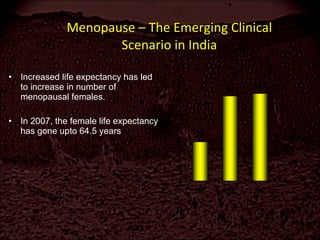
Menopause – The Emerging Clinical Scenario in India Increased life expectancy has led to increase in number of menopausal females. In 2007, the female life expectancy has gone upto 64.5 years
Comparison of world wide postmenopausal  women over the years 05/01/10 maninder ahuja 1990 2030 World wise population 470nmillion 1.2 billion Developing countries 40% 24%  Developed countries 60% 76%
FOR ALL THESE WOMEN QUALITY OF LIFE IS IMPORTANT !  05/01/10 maninder ahuja
ATROPHIC VAGINITIS  MOST UNDER REPORTED UNDER DIAGNOSED & UNDERTREATED  05/01/10 maninder ahuja
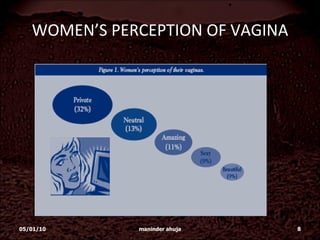
Perception about vagina Women don’t  want to talk about vagina in public It is considered a private part Some want to talk but feel society is not ready for it. So on the whole is still hussh hush  No don’t talk! 05/01/10 maninder ahuja
WOMEN’S PERCEPTION OF VAGINA 05/01/10 maninder ahuja
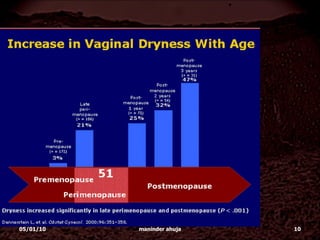
EPIDEMIOLOGY OF  ATROPHIC VAGINITIS About 80% of postmenopausal women  symptomatic.  About 20% present with atrophic vaginitis symptoms.  Of those, about 1% to 5% will seek specific treatment for atrophic vaginitis symptoms.  Many will seek treatment at a relatively advanced age, about 5 to 10 years after menopause.  The reason,  is an age-related increase in the severity of symptoms -- less than 5% among premenopausal women, going up to about 25% of women by 1 year after menopause, and to 50% by years 3 to 5. 05/01/10 maninder ahuja
05/01/10 maninder ahuja
ROLE OF VAGINAL PH The normal premenopausal vagina has a pH of  3.5-4.5  Estrogen stimulates maturation of the vaginal epithelium  Lactobacilli in the vagina metabolize glucose (produced by the breakdown of glycogen) to lactic acid, which is responsible for the acidic nature of the vagina.  > 5 in a premenopausal woman suggests the presence of a pathologic vaginitis.  05/01/10 maninder ahuja
CONT.– VAGINAL PH Estradiol levels  fall from about  120 ng/L  in perimenopause to  < 20 ng/L  after menopause. This drop in estrogen leads to a decrease in glycogen and lactobacilli, resulting in a shift toward a less healthy alkaline pH pH >5  predisposes the vagina to infection by pathogens. 05/01/10 maninder ahuja
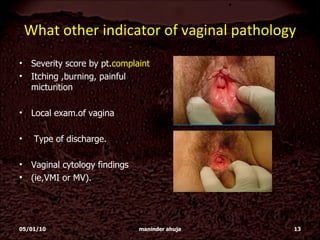
What other indicator of vaginal pathology Severity score by pt. complaint Itching ,burning, painful micturition Local exam.of vagina  Type of discharge. Vaginal cytology findings  (ie,VMI or MV).  05/01/10 maninder ahuja
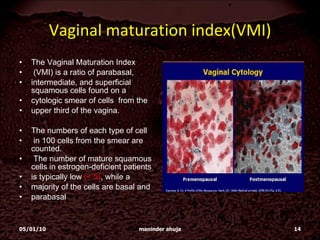
Vaginal maturation index(VMI) The Vaginal Maturation Index (VMI) is a ratio of parabasal,  intermediate, and superficial squamous cells found on a  cytologic smear of cells  from the  upper third of the vagina. The numbers of each type of cell in 100 cells from the smear are counted. The number of mature squamous cells in estrogen-deficient patients  is typically low  (< 5) , while a  majority of the cells are basal and  parabasal 05/01/10 maninder ahuja
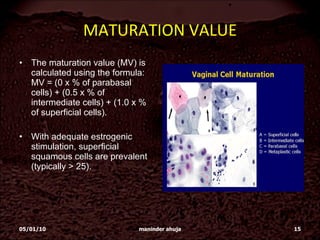
MATURATION VALUE The maturation value (MV) is calculated using the formula: MV = (0 x % of parabasal cells) + (0.5 x % of intermediate cells) + (1.0 x % of superficial cells). With adequate estrogenic stimulation, superficial squamous cells are prevalent (typically > 25). 05/01/10 maninder ahuja
IN POSTMENOPUASE The menopausal vagina alterations in the quantity and quality of its vaginal secretions. Prior to menopause, women typically produce vaginal fluid that is clear or slightly white in color, odorless, and nonirritating.  As estrogen levels decline at menopause, vaginal fluid becomes scant and yellowish in color, and lubrication is diminished during sexual activity 05/01/10 maninder ahuja
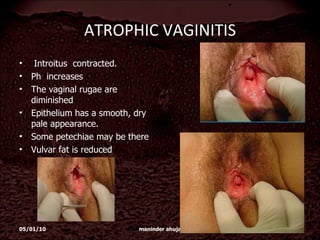
ATROPHIC VAGINITIS Introitus  contracted.  Ph  increases The vaginal rugae are diminished  Epithelium has a smooth, dry  pale appearance.  Some petechiae may be there Vulvar fat is reduced 05/01/10 maninder ahuja
Symptoms  Itching Burning  Painful micturition Frequency of micturition Dysparunia Decreased sexual desire 05/01/10 maninder ahuja
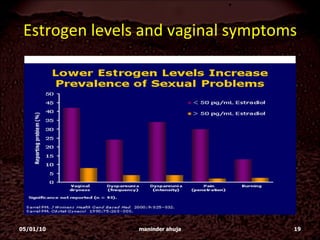
Estrogen levels and vaginal symptoms 05/01/10 maninder ahuja
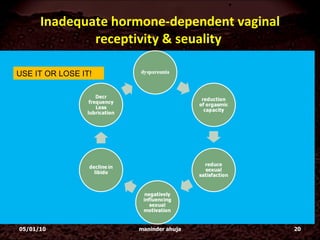
Inadequate hormone-dependent vaginal receptivity & seuality  05/01/10 maninder ahuja USE IT OR LOSE IT!
Other causes Prolonged breastfeeding Premature ovarian failure After ovarian ablation (chemical or radiation induced) Hypothalamic amenorrhea or hyperprolactinemia Medication to decrease estrogen levels as a treatment for endometriosis or uterine fibroids.  05/01/10 maninder ahuja
other causes of vaginitis Vaginal infection Bacterial vaginosis  (overgrowth of certain vaginal bacteria)  Sexually transmitted diseases  Allergic reactions Douching  Irritation from tampons or birth control devices Trauma  Foreign body  05/01/10 maninder ahuja
Other causes  Skin conditions Certain diseases like diabetes Benign and malignant tumors  Psychological causes  Injury to pelvic nerve fibers,  vulvar pain Vulvodynia  Certain endocrine therapies (eg, aromatase inhibitors)  Certain medications (eg, antibiotics) Medically induced menopause  (eg, cancer treatment)  05/01/10 maninder ahuja
Atrophic vaginitis is progressive vasomotor symptoms  may decrease over time  Atrophic  vaginitis  usually persists if left untreated. Both estrogen and sexual activity, which promotes blood flow to the genital area, help maintain vaginal health .. 05/01/10 maninder ahuja
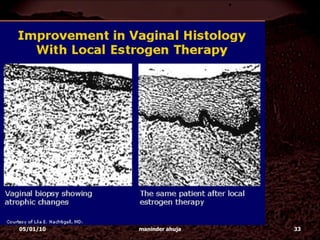
Management  ET improves the maturation (thickness)  Elasticity of the epithelium increased Increases blood flow to the vagina Reduces vaginal pH Increases the production of vaginal secretions 05/01/10 maninder ahuja
Local estrogens Localized ET is  as effective as systemic ET for treating vaginal atrophy and is associated with fewer side effects.  Twice-weekly regimen often follows 1-2 weeks of daily administration ER-alpha activity in vaginal cells decreases with age There fore Vaginal estrogen therapy may require long-term treatment  with  increasing  dosage of the hormone.  05/01/10 maninder ahuja
Urinary symptoms Local vaginal estrogen therapy affects ERs in urethral mucosa and smooth muscle. Although some studies have demonstrated a worsening of incontinence with oral therapies, vaginal estrogen has reduced the frequency of urinary tract infections in menopausal women. Perrotta C, Aznar M, Mejia R, Albert X, Ng CW: Oestrogens for preventing recurrent urinary tract infection in postmenopausal women.  Cochrane Database Syst. Rev. 2(2),CD005131 (2008) .  05/01/10 maninder ahuja
Low dose vaginal estrogens are effective Usual dose of estradiol vaginal cream is 100 –400 mcg/day Lower doses of 10 mcg/day, relieved more than 80% of symptoms,  Santen RJ, Pinkerton JV, Conaway M  et al. : Treatment of urogenital atrophy with low-dose estradiol: preliminary results.  Menopause 9(3),179–187 (2002).  • Small pilot study on the positive effect of lower dose vaginal estrogen 05/01/10 maninder ahuja
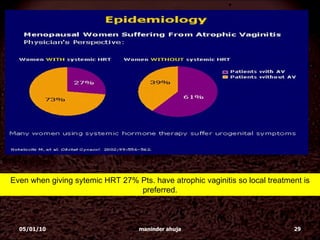
05/01/10 maninder ahuja Even when giving sytemic HRT 27% Pts. have atrophic vaginitis so local treatment is preferred.
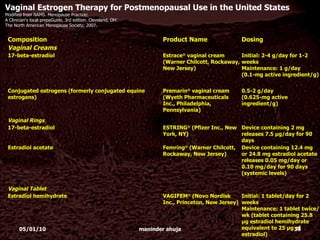
Vaginal Estrogen Therapy for Postmenopausal Use in the United States   Modified from NAMS. Menopause Practice:  A Clinician's local prepaGuide, 3rd edition. Cleveland, OH:  The North American Menopause Society; 2007.  05/01/10 maninder ahuja Composition Product Name Dosing Vaginal Creams   17-beta-estradiol Estrace ®  vaginal cream (Warner Chilcott, Rockaway, New Jersey) Initial: 2-4 g/day for 1-2 weeks Maintenance: 1 g/day (0.1-mg active ingredient/g) Conjugated estrogens (formerly conjugated equine estrogens) Premarin ®  vaginal cream (Wyeth Pharmaceuticals Inc., Philadelphia, Pennsylvania) 0.5-2 g/day (0.625-mg active ingredient/g) Vaginal Rings   17-beta-estradiol ESTRING ®  (Pfizer Inc., New York, NY) Device containing 2 mg releases 7.5 µg/day for 90 days Estradiol acetate Femring ®  (Warner Chilcott, Rockaway, New Jersey) Device containing 12.4 mg or 24.8 mg estradiol acetate releases 0.05 mg/day or 0.10 mg/day for 90 days (systemic levels) Vaginal Tablet   Estradiol hemihydrate VAGIFEM ®  (Novo Nordisk Inc., Princeton, New Jersey) Initial: 1 tablet/day for 2 weeks Maintenance: 1 tablet twice/wk (tablet containing 25.8 µg estradiol hemihydrate equivalent to 25 µg of estradiol)
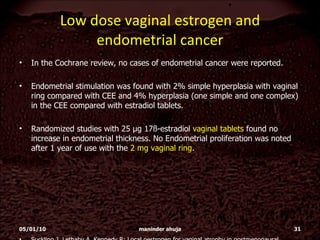
Low dose vaginal estrogen and endometrial cancer In the Cochrane review, no cases of endometrial cancer were reported.  Endometrial stimulation was found with 2% simple hyperplasia with vaginal ring compared with CEE and 4% hyperplasia (one simple and one complex) in the CEE compared with estradiol tablets.  Randomized studies with 25 µg 17ß-estradiol  vaginal tablets  found no increase in endometrial thickness. No Endometrial proliferation was noted after 1 year of use with the  2 mg vaginal ring . Suckling J, Lethaby A, Kennedy R: Local oestrogen for vaginal atrophy in postmenopausal women.  Cochrane Database Syst. Rev. 4(4),CD001500 (2006).  05/01/10 maninder ahuja
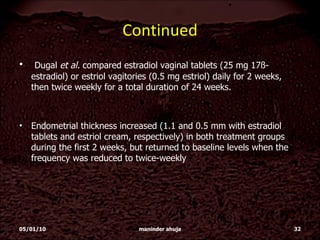
Continued Dugal  et al.  compared estradiol vaginal tablets (25 mg 17ß-estradiol) or estriol vagitories (0.5 mg estriol) daily for 2 weeks, then twice weekly for a total duration of 24 weeks. Endometrial thickness increased (1.1 and 0.5 mm with estradiol tablets and estriol cream, respectively) in both treatment groups during the first 2 weeks, but returned to baseline levels when the frequency was reduced to twice-weekly 05/01/10 maninder ahuja
05/01/10 maninder ahuja
Effect on breast? Reports  conflicting regarding breast safety.  Rosenberg  et al.  found no associations between nonexclusive or exclusive use of local low-potency estrogen therapy and either ductal or lobular breast cancer Kendall  et al.  found that the vaginal estradiol tablet significantly raised systemic estradiol levels greater than 19 pmol/l over low baseline estradiol levels and suggested that this could affect the estradiol suppression achieved by  aromatase inhibitors in women with breast cancer. Rosenberg LU, Magnusson C, Lindstrom E  et al. : Menopausal hormone therapy and other breast cancer risk factors in relation to the risk of different histological subtypes of breast cancer: a case–control study.  Breast Cancer Res. 8(1),R11 (2006).  Kendall A, Dowsett M, Folkerd E, Smith I: Caution: vaginal estradiol appears to be contraindicated in postmenopausal women on adjuvant aromatase inhibitors.  Ann. Oncol. 17(4),584–587 (2006).  05/01/10 maninder ahuja
Carry home message Specifically enquire about atrophic vaginitis symptoms Counsel regarding the fact that it is progressive More often use topical estrogens No progestrone needed with local  estrogen preparations Even urinary symptoms may improve Sexuality problems if because of vaginitis would  improve Local Ph testing would diagnose early 05/01/10 maninder ahuja
THIS IS NOT END , THIS IS THE BEGINNIG OF OUR EFFORTS FOR QUALITY CARE! 05/01/10 maninder ahuja

Atrophic vaginitis under treated under diagnosed(f)

  • 1.
    Atrophic vaginitis underdiagnosed and under treated Dr.MANINDER AHUJA FARIDABAD CHAIR PERSON GERIATRIC GYNAECOLOGY COMMITTEE OF FOGSI 05/01/10 maninder ahuja
  • 2.
    What has changedWomen have to spend more than 1/3 rd of their life in menopause More stress on quality of life Prevention has a central role to play Symptomatic relief of menopausal problems with shortest period and smallest dosage possible Search for newer salts, new dosage schedule 05/01/10 maninder ahuja
  • 3.
    Menopause – TheEmerging Clinical Scenario in India Increased life expectancy has led to increase in number of menopausal females. In 2007, the female life expectancy has gone upto 64.5 years
  • 4.
    Comparison of worldwide postmenopausal women over the years 05/01/10 maninder ahuja 1990 2030 World wise population 470nmillion 1.2 billion Developing countries 40% 24% Developed countries 60% 76%
  • 5.
    FOR ALL THESEWOMEN QUALITY OF LIFE IS IMPORTANT ! 05/01/10 maninder ahuja
  • 6.
    ATROPHIC VAGINITIS MOST UNDER REPORTED UNDER DIAGNOSED & UNDERTREATED 05/01/10 maninder ahuja
  • 7.
    Perception about vaginaWomen don’t want to talk about vagina in public It is considered a private part Some want to talk but feel society is not ready for it. So on the whole is still hussh hush No don’t talk! 05/01/10 maninder ahuja
  • 8.
    WOMEN’S PERCEPTION OFVAGINA 05/01/10 maninder ahuja
  • 9.
    EPIDEMIOLOGY OF ATROPHIC VAGINITIS About 80% of postmenopausal women symptomatic. About 20% present with atrophic vaginitis symptoms. Of those, about 1% to 5% will seek specific treatment for atrophic vaginitis symptoms. Many will seek treatment at a relatively advanced age, about 5 to 10 years after menopause. The reason, is an age-related increase in the severity of symptoms -- less than 5% among premenopausal women, going up to about 25% of women by 1 year after menopause, and to 50% by years 3 to 5. 05/01/10 maninder ahuja
  • 10.
  • 11.
    ROLE OF VAGINALPH The normal premenopausal vagina has a pH of 3.5-4.5 Estrogen stimulates maturation of the vaginal epithelium Lactobacilli in the vagina metabolize glucose (produced by the breakdown of glycogen) to lactic acid, which is responsible for the acidic nature of the vagina. > 5 in a premenopausal woman suggests the presence of a pathologic vaginitis. 05/01/10 maninder ahuja
  • 12.
    CONT.– VAGINAL PHEstradiol levels fall from about 120 ng/L in perimenopause to < 20 ng/L after menopause. This drop in estrogen leads to a decrease in glycogen and lactobacilli, resulting in a shift toward a less healthy alkaline pH pH >5 predisposes the vagina to infection by pathogens. 05/01/10 maninder ahuja
  • 13.
    What other indicatorof vaginal pathology Severity score by pt. complaint Itching ,burning, painful micturition Local exam.of vagina Type of discharge. Vaginal cytology findings (ie,VMI or MV). 05/01/10 maninder ahuja
  • 14.
    Vaginal maturation index(VMI)The Vaginal Maturation Index (VMI) is a ratio of parabasal, intermediate, and superficial squamous cells found on a cytologic smear of cells from the upper third of the vagina. The numbers of each type of cell in 100 cells from the smear are counted. The number of mature squamous cells in estrogen-deficient patients is typically low (< 5) , while a majority of the cells are basal and parabasal 05/01/10 maninder ahuja
  • 15.
    MATURATION VALUE Thematuration value (MV) is calculated using the formula: MV = (0 x % of parabasal cells) + (0.5 x % of intermediate cells) + (1.0 x % of superficial cells). With adequate estrogenic stimulation, superficial squamous cells are prevalent (typically > 25). 05/01/10 maninder ahuja
  • 16.
    IN POSTMENOPUASE Themenopausal vagina alterations in the quantity and quality of its vaginal secretions. Prior to menopause, women typically produce vaginal fluid that is clear or slightly white in color, odorless, and nonirritating. As estrogen levels decline at menopause, vaginal fluid becomes scant and yellowish in color, and lubrication is diminished during sexual activity 05/01/10 maninder ahuja
  • 17.
    ATROPHIC VAGINITIS Introitus contracted. Ph increases The vaginal rugae are diminished Epithelium has a smooth, dry pale appearance. Some petechiae may be there Vulvar fat is reduced 05/01/10 maninder ahuja
  • 18.
    Symptoms ItchingBurning Painful micturition Frequency of micturition Dysparunia Decreased sexual desire 05/01/10 maninder ahuja
  • 19.
    Estrogen levels andvaginal symptoms 05/01/10 maninder ahuja
  • 20.
    Inadequate hormone-dependent vaginalreceptivity & seuality 05/01/10 maninder ahuja USE IT OR LOSE IT!
  • 21.
    Other causes Prolongedbreastfeeding Premature ovarian failure After ovarian ablation (chemical or radiation induced) Hypothalamic amenorrhea or hyperprolactinemia Medication to decrease estrogen levels as a treatment for endometriosis or uterine fibroids. 05/01/10 maninder ahuja
  • 22.
    other causes ofvaginitis Vaginal infection Bacterial vaginosis (overgrowth of certain vaginal bacteria) Sexually transmitted diseases Allergic reactions Douching Irritation from tampons or birth control devices Trauma Foreign body 05/01/10 maninder ahuja
  • 23.
    Other causes Skin conditions Certain diseases like diabetes Benign and malignant tumors Psychological causes Injury to pelvic nerve fibers, vulvar pain Vulvodynia Certain endocrine therapies (eg, aromatase inhibitors) Certain medications (eg, antibiotics) Medically induced menopause (eg, cancer treatment) 05/01/10 maninder ahuja
  • 24.
    Atrophic vaginitis isprogressive vasomotor symptoms may decrease over time Atrophic vaginitis usually persists if left untreated. Both estrogen and sexual activity, which promotes blood flow to the genital area, help maintain vaginal health .. 05/01/10 maninder ahuja
  • 25.
    Management ETimproves the maturation (thickness) Elasticity of the epithelium increased Increases blood flow to the vagina Reduces vaginal pH Increases the production of vaginal secretions 05/01/10 maninder ahuja
  • 26.
    Local estrogens LocalizedET is as effective as systemic ET for treating vaginal atrophy and is associated with fewer side effects. Twice-weekly regimen often follows 1-2 weeks of daily administration ER-alpha activity in vaginal cells decreases with age There fore Vaginal estrogen therapy may require long-term treatment with increasing dosage of the hormone. 05/01/10 maninder ahuja
  • 27.
    Urinary symptoms Localvaginal estrogen therapy affects ERs in urethral mucosa and smooth muscle. Although some studies have demonstrated a worsening of incontinence with oral therapies, vaginal estrogen has reduced the frequency of urinary tract infections in menopausal women. Perrotta C, Aznar M, Mejia R, Albert X, Ng CW: Oestrogens for preventing recurrent urinary tract infection in postmenopausal women. Cochrane Database Syst. Rev. 2(2),CD005131 (2008) . 05/01/10 maninder ahuja
  • 28.
    Low dose vaginalestrogens are effective Usual dose of estradiol vaginal cream is 100 –400 mcg/day Lower doses of 10 mcg/day, relieved more than 80% of symptoms, Santen RJ, Pinkerton JV, Conaway M et al. : Treatment of urogenital atrophy with low-dose estradiol: preliminary results. Menopause 9(3),179–187 (2002). • Small pilot study on the positive effect of lower dose vaginal estrogen 05/01/10 maninder ahuja
  • 29.
    05/01/10 maninder ahujaEven when giving sytemic HRT 27% Pts. have atrophic vaginitis so local treatment is preferred.
  • 30.
    Vaginal Estrogen Therapyfor Postmenopausal Use in the United States Modified from NAMS. Menopause Practice: A Clinician's local prepaGuide, 3rd edition. Cleveland, OH: The North American Menopause Society; 2007. 05/01/10 maninder ahuja Composition Product Name Dosing Vaginal Creams 17-beta-estradiol Estrace ® vaginal cream (Warner Chilcott, Rockaway, New Jersey) Initial: 2-4 g/day for 1-2 weeks Maintenance: 1 g/day (0.1-mg active ingredient/g) Conjugated estrogens (formerly conjugated equine estrogens) Premarin ® vaginal cream (Wyeth Pharmaceuticals Inc., Philadelphia, Pennsylvania) 0.5-2 g/day (0.625-mg active ingredient/g) Vaginal Rings 17-beta-estradiol ESTRING ® (Pfizer Inc., New York, NY) Device containing 2 mg releases 7.5 µg/day for 90 days Estradiol acetate Femring ® (Warner Chilcott, Rockaway, New Jersey) Device containing 12.4 mg or 24.8 mg estradiol acetate releases 0.05 mg/day or 0.10 mg/day for 90 days (systemic levels) Vaginal Tablet Estradiol hemihydrate VAGIFEM ® (Novo Nordisk Inc., Princeton, New Jersey) Initial: 1 tablet/day for 2 weeks Maintenance: 1 tablet twice/wk (tablet containing 25.8 µg estradiol hemihydrate equivalent to 25 µg of estradiol)
  • 31.
    Low dose vaginalestrogen and endometrial cancer In the Cochrane review, no cases of endometrial cancer were reported. Endometrial stimulation was found with 2% simple hyperplasia with vaginal ring compared with CEE and 4% hyperplasia (one simple and one complex) in the CEE compared with estradiol tablets. Randomized studies with 25 µg 17ß-estradiol vaginal tablets found no increase in endometrial thickness. No Endometrial proliferation was noted after 1 year of use with the 2 mg vaginal ring . Suckling J, Lethaby A, Kennedy R: Local oestrogen for vaginal atrophy in postmenopausal women. Cochrane Database Syst. Rev. 4(4),CD001500 (2006). 05/01/10 maninder ahuja
  • 32.
    Continued Dugal et al. compared estradiol vaginal tablets (25 mg 17ß-estradiol) or estriol vagitories (0.5 mg estriol) daily for 2 weeks, then twice weekly for a total duration of 24 weeks. Endometrial thickness increased (1.1 and 0.5 mm with estradiol tablets and estriol cream, respectively) in both treatment groups during the first 2 weeks, but returned to baseline levels when the frequency was reduced to twice-weekly 05/01/10 maninder ahuja
  • 33.
  • 34.
    Effect on breast?Reports conflicting regarding breast safety. Rosenberg et al. found no associations between nonexclusive or exclusive use of local low-potency estrogen therapy and either ductal or lobular breast cancer Kendall et al. found that the vaginal estradiol tablet significantly raised systemic estradiol levels greater than 19 pmol/l over low baseline estradiol levels and suggested that this could affect the estradiol suppression achieved by aromatase inhibitors in women with breast cancer. Rosenberg LU, Magnusson C, Lindstrom E et al. : Menopausal hormone therapy and other breast cancer risk factors in relation to the risk of different histological subtypes of breast cancer: a case–control study. Breast Cancer Res. 8(1),R11 (2006). Kendall A, Dowsett M, Folkerd E, Smith I: Caution: vaginal estradiol appears to be contraindicated in postmenopausal women on adjuvant aromatase inhibitors. Ann. Oncol. 17(4),584–587 (2006). 05/01/10 maninder ahuja
  • 35.
    Carry home messageSpecifically enquire about atrophic vaginitis symptoms Counsel regarding the fact that it is progressive More often use topical estrogens No progestrone needed with local estrogen preparations Even urinary symptoms may improve Sexuality problems if because of vaginitis would improve Local Ph testing would diagnose early 05/01/10 maninder ahuja
  • 36.
    THIS IS NOTEND , THIS IS THE BEGINNIG OF OUR EFFORTS FOR QUALITY CARE! 05/01/10 maninder ahuja

Editor's Notes

  • #5 DR.MANINDER AHUJA
  • #7 DR.MANINDER AHUJA
  • #9 DR.MANINDER AHUJA
  • #10 DR.MANINDER AHUJA
  • #11 DR.MANINDER AHUJA
  • #14 DR.MANINDER AHUJA
  • #18 DR.MANINDER AHUJA
  • #23 to chemicals in soaps, bubble baths, spermicides, condoms, feminine hygiene sprays, deodorant tampons/pads
  • #24 (eg, inflammatory bowel disease, diabetes mellitus, lupus erythematosus)
  • #30 DR.MANINDER AHUJA
  • #31 DR.MANINDER AHUJA
  • #34 DR.MANINDER AHUJA