Syndromic Approach
Syndrome – is group of symptoms patient
complains about and clinical signs you
observe during examination
Different organisms that cause STIs give rise
to only limited number of syndromes
Although many different pathogens cause
STIs, some of them give rise to similar or
overlapping clinical appearances
WHO recommendation
Syndromic Approach cont’d
The syndromic approach using flowcharts
to guide diagnosis and treatment is more
accurate than diagnosis based on clinical
judgment alone
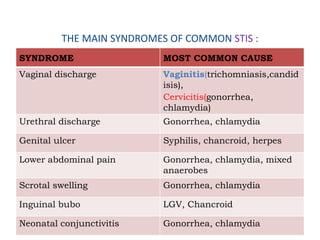
THE MAIN SYNDROMES OF COMMON STIS :
SYNDROME MOST COMMON CAUSE
Vaginal discharge Vaginitis(trichomniasis,candid
isis),
Cervicitis(gonorrhea,
chlamydia)
Urethral discharge Gonorrhea, chlamydia
Genital ulcer Syphilis, chancroid, herpes
Lower abdominal pain Gonorrhea, chlamydia, mixed
anaerobes
Scrotal swelling Gonorrhea, chlamydia
Inguinal bubo LGV, Chancroid
Neonatal conjunctivitis Gonorrhea, chlamydia
Key Features of Syndromic Management
Problem oriented (responds to patient’s symptoms
)
Highly sensitive and does not miss mixed
infections
Treats the patient at first visit
Can be implemented at primary health care level
Use flow charts with logical steps
Provides opportunity and time for education and
counseling
The Five Steps in Syndromic STI Case
1. History taking and examination
2. Syndromic diagnosis and treatment, using flow
charts
3. Education and counseling on HIV testing and
safer sex, including condom promotion and
provision
4. Management of sexual partners
5. Recording and reporting
Criteria for the selection of STI drugs
A. Availability
B. Low cost
C. High efficacy (at least 95%)
D. Acceptable toxicity and tolerance (safety)
E. Organism resistance unlikely to develop or likely to
be delayed
F. Single dose
G. Oral administration
H. Not contraindicated for pregnant or lactating
.
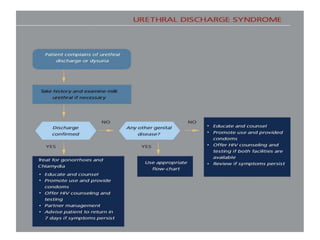
Urethral discharge and/or burning
Common symptoms of urethritis in men
History taking and examination:
Take history and examine the patient.
Inspect genital organs.
Do not forget to inspect the interior part
of the prepuce and the covered part of
glans penis.
Reasons for medical examination:
 To confirm the presence of urethral discharge
 To rule out existence of other STIs
Major pathogens
causes urethral discharge:
Neisseria Gonorrhoea and Chlamydia
trachomatis (2nd in Ethiopia)
Rarely other causes mycoplasma
genitalium
Occur in NGU (Chlamydia trachomatis the
most common)
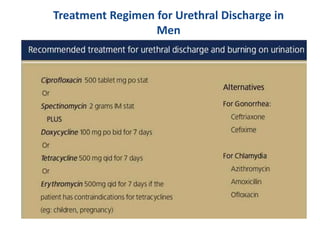
Treatment Regimen for Urethral Discharge in
Men
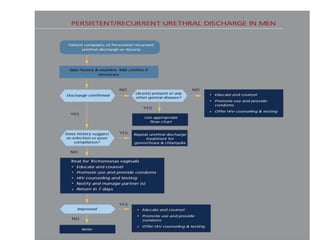
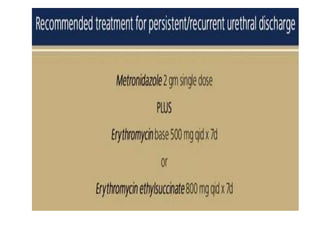
Persistent (Recurrent Urethral
discharge
Pt present with persistent or recurrent
burning sensation on urination with or with
out discharge
Cause can be:
In adequate Rx
Re infection
Infection by drug resistance
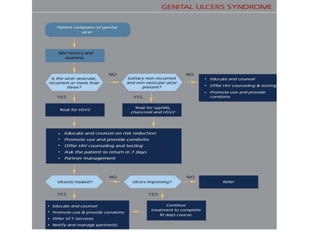
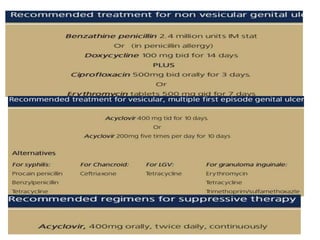
Genital Ulcer /vesicular or non
vesicular ulcer)
History taking and examination:
 Take the client’s history and conduct an
examination.
 Inspect the genital organs.
 Do not forget to inspect the interior part of
the prepuce and the covered part of the glans
penis in men and the skin of the external
genitalia, including the mucous surfaces of the
labia and anus in women.
Reasons for medical examination:
To confirm the presence of ulcer(s)
To ensure no other STIs are present
Special Circumstances
If there are no ulcers, the patient may have
grouped vesicular lesions with a history of
recurrence that require the management of
Herpes
Ulcers due to drug intake (fixed drug eruption),
scabies and trauma can be excluded by
determining the patient’s history and through a
urine analysis
If you have not been able to confirm the presence
of STIs, reassure your patient, educate him/her
and promote the use of condoms
Major Pathogens
Treponema pallidum (Syphilis)
Hemophilus ducreyi (Chancroid)
Herpes simplex virus (Genital herpes)
Chlamydia trachomatis (LGV)
Calymmato bacterium granulomatis
(Donovanosis)
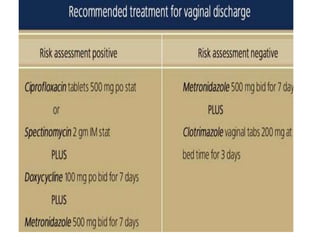
Vaginal discharge syndrome
Most cases of vaginal discharge are not of an
STI origin, Candidiasis and bacterial vaginosis
are the most common causes.
History taking and examination:
Take history and try to assess clients STI risks.
An STI risk assessment is considered positive if the
patient or her partner has an STI or a high-risk
behavior.
 Examine the patient.
Vaginal discharge syndrome cont’d
Remember:
Vaginal discharges may be physiological.
Using speculum, if available, inspect the cervix
and the vagina to locate the origin of the
discharge.
Do not forget to note the type, color, odor and
amount of discharge.
Ask whether the patient also has pain in the lower
abdomen.
Vaginal discharge syndrome cont’d
The wet mount/gram stain microscopy of
vaginal specimen will help in the diagnosis of:
Trichomoniasis: mobile trichomonads
Candidiasis: Budding yeasts or
pseudohyphae
Bacterial vaginosis: presence of Clue
cells plus pH > 4.5 or KOH positive
Cause
•Vaginitis
•Cervicitis
Major Pathogens that cause Vaginitis
• Trichomonas vaginalis
• Candida albicans
• Non specific vaginitis (Gardnella vaginalis)
Major Pathogens that cause Cervicitis:
Neisseria gonorrhea (Gonorrhea)
Chlamydia trachomatis (Chlamydial infection)
Bacterial vaginosis (Gardnella vaginalis) is the
leading cause of vaginal discharge in Ethiopia.
List of cause of vaginal discharge from
commonest to less common :-
Vaginosis (G.vaginalis) , candidiasis,
Trichomoniasis ,Gonorrhoea& Chlamydia
Complication of Cervicitis and vaginitis
PID
PRM
 pre-term labour
Infectivity
 chronic pelvic pain
Risk assessment
one or more:
Multiple sexual partner in last 3 month
New sexual partner in last 3 month
Ever traded sex and Age below 25 years
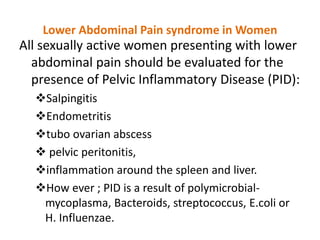
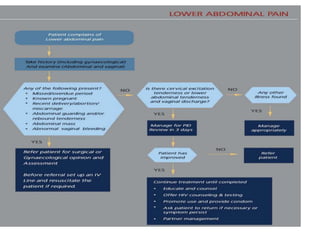
Lower Abdominal Pain syndrome in Women
All sexually active women presenting with lower
abdominal pain should be evaluated for the
presence of Pelvic Inflammatory Disease (PID):
Salpingitis
Endometritis
tubo ovarian abscess
 pelvic peritonitis,
inflammation around the spleen and liver.
How ever ; PID is a result of polymicrobial-
mycoplasma, Bacteroids, streptococcus, E.coli or
H. Influenzae.
Lower Abdominal Pain syndrome in Women
cont’d
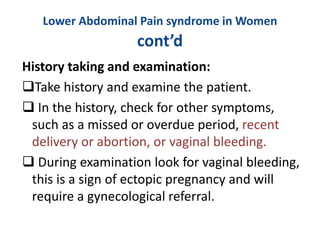
History taking and examination:
Take history and examine the patient.
 In the history, check for other symptoms,
such as a missed or overdue period, recent
delivery or abortion, or vaginal bleeding.
 During examination look for vaginal bleeding,
this is a sign of ectopic pregnancy and will
require a gynecological referral.
Lower Abdominal Pain syndrome in Women cont’d
Bimanual Examination:
During bimanual examination look for
swelling or lumps in the patient's abdomen.
 Notice tenderness on cervical mobilization
Lower Abdominal Pain syndrome in Women cont’d
During the examination, keep the following
points in mind:
Tenderness: superficial palpation
Rebound tenderness: deep palpation – severe
tenderness when pressed slowly and pressure
is suddenly removed
Guarding: rigid abdominal muscles
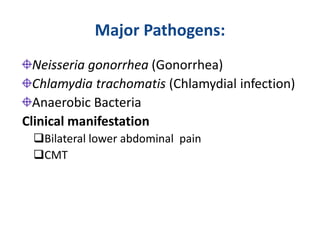
Major Pathogens:
Neisseria gonorrhea (Gonorrhea)
Chlamydia trachomatis (Chlamydial infection)
Anaerobic Bacteria
Clinical manifestation
Bilateral lower abdominal pain
CMT
Complications
Ectopic pregnancy
Infertility
Peritonitis and intera-abdominal abscess
Adhesion or intestinal obstruction
Note:
No pain killers should be used since they may
mask serious complications.
Patients receiving metronidazole should be
cautioned to avoid alcohol.
Persistence of lower abdominal pain may be
due to:
Incorrect diagnosis
Complicated infections
Incorrect use of anti-microbial drugs
Hospitalization should be considered in the following
circumstances:
The diagnosis is uncertain
Surgical emergencies, such as appendicitis and
ectopic pregnancy
Suspected pelvic abscess
Severe illness
The patient is pregnant
The patient failed to respond to outpatient
therapy
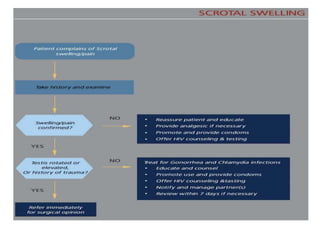
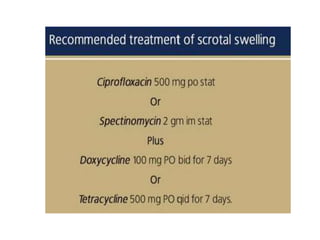
Scrotal Swelling and Pain syndrome
• Inflammation of the epididymis (epididymitis)
usually manifests itself by acute onset of
unilateral testicular pain and swelling.
• The adjacent testis is often inflamed
(orchitis), giving rise to epididymo-orchitis.
Scrotal Swelling and Pain syndrome
History taking and examination:
Take history and examine the patient In the
history, check whether the patient has injured
himself or whether the patient has had an STI
in the last six weeks.
Inspect the scrotal skin for bruising.
Do not forget to palpate the scrotal sac,
comparing the two sides, and check for
swelling and pain in the testis, position of the
testis in the scrotal sac (elevation, rotation or
torsion).
The reasons for examination are:
To exclude the presence of swelling and or
pain in the testis
To exclude rotation or elevation or torsion or
trauma to the testis
To exclude inguinal hernia
To exclude trauma to tests
To confirm the presence of urethral discharge
To make sure that there are no other STIs
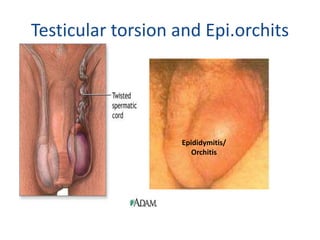
Testicular torsion and Epi.orchits
Epididymitis/
Orchitis
Major Pathogens
• Neisseria gonorrhea (Gonorrhea)
• Chlamydia trachomatis (Chlamydial
infection)
• The cause varies according to the age of the
pt.
If younger than 35 years – the cause likely N.
Gonorrhoea or C. Trachomatis
If older than 35 year – gram negative organisms
Possibly TBC if not involved in unsafe sex
• Other causes may be Brucellosis, mumps,
onchocerciasis, w. Flariasis
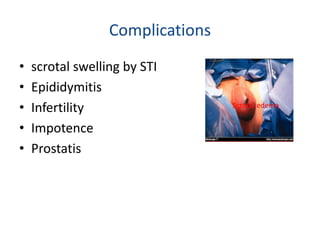
Complications
• scrotal swelling by STI
• Epididymitis
• Infertility
• Impotence
• Prostatis
Scrotal edema
Inguinal Bubo syndrome (Inguinal Swelling)
Swelling of inguinal lymph nods as a result
of STI
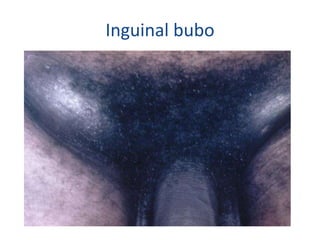
Inguinal bubo is an abscess of a lymph
node.
It presents as a localized enlargement,
which is often painful and may be fluctuant.
Frequently, inguinal bubo is caused by LGV
and chancroid.
Inguinal Bubo syndrome (Inguinal Swelling
cont’d
• Acute infection of either the lower limbs or
genital region may cause inguinal
Adenophathy.
• The enlarged lymph nodes may appear in
syphilitic or HIV infection.
• These lymph nodes are not really
considered as bubo.
Inguinal Bubo syndrome (Inguinal Swelling cont’d
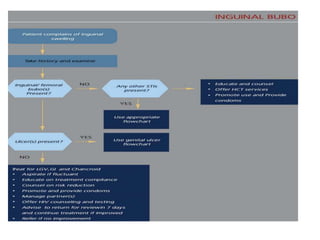
• If the patient presents with bubo and
associated ulcers, the care provider must
refer to the genital ulcer flow-chart.
• This would include treatment for syphilis and
Chancroid.
• If a patient complains of having bubo
without the presence of ulcers, use the
inguinal bubo flow chart in determining
proper treatment.
Inguinal Bubo syndrome (Inguinal
Swelling cont’d
History taking and examination:
• Take history and examine the patient.
• When taking the history, check to determine
whether the patient has groin pain, recent
or past genital ulcer or swelling anywhere in
the body.
• Inspect the lymph nodes and examine to
confirm whether the enlarged node is
painful, warm, and tender to palpation and
fluctuant.
Inguinal Bubo syndrome (Inguinal
Swelling cont’d
If a bubo is present, do not forget to
inspect the interior part of the prepuce
and covered part of the glans penis in men
and external genitalia and mucous surface
of the labia in women, to exclude the
presence of genital ulcer.
If the patient does not have any ulcers, the
patient may have vesicular lesions. If this is
the case, the care provider should provide
treatment for herpes.
Inguinal bubo
Reasons for the examination:
• To confirm the presence of bubo
• To exclude the presence of ulcers
• To make sure the patient does not have
another STI
• If you have not been able to confirm the
presence of STIs, reassure your patient,
educate him/her and promote the use of
condoms.
Major Pathogens:
• Lymphogranuloma venereum Chlamydia
• Hemophilus ducreyi (Chancroid)
• Chlamydia granulomatis
• Sometimes T.Palladium (does not produce
necrosis & abscess)
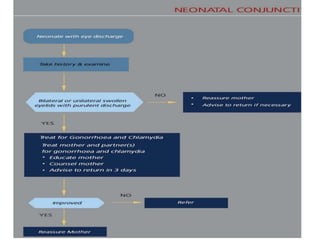
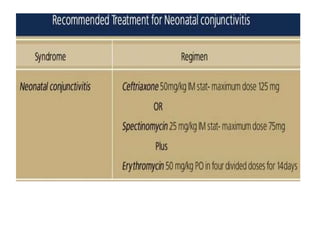
Neonatal conjunctivitis
• Conjunctivitis in a newborn may be caused by
• infection,
• a blocked tear duct, or by
• irritation produced by the antibiotic eye drops
given at birth.
Neonatal conjunctivitis cont’d
Many organisms can cause infection in the
eyes of newborn infants.
The most common bacterial infections with
potential to cause serious eye damage are
gonorrhea and Chlamydia, which can be
passed from mother to child during birth.
The viruses that cause genital and oral herpes
can also cause neonatal conjunctivitis and
severe eye damage.
Prevention of Neonatal Conjunctivitis:
• Immediately after delivery, the eyelids are
cleaned with hydrophilic cotton; before the
eyes are opened
• 1% tetracycline eye ointment is applied into
each inferior conjunctival sac
• The management of neonatal conjunctivitis
must be applied for any baby less than 1
month of age that is suffering from eye
suppuration
History taking and examination
• Take history from the mother andexamine the
baby. Ask the mother if she or her sexual
partner(s) have any STI symptoms. Inspect the
baby's eyes for a purulent conjunctival
discharge. Do not forget to separate or press
the eye lids, to look for pus pouring out from
beneath them.
Reasons for history taking and examination
• To confirm the presence of purulent
conjunctival discharge frombaby's eyes
• To make sure that the mother does not have
any other STIs
Major Pathogens:
• Neisseria gonorrhea (Gonorrhea)
• Chlamydia trachomatis (Chlamydial infection)
Clinical manifestations
• Pre-orbital swelling
• Redness of the eye
• Purulent discharge from eye
Complications
• Blindness if not treated early
Summary
STD’s can be transmitted by any sexual activity
between opposite sex or the same sex partner
Havening one STD does not confirm future
immunity except probably hepatitis B
Sexual partner of infected person needs
treatment
STD affects people of all socioeconomic class
 women bears disproportionate effect of STD
Summary cont’d
• Frustration, anger, anxiety ,fear , shame and guilty
are common emission associated with STD diagnose
and treatment
• Different STDs frequently co-exist in the same client
• There are sexually transmitted enteric infections by
oral anal contact.
Examples:
Shigelosis ,salmunellosis ,ameobiasis and giardiasis

Syndromic approach

  • 1.
    Syndromic Approach Syndrome –is group of symptoms patient complains about and clinical signs you observe during examination Different organisms that cause STIs give rise to only limited number of syndromes Although many different pathogens cause STIs, some of them give rise to similar or overlapping clinical appearances WHO recommendation
  • 2.
    Syndromic Approach cont’d Thesyndromic approach using flowcharts to guide diagnosis and treatment is more accurate than diagnosis based on clinical judgment alone
  • 3.
    THE MAIN SYNDROMESOF COMMON STIS : SYNDROME MOST COMMON CAUSE Vaginal discharge Vaginitis(trichomniasis,candid isis), Cervicitis(gonorrhea, chlamydia) Urethral discharge Gonorrhea, chlamydia Genital ulcer Syphilis, chancroid, herpes Lower abdominal pain Gonorrhea, chlamydia, mixed anaerobes Scrotal swelling Gonorrhea, chlamydia Inguinal bubo LGV, Chancroid Neonatal conjunctivitis Gonorrhea, chlamydia
  • 4.
    Key Features ofSyndromic Management Problem oriented (responds to patient’s symptoms ) Highly sensitive and does not miss mixed infections Treats the patient at first visit Can be implemented at primary health care level Use flow charts with logical steps Provides opportunity and time for education and counseling
  • 5.
    The Five Stepsin Syndromic STI Case 1. History taking and examination 2. Syndromic diagnosis and treatment, using flow charts 3. Education and counseling on HIV testing and safer sex, including condom promotion and provision 4. Management of sexual partners 5. Recording and reporting
  • 6.
    Criteria for theselection of STI drugs A. Availability B. Low cost C. High efficacy (at least 95%) D. Acceptable toxicity and tolerance (safety) E. Organism resistance unlikely to develop or likely to be delayed F. Single dose G. Oral administration H. Not contraindicated for pregnant or lactating
  • 7.
    . Urethral discharge and/orburning Common symptoms of urethritis in men History taking and examination: Take history and examine the patient. Inspect genital organs. Do not forget to inspect the interior part of the prepuce and the covered part of glans penis.
  • 8.
    Reasons for medicalexamination:  To confirm the presence of urethral discharge  To rule out existence of other STIs
  • 9.
    Major pathogens causes urethraldischarge: Neisseria Gonorrhoea and Chlamydia trachomatis (2nd in Ethiopia) Rarely other causes mycoplasma genitalium Occur in NGU (Chlamydia trachomatis the most common)
  • 11.
    Treatment Regimen forUrethral Discharge in Men
  • 12.
    Persistent (Recurrent Urethral discharge Ptpresent with persistent or recurrent burning sensation on urination with or with out discharge Cause can be: In adequate Rx Re infection Infection by drug resistance
  • 15.
    Genital Ulcer /vesicularor non vesicular ulcer) History taking and examination:  Take the client’s history and conduct an examination.  Inspect the genital organs.  Do not forget to inspect the interior part of the prepuce and the covered part of the glans penis in men and the skin of the external genitalia, including the mucous surfaces of the labia and anus in women.
  • 16.
    Reasons for medicalexamination: To confirm the presence of ulcer(s) To ensure no other STIs are present
  • 17.
    Special Circumstances If thereare no ulcers, the patient may have grouped vesicular lesions with a history of recurrence that require the management of Herpes Ulcers due to drug intake (fixed drug eruption), scabies and trauma can be excluded by determining the patient’s history and through a urine analysis If you have not been able to confirm the presence of STIs, reassure your patient, educate him/her and promote the use of condoms
  • 18.
    Major Pathogens Treponema pallidum(Syphilis) Hemophilus ducreyi (Chancroid) Herpes simplex virus (Genital herpes) Chlamydia trachomatis (LGV) Calymmato bacterium granulomatis (Donovanosis)
  • 21.
    Vaginal discharge syndrome Mostcases of vaginal discharge are not of an STI origin, Candidiasis and bacterial vaginosis are the most common causes. History taking and examination: Take history and try to assess clients STI risks. An STI risk assessment is considered positive if the patient or her partner has an STI or a high-risk behavior.  Examine the patient.
  • 22.
    Vaginal discharge syndromecont’d Remember: Vaginal discharges may be physiological. Using speculum, if available, inspect the cervix and the vagina to locate the origin of the discharge. Do not forget to note the type, color, odor and amount of discharge. Ask whether the patient also has pain in the lower abdomen.
  • 23.
    Vaginal discharge syndromecont’d The wet mount/gram stain microscopy of vaginal specimen will help in the diagnosis of: Trichomoniasis: mobile trichomonads Candidiasis: Budding yeasts or pseudohyphae Bacterial vaginosis: presence of Clue cells plus pH > 4.5 or KOH positive
  • 24.
  • 25.
    Major Pathogens thatcause Vaginitis • Trichomonas vaginalis • Candida albicans • Non specific vaginitis (Gardnella vaginalis)
  • 26.
    Major Pathogens thatcause Cervicitis: Neisseria gonorrhea (Gonorrhea) Chlamydia trachomatis (Chlamydial infection) Bacterial vaginosis (Gardnella vaginalis) is the leading cause of vaginal discharge in Ethiopia. List of cause of vaginal discharge from commonest to less common :- Vaginosis (G.vaginalis) , candidiasis, Trichomoniasis ,Gonorrhoea& Chlamydia
  • 27.
    Complication of Cervicitisand vaginitis PID PRM  pre-term labour Infectivity  chronic pelvic pain
  • 28.
    Risk assessment one ormore: Multiple sexual partner in last 3 month New sexual partner in last 3 month Ever traded sex and Age below 25 years
  • 30.
    Lower Abdominal Painsyndrome in Women All sexually active women presenting with lower abdominal pain should be evaluated for the presence of Pelvic Inflammatory Disease (PID): Salpingitis Endometritis tubo ovarian abscess  pelvic peritonitis, inflammation around the spleen and liver. How ever ; PID is a result of polymicrobial- mycoplasma, Bacteroids, streptococcus, E.coli or H. Influenzae.
  • 31.
    Lower Abdominal Painsyndrome in Women cont’d History taking and examination: Take history and examine the patient.  In the history, check for other symptoms, such as a missed or overdue period, recent delivery or abortion, or vaginal bleeding.  During examination look for vaginal bleeding, this is a sign of ectopic pregnancy and will require a gynecological referral.
  • 32.
    Lower Abdominal Painsyndrome in Women cont’d Bimanual Examination: During bimanual examination look for swelling or lumps in the patient's abdomen.  Notice tenderness on cervical mobilization
  • 33.
    Lower Abdominal Painsyndrome in Women cont’d During the examination, keep the following points in mind: Tenderness: superficial palpation Rebound tenderness: deep palpation – severe tenderness when pressed slowly and pressure is suddenly removed Guarding: rigid abdominal muscles
  • 34.
    Major Pathogens: Neisseria gonorrhea(Gonorrhea) Chlamydia trachomatis (Chlamydial infection) Anaerobic Bacteria Clinical manifestation Bilateral lower abdominal pain CMT
  • 35.
    Complications Ectopic pregnancy Infertility Peritonitis andintera-abdominal abscess Adhesion or intestinal obstruction
  • 38.
    Note: No pain killersshould be used since they may mask serious complications. Patients receiving metronidazole should be cautioned to avoid alcohol. Persistence of lower abdominal pain may be due to: Incorrect diagnosis Complicated infections Incorrect use of anti-microbial drugs
  • 39.
    Hospitalization should beconsidered in the following circumstances: The diagnosis is uncertain Surgical emergencies, such as appendicitis and ectopic pregnancy Suspected pelvic abscess Severe illness The patient is pregnant The patient failed to respond to outpatient therapy
  • 40.
    Scrotal Swelling andPain syndrome • Inflammation of the epididymis (epididymitis) usually manifests itself by acute onset of unilateral testicular pain and swelling. • The adjacent testis is often inflamed (orchitis), giving rise to epididymo-orchitis.
  • 41.
    Scrotal Swelling andPain syndrome History taking and examination: Take history and examine the patient In the history, check whether the patient has injured himself or whether the patient has had an STI in the last six weeks. Inspect the scrotal skin for bruising. Do not forget to palpate the scrotal sac, comparing the two sides, and check for swelling and pain in the testis, position of the testis in the scrotal sac (elevation, rotation or torsion).
  • 42.
    The reasons forexamination are: To exclude the presence of swelling and or pain in the testis To exclude rotation or elevation or torsion or trauma to the testis To exclude inguinal hernia To exclude trauma to tests To confirm the presence of urethral discharge To make sure that there are no other STIs
  • 43.
    Testicular torsion andEpi.orchits Epididymitis/ Orchitis
  • 44.
    Major Pathogens • Neisseriagonorrhea (Gonorrhea) • Chlamydia trachomatis (Chlamydial infection) • The cause varies according to the age of the pt. If younger than 35 years – the cause likely N. Gonorrhoea or C. Trachomatis If older than 35 year – gram negative organisms Possibly TBC if not involved in unsafe sex • Other causes may be Brucellosis, mumps, onchocerciasis, w. Flariasis
  • 45.
    Complications • scrotal swellingby STI • Epididymitis • Infertility • Impotence • Prostatis Scrotal edema
  • 48.
    Inguinal Bubo syndrome(Inguinal Swelling) Swelling of inguinal lymph nods as a result of STI Inguinal bubo is an abscess of a lymph node. It presents as a localized enlargement, which is often painful and may be fluctuant. Frequently, inguinal bubo is caused by LGV and chancroid.
  • 49.
    Inguinal Bubo syndrome(Inguinal Swelling cont’d • Acute infection of either the lower limbs or genital region may cause inguinal Adenophathy. • The enlarged lymph nodes may appear in syphilitic or HIV infection. • These lymph nodes are not really considered as bubo.
  • 50.
    Inguinal Bubo syndrome(Inguinal Swelling cont’d • If the patient presents with bubo and associated ulcers, the care provider must refer to the genital ulcer flow-chart. • This would include treatment for syphilis and Chancroid. • If a patient complains of having bubo without the presence of ulcers, use the inguinal bubo flow chart in determining proper treatment.
  • 51.
    Inguinal Bubo syndrome(Inguinal Swelling cont’d History taking and examination: • Take history and examine the patient. • When taking the history, check to determine whether the patient has groin pain, recent or past genital ulcer or swelling anywhere in the body. • Inspect the lymph nodes and examine to confirm whether the enlarged node is painful, warm, and tender to palpation and fluctuant.
  • 52.
    Inguinal Bubo syndrome(Inguinal Swelling cont’d If a bubo is present, do not forget to inspect the interior part of the prepuce and covered part of the glans penis in men and external genitalia and mucous surface of the labia in women, to exclude the presence of genital ulcer. If the patient does not have any ulcers, the patient may have vesicular lesions. If this is the case, the care provider should provide treatment for herpes.
  • 53.
  • 54.
    Reasons for theexamination: • To confirm the presence of bubo • To exclude the presence of ulcers • To make sure the patient does not have another STI • If you have not been able to confirm the presence of STIs, reassure your patient, educate him/her and promote the use of condoms.
  • 55.
    Major Pathogens: • Lymphogranulomavenereum Chlamydia • Hemophilus ducreyi (Chancroid) • Chlamydia granulomatis • Sometimes T.Palladium (does not produce necrosis & abscess)
  • 58.
    Neonatal conjunctivitis • Conjunctivitisin a newborn may be caused by • infection, • a blocked tear duct, or by • irritation produced by the antibiotic eye drops given at birth.
  • 59.
    Neonatal conjunctivitis cont’d Manyorganisms can cause infection in the eyes of newborn infants. The most common bacterial infections with potential to cause serious eye damage are gonorrhea and Chlamydia, which can be passed from mother to child during birth. The viruses that cause genital and oral herpes can also cause neonatal conjunctivitis and severe eye damage.
  • 60.
    Prevention of NeonatalConjunctivitis: • Immediately after delivery, the eyelids are cleaned with hydrophilic cotton; before the eyes are opened • 1% tetracycline eye ointment is applied into each inferior conjunctival sac • The management of neonatal conjunctivitis must be applied for any baby less than 1 month of age that is suffering from eye suppuration
  • 61.
    History taking andexamination • Take history from the mother andexamine the baby. Ask the mother if she or her sexual partner(s) have any STI symptoms. Inspect the baby's eyes for a purulent conjunctival discharge. Do not forget to separate or press the eye lids, to look for pus pouring out from beneath them.
  • 62.
    Reasons for historytaking and examination • To confirm the presence of purulent conjunctival discharge frombaby's eyes • To make sure that the mother does not have any other STIs
  • 63.
    Major Pathogens: • Neisseriagonorrhea (Gonorrhea) • Chlamydia trachomatis (Chlamydial infection)
  • 64.
    Clinical manifestations • Pre-orbitalswelling • Redness of the eye • Purulent discharge from eye
  • 65.
  • 68.
    Summary STD’s can betransmitted by any sexual activity between opposite sex or the same sex partner Havening one STD does not confirm future immunity except probably hepatitis B Sexual partner of infected person needs treatment STD affects people of all socioeconomic class  women bears disproportionate effect of STD
  • 69.
    Summary cont’d • Frustration,anger, anxiety ,fear , shame and guilty are common emission associated with STD diagnose and treatment • Different STDs frequently co-exist in the same client • There are sexually transmitted enteric infections by oral anal contact. Examples: Shigelosis ,salmunellosis ,ameobiasis and giardiasis