Lesson 17 Long and Short Vowels ♥   Luisa  ♥
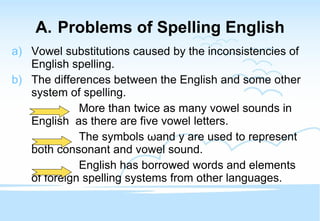
Problems of Spelling English Vowel substitutions caused by the inconsistencies of English spelling. The differences between the English and some other system of spelling. More than twice as many vowel sounds in English  as there are five vowel letters. The symbols  ω and y are used to represent both consonant and vowel sound. English has borrowed words and elements of foreign spelling systems from other languages.
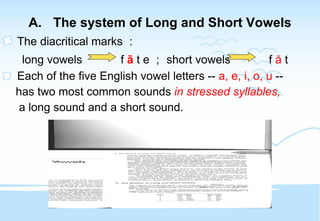
The system of Long and Short Vowels The diacritical marks : long vowels  f  ā  t e ; short vowels  f  ă  t Each of the five English vowel letters  --   a, e, i, o, u  -- has two most common sounds  in stressed syllables,   a long sound and a short sound.
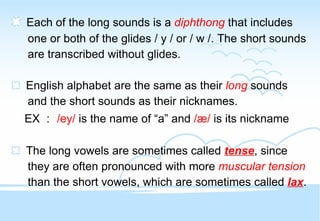
Each of the long sounds is a   diphthong   that includes one or both of the glides / y / or / w /. The short sounds are transcribed without glides. English alphabet are the same as their  long  sounds and the short sounds as their nicknames. EX : /ey/  is the name of “a” and  /æ/  is its nickname The long vowels are sometimes called  tense , since they are often pronounced with more  muscular tension than the short vowels, which are sometimes called  lax .
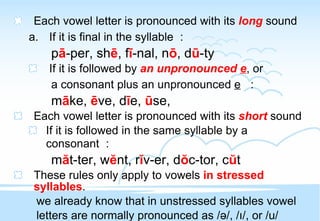
Each vowel letter is pronounced with its  long  sound If it is final in the syllable : p ā -per, sh ē , f ī -nal, n ō , d ū -ty If it is followed by  an unpronounced  e , or  a consonant plus an unpronounced  e   : m ā ke,  ē ve, d ī e,  ū se, Each vowel letter is pronounced with its  short  sound If it is followed in the same syllable by a consonant : m ă t-ter, w ĕ nt, r ĭ v-er, d ŏ c-tor, c ŭ t These rules only apply to vowels  in stressed syllables . we already know that in unstressed syllables vowel letters are normally pronounced as / ə /, / ı /, or / u /
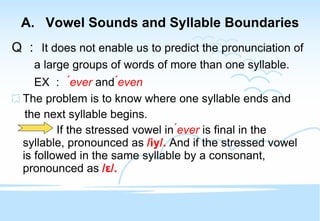
Vowel Sounds and Syllable Boundaries Q : It does not enable us to predict the pronunciation of  a large groups of words of more than one syllable. EX :   ́ ever  and  ́ even The problem is to know where one syllable ends and the next syllable begins. If the stressed vowel in  ́ ever  is final in the syllable, pronounced as  /iy/.  And if the stressed vowel is followed in the same syllable by a consonant, pronounced as  / ε /.
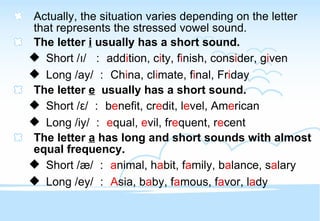
Actually, the situation varies depending on the letter  that represents the stressed vowel sound. The letter  i  usually has a short sound. Short / ı /  : add i tion, c i ty, f i nish, cons i der, g i ven Long /ay/ : Ch i na, cl i mate, f i nal, Fr i day The letter  e   usually has a short sound. Short / ε / : b e nefit, cr e dit, l e vel, Am e rican Long /iy/ : e qual,  e vil, fr e quent, r e cent The letter  a  has long and short sounds with almost equal frequency. Short / æ / : a nimal, h a bit, f a mily, b a lance, s a lary Long /ey/ : A sia, b a by, f a mous, f a vor, l a dy
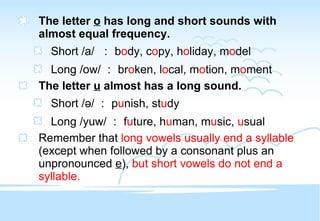
The letter  o  has long and short sounds with almost equal frequency. Short /a/  : b o dy, c o py, h o liday, m o del Long /ow/ : br o ken, l o cal, m o tion, m o ment The letter  u  almost has a long sound. Short / ə/ : p u nish, st u dy Long /yuw/ : f u ture, h u man, m u sic,  u sual Remember that  long vowels usually end a syllable  (except when followed by a consonant plus an unpronounced  e ),  but short vowels do not end a syllable.
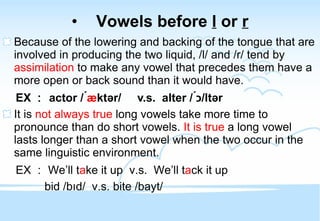
Vowels before  l  or  r Because of the lowering and backing of the tongue that are involved in producing the two liquid, /l/ and /r/ tend by  assimilation  to make any vowel that precedes them have a more open or back sound than it would have. EX : actor / ́ æ ktər/  v.s.  alter / ́ כ ltər/ It is  not always true  long vowels take more time to pronounce than do short vowels.  It is true  a long vowel lasts longer than a short vowel when the two occur in the same linguistic environment.  EX : We’ll t a ke it up  v.s.  We’ll t a ck it up bid /b ı d/  v.s. bite /bayt/
          
 
Lesson 13 Consonant Substitutions Part 1
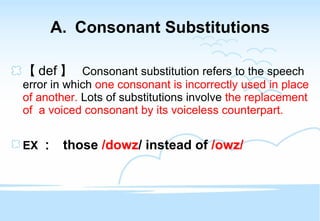
Consonant Substitutions 【 def 】  Consonant substitution refers to the speech error in which  one consonant is incorrectly used in place of another.  Lots of substitutions involve  the replacement of  a voiced consonant by its voiceless counterpart. EX :  those  /dowz / instead of  /owz/
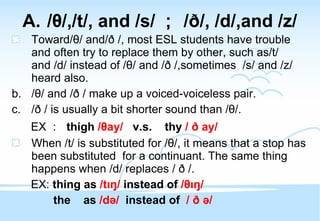
/ θ /,/t/, and /s/ ; / ð /, /d/,and /z/ Toward/ θ / and/ð /, most ESL students have trouble and often try to replace them by other, such as/t/ and /d/ instead of / θ / and / ð  /,sometimes  /s/ and /z/ heard also. / θ / and / ð  / make up a voiced-voiceless pair. / ð  / is usually a bit shorter sound than / θ /. EX :  thigh  / θ ay/   v.s.  thy  /  ð  ay/ When /t/ is substituted for / θ /, it means that a stop has been substituted  for a continuant. The same thing happens when /d/ replaces /  ð  /. EX:  thing as  /tıŋ/  instead of  / θ ıŋ/ the  as  /də/  instead of   /  ð  ə/
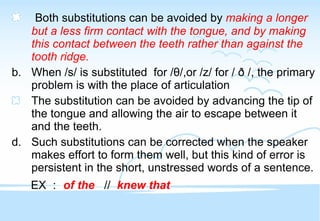
Both substitutions can be avoided by  making a longer but a less firm contact with the tongue, and by making this contact between the teeth rather than against the tooth ridge. When /s/ is substituted  for / θ /,or /z/ for / ð /, the primary problem is with the place of articulation  The substitution can be avoided by advancing the tip of the tongue and allowing the air to escape between it and the teeth. Such substitutions can be corrected when the speaker makes effort to form them well, but this kind of error is persistent in the short, unstressed words of a sentence. EX : of the   //  knew that
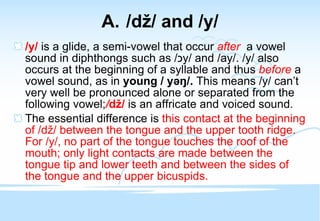
/d ž / and /y/ /y/  is a glide, a semi-vowel that occur   after   a vowel sound   in diphthongs such as / כ y / and /ay/. /y/ also occurs at the beginning of a syllable and thus  before  a vowel sound, as in  young / y əŋ /.  This means /y/ can’t very well be pronounced alone or separated from the following vowel; / d ž /  is an affricate and voiced sound. The essential difference is  this contact at the beginning of /d ž / between the tongue and the upper tooth ridge. For /y/, no part of the tongue touches the roof of the mouth; only light contacts are made between the tongue tip and lower teeth and between the sides of the tongue and the upper bicuspids.
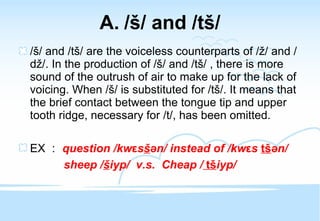
/ š / and /t š / / š / and /t š / are the voiceless counterparts of / ž / and /d ž /. In the production of / š / and /t š / , there is more sound of the outrush of air to make up for the lack of voicing. When / š / is substituted for /t š /. It means that the brief contact between the tongue tip and upper tooth ridge, necessary for /t/, has been omitted. EX : question /kw ε s š ən/ instead of /kw ε s  t š ən/  sheep / š iyp/  v.s.  Cheap /   t š iyp/
      ♥  Thank you for your attention  ♥ ﹡ (σ ゚∀゚ *)σ

Phonetics Ppt

  • 1.
    Lesson 17 Longand Short Vowels ♥ Luisa ♥
  • 2.
    Problems of SpellingEnglish Vowel substitutions caused by the inconsistencies of English spelling. The differences between the English and some other system of spelling. More than twice as many vowel sounds in English as there are five vowel letters. The symbols ω and y are used to represent both consonant and vowel sound. English has borrowed words and elements of foreign spelling systems from other languages.
  • 3.
    The system ofLong and Short Vowels The diacritical marks : long vowels f ā t e ; short vowels f ă t Each of the five English vowel letters -- a, e, i, o, u -- has two most common sounds in stressed syllables, a long sound and a short sound.
  • 4.
    Each of thelong sounds is a diphthong that includes one or both of the glides / y / or / w /. The short sounds are transcribed without glides. English alphabet are the same as their long sounds and the short sounds as their nicknames. EX : /ey/ is the name of “a” and /æ/ is its nickname The long vowels are sometimes called tense , since they are often pronounced with more muscular tension than the short vowels, which are sometimes called lax .
  • 5.
    Each vowel letteris pronounced with its long sound If it is final in the syllable : p ā -per, sh ē , f ī -nal, n ō , d ū -ty If it is followed by an unpronounced e , or a consonant plus an unpronounced e : m ā ke, ē ve, d ī e, ū se, Each vowel letter is pronounced with its short sound If it is followed in the same syllable by a consonant : m ă t-ter, w ĕ nt, r ĭ v-er, d ŏ c-tor, c ŭ t These rules only apply to vowels in stressed syllables . we already know that in unstressed syllables vowel letters are normally pronounced as / ə /, / ı /, or / u /
  • 6.
    Vowel Sounds andSyllable Boundaries Q : It does not enable us to predict the pronunciation of a large groups of words of more than one syllable. EX : ́ ever and ́ even The problem is to know where one syllable ends and the next syllable begins. If the stressed vowel in ́ ever is final in the syllable, pronounced as /iy/. And if the stressed vowel is followed in the same syllable by a consonant, pronounced as / ε /.
  • 7.
    Actually, the situationvaries depending on the letter that represents the stressed vowel sound. The letter i usually has a short sound. Short / ı / : add i tion, c i ty, f i nish, cons i der, g i ven Long /ay/ : Ch i na, cl i mate, f i nal, Fr i day The letter e usually has a short sound. Short / ε / : b e nefit, cr e dit, l e vel, Am e rican Long /iy/ : e qual, e vil, fr e quent, r e cent The letter a has long and short sounds with almost equal frequency. Short / æ / : a nimal, h a bit, f a mily, b a lance, s a lary Long /ey/ : A sia, b a by, f a mous, f a vor, l a dy
  • 8.
    The letter o has long and short sounds with almost equal frequency. Short /a/ : b o dy, c o py, h o liday, m o del Long /ow/ : br o ken, l o cal, m o tion, m o ment The letter u almost has a long sound. Short / ə/ : p u nish, st u dy Long /yuw/ : f u ture, h u man, m u sic, u sual Remember that long vowels usually end a syllable (except when followed by a consonant plus an unpronounced e ), but short vowels do not end a syllable.
  • 9.
    Vowels before l or r Because of the lowering and backing of the tongue that are involved in producing the two liquid, /l/ and /r/ tend by assimilation to make any vowel that precedes them have a more open or back sound than it would have. EX : actor / ́ æ ktər/ v.s. alter / ́ כ ltər/ It is not always true long vowels take more time to pronounce than do short vowels. It is true a long vowel lasts longer than a short vowel when the two occur in the same linguistic environment. EX : We’ll t a ke it up v.s. We’ll t a ck it up bid /b ı d/ v.s. bite /bayt/
  • 10.
  • 11.
  • 12.
    Lesson 13 ConsonantSubstitutions Part 1
  • 13.
    Consonant Substitutions 【def 】 Consonant substitution refers to the speech error in which one consonant is incorrectly used in place of another. Lots of substitutions involve the replacement of a voiced consonant by its voiceless counterpart. EX : those /dowz / instead of /owz/
  • 14.
    / θ /,/t/,and /s/ ; / ð /, /d/,and /z/ Toward/ θ / and/ð /, most ESL students have trouble and often try to replace them by other, such as/t/ and /d/ instead of / θ / and / ð /,sometimes /s/ and /z/ heard also. / θ / and / ð / make up a voiced-voiceless pair. / ð / is usually a bit shorter sound than / θ /. EX : thigh / θ ay/ v.s. thy / ð ay/ When /t/ is substituted for / θ /, it means that a stop has been substituted for a continuant. The same thing happens when /d/ replaces / ð /. EX: thing as /tıŋ/ instead of / θ ıŋ/ the as /də/ instead of / ð ə/
  • 15.
    Both substitutions canbe avoided by making a longer but a less firm contact with the tongue, and by making this contact between the teeth rather than against the tooth ridge. When /s/ is substituted for / θ /,or /z/ for / ð /, the primary problem is with the place of articulation The substitution can be avoided by advancing the tip of the tongue and allowing the air to escape between it and the teeth. Such substitutions can be corrected when the speaker makes effort to form them well, but this kind of error is persistent in the short, unstressed words of a sentence. EX : of the // knew that
  • 16.
    /d ž /and /y/ /y/ is a glide, a semi-vowel that occur after a vowel sound in diphthongs such as / כ y / and /ay/. /y/ also occurs at the beginning of a syllable and thus before a vowel sound, as in young / y əŋ /. This means /y/ can’t very well be pronounced alone or separated from the following vowel; / d ž / is an affricate and voiced sound. The essential difference is this contact at the beginning of /d ž / between the tongue and the upper tooth ridge. For /y/, no part of the tongue touches the roof of the mouth; only light contacts are made between the tongue tip and lower teeth and between the sides of the tongue and the upper bicuspids.
  • 17.
    / š /and /t š / / š / and /t š / are the voiceless counterparts of / ž / and /d ž /. In the production of / š / and /t š / , there is more sound of the outrush of air to make up for the lack of voicing. When / š / is substituted for /t š /. It means that the brief contact between the tongue tip and upper tooth ridge, necessary for /t/, has been omitted. EX : question /kw ε s š ən/ instead of /kw ε s t š ən/ sheep / š iyp/ v.s. Cheap / t š iyp/
  • 18.
        ♥ Thank you for your attention ♥ ﹡ (σ ゚∀゚ *)σ