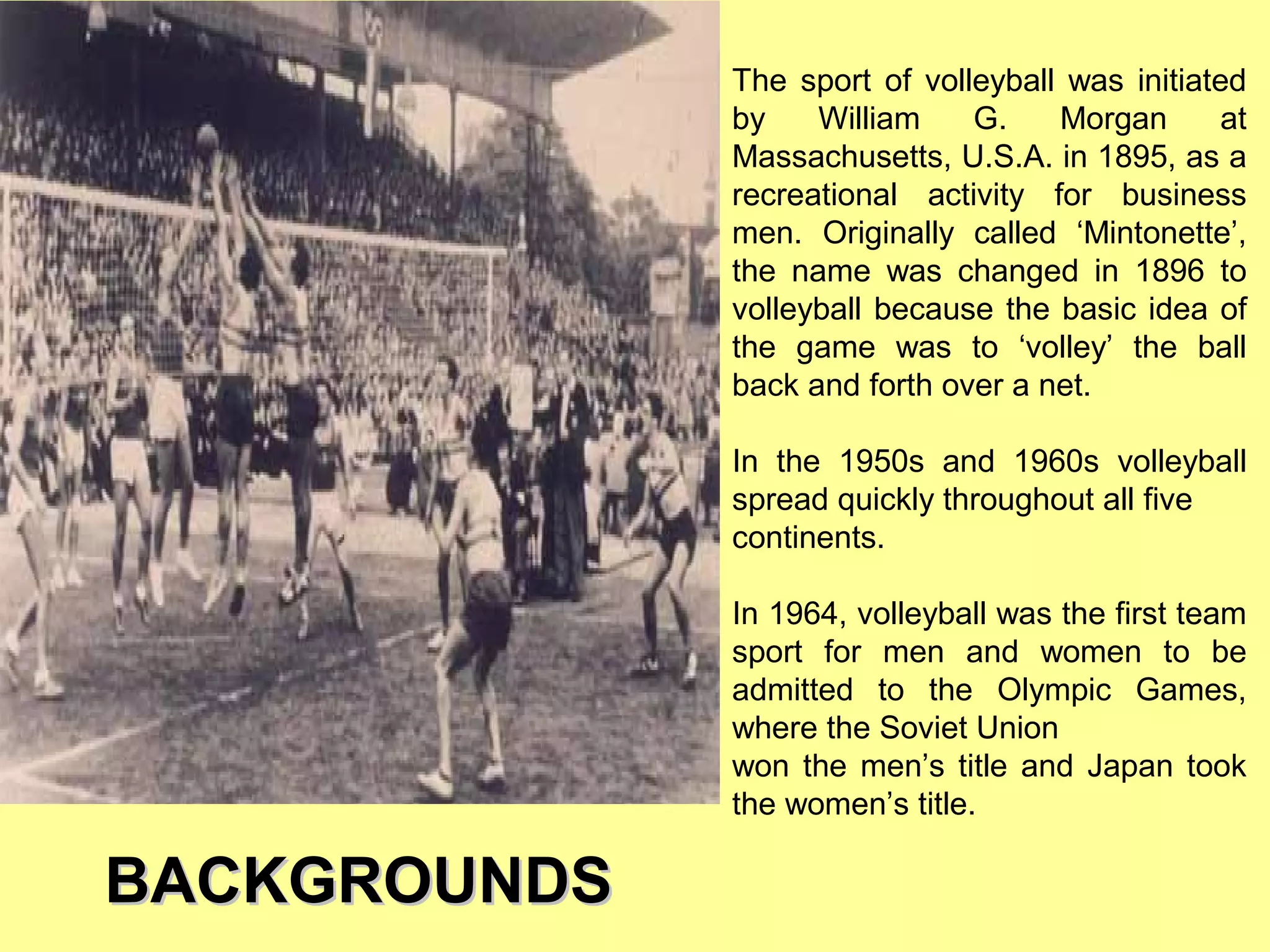
The sport of volleyball was initiated
by William G. Morgan at
Massachusetts, U.S.A. in 1895, as a
recreational activity for business
men. Originally called ‘Mintonette’,
the name was changed in 1896 to
volleyball because the basic idea of
the game was to ‘volley’ the ball
back and forth over a net.
In the 1950s and 1960s volleyball
spread quickly throughout all five
continents.
In 1964, volleyball was the first team
sport for men and women to be
admitted to the Olympic Games,
where the Soviet Union
won the men’s title and Japan took
the women’s title.
BACKGROUNDSBACKGROUNDS
VOLLEYBALL
The goal of the game
is for each team to
send the ball over the
net to ground it on the
opponents’ court and
to prevent the ball from
being grounded on its
own court.
Volleyball is a team
sport played by two
teams (of 6 players
each) on a playing
court divided by a
net.
The ball is put into play
by the right back-row.
A team is entitled to hit the ball three times (in addition to the block contact) in
returning it to the opponents’ court.
A player is not allowed to hit the ball twice consecutively (except when blocking).
GLOSSARY OF TERMS USED
IN VOLLEYBALL
Defence:Defence: The phase of the
game in which the court players
try to prevent the ball from
landing on their court.
Attack/OffenceAttack/Offence: The phase of
the game in which the players
combine to make an attack.
TACTICAL AND TECHNICAL
DEVELOPMENT
SERVE
(underarm or
overarm serve)
RECEPTION
(forearm pass)
SET /SETTER
(volley pass)
Smash/hit
The phase of the game where the team
takes up positions and passes the served
ball to the setter. (The service is normally
controlled with a forearm pass)
Set/setter: The skill of volleying the ball
high and close to the net for a
smasher.
Smash/hit/spike: Jumping above
the net and with one hand striking
the ball down into the opponent’s
court.
It used to start every point
BASIC SKILLS: Volley pass
The volley is a two-handed pass played
above the forehead.
Volley-passes could be forwards or
backwards.
BASIC SKILLS: Forearm pass
The forearm pass is used to play a ball
which is travelling too fast and low to
volley, and is performed by bringing the
forearms together to make a platform, off
which the ball rebounds.
It is used most often to receive the service
or an attacking shot from the opponents.
BASIC SKILLS: Service
The serve is used to start every rally/point.
Types of Serve
There are many different serves. We’ll learn and practice the followings:
Overarm ServeUnderarm Serve
BASIC SKILLS: The block
The block is the first line of defense against the smash. It may be performed
by one, two or three front-row players who jump at the net to stop the
smashed ball from crossing the net and to deflect it back into the
opposition’s court.
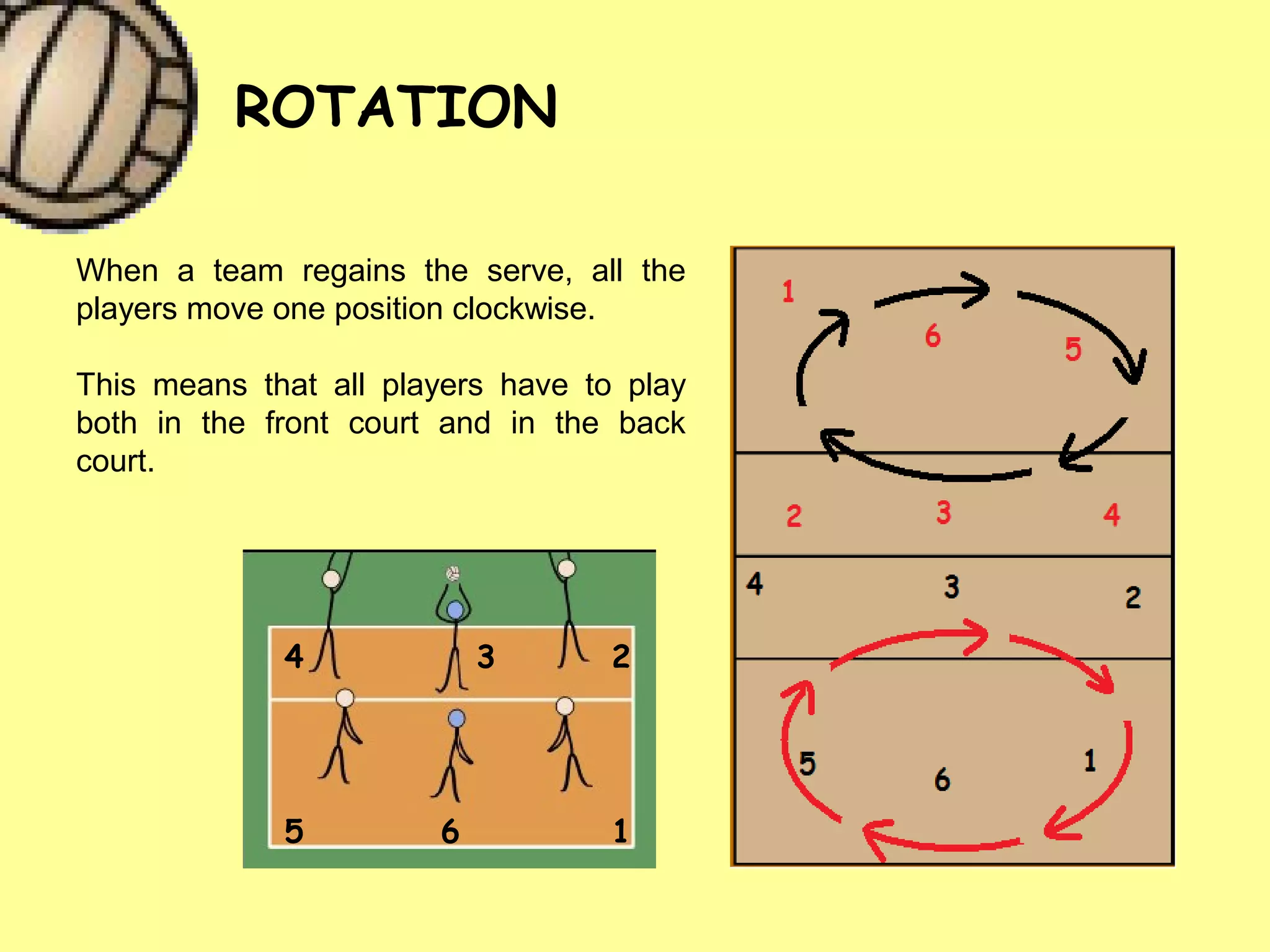
ROTATION
When a team regains the serve, all the
players move one position clockwise.
This means that all players have to play
both in the front court and in the back
court.
1
234
5 6
BASE POSITION
Key characteristics:
• Feet shoulder-width apart
• Knees bent and inside the line of the toes
• Weight forward with the knees loaded
• Spine straight
• Hands in front of the body, ready to move
This posture is the best position from which
to move quickly and efficiently in any
direction forwards, backwards or sideways.
SCORING
When the ball contacts the floor within the court boundaries or
an error is made, the team that did not make the error is
awarded a point.
The team that won the point serves for the next point.
If the team that won the point served in the previous point, the
same player serves again.
If the team that won the point did not serve the previous point,
the players of the serving team rotate their position on the court.
The game continues, with the first team to score 25 points by a
two-point margin is awarded the set.
Matches are best-of-five sets and the fifth set, if necessary, is
usually played to 15 points.
25 points
1 set
The best of
five sets
Winner!
Other types of Volleyball
Sitting VolleyballSitting Volleyball
Sitting volleyball can be played by both the able-bodied and
people with disabilities. It is played on a court ten metres by six
metres over a net 1.15 metres high for men, 1.10 metres for
women. There are six players per team.
Beach volleyball: It can be played with two players per team.
Mini volleyball: It can be played with three
or four players per team (young people).

Volleyball notes

  • 2.
    The sport ofvolleyball was initiated by William G. Morgan at Massachusetts, U.S.A. in 1895, as a recreational activity for business men. Originally called ‘Mintonette’, the name was changed in 1896 to volleyball because the basic idea of the game was to ‘volley’ the ball back and forth over a net. In the 1950s and 1960s volleyball spread quickly throughout all five continents. In 1964, volleyball was the first team sport for men and women to be admitted to the Olympic Games, where the Soviet Union won the men’s title and Japan took the women’s title. BACKGROUNDSBACKGROUNDS
  • 3.
    VOLLEYBALL The goal ofthe game is for each team to send the ball over the net to ground it on the opponents’ court and to prevent the ball from being grounded on its own court. Volleyball is a team sport played by two teams (of 6 players each) on a playing court divided by a net. The ball is put into play by the right back-row. A team is entitled to hit the ball three times (in addition to the block contact) in returning it to the opponents’ court. A player is not allowed to hit the ball twice consecutively (except when blocking).
  • 4.
    GLOSSARY OF TERMSUSED IN VOLLEYBALL Defence:Defence: The phase of the game in which the court players try to prevent the ball from landing on their court. Attack/OffenceAttack/Offence: The phase of the game in which the players combine to make an attack.
  • 5.
    TACTICAL AND TECHNICAL DEVELOPMENT SERVE (underarmor overarm serve) RECEPTION (forearm pass) SET /SETTER (volley pass) Smash/hit The phase of the game where the team takes up positions and passes the served ball to the setter. (The service is normally controlled with a forearm pass) Set/setter: The skill of volleying the ball high and close to the net for a smasher. Smash/hit/spike: Jumping above the net and with one hand striking the ball down into the opponent’s court. It used to start every point
  • 6.
    BASIC SKILLS: Volleypass The volley is a two-handed pass played above the forehead. Volley-passes could be forwards or backwards.
  • 7.
    BASIC SKILLS: Forearmpass The forearm pass is used to play a ball which is travelling too fast and low to volley, and is performed by bringing the forearms together to make a platform, off which the ball rebounds. It is used most often to receive the service or an attacking shot from the opponents.
  • 8.
    BASIC SKILLS: Service Theserve is used to start every rally/point. Types of Serve There are many different serves. We’ll learn and practice the followings: Overarm ServeUnderarm Serve
  • 9.
    BASIC SKILLS: Theblock The block is the first line of defense against the smash. It may be performed by one, two or three front-row players who jump at the net to stop the smashed ball from crossing the net and to deflect it back into the opposition’s court.
  • 10.
    ROTATION When a teamregains the serve, all the players move one position clockwise. This means that all players have to play both in the front court and in the back court. 1 234 5 6
  • 11.
    BASE POSITION Key characteristics: •Feet shoulder-width apart • Knees bent and inside the line of the toes • Weight forward with the knees loaded • Spine straight • Hands in front of the body, ready to move This posture is the best position from which to move quickly and efficiently in any direction forwards, backwards or sideways.
  • 12.
    SCORING When the ballcontacts the floor within the court boundaries or an error is made, the team that did not make the error is awarded a point. The team that won the point serves for the next point. If the team that won the point served in the previous point, the same player serves again. If the team that won the point did not serve the previous point, the players of the serving team rotate their position on the court. The game continues, with the first team to score 25 points by a two-point margin is awarded the set. Matches are best-of-five sets and the fifth set, if necessary, is usually played to 15 points. 25 points 1 set The best of five sets Winner!
  • 13.
    Other types ofVolleyball Sitting VolleyballSitting Volleyball Sitting volleyball can be played by both the able-bodied and people with disabilities. It is played on a court ten metres by six metres over a net 1.15 metres high for men, 1.10 metres for women. There are six players per team. Beach volleyball: It can be played with two players per team. Mini volleyball: It can be played with three or four players per team (young people).