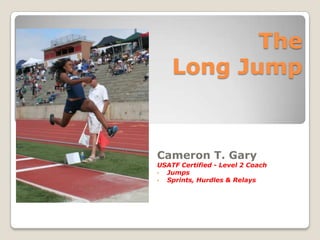
The
    Long Jump


Cameron T. Gary
USATF Certified - Level 2 Coach
• Jumps
• Sprints, Hurdles & Relays
History
                          (Courtesy of the IAAF)


   The long jump has been part of all Athletics
    competitions since ancient times
    ◦ In the Games of 708 BC it was part of the pentathlon
    ◦ The jumper took a run-up holding a small weight in each hand
      which gave greater impetus
   1860 - Modern event regulated in England/USA
    ◦ The take-off had to be made from a 20cm (8-inch) wide board
      into a sand pit
       Hand weights are not used.
   Until the 1920s, technique was rudimentary
    ◦ Most jumped by drawing up and tucking the legs under the
      body after take-off, then extended them again for landing.
    ◦ This is currently known as the “stride” or “tuck” method
       Is still acceptable for beginners
       Is not as efficient for higher level performers
More Long Jump History
                                 (Cont.)


   1922 - 1927
    ◦ Americans William De Hart Hubbard (co-holder of the world
      100-yard dash record of 9.6) and Robert LeGendre introduced
      the "hitch kick“
       “Hitch-Kick” is a running motion of the legs in mid-air
       Variations of this, and simple “hang” technique, remain the norm
        today
   1895 - The first women's long jump contests
    took place in the USA
   1928 - First IAAF women's world record
   1948 – London, England; First women’s Olympic
    long jump competition
LONG JUMP
              Current Records
                     (Men & women)
   World
      8.95m (29’-4.5”); Michael Powell (USA);
       Tokyo, Japan - 1991
      7.52m (24’-8.25”); Galina Chistyakova (Soviet
       Union); St. Petersburg, Russia - 1988
   High School
      8.18m (26’-10”); Marquis Goodwin
       (Rowlett, Texas); Eugene, Oregon - 2009
      6.78m (22’-3”); Kathy McMillan (Hoke
       County, Raeford, North Carolina);
       Westwood, California - 1976
Key Points
   One explosive movement
   Maximum controlled approach speed
     One must run TALL!
     One must run FAST!
     One must ATTACK the board with
      ACTIVE foot strikes
      LONG strides – until the last stride
      PROGRESSIVE AGGRESSION through the board
   DON’T over-emphasize jumping up!
    ◦ Alters long jump mechanics
    ◦ The goal is to jump OUT
      This is not the high jump
      This IS the long jump
More Key Points…
 Long   Jump vs. Triple Jump
  VERY different take-offs
   LJ prep movements are greater than triple jump
     LJ uses a dramatic penultimate-to-ultimate stride change
   Take-off angle in the Long Jump is steeper
     Triple jumpers must maintain speed over three phases
     Long jumpers only have to apply speed/power over one
  Few elite triple jumpers also long jump
   However; there are high school realities of…
    Team dynamics
    Point scoring
    Etc.
Basic Skills
   Full foot plant
    ◦ THE most basic skill a jumper must learn
       Same for the Long Jump and Triple Jump
    ◦ NOT a “dead” or “lazy” foot
   Emphasize middle of the foot striking the board
    ◦ Activates large muscles of the upper leg and hip
    ◦ Deliver a Blow to the Board
         NOT heel first
         NOT toe first
         “Pawing” may encourage dropping the toe (BE CAREFUL!)
         Dorsi-flexion of the foot
          ◦ Facilitates pre-recruitment of the lower leg muscles
          ◦ Activates an eccentric stretch-shortening response at the foot plant

   Useful cues:
    ◦ “Squish a bug”
    ◦ “Break a board”
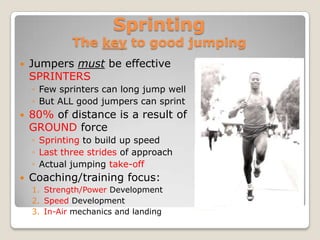
Sprinting
             The key to good jumping
   Jumpers must be effective
    SPRINTERS
    ◦ Few sprinters can long jump well
    ◦ But ALL good jumpers can sprint
   80% of distance is a result of
    GROUND force
    ◦ Sprinting to build up speed
    ◦ Last three strides of approach
    ◦ Actual jumping take-off
   Coaching/training focus:
    1. Strength/Power Development
    2. Speed Development
    3. In-Air mechanics and landing
COM Projection
                         Why Speed is so Important
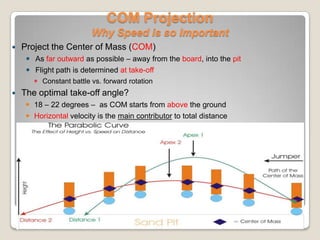
   Project the Center of Mass (COM)
      As far outward as possible – away from the board, into the pit
      Flight path is determined at take-off
        Constant battle vs. forward rotation
   The optimal take-off angle?
      18 – 22 degrees – as COM starts from above the ground
      Horizontal velocity is the main contributor to total distance
Hinged-Moment Rotation
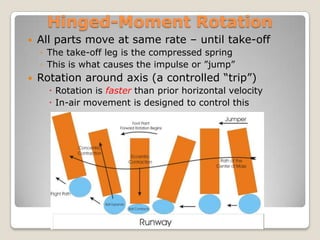
   All parts move at same rate – until take-off
    ◦ The take-off leg is the compressed spring
    ◦ This is what causes the impulse or ”jump”
   Rotation around axis (a controlled “trip”)
       Rotation is faster than prior horizontal velocity
       In-air movement is designed to control this
Approach Running
   Key aspects of the approach
    ◦ Speed – determines the potential jump distance
    ◦ Consistency – especially in first few strides
       Consistent strides lead to consistent jumps
    ◦ Accuracy – minimizes doubt/fouling
       Jumpers should be confident of hitting the board
   Advice to beginners – K.I.S.S.
    ◦ Avoid the “Voodoo Dance”
    ◦ Use a checkmark for accuracy
   In-Air gymnastic movements are secondary
    ◦ They are the result of what happens on the ground
    ◦ They maximize what is established via the run/takeoff
    ◦ The primary focus should be on the approach run
Constructing the Approach Run
   Begin on the track – away from the runway
    ◦ Mark off 50 meters on one lane line
    ◦ Right-foot jumpers to the left of the line, left-footers to the right
   Perform “build-up” sprints from a set position
    ◦ It has to start off the same every time
    ◦ Easier to start on the dominant jump leg (even number of strides)
    ◦ Accelerate for 40 – 50 meters
   Count “Beats” - every two steps (jump leg only)
    ◦   Determine where the third beat strikes consistently – mark it
    ◦   Count subsequent beats to the full run distance
    ◦   Take measurements and transfer the marks to the runway
    ◦   The jumper should focus on running to a count – not a place
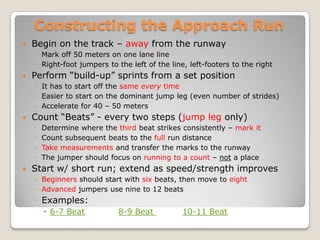
   Start w/ short run; extend as speed/strength improves
    ◦ Beginners should start with six beats, then move to eight
    ◦ Advanced jumpers use nine to 12 beats
    ◦ Examples:
         6-7 Beat           8-9 Beat           10-11 Beat
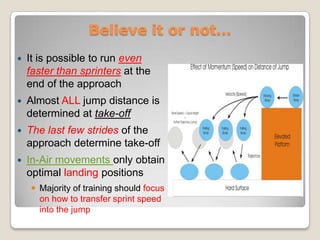
Believe it or not…
   It is possible to run even
    faster than sprinters at the
    end of the approach
   Almost ALL jump distance is
    determined at take-off
   The last few strides of the
    approach determine take-off
   In-Air movements only obtain
    optimal landing positions
     Majority of training should focus
      on how to transfer sprint speed
      into the jump
Plant & Take-off
   You have to get down to get up
    ◦ Hips drop - next-to-last stride
       Count (ex. 8-beat) is: “seven-and-EIGHT”
       Step pattern is: “short-long-short”, or “flat-roll-flat”
       Hips at low point over take-off board
    ◦ Take-off leg pre-recruitment
       Muscles pre-stretched (tightened)
   Last stride is shorter and faster
    ◦ Not too short – long strides = long jumps
    ◦ Foot plant is in front of COM
   FULLY punch elbows front and back
    ◦ “Telephone – Pager” position
   Knee punches up in reaction to a strong downward stomp
    ◦ Avoid “pulling” leg up
    ◦ IRRESPECTIVE of subsequent flight style
       Position is always the same!
LONG JUMP
                  Flight Examples

   Sail/Stride Jump
     Generally used by beginning jumpers
     However, good jumps can be made with it
   Hang
     Athlete “hangs” as if suspended from a bar
     Lengthens the body, slows rotation
   Hitch-Kick
     “Running” in the air
     The arms and legs move quickly
     Arms/Legs counteract rotation
Horizontal Jump Landings
 Heels out, toes up
 Hands stay outside of the hips
 Variations
    ◦ Slide in
    ◦ Buttocks in Hole
    ◦ Pop-Out – sort of…
   NEVER reach forward on the landing!
    ◦ It does not combat forward rotation
      It actually makes it faster
    ◦ One will NOT be able to hold the feet up – regardless
      of the number of sit-ups one does!
JUMP WORKOUTS &
              VIDEO REVIEW
 Jumping is Sprinting/Sprinting is Jumping
 Train the Energy System (CP/ATP)
 Get Strong…Weights are our friend!
    ◦ Consider the Olympic lifts
      Develops applied strength w/o added bulk
    ◦ Reserve bodybuilding lifts for:
      Correcting isolated deficiencies
      Recovering from injury
 Take care of your feet!!!
 Use REST as a training tool
Thank you for your attention!!


             Questions?
             Comments?
               Jokes?

     If not… then it is break time!
Cameron T. Gary
    USATF Certified - Level 2 Coach
                Jumps
      Sprints, Hurdles & Relays


  www.ctgdevelopment.net
                           619-895-4699
jumpmaster@ctgdevelopment.net

Long Jump Web2011

  • 1.
    The Long Jump Cameron T. Gary USATF Certified - Level 2 Coach • Jumps • Sprints, Hurdles & Relays
  • 2.
    History (Courtesy of the IAAF)  The long jump has been part of all Athletics competitions since ancient times ◦ In the Games of 708 BC it was part of the pentathlon ◦ The jumper took a run-up holding a small weight in each hand which gave greater impetus  1860 - Modern event regulated in England/USA ◦ The take-off had to be made from a 20cm (8-inch) wide board into a sand pit  Hand weights are not used.  Until the 1920s, technique was rudimentary ◦ Most jumped by drawing up and tucking the legs under the body after take-off, then extended them again for landing. ◦ This is currently known as the “stride” or “tuck” method  Is still acceptable for beginners  Is not as efficient for higher level performers
  • 3.
    More Long JumpHistory (Cont.)  1922 - 1927 ◦ Americans William De Hart Hubbard (co-holder of the world 100-yard dash record of 9.6) and Robert LeGendre introduced the "hitch kick“  “Hitch-Kick” is a running motion of the legs in mid-air  Variations of this, and simple “hang” technique, remain the norm today  1895 - The first women's long jump contests took place in the USA  1928 - First IAAF women's world record  1948 – London, England; First women’s Olympic long jump competition
  • 4.
    LONG JUMP Current Records (Men & women)  World  8.95m (29’-4.5”); Michael Powell (USA); Tokyo, Japan - 1991  7.52m (24’-8.25”); Galina Chistyakova (Soviet Union); St. Petersburg, Russia - 1988  High School  8.18m (26’-10”); Marquis Goodwin (Rowlett, Texas); Eugene, Oregon - 2009  6.78m (22’-3”); Kathy McMillan (Hoke County, Raeford, North Carolina); Westwood, California - 1976
  • 5.
    Key Points  One explosive movement  Maximum controlled approach speed  One must run TALL!  One must run FAST!  One must ATTACK the board with  ACTIVE foot strikes  LONG strides – until the last stride  PROGRESSIVE AGGRESSION through the board  DON’T over-emphasize jumping up! ◦ Alters long jump mechanics ◦ The goal is to jump OUT  This is not the high jump  This IS the long jump
  • 6.
    More Key Points… Long Jump vs. Triple Jump  VERY different take-offs  LJ prep movements are greater than triple jump  LJ uses a dramatic penultimate-to-ultimate stride change  Take-off angle in the Long Jump is steeper  Triple jumpers must maintain speed over three phases  Long jumpers only have to apply speed/power over one  Few elite triple jumpers also long jump  However; there are high school realities of…  Team dynamics  Point scoring  Etc.
  • 7.
    Basic Skills  Full foot plant ◦ THE most basic skill a jumper must learn  Same for the Long Jump and Triple Jump ◦ NOT a “dead” or “lazy” foot  Emphasize middle of the foot striking the board ◦ Activates large muscles of the upper leg and hip ◦ Deliver a Blow to the Board  NOT heel first  NOT toe first  “Pawing” may encourage dropping the toe (BE CAREFUL!)  Dorsi-flexion of the foot ◦ Facilitates pre-recruitment of the lower leg muscles ◦ Activates an eccentric stretch-shortening response at the foot plant  Useful cues: ◦ “Squish a bug” ◦ “Break a board”
  • 8.
    Sprinting The key to good jumping  Jumpers must be effective SPRINTERS ◦ Few sprinters can long jump well ◦ But ALL good jumpers can sprint  80% of distance is a result of GROUND force ◦ Sprinting to build up speed ◦ Last three strides of approach ◦ Actual jumping take-off  Coaching/training focus: 1. Strength/Power Development 2. Speed Development 3. In-Air mechanics and landing
  • 9.
    COM Projection Why Speed is so Important  Project the Center of Mass (COM)  As far outward as possible – away from the board, into the pit  Flight path is determined at take-off  Constant battle vs. forward rotation  The optimal take-off angle?  18 – 22 degrees – as COM starts from above the ground  Horizontal velocity is the main contributor to total distance
  • 10.
    Hinged-Moment Rotation  All parts move at same rate – until take-off ◦ The take-off leg is the compressed spring ◦ This is what causes the impulse or ”jump”  Rotation around axis (a controlled “trip”)  Rotation is faster than prior horizontal velocity  In-air movement is designed to control this
  • 11.
    Approach Running  Key aspects of the approach ◦ Speed – determines the potential jump distance ◦ Consistency – especially in first few strides  Consistent strides lead to consistent jumps ◦ Accuracy – minimizes doubt/fouling  Jumpers should be confident of hitting the board  Advice to beginners – K.I.S.S. ◦ Avoid the “Voodoo Dance” ◦ Use a checkmark for accuracy  In-Air gymnastic movements are secondary ◦ They are the result of what happens on the ground ◦ They maximize what is established via the run/takeoff ◦ The primary focus should be on the approach run
  • 12.
    Constructing the ApproachRun  Begin on the track – away from the runway ◦ Mark off 50 meters on one lane line ◦ Right-foot jumpers to the left of the line, left-footers to the right  Perform “build-up” sprints from a set position ◦ It has to start off the same every time ◦ Easier to start on the dominant jump leg (even number of strides) ◦ Accelerate for 40 – 50 meters  Count “Beats” - every two steps (jump leg only) ◦ Determine where the third beat strikes consistently – mark it ◦ Count subsequent beats to the full run distance ◦ Take measurements and transfer the marks to the runway ◦ The jumper should focus on running to a count – not a place  Start w/ short run; extend as speed/strength improves ◦ Beginners should start with six beats, then move to eight ◦ Advanced jumpers use nine to 12 beats ◦ Examples:  6-7 Beat 8-9 Beat 10-11 Beat
  • 13.
    Believe it ornot…  It is possible to run even faster than sprinters at the end of the approach  Almost ALL jump distance is determined at take-off  The last few strides of the approach determine take-off  In-Air movements only obtain optimal landing positions  Majority of training should focus on how to transfer sprint speed into the jump
  • 14.
    Plant & Take-off  You have to get down to get up ◦ Hips drop - next-to-last stride  Count (ex. 8-beat) is: “seven-and-EIGHT”  Step pattern is: “short-long-short”, or “flat-roll-flat”  Hips at low point over take-off board ◦ Take-off leg pre-recruitment  Muscles pre-stretched (tightened)  Last stride is shorter and faster ◦ Not too short – long strides = long jumps ◦ Foot plant is in front of COM  FULLY punch elbows front and back ◦ “Telephone – Pager” position  Knee punches up in reaction to a strong downward stomp ◦ Avoid “pulling” leg up ◦ IRRESPECTIVE of subsequent flight style  Position is always the same!
  • 15.
    LONG JUMP Flight Examples  Sail/Stride Jump  Generally used by beginning jumpers  However, good jumps can be made with it  Hang  Athlete “hangs” as if suspended from a bar  Lengthens the body, slows rotation  Hitch-Kick  “Running” in the air  The arms and legs move quickly  Arms/Legs counteract rotation
  • 16.
    Horizontal Jump Landings Heels out, toes up  Hands stay outside of the hips  Variations ◦ Slide in ◦ Buttocks in Hole ◦ Pop-Out – sort of…  NEVER reach forward on the landing! ◦ It does not combat forward rotation  It actually makes it faster ◦ One will NOT be able to hold the feet up – regardless of the number of sit-ups one does!
  • 17.
    JUMP WORKOUTS & VIDEO REVIEW  Jumping is Sprinting/Sprinting is Jumping  Train the Energy System (CP/ATP)  Get Strong…Weights are our friend! ◦ Consider the Olympic lifts  Develops applied strength w/o added bulk ◦ Reserve bodybuilding lifts for:  Correcting isolated deficiencies  Recovering from injury  Take care of your feet!!!  Use REST as a training tool
  • 18.
    Thank you foryour attention!! Questions? Comments? Jokes? If not… then it is break time!
  • 19.
    Cameron T. Gary USATF Certified - Level 2 Coach Jumps Sprints, Hurdles & Relays www.ctgdevelopment.net 619-895-4699 jumpmaster@ctgdevelopment.net