PHYSICAL ACTIVITY TOWARDS FITNESS AND HEALTH
IS ANY MOVEMENT MADE BYYOUR BODY THAT USES
ENERGY.WHEN IT IS INCORPORATED REGULARLY
INTOYOUR ROUTINE, IT GREATLY BENEFITSYOUR
FITNESS AND HEALTH.
VOLLEYBALL
*Background
*Techniques
*Tactics and Rules inVolleyball
*Basic Skill
Background of Volleyball
- Is a game played by two teams, usually of six players on a
side, in which the players use their hands to bat a ball back and
forth over a high net, trying to make the ball touch the court
within the opponents’ playing area before it can be returned.
To prevent this, a player on the opposing team bats the ball up
toward a teammate before it touches the court surface—that
teammate may then volley it back across the net or bat it to a
third teammate who volleys it across the net.A team is
allowed only three touches of the ball before it must be
returned over the net.
-Volleyball was invented in 1895 by
William G. Morgan, physical director of the
Young Men’s Christian Association (YMCA)
in Holyoke, Massachusetts. It was designed as
a less physically demanding alternative to
basketball.
History
- Alfred Halstead later renamed it to volleyball because the objective
of the game was to volley the ball back and forth over a net.
The name was changed to volleyball due to the nature of the game
involving volleying the ball back and forth over the net.The sport
quickly grew in popularity and was officially recognized by the
InternationalVolleyball Federation (FIVB) in 1947
Positions and Roles
•Outside Hitter (Left Side Hitter): Focuses on attacking from
the front left side of the court.This player also has defensive
responsibilities.
•Right Side Hitter (Opposite Hitter): Plays opposite the setter
and often takes on blocking duties along with attacking.
•SETTER:ACTS ASTHE PLAYMAKER, SETTING UP OFFENSIVE
PLAYS BY DELIVERING ACCURATE SETS TO ATTACKERS.
•Libero: A defensive specialist who wears a different color
jersey and cannot attack the ball above the net's height. The
libero’s main role is to receive serves and play in the back row.
•Middle Blocker (Middle Hitter): Focuses on blocking and
attacking from the middle of the net. Often responsible for
quick attacks and defensive plays.
TYPES OFVOLLEYBALL
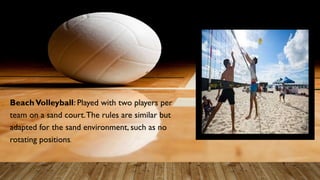
BeachVolleyball: Played with two players per
team on a sand court.The rules are similar but
adapted for the sand environment, such as no
rotating positions.
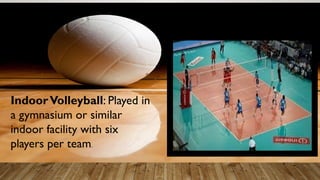
IndoorVolleyball: Played in
a gymnasium or similar
indoor facility with six
players per team.
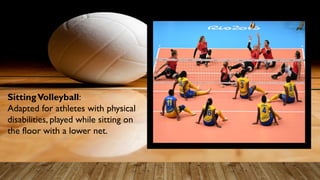
SittingVolleyball:
Adapted for athletes with physical
disabilities, played while sitting on
the floor with a lower net.
Rules inVolleyball
1.Scoring System:
1.Rally Scoring: Points are scored on every rally, regardless
of which team served.A match is typically played best of five
sets.
2.Set Scores: Sets are played to 25 points (or 15 in the fifth
set), with a team needing to win by at least 2 points.
2.Hits and Contacts:
1.Three Hits Rule: Each team is allowed up to three hits to
return the ball over the net.A block does not count as a hit.
2.Double Hit:A player cannot hit the ball twice consecutively,
except for the first touch of the ball by the setter.
3. Net and Line Rules
•Net Touch: Players must not touch the net during play. However,
slight contact with the net while attacking or blocking is allowed as
long as it doesn’t interfere with play.
•Crossing the Center Line: Players must not cross the center line or
interfere with the opponent's space under the net.
4. Player Positions:
•Rotation: Players must rotate positions clockwise every time their
team wins the serve from the opponents.
•Front and Back Row: Only front-row players can attack the ball
above the net. Back-row players cannot spike from the front zone but
can attack from behind the 3-meter line.
5. Substitutions:
•Limits: Teams are allowed a limited number of substitutions
per set. The exact number can vary based on the competition
or league rules.
•Libero: The libero can replace any back-row player without
prior notice to the officials and can make multiple substitutions
in the back row.
6. Serving Rules:
•Serve Must be Overhand: The serve must be executed from
behind the end line and must cross the net without touching it.
•Foot Fault: Servers must not step on or over the end line
before making contact with the ball.
7. llegal Actions:
•Four Hits: If a team hits the ball more than three times before
returning it, it results in a fault.
•Lift: Carrying or holding the ball, rather than cleanly hitting it, is
not allowed.
Tactics inVolleyball
Defensive Tactics in Volleyball
- a defensive play that is accomplished by 1, 2, or 3 front-row
players jumping and pressing their arms over the net in an
effort to “block” the opposing hitter. Blocking is one of the most
worked-on skills out there. It's complex, demanding, and requires great
discipline to get good at.
Blocking
- the job of a defensive volleyball player is not to let the ball hit the
ground. If this happens for some reason the volleyball team will lose a
point. So, to prevent such a situation from happening, a volleyball player
must be able to dive, roll, and slide.
Diving, rolling and sliding
Passing Tactics in Volleyball
- the preparation for a volleyball attack starts with a dig.
Actually, a dig is an accurate and controlled volleyball
shot.A dig is also known as the first shot after an attack
of the opposite team is resisted.As previously
mentioned, a volleyball team has the right to make 3
shots only. So, dig is the first of 3 shots.
Digging
- an athlete needs to put hands together and arms straight. By
doing this, a volleyball player will be able to prepare for a dig
successfully. Finally, a volleyball player needs to hit the ball.The ball
should be hit on the player’s forearms.
Setting
is the final stage of preparing for an attack hit.You need to know that there
are two types of volleyball sets – an overhand shot as well as overhead shot.
Setting involves hitting the ball with palms. Obviously, a setter shouldn’t hit
the ball forcefully.Actually, the job of a setter is to make it easy for an
attacker to carry out the final third shot (an attack hit).That’s why it’s fair to
say that the success of an attacker depends a lot on setter’s job.
Attacking Tactics inVolleyball
- Serve is considered to be one of the most important shots in volleyball.
There are different types of serves in volleyball – float serve, jump serve
as well as topspin serve. Obviously, a server should aim to make it
difficult for the opposite team to dig and pass the ball. It’s important to
keep in mind that if a server does great job then he/she will be able to
put a lot of pressure on the opposite team.
Serving
- A spike is another type of an attack hit in volleyball.After the ball is
digged and set, it’s time for an attacker to carry out the attack hit.
And of course, an attacker should aim to land the ball on the
opposite side of the court to win a score for his/her team. So, if an
attacker does great job then he/she will be able either to win a point
for his/her team or create a lot of difficulties for the opposite team.
Spiking
6 Fundamental Skills inVolleyball
Serving
A properly executed serve provides the serving team with
a significant advantage over the receiving team. A serve
that is properly placed can cause players on the receiving
team to get out of position or attempt awkward returns.
The server must stand behind the service line at the end of
the court. There are three serving styles in volleyball. The
underhand serve, the overhand serve and the jump serve.
The underhand serve generally is a relatively slow serve
that travels high in the air toward the rear of the court.
Both the overhand serve and the jump serve are fast
serves frequently struck with top spin.
Passing
Passing also is known as "bumping" in an
offensive sequence and "digging" when used to
defend an offensive shot. Passing is executed by
interlocking your fingers, holding your arms
straight and away from your body. Make contact
with the ball on your forearms and follow
through to your target. The only allowable service
return is a pass, so it is frequently the first shot in
a three-shot sequence.
Setting
Setting, or overhead passing, typically is the
second shot in a three-shot sequence. A
properly executed set is placed close and above
the net. You want to place the ball about four
feet from the net so on the third shot, typically
a spike, your teammate won't hit the net on her
follow through.
Hitting
Generally, you want to hit the ball with the
greatest force possible on the third shot of a
sequence. When the ball is struck forcefully
downward, above the height of the net, it is
referred to as a "spike" or "kill" shot. To execute
a kill shot, a player may use either a two- or
three-step approach. Strike the ball at the top of
your vertical leap, using the heel of your palm,
followed by wrapping your hand on the ball with
your fingers and snapping your wrist.
Blocking
Blocking is a defensive play made close to the
net. The object of a block is to deflect an
offensive shot directly back toward your
opponent. Block attempts can be made by
individual players or pairs of players. Blocking
is not allowed on serves. Blocks often are
utilized as a defense against "kill" shots.

ppt-in-Physical-activity.-Autosaved-Autosaved.pptx

  • 1.
    PHYSICAL ACTIVITY TOWARDSFITNESS AND HEALTH
  • 2.
    IS ANY MOVEMENTMADE BYYOUR BODY THAT USES ENERGY.WHEN IT IS INCORPORATED REGULARLY INTOYOUR ROUTINE, IT GREATLY BENEFITSYOUR FITNESS AND HEALTH.
  • 3.
  • 4.
  • 5.
    Background of Volleyball -Is a game played by two teams, usually of six players on a side, in which the players use their hands to bat a ball back and forth over a high net, trying to make the ball touch the court within the opponents’ playing area before it can be returned. To prevent this, a player on the opposing team bats the ball up toward a teammate before it touches the court surface—that teammate may then volley it back across the net or bat it to a third teammate who volleys it across the net.A team is allowed only three touches of the ball before it must be returned over the net.
  • 6.
    -Volleyball was inventedin 1895 by William G. Morgan, physical director of the Young Men’s Christian Association (YMCA) in Holyoke, Massachusetts. It was designed as a less physically demanding alternative to basketball. History
  • 7.
    - Alfred Halsteadlater renamed it to volleyball because the objective of the game was to volley the ball back and forth over a net. The name was changed to volleyball due to the nature of the game involving volleying the ball back and forth over the net.The sport quickly grew in popularity and was officially recognized by the InternationalVolleyball Federation (FIVB) in 1947 Positions and Roles •Outside Hitter (Left Side Hitter): Focuses on attacking from the front left side of the court.This player also has defensive responsibilities. •Right Side Hitter (Opposite Hitter): Plays opposite the setter and often takes on blocking duties along with attacking.
  • 8.
    •SETTER:ACTS ASTHE PLAYMAKER,SETTING UP OFFENSIVE PLAYS BY DELIVERING ACCURATE SETS TO ATTACKERS. •Libero: A defensive specialist who wears a different color jersey and cannot attack the ball above the net's height. The libero’s main role is to receive serves and play in the back row. •Middle Blocker (Middle Hitter): Focuses on blocking and attacking from the middle of the net. Often responsible for quick attacks and defensive plays.
  • 9.
  • 10.
    BeachVolleyball: Played withtwo players per team on a sand court.The rules are similar but adapted for the sand environment, such as no rotating positions.
  • 11.
    IndoorVolleyball: Played in agymnasium or similar indoor facility with six players per team.
  • 12.
    SittingVolleyball: Adapted for athleteswith physical disabilities, played while sitting on the floor with a lower net.
  • 13.
  • 14.
    1.Scoring System: 1.Rally Scoring:Points are scored on every rally, regardless of which team served.A match is typically played best of five sets. 2.Set Scores: Sets are played to 25 points (or 15 in the fifth set), with a team needing to win by at least 2 points. 2.Hits and Contacts: 1.Three Hits Rule: Each team is allowed up to three hits to return the ball over the net.A block does not count as a hit. 2.Double Hit:A player cannot hit the ball twice consecutively, except for the first touch of the ball by the setter.
  • 15.
    3. Net andLine Rules •Net Touch: Players must not touch the net during play. However, slight contact with the net while attacking or blocking is allowed as long as it doesn’t interfere with play. •Crossing the Center Line: Players must not cross the center line or interfere with the opponent's space under the net. 4. Player Positions: •Rotation: Players must rotate positions clockwise every time their team wins the serve from the opponents. •Front and Back Row: Only front-row players can attack the ball above the net. Back-row players cannot spike from the front zone but can attack from behind the 3-meter line.
  • 16.
    5. Substitutions: •Limits: Teamsare allowed a limited number of substitutions per set. The exact number can vary based on the competition or league rules. •Libero: The libero can replace any back-row player without prior notice to the officials and can make multiple substitutions in the back row. 6. Serving Rules: •Serve Must be Overhand: The serve must be executed from behind the end line and must cross the net without touching it. •Foot Fault: Servers must not step on or over the end line before making contact with the ball.
  • 17.
    7. llegal Actions: •FourHits: If a team hits the ball more than three times before returning it, it results in a fault. •Lift: Carrying or holding the ball, rather than cleanly hitting it, is not allowed.
  • 18.
  • 19.
    Defensive Tactics inVolleyball - a defensive play that is accomplished by 1, 2, or 3 front-row players jumping and pressing their arms over the net in an effort to “block” the opposing hitter. Blocking is one of the most worked-on skills out there. It's complex, demanding, and requires great discipline to get good at. Blocking - the job of a defensive volleyball player is not to let the ball hit the ground. If this happens for some reason the volleyball team will lose a point. So, to prevent such a situation from happening, a volleyball player must be able to dive, roll, and slide. Diving, rolling and sliding
  • 20.
    Passing Tactics inVolleyball - the preparation for a volleyball attack starts with a dig. Actually, a dig is an accurate and controlled volleyball shot.A dig is also known as the first shot after an attack of the opposite team is resisted.As previously mentioned, a volleyball team has the right to make 3 shots only. So, dig is the first of 3 shots. Digging
  • 21.
    - an athleteneeds to put hands together and arms straight. By doing this, a volleyball player will be able to prepare for a dig successfully. Finally, a volleyball player needs to hit the ball.The ball should be hit on the player’s forearms. Setting is the final stage of preparing for an attack hit.You need to know that there are two types of volleyball sets – an overhand shot as well as overhead shot. Setting involves hitting the ball with palms. Obviously, a setter shouldn’t hit the ball forcefully.Actually, the job of a setter is to make it easy for an attacker to carry out the final third shot (an attack hit).That’s why it’s fair to say that the success of an attacker depends a lot on setter’s job.
  • 22.
  • 23.
    - Serve isconsidered to be one of the most important shots in volleyball. There are different types of serves in volleyball – float serve, jump serve as well as topspin serve. Obviously, a server should aim to make it difficult for the opposite team to dig and pass the ball. It’s important to keep in mind that if a server does great job then he/she will be able to put a lot of pressure on the opposite team. Serving
  • 24.
    - A spikeis another type of an attack hit in volleyball.After the ball is digged and set, it’s time for an attacker to carry out the attack hit. And of course, an attacker should aim to land the ball on the opposite side of the court to win a score for his/her team. So, if an attacker does great job then he/she will be able either to win a point for his/her team or create a lot of difficulties for the opposite team. Spiking
  • 25.
  • 26.
    Serving A properly executedserve provides the serving team with a significant advantage over the receiving team. A serve that is properly placed can cause players on the receiving team to get out of position or attempt awkward returns. The server must stand behind the service line at the end of the court. There are three serving styles in volleyball. The underhand serve, the overhand serve and the jump serve. The underhand serve generally is a relatively slow serve that travels high in the air toward the rear of the court. Both the overhand serve and the jump serve are fast serves frequently struck with top spin.
  • 27.
    Passing Passing also isknown as "bumping" in an offensive sequence and "digging" when used to defend an offensive shot. Passing is executed by interlocking your fingers, holding your arms straight and away from your body. Make contact with the ball on your forearms and follow through to your target. The only allowable service return is a pass, so it is frequently the first shot in a three-shot sequence.
  • 28.
    Setting Setting, or overheadpassing, typically is the second shot in a three-shot sequence. A properly executed set is placed close and above the net. You want to place the ball about four feet from the net so on the third shot, typically a spike, your teammate won't hit the net on her follow through.
  • 29.
    Hitting Generally, you wantto hit the ball with the greatest force possible on the third shot of a sequence. When the ball is struck forcefully downward, above the height of the net, it is referred to as a "spike" or "kill" shot. To execute a kill shot, a player may use either a two- or three-step approach. Strike the ball at the top of your vertical leap, using the heel of your palm, followed by wrapping your hand on the ball with your fingers and snapping your wrist.
  • 30.
    Blocking Blocking is adefensive play made close to the net. The object of a block is to deflect an offensive shot directly back toward your opponent. Block attempts can be made by individual players or pairs of players. Blocking is not allowed on serves. Blocks often are utilized as a defense against "kill" shots.