BORCELLE
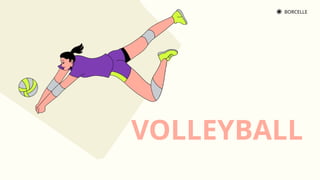
VOLLEYBALL
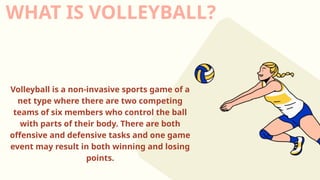
WHAT IS VOLLEYBALL?
Volleyball is a non-invasive sports game of a
net type where there are two competing
teams of six members who control the ball
with parts of their body. There are both
offensive and defensive tasks and one game
event may result in both winning and losing
points.
HISTORY
• Originally called mintonette, the origin of
volleyball can be traced back to 1895 in
Massachusetts, USA. It was created by American
William G. Morgan.
• Volleyball was invented in 1895 by William G. Morgan, the
physical director at the YMCA in Holyoke, Massachusetts, as
a less strenuous alternative to basketball. Combining
elements from basketball, baseball, tennis, and handball,
the sport as initially called “mintonette” before being
renamed volleyball.
HISTORY
• During a demonstration of the game, a professor
named Alfred Halstead suggested the term
"volleyball" because the ball was meant to be
"volleyed" back and forth over the net.
• A specially designed ball was introduced in 1900,
and the sport gained popularity through the
YMCA network, evolving into the globally played
game we know today with over 800 million
participant
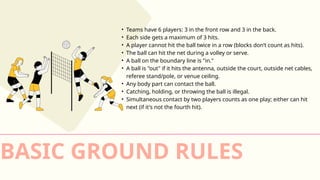
• Teams have 6 players: 3 in the front row and 3 in the back.
• Each side gets a maximum of 3 hits.
• A player cannot hit the ball twice in a row (blocks don’t count as hits).
• The ball can hit the net during a volley or serve.
• A ball on the boundary line is "in."
• A ball is "out" if it hits the antenna, outside the court, outside net cables,
referee stand/pole, or venue ceiling.
• Any body part can contact the ball.
• Catching, holding, or throwing the ball is illegal.
• Simultaneous contact by two players counts as one play; either can hit
next (if it's not the fourth hit).
BASIC GROUND RULES
SKILLS
Key skills in volleyball include:
1. Serving: Delivering the ball into play from behind the end line. Types include underhand,
overhand, jump serve, and float serve.
2. Passing (Bumping): Using the forearms to receive the ball and direct it to the setter,
crucial for good ball control.
3. Setting: Using the fingertips to deliver a high, accurate ball for a teammate to spike.
4. Spiking (Attacking): Hitting the ball forcefully over the net into the opponent’s court,
aiming for power and placement.
5. Blocking: Defending against a spike by jumping at the net with arms extended to stop or
deflect the ball.
6. Digging: Preventing the ball from touching the ground after an opponent’s spike, often
requiring diving or lunging.
7. Footwork and Positioning: Moving efficiently to cover the court and be in the right place
for each play.
8. Communication: Calling out plays, positions, and ball direction to maintain team
coordination.
9. Teamwork and Strategy: Understanding rotations, formations, and tactics like 6-2 or 5-1
systems for effective play.
10. Physical Conditioning: Agility, speed, and vertical jump are essential for performance
and injury prevention.
EQUIPMENT BEING USED
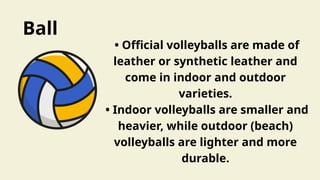
Ball
• Official volleyballs are made of
leather or synthetic leather and
come in indoor and outdoor
varieties.
• Indoor volleyballs are smaller and
heavier, while outdoor (beach)
volleyballs are lighter and more
durable.
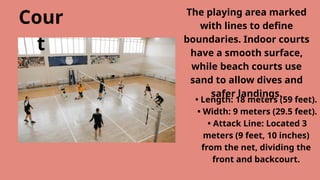
The playing area marked
with lines to define
boundaries. Indoor courts
have a smooth surface,
while beach courts use
sand to allow dives and
safer landings.
Cour
t
• Length: 18 meters (59 feet).
• Width: 9 meters (29.5 feet).
• Attack Line: Located 3
meters (9 feet, 10 inches)
from the net, dividing the
front and backcourt.
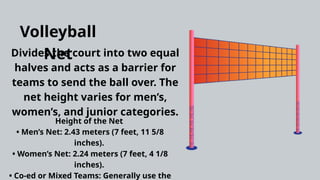
Divides the court into two equal
halves and acts as a barrier for
teams to send the ball over. The
net height varies for men’s,
women’s, and junior categories.
Volleyball
Net
Height of the Net
• Men’s Net: 2.43 meters (7 feet, 11 5/8
inches).
• Women’s Net: 2.24 meters (7 feet, 4 1/8
inches).
• Co-ed or Mixed Teams: Generally use the
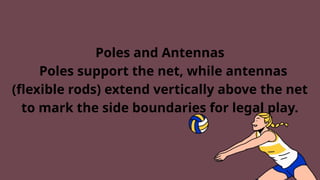
Poles and Antennas
Poles support the net, while antennas
(flexible rods) extend vertically above the net
to mark the side boundaries for legal play.
Knee Pads
• Protect the knees from impact during dives,
falls, and quick movements. Essential for
preventing injuries in indoor volleyball.
Uniforms
• Includes jerseys and shorts, designed for comfort and
freedom of movement. In beach volleyball, players wear
lighter clothing due to the hot and sandy environment.
Volleyball Shoes
• Specially designed shoes with non-marking soles for better
traction on indoor courts. They offer stability and cushioning
for lateral movements and jumps.
• FIRST REFEREE (R1]
• SECOND REFEREE (R2)
• SCOREKEEPER
• LIBERO TRACKER
• LINE JUDGES
• ASSISTANT REFEREE
OFFICIATING OFFICIALS AND
THEIR FUNCTIONS
• FIVB (federation internationale de
volleyball)
• Continental Federations
• National Volleyball Federation
• Proffesional Leagues
• School Volleyball Organizations
GOVERNING BODIES &
DIFFERENT EXISTING ORG
THANK YOU!

P.E. VOLLEYBALL REPORTING PHYSICAL EDUCATION

  • 1.
  • 2.
    WHAT IS VOLLEYBALL? Volleyballis a non-invasive sports game of a net type where there are two competing teams of six members who control the ball with parts of their body. There are both offensive and defensive tasks and one game event may result in both winning and losing points.
  • 3.
    HISTORY • Originally calledmintonette, the origin of volleyball can be traced back to 1895 in Massachusetts, USA. It was created by American William G. Morgan. • Volleyball was invented in 1895 by William G. Morgan, the physical director at the YMCA in Holyoke, Massachusetts, as a less strenuous alternative to basketball. Combining elements from basketball, baseball, tennis, and handball, the sport as initially called “mintonette” before being renamed volleyball.
  • 4.
    HISTORY • During ademonstration of the game, a professor named Alfred Halstead suggested the term "volleyball" because the ball was meant to be "volleyed" back and forth over the net. • A specially designed ball was introduced in 1900, and the sport gained popularity through the YMCA network, evolving into the globally played game we know today with over 800 million participant
  • 5.
    • Teams have6 players: 3 in the front row and 3 in the back. • Each side gets a maximum of 3 hits. • A player cannot hit the ball twice in a row (blocks don’t count as hits). • The ball can hit the net during a volley or serve. • A ball on the boundary line is "in." • A ball is "out" if it hits the antenna, outside the court, outside net cables, referee stand/pole, or venue ceiling. • Any body part can contact the ball. • Catching, holding, or throwing the ball is illegal. • Simultaneous contact by two players counts as one play; either can hit next (if it's not the fourth hit). BASIC GROUND RULES
  • 6.
    SKILLS Key skills involleyball include: 1. Serving: Delivering the ball into play from behind the end line. Types include underhand, overhand, jump serve, and float serve. 2. Passing (Bumping): Using the forearms to receive the ball and direct it to the setter, crucial for good ball control. 3. Setting: Using the fingertips to deliver a high, accurate ball for a teammate to spike. 4. Spiking (Attacking): Hitting the ball forcefully over the net into the opponent’s court, aiming for power and placement. 5. Blocking: Defending against a spike by jumping at the net with arms extended to stop or deflect the ball. 6. Digging: Preventing the ball from touching the ground after an opponent’s spike, often requiring diving or lunging. 7. Footwork and Positioning: Moving efficiently to cover the court and be in the right place for each play. 8. Communication: Calling out plays, positions, and ball direction to maintain team coordination. 9. Teamwork and Strategy: Understanding rotations, formations, and tactics like 6-2 or 5-1 systems for effective play. 10. Physical Conditioning: Agility, speed, and vertical jump are essential for performance and injury prevention.
  • 7.
  • 8.
    Ball • Official volleyballsare made of leather or synthetic leather and come in indoor and outdoor varieties. • Indoor volleyballs are smaller and heavier, while outdoor (beach) volleyballs are lighter and more durable.
  • 9.
    The playing areamarked with lines to define boundaries. Indoor courts have a smooth surface, while beach courts use sand to allow dives and safer landings. Cour t • Length: 18 meters (59 feet). • Width: 9 meters (29.5 feet). • Attack Line: Located 3 meters (9 feet, 10 inches) from the net, dividing the front and backcourt.
  • 10.
    Divides the courtinto two equal halves and acts as a barrier for teams to send the ball over. The net height varies for men’s, women’s, and junior categories. Volleyball Net Height of the Net • Men’s Net: 2.43 meters (7 feet, 11 5/8 inches). • Women’s Net: 2.24 meters (7 feet, 4 1/8 inches). • Co-ed or Mixed Teams: Generally use the
  • 11.
    Poles and Antennas Polessupport the net, while antennas (flexible rods) extend vertically above the net to mark the side boundaries for legal play.
  • 12.
    Knee Pads • Protectthe knees from impact during dives, falls, and quick movements. Essential for preventing injuries in indoor volleyball. Uniforms • Includes jerseys and shorts, designed for comfort and freedom of movement. In beach volleyball, players wear lighter clothing due to the hot and sandy environment. Volleyball Shoes • Specially designed shoes with non-marking soles for better traction on indoor courts. They offer stability and cushioning for lateral movements and jumps.
  • 13.
    • FIRST REFEREE(R1] • SECOND REFEREE (R2) • SCOREKEEPER • LIBERO TRACKER • LINE JUDGES • ASSISTANT REFEREE OFFICIATING OFFICIALS AND THEIR FUNCTIONS
  • 14.
    • FIVB (federationinternationale de volleyball) • Continental Federations • National Volleyball Federation • Proffesional Leagues • School Volleyball Organizations GOVERNING BODIES & DIFFERENT EXISTING ORG
  • 15.