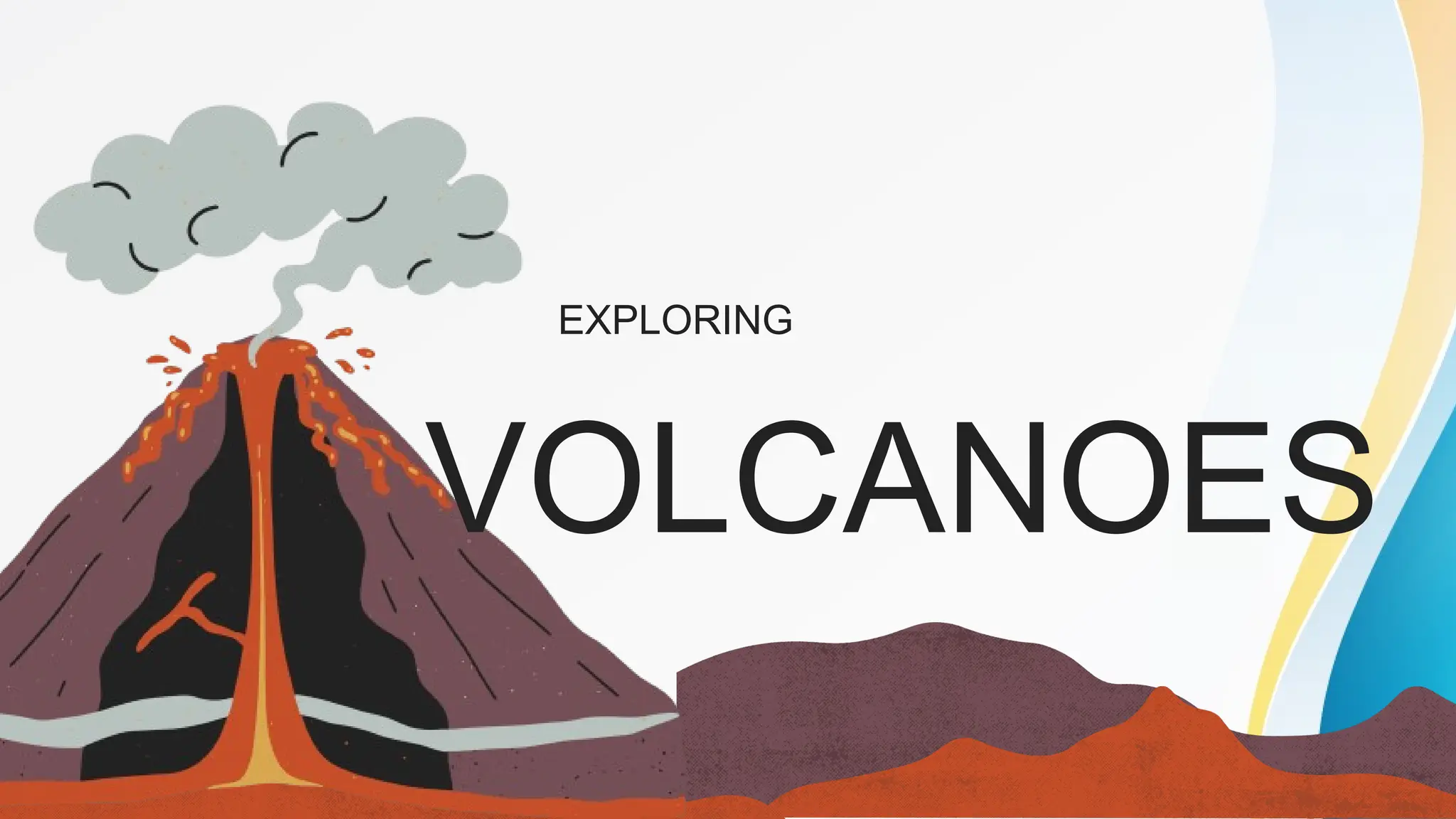
VOLCANOES
EXPLORING
Volcanoes are majestic natural wonders that captivate our
imagination and shape the landscapes around us.
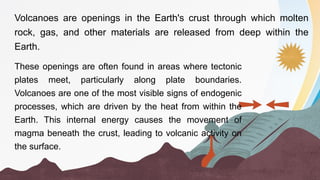
Volcanoes are openings in the Earth's crust through which molten
rock, gas, and other materials are released from deep within the
Earth.
These openings are often found in areas where tectonic
plates meet, particularly along plate boundaries.
Volcanoes are one of the most visible signs of endogenic
processes, which are driven by the heat from within the
Earth. This internal energy causes the movement of
magma beneath the crust, leading to volcanic activity on
the surface.
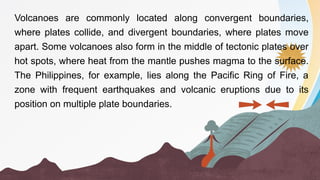
Volcanoes are commonly located along convergent boundaries,
where plates collide, and divergent boundaries, where plates move
apart. Some volcanoes also form in the middle of tectonic plates over
hot spots, where heat from the mantle pushes magma to the surface.
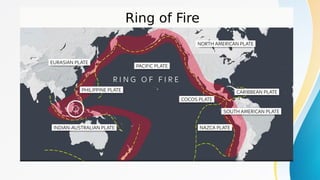
The Philippines, for example, lies along the Pacific Ring of Fire, a
zone with frequent earthquakes and volcanic eruptions due to its
position on multiple plate boundaries.
VOLCANOES
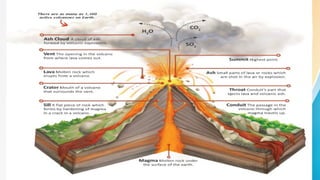
PARTS OF
VOLCANOES
TYPES OF
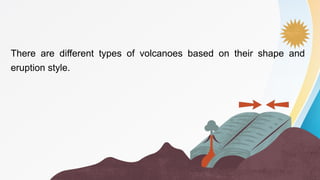
There are different types of volcanoes based on their shape and
eruption style.
DESCRIPTION:
ERUPTION STYLE:
EXAMPLES:
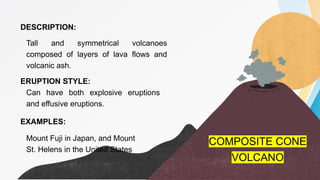
Tall and symmetrical volcanoes
composed of layers of lava flows and
volcanic ash.
Can have both explosive eruptions
and effusive eruptions.
Mount Fuji in Japan, and Mount
St. Helens in the United States
COMPOSITE CONE
VOLCANO
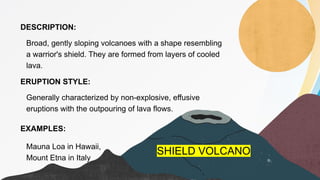
SHIELD VOLCANO
DESCRIPTION:
ERUPTION STYLE:
EXAMPLES:
Broad, gently sloping volcanoes with a shape resembling
a warrior's shield. They are formed from layers of cooled
lava.
Generally characterized by non-explosive, effusive
eruptions with the outpouring of lava flows.
Mauna Loa in Hawaii,
Mount Etna in Italy
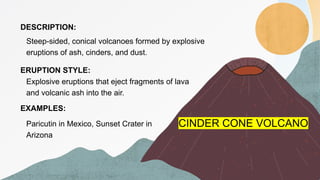
CINDER CONE VOLCANO
DESCRIPTION:
ERUPTION STYLE:
EXAMPLES:
Steep-sided, conical volcanoes formed by explosive
eruptions of ash, cinders, and dust.
Explosive eruptions that eject fragments of lava
and volcanic ash into the air.
Paricutin in Mexico, Sunset Crater in
Arizona
VOLCANO
ERUPTION
S
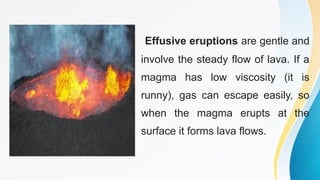
Effusive eruptions are gentle and
involve the steady flow of lava. If a
magma has low viscosity (it is
runny), gas can escape easily, so
when the magma erupts at the
surface it forms lava flows.
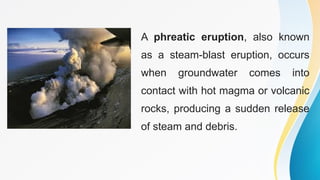
A phreatic eruption, also known
as a steam-blast eruption, occurs
when groundwater comes into
contact with hot magma or volcanic
rocks, producing a sudden release
of steam and debris.
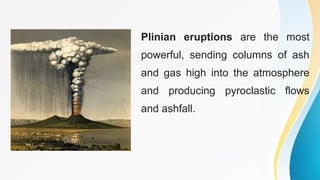
Plinian eruptions are the most
powerful, sending columns of ash
and gas high into the atmosphere
and producing pyroclastic flows
and ashfall.
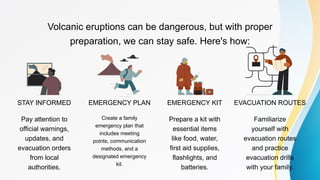
STAY INFORMED EMERGENCY PLAN
Volcanic eruptions can be dangerous, but with proper
preparation, we can stay safe. Here's how:
EMERGENCY KIT EVACUATION ROUTES
Pay attention to
official warnings,
updates, and
evacuation orders
from local
authorities.
Create a family
emergency plan that
includes meeting
points, communication
methods, and a
designated emergency
kit.
Prepare a kit with
essential items
like food, water,
first aid supplies,
flashlights, and
batteries.
Familiarize
yourself with
evacuation routes
and practice
evacuation drills
with your family.
Volcanoes pose several hazards. Lava flows, though usually
slow, can destroy everything in their path. Ashfall can cause
respiratory issues, damage crops, and affect air travel.
Pyroclastic flows, which are fast-moving clouds of hot gas, ash,
and rock, are extremely dangerous. Lahars, or volcanic
mudflows, often occur when volcanic ash mixes with rainwater
and can bury communities. Volcanic gases such as sulfur dioxide
and carbon dioxide can be harmful to both humans and the
environment.
To reduce the risks associated with volcanoes, scientists monitor
volcanic activity through agencies like PHIVOLCS in the
Philippines. They use instruments to detect earthquakes, ground
deformation, gas emissions, and other signs of an impending
eruption. The government uses an alert level system ranging
from 0 to 5 to inform the public about the level of danger.
Preparedness measures such as early evacuation, public
education, and disaster drills are essential in keeping
communities safe.
The Philippines is home to several active volcanoes, including
Mayon, Taal, Kanlaon, and the historically significant Mount
Pinatubo. The 1991 eruption of Mount Pinatubo was one of the
most powerful eruptions in the 20th century and had global
environmental impacts, including temporary climate cooling.
Studying volcanoes helps us understand how the Earth works,
especially the powerful forces beneath the surface. It also helps
us prepare for natural disasters, minimize damage, and save
lives. Through science and awareness, we can better appreciate
the dynamic nature of our planet.
QUIZ 3
Write the correct answer on the blank.
1. _____ is an opening in the Earth's crust where magma, gas,
and ash escape.
2. The zone where the Philippines is located that has frequent
volcanic eruptions is called the _____.
3. A type of volcano with broad, gentle slopes and quiet lava
flows is the _____.
4. The eruption caused by magma meeting groundwater,
producing steam and debris, is called _____.
5. A wide, sunken depression formed after a major eruption and
collapse of a volcano is called a _____.
COLUMN A COLUMN B
6. Stratovolcano a. Caused by high gas and
silica content
7. Plinian eruption b. Responsible for monitoring
Philippine volcanoes
8. PHIVOLCS c. Broad volcano with gentle
slopes
9. Lahars d. Violent eruption with tall ash
column
10. Shield volcano e. Mudflows from volcanic ash
and rain
Match Column A with Column B. Write the letter of the
correct answer.
Write True if the statement is correct and False if it is not.
11. All volcanoes are formed only at plate boundaries.
12. Cinder cone volcanoes are small and formed by explosive
eruptions.
13. Effusive eruptions involve violent explosions of magma and
ash.
14. Taal Volcano is an example of a caldera in the Philippines.
15. Pyroclastic flows move slowly and are not dangerous.
THANK
YOU!

Science 10 Exploring Volcanoes- Lesson 5.pptx

  • 1.
  • 2.
    Volcanoes are majesticnatural wonders that captivate our imagination and shape the landscapes around us.
  • 3.
    Volcanoes are openingsin the Earth's crust through which molten rock, gas, and other materials are released from deep within the Earth. These openings are often found in areas where tectonic plates meet, particularly along plate boundaries. Volcanoes are one of the most visible signs of endogenic processes, which are driven by the heat from within the Earth. This internal energy causes the movement of magma beneath the crust, leading to volcanic activity on the surface.
  • 4.
    Volcanoes are commonlylocated along convergent boundaries, where plates collide, and divergent boundaries, where plates move apart. Some volcanoes also form in the middle of tectonic plates over hot spots, where heat from the mantle pushes magma to the surface. The Philippines, for example, lies along the Pacific Ring of Fire, a zone with frequent earthquakes and volcanic eruptions due to its position on multiple plate boundaries.
  • 6.
  • 8.
  • 9.
    There are differenttypes of volcanoes based on their shape and eruption style.
  • 10.
    DESCRIPTION: ERUPTION STYLE: EXAMPLES: Tall andsymmetrical volcanoes composed of layers of lava flows and volcanic ash. Can have both explosive eruptions and effusive eruptions. Mount Fuji in Japan, and Mount St. Helens in the United States COMPOSITE CONE VOLCANO
  • 11.
    SHIELD VOLCANO DESCRIPTION: ERUPTION STYLE: EXAMPLES: Broad,gently sloping volcanoes with a shape resembling a warrior's shield. They are formed from layers of cooled lava. Generally characterized by non-explosive, effusive eruptions with the outpouring of lava flows. Mauna Loa in Hawaii, Mount Etna in Italy
  • 12.
    CINDER CONE VOLCANO DESCRIPTION: ERUPTIONSTYLE: EXAMPLES: Steep-sided, conical volcanoes formed by explosive eruptions of ash, cinders, and dust. Explosive eruptions that eject fragments of lava and volcanic ash into the air. Paricutin in Mexico, Sunset Crater in Arizona
  • 14.
  • 15.
    Effusive eruptions aregentle and involve the steady flow of lava. If a magma has low viscosity (it is runny), gas can escape easily, so when the magma erupts at the surface it forms lava flows.
  • 16.
    A phreatic eruption,also known as a steam-blast eruption, occurs when groundwater comes into contact with hot magma or volcanic rocks, producing a sudden release of steam and debris.
  • 17.
    Plinian eruptions arethe most powerful, sending columns of ash and gas high into the atmosphere and producing pyroclastic flows and ashfall.
  • 19.
    STAY INFORMED EMERGENCYPLAN Volcanic eruptions can be dangerous, but with proper preparation, we can stay safe. Here's how: EMERGENCY KIT EVACUATION ROUTES Pay attention to official warnings, updates, and evacuation orders from local authorities. Create a family emergency plan that includes meeting points, communication methods, and a designated emergency kit. Prepare a kit with essential items like food, water, first aid supplies, flashlights, and batteries. Familiarize yourself with evacuation routes and practice evacuation drills with your family.
  • 20.
    Volcanoes pose severalhazards. Lava flows, though usually slow, can destroy everything in their path. Ashfall can cause respiratory issues, damage crops, and affect air travel. Pyroclastic flows, which are fast-moving clouds of hot gas, ash, and rock, are extremely dangerous. Lahars, or volcanic mudflows, often occur when volcanic ash mixes with rainwater and can bury communities. Volcanic gases such as sulfur dioxide and carbon dioxide can be harmful to both humans and the environment.
  • 21.
    To reduce therisks associated with volcanoes, scientists monitor volcanic activity through agencies like PHIVOLCS in the Philippines. They use instruments to detect earthquakes, ground deformation, gas emissions, and other signs of an impending eruption. The government uses an alert level system ranging from 0 to 5 to inform the public about the level of danger. Preparedness measures such as early evacuation, public education, and disaster drills are essential in keeping communities safe.
  • 22.
    The Philippines ishome to several active volcanoes, including Mayon, Taal, Kanlaon, and the historically significant Mount Pinatubo. The 1991 eruption of Mount Pinatubo was one of the most powerful eruptions in the 20th century and had global environmental impacts, including temporary climate cooling.
  • 23.
    Studying volcanoes helpsus understand how the Earth works, especially the powerful forces beneath the surface. It also helps us prepare for natural disasters, minimize damage, and save lives. Through science and awareness, we can better appreciate the dynamic nature of our planet.
  • 24.
    QUIZ 3 Write thecorrect answer on the blank. 1. _____ is an opening in the Earth's crust where magma, gas, and ash escape. 2. The zone where the Philippines is located that has frequent volcanic eruptions is called the _____. 3. A type of volcano with broad, gentle slopes and quiet lava flows is the _____. 4. The eruption caused by magma meeting groundwater, producing steam and debris, is called _____. 5. A wide, sunken depression formed after a major eruption and collapse of a volcano is called a _____.
  • 25.
    COLUMN A COLUMNB 6. Stratovolcano a. Caused by high gas and silica content 7. Plinian eruption b. Responsible for monitoring Philippine volcanoes 8. PHIVOLCS c. Broad volcano with gentle slopes 9. Lahars d. Violent eruption with tall ash column 10. Shield volcano e. Mudflows from volcanic ash and rain Match Column A with Column B. Write the letter of the correct answer.
  • 26.
    Write True ifthe statement is correct and False if it is not. 11. All volcanoes are formed only at plate boundaries. 12. Cinder cone volcanoes are small and formed by explosive eruptions. 13. Effusive eruptions involve violent explosions of magma and ash. 14. Taal Volcano is an example of a caldera in the Philippines. 15. Pyroclastic flows move slowly and are not dangerous.
  • 27.

Editor's Notes

  • #24 1. Volcano 2. Pacific Ring of Fire 3. Shield volcano 4. Phreatic eruption 5. Caldera
  • #25 6 – a 7 – d 8 – b 9 – e 10 – c
  • #26 11 – False 12 – True 13 – False 14 – True 15 – False