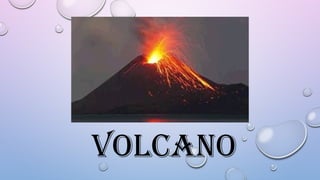
VOLCANO
Structure of a Volcano
The term “volcano” refers to mountain or hill,
typically conical, having a crater or vent in which lava,
rock fragments, hot vapor, and gas are or have been
erupted from the earth's crust. The lava and other
volcanic materials originated from molten materials
called magma found beneath the surface of the Earth.
Magma and other volcanic materials are finding its
way to the surface where they are expelled through
openings like cracks and holes. Any activity that
includes the movement of magma towards or onto the
surface is called volcanism.
The Parts of a Volcano are:
⮚ Summit is the highest point or the apex of the
volcano. At the summit,
you have an opening called vent.
⮚ Slopes are the sides or flanks of a volcano that
radiate from the main or
central vent.
⮚ Base is lower outer part of the volcano.
Other Geologic features of a volcano:
 Magma Chamber is a region beneath the vent of a
volcano where molten
rock or magma is deposited or stored before eruption.
 Main Vent is the main opening or outlet on the surface of a
volcano that emits lava, gases, ash or other volcanic materials.
 Conduit is an underground central tube-like or pipe-like
structure of a volcano that connects the magma chamber to the
crater through which the magma travels.
 Side Vent is a smaller outlet through which magma escapes.
 Crater is the mouth of the volcano which is a funnel-shaped or
bowlshaped hollow at the top of the vent from where magma, ash
and gas comes out.
 Lava is a molten rock which is given off onto the surface of the
Earth when a volcano erupts.
 Ash and Gas Cloud is a of mixtures of rock, minerals, glass
particles and gases expelled or pushed out of the volcano during
volcanic eruption.
Classification of Volcanoes
There are several ways by which volcanoes can be
classified. They can be classified based on structure
and activity.
Types of Volcanoes Based on Structure
One way to classify different types of volcanoes is through
the structure characterized by their shape, parts and formation.
Cinder Cone Volcano
Cinder cone volcanoes
are the simplest type of volcano. They are built from
particles and blobs of solidified lava ejected from a single vent.
Lava is thrown into the air, which breaks into small fragments
that solidify and fall as cinders around the vent to form a
circular or oval cone. Most cinder cones have a steep slope,
wide crater and are the most abundant of the three major
volcano types. An example of this type in the Philippines are
Taal Volcano in Batangas, Smith Volcano found in Babuyan
Group of Islands, Mount Mayabobo found in Quezon Province,
and Mount Musuan in Bukidnon. Anexample of this outside of
the Philippines is the Paricutin volcano in Mexico.
Figure 4.1 Mount Babuyan
Figure 4.2 Taal Volcano
Figure 4.3 Mount Mayabobo
Composite Volcano
Composite volcanoes or stratovolcanoes
are large, typically steepsided, symmetrical cones of large
dimension formed from alternating layers of lava flows, volcanic
ash, cinders, blocks, and pyroclastic materials. One important
feature of a composite volcanoes is theconduit system from
which magma rises to the surface of the Earth. They are formed
from viscous, or sticky, lava that does not flow easily. The lava
builds up around the vent forming a volcano with steep sides.
Some famous composite volcanoes in the Philippines are Mount
Mayon in Albay, Mount Arayat in Pampanga, Mount Kanlaon in
Negros Island, and Mount Apo in Davao Region. An example of
these outside the Philippines are Mount Rainier in Washington,
USA, and Mount Fuji in Japan
Figure 5.1 Mount Mayon
Figure 5.3 Mount Kanlaon
Figure 5.4 Mount Apo
Shield Volcano
Shield volcanoes
are large, broad volcanoes that look similar to
shields from above – hence the name. These volcanoes
are built almost entirely of fluid lava flow thus these
volcanoes are not steep. They can be easily identified
because they are tall and broad, with flat, rounded
shapes. The lava is not accompanied by pyroclastic
materials, which makes shield volcanoes relatively safe.
Eruptions at shield volcanoes are only explosive if water
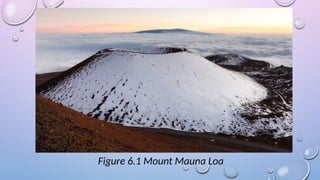
somehow gets into the vent. Mauna Loa is one of the
largest shield volcanoes.
Figure 6.1 Mount Mauna Loa
Types of Volcanoes Based on Activity
Another way of classifying volcanoes according to
the Philippine Institute of Volcanology and Seismology
(PHIVOLCS) is based on their activity as indicated by
their behavior and historical records.
 Active volcanoes
are those volcanoes that have had at least one
eruption during the past 10,000 years. They are those
that erupted recently and still
showing regular activity like emission of gases, lava and
ash flows.
 Inactive volcanoes
are those that have not erupted for the last 10,000 years
and is not expected to erupt again in a comparable time scale of
the future. There are no signs of volcanic activity for a long
period of time because magma supply is cut off. Also the
physical form of the volcano has signs of intensive weathering
and erosion.
 Potentially active volcanoes
are those that have no records of volcanic activity but are
morphologically young-looking.
Our country has more than a hundred volcanoes. Twenty four
(24) are active while the rest are either potentially active or
inactive volcanoes. Below are some examples of active volcanoes.
Figure 7. Mount Banahaw Figure7.1. Mount Hibok hibok
Figure 7.2. Mount Kanlaon Figure 7.3. Mount Apo
Types of Volcanic Eruptions
Different types of volcanoes erupt differently. They
are generally classified as wet or dry depending on the
magma’s water content. Volcanoes are described
according to the style of eruption as follows:
Phreatic or hydrothermal is a stream-driven eruption as the hot
rocks come in contact with water. It is short lived, characterized
by ash columns but may be a beginning of a larger eruption.
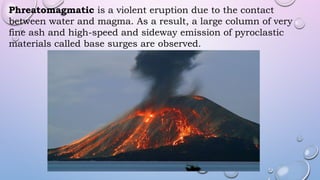
Phreatomagmatic is a violent eruption due to the contact
between water and magma. As a result, a large column of very
fine ash and high-speed and sideway emission of pyroclastic
materials called base surges are observed.
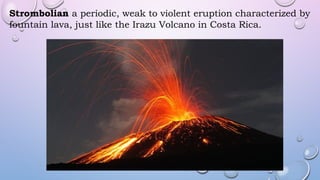
Strombolian a periodic, weak to violent eruption characterized by
fountain lava, just like the Irazu Volcano in Costa Rica.
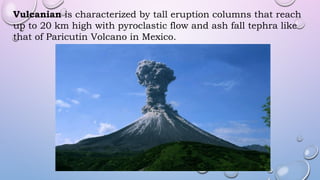
Vulcanian is characterized by tall eruption columns that reach
up to 20 km high with pyroclastic flow and ash fall tephra like
that of Paricutin Volcano in Mexico.
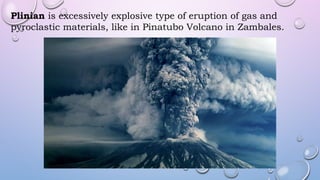
Plinian is excessively explosive type of eruption of gas and
pyroclastic materials, like in Pinatubo Volcano in Zambales.
Signs of an Impending Volcanic Eruption
Philippine Institute of Volcanology and Seismology
(PHIVOLCS) is the government agency tasked with
monitoring earthquakes and volcanoes in the
country. Based on their findings, here are the
commonly observed signs when a volcano is about
to erupt.
VOLCANO -science9.module1 unit 3PPT.pptx

VOLCANO -science9.module1 unit 3PPT.pptx

  • 1.
  • 2.
    Structure of aVolcano The term “volcano” refers to mountain or hill, typically conical, having a crater or vent in which lava, rock fragments, hot vapor, and gas are or have been erupted from the earth's crust. The lava and other volcanic materials originated from molten materials called magma found beneath the surface of the Earth. Magma and other volcanic materials are finding its way to the surface where they are expelled through openings like cracks and holes. Any activity that includes the movement of magma towards or onto the surface is called volcanism.
  • 4.
    The Parts ofa Volcano are: ⮚ Summit is the highest point or the apex of the volcano. At the summit, you have an opening called vent. ⮚ Slopes are the sides or flanks of a volcano that radiate from the main or central vent. ⮚ Base is lower outer part of the volcano. Other Geologic features of a volcano:  Magma Chamber is a region beneath the vent of a volcano where molten rock or magma is deposited or stored before eruption.
  • 5.
     Main Ventis the main opening or outlet on the surface of a volcano that emits lava, gases, ash or other volcanic materials.  Conduit is an underground central tube-like or pipe-like structure of a volcano that connects the magma chamber to the crater through which the magma travels.  Side Vent is a smaller outlet through which magma escapes.  Crater is the mouth of the volcano which is a funnel-shaped or bowlshaped hollow at the top of the vent from where magma, ash and gas comes out.  Lava is a molten rock which is given off onto the surface of the Earth when a volcano erupts.  Ash and Gas Cloud is a of mixtures of rock, minerals, glass particles and gases expelled or pushed out of the volcano during volcanic eruption.
  • 6.
    Classification of Volcanoes Thereare several ways by which volcanoes can be classified. They can be classified based on structure and activity. Types of Volcanoes Based on Structure One way to classify different types of volcanoes is through the structure characterized by their shape, parts and formation.
  • 7.
  • 8.
    Cinder cone volcanoes arethe simplest type of volcano. They are built from particles and blobs of solidified lava ejected from a single vent. Lava is thrown into the air, which breaks into small fragments that solidify and fall as cinders around the vent to form a circular or oval cone. Most cinder cones have a steep slope, wide crater and are the most abundant of the three major volcano types. An example of this type in the Philippines are Taal Volcano in Batangas, Smith Volcano found in Babuyan Group of Islands, Mount Mayabobo found in Quezon Province, and Mount Musuan in Bukidnon. Anexample of this outside of the Philippines is the Paricutin volcano in Mexico.
  • 9.
  • 10.
  • 11.
  • 12.
  • 13.
    Composite volcanoes orstratovolcanoes are large, typically steepsided, symmetrical cones of large dimension formed from alternating layers of lava flows, volcanic ash, cinders, blocks, and pyroclastic materials. One important feature of a composite volcanoes is theconduit system from which magma rises to the surface of the Earth. They are formed from viscous, or sticky, lava that does not flow easily. The lava builds up around the vent forming a volcano with steep sides. Some famous composite volcanoes in the Philippines are Mount Mayon in Albay, Mount Arayat in Pampanga, Mount Kanlaon in Negros Island, and Mount Apo in Davao Region. An example of these outside the Philippines are Mount Rainier in Washington, USA, and Mount Fuji in Japan
  • 14.
  • 16.
  • 17.
  • 18.
  • 19.
    Shield volcanoes are large,broad volcanoes that look similar to shields from above – hence the name. These volcanoes are built almost entirely of fluid lava flow thus these volcanoes are not steep. They can be easily identified because they are tall and broad, with flat, rounded shapes. The lava is not accompanied by pyroclastic materials, which makes shield volcanoes relatively safe. Eruptions at shield volcanoes are only explosive if water somehow gets into the vent. Mauna Loa is one of the largest shield volcanoes.
  • 20.
  • 21.
    Types of VolcanoesBased on Activity Another way of classifying volcanoes according to the Philippine Institute of Volcanology and Seismology (PHIVOLCS) is based on their activity as indicated by their behavior and historical records.  Active volcanoes are those volcanoes that have had at least one eruption during the past 10,000 years. They are those that erupted recently and still showing regular activity like emission of gases, lava and ash flows.
  • 22.
     Inactive volcanoes arethose that have not erupted for the last 10,000 years and is not expected to erupt again in a comparable time scale of the future. There are no signs of volcanic activity for a long period of time because magma supply is cut off. Also the physical form of the volcano has signs of intensive weathering and erosion.  Potentially active volcanoes are those that have no records of volcanic activity but are morphologically young-looking. Our country has more than a hundred volcanoes. Twenty four (24) are active while the rest are either potentially active or inactive volcanoes. Below are some examples of active volcanoes.
  • 23.
    Figure 7. MountBanahaw Figure7.1. Mount Hibok hibok Figure 7.2. Mount Kanlaon Figure 7.3. Mount Apo
  • 24.
    Types of VolcanicEruptions Different types of volcanoes erupt differently. They are generally classified as wet or dry depending on the magma’s water content. Volcanoes are described according to the style of eruption as follows:
  • 25.
    Phreatic or hydrothermalis a stream-driven eruption as the hot rocks come in contact with water. It is short lived, characterized by ash columns but may be a beginning of a larger eruption.
  • 26.
    Phreatomagmatic is aviolent eruption due to the contact between water and magma. As a result, a large column of very fine ash and high-speed and sideway emission of pyroclastic materials called base surges are observed.
  • 27.
    Strombolian a periodic,weak to violent eruption characterized by fountain lava, just like the Irazu Volcano in Costa Rica.
  • 28.
    Vulcanian is characterizedby tall eruption columns that reach up to 20 km high with pyroclastic flow and ash fall tephra like that of Paricutin Volcano in Mexico.
  • 29.
    Plinian is excessivelyexplosive type of eruption of gas and pyroclastic materials, like in Pinatubo Volcano in Zambales.
  • 30.
    Signs of anImpending Volcanic Eruption Philippine Institute of Volcanology and Seismology (PHIVOLCS) is the government agency tasked with monitoring earthquakes and volcanoes in the country. Based on their findings, here are the commonly observed signs when a volcano is about to erupt.