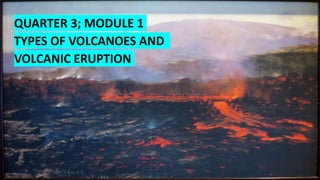
QUARTER 3; MODULE 1
TYPES OF VOLCANOES AND
VOLCANIC ERUPTION
What comes into your mind when
you hear the word “volcano”?
Some of you might think of
negative things like lava, smoke,
ashes, earthquake, and loss of lives
and properties.
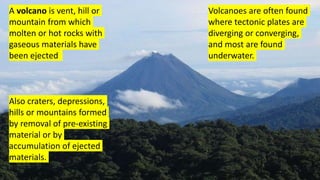
A volcano is vent, hill or
mountain from which
molten or hot rocks with
gaseous materials have
been ejected
Volcanoes are often found
where tectonic plates are
diverging or converging,
and most are found
underwater.
Also craters, depressions,
hills or mountains formed
by removal of pre-existing
material or by
accumulation of ejected
materials.
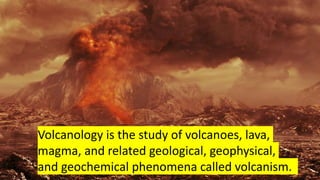
Volcanology is the study of volcanoes, lava,
magma, and related geological, geophysical,
and geochemical phenomena called volcanism.
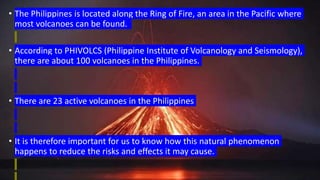
• The Philippines is located along the Ring of Fire, an area in the Pacific where
most volcanoes can be found.
• According to PHIVOLCS (Philippine Institute of Volcanology and Seismology),
there are about 100 volcanoes in the Philippines.
• There are 23 active volcanoes in the Philippines
• It is therefore important for us to know how this natural phenomenon
happens to reduce the risks and effects it may cause.
SOME ACTIVE VOLCANOES IN THE PHILIPPINES:
Ambalatungan Group Iriga Smith
Babuyan Claro Jolo Group Taal
Banahaw Kanlaon
Biliran Leonard Kniaseff (active 1800 years ago)
Bulusan Makaturing
Cabalian Matutum
Cagua Mayon
Camiguin de Babuyanes Musuan
Didicas Parker
Hibok-Hibok Pinatubo
Iraya Ragang
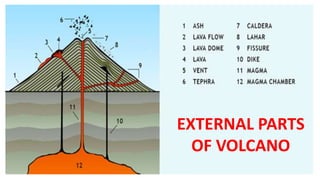
EXTERNAL PARTS
OF VOLCANO
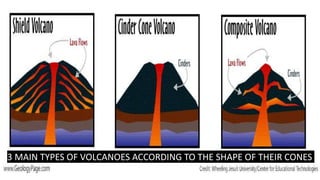
3 MAIN TYPES OF VOLCANOES ACCORDING TO THE SHAPE OF THEIR CONES
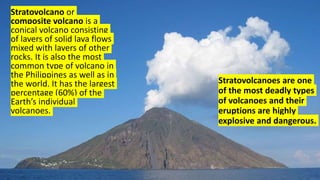
Stratovolcano or
composite volcano is a
conical volcano consisting
of layers of solid lava flows
mixed with layers of other
rocks. It is also the most
common type of volcano in
the Philippines as well as in
the world. It has the largest
percentage (60%) of the
Earth’s individual
volcanoes.
Stratovolcanoes are one
of the most deadly types
of volcanoes and their
eruptions are highly
explosive and dangerous.
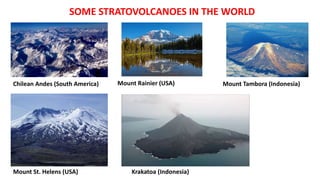
SOME STRATOVOLCANOES IN THE WORLD
Chilean Andes (South America) Mount Rainier (USA)
Mount St. Helens (USA) Krakatoa (Indonesia)
Mount Tambora (Indonesia)
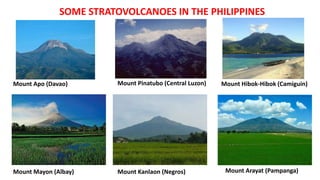
SOME STRATOVOLCANOES IN THE PHILIPPINES
Mount Apo (Davao) Mount Pinatubo (Central Luzon)
Mount Mayon (Albay) Mount Kanlaon (Negros)
Mount Hibok-Hibok (Camiguin)
Mount Arayat (Pampanga)
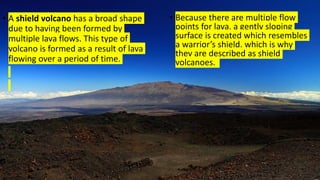
• A shield volcano has a broad shape
due to having been formed by
multiple lava flows. This type of
volcano is formed as a result of lava
flowing over a period of time.
• Because there are multiple flow
points for lava, a gently sloping
surface is created which resembles
a warrior’s shield, which is why
they are described as shield
volcanoes.
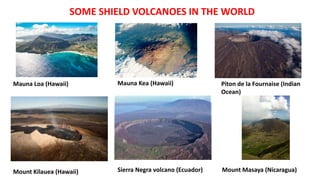
SOME SHIELD VOLCANOES IN THE WORLD
Mauna Loa (Hawaii) Mauna Kea (Hawaii)
Mount Kilauea (Hawaii) Sierra Negra volcano (Ecuador)
Piton de la Fournaise (Indian
Ocean)
Mount Masaya (Nicaragua)
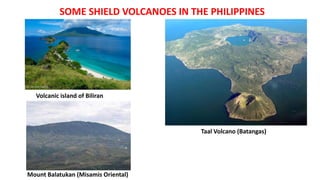
SOME SHIELD VOLCANOES IN THE PHILIPPINES
Volcanic island of Biliran
Taal Volcano (Batangas)
Mount Balatukan (Misamis Oriental)
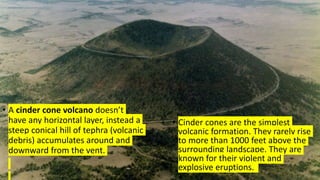
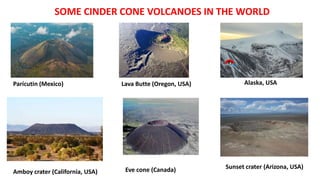
• A cinder cone volcano doesn’t
have any horizontal layer, instead a
steep conical hill of tephra (volcanic
debris) accumulates around and
downward from the vent.
• Cinder cones are the simplest
volcanic formation. They rarely rise
to more than 1000 feet above the
surrounding landscape. They are
known for their violent and
explosive eruptions.
SOME CINDER CONE VOLCANOES IN THE WORLD
Parícutin (Mexico) Lava Butte (Oregon, USA)
Amboy crater (California, USA) Eve cone (Canada)
Alaska, USA
Sunset crater (Arizona, USA)
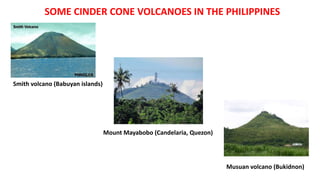
SOME CINDER CONE VOLCANOES IN THE PHILIPPINES
Smith volcano (Babuyan islands)
Musuan volcano (Bukidnon)
Mount Mayabobo (Candelaria, Quezon)
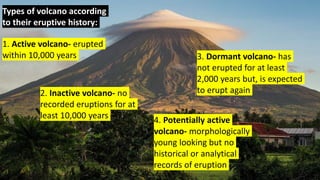
Types of volcano according
to their eruptive history:
1. Active volcano- erupted
within 10,000 years
2. Inactive volcano- no
recorded eruptions for at
least 10,000 years
3. Dormant volcano- has
not erupted for at least
2,000 years but, is expected
to erupt again
4. Potentially active
volcano- morphologically
young looking but no
historical or analytical
records of eruption
Types of volcanic eruption:
1. Strombolian and Hawaiian
eruptions
2. Vucanian eruptions
3. Subplinian and Plinian
eruptions
4. Phreatic eruptions
5. Phreatomagmatic eruptions
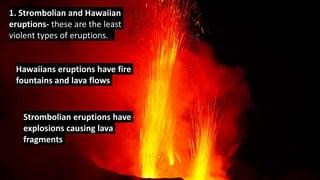
1. Strombolian and Hawaiian
eruptions- these are the least
violent types of eruptions.
Hawaiians eruptions have fire
fountains and lava flows
Strombolian eruptions have
explosions causing lava
fragments
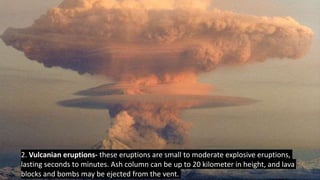
2. Vulcanian eruptions- these eruptions are small to moderate explosive eruptions,
lasting seconds to minutes. Ash column can be up to 20 kilometer in height, and lava
blocks and bombs may be ejected from the vent.
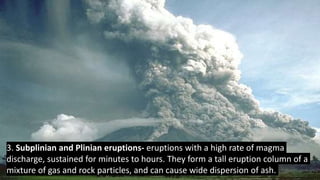
3. Subplinian and Plinian eruptions- eruptions with a high rate of magma
discharge, sustained for minutes to hours. They form a tall eruption column of a
mixture of gas and rock particles, and can cause wide dispersion of ash.
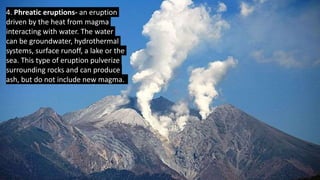
4. Phreatic eruptions- an eruption
driven by the heat from magma
interacting with water. The water
can be groundwater, hydrothermal
systems, surface runoff, a lake or the
sea. This type of eruption pulverize
surrounding rocks and can produce
ash, but do not include new magma.
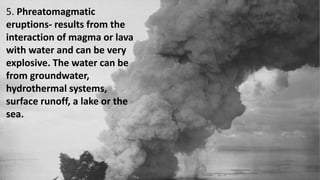
5. Phreatomagmatic
eruptions- results from the
interaction of magma or lava
with water and can be very
explosive. The water can be
from groundwater,
hydrothermal systems,
surface runoff, a lake or the
sea.

VOLCANOES PPT.pptx

  • 1.
    QUARTER 3; MODULE1 TYPES OF VOLCANOES AND VOLCANIC ERUPTION
  • 2.
    What comes intoyour mind when you hear the word “volcano”?
  • 3.
    Some of youmight think of negative things like lava, smoke, ashes, earthquake, and loss of lives and properties.
  • 4.
    A volcano isvent, hill or mountain from which molten or hot rocks with gaseous materials have been ejected Volcanoes are often found where tectonic plates are diverging or converging, and most are found underwater. Also craters, depressions, hills or mountains formed by removal of pre-existing material or by accumulation of ejected materials.
  • 5.
    Volcanology is thestudy of volcanoes, lava, magma, and related geological, geophysical, and geochemical phenomena called volcanism.
  • 6.
    • The Philippinesis located along the Ring of Fire, an area in the Pacific where most volcanoes can be found. • According to PHIVOLCS (Philippine Institute of Volcanology and Seismology), there are about 100 volcanoes in the Philippines. • There are 23 active volcanoes in the Philippines • It is therefore important for us to know how this natural phenomenon happens to reduce the risks and effects it may cause.
  • 7.
    SOME ACTIVE VOLCANOESIN THE PHILIPPINES: Ambalatungan Group Iriga Smith Babuyan Claro Jolo Group Taal Banahaw Kanlaon Biliran Leonard Kniaseff (active 1800 years ago) Bulusan Makaturing Cabalian Matutum Cagua Mayon Camiguin de Babuyanes Musuan Didicas Parker Hibok-Hibok Pinatubo Iraya Ragang
  • 8.
  • 9.
    3 MAIN TYPESOF VOLCANOES ACCORDING TO THE SHAPE OF THEIR CONES
  • 10.
    Stratovolcano or composite volcanois a conical volcano consisting of layers of solid lava flows mixed with layers of other rocks. It is also the most common type of volcano in the Philippines as well as in the world. It has the largest percentage (60%) of the Earth’s individual volcanoes. Stratovolcanoes are one of the most deadly types of volcanoes and their eruptions are highly explosive and dangerous.
  • 11.
    SOME STRATOVOLCANOES INTHE WORLD Chilean Andes (South America) Mount Rainier (USA) Mount St. Helens (USA) Krakatoa (Indonesia) Mount Tambora (Indonesia)
  • 12.
    SOME STRATOVOLCANOES INTHE PHILIPPINES Mount Apo (Davao) Mount Pinatubo (Central Luzon) Mount Mayon (Albay) Mount Kanlaon (Negros) Mount Hibok-Hibok (Camiguin) Mount Arayat (Pampanga)
  • 13.
    • A shieldvolcano has a broad shape due to having been formed by multiple lava flows. This type of volcano is formed as a result of lava flowing over a period of time. • Because there are multiple flow points for lava, a gently sloping surface is created which resembles a warrior’s shield, which is why they are described as shield volcanoes.
  • 14.
    SOME SHIELD VOLCANOESIN THE WORLD Mauna Loa (Hawaii) Mauna Kea (Hawaii) Mount Kilauea (Hawaii) Sierra Negra volcano (Ecuador) Piton de la Fournaise (Indian Ocean) Mount Masaya (Nicaragua)
  • 15.
    SOME SHIELD VOLCANOESIN THE PHILIPPINES Volcanic island of Biliran Taal Volcano (Batangas) Mount Balatukan (Misamis Oriental)
  • 16.
    • A cindercone volcano doesn’t have any horizontal layer, instead a steep conical hill of tephra (volcanic debris) accumulates around and downward from the vent. • Cinder cones are the simplest volcanic formation. They rarely rise to more than 1000 feet above the surrounding landscape. They are known for their violent and explosive eruptions.
  • 17.
    SOME CINDER CONEVOLCANOES IN THE WORLD Parícutin (Mexico) Lava Butte (Oregon, USA) Amboy crater (California, USA) Eve cone (Canada) Alaska, USA Sunset crater (Arizona, USA)
  • 18.
    SOME CINDER CONEVOLCANOES IN THE PHILIPPINES Smith volcano (Babuyan islands) Musuan volcano (Bukidnon) Mount Mayabobo (Candelaria, Quezon)
  • 19.
    Types of volcanoaccording to their eruptive history: 1. Active volcano- erupted within 10,000 years 2. Inactive volcano- no recorded eruptions for at least 10,000 years 3. Dormant volcano- has not erupted for at least 2,000 years but, is expected to erupt again 4. Potentially active volcano- morphologically young looking but no historical or analytical records of eruption
  • 20.
    Types of volcaniceruption: 1. Strombolian and Hawaiian eruptions 2. Vucanian eruptions 3. Subplinian and Plinian eruptions 4. Phreatic eruptions 5. Phreatomagmatic eruptions
  • 21.
    1. Strombolian andHawaiian eruptions- these are the least violent types of eruptions. Hawaiians eruptions have fire fountains and lava flows Strombolian eruptions have explosions causing lava fragments
  • 22.
    2. Vulcanian eruptions-these eruptions are small to moderate explosive eruptions, lasting seconds to minutes. Ash column can be up to 20 kilometer in height, and lava blocks and bombs may be ejected from the vent.
  • 23.
    3. Subplinian andPlinian eruptions- eruptions with a high rate of magma discharge, sustained for minutes to hours. They form a tall eruption column of a mixture of gas and rock particles, and can cause wide dispersion of ash.
  • 24.
    4. Phreatic eruptions-an eruption driven by the heat from magma interacting with water. The water can be groundwater, hydrothermal systems, surface runoff, a lake or the sea. This type of eruption pulverize surrounding rocks and can produce ash, but do not include new magma.
  • 25.
    5. Phreatomagmatic eruptions- resultsfrom the interaction of magma or lava with water and can be very explosive. The water can be from groundwater, hydrothermal systems, surface runoff, a lake or the sea.