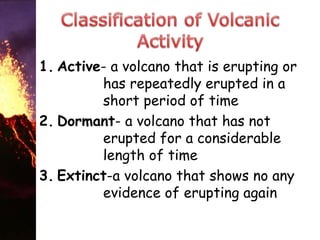
1. Active- a volcano that is erupting or
has repeatedly erupted in a
short period of time
2. Dormant- a volcano that has not
erupted for a considerable
length of time
3. Extinct-a volcano that shows no any
evidence of erupting again
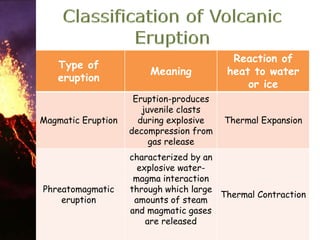
Type of
eruption
Meaning
Reaction of
heat to water
or ice
Magmatic Eruption
Eruption-produces
juvenile clasts
during explosive
decompression from
gas release
Thermal Expansion
Phreatomagmatic
eruption
characterized by an
explosive water-
magma interaction
through which large
amounts of steam
and magmatic gases
are released
Thermal Contraction
Specific
type
Unification Distinguished features
Displayed
in/by
Hawaiian Magmatic  Generally basaltic
 Low level eruption
 Effusive eruption/fire fountain
 Column generally less than 500 m
 Associated with a hotspot
 Fluid lava flows
 Result in vast gentle volcanoes
Kilauea, Hawaii
Mauna Loa volcano
in 1950
Lava lake Magmatic • Rare cases
• Very fluid lava
• Weak pyroclastic production
Mauna Ulu, Lava
Lake
Erta Ale, Ethiopia
Strombolian Magmatic  Basaltic magma
 More viscous than Hawaiian
 Intermittent explosions
 No sustained column
 Ejecta to heights of a few
hundred meters
 Minutes of pause between bursts
Stromboli, Sicily
Paricutin 1943-
1952
Mt. Erebus,
Antartica
Specific
type
Unification Distinguished features
Displayed
in/by
Vulcanian Magmatic  Similar to hydrovolcanic activity
 Begins with violent noisy explosion
 Ejects new lava fragment that do
not take on a rounded shape
during their flight through the air
 Highly viscous fragmented magma
 Clouds rise to 10-20 km
 Wide dispersal of tephra
 Can last, with long intervals of
repose, for several millenia
Vulcano, Sicily
Sakurajima in
Japan (ongoing)
and Irazu in Costa
Rica (1965)
Plinian Magmatic  Rare events (2-3 in century)
 Most explosive and powerful
 Highly evolved magma with
abundant pumice
 Statospheric eruption columns
 Huge volumes and large mass flux
Vesuvius, 79 CE
Mt. Pinatubo 1991
Specific
type
Unification Distinguished features
Displayed
in/by
Subplinian Magmatic  High eruptive plumes up to 30 km
 Eruption happens after long years
of dormancy
 Sustained column
 Generally dacite to rhyolite
composition
 Continuous sheet of tephra
 Pumice is common
 Less fragmented than Vulcanian
products
 Discrete explosions lasting
seconds to few minutes
Vesuvius,
1822
Phreato-
plinian
Phreato-
magmatic
 No historic eruptions of this type
 High eruptive column
 Extremely fine tephra
 Wide dispersal of deposit
none
Specific
type
Unification Distinguished features
Displayed
in/by
Surtseyan/
Hydro-
volcanic
Phreato-
magmatic
 Rapid small explosion
 Viscous, basaltic
 Column less than 500 m
 Associated with surge clouds
 Highly fragmented material
 Commonly within a standing water
body
Surtsey,
Iceland
Fire Island,
Alaska, USA
1796
Taal Volcano,
Batangas,
Philippines (last
eruption was in
1977)
Subglacial Phreato-
magmatic
 No eruptive column. Some ash on
the surface of ice sheets
 Only surface effect is a ‘’sag’’ in
the glacier
 Melted ice, fragmented lava and
water flood out
Iceland
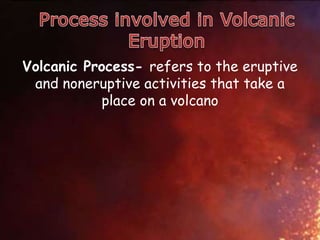
Volcanic Process- refers to the eruptive
and noneruptive activities that take a
place on a volcano
1. Confining pressure decreases as a
result of decompression from the
magma rising from a higher pressure
point to a lower pressure point
2. Vapor pressure increases because
the magma cools which initiates a
crystallization process that enriches
the magma content.
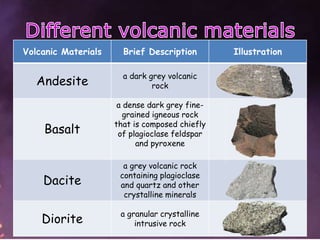
Volcanic Materials Brief Description Illustration
Andesite
a dark grey volcanic
rock
Basalt
a dense dark grey fine-
grained igneous rock
that is composed chiefly
of plagioclase feldspar
and pyroxene
Dacite
a grey volcanic rock
containing plagioclase
and quartz and other
crystalline minerals
Diorite
a granular crystalline
intrusive rock
Volcanic Materials Brief Description Illustration
Gabbro one of a family of granular
intrusive rocks
Granodiorite
an intrusive igneous rock
similar to granite, but
containing more plagioclase
than potassium feldspar
Obsidian
acid or granitic glass formed
by the rapid cooling of lava
without crystallization; usually
dark, but transparent in thin
pieces
Pegmatite
a form of igneous rock
consisting of extremely coarse
granite resulting from the
crystallization of magma rich in
rare elements
Volcanic Materials Brief Description Illustration
Peridotite
a dark coarse-grained
igneous rock consisting
principally of olivine
Plutonic
igneous rock that has
solidified beneath the
earth's surface; granite
or diorite or gabbro
Pyroxenite
A heavy, dark igneous
rock consisting mostly
of pyroxene minerals
with smaller amounts of
olivine and hornblende
Scoria
the scum formed by
oxidation at the surface
of molten metals
Volcanic Materials Brief Description Illustration
Rhyolite very acid volcanic rock
Tuff
hard volcanic rock
composed of compacted
volcanic ash
Volcanic Gases
Volcanoes emit gases during
eruptions. Even when a volcano
is not erupting, cracks in the
ground allow gases to reach the
surface through small openings
called fumaroles
Volcanic Activity

Volcanic Activity

  • 2.
    1. Active- avolcano that is erupting or has repeatedly erupted in a short period of time 2. Dormant- a volcano that has not erupted for a considerable length of time 3. Extinct-a volcano that shows no any evidence of erupting again
  • 3.
    Type of eruption Meaning Reaction of heatto water or ice Magmatic Eruption Eruption-produces juvenile clasts during explosive decompression from gas release Thermal Expansion Phreatomagmatic eruption characterized by an explosive water- magma interaction through which large amounts of steam and magmatic gases are released Thermal Contraction
  • 4.
    Specific type Unification Distinguished features Displayed in/by HawaiianMagmatic  Generally basaltic  Low level eruption  Effusive eruption/fire fountain  Column generally less than 500 m  Associated with a hotspot  Fluid lava flows  Result in vast gentle volcanoes Kilauea, Hawaii Mauna Loa volcano in 1950 Lava lake Magmatic • Rare cases • Very fluid lava • Weak pyroclastic production Mauna Ulu, Lava Lake Erta Ale, Ethiopia Strombolian Magmatic  Basaltic magma  More viscous than Hawaiian  Intermittent explosions  No sustained column  Ejecta to heights of a few hundred meters  Minutes of pause between bursts Stromboli, Sicily Paricutin 1943- 1952 Mt. Erebus, Antartica
  • 5.
    Specific type Unification Distinguished features Displayed in/by VulcanianMagmatic  Similar to hydrovolcanic activity  Begins with violent noisy explosion  Ejects new lava fragment that do not take on a rounded shape during their flight through the air  Highly viscous fragmented magma  Clouds rise to 10-20 km  Wide dispersal of tephra  Can last, with long intervals of repose, for several millenia Vulcano, Sicily Sakurajima in Japan (ongoing) and Irazu in Costa Rica (1965) Plinian Magmatic  Rare events (2-3 in century)  Most explosive and powerful  Highly evolved magma with abundant pumice  Statospheric eruption columns  Huge volumes and large mass flux Vesuvius, 79 CE Mt. Pinatubo 1991
  • 6.
    Specific type Unification Distinguished features Displayed in/by SubplinianMagmatic  High eruptive plumes up to 30 km  Eruption happens after long years of dormancy  Sustained column  Generally dacite to rhyolite composition  Continuous sheet of tephra  Pumice is common  Less fragmented than Vulcanian products  Discrete explosions lasting seconds to few minutes Vesuvius, 1822 Phreato- plinian Phreato- magmatic  No historic eruptions of this type  High eruptive column  Extremely fine tephra  Wide dispersal of deposit none
  • 7.
    Specific type Unification Distinguished features Displayed in/by Surtseyan/ Hydro- volcanic Phreato- magmatic Rapid small explosion  Viscous, basaltic  Column less than 500 m  Associated with surge clouds  Highly fragmented material  Commonly within a standing water body Surtsey, Iceland Fire Island, Alaska, USA 1796 Taal Volcano, Batangas, Philippines (last eruption was in 1977) Subglacial Phreato- magmatic  No eruptive column. Some ash on the surface of ice sheets  Only surface effect is a ‘’sag’’ in the glacier  Melted ice, fragmented lava and water flood out Iceland
  • 8.
    Volcanic Process- refersto the eruptive and noneruptive activities that take a place on a volcano
  • 9.
    1. Confining pressuredecreases as a result of decompression from the magma rising from a higher pressure point to a lower pressure point 2. Vapor pressure increases because the magma cools which initiates a crystallization process that enriches the magma content.
  • 10.
    Volcanic Materials BriefDescription Illustration Andesite a dark grey volcanic rock Basalt a dense dark grey fine- grained igneous rock that is composed chiefly of plagioclase feldspar and pyroxene Dacite a grey volcanic rock containing plagioclase and quartz and other crystalline minerals Diorite a granular crystalline intrusive rock
  • 11.
    Volcanic Materials BriefDescription Illustration Gabbro one of a family of granular intrusive rocks Granodiorite an intrusive igneous rock similar to granite, but containing more plagioclase than potassium feldspar Obsidian acid or granitic glass formed by the rapid cooling of lava without crystallization; usually dark, but transparent in thin pieces Pegmatite a form of igneous rock consisting of extremely coarse granite resulting from the crystallization of magma rich in rare elements
  • 12.
    Volcanic Materials BriefDescription Illustration Peridotite a dark coarse-grained igneous rock consisting principally of olivine Plutonic igneous rock that has solidified beneath the earth's surface; granite or diorite or gabbro Pyroxenite A heavy, dark igneous rock consisting mostly of pyroxene minerals with smaller amounts of olivine and hornblende Scoria the scum formed by oxidation at the surface of molten metals
  • 13.
    Volcanic Materials BriefDescription Illustration Rhyolite very acid volcanic rock Tuff hard volcanic rock composed of compacted volcanic ash Volcanic Gases Volcanoes emit gases during eruptions. Even when a volcano is not erupting, cracks in the ground allow gases to reach the surface through small openings called fumaroles