
CONCEPT AND TERMINOLOGY AS
PER UNFC
(UNITED NATIONS FRAME WORK CLASSIFICATION)
OF RESOURCES
V.JAYA KRISHNA BABU,
Regional Controller of Mines,
INDIAN BUREAU OF MINES
1. Introduction
2. Resource classification systems
3. Evolution of UNFC concept
4. Implementation of UNFC concept
5. Advantages of UNFC
6. Terminology as per UNFC
7. Stages/Levels of three axes
8. Categories of UNFC & their codes
9. Conclusion
INTRODUCTION
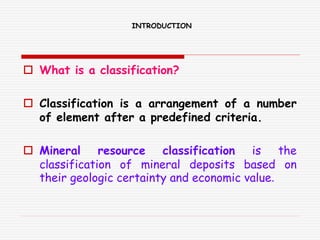
 What is a classification?
 Classification is a arrangement of a number
of element after a predefined criteria.
 Mineral resource classification is the
classification of mineral deposits based on
their geologic certainty and economic value.
INTRODUCTION
Mineral deposits can be classified as:
 Mineral occurrences or prospects of geological
interest but not necessarily of economic interest
 Mineral resources that are potentially valuable,
and for which reasonable prospects exist for
eventual economic extraction.
 Mineral reserves or Ore reserves that are
valuable and economically and technically feasible
to extract.
INTRODUCTION
 Resource and reserve classification systems
should reflect the reality as much as the
requirement.
 Universally understandable.
 More than 150 reserve/resource classification
systems with different terms and definitions,
world-wide.
RESOURCES CLASSIFICATION SYSTEMS
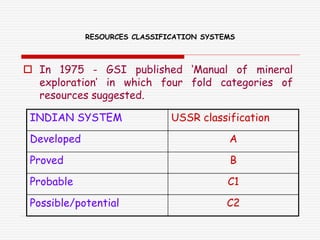
 In 1975 - GSI published ‘Manual of mineral
exploration’ in which four fold categories of
resources suggested.
INDIAN SYSTEM USSR classification
Developed A
Proved B
Probable C1
Possible/potential C2
RESOURCES CLASSIFICATION SYSTEMS
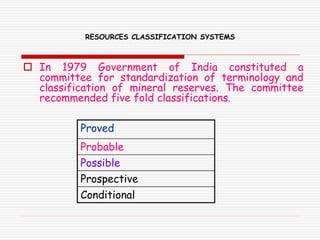
 In 1979 Government of India constituted a
committee for standardization of terminology and
classification of mineral reserves. The committee
recommended five fold classifications.
Proved
Probable
Possible
Prospective
Conditional
RESOURCES CLASSIFICATION SYSTEMS
 In India mineral resources were
classified into insitu and recoverable and
into proved, probable and possible
categories based on degree of
confidence of various geological
parameters and also into reserves and
conditional resources based on grade,
usability, etc.
RESOURCES CLASSIFICATION SYSTEMS
 Prior to 1981, there was no nationally
accepted system.
 Different agencies followed different
systems (e.g. USGS, Russian)
terminologically and to a large extent
definitively.
 In 1981, a system was standardized &
adapted to the National Mineral
Inventory database of IBM.
Evolution of UNFC concept
 In the changed scenario of globalization and
liberalization regime of market economy, necessity
of having universally understandable and
acceptable system for classification of reserves is
felt.
 In fact as early as 1993, definition of UNFC found
acceptable by Johannesburg and Brussel Stock
Exchanges in cases related to investment by
multinational entrepreneurs in developing
countries.
Evolution of UNFC concept
 Initially in the year 1992 three dimensional system of
classification of resources were introduced in Germany first
for ground water, and later for solid minerals.
 In 1997 the Energy Division, United Nations Economic
Commission for Europe (UNECE) Geneva circulated a draft
UNFC for mineral resources for trial application in 57
deposits identified in different countries.
 In November, 1999, decision was taken in Geneva conference
of UNECE on global adoption and implementation of UNFC
based on 3 digit code.
Evolution of UNFC concept
 This system known as United Nations Framework
Classification (UNFC) was finally adopted in this
meeting.
 Accordingly, the Ministry of Mines on 30th May,
2000 constituted a committee comprising members
from various government organizations and mining
industry to formulate field guidelines for
implementation of UNFC in exploration and mineral
resource estimation in India.
IMPLEMENTATION OF UNFC
 To implement UNFC …
Ministry of Mines, Govt. of India constituted a
Committee to formulate field guidelines for
mineral resource estimation in India.
The committee has identified seven types of
mineral deposits with exploration norms.
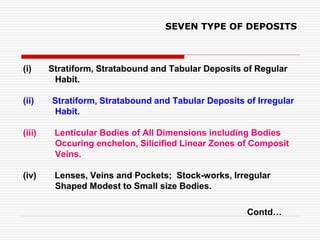
SEVEN TYPE OF DEPOSITS
(i) Stratiform, Stratabound and Tabular Deposits of Regular
Habit.
(ii) Stratiform, Stratabound and Tabular Deposits of Irregular
Habit.
(iii) Lenticular Bodies of All Dimensions including Bodies
Occuring enchelon, Silicified Linear Zones of Composit
Veins.
(iv) Lenses, Veins and Pockets; Stock-works, Irregular
Shaped Modest to Small size Bodies.
Contd…
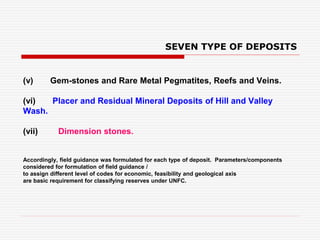
SEVEN TYPE OF DEPOSITS
(v) Gem-stones and Rare Metal Pegmatites, Reefs and Veins.
(vi) Placer and Residual Mineral Deposits of Hill and Valley
Wash.
(vii) Dimension stones.
Accordingly, field guidance was formulated for each type of deposit. Parameters/components
considered for formulation of field guidance /
to assign different level of codes for economic, feasibility and geological axis
are basic requirement for classifying reserves under UNFC.
UNFC CONCEPT IMPLEMENTATION
 After adoption of UNFC by India, an amendment in
MCDR, 1988 was notified on 17/4/2003 which
makes it statutory for all non coal major mineral
lessees to furnish reserve as per UNFC in
 Annual Returns,
 Mining Plans / Scheme of Mining
 PL Reports
Advantages of UNFC
 It is an internationally uniform system
based on market economy criteria.
 It enhances international communications.
 It is simple and easy to use.
 It is easily understandable across the globe
by all the countries.
Advantages of UNFC
 It projects the true worth of a resource.
 It is a flexible system meeting the
requirements for applications on national,
company or institutional level.
TERMINOLOGY AS PER UNFC
 United Nations Framework Classification (UNFC)
provides an internationally uniform system of
classification of reserves.
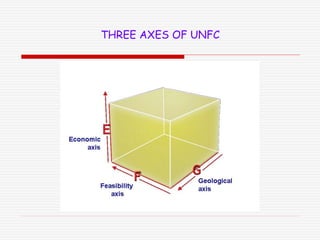
 UNFC is three-digit code bases system
 Economic axis (E) - the first digit from left to
right
 Feasibility axis (F) the second digit and
 Geological axis (G) is the third digit.
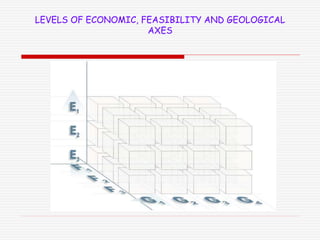
THREE AXES OF UNFC
TERMINOLOGY AS PER UNFC
 In UNFC there are three levels for
economic and feasibility axis i.e. 1,2 and
3 (in decreasing order).
 However, four levels for geological
axis i.e 1,2,3 and 4 (in decreasing
order).
LEVELS OF ECONOMIC, FEASIBILITY AND GEOLOGICAL
AXES
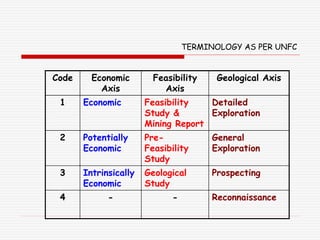
TERMINOLOGY AS PER UNFC
Code Economic
Axis
Feasibility
Axis
Geological Axis
1 Economic Feasibility
Study &
Mining Report
Detailed
Exploration
2 Potentially
Economic
Pre-
Feasibility
Study
General
Exploration
3 Intrinsically
Economic
Geological
Study
Prospecting
4 - - Reconnaissance
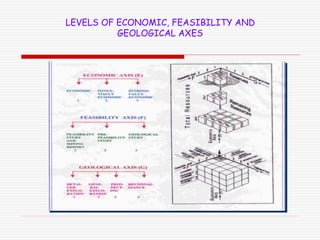
LEVELS OF ECONOMIC, FEASIBILITY AND
GEOLOGICAL AXES
STAGES OF GEOLOGICAL AXIS
These four stages of exploration is not new one the
same is practiced in the existing system of
classification of reserves i.e. National Classification
BIS No. 12595 (1989).
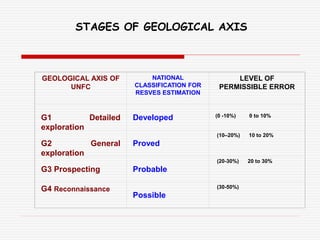
For better understanding let us compare these four
stages of exploration of geological axis under UNFC
with National classification of reserves.
STAGES OF GEOLOGICAL AXIS
GEOLOGICAL AXIS OF
UNFC
NATIONAL
CLASSIFICATION FOR
RESVES ESTIMATION
LEVEL OF
PERMISSIBLE ERROR
G1 Detailed
exploration
Developed (0 -10%) 0 to 10%
G2 General
exploration
Proved
(10–20%) 10 to 20%
G3 Prospecting Probable
(20-30%) 20 to 30%
G4 Reconnaissance
Possible
(30-50%)
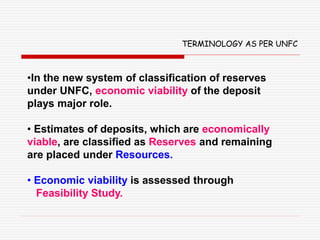
•In the new system of classification of reserves
under UNFC, economic viability of the deposit
plays major role.
• Estimates of deposits, which are economically
viable, are classified as Reserves and remaining
are placed under Resources.
• Economic viability is assessed through
Feasibility Study.
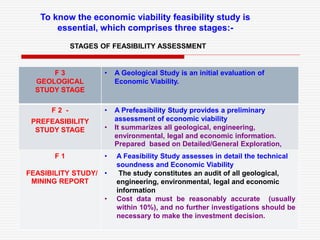
TERMINOLOGY AS PER UNFC
F 3
GEOLOGICAL
STUDY STAGE
• A Geological Study is an initial evaluation of
Economic Viability.
F 2 -
PREFEASIBILITY
STUDY STAGE
• A Prefeasibility Study provides a preliminary
assessment of economic viability
• It summarizes all geological, engineering,
environmental, legal and economic information.
Prepared based on Detailed/General Exploration,
F 1
FEASIBILITY STUDY/
MINING REPORT
• A Feasibility Study assesses in detail the technical
soundness and Economic Viability
• The study constitutes an audit of all geological,
engineering, environmental, legal and economic
information
• Cost data must be reasonably accurate (usually
within 10%), and no further investigations should be
necessary to make the investment decision.
To know the economic viability feasibility study is
essential, which comprises three stages:-
STAGES OF FEASIBILITY ASSESSMENT
• E 3 - INTRINSICALLY ECONOMIC STAGE
No feasibility study or pre-feasibility study conducted. Detailed
information on a deposit is available based on Geological Study.
E 2 POTENTIALLY ECONOMIC STAGE
•Feasibility or Pre-feasibility study results indicate the deposit or
part of it can be mined profitably at present and in near future.
•E 1 - ECONOMIC STAGE
Feasibility and Pre-feasibility study results indicate the deposit
can be profitably mined under the present economic,
technological, ecological and political conditions
STAGES OF ECONOMIC ASSESSMENT
•In combination of level of study conducted in the three
axes, status of classification of reserves/resources is
assigned.
•Under UNFC, to get status of reserves economic
viability is essential, otherwise it will be classified
under resources.
(i.e economically minable part of resources is only reserves under UNFC)
TERMINOLOGY AS PER UNFC
Categories of UNFC and their codes
 1. Reconnaissance mineral resource (334):
It is based on regional geological studies and mapping.
Airborne and indirect methods, preliminary field inspection
and limited information.
 2. Inferred mineral resource (333):
It is based on estimation with a low level of confidence and
of intrinsic economic interest based on prospecting, outcrop
identification, indirect method and limited sampling.
Categories of UNFC and their codes:
 3. Indicated mineral resource(332):
It is based on which tonnage, shape, grade can be estimated
with reasonable level of confidence. It is generally based on
general exploration. It will open way for preliminary study
and detailed exploration.
 4. Measured mineral resource (331):
A mineral resource for which tonnage, grade, shape etc. are
estimated with a high level of confidence.
Categories of UNFC and their codes
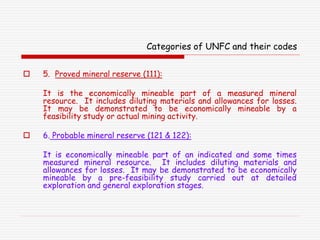
 5. Proved mineral reserve (111):
It is the economically mineable part of a measured mineral
resource. It includes diluting materials and allowances for losses.
It may be demonstrated to be economically mineable by a
feasibility study or actual mining activity.
 6. Probable mineral reserve (121 & 122):
It is economically mineable part of an indicated and some times
measured mineral resource. It includes diluting materials and
allowances for losses. It may be demonstrated to be economically
mineable by a pre-feasibility study carried out at detailed
exploration and general exploration stages.
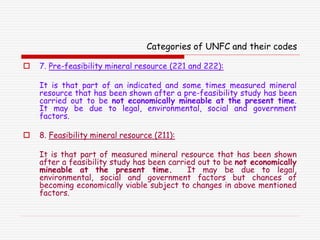
Categories of UNFC and their codes
 7. Pre-feasibility mineral resource (221 and 222):
It is that part of an indicated and some times measured mineral
resource that has been shown after a pre-feasibility study has been
carried out to be not economically mineable at the present time.
It may be due to legal, environmental, social and government
factors.
 8. Feasibility mineral resource (211):
It is that part of measured mineral resource that has been shown
after a feasibility study has been carried out to be not economically
mineable at the present time. It may be due to legal,
environmental, social and government factors but chances of
becoming economically viable subject to changes in above mentioned
factors.
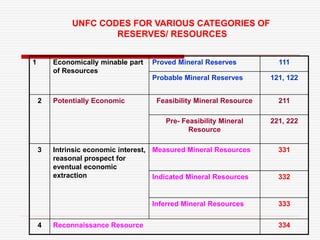
UNFC CODES FOR VARIOUS CATEGORIES OF
RESERVES/ RESOURCES
1 Economically minable part
of Resources
Proved Mineral Reserves 111
Probable Mineral Reserves 121, 122
2 Potentially Economic Feasibility Mineral Resource 211
Pre- Feasibility Mineral
Resource
221, 222
3 Intrinsic economic interest,
reasonal prospect for
eventual economic
extraction
Measured Mineral Resources 331
Indicated Mineral Resources 332
Inferred Mineral Resources 333
4 Reconnaissance Resource 334
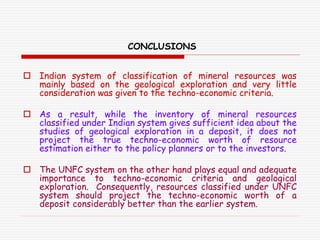
CONCLUSIONS
 Indian system of classification of mineral resources was
mainly based on the geological exploration and very little
consideration was given to the techno-economic criteria.
 As a result, while the inventory of mineral resources
classified under Indian system gives sufficient idea about the
studies of geological exploration in a deposit, it does not
project the true techno-economic worth of resource
estimation either to the policy planners or to the investors.
 The UNFC system on the other hand plays equal and adequate
importance to techno-economic criteria and geological
exploration. Consequently, resources classified under UNFC
system should project the techno-economic worth of a
deposit considerably better than the earlier system.

UNFC concept & teminology.ppt

  • 1.
    CONCEPT AND TERMINOLOGYAS PER UNFC (UNITED NATIONS FRAME WORK CLASSIFICATION) OF RESOURCES V.JAYA KRISHNA BABU, Regional Controller of Mines, INDIAN BUREAU OF MINES
  • 2.
    1. Introduction 2. Resourceclassification systems 3. Evolution of UNFC concept 4. Implementation of UNFC concept 5. Advantages of UNFC 6. Terminology as per UNFC 7. Stages/Levels of three axes 8. Categories of UNFC & their codes 9. Conclusion
  • 3.
    INTRODUCTION  What isa classification?  Classification is a arrangement of a number of element after a predefined criteria.  Mineral resource classification is the classification of mineral deposits based on their geologic certainty and economic value.
  • 4.
    INTRODUCTION Mineral deposits canbe classified as:  Mineral occurrences or prospects of geological interest but not necessarily of economic interest  Mineral resources that are potentially valuable, and for which reasonable prospects exist for eventual economic extraction.  Mineral reserves or Ore reserves that are valuable and economically and technically feasible to extract.
  • 5.
    INTRODUCTION  Resource andreserve classification systems should reflect the reality as much as the requirement.  Universally understandable.  More than 150 reserve/resource classification systems with different terms and definitions, world-wide.
  • 6.
    RESOURCES CLASSIFICATION SYSTEMS In 1975 - GSI published ‘Manual of mineral exploration’ in which four fold categories of resources suggested. INDIAN SYSTEM USSR classification Developed A Proved B Probable C1 Possible/potential C2
  • 7.
    RESOURCES CLASSIFICATION SYSTEMS In 1979 Government of India constituted a committee for standardization of terminology and classification of mineral reserves. The committee recommended five fold classifications. Proved Probable Possible Prospective Conditional
  • 8.
    RESOURCES CLASSIFICATION SYSTEMS In India mineral resources were classified into insitu and recoverable and into proved, probable and possible categories based on degree of confidence of various geological parameters and also into reserves and conditional resources based on grade, usability, etc.
  • 9.
    RESOURCES CLASSIFICATION SYSTEMS Prior to 1981, there was no nationally accepted system.  Different agencies followed different systems (e.g. USGS, Russian) terminologically and to a large extent definitively.  In 1981, a system was standardized & adapted to the National Mineral Inventory database of IBM.
  • 10.
    Evolution of UNFCconcept  In the changed scenario of globalization and liberalization regime of market economy, necessity of having universally understandable and acceptable system for classification of reserves is felt.  In fact as early as 1993, definition of UNFC found acceptable by Johannesburg and Brussel Stock Exchanges in cases related to investment by multinational entrepreneurs in developing countries.
  • 11.
    Evolution of UNFCconcept  Initially in the year 1992 three dimensional system of classification of resources were introduced in Germany first for ground water, and later for solid minerals.  In 1997 the Energy Division, United Nations Economic Commission for Europe (UNECE) Geneva circulated a draft UNFC for mineral resources for trial application in 57 deposits identified in different countries.  In November, 1999, decision was taken in Geneva conference of UNECE on global adoption and implementation of UNFC based on 3 digit code.
  • 12.
    Evolution of UNFCconcept  This system known as United Nations Framework Classification (UNFC) was finally adopted in this meeting.  Accordingly, the Ministry of Mines on 30th May, 2000 constituted a committee comprising members from various government organizations and mining industry to formulate field guidelines for implementation of UNFC in exploration and mineral resource estimation in India.
  • 13.
    IMPLEMENTATION OF UNFC To implement UNFC … Ministry of Mines, Govt. of India constituted a Committee to formulate field guidelines for mineral resource estimation in India. The committee has identified seven types of mineral deposits with exploration norms.
  • 14.
    SEVEN TYPE OFDEPOSITS (i) Stratiform, Stratabound and Tabular Deposits of Regular Habit. (ii) Stratiform, Stratabound and Tabular Deposits of Irregular Habit. (iii) Lenticular Bodies of All Dimensions including Bodies Occuring enchelon, Silicified Linear Zones of Composit Veins. (iv) Lenses, Veins and Pockets; Stock-works, Irregular Shaped Modest to Small size Bodies. Contd…
  • 15.
    SEVEN TYPE OFDEPOSITS (v) Gem-stones and Rare Metal Pegmatites, Reefs and Veins. (vi) Placer and Residual Mineral Deposits of Hill and Valley Wash. (vii) Dimension stones. Accordingly, field guidance was formulated for each type of deposit. Parameters/components considered for formulation of field guidance / to assign different level of codes for economic, feasibility and geological axis are basic requirement for classifying reserves under UNFC.
  • 16.
    UNFC CONCEPT IMPLEMENTATION After adoption of UNFC by India, an amendment in MCDR, 1988 was notified on 17/4/2003 which makes it statutory for all non coal major mineral lessees to furnish reserve as per UNFC in  Annual Returns,  Mining Plans / Scheme of Mining  PL Reports
  • 17.
    Advantages of UNFC It is an internationally uniform system based on market economy criteria.  It enhances international communications.  It is simple and easy to use.  It is easily understandable across the globe by all the countries.
  • 18.
    Advantages of UNFC It projects the true worth of a resource.  It is a flexible system meeting the requirements for applications on national, company or institutional level.
  • 19.
    TERMINOLOGY AS PERUNFC  United Nations Framework Classification (UNFC) provides an internationally uniform system of classification of reserves.  UNFC is three-digit code bases system  Economic axis (E) - the first digit from left to right  Feasibility axis (F) the second digit and  Geological axis (G) is the third digit.
  • 20.
  • 21.
    TERMINOLOGY AS PERUNFC  In UNFC there are three levels for economic and feasibility axis i.e. 1,2 and 3 (in decreasing order).  However, four levels for geological axis i.e 1,2,3 and 4 (in decreasing order).
  • 22.
    LEVELS OF ECONOMIC,FEASIBILITY AND GEOLOGICAL AXES
  • 23.
    TERMINOLOGY AS PERUNFC Code Economic Axis Feasibility Axis Geological Axis 1 Economic Feasibility Study & Mining Report Detailed Exploration 2 Potentially Economic Pre- Feasibility Study General Exploration 3 Intrinsically Economic Geological Study Prospecting 4 - - Reconnaissance
  • 24.
    LEVELS OF ECONOMIC,FEASIBILITY AND GEOLOGICAL AXES
  • 25.
    STAGES OF GEOLOGICALAXIS These four stages of exploration is not new one the same is practiced in the existing system of classification of reserves i.e. National Classification BIS No. 12595 (1989). For better understanding let us compare these four stages of exploration of geological axis under UNFC with National classification of reserves.
  • 26.
    STAGES OF GEOLOGICALAXIS GEOLOGICAL AXIS OF UNFC NATIONAL CLASSIFICATION FOR RESVES ESTIMATION LEVEL OF PERMISSIBLE ERROR G1 Detailed exploration Developed (0 -10%) 0 to 10% G2 General exploration Proved (10–20%) 10 to 20% G3 Prospecting Probable (20-30%) 20 to 30% G4 Reconnaissance Possible (30-50%)
  • 27.
    •In the newsystem of classification of reserves under UNFC, economic viability of the deposit plays major role. • Estimates of deposits, which are economically viable, are classified as Reserves and remaining are placed under Resources. • Economic viability is assessed through Feasibility Study. TERMINOLOGY AS PER UNFC
  • 28.
    F 3 GEOLOGICAL STUDY STAGE •A Geological Study is an initial evaluation of Economic Viability. F 2 - PREFEASIBILITY STUDY STAGE • A Prefeasibility Study provides a preliminary assessment of economic viability • It summarizes all geological, engineering, environmental, legal and economic information. Prepared based on Detailed/General Exploration, F 1 FEASIBILITY STUDY/ MINING REPORT • A Feasibility Study assesses in detail the technical soundness and Economic Viability • The study constitutes an audit of all geological, engineering, environmental, legal and economic information • Cost data must be reasonably accurate (usually within 10%), and no further investigations should be necessary to make the investment decision. To know the economic viability feasibility study is essential, which comprises three stages:- STAGES OF FEASIBILITY ASSESSMENT
  • 29.
    • E 3- INTRINSICALLY ECONOMIC STAGE No feasibility study or pre-feasibility study conducted. Detailed information on a deposit is available based on Geological Study. E 2 POTENTIALLY ECONOMIC STAGE •Feasibility or Pre-feasibility study results indicate the deposit or part of it can be mined profitably at present and in near future. •E 1 - ECONOMIC STAGE Feasibility and Pre-feasibility study results indicate the deposit can be profitably mined under the present economic, technological, ecological and political conditions STAGES OF ECONOMIC ASSESSMENT
  • 30.
    •In combination oflevel of study conducted in the three axes, status of classification of reserves/resources is assigned. •Under UNFC, to get status of reserves economic viability is essential, otherwise it will be classified under resources. (i.e economically minable part of resources is only reserves under UNFC) TERMINOLOGY AS PER UNFC
  • 31.
    Categories of UNFCand their codes  1. Reconnaissance mineral resource (334): It is based on regional geological studies and mapping. Airborne and indirect methods, preliminary field inspection and limited information.  2. Inferred mineral resource (333): It is based on estimation with a low level of confidence and of intrinsic economic interest based on prospecting, outcrop identification, indirect method and limited sampling.
  • 32.
    Categories of UNFCand their codes:  3. Indicated mineral resource(332): It is based on which tonnage, shape, grade can be estimated with reasonable level of confidence. It is generally based on general exploration. It will open way for preliminary study and detailed exploration.  4. Measured mineral resource (331): A mineral resource for which tonnage, grade, shape etc. are estimated with a high level of confidence.
  • 33.
    Categories of UNFCand their codes  5. Proved mineral reserve (111): It is the economically mineable part of a measured mineral resource. It includes diluting materials and allowances for losses. It may be demonstrated to be economically mineable by a feasibility study or actual mining activity.  6. Probable mineral reserve (121 & 122): It is economically mineable part of an indicated and some times measured mineral resource. It includes diluting materials and allowances for losses. It may be demonstrated to be economically mineable by a pre-feasibility study carried out at detailed exploration and general exploration stages.
  • 34.
    Categories of UNFCand their codes  7. Pre-feasibility mineral resource (221 and 222): It is that part of an indicated and some times measured mineral resource that has been shown after a pre-feasibility study has been carried out to be not economically mineable at the present time. It may be due to legal, environmental, social and government factors.  8. Feasibility mineral resource (211): It is that part of measured mineral resource that has been shown after a feasibility study has been carried out to be not economically mineable at the present time. It may be due to legal, environmental, social and government factors but chances of becoming economically viable subject to changes in above mentioned factors.
  • 35.
    UNFC CODES FORVARIOUS CATEGORIES OF RESERVES/ RESOURCES 1 Economically minable part of Resources Proved Mineral Reserves 111 Probable Mineral Reserves 121, 122 2 Potentially Economic Feasibility Mineral Resource 211 Pre- Feasibility Mineral Resource 221, 222 3 Intrinsic economic interest, reasonal prospect for eventual economic extraction Measured Mineral Resources 331 Indicated Mineral Resources 332 Inferred Mineral Resources 333 4 Reconnaissance Resource 334
  • 36.
    CONCLUSIONS  Indian systemof classification of mineral resources was mainly based on the geological exploration and very little consideration was given to the techno-economic criteria.  As a result, while the inventory of mineral resources classified under Indian system gives sufficient idea about the studies of geological exploration in a deposit, it does not project the true techno-economic worth of resource estimation either to the policy planners or to the investors.  The UNFC system on the other hand plays equal and adequate importance to techno-economic criteria and geological exploration. Consequently, resources classified under UNFC system should project the techno-economic worth of a deposit considerably better than the earlier system.