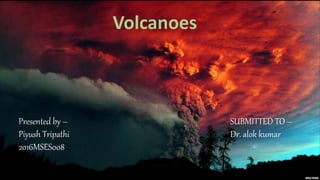
Volcanoes
Presented by –
Piyush Tripathi
2016MSES008
SUBMITTED TO –
Dr. alok kumar
volcano
“A volcano is a vent or opening ,
usually circular , through which
heated materials consisting of Gases,
water, liquid lava , and fragments of
rock are ejected from the highly
heated interior to the surface of earth’’
-- P. G. Worcester [1948]
 Simply we can say , All
phenomenon connected with the
movement of heated material from
the interior of earth to the surface
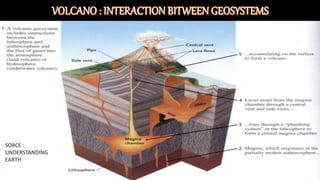
SORCE :
UNDERSTANDING
EARTH
Volcanic materials
1.Vapor and gases –
Steam and vapor constitute 60 to 90 % of total gas discharge
Gases are – CO2 NOx SO2 H2 CO etc
Gases with compounds are – sulphureted Hydrogen, HCl, potassium and
other metallic compounds
2. Fragmental or Pyroclastic Materials-
- volcanic dust [ Finest ]
- volcanic ash [2 mm ]
- lapilli [ Pea size ]
-Volcanic bomb [6 mm or more ]
3. Magma and Lava-
molten rock material –below the earth surface – MAGMA
-- Above the earth surface – LAVA
Magma formation
• Crust and mental are entirely solid
• Magma forms in only special places where pre-existing rock undergoes melting
Causes of melting :
 Melting due to pressure decrease
Melting as a result of addition of volatiles
Melting as a result of heat transfer from rising magma
Why does magma rise :
1)Buoyancy – [ magma less Denser than surrounding rock ]
2)Weight of overlying rock - [creates pressure at depth that literally squeezes
magma upward]
Partial melting
Under the earths temp and pressure condition
only 2% to 30% rock can melt to form
magma
the temperature at site simply never goes
high enough to melt a entire rock
Xenolith
A process during which a magma assimilate
wall rock brake off
and sink into the magma
The rock does not melt entirely but rather
becomes surrounded by
New igneous rock is called xenolith
Geyser
• Geyser is a vent in Earth Surface
that periodically eject a column of
HOT WATER & STEAM
• It forms when percolated ground
water comes in contact with hot
magma
• Worldwide about 1000 geyers
• Most of them found in Yellow stone
National Park
TYPES OF LAVABasaltic lava
• Extrusive rock with MAFIC composition
• Intrusive equivalent is : GABBRO
• Produced along mid-oceanic spreding centers & Rift vallies
• Extremely fluid
• Rarely explosive
Andesitic lava
• Extrusive Rock with intermediate Silica content
• Intrusive equivalent is : DIORITE
• Produced in subduction zone along oceanic and continental
plate
Rhyolitic lava
• Extrusive with FELSIC composition
• Intrusive equivalent is : GRANITE
• Produced in a zone heat from the Mantle has melted
continental crust
Basaltic lava
Andesitic lava
Rhyolitic lava
Viscosity and the LAVA Flow
• low viscosity : long Distance flow
(MAFIC)
[Basaltic flow]
• Average viscosity : Moderate flow
[Andesitic flow]
• High viscosity : shorter flow
(FELSIC)
[Rhyolitic flow]
Rhyolitic vs Basaltic magma
• Rhyolitic magma is highly viscous in nature
• Due to high FELSIC materials freezing point
of lava decreases
• That’s why the lava solidified fastly
• As a result violent explosion
Basaltic magma has low viscosity
Higher rock temperature as
compare to rhyolitic magma
Lava takes time to solidified
As a result Fissure flow of magma
texture of rock : due to cooling conditions of magma
Source :
Types of volcano
1. Central or explosive volcano
A. Hawaiin types volcano
B. Strombolian type volcano
C. Vulcanian type volcano
D. Peleen type volcano
2. Fissure or quite eruption type volcano
A. Hawaiin type of volcano-
 Erupt quitely due to less viscous lava
and non violent nature of gases
 Explosive activity is very rare because of
extremely Basic lava flow
B. Strombolian type of volcano
 It erupt with moderate intensity
 Besides lava the other volcanic material
like Pumice scoria bomb , etc are ejected
 lava is less basic than hawaiin volcano
C. Vulcanian types of volcano
 Cauliflower shape
 Lava surface solidified rapidly because of
its high viscosity
 Solidification results in build up of pressure inside
 Violent explosion : pyroclastic materials are ejected
D. Peleen type of volcano
 Most violent and most explosive
 Most viscous and plasty lava
 Consist the mixture of extremely hot
incandescent fine ash
 Courser rock
2. Fissure erupted volcano
 Volcanoes occure along a long fault , fracture
and fissure
 Slow upwelling of magma
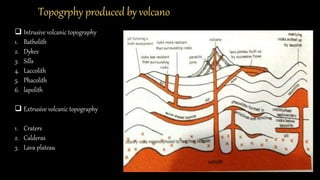
Topogrphy produced by volcano
 Intrusive volcanic topography
1. Batholith
2. Dykes
3. Sills
4. Laccolith
5. Phacolith
6. lapolith
 Extrusive volcanic topography
1. Craters
2. Calderas
3. Lava plateau
1. Batholith :
• Large rock masses formed due to solidification of hot magma
• Appear on the surface only by Denudation processes
• Granitic
• Eg. Rocks of Sierra Nevada of California Batholith
2. Dykes
• Discardent intrusion
• Wall like formation of solidified magma
• Dykes are usually high angle to near verticle
3. Sills
• Conchoidal intrusion
• Paralall to the bedding rock
• Formed due to injection and solidification of magma
between the bedding plains of sedimentary rock
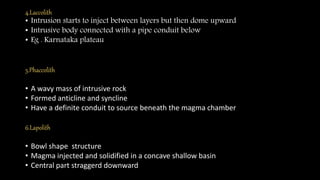
4.Laccolith
• Intrusion starts to inject between layers but then dome upward
• Intrusive body connected with a pipe conduit below
• Eg . Karnataka plateau
5.Phaccolith
• A wavy mass of intrusive rock
• Formed anticline and syncline
• Have a definite conduit to source beneath the magma chamber
6.Lapolith
• Bowl shape structure
• Magma injected and solidified in a concave shallow basin
• Central part straggerd downward
Extrusive volcanic topography
1. Craters
• The dippresion formed at the mouth of volcano vent
• Usually funnel shaped
2. Calderas
• Calderas are the large volcanic craters
• Formed by two methods
1.Explosive volcanic eruption
2.Colapse calderas
• The Ring of Fire is a ring of volcanoes
around the Pacific Ocean that result from
subduction of oceanic plates beneath lighter
continental plates.
• Most of the Earth's volcanoes are located
around the Pacific Ring of Fire because that
the location of most of the Earth's
subduction zones.
• A subduction zone is a place where one
plate of oceanic lithosphe is shoved under
another plate. The downgoing plate is
always the oceanic one.
Ring of fire
Benefits of volcano
• Soil enrichment
• Hot springs and
geothermal energy
• Global cooling
• Volcanic mineral and
stone
Case study
Nyiragongo : Democratic Republic of Congo
Cause of the eruption:
The eruption happened on 17 January 2002.
The volcano has a lava lake in its crater.
Fissure opened up to the south side of the volcano and three streams
of lava from the lake drained through the fissures.
The lava reached speeds of 60 km/h.
• It is a steep sided active volcano
• Part of African Rift vally , the Area of
many faults
Social impacts of the eruption (effects on
people)
•Homes were destroyed by ash and lava.
•45 people died in the first 24 hours.
•The lava flow made it difficult to travel around Goma as it
filled the roads. Aid agencies were unable to access some
areas of Goma.
•Cholera spread because of lack of sanitation in areas that
people fled to.
•Around 50 people were killed when fuel exploded while
they were trying to siphon it off at a petrol station.
Economic impacts of the eruption
•People returned to Goma hoping to find aid. One month after the
eruption, 350,000 people were dependant on aid
•People lost their businesses and jobs
•Aviation fuel stores exploded as the lava flow damaged Goma airport.
Environmentalimpacts of the eruption
•Lava covered 15 per cent of the city of Goma and destroyed 30 per
cent of the city
•If the lava was to reach Lake Kivu, or seismic activity disrupted the
lake, then dangerous gases of carbon dioxide and methane could be
released from the floor of the lake
Case study : 2
Barrenisland volcano: Andaman and nicobar island
 Tectonically they are related to the Sumatra in
Indonesia
 The volcano is assotiated with the subduction of
NE-Moving indian plate
Beneath the Burmese plate
 The volcano would be at least 1.8 million years
old [ IIT-Bombey]
 The eruption is strombolian type in which the
central cone produced cloud
Of Ash and incandescent ejecta
 The eruption cycle occurred in every 1 to 3 year
 The last eruption takes place in 5th May 2015
 Stephen Marshak;2013; essential of geology,4th edition : Up from the Inferno: Magma and Igneous Rocks & The Wrath of
Vulcan: Volcanic Eruptions ;97-146
• Jhon,Thomas,Frank,R.Siever,2007;understanding earth; 5th edition; Igneous Rocks: Solids from Melts
&Volcanoes; 76-270
 Edward A. Keller;2012;interoduction of environmental geology;5th edition; ISBN-10: 0-321-72751-7 / ISBN-13: 978-0-321-72751-0
;volcanic activity;
 K3S Bitesize;BBC;physical processes
 Wikipedia.org
references
Volcano piyush

Volcano piyush

  • 1.
    Volcanoes Presented by – PiyushTripathi 2016MSES008 SUBMITTED TO – Dr. alok kumar
  • 2.
    volcano “A volcano isa vent or opening , usually circular , through which heated materials consisting of Gases, water, liquid lava , and fragments of rock are ejected from the highly heated interior to the surface of earth’’ -- P. G. Worcester [1948]  Simply we can say , All phenomenon connected with the movement of heated material from the interior of earth to the surface
  • 3.
  • 4.
    Volcanic materials 1.Vapor andgases – Steam and vapor constitute 60 to 90 % of total gas discharge Gases are – CO2 NOx SO2 H2 CO etc Gases with compounds are – sulphureted Hydrogen, HCl, potassium and other metallic compounds 2. Fragmental or Pyroclastic Materials- - volcanic dust [ Finest ] - volcanic ash [2 mm ] - lapilli [ Pea size ] -Volcanic bomb [6 mm or more ] 3. Magma and Lava- molten rock material –below the earth surface – MAGMA -- Above the earth surface – LAVA
  • 5.
    Magma formation • Crustand mental are entirely solid • Magma forms in only special places where pre-existing rock undergoes melting Causes of melting :  Melting due to pressure decrease Melting as a result of addition of volatiles Melting as a result of heat transfer from rising magma Why does magma rise : 1)Buoyancy – [ magma less Denser than surrounding rock ] 2)Weight of overlying rock - [creates pressure at depth that literally squeezes magma upward]
  • 6.
    Partial melting Under theearths temp and pressure condition only 2% to 30% rock can melt to form magma the temperature at site simply never goes high enough to melt a entire rock Xenolith A process during which a magma assimilate wall rock brake off and sink into the magma The rock does not melt entirely but rather becomes surrounded by New igneous rock is called xenolith
  • 7.
    Geyser • Geyser isa vent in Earth Surface that periodically eject a column of HOT WATER & STEAM • It forms when percolated ground water comes in contact with hot magma • Worldwide about 1000 geyers • Most of them found in Yellow stone National Park
  • 8.
    TYPES OF LAVABasalticlava • Extrusive rock with MAFIC composition • Intrusive equivalent is : GABBRO • Produced along mid-oceanic spreding centers & Rift vallies • Extremely fluid • Rarely explosive Andesitic lava • Extrusive Rock with intermediate Silica content • Intrusive equivalent is : DIORITE • Produced in subduction zone along oceanic and continental plate Rhyolitic lava • Extrusive with FELSIC composition • Intrusive equivalent is : GRANITE • Produced in a zone heat from the Mantle has melted continental crust Basaltic lava Andesitic lava Rhyolitic lava
  • 9.
    Viscosity and theLAVA Flow • low viscosity : long Distance flow (MAFIC) [Basaltic flow] • Average viscosity : Moderate flow [Andesitic flow] • High viscosity : shorter flow (FELSIC) [Rhyolitic flow]
  • 10.
    Rhyolitic vs Basalticmagma • Rhyolitic magma is highly viscous in nature • Due to high FELSIC materials freezing point of lava decreases • That’s why the lava solidified fastly • As a result violent explosion Basaltic magma has low viscosity Higher rock temperature as compare to rhyolitic magma Lava takes time to solidified As a result Fissure flow of magma
  • 11.
    texture of rock: due to cooling conditions of magma Source :
  • 12.
    Types of volcano 1.Central or explosive volcano A. Hawaiin types volcano B. Strombolian type volcano C. Vulcanian type volcano D. Peleen type volcano 2. Fissure or quite eruption type volcano
  • 13.
    A. Hawaiin typeof volcano-  Erupt quitely due to less viscous lava and non violent nature of gases  Explosive activity is very rare because of extremely Basic lava flow B. Strombolian type of volcano  It erupt with moderate intensity  Besides lava the other volcanic material like Pumice scoria bomb , etc are ejected  lava is less basic than hawaiin volcano C. Vulcanian types of volcano  Cauliflower shape  Lava surface solidified rapidly because of its high viscosity  Solidification results in build up of pressure inside  Violent explosion : pyroclastic materials are ejected
  • 14.
    D. Peleen typeof volcano  Most violent and most explosive  Most viscous and plasty lava  Consist the mixture of extremely hot incandescent fine ash  Courser rock 2. Fissure erupted volcano  Volcanoes occure along a long fault , fracture and fissure  Slow upwelling of magma
  • 15.
    Topogrphy produced byvolcano  Intrusive volcanic topography 1. Batholith 2. Dykes 3. Sills 4. Laccolith 5. Phacolith 6. lapolith  Extrusive volcanic topography 1. Craters 2. Calderas 3. Lava plateau
  • 17.
    1. Batholith : •Large rock masses formed due to solidification of hot magma • Appear on the surface only by Denudation processes • Granitic • Eg. Rocks of Sierra Nevada of California Batholith 2. Dykes • Discardent intrusion • Wall like formation of solidified magma • Dykes are usually high angle to near verticle 3. Sills • Conchoidal intrusion • Paralall to the bedding rock • Formed due to injection and solidification of magma between the bedding plains of sedimentary rock
  • 18.
    4.Laccolith • Intrusion startsto inject between layers but then dome upward • Intrusive body connected with a pipe conduit below • Eg . Karnataka plateau 5.Phaccolith • A wavy mass of intrusive rock • Formed anticline and syncline • Have a definite conduit to source beneath the magma chamber 6.Lapolith • Bowl shape structure • Magma injected and solidified in a concave shallow basin • Central part straggerd downward
  • 19.
    Extrusive volcanic topography 1.Craters • The dippresion formed at the mouth of volcano vent • Usually funnel shaped 2. Calderas • Calderas are the large volcanic craters • Formed by two methods 1.Explosive volcanic eruption 2.Colapse calderas
  • 20.
    • The Ringof Fire is a ring of volcanoes around the Pacific Ocean that result from subduction of oceanic plates beneath lighter continental plates. • Most of the Earth's volcanoes are located around the Pacific Ring of Fire because that the location of most of the Earth's subduction zones. • A subduction zone is a place where one plate of oceanic lithosphe is shoved under another plate. The downgoing plate is always the oceanic one. Ring of fire
  • 21.
    Benefits of volcano •Soil enrichment • Hot springs and geothermal energy • Global cooling • Volcanic mineral and stone
  • 22.
    Case study Nyiragongo :Democratic Republic of Congo Cause of the eruption: The eruption happened on 17 January 2002. The volcano has a lava lake in its crater. Fissure opened up to the south side of the volcano and three streams of lava from the lake drained through the fissures. The lava reached speeds of 60 km/h. • It is a steep sided active volcano • Part of African Rift vally , the Area of many faults
  • 23.
    Social impacts ofthe eruption (effects on people) •Homes were destroyed by ash and lava. •45 people died in the first 24 hours. •The lava flow made it difficult to travel around Goma as it filled the roads. Aid agencies were unable to access some areas of Goma. •Cholera spread because of lack of sanitation in areas that people fled to. •Around 50 people were killed when fuel exploded while they were trying to siphon it off at a petrol station.
  • 24.
    Economic impacts ofthe eruption •People returned to Goma hoping to find aid. One month after the eruption, 350,000 people were dependant on aid •People lost their businesses and jobs •Aviation fuel stores exploded as the lava flow damaged Goma airport. Environmentalimpacts of the eruption •Lava covered 15 per cent of the city of Goma and destroyed 30 per cent of the city •If the lava was to reach Lake Kivu, or seismic activity disrupted the lake, then dangerous gases of carbon dioxide and methane could be released from the floor of the lake
  • 25.
    Case study :2 Barrenisland volcano: Andaman and nicobar island  Tectonically they are related to the Sumatra in Indonesia  The volcano is assotiated with the subduction of NE-Moving indian plate Beneath the Burmese plate  The volcano would be at least 1.8 million years old [ IIT-Bombey]  The eruption is strombolian type in which the central cone produced cloud Of Ash and incandescent ejecta  The eruption cycle occurred in every 1 to 3 year  The last eruption takes place in 5th May 2015
  • 26.
     Stephen Marshak;2013;essential of geology,4th edition : Up from the Inferno: Magma and Igneous Rocks & The Wrath of Vulcan: Volcanic Eruptions ;97-146 • Jhon,Thomas,Frank,R.Siever,2007;understanding earth; 5th edition; Igneous Rocks: Solids from Melts &Volcanoes; 76-270  Edward A. Keller;2012;interoduction of environmental geology;5th edition; ISBN-10: 0-321-72751-7 / ISBN-13: 978-0-321-72751-0 ;volcanic activity;  K3S Bitesize;BBC;physical processes  Wikipedia.org references