VOLCANOES
By Dr.Mohammad Subhan Lone.
Lecturer in higher education
department (J&K)
INTRODUCTION
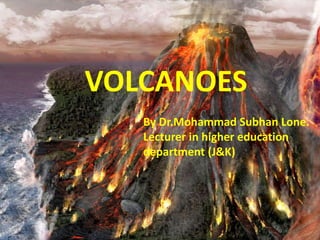
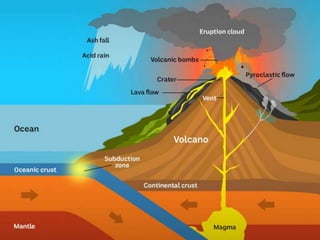
• A volcano is an opening in the Earth’s crust
that allows molten rock, gases and debris to
escape to the surface.
• During a volcanic eruption, lava and other
debris can flow at speeds of up to 100 mph,
destroying everything in their path.
• Different magma types behave differently as
lava flows, depending on their temperature,
viscosity, and gas content.
Volcanic Eruption types
• Magmas that are generated deep within the
Earth begin to rise because they are less dense
than the surrounding solid rocks.
• As they rise they may encounter a depth or
pressure where the dissolved gas no longer
can be held in solution in the magma, and the
gas begins to form a separate phase
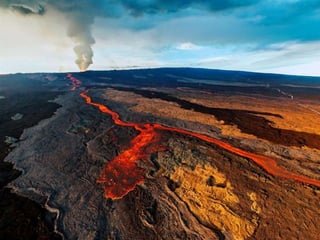
Non-Explosive Eruptions
• Effusive or Non explosive eruptions are
favored by low gas content and low viscosity
magmas (basaltic to andesitic magmas).
• Lava flows are produced on the surface, and
these run like liquids down slope, along the
lowest areas they can find.
• If the viscosity is high, but the gas content is
low, then the lava will pile up over the vent to
produce a lava dome or volcanic dome.
Explosive Eruptions
• Explosive eruptions are favored by high gas
content & high viscosity magmas (andesitic to
Rhyolitic magmas).
• The explosive bursting of bubbles fragments the
magma into clots of liquid that cool as they fall
through the air.
• These solid particles become pyroclasts or
volcanic ash, volcanic bombs.
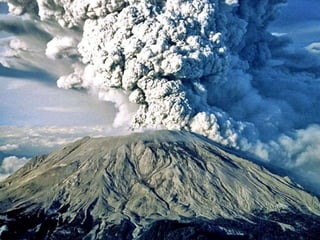
• Clouds of gas and tephra that rise above a
volcano produce an eruption column that can
rise up to 45 km into the atmosphere.
Products of Volcano
• Pyroclastic Material
• If the magma has high gas content and high
viscosity, the gas will expand in an explosive
fashion and break the liquid into clots that fly
through the air and cool along their path
through the atmosphere.
• Alternatively it blast out solid pieces of rock
that once formed the volcanic edifice.
• All of these fragments are referred to as
• Pyroclasts = hot, broken fragments.
• Depending on size, tephra can be classified as
bombs. blocks, lapilli, or ash.
• Volcanic Blocks are angular fragments that
were solid when ejected.
• Volcanic Bombs have an aerodynamic shape
indicating they were liquid when ejected.
• Bombs and lapilli that consist mostly of gas
bubbles (vesicles) result in a low density
highly vesicular rock fragment called pumice.
TYPES OF VOLCANOS
• Volcanoes can be classified into three
categories as fallow
• 1. On the Basis of Morphology/ Appearance
• 2. On the Basis of Frequency of Volcanic
Eruptions
• 3. On the Basis of Volcanic Eruption Style/
Strength
1. On the Basis of Morphology/
Appearance
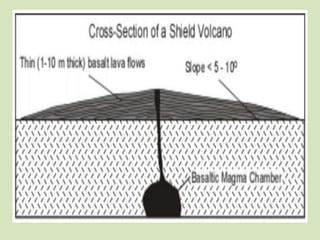
• Shield Volcanoes
• A shield volcano is characterized by gentle
upper slopes (about 5o) and somewhat
steeper lower slopes (about 10o). Shield
volcanoes are composed almost entirely of
relatively thin lava flows built up over a central
vent.
• Most shields were formed by low viscosity
basaltic magma that flows easily down slope
away from the summit vent.
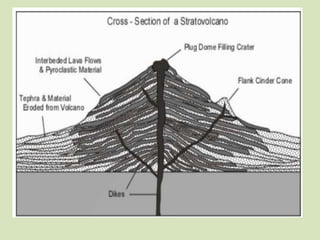
• Stratovolcanoes (also called Composite
Volcanoes
• Have steeper slopes than shield volcanoes, with
slopes of 6 to 10o low on the flanks to 30o near
the top.
• The steep slope near the summit is due partly to
thick, short viscous lava flows that do not travel
far down slope from the vent.
• The gentler slopes near the base are due to
accumulations of material eroded from the
volcano
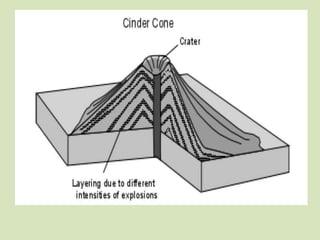
• Cinder Cones
• Cinder cones are small volume cones
consisting predominantly of ash and
pyroclasts that result from mildly explosive
eruptions.
• They usually consist of basaltic to andesitic
material
• Slopes of the cones are controlled by the
angle of repose between about 25 and 35
degrees.
2. On the Basis of Frequency of Volcanic
Eruptions
• 1. Active volcanoes
• These can erupt at any time. Active volcanoes
keep erupting lava and/ or gas, even generating
seismicity Examples: Barren Island in the
Andaman Islands (India), Sakurajima volcano
(Japan),
• 2. Dormant volcanoes
• These have not been known to erupt for a long
time but could erupt again in the future.
Examples: Mt. Apo and Mt. Isarog (Philippines).
• 3. Extinct volcanoes
• They have not been erupted since historic
times. An extinct volcano is one which has
been dormant for more than 10,000 years.
Example/s: Mount Kenya in Kenya, Mount
Ashitaka in Japan, Dhinodhar hills in Gujarat
(India), Dhosi hill in Haryana (India).
On the Basis of Volcanic Eruption Style/
Strength
• 1. Destructive/Explosive:
• Gas driven eruptions are explosive which
propel magma and tephra. Large amounts of
water and carbon dioxide are dissolved in
magma Extreme violent eruptions eject
pyroclastic. Heavy particles settle near crater
whereas lighter particles can be deposited
hundreds of miles away by the action of wind.
• 2. Non-destructive/Effusive:
• These form quiet emissions of lava. Such types
of eruptions are characterized by lava
outpouring without significant explosion due
to lesser quantities of gases and so are more
fluid.
Distribution
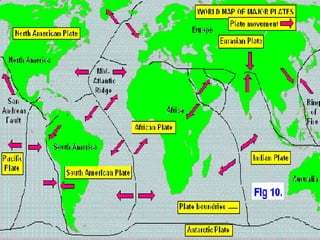
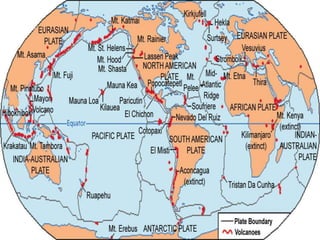
• The distribution of volcanoes in the world is
majorly present near both divergent and
convergent plate boundaries.
• Most are concentrated on the equator, along
island chains, or beneath the sea, forming long
mountain ranges.
• The distribution of Volcanoes around the Globe is
highest near the Pacific Ring of Fire as it is home
to nearly 70% of the world's volcanoes.
• Following are the major areas of active
volcanoes:
• i. Circum Pacific region around the Pacific
Ocean (also known as ‘Ring of Fire’)
• ii. Southern Europe
• iii. Along Mid Atlantic Ridge
• iv. East Coast of Africa
The End…..

VOLCANO.pptx. By Dr.Mohammad Subhan Lone

  • 1.
    VOLCANOES By Dr.Mohammad SubhanLone. Lecturer in higher education department (J&K)
  • 2.
    INTRODUCTION • A volcanois an opening in the Earth’s crust that allows molten rock, gases and debris to escape to the surface. • During a volcanic eruption, lava and other debris can flow at speeds of up to 100 mph, destroying everything in their path. • Different magma types behave differently as lava flows, depending on their temperature, viscosity, and gas content.
  • 4.
    Volcanic Eruption types •Magmas that are generated deep within the Earth begin to rise because they are less dense than the surrounding solid rocks. • As they rise they may encounter a depth or pressure where the dissolved gas no longer can be held in solution in the magma, and the gas begins to form a separate phase
  • 5.
    Non-Explosive Eruptions • Effusiveor Non explosive eruptions are favored by low gas content and low viscosity magmas (basaltic to andesitic magmas). • Lava flows are produced on the surface, and these run like liquids down slope, along the lowest areas they can find. • If the viscosity is high, but the gas content is low, then the lava will pile up over the vent to produce a lava dome or volcanic dome.
  • 7.
    Explosive Eruptions • Explosiveeruptions are favored by high gas content & high viscosity magmas (andesitic to Rhyolitic magmas). • The explosive bursting of bubbles fragments the magma into clots of liquid that cool as they fall through the air. • These solid particles become pyroclasts or volcanic ash, volcanic bombs. • Clouds of gas and tephra that rise above a volcano produce an eruption column that can rise up to 45 km into the atmosphere.
  • 9.
    Products of Volcano •Pyroclastic Material • If the magma has high gas content and high viscosity, the gas will expand in an explosive fashion and break the liquid into clots that fly through the air and cool along their path through the atmosphere. • Alternatively it blast out solid pieces of rock that once formed the volcanic edifice. • All of these fragments are referred to as • Pyroclasts = hot, broken fragments.
  • 10.
    • Depending onsize, tephra can be classified as bombs. blocks, lapilli, or ash. • Volcanic Blocks are angular fragments that were solid when ejected. • Volcanic Bombs have an aerodynamic shape indicating they were liquid when ejected. • Bombs and lapilli that consist mostly of gas bubbles (vesicles) result in a low density highly vesicular rock fragment called pumice.
  • 11.
    TYPES OF VOLCANOS •Volcanoes can be classified into three categories as fallow • 1. On the Basis of Morphology/ Appearance • 2. On the Basis of Frequency of Volcanic Eruptions • 3. On the Basis of Volcanic Eruption Style/ Strength
  • 12.
    1. On theBasis of Morphology/ Appearance • Shield Volcanoes • A shield volcano is characterized by gentle upper slopes (about 5o) and somewhat steeper lower slopes (about 10o). Shield volcanoes are composed almost entirely of relatively thin lava flows built up over a central vent. • Most shields were formed by low viscosity basaltic magma that flows easily down slope away from the summit vent.
  • 14.
    • Stratovolcanoes (alsocalled Composite Volcanoes • Have steeper slopes than shield volcanoes, with slopes of 6 to 10o low on the flanks to 30o near the top. • The steep slope near the summit is due partly to thick, short viscous lava flows that do not travel far down slope from the vent. • The gentler slopes near the base are due to accumulations of material eroded from the volcano
  • 16.
    • Cinder Cones •Cinder cones are small volume cones consisting predominantly of ash and pyroclasts that result from mildly explosive eruptions. • They usually consist of basaltic to andesitic material • Slopes of the cones are controlled by the angle of repose between about 25 and 35 degrees.
  • 18.
    2. On theBasis of Frequency of Volcanic Eruptions • 1. Active volcanoes • These can erupt at any time. Active volcanoes keep erupting lava and/ or gas, even generating seismicity Examples: Barren Island in the Andaman Islands (India), Sakurajima volcano (Japan), • 2. Dormant volcanoes • These have not been known to erupt for a long time but could erupt again in the future. Examples: Mt. Apo and Mt. Isarog (Philippines).
  • 19.
    • 3. Extinctvolcanoes • They have not been erupted since historic times. An extinct volcano is one which has been dormant for more than 10,000 years. Example/s: Mount Kenya in Kenya, Mount Ashitaka in Japan, Dhinodhar hills in Gujarat (India), Dhosi hill in Haryana (India).
  • 20.
    On the Basisof Volcanic Eruption Style/ Strength • 1. Destructive/Explosive: • Gas driven eruptions are explosive which propel magma and tephra. Large amounts of water and carbon dioxide are dissolved in magma Extreme violent eruptions eject pyroclastic. Heavy particles settle near crater whereas lighter particles can be deposited hundreds of miles away by the action of wind.
  • 21.
    • 2. Non-destructive/Effusive: •These form quiet emissions of lava. Such types of eruptions are characterized by lava outpouring without significant explosion due to lesser quantities of gases and so are more fluid.
  • 22.
    Distribution • The distributionof volcanoes in the world is majorly present near both divergent and convergent plate boundaries. • Most are concentrated on the equator, along island chains, or beneath the sea, forming long mountain ranges. • The distribution of Volcanoes around the Globe is highest near the Pacific Ring of Fire as it is home to nearly 70% of the world's volcanoes.
  • 23.
    • Following arethe major areas of active volcanoes: • i. Circum Pacific region around the Pacific Ocean (also known as ‘Ring of Fire’) • ii. Southern Europe • iii. Along Mid Atlantic Ridge • iv. East Coast of Africa
  • 26.