Empowerment
 giving others authority to reach their
goals as they see fit.
 provides others the opportunities
to make their own decisions and
choices
 its goal is developing an environment
of trust, where every team member is
accountable for their own actions
Empowerment
 It also means that you share some of your authority
and responsibilities with team members. You’re
developing the intellectual capital of your business
and giving team members a greater feeling of
involvement in the business.
 It can mean some extra mentoring for you at the
start of the process, but the ultimate result is that
you have more time to work on your business instead
of in it, and the ability to be a more productive
manger.
Empowerment
 It naturally involves a bit of risk. There’s
always the possibility that the person given
the new assignment might not get it right,
certainly at first. Don’t let this daunt your
enthusiasm for the principle. Learn from any
mistakes and apply your own experience to
work out how to prevent them from
recurring.
 Sometimes deals with ‘’Teamwork’’
Students in Elementary
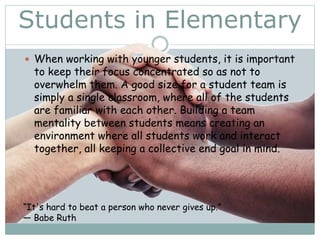
 When working with younger students, it is important
to keep their focus concentrated so as not to
overwhelm them. A good size for a student team is
simply a single classroom, where all of the students
are familiar with each other. Building a team
mentality between students means creating an
environment where all students work and interact
together, all keeping a collective end goal in mind.
“It's hard to beat a person who never gives up.”
― Babe Ruth
Students in Highschool
In high school, building a team mentality among
students becomes more difficult as students become
highly engrossed in individual achievement, social
groups, athletics, college admissions, employment,
and other extracurricular activities. Despite the
possibility of initial student resistance, working to
build a team atmosphere in high school can help
eliminate many of the feelings of isolation associated
with high school.
“Alone we can do so little; together we can do so much”
― Helen Keller
Students in Highschool
At the higher age level, teams can be built on the micro
or the macro level. An example of teams at the micro
level, would be having an hour each week for "club"
team, where every student must attend a student-run,
faculty sponsored club of their choice. Each club
should be required to write a mission statement, raise
a certain amount of funds for one field trip, and
complete a certain number of community service hours,
as well as plan and implement meeting agendas that are
in line with the club's mission statement.
“Talent wins games, but teamwork and intelligence wins championships.”
― Michael Jordan
Students in Highschool
On the macro level, students can be teamed by grade
level, or further divided by random homeroom pairings,
or by academic focus. Large teams can focus on passing
state benchmark exams, college and workforce
admissions, funds for school dances and class trips and
community service hours.
“The strength of the team is each individual member. The strength
of each member is the team.”
― Phil Jackson
1. Share information
By informing everyone of the true
issues, concerns and obstacles, nobody is
left in the dark with a lack of knowledge.
Everyone can then make decisions on an
equal playing field.
Ways to create an empowered
membership
2. Offer skills training or mentoring to
anyone who needs to improve to make
stronger and wiser decisions. The worst
thing a leader can do is telling their team
to make an important decision without
providing them with the skills, knowledge
and strategies to be successful.
Ways to create an empowered
membership
Ways to create an empowered
membership
3. Encourage others to assert themselves and
share ideas so that all suggestions are
offered and evaluated. If others feel that
what they have to say will not be considered
or valued, critical opinions will be overlooked.
The result of missing analyses can lead to a
team not voting on the best choice, or even a
misguided choice.
Ways to create an empowered
membership
4. Analyze those tasks you now perform that
could be done by somebody else. Also take a
look around your business for tasks that
should be done but haven’t been for one
reason or another.
Ways to create an empowered
membership
5. Assign these tasks to appropriate
team members after you ensure it’s
within their capabilities and won’t make
their workloads too heavy.
Ways to create an empowered
membership
6. Whenever you assign a new task to
someone explain clearly why you feel
they can handle it and let them know it’s
part of their overall development.
Ways to create an empowered
membership
7. Take the team members, receiving
new assignments, through the tasks in
detail. Allow them to ask questions if
they want to, and assure them that
you’ll be available to assist them if they
have any questions.
Ways to create an empowered
membership
8. Invite them to consider the methods
now being used to accomplish the task
and make any recommendations they’d
like about alternative ways to do it. You
may be surprised at new efficiencies
that can be discovered this way.
Ways to create an empowered
membership
9. Give your team members the
authority they need to perform the
task.
Ways to create an empowered
membership
10. Be very specific about time limits
and deadlines. If a task needs to be
performed by a particular date tell
them and follow up in sufficient time to
make sure it’s completed on schedule.
Ways to create an empowered
membership
11. Prioritize the work. Tell them clearly
how important the task is and how it
relates in importance to their other
duties. Otherwise you could find that
the new task is done first, to the
detriment of their other work.
Ways to create an empowered
membership
12. Allow members to be flexible in
their methodologies. Unless there are
very specific reasons for doing a task in
a particular way, encourage them to be
creative in their approach to
performing it.
Ways to create an empowered
membership
13. Give the team members full access
to information about the task. Put them
fully ‘in the picture’ as to how the task
fits into the overall strategy of the
business.
Ways to create an empowered
membership
14. Encourage your team members to
share any insights or new ideas that
might arise from their performance of
new duties. It may not happen at first
but as they get used to doing something
new they may find that their
perceptions of other areas of the
business change as well.
A good leader
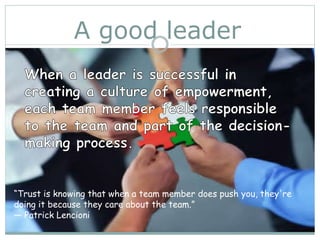
“Trust is knowing that when a team member does push you, they're
doing it because they care about the team.”
― Patrick Lencioni
A good leader
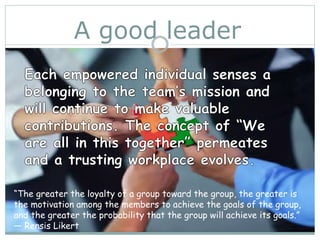
“The greater the loyalty of a group toward the group, the greater is
the motivation among the members to achieve the goals of the group,
and the greater the probability that the group will achieve its goals.”
― Rensis Likert
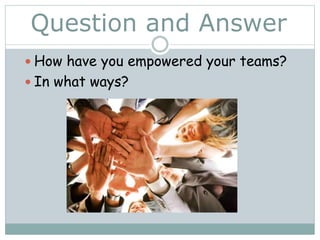
Question and Answer
 How have you empowered your teams?
 In what ways?
Let’s watch this vid!
Empowered Membership

Empowered Membership

  • 2.
    Empowerment  giving othersauthority to reach their goals as they see fit.  provides others the opportunities to make their own decisions and choices  its goal is developing an environment of trust, where every team member is accountable for their own actions
  • 3.
    Empowerment  It alsomeans that you share some of your authority and responsibilities with team members. You’re developing the intellectual capital of your business and giving team members a greater feeling of involvement in the business.  It can mean some extra mentoring for you at the start of the process, but the ultimate result is that you have more time to work on your business instead of in it, and the ability to be a more productive manger.
  • 4.
    Empowerment  It naturallyinvolves a bit of risk. There’s always the possibility that the person given the new assignment might not get it right, certainly at first. Don’t let this daunt your enthusiasm for the principle. Learn from any mistakes and apply your own experience to work out how to prevent them from recurring.  Sometimes deals with ‘’Teamwork’’
  • 6.
    Students in Elementary When working with younger students, it is important to keep their focus concentrated so as not to overwhelm them. A good size for a student team is simply a single classroom, where all of the students are familiar with each other. Building a team mentality between students means creating an environment where all students work and interact together, all keeping a collective end goal in mind. “It's hard to beat a person who never gives up.” ― Babe Ruth
  • 7.
    Students in Highschool Inhigh school, building a team mentality among students becomes more difficult as students become highly engrossed in individual achievement, social groups, athletics, college admissions, employment, and other extracurricular activities. Despite the possibility of initial student resistance, working to build a team atmosphere in high school can help eliminate many of the feelings of isolation associated with high school. “Alone we can do so little; together we can do so much” ― Helen Keller
  • 8.
    Students in Highschool Atthe higher age level, teams can be built on the micro or the macro level. An example of teams at the micro level, would be having an hour each week for "club" team, where every student must attend a student-run, faculty sponsored club of their choice. Each club should be required to write a mission statement, raise a certain amount of funds for one field trip, and complete a certain number of community service hours, as well as plan and implement meeting agendas that are in line with the club's mission statement. “Talent wins games, but teamwork and intelligence wins championships.” ― Michael Jordan
  • 9.
    Students in Highschool Onthe macro level, students can be teamed by grade level, or further divided by random homeroom pairings, or by academic focus. Large teams can focus on passing state benchmark exams, college and workforce admissions, funds for school dances and class trips and community service hours. “The strength of the team is each individual member. The strength of each member is the team.” ― Phil Jackson
  • 11.
    1. Share information Byinforming everyone of the true issues, concerns and obstacles, nobody is left in the dark with a lack of knowledge. Everyone can then make decisions on an equal playing field. Ways to create an empowered membership
  • 12.
    2. Offer skillstraining or mentoring to anyone who needs to improve to make stronger and wiser decisions. The worst thing a leader can do is telling their team to make an important decision without providing them with the skills, knowledge and strategies to be successful. Ways to create an empowered membership
  • 13.
    Ways to createan empowered membership 3. Encourage others to assert themselves and share ideas so that all suggestions are offered and evaluated. If others feel that what they have to say will not be considered or valued, critical opinions will be overlooked. The result of missing analyses can lead to a team not voting on the best choice, or even a misguided choice.
  • 14.
    Ways to createan empowered membership 4. Analyze those tasks you now perform that could be done by somebody else. Also take a look around your business for tasks that should be done but haven’t been for one reason or another.
  • 15.
    Ways to createan empowered membership 5. Assign these tasks to appropriate team members after you ensure it’s within their capabilities and won’t make their workloads too heavy.
  • 16.
    Ways to createan empowered membership 6. Whenever you assign a new task to someone explain clearly why you feel they can handle it and let them know it’s part of their overall development.
  • 17.
    Ways to createan empowered membership 7. Take the team members, receiving new assignments, through the tasks in detail. Allow them to ask questions if they want to, and assure them that you’ll be available to assist them if they have any questions.
  • 18.
    Ways to createan empowered membership 8. Invite them to consider the methods now being used to accomplish the task and make any recommendations they’d like about alternative ways to do it. You may be surprised at new efficiencies that can be discovered this way.
  • 19.
    Ways to createan empowered membership 9. Give your team members the authority they need to perform the task.
  • 20.
    Ways to createan empowered membership 10. Be very specific about time limits and deadlines. If a task needs to be performed by a particular date tell them and follow up in sufficient time to make sure it’s completed on schedule.
  • 21.
    Ways to createan empowered membership 11. Prioritize the work. Tell them clearly how important the task is and how it relates in importance to their other duties. Otherwise you could find that the new task is done first, to the detriment of their other work.
  • 22.
    Ways to createan empowered membership 12. Allow members to be flexible in their methodologies. Unless there are very specific reasons for doing a task in a particular way, encourage them to be creative in their approach to performing it.
  • 23.
    Ways to createan empowered membership 13. Give the team members full access to information about the task. Put them fully ‘in the picture’ as to how the task fits into the overall strategy of the business.
  • 24.
    Ways to createan empowered membership 14. Encourage your team members to share any insights or new ideas that might arise from their performance of new duties. It may not happen at first but as they get used to doing something new they may find that their perceptions of other areas of the business change as well.
  • 25.
    A good leader “Trustis knowing that when a team member does push you, they're doing it because they care about the team.” ― Patrick Lencioni
  • 26.
    A good leader “Thegreater the loyalty of a group toward the group, the greater is the motivation among the members to achieve the goals of the group, and the greater the probability that the group will achieve its goals.” ― Rensis Likert
  • 27.
    Question and Answer How have you empowered your teams?  In what ways?
  • 28.