THE VERB The Category of Order  The Category of Voice
The Category of Order  The opposition of the category The problem of the Perfect The Function of the Category of Order The Perfective Form and the Pefective Aspect
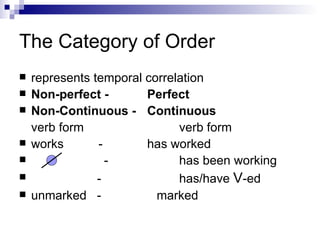
The Category of Order represents temporal correlation  Non-perfect -  Perfect Non-Continuous -  Continuous verb form verb form works  -  has worked   - has been working - has/have  V -ed unmarked  -  marked
The problem of the Perfect The English perfect has been the subject of a lengthy discussion.  There are three views on the problem:  1) the tense-view;  2) the aspect-view,  3) the specific category-view.
The problem of the Perfect Henry Sweet (1892), G. O. Curme (1931), Otto   Jespersen (1931) and other traditional grammarians treat the perfect   as tense. It should be classified in the same way as the categories of past, present
The problem of the Perfect John Lyons (1968) ,  G. Vorontsova (1960).  They  argue that English has two main   aspects “which combine fairly freely with tense and mood: the ’perfect’ (e.g. I   have/had read the book, I will/would have read the book) and the ‘progressive’   (I am/was reading the book, I will/would be reading the book). They also   combine freely with one another (I have/had been reading the book)”.  The   scholar s  also speak of other aspectual distinctions, e.g. the ‘habitual’ (I used to   read), the ‘mutative’ (e.g. I got killed).
The problem of the Perfect A.I. Smirnitsky (1959)   The perfect   is neither tense nor aspect, but a specific category different from both. He  call s  it  “ the category of time relation”.  “the category of correlation”( 1955) . B. Ilyish (1971)   -  “the category of correlation” B. S. Khaimovich and B. I. Rogovskaya   -  “the category of order”  M.   Blokh   -  “the category of retrospective   coordination”  or  “the category of retrospect”.   N. Slonimskaya   (1975)  -  “the category of   taxis”.   There is  one more term –  “ the category of relevant retrospect or   the category of relevant precedence ” .
The category of  order The perfect form builds up its own category, different from both the "tense" (present  —  past  —  future) and the "aspect" (continuous  —  indefinite), and not reducible to either of them.  The functional content of the category of "time correlation"  (« временная   отнесенность »)  was defined as priority expressed by the perfect forms in the present, past or future contrasted against the non-expression of priority by the non-perfect forms.
The  Function of the C ategory of  Order to actualize a process that is anterior to another process, or another   moment of time
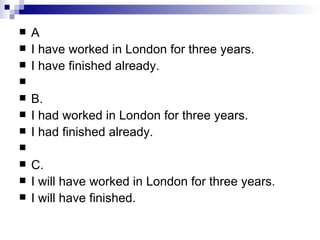
A I have worked in London for three years. I have finished already. B. I had worked in London for three years. I had finished already. C. I will have worked in London for three years. I will have finished .
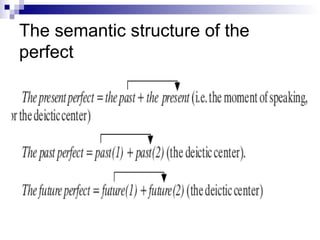
The semantic structure of the perfect
Theoretically, the use of the perfect is not necessary when the connection to the deictic centre or centres is expressed by the context or by the co-text.  According to Marcella Frank (1972:81) “ except for  since  and  for , most of the other past-to-present time expressions may be used informally with the past tense”
We finished five chapters so far. He just (now) came in. He recently published his memoirs. Compare He will   not go to the party until he has written the essay. BUT He won’t go to the party until he completes (finishes) his   essay. The difference between the perfect and the non-perfect form is that of   emphasis
Meaning of The Perfect Form priority of an action to the moment in the past, present and future resultative meaning or the meaning of completeness length of an action in time till now meaning of a repeated action
The Perfective Form and the Perfective Aspect I have already written the letter. Я уже написал письмо.  After the teacher had gone, the students dispersed. После того как учитель ушёл, студенты разошлись.  Only fancy, I have not read anything of his yet! Представьте, я ещё не   читала   его книги!
The Perfective Form and the Perfective Aspect All this goes to say that the English perfect is indifferent to aspect.  It is as   indifferent as the past simple.  I wrote the letter. vs. I skated yesterday.
The Perfective Form and the Perfective Aspect If the verb denotes a bounded perfective process only, the perfect   form, irrespective of the co-text, denotes the end of the process.  The child broke the vase. vs. The child has broken the vase. John sold his car to Mary. vs. John has sold his car to Mary. You look worried. What happened? vs. You look worried. What’s happened?
The Perfective Form and the Perfective Aspect If the verb denotes a bounded perfective and an imperfective aspect, the   actual meaning of the perfect form is determined by the co-text.  We sat on the couch and she played records. We drank and watched TV. vs. We have played records. We have drunk and watched TV. How did he earn his living? He made films. vs. He has made films.
The Category of Voice Definition The problem of homonymous forms The ways of translating Passive constructions
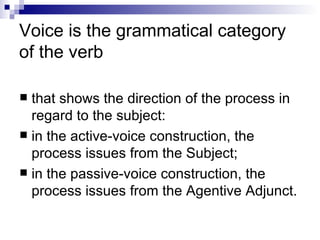
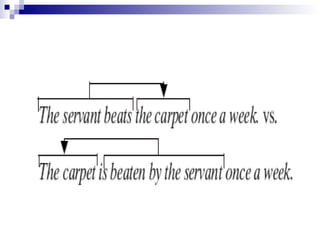
Voice is the grammatical category of the verb  that shows the direction of   the process in regard to the subject:  in the active-voice construction, the process   issues from the Subject; in the passive-voice construction, the process issues   from the Agentive Adjunct.
 
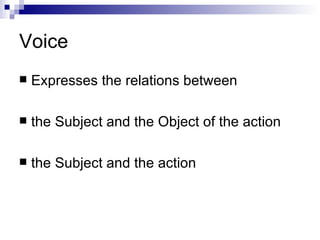
Voice Expresses the relations between the Subject and the Object of the action the Subject and the action
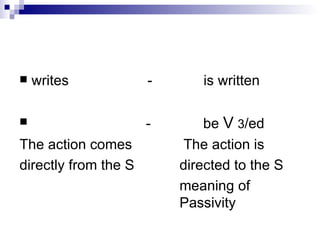
writes  -  is written -   be  V   3 /ed The action comes  The action is directly from the S directed to the S meaning of  Passivity
What motivates the process of passivization? The motives are informational-pragmatic: 1) the speaker’s wish to use the Agent as the Theme (the active construction)   or the Affected as the Theme (the passive construction).  Who made this chair? My father did./This chair was made by my father.
2) the speaker’s reluctance or inability to use the Agent.   The speaker may not want to mention the Agent for the sake of tact, or he/she may want to avoid making explicit reference to the Agent and thus give the   writing a more objective flavour, or he/she simply may not know who carried   out the process.  A man was killed yesterday. The room has not been cleaned.
3) the speaker’s wish to avoid semantic redundancy, i.e. to avoid non - informative   constituents.  English is spoken in many countries ( instead of  People speak English in   many countries) .
The   category of voice is based on transitive verbs, i.e. verbs associated with at least two nouns whose semantic roles are characteristically those of an Agent and an Affected (Patient).  The passive voice is an analytical form: it is built up by means of the corresponding tense of the auxiliary verb be and the past participle of the given verb.
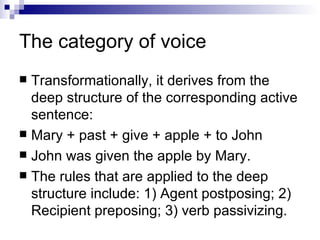
The   category of voice Transformationally, it derives from the deep structure of the corresponding active sentence:  Mary + past + give + apple + to John  John was given the apple by Mary.  The rules that are applied to the deep structure include: 1) Agent postposing; 2) Recipient preposing; 3) verb passivizing.
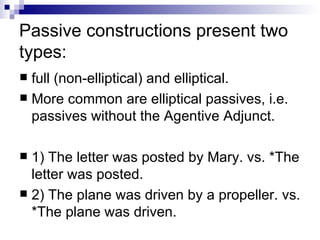
Passive constructions present two types: full (non-elliptical) and elliptical.  More common are elliptical passives, i.e. passives without the Agentive Adjunct.  1) The letter was posted by Mary. vs. *The letter was posted. 2) The plane was driven by a propeller. vs. *The plane was driven.
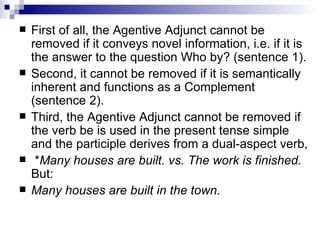
First of all, the Agentive Adjunct cannot be removed if it conveys novel information, i.e. if it is the answer to the question Who by? (sentence 1).  Second, it cannot be removed if it is semantically inherent and functions as a Complement (sentence 2).  Third, the Agentive Adjunct cannot be removed if the verb be is used in the present tense simple and the participle derives from a dual-aspect verb,  * Many houses are built. vs. The work is finished.  But: Many houses are built in the town.
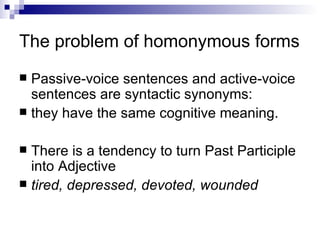
The problem of homonymous forms Passive-voice sentences and active-voice sentences are syntactic synonyms:  they have the same cognitive meaning. There is a tendency to turn Past Participle into Adjective tired, depressed, devoted, wounded
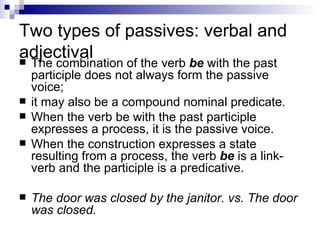
Two types of passives: verbal and adjectival The combination of the verb  be  with the past participle does not always form the passive voice;  it may also be a compound nominal predicate.  When the verb be with the past participle expresses a process, it is the passive voice.  When the construction expresses a state resulting from a process, the verb  be  is a link-verb and the participle is a predicative.  The door was closed by the janitor. vs. The door was closed.
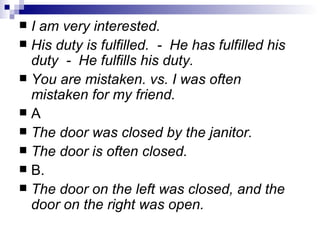
I  am very interested. His duty is fulfilled.  -  He has fulfilled his duty  -  He fulfills his duty. You are mistaken. vs. I was often mistaken for my friend. A The door was closed by the janitor.  The door is often closed. B. The door on the left was closed, and the door on the right was open.
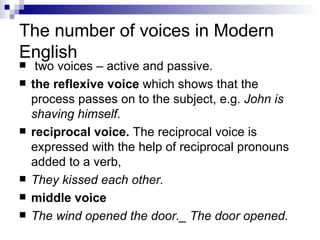
The number of voices in Modern English two voices – active and passive.  the reflexive voice  which shows that the process passes on to the subject, e.g.  John is shaving himself . reciprocal voice.  The reciprocal voice is expressed with the help of reciprocal pronouns added to a verb, They kissed each other. middle voice The wind opened the door._ The door opened.
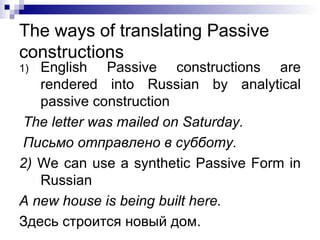
The ways of translating Passive constructions English Passive constructions are rendered into Russian by analytical passive construction The letter was mailed on Saturday. Письмо отправлено в субботу. 2)  We can use a synthetic Passive Form in Russian A new house is being built here. Здесь строится новый дом.
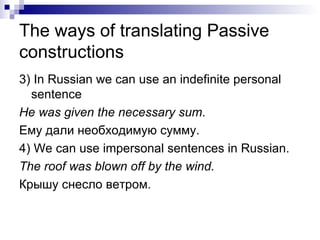
The ways of translating Passive constructions 3)  In Russian we can use an indefinite personal sentence He was given the necessar y sum . Ему дали необходимую сумму. 4)  We can use impersonal sentences in Russian. The roof was blown off by the wind. Крышу снесло ветром.
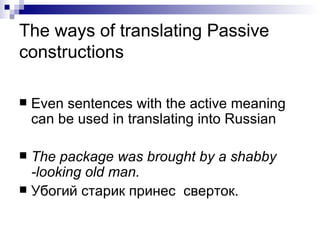
The ways of translating Passive constructions Even sentences with the active meaning can be used in translating into Russian The package was brought b y  a shabby -looking old man. Убогий старик принес  сверток.

Voice

  • 1.
    THE VERB TheCategory of Order The Category of Voice
  • 2.
    The Category ofOrder The opposition of the category The problem of the Perfect The Function of the Category of Order The Perfective Form and the Pefective Aspect
  • 3.
    The Category ofOrder represents temporal correlation Non-perfect - Perfect Non-Continuous - Continuous verb form verb form works - has worked - has been working - has/have V -ed unmarked - marked
  • 4.
    The problem ofthe Perfect The English perfect has been the subject of a lengthy discussion. There are three views on the problem: 1) the tense-view; 2) the aspect-view, 3) the specific category-view.
  • 5.
    The problem ofthe Perfect Henry Sweet (1892), G. O. Curme (1931), Otto Jespersen (1931) and other traditional grammarians treat the perfect as tense. It should be classified in the same way as the categories of past, present
  • 6.
    The problem ofthe Perfect John Lyons (1968) , G. Vorontsova (1960). They argue that English has two main aspects “which combine fairly freely with tense and mood: the ’perfect’ (e.g. I have/had read the book, I will/would have read the book) and the ‘progressive’ (I am/was reading the book, I will/would be reading the book). They also combine freely with one another (I have/had been reading the book)”. The scholar s also speak of other aspectual distinctions, e.g. the ‘habitual’ (I used to read), the ‘mutative’ (e.g. I got killed).
  • 7.
    The problem ofthe Perfect A.I. Smirnitsky (1959) The perfect is neither tense nor aspect, but a specific category different from both. He call s it “ the category of time relation”. “the category of correlation”( 1955) . B. Ilyish (1971) - “the category of correlation” B. S. Khaimovich and B. I. Rogovskaya - “the category of order” M. Blokh - “the category of retrospective coordination” or “the category of retrospect”. N. Slonimskaya (1975) - “the category of taxis”. There is one more term – “ the category of relevant retrospect or the category of relevant precedence ” .
  • 8.
    The category of order The perfect form builds up its own category, different from both the "tense" (present — past — future) and the "aspect" (continuous — indefinite), and not reducible to either of them. The functional content of the category of "time correlation" (« временная отнесенность ») was defined as priority expressed by the perfect forms in the present, past or future contrasted against the non-expression of priority by the non-perfect forms.
  • 9.
    The Functionof the C ategory of Order to actualize a process that is anterior to another process, or another moment of time
  • 10.
    A I haveworked in London for three years. I have finished already. B. I had worked in London for three years. I had finished already. C. I will have worked in London for three years. I will have finished .
  • 11.
    The semantic structureof the perfect
  • 12.
    Theoretically, the useof the perfect is not necessary when the connection to the deictic centre or centres is expressed by the context or by the co-text. According to Marcella Frank (1972:81) “ except for since and for , most of the other past-to-present time expressions may be used informally with the past tense”
  • 13.
    We finished fivechapters so far. He just (now) came in. He recently published his memoirs. Compare He will not go to the party until he has written the essay. BUT He won’t go to the party until he completes (finishes) his essay. The difference between the perfect and the non-perfect form is that of emphasis
  • 14.
    Meaning of ThePerfect Form priority of an action to the moment in the past, present and future resultative meaning or the meaning of completeness length of an action in time till now meaning of a repeated action
  • 15.
    The Perfective Formand the Perfective Aspect I have already written the letter. Я уже написал письмо. After the teacher had gone, the students dispersed. После того как учитель ушёл, студенты разошлись. Only fancy, I have not read anything of his yet! Представьте, я ещё не читала его книги!
  • 16.
    The Perfective Formand the Perfective Aspect All this goes to say that the English perfect is indifferent to aspect. It is as indifferent as the past simple. I wrote the letter. vs. I skated yesterday.
  • 17.
    The Perfective Formand the Perfective Aspect If the verb denotes a bounded perfective process only, the perfect form, irrespective of the co-text, denotes the end of the process. The child broke the vase. vs. The child has broken the vase. John sold his car to Mary. vs. John has sold his car to Mary. You look worried. What happened? vs. You look worried. What’s happened?
  • 18.
    The Perfective Formand the Perfective Aspect If the verb denotes a bounded perfective and an imperfective aspect, the actual meaning of the perfect form is determined by the co-text. We sat on the couch and she played records. We drank and watched TV. vs. We have played records. We have drunk and watched TV. How did he earn his living? He made films. vs. He has made films.
  • 19.
    The Category ofVoice Definition The problem of homonymous forms The ways of translating Passive constructions
  • 20.
    Voice is thegrammatical category of the verb that shows the direction of the process in regard to the subject: in the active-voice construction, the process issues from the Subject; in the passive-voice construction, the process issues from the Agentive Adjunct.
  • 21.
  • 22.
    Voice Expresses therelations between the Subject and the Object of the action the Subject and the action
  • 23.
    writes - is written - be V 3 /ed The action comes The action is directly from the S directed to the S meaning of Passivity
  • 24.
    What motivates theprocess of passivization? The motives are informational-pragmatic: 1) the speaker’s wish to use the Agent as the Theme (the active construction) or the Affected as the Theme (the passive construction). Who made this chair? My father did./This chair was made by my father.
  • 25.
    2) the speaker’sreluctance or inability to use the Agent. The speaker may not want to mention the Agent for the sake of tact, or he/she may want to avoid making explicit reference to the Agent and thus give the writing a more objective flavour, or he/she simply may not know who carried out the process. A man was killed yesterday. The room has not been cleaned.
  • 26.
    3) the speaker’swish to avoid semantic redundancy, i.e. to avoid non - informative constituents. English is spoken in many countries ( instead of People speak English in many countries) .
  • 27.
    The category of voice is based on transitive verbs, i.e. verbs associated with at least two nouns whose semantic roles are characteristically those of an Agent and an Affected (Patient). The passive voice is an analytical form: it is built up by means of the corresponding tense of the auxiliary verb be and the past participle of the given verb.
  • 28.
    The category of voice Transformationally, it derives from the deep structure of the corresponding active sentence: Mary + past + give + apple + to John John was given the apple by Mary. The rules that are applied to the deep structure include: 1) Agent postposing; 2) Recipient preposing; 3) verb passivizing.
  • 29.
    Passive constructions presenttwo types: full (non-elliptical) and elliptical. More common are elliptical passives, i.e. passives without the Agentive Adjunct. 1) The letter was posted by Mary. vs. *The letter was posted. 2) The plane was driven by a propeller. vs. *The plane was driven.
  • 30.
    First of all,the Agentive Adjunct cannot be removed if it conveys novel information, i.e. if it is the answer to the question Who by? (sentence 1). Second, it cannot be removed if it is semantically inherent and functions as a Complement (sentence 2). Third, the Agentive Adjunct cannot be removed if the verb be is used in the present tense simple and the participle derives from a dual-aspect verb, * Many houses are built. vs. The work is finished. But: Many houses are built in the town.
  • 31.
    The problem ofhomonymous forms Passive-voice sentences and active-voice sentences are syntactic synonyms: they have the same cognitive meaning. There is a tendency to turn Past Participle into Adjective tired, depressed, devoted, wounded
  • 32.
    Two types ofpassives: verbal and adjectival The combination of the verb be with the past participle does not always form the passive voice; it may also be a compound nominal predicate. When the verb be with the past participle expresses a process, it is the passive voice. When the construction expresses a state resulting from a process, the verb be is a link-verb and the participle is a predicative. The door was closed by the janitor. vs. The door was closed.
  • 33.
    I amvery interested. His duty is fulfilled. - He has fulfilled his duty - He fulfills his duty. You are mistaken. vs. I was often mistaken for my friend. A The door was closed by the janitor. The door is often closed. B. The door on the left was closed, and the door on the right was open.
  • 34.
    The number ofvoices in Modern English two voices – active and passive. the reflexive voice which shows that the process passes on to the subject, e.g. John is shaving himself . reciprocal voice. The reciprocal voice is expressed with the help of reciprocal pronouns added to a verb, They kissed each other. middle voice The wind opened the door._ The door opened.
  • 35.
    The ways oftranslating Passive constructions English Passive constructions are rendered into Russian by analytical passive construction The letter was mailed on Saturday. Письмо отправлено в субботу. 2) We can use a synthetic Passive Form in Russian A new house is being built here. Здесь строится новый дом.
  • 36.
    The ways oftranslating Passive constructions 3) In Russian we can use an indefinite personal sentence He was given the necessar y sum . Ему дали необходимую сумму. 4) We can use impersonal sentences in Russian. The roof was blown off by the wind. Крышу снесло ветром.
  • 37.
    The ways oftranslating Passive constructions Even sentences with the active meaning can be used in translating into Russian The package was brought b y a shabby -looking old man. Убогий старик принес сверток.