THE VERB CATEGORIES
1. The Category of Person
2. The Category of Number
3. The Category of Tense
4. Present Tense
5. Past Tense
6. The Problem of Future Tense
7. The Category of Aspect
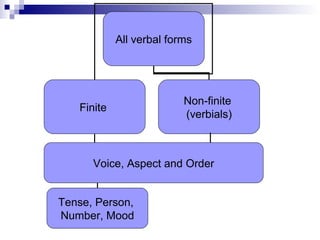
All verbal forms
Finite
Non-finite
(verbials)
Voice, Aspect and Order
Tense, Person,
Number, Mood
The Category of Person
 The category of person serves to
associate the process with three deictic
categories in a communicative act:
 the speaker (I, we) ,
 the addressee (you)
 and the one (ones) not participating in a
communicative act (he, she, it, they).
The deictic centre of the
communicative act
 is the speaker, i.e. first person.
 In the process of communication, the
deictic center keeps changing: I you;
you I
 The three deictic categories, or persons,
are lexicalized in personal pronouns.
The category of person
 is often grammaticalized, i.e. a special form
of the verb additionally shows which person,
or deictic category, is meant.
 [Я] иду - [мы] идем I go – we go
 [Ты] идешь - [вы] идете You go – you go
 [Он/Она] идет - [они] идут [He, she, it] goes –
They go
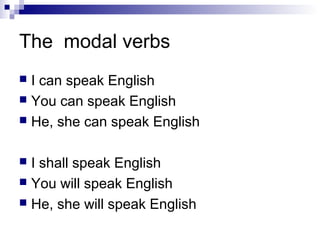
The modal verbs
 I can speak English
 You can speak English
 He, she can speak English
 I shall speak English
 You will speak English
 He, she will speak English
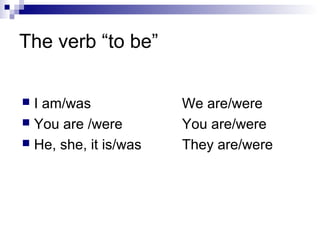
The verb “to be”
 I am/was We are/were
 You are /were You are/were
 He, she, it is/was They are/were
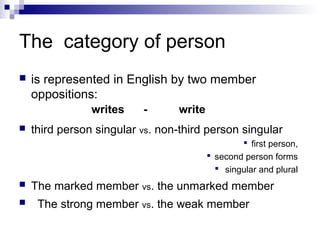
The category of person
 is represented in English by two member
oppositions:
 third person singular vs. non-third person singular
 first person,
 second person forms
 singular and plural
 The marked member vs. the unmarked member
 The strong member vs. the weak member
writes - write
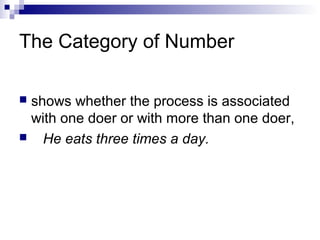
The Category of Number
 shows whether the process is associated
with one doer or with more than one doer,
 He eats three times a day.
The Category of Number
 is a two-member opposition:
 singular and plural.
 Number and person make use of the
same morpheme.
Number is restricted to the
Present tense.
 John goes to college. vs. John went to college.
 The students live in dormitories. vs. The
students lived in dormitories.
 I am/ at home.
 John is/ at college now.
 I was at home.
 John was at college.
 You were at home.
 They were at home.
 The boys crowded round him. vs. *The
boy crowded round him.
 The soldiers regrouped and opened fire.
vs *The soldier regrouped and opened
fire.
The analysis demonstrates
 the weakness of the English verb as
concerns the expression of person and
number
 and its heavy reliance on the subject:
 it is the subject that is generally
responsible for the expression of person
and number in English.
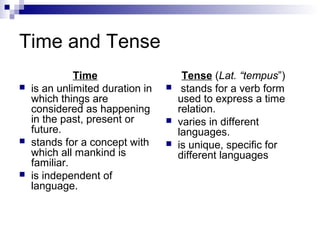
Time and Tense
Time
 is an unlimited duration in
which things are
considered as happening
in the past, present or
future.
 stands for a concept with
which all mankind is
familiar.
 is independent of
language.
Tense (Lat. “tempus”)
 stands for a verb form
used to express a time
relation.
 varies in different
languages.
 is unique, specific for
different languages
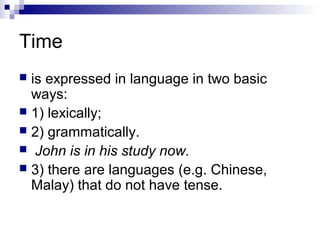
Time
 is expressed in language in two basic
ways:
 1) lexically;
 2) grammatically.
 John is in his study now.
 3) there are languages (e.g. Chinese,
Malay) that do not have tense.
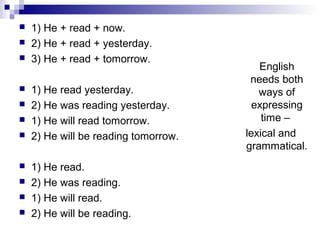
 1) He + read + now.
 2) He + read + yesterday.
 3) He + read + tomorrow.
 1) He read yesterday.
 2) He was reading yesterday.
 1) He will read tomorrow.
 2) He will be reading tomorrow.
 1) He read.
 2) He was reading.
 1) He will read.
 2) He will be reading.
English
needs both
ways of
expressing
time –
lexical and
grammatical.
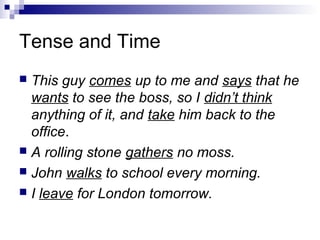
Tense and Time
 This guy comes up to me and says that he
wants to see the boss, so I didn’t think
anything of it, and take him back to the
office.
 A rolling stone gathers no moss.
 John walks to school every morning.
 I leave for London tomorrow.
Tense and Time
 Tense is a verbal category which reflects
the objective category of time and
expresses on this background the relation
between time of the action and time of the
utterance.
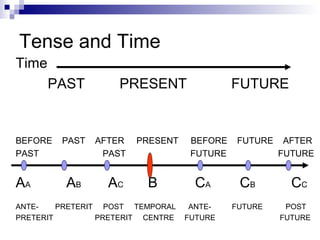
Tense and Time
Time
PAST PRESENT FUTURE
BEFORE PAST AFTER PRESENT BEFORE FUTURE AFTER
PAST PAST FUTURE FUTURE
AA AB AC B CA CB CC
ANTE- PRETERIT POST TEMPORAL ANTE- FUTURE POST
PRETERIT PRETERIT CENTRE FUTURE FUTURE
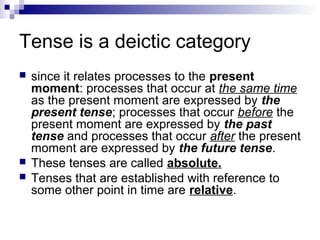
Tense is a deictic category
 since it relates processes to the present
moment: processes that occur at the same time
as the present moment are expressed by the
present tense; processes that occur before the
present moment are expressed by the past
tense and processes that occur after the present
moment are expressed by the future tense.
 These tenses are called absolute.
 Tenses that are established with reference to
some other point in time are relative.
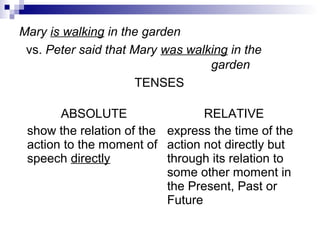
Mary is walking in the garden
vs. Peter said that Mary was walking in the
garden
TENSES
ABSOLUTE
show the relation of the
action to the moment of
speech directly
RELATIVE
express the time of the
action not directly but
through its relation to
some other moment in
the Present, Past or
Future
Tense
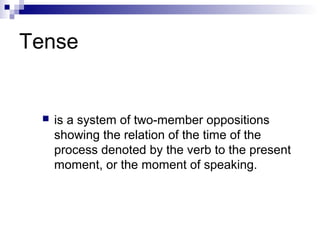
 is a system of two-member oppositions
showing the relation of the time of the
process denoted by the verb to the present
moment, or the moment of speaking.
Tense
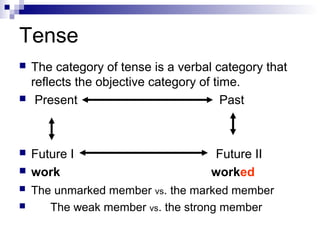
 The category of tense is a verbal category that
reflects the objective category of time.
 Present Past
 Future I Future II
 work worked
 The unmarked member vs. the marked member
 The weak member vs. the strong member
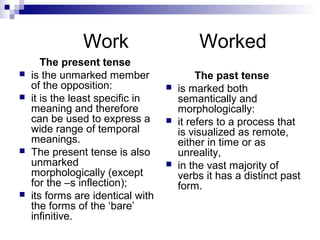
Work Worked
The present tense
 is the unmarked member
of the opposition:
 it is the least specific in
meaning and therefore
can be used to express a
wide range of temporal
meanings.
 The present tense is also
unmarked
morphologically (except
for the –s inflection);
 its forms are identical with
the forms of the ‘bare’
infinitive.
The past tense
 is marked both
semantically and
morphologically:
 it refers to a process that
is visualized as remote,
either in time or as
unreality,
 in the vast majority of
verbs it has a distinct past
form.
The Present Tense
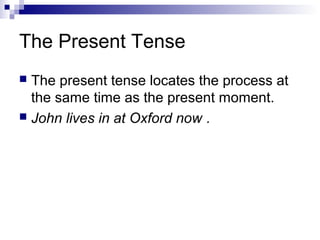
 The present tense locates the process at
the same time as the present moment.
 John lives in at Oxford now .
Three types of relationship between the process and
the present moment:
 1) the duration of the process is the same
as the duration of the report of the
process;
 2) the duration of the process is longer
than the duration of the report of the
process
 3) the duration of the process is shorter
than the duration of the report of the
process
 I name this ship the ‘Titanic’
 The Eiffel Tower stands in Paris.
 He shoots an arrow and runs away.
The Past Tense
 locates the process prior to the present moment.
 The past form of the verb does not say anything
about whether the past process occupied a
single point or an extended time period.
 At seven o’clock yesterday John promised to
give me ten pounds (a single point).
 John lived in Manchester from 1962 to 1982 (an
extended time period).
The Problem of the Future Tense
 Mary will get married tomorrow.
Objections
 concerns the meaning of the future tense in
general: the future describes a non-factive
situation while the past and the present tense
describe a factive situation.
 The second objection concerns the meaning
peculiarities of will
 The third objection concerns the expression of a
future meaning by the present tense
The Problem of the Future Tense
 The difference between the past tense and the
present tense on the one hand, and the future
tense on the other, can be treated as a
difference of mood (a speculative one) rather
than that of tense:
 will or shall +infinitive does not describe a real
situation, a feature not peculiar to tense.
 We cannot refer to future events as facts, as we
can to past and present events.
 Events in the future have not yet happened; we
can predict them with more or less success.
The Aspect
The Definition
The Problem of Aspect
The Usage and Peculiarities of
Aspect
Aspect
 is a grammatical category of the Verb which
expesses a difference in the way the action is
shown to proceed.
 write - is writing
 wrote - was writing
 will write - will be writing
 - be V ing
discontinuous morpheme
 The unmarked member vs. the marked member
 The weak member vs. the strong member
Aspect
 The basic meaning of the continuous form is
 used to present a durative situation as dynamic,
or developing at a definite period of time within
certain time limits.
 1. John is working in the library.
 2. This process has been going on ever since
the beginning of time.
Aspect
 Being confined to a particular moment,
dynamic durative situations are of
relatively limited duration,
 the limit is established by appropriate
temporal circumstances (now, today, this
week, this month, this year, this century,
this millennium, etc.).
Aspect
 Progressive forms are relatively new forms in
English.
 According to B. Ylyish (1973: 288-9), in Anglo-
Saxon (700 A.D. – 1100 A.D.) such forms did not
exist.
 The first instances of the progressive aspect
appear in Middle English (1100 – 1500);
 they were still rare in Early Modern English (in the
17th and 18th centuries).
 In the 17th century they were considered a feature
of spoken English and were not used in poetry.
 William Wordsworth (1770 – 1850) was the first to
use progressive forms in his poem Written in
March (1802).
The problem of Aspect
 Some scholars (O.Jesperson, N.V. Yartseva)
either treat aspect forms as tense forms or
assert that the English verb is neutral to aspects.
 Others speak of 9 aspects: iterative,
frequentative, inchoative, intensive, co-
intensive, perfect, resultative, imperfective,
positive.
 I always get it at the same shop.
The problem of Aspect
 Curme G.O. finds the so-called ingressive
aspect.
 He begins to work at 7 o’clock.
 Gruzinskaya expresses the point of view that
there are 3 aspects in English: common,
continuous, resultive.
 Professors Жигадло В. Я., Иванова И.Я.,
Иофик Л. Л. stick to the opinion that there are
pure tense forms in English which do not
express aspect at all, but some tense-aspect
forms.
The Usage and Peculiarities of
Aspect
 The continuous forms have a smaller range of
distribution.
 With regard to the category of aspect, verbs are
divided into two categories: those that have not
aspect opposites and those that have.
 To the first category belong stative verbs
(mental, relational, and existential);
 to the second category belong process,
achievement, and accomplishment verbs.
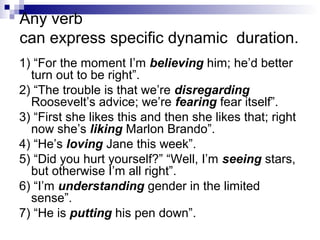
Any verb
can express specific dynamic duration.
1) “For the moment I’m believing him; he’d better
turn out to be right”.
2) “The trouble is that we’re disregarding
Roosevelt’s advice; we’re fearing fear itself”.
3) “First she likes this and then she likes that; right
now she’s liking Marlon Brando”.
4) “He’s loving Jane this week”.
5) “Did you hurt yourself?” “Well, I’m seeing stars,
but otherwise I’m all right”.
6) “I’m understanding gender in the limited
sense”.
7) “He is putting his pen down”.

The verb

  • 1.
    THE VERB CATEGORIES 1.The Category of Person 2. The Category of Number 3. The Category of Tense 4. Present Tense 5. Past Tense 6. The Problem of Future Tense 7. The Category of Aspect
  • 2.
    All verbal forms Finite Non-finite (verbials) Voice,Aspect and Order Tense, Person, Number, Mood
  • 3.
    The Category ofPerson  The category of person serves to associate the process with three deictic categories in a communicative act:  the speaker (I, we) ,  the addressee (you)  and the one (ones) not participating in a communicative act (he, she, it, they).
  • 4.
    The deictic centreof the communicative act  is the speaker, i.e. first person.  In the process of communication, the deictic center keeps changing: I you; you I  The three deictic categories, or persons, are lexicalized in personal pronouns.
  • 5.
    The category ofperson  is often grammaticalized, i.e. a special form of the verb additionally shows which person, or deictic category, is meant.  [Я] иду - [мы] идем I go – we go  [Ты] идешь - [вы] идете You go – you go  [Он/Она] идет - [они] идут [He, she, it] goes – They go
  • 6.
    The modal verbs I can speak English  You can speak English  He, she can speak English  I shall speak English  You will speak English  He, she will speak English
  • 7.
    The verb “tobe”  I am/was We are/were  You are /were You are/were  He, she, it is/was They are/were
  • 8.
    The category ofperson  is represented in English by two member oppositions:  third person singular vs. non-third person singular  first person,  second person forms  singular and plural  The marked member vs. the unmarked member  The strong member vs. the weak member writes - write
  • 9.
    The Category ofNumber  shows whether the process is associated with one doer or with more than one doer,  He eats three times a day.
  • 10.
    The Category ofNumber  is a two-member opposition:  singular and plural.  Number and person make use of the same morpheme.
  • 11.
    Number is restrictedto the Present tense.  John goes to college. vs. John went to college.  The students live in dormitories. vs. The students lived in dormitories.  I am/ at home.  John is/ at college now.  I was at home.  John was at college.  You were at home.  They were at home.
  • 12.
     The boyscrowded round him. vs. *The boy crowded round him.  The soldiers regrouped and opened fire. vs *The soldier regrouped and opened fire.
  • 13.
    The analysis demonstrates the weakness of the English verb as concerns the expression of person and number  and its heavy reliance on the subject:  it is the subject that is generally responsible for the expression of person and number in English.
  • 14.
    Time and Tense Time is an unlimited duration in which things are considered as happening in the past, present or future.  stands for a concept with which all mankind is familiar.  is independent of language. Tense (Lat. “tempus”)  stands for a verb form used to express a time relation.  varies in different languages.  is unique, specific for different languages
  • 15.
    Time  is expressedin language in two basic ways:  1) lexically;  2) grammatically.  John is in his study now.  3) there are languages (e.g. Chinese, Malay) that do not have tense.
  • 16.
     1) He+ read + now.  2) He + read + yesterday.  3) He + read + tomorrow.  1) He read yesterday.  2) He was reading yesterday.  1) He will read tomorrow.  2) He will be reading tomorrow.  1) He read.  2) He was reading.  1) He will read.  2) He will be reading. English needs both ways of expressing time – lexical and grammatical.
  • 17.
    Tense and Time This guy comes up to me and says that he wants to see the boss, so I didn’t think anything of it, and take him back to the office.  A rolling stone gathers no moss.  John walks to school every morning.  I leave for London tomorrow.
  • 18.
    Tense and Time Tense is a verbal category which reflects the objective category of time and expresses on this background the relation between time of the action and time of the utterance.
  • 19.
    Tense and Time Time PASTPRESENT FUTURE BEFORE PAST AFTER PRESENT BEFORE FUTURE AFTER PAST PAST FUTURE FUTURE AA AB AC B CA CB CC ANTE- PRETERIT POST TEMPORAL ANTE- FUTURE POST PRETERIT PRETERIT CENTRE FUTURE FUTURE
  • 20.
    Tense is adeictic category  since it relates processes to the present moment: processes that occur at the same time as the present moment are expressed by the present tense; processes that occur before the present moment are expressed by the past tense and processes that occur after the present moment are expressed by the future tense.  These tenses are called absolute.  Tenses that are established with reference to some other point in time are relative.
  • 21.
    Mary is walkingin the garden vs. Peter said that Mary was walking in the garden TENSES ABSOLUTE show the relation of the action to the moment of speech directly RELATIVE express the time of the action not directly but through its relation to some other moment in the Present, Past or Future
  • 22.
    Tense  is asystem of two-member oppositions showing the relation of the time of the process denoted by the verb to the present moment, or the moment of speaking.
  • 23.
    Tense  The categoryof tense is a verbal category that reflects the objective category of time.  Present Past  Future I Future II  work worked  The unmarked member vs. the marked member  The weak member vs. the strong member
  • 24.
    Work Worked The presenttense  is the unmarked member of the opposition:  it is the least specific in meaning and therefore can be used to express a wide range of temporal meanings.  The present tense is also unmarked morphologically (except for the –s inflection);  its forms are identical with the forms of the ‘bare’ infinitive. The past tense  is marked both semantically and morphologically:  it refers to a process that is visualized as remote, either in time or as unreality,  in the vast majority of verbs it has a distinct past form.
  • 25.
    The Present Tense The present tense locates the process at the same time as the present moment.  John lives in at Oxford now .
  • 26.
    Three types ofrelationship between the process and the present moment:  1) the duration of the process is the same as the duration of the report of the process;  2) the duration of the process is longer than the duration of the report of the process  3) the duration of the process is shorter than the duration of the report of the process
  • 27.
     I namethis ship the ‘Titanic’  The Eiffel Tower stands in Paris.  He shoots an arrow and runs away.
  • 28.
    The Past Tense locates the process prior to the present moment.  The past form of the verb does not say anything about whether the past process occupied a single point or an extended time period.  At seven o’clock yesterday John promised to give me ten pounds (a single point).  John lived in Manchester from 1962 to 1982 (an extended time period).
  • 29.
    The Problem ofthe Future Tense  Mary will get married tomorrow. Objections  concerns the meaning of the future tense in general: the future describes a non-factive situation while the past and the present tense describe a factive situation.  The second objection concerns the meaning peculiarities of will  The third objection concerns the expression of a future meaning by the present tense
  • 30.
    The Problem ofthe Future Tense  The difference between the past tense and the present tense on the one hand, and the future tense on the other, can be treated as a difference of mood (a speculative one) rather than that of tense:  will or shall +infinitive does not describe a real situation, a feature not peculiar to tense.  We cannot refer to future events as facts, as we can to past and present events.  Events in the future have not yet happened; we can predict them with more or less success.
  • 31.
    The Aspect The Definition TheProblem of Aspect The Usage and Peculiarities of Aspect
  • 32.
    Aspect  is agrammatical category of the Verb which expesses a difference in the way the action is shown to proceed.  write - is writing  wrote - was writing  will write - will be writing  - be V ing discontinuous morpheme  The unmarked member vs. the marked member  The weak member vs. the strong member
  • 33.
    Aspect  The basicmeaning of the continuous form is  used to present a durative situation as dynamic, or developing at a definite period of time within certain time limits.  1. John is working in the library.  2. This process has been going on ever since the beginning of time.
  • 34.
    Aspect  Being confinedto a particular moment, dynamic durative situations are of relatively limited duration,  the limit is established by appropriate temporal circumstances (now, today, this week, this month, this year, this century, this millennium, etc.).
  • 35.
    Aspect  Progressive formsare relatively new forms in English.  According to B. Ylyish (1973: 288-9), in Anglo- Saxon (700 A.D. – 1100 A.D.) such forms did not exist.  The first instances of the progressive aspect appear in Middle English (1100 – 1500);  they were still rare in Early Modern English (in the 17th and 18th centuries).  In the 17th century they were considered a feature of spoken English and were not used in poetry.  William Wordsworth (1770 – 1850) was the first to use progressive forms in his poem Written in March (1802).
  • 36.
    The problem ofAspect  Some scholars (O.Jesperson, N.V. Yartseva) either treat aspect forms as tense forms or assert that the English verb is neutral to aspects.  Others speak of 9 aspects: iterative, frequentative, inchoative, intensive, co- intensive, perfect, resultative, imperfective, positive.  I always get it at the same shop.
  • 37.
    The problem ofAspect  Curme G.O. finds the so-called ingressive aspect.  He begins to work at 7 o’clock.  Gruzinskaya expresses the point of view that there are 3 aspects in English: common, continuous, resultive.  Professors Жигадло В. Я., Иванова И.Я., Иофик Л. Л. stick to the opinion that there are pure tense forms in English which do not express aspect at all, but some tense-aspect forms.
  • 38.
    The Usage andPeculiarities of Aspect  The continuous forms have a smaller range of distribution.  With regard to the category of aspect, verbs are divided into two categories: those that have not aspect opposites and those that have.  To the first category belong stative verbs (mental, relational, and existential);  to the second category belong process, achievement, and accomplishment verbs.
  • 39.
    Any verb can expressspecific dynamic duration. 1) “For the moment I’m believing him; he’d better turn out to be right”. 2) “The trouble is that we’re disregarding Roosevelt’s advice; we’re fearing fear itself”. 3) “First she likes this and then she likes that; right now she’s liking Marlon Brando”. 4) “He’s loving Jane this week”. 5) “Did you hurt yourself?” “Well, I’m seeing stars, but otherwise I’m all right”. 6) “I’m understanding gender in the limited sense”. 7) “He is putting his pen down”.