Active / Passive Verb Forms
Sentences can be active or passive. Therefore, tenses also have "active forms"
and "passive forms." You must learn to recognize the difference to successfully
speak English.
Active Form
In active sentences, the thing doing the action is the subject of the sentence and
the thing receiving the action is the object. Most sentences are active.
[Thing doing action] + [verb] + [thing receiving action]
Examples:
Passive Form
In passive sentences, the thing receiving the action is the subject of the sentence
and the thing doing the action is optionally included near the end of the sentence.
You can use the passive form if you think that the thing receiving the action is more
important or should be emphasized. You can also use the passive form if you do
not know who is doing the action or if you do not want to mention who is doing the
action.
[Thing receiving action] + [be] + [past participle of verb] + [by] + [thing doing
action]
Examples:
Active / Passive Overview
Active Passive
Simple
Present
Once a week, Tom cleans the
house.
Once a week, the house is
cleaned by Tom.
Present
Continuous
Right now, Sarah is
writing the letter.
Right now, the letter is being
written by Sarah.
Simple Past Sam repaired the car. The car was repaired by Sam.
Past
Continuous
The salesman was
helping the customer when
the thief came into the store.
The customer was being
helped by the salesman when
the thief came into the store.
Present
Perfect
Many tourists have
visited that castle.
That castle has been visited by
many tourists.
Present
Perfect
Continuous
Recently, John has been
doing the work.
Recently, the work has been
being done by John.
Past Perfect George had repaired many
cars before he received his
mechanic's license.
Many cars had been
repaired by George before he
received his mechanic's license.
Past Perfect
Continuous
Chef Jones had been
preparing the restaurant's
fantastic dinners for two years
before he moved to Paris.
The restaurant's fantastic
dinners had been being
prepared by Chef Jones for two
years before he moved to Paris.
Simple
Future
WILL
Someone will finish the work
by 5:00 PM.
The work will be finished by
5:00 PM.
Simple
Future
BE GOING TO
Sally is going to make a
beautiful dinner tonight.
A beautiful dinner is going to
be made by Sally tonight.
Future
Continuous
WILL
At 8:00 PM tonight, John will
be washing the dishes.
At 8:00 PM tonight, the
dishes will be being washed by
John.
Future
Continuous
BE GOING TO
At 8:00 PM tonight, John is
going to be washing the
dishes.
At 8:00 PM tonight, the
dishes are going to be being
washed by John.
Future
Perfect
WILL
They will have completed the
project before the deadline.
The project will have been
completed before the deadline.
Future
Perfect
BE GOING TO
They are going to have
completed the project before
the deadline.
The project is going to have
been completed before the
deadline.
Future
Perfect
Continuous
WILL
The famous artist will have
been painting the mural for
over six months by the time it
is finished.
The mural will have been
being painted by the famous
artist for over six months by the
time it is finished.
Future
Perfect
Continuous
BE GOING TO
The famous artist is going to
have been painting the mural
for over six months by the time
it is finished.
The mural is going to have
been being painted by the
famous artist for over six months
by the time it is finished.
Used to Jerry used to pay the bills. The bills used to be paid by
Jerry.
Would
Always
My mother would always
make the pies.
The pies would always be
made by my mother.
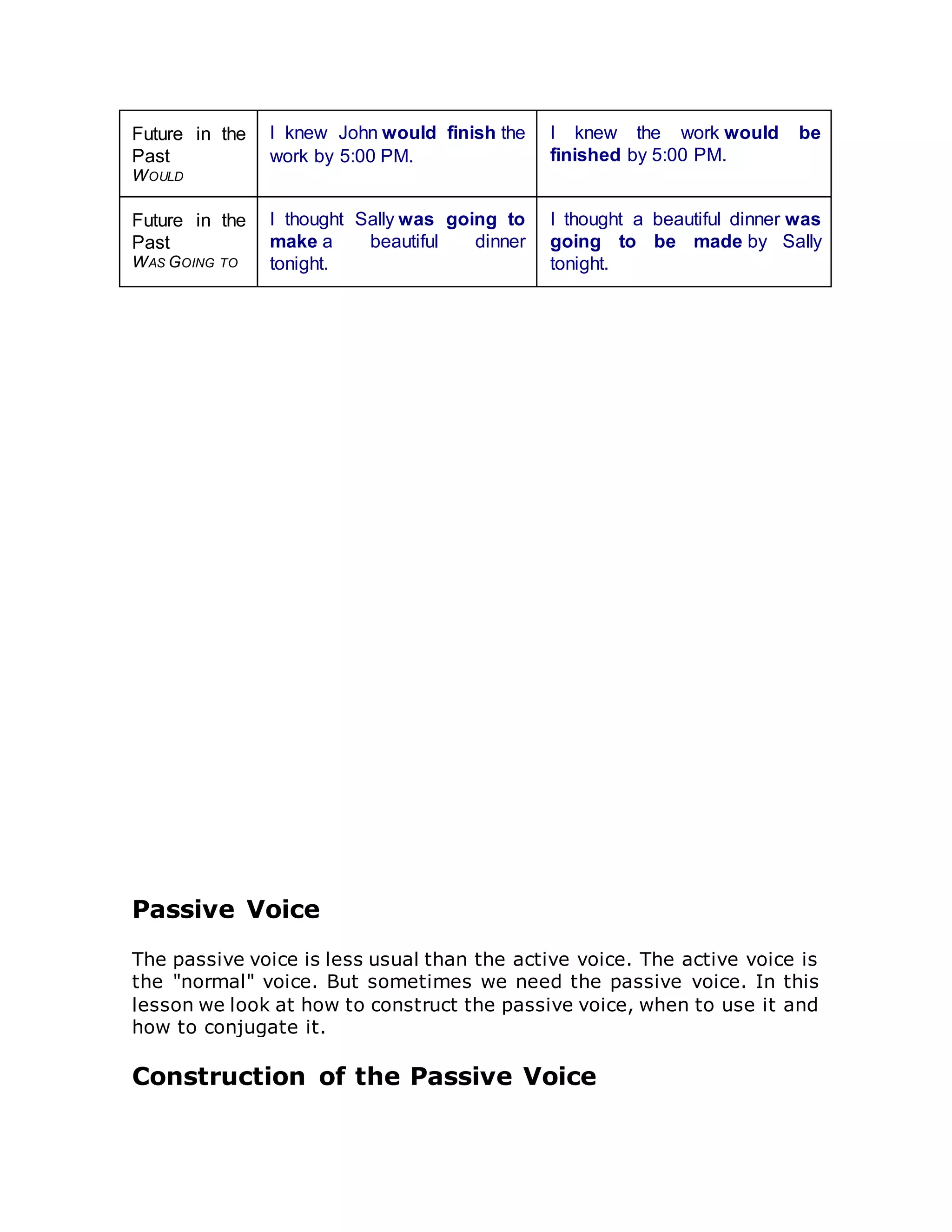
Future in the
Past
WOULD
I knew John would finish the
work by 5:00 PM.
I knew the work would be
finished by 5:00 PM.
Future in the
Past
WAS GOING TO
I thought Sally was going to
make a beautiful dinner
tonight.
I thought a beautiful dinner was
going to be made by Sally
tonight.
Passive Voice
The passive voice is less usual than the active voice. The active voice is
the "normal" voice. But sometimes we need the passive voice. In this
lesson we look at how to construct the passive voice, when to use it and
how to conjugate it.
Construction of the Passive Voice
The structure of the passive voice is very simple:
subject + auxiliary verb (be) + main verb (past participle)
The main verb is always in its past participle form.
Look at these examples:
subject auxiliary verb
(to be)
main verb
(past participle)
Water is drunk by everyone.
100 people are employed by this company.
I am paid in euro.
We are not paid in dollars.
Are they paid in yen?
Use of the Passive Voice
We use the passive when:
 we want to make the active object more important
 we do not know the active subject
subject verb object
give importance to active
object (President Kennedy)
President
Kennedy
was killed by Lee
Harvey
Oswald.
active subject unknown My wallet has been
stolen.
?
Note that we always use by to introduce the passive object (Fish are
eaten by cats).
Look at this sentence:
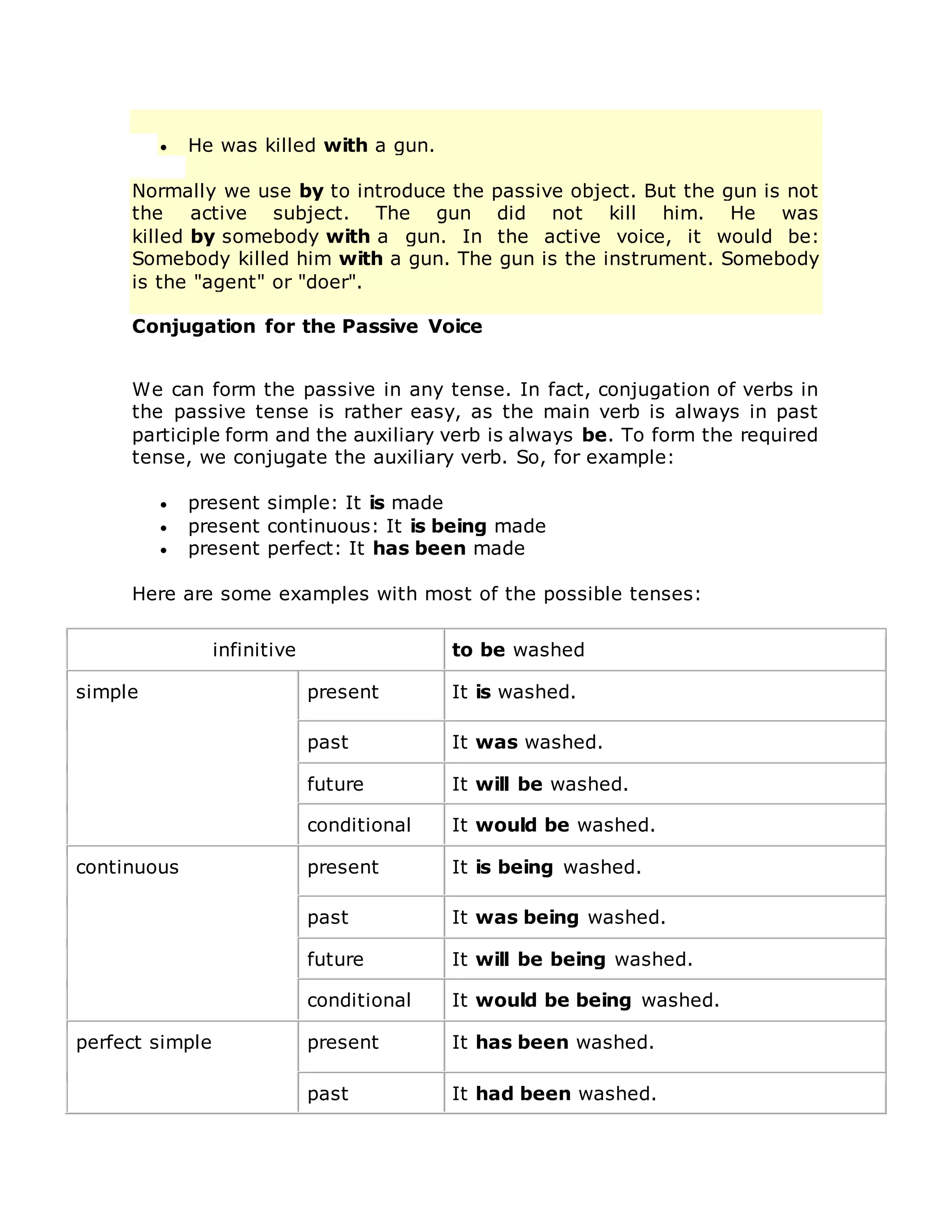
 He was killed with a gun.
Normally we use by to introduce the passive object. But the gun is not
the active subject. The gun did not kill him. He was
killed by somebody with a gun. In the active voice, it would be:
Somebody killed him with a gun. The gun is the instrument. Somebody
is the "agent" or "doer".
Conjugation for the Passive Voice
We can form the passive in any tense. In fact, conjugation of verbs in
the passive tense is rather easy, as the main verb is always in past
participle form and the auxiliary verb is always be. To form the required
tense, we conjugate the auxiliary verb. So, for example:
 present simple: It is made
 present continuous: It is being made
 present perfect: It has been made
Here are some examples with most of the possible tenses:
infinitive to be washed
simple present It is washed.
past It was washed.
future It will be washed.
conditional It would be washed.
continuous present It is being washed.
past It was being washed.
future It will be being washed.
conditional It would be being washed.
perfect simple present It has been washed.
past It had been washed.
future It will have been washed.
conditional It would have been washed.
perfect continuous present It has been being washed.
past It had been being washed.
future It will have been being washed.
conditional It would have been being washed.
Active and passive voice exercise
1. The problem …………………. to the children. (explained / was explained)
2. Those pyramids ……………………. around 400 AD. (built / were built)
3. All the trouble ……………………….. by your mother. (has caused / was caused)
4. The visitors ……………………. (were shown / have shown) a collection of old
manuscripts.
5. I …………………. him ten thousand pounds last year. (lend / lent / was lent)
6. She …………………… of spiders. (frightened / is frightened)
7. That picture …………………. by my grandmother. (painted / was painted)
8. I ………………….. by his attitude. (shocked / have shocked / was shocked)
9. Excuse the mess. The house ………………… (is painting / is being painted / has
painted)
10. I knew why I …………………. (had chosen / had been chosen)
Answers
1. The problem was explained tothe children.
2. Those pyramids were built around 400 AD.
3. All the trouble was caused by your mother.
4. The visitors were shown a collection of old manuscripts.
5. I lent him ten thousand pounds last year.
6. She is frightened of spiders.
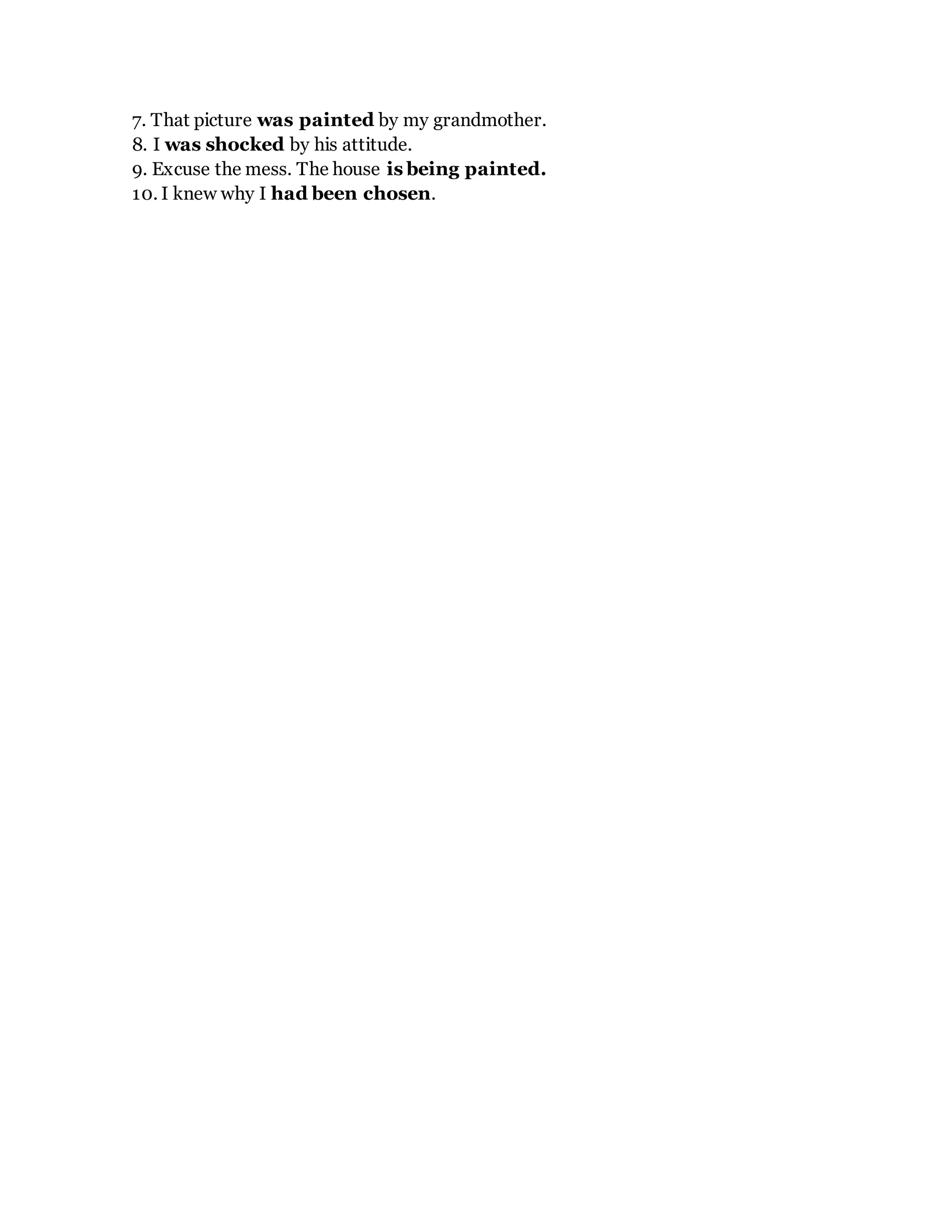
7. That picture was painted by my grandmother.
8. I was shocked by his attitude.
9. Excuse the mess. The house is being painted.
10. I knew why I had been chosen.

Active and passive voice

  • 1.
    Active / PassiveVerb Forms Sentences can be active or passive. Therefore, tenses also have "active forms" and "passive forms." You must learn to recognize the difference to successfully speak English. Active Form In active sentences, the thing doing the action is the subject of the sentence and the thing receiving the action is the object. Most sentences are active. [Thing doing action] + [verb] + [thing receiving action] Examples: Passive Form In passive sentences, the thing receiving the action is the subject of the sentence and the thing doing the action is optionally included near the end of the sentence. You can use the passive form if you think that the thing receiving the action is more important or should be emphasized. You can also use the passive form if you do not know who is doing the action or if you do not want to mention who is doing the action. [Thing receiving action] + [be] + [past participle of verb] + [by] + [thing doing action] Examples:
  • 2.
    Active / PassiveOverview Active Passive Simple Present Once a week, Tom cleans the house. Once a week, the house is cleaned by Tom. Present Continuous Right now, Sarah is writing the letter. Right now, the letter is being written by Sarah. Simple Past Sam repaired the car. The car was repaired by Sam. Past Continuous The salesman was helping the customer when the thief came into the store. The customer was being helped by the salesman when the thief came into the store. Present Perfect Many tourists have visited that castle. That castle has been visited by many tourists. Present Perfect Continuous Recently, John has been doing the work. Recently, the work has been being done by John. Past Perfect George had repaired many cars before he received his mechanic's license. Many cars had been repaired by George before he received his mechanic's license.
  • 3.
    Past Perfect Continuous Chef Joneshad been preparing the restaurant's fantastic dinners for two years before he moved to Paris. The restaurant's fantastic dinners had been being prepared by Chef Jones for two years before he moved to Paris. Simple Future WILL Someone will finish the work by 5:00 PM. The work will be finished by 5:00 PM. Simple Future BE GOING TO Sally is going to make a beautiful dinner tonight. A beautiful dinner is going to be made by Sally tonight. Future Continuous WILL At 8:00 PM tonight, John will be washing the dishes. At 8:00 PM tonight, the dishes will be being washed by John. Future Continuous BE GOING TO At 8:00 PM tonight, John is going to be washing the dishes. At 8:00 PM tonight, the dishes are going to be being washed by John. Future Perfect WILL They will have completed the project before the deadline. The project will have been completed before the deadline. Future Perfect BE GOING TO They are going to have completed the project before the deadline. The project is going to have been completed before the deadline. Future Perfect Continuous WILL The famous artist will have been painting the mural for over six months by the time it is finished. The mural will have been being painted by the famous artist for over six months by the time it is finished. Future Perfect Continuous BE GOING TO The famous artist is going to have been painting the mural for over six months by the time it is finished. The mural is going to have been being painted by the famous artist for over six months by the time it is finished. Used to Jerry used to pay the bills. The bills used to be paid by Jerry. Would Always My mother would always make the pies. The pies would always be made by my mother.
  • 4.
    Future in the Past WOULD Iknew John would finish the work by 5:00 PM. I knew the work would be finished by 5:00 PM. Future in the Past WAS GOING TO I thought Sally was going to make a beautiful dinner tonight. I thought a beautiful dinner was going to be made by Sally tonight. Passive Voice The passive voice is less usual than the active voice. The active voice is the "normal" voice. But sometimes we need the passive voice. In this lesson we look at how to construct the passive voice, when to use it and how to conjugate it. Construction of the Passive Voice
  • 5.
    The structure ofthe passive voice is very simple: subject + auxiliary verb (be) + main verb (past participle) The main verb is always in its past participle form. Look at these examples: subject auxiliary verb (to be) main verb (past participle) Water is drunk by everyone. 100 people are employed by this company. I am paid in euro. We are not paid in dollars. Are they paid in yen? Use of the Passive Voice We use the passive when:  we want to make the active object more important  we do not know the active subject subject verb object give importance to active object (President Kennedy) President Kennedy was killed by Lee Harvey Oswald. active subject unknown My wallet has been stolen. ? Note that we always use by to introduce the passive object (Fish are eaten by cats). Look at this sentence:
  • 6.
     He waskilled with a gun. Normally we use by to introduce the passive object. But the gun is not the active subject. The gun did not kill him. He was killed by somebody with a gun. In the active voice, it would be: Somebody killed him with a gun. The gun is the instrument. Somebody is the "agent" or "doer". Conjugation for the Passive Voice We can form the passive in any tense. In fact, conjugation of verbs in the passive tense is rather easy, as the main verb is always in past participle form and the auxiliary verb is always be. To form the required tense, we conjugate the auxiliary verb. So, for example:  present simple: It is made  present continuous: It is being made  present perfect: It has been made Here are some examples with most of the possible tenses: infinitive to be washed simple present It is washed. past It was washed. future It will be washed. conditional It would be washed. continuous present It is being washed. past It was being washed. future It will be being washed. conditional It would be being washed. perfect simple present It has been washed. past It had been washed.
  • 7.
    future It willhave been washed. conditional It would have been washed. perfect continuous present It has been being washed. past It had been being washed. future It will have been being washed. conditional It would have been being washed.
  • 8.
    Active and passivevoice exercise 1. The problem …………………. to the children. (explained / was explained) 2. Those pyramids ……………………. around 400 AD. (built / were built) 3. All the trouble ……………………….. by your mother. (has caused / was caused) 4. The visitors ……………………. (were shown / have shown) a collection of old manuscripts. 5. I …………………. him ten thousand pounds last year. (lend / lent / was lent) 6. She …………………… of spiders. (frightened / is frightened) 7. That picture …………………. by my grandmother. (painted / was painted) 8. I ………………….. by his attitude. (shocked / have shocked / was shocked) 9. Excuse the mess. The house ………………… (is painting / is being painted / has painted) 10. I knew why I …………………. (had chosen / had been chosen) Answers 1. The problem was explained tothe children. 2. Those pyramids were built around 400 AD. 3. All the trouble was caused by your mother. 4. The visitors were shown a collection of old manuscripts. 5. I lent him ten thousand pounds last year. 6. She is frightened of spiders.
  • 9.
    7. That picturewas painted by my grandmother. 8. I was shocked by his attitude. 9. Excuse the mess. The house is being painted. 10. I knew why I had been chosen.