THE VERB CATEGORIES
Выполнила
Хижнякова Анна, 3
курс, гр.2ПА
THE VERB CATEGORIES :
 The Category of Person
 The Category of Number
 The Category of Tense
 The Category of Voice
 The Category of Mood
The Category of Person
 The category of person expresses the relation of the
action and its doer to the speaker, showing whether
the action is performed by :
 the speaker (the 1st
person)
 Someone addressed - the addressee (the 2nd
person)
 Someone/something other than the speaker or the
person addressed (the 3rd
person)
The Category of Person
 The category of person is often grammaticalized, i.e.
a special form of the verb additionally shows which
person is meant.
 E.g. I go – we go
[He, she, it] goes – They go
The Category of Number
 The Category of number shows whether the action is
performed by one or more than one persons or non-
persons
 The Category of Number is a two-member
opposition: singular and plural.
 Number is mostly restricted to the Present tense.
E.g. John goes to college. vs. John went to college.
In the Past Simple tense it is only the verb to be that
has the category of number. I/he/she/it was –
you/we/they were
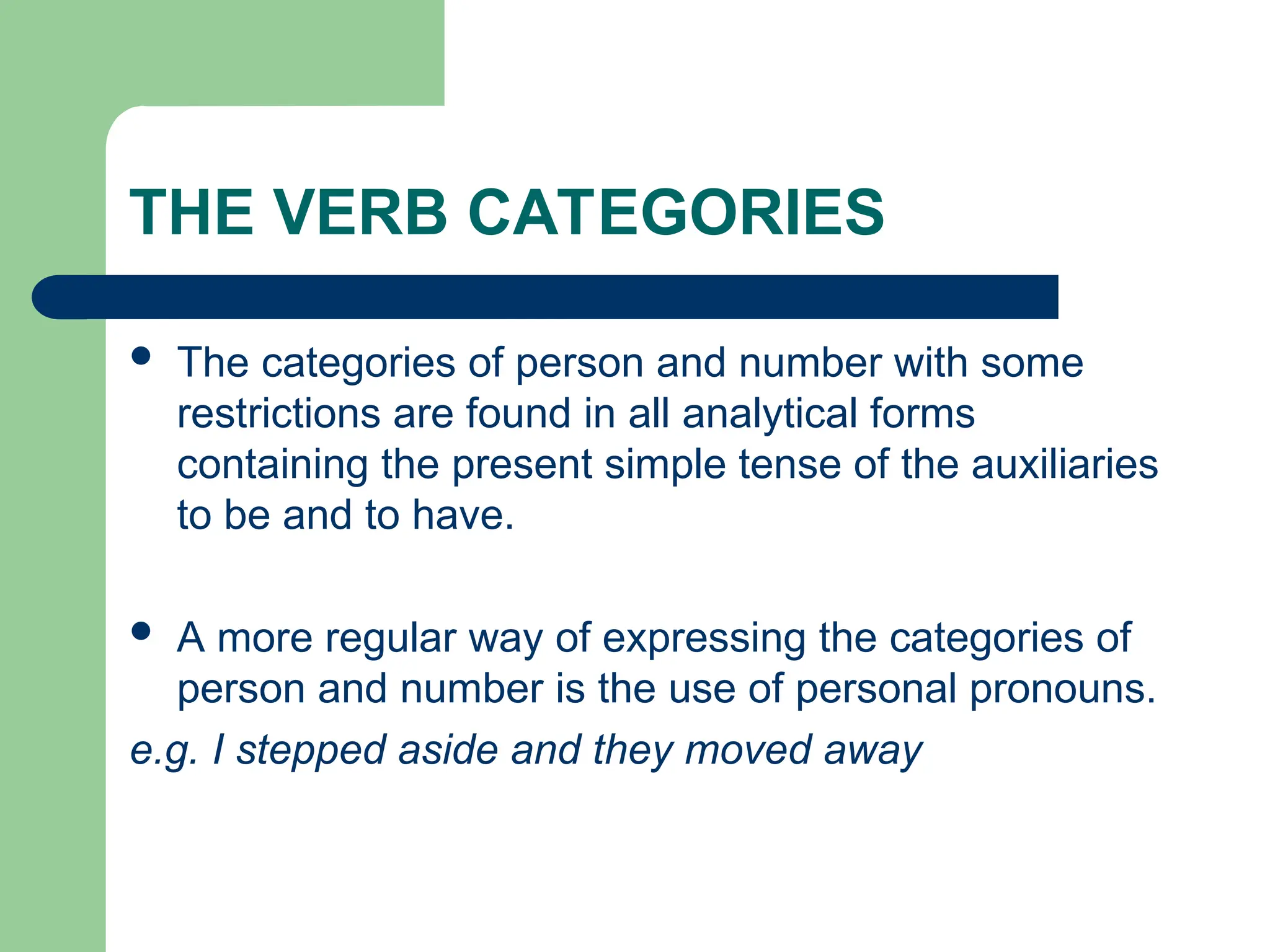
THE VERB CATEGORIES
 The categories of person and number with some
restrictions are found in all analytical forms
containing the present simple tense of the auxiliaries
to be and to have.
 A more regular way of expressing the categories of
person and number is the use of personal pronouns.
e.g. I stepped aside and they moved away
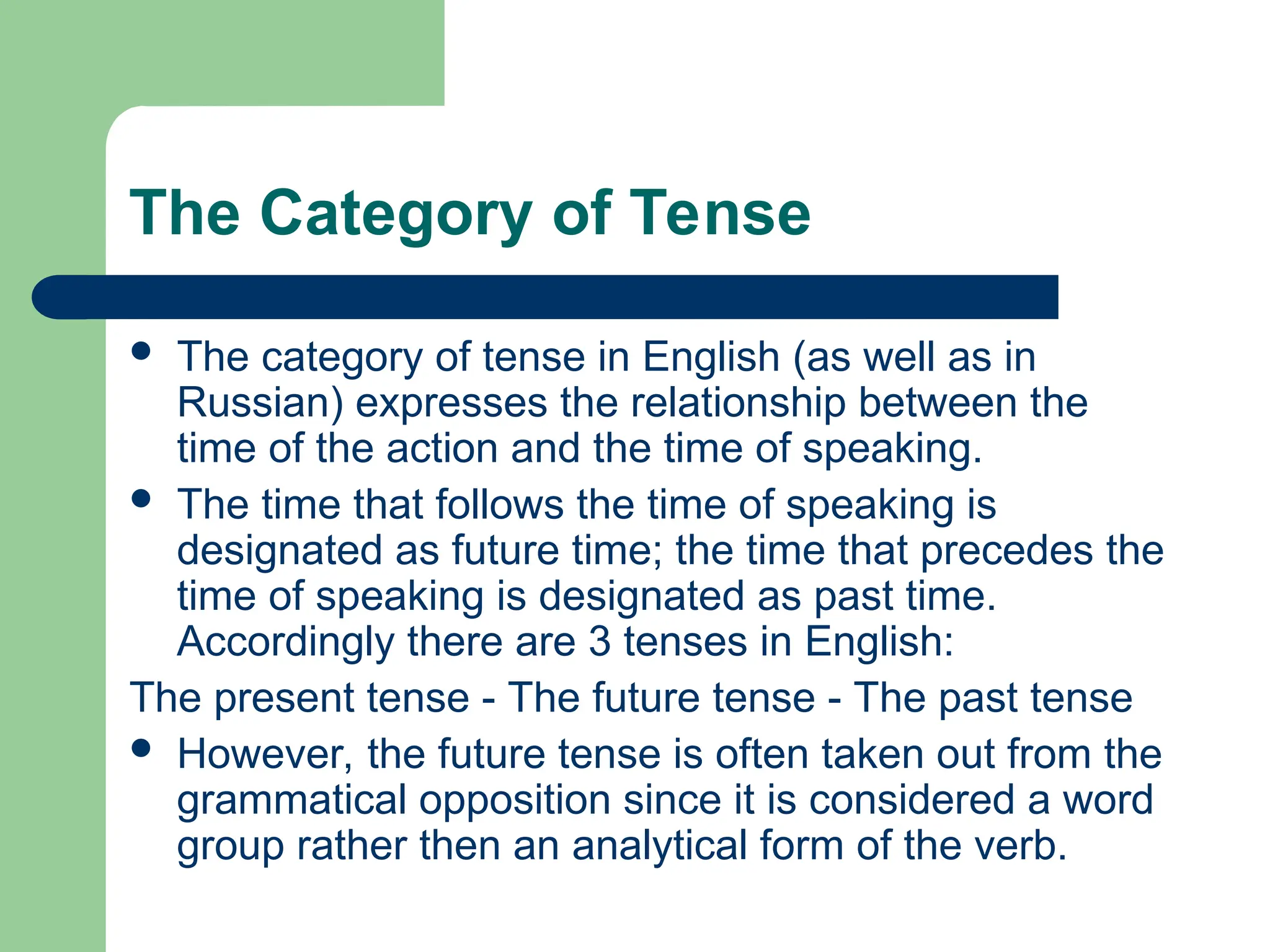
The Category of Tense
 The category of tense in English (as well as in
Russian) expresses the relationship between the
time of the action and the time of speaking.
 The time that follows the time of speaking is
designated as future time; the time that precedes the
time of speaking is designated as past time.
Accordingly there are 3 tenses in English:
The present tense - The future tense - The past tense
 However, the future tense is often taken out from the
grammatical opposition since it is considered a word
group rather then an analytical form of the verb.
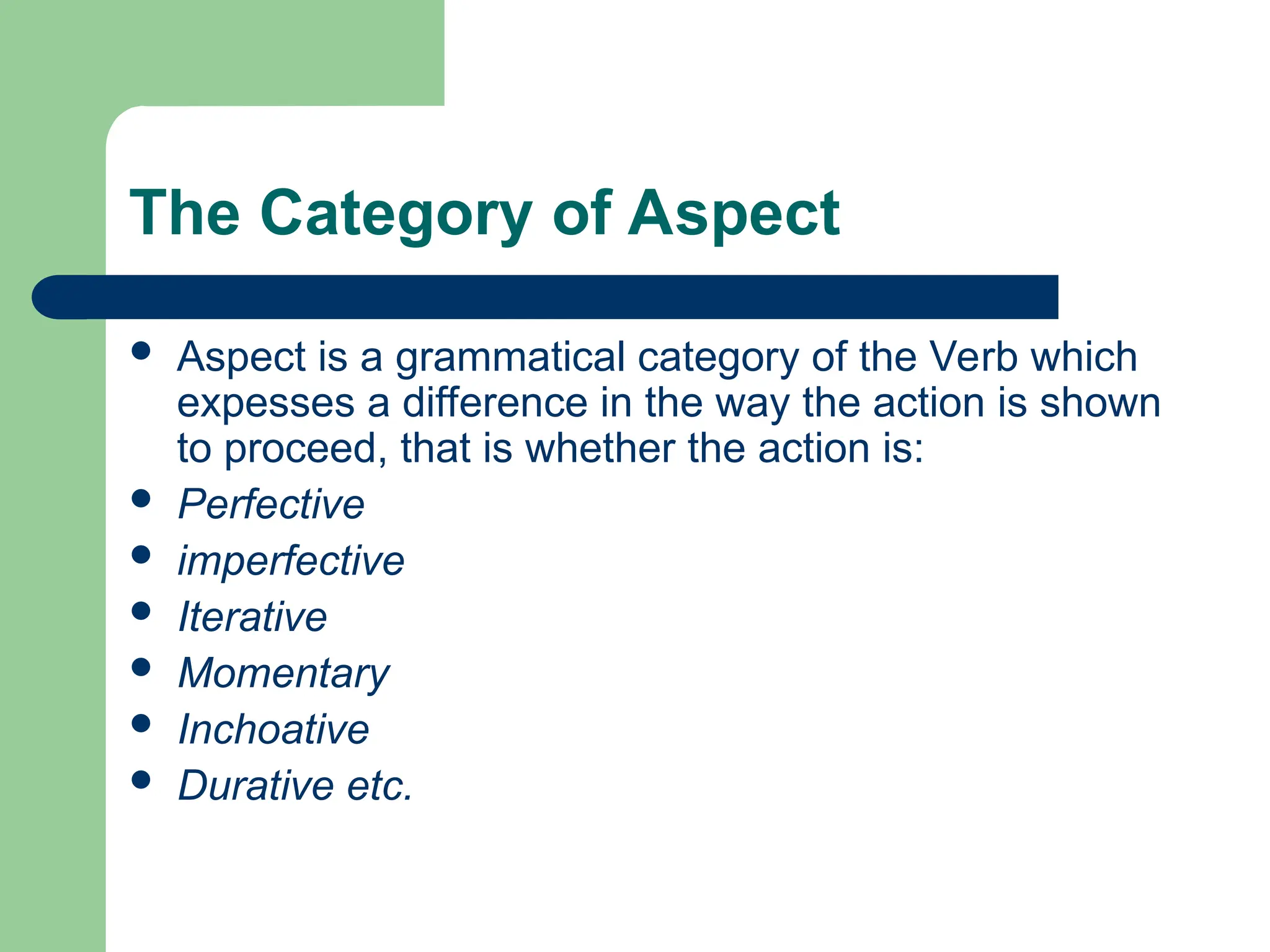
The Category of Aspect
 Aspect is a grammatical category of the Verb which
expesses a difference in the way the action is shown
to proceed, that is whether the action is:
 Perfective
 imperfective
 Iterative
 Momentary
 Inchoative
 Durative etc.
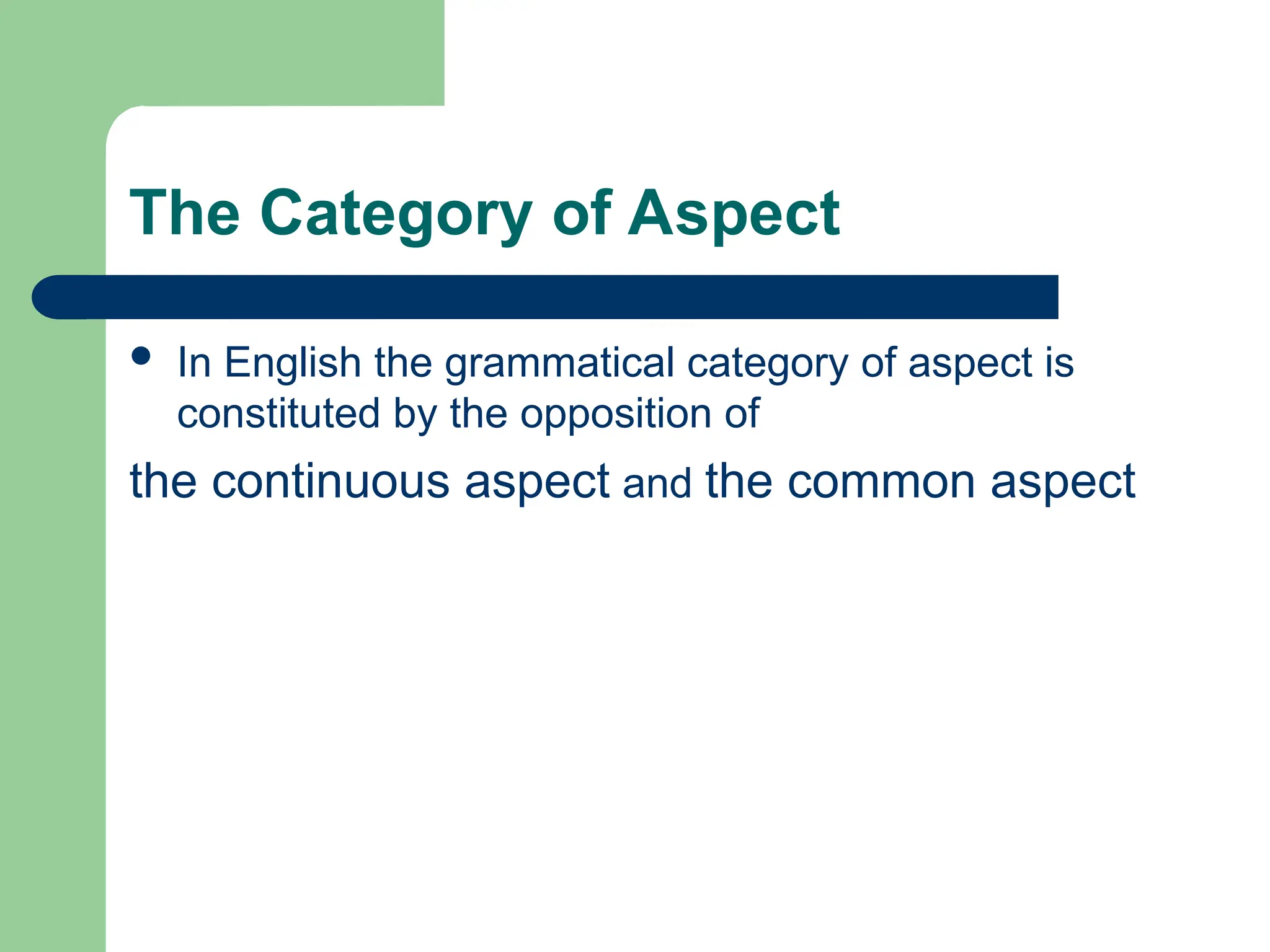
The Category of Aspect
 In English the grammatical category of aspect is
constituted by the opposition of
the continuous aspect and the common aspect
The Category of Aspect
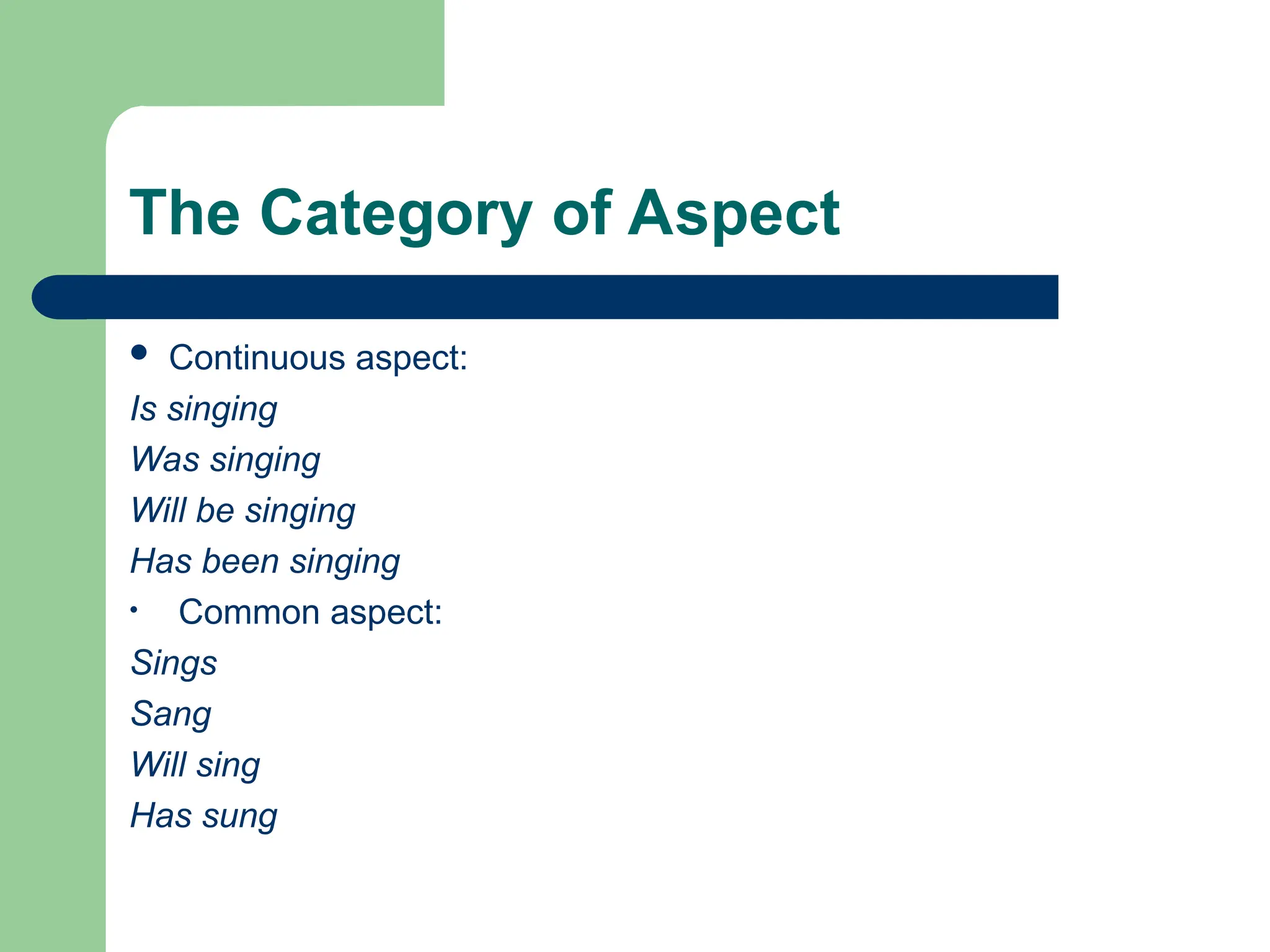
 Continuous aspect:
Is singing
Was singing
Will be singing
Has been singing
• Common aspect:
Sings
Sang
Will sing
Has sung
The Category of Voice
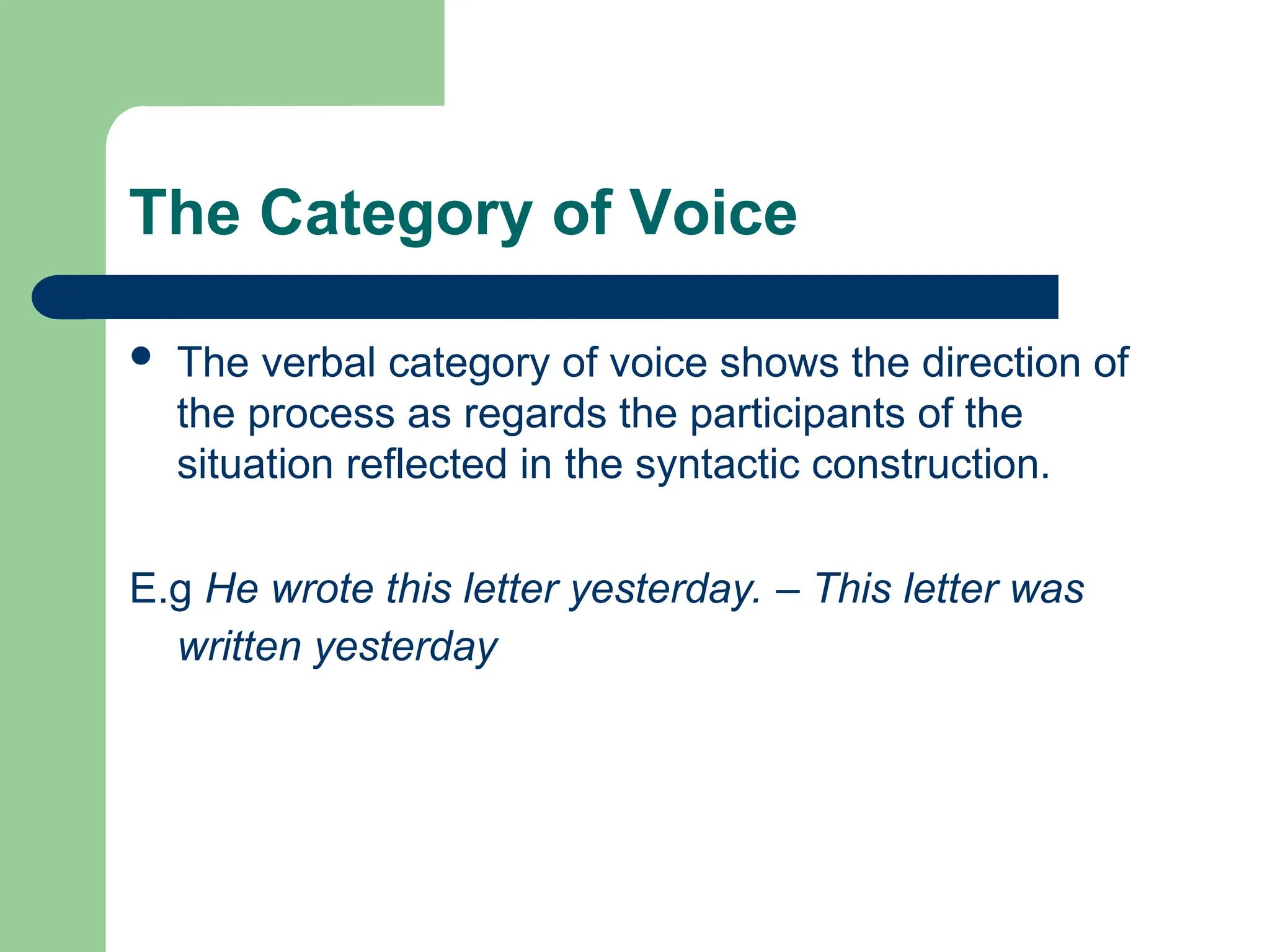
 The verbal category of voice shows the direction of
the process as regards the participants of the
situation reflected in the syntactic construction.
E.g He wrote this letter yesterday. – This letter was
written yesterday
The Category of Voice
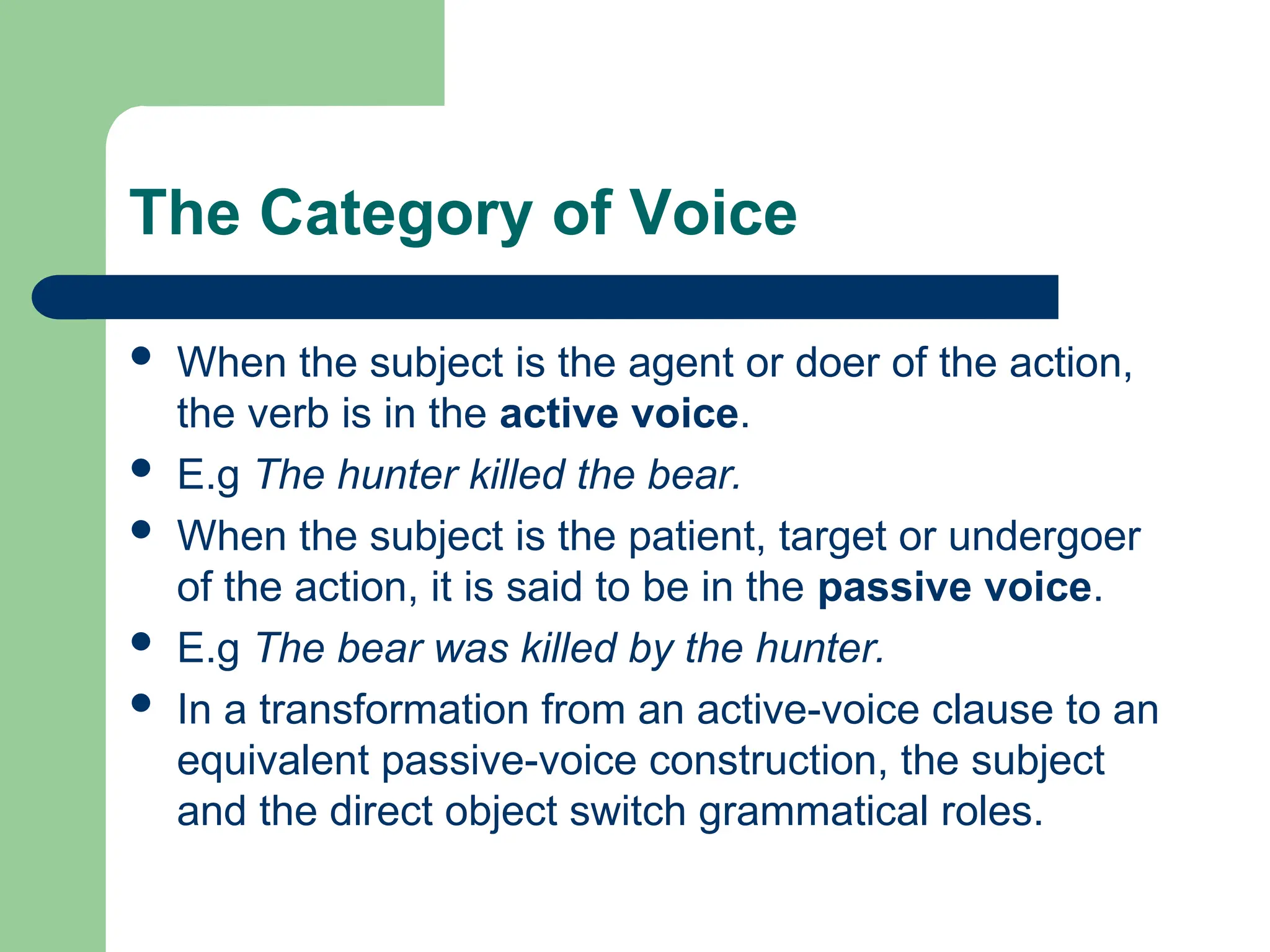
 When the subject is the agent or doer of the action,
the verb is in the active voice.
 E.g The hunter killed the bear.
 When the subject is the patient, target or undergoer
of the action, it is said to be in the passive voice.
 E.g The bear was killed by the hunter.
 In a transformation from an active-voice clause to an
equivalent passive-voice construction, the subject
and the direct object switch grammatical roles.
The Category of Mood
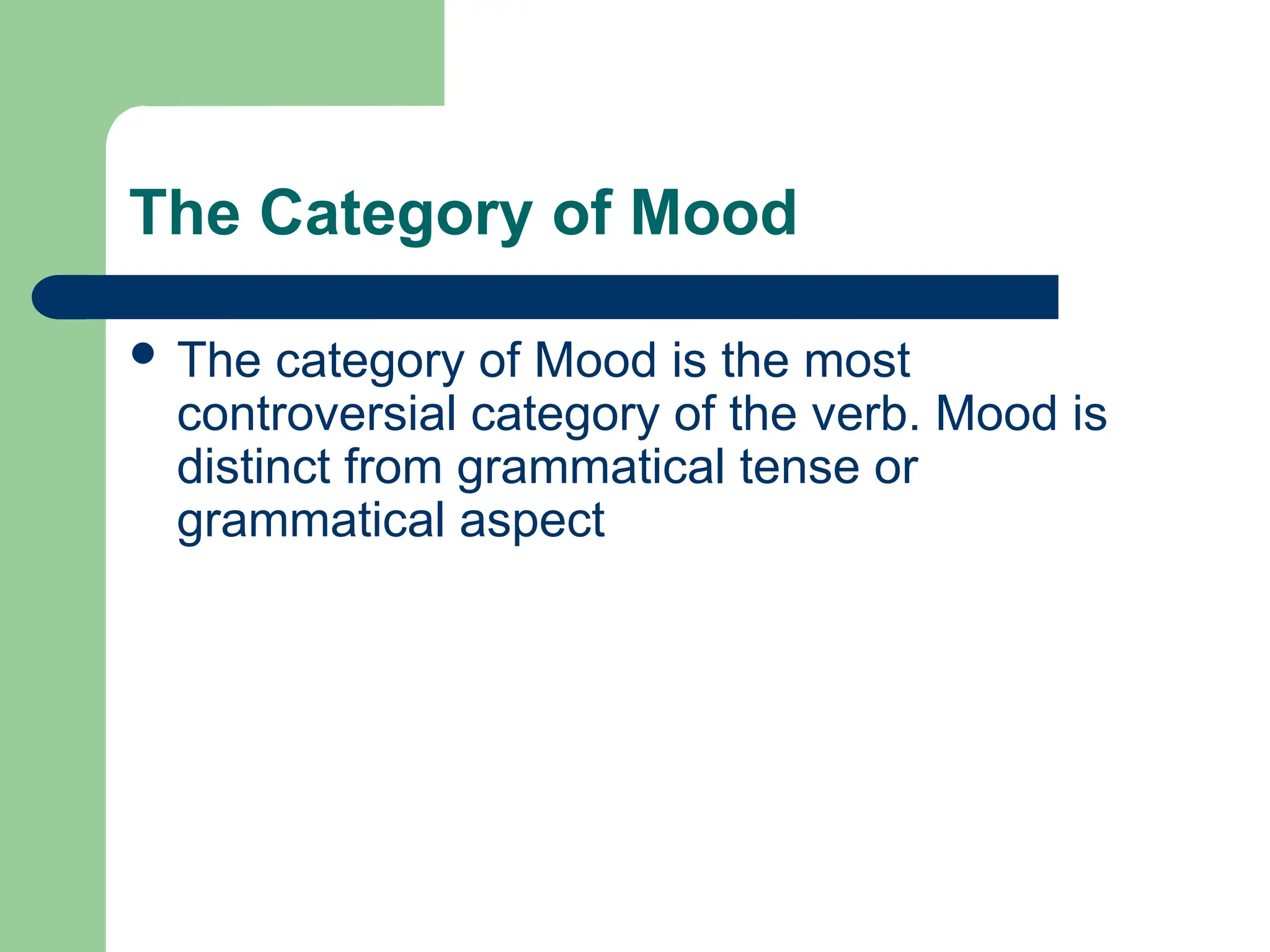
 The category of Mood is the most
controversial category of the verb. Mood is
distinct from grammatical tense or
grammatical aspect
 The category of Mood expresses the character of
connection between the process denoted by the verb
and the actual reality, either presenting the process
as a fact that really happened, happens or will
happen, or treating it as an imaginary phenomenon.
 the Indicative Mood
 the Imperative Mood
 the Subjunctive Mood

the grammatical categories of verbs .ppt

  • 1.
  • 2.
    THE VERB CATEGORIES:  The Category of Person  The Category of Number  The Category of Tense  The Category of Voice  The Category of Mood
  • 3.
    The Category ofPerson  The category of person expresses the relation of the action and its doer to the speaker, showing whether the action is performed by :  the speaker (the 1st person)  Someone addressed - the addressee (the 2nd person)  Someone/something other than the speaker or the person addressed (the 3rd person)
  • 4.
    The Category ofPerson  The category of person is often grammaticalized, i.e. a special form of the verb additionally shows which person is meant.  E.g. I go – we go [He, she, it] goes – They go
  • 5.
    The Category ofNumber  The Category of number shows whether the action is performed by one or more than one persons or non- persons  The Category of Number is a two-member opposition: singular and plural.  Number is mostly restricted to the Present tense. E.g. John goes to college. vs. John went to college. In the Past Simple tense it is only the verb to be that has the category of number. I/he/she/it was – you/we/they were
  • 6.
    THE VERB CATEGORIES The categories of person and number with some restrictions are found in all analytical forms containing the present simple tense of the auxiliaries to be and to have.  A more regular way of expressing the categories of person and number is the use of personal pronouns. e.g. I stepped aside and they moved away
  • 7.
    The Category ofTense  The category of tense in English (as well as in Russian) expresses the relationship between the time of the action and the time of speaking.  The time that follows the time of speaking is designated as future time; the time that precedes the time of speaking is designated as past time. Accordingly there are 3 tenses in English: The present tense - The future tense - The past tense  However, the future tense is often taken out from the grammatical opposition since it is considered a word group rather then an analytical form of the verb.
  • 8.
    The Category ofAspect  Aspect is a grammatical category of the Verb which expesses a difference in the way the action is shown to proceed, that is whether the action is:  Perfective  imperfective  Iterative  Momentary  Inchoative  Durative etc.
  • 9.
    The Category ofAspect  In English the grammatical category of aspect is constituted by the opposition of the continuous aspect and the common aspect
  • 10.
    The Category ofAspect  Continuous aspect: Is singing Was singing Will be singing Has been singing • Common aspect: Sings Sang Will sing Has sung
  • 11.
    The Category ofVoice  The verbal category of voice shows the direction of the process as regards the participants of the situation reflected in the syntactic construction. E.g He wrote this letter yesterday. – This letter was written yesterday
  • 12.
    The Category ofVoice  When the subject is the agent or doer of the action, the verb is in the active voice.  E.g The hunter killed the bear.  When the subject is the patient, target or undergoer of the action, it is said to be in the passive voice.  E.g The bear was killed by the hunter.  In a transformation from an active-voice clause to an equivalent passive-voice construction, the subject and the direct object switch grammatical roles.
  • 13.
    The Category ofMood  The category of Mood is the most controversial category of the verb. Mood is distinct from grammatical tense or grammatical aspect
  • 14.
     The categoryof Mood expresses the character of connection between the process denoted by the verb and the actual reality, either presenting the process as a fact that really happened, happens or will happen, or treating it as an imaginary phenomenon.  the Indicative Mood  the Imperative Mood  the Subjunctive Mood