Guidance Services and
Facilities
Guidance Services is a program
designed for each school. No two
schools have exactly the same
social settings. There are particular
needs and characteristics that
must be met to satisfy the learners.
Guidance serves as a support
function. It is one of the components
of the educational system that
consists of services concerned with
helping the individual develop into
the person he’s capable of becoming.
Essentials of Guidance Services
• A Program of Guidance Services is designed for
each school
• Guidance Services are designed to help students
• Guidance is one of the components of education
system
• Guidance Services were developed to help young
people come to know and accept themselves and
their aptitudes and interest
• Guidance Services may be defined as a group of
services to individual
Individual Inventory
Service
This is a service which provides a
synthesis of information about the
individual which can be used to gain an
understanding of himself as he is
potentially capable of becoming. The
Individual Inventory Service is a
development and longitudinal process.
It consists of all the information
gathered about each individual in
school. The information is usually
stored in a Cumulative Folder where
the data accumulated about each
student are kept while the student is in
school, and up to a few years after.
PRINCIPLES:
• The collection of data about the learners
should be started from the time they begin
schooling
• Records should grow with the learners as
they progress in their studies
• Records should be cumulative and inclusive
• Records should be unbiased, objective and
opinionated
• The data contained in the inventory should
be properly interpreted well synthesized
and carefully used for benefit of the child
• Only the proper tools, techniques and
instruments should be used in gathering of
the necessary information
• Records should be systematically kept and
conveniently
Cumulative Record
Contents
 Personal Data – the information gives the
counselor a view of the factors that may
contribute to the development of the client’s
personality and concerns.
 Age – indicates the developmental tasks and
crises that the individual may be encountering.
 Family Background and Home Environment –
can identify possible areas of concern.
 Hobbies, interests, goals and values – positive
moving forces which the counselor can use to
motivate, encourage, and galvanize the person into
action.
 Personal strengths and personality traits and
characteristic – can help pinpoint areas where the
person can excel and what he/she can pursue, modify,
develop or try to avoid.
 Problems and needs – point out the areas where more
intensive and personal work with the client is needed.
 Educational data – can give indications
regarding the client’s mental ability, aptitudes
and special strengths.
 Schools attended – kinds and locations of
schools may give a clue to strengths,
weaknesses and patterns.
 Grades – can give a glimpse not only of subjects
where the student might be interested,
motivated, or encouraged, but also of aptitudes
or intelligence type.
 Co-curricular extracurricular activities –
gives a glimpse of the personality of the
person: Is the person active? Does he/she
have initiative? Etc.
 Courses taken – refers to special courses
like Taekwondo or Kumon or singing.
Orientation/
Information
Service
An activity whereby descriptive materials and
media are accumulated, organized and
disseminated through planned group
activities. This service provides information
available to the learners which can be
classified into occupational, educational and
personal-social.
OBJECTIVES:
• To develop a broad and realistic view of life’s
opportunities and problems at all levels of
training.
• To create an awareness of the need and an
active desire for accurate and valid
occupational, educational and personal social
information.
• To provide wide understanding of the wide
scope of educational, occupational and social
activities in terms of broad categories of
related activities.
• To assist in the mastery of the techniques of
obtaining and interpreting information for
progressive self- defectiveness.
• To promote attitudes and habits that will assist
in the making of choices and adjustments
productive of personal satisfaction.
• To provide assistance in narrowing choices
progressively to specific activities which are
appropriate to aptitudes, abilities, and interests
and to the proximity of definite decisions
 Occupational Information – is the valid and
usable data about positions & occupations,
including duties, requirements for entrance,
conditions of work, rewards offered,
advancement pattern, existing and predicted
supply of and demand for workers, and
sources for further information.
 Educational Information – refers to the valid
and usable data about all types of present
and probable future educational or training
opportunities and requirements.
 Personal-Social Information – this
information is valid and usable data about
the opportunities and influences of the
human beings which will help the learner
understand himself better and improve his
relation with others.
Placement
According to Ryan and Zeran,
placement by definition is the
satisfactory adjustment of the
individual to the next situation
whether in school or on the job.
It provides clients with
options, enables them to act
on their choices, and helps
them adjust to the chosen
environment.
Types of Placement
Personal-Social Placement
These are social-personal concerns that may
not necessarily be responded to by the
institution that the client is affiliated with. For
example: shyness/ social phobia, poor self-
esteem, lack of friends, unusual or uncommon
interests or talents, physical disabilities etc.
Educational/Academic Placement
This occurs when a person is placed in the
appropriate educational setting. Such placement
is necessary for students who are going to school
for the first time, are transferring from one
locality to another, want or need to transfer to
another school, are gifted etc.
Occupational/Career Placement
This has become necessary because the
competition in the world of work in the
Philippines requires a full-time person to attend
to the facets of marketing the students and
ensuring that they have the appropriate skills for
job hunting, job entry and job maintenance.
Follow-Up
Like a physician who checks on
whether his patient has recovered
from an illness, the counselor should
also find out what happened to his
counselee. Without the follow-up
counseling is incomplete.
A service extended to anyone is followed-up to
determine goal attainment and customer
satisfaction. In the case of the Guidance
Program, the Follow-Up Services helps
determine the status of the person who
received assistance and what other assistance
must be rendered so that the service is
complete and holistic.
Testing/
Research/Evaluation
Testing
Testing
This service uses standardized
psychological test to be administered,
scored and objectively interpreted to
students for awareness and realization of
their potentials and interest and other
factors as defined in the following
descriptions of psychological test available
in the Center
PRINCIPLES:
• Recognize the limits of your competence and
perform only those functions which fall
within your preparation.
• Select tests for use in a situation or with a
counselee in accordance with validity ,
reliability and appropriateness.
• Administer tests under the prescribed
condition.
• Report the tests according to the norms
under which the tests were originally
standardized.
• Take precaution to guard the confidentiality
and security of the psychological test.
• Inform examinees about the purpose of the
testing, considering the examinees welfare
and the explicit or implicit prior
understanding as to whom the results may be
revealed.
• Take care when any statements about tests
and testing, to give accurate information and
to avoid any false claim or misconception.
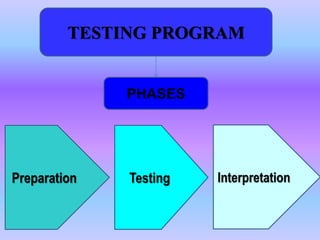
TESTING PROGRAM
Preparation Testing Interpretation
PHASES
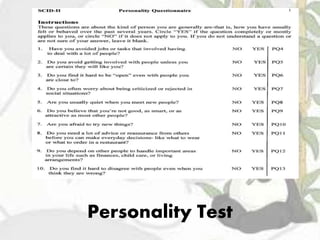
1. Personality Test – This test is designed to yield
information about a person’s characteristics,
traits, behavior, attitude, opinions, and/or
emotions.
2. Occupational Inventory – this test is designed to
assist students in self-exploratory, vocational,
expectation, and career development.
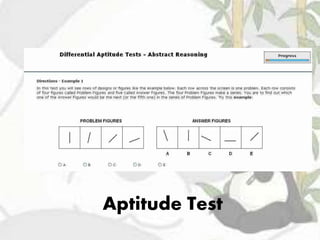
3. Aptitude Test – This test is designed to predict
future performance in an academic curriculum
area in a specialized vocational activity.
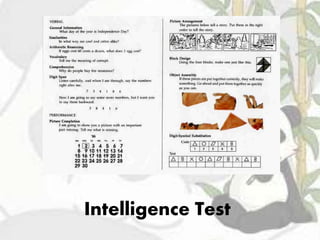
4. Intelligence Test – This test is designed to
measure level of intelligence.
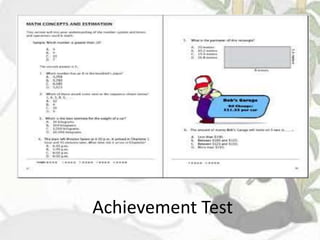
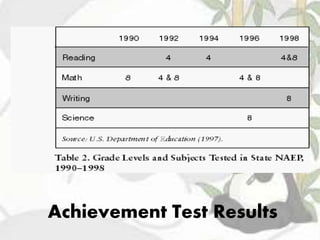
5. Achievement Test – This test is designed to measure
a person’s previous learning in a specific academic area.
It is also referred to as Test of Knowledge.
6. Stress Profile – The stress profile provides data in
areas related to stress and health risk and is based on
the cognitive-transactional approach to stress and
coping.
7. Diagnostic Test – An inventory for use of
professionals who provide counseling services to
college students. It provides measures of psychological
distress, relationship conflict, low self-esteem and
academic and career choice difficulties.
8. Work Values Scale – A tool which can be used to
assess work values.
SAMPLE TESTS
Achievement Test
Achievement Test Results
Aptitude Test
Intelligence Test
Personality Test
Research
Research is an organized scientific effort for
discovering new material, finding explanations
for current situations and debunking
theoretical assumptions. Its benefits include
the deepening of insights into the clientele, the
self, and the counseling profession and how
they relate to one another.
PRINCIPLES:
• Take the initiative in undertaking research to
contribute to the advancement of the counseling
profession.
• Inform the subjects of the general purpose of the
study and secure their full cooperation.
• Adhere to the highest standards, following
procedures appropriate to the problem.
• Identity of subject must be withheld and
revealed only with the subject permission and
for professional purposes, primarily for the
counselee’s interests
• Evaluative data and judgment should be
shared only with persons who need them
and will use them in confidence and for
professional purposes.
• Make available the original research data to
qualified researchers.
• Meet the commitments you have previously
made to the subjects of research study and to
others.
Program Evaluation
Evaluation is done to discover whether
programs, services or activities attain the
goals for which they are implemented. It may
be considered a form of research. It requires
systematic collection and analysis of data to
determine the value of a program – its
effectiveness, adequacy and efficiency.
Evaluation justifies the existence
of the Guidance Program and the
need to support it to make it more
functional and effective.
Purpose of Evaluation:
• To provide a periodic check on the effectiveness of
a guidance program and thus indicate the points at
which the program may be improved.
• To determine the correctness and incorrectness of
the hypotheses on which the guidance program
operates.
• To provide the information basic to individual
guidance. This must include all significant aspects
of the pupil’s accomplishments, abilities and
personality.
• To provide a certain psychological security to the
school staff, to pupils and to parents.
• To provide a sound basis for the public relations
Approaches to Evaluation:
• Survey Approach
• Experimental Approach
• Case- Study Approach
Thank You! 
REFERENCES:
1. http://personality-testing.info/
2. www.usi.edu.ph
3. www.upmin.edu.ph
4. www.careerplanning.about.com
5. www.chronicleguidance.com
6. http://www.educationalguidanceservices
.com/
7. http://idc.edu.ph/academics/student-
services/guidance-services/

Guidance services and facilities

  • 1.
  • 2.
    Guidance Services isa program designed for each school. No two schools have exactly the same social settings. There are particular needs and characteristics that must be met to satisfy the learners.
  • 3.
    Guidance serves asa support function. It is one of the components of the educational system that consists of services concerned with helping the individual develop into the person he’s capable of becoming.
  • 4.
    Essentials of GuidanceServices • A Program of Guidance Services is designed for each school • Guidance Services are designed to help students • Guidance is one of the components of education system • Guidance Services were developed to help young people come to know and accept themselves and their aptitudes and interest • Guidance Services may be defined as a group of services to individual
  • 5.
  • 6.
    This is aservice which provides a synthesis of information about the individual which can be used to gain an understanding of himself as he is potentially capable of becoming. The Individual Inventory Service is a development and longitudinal process.
  • 7.
    It consists ofall the information gathered about each individual in school. The information is usually stored in a Cumulative Folder where the data accumulated about each student are kept while the student is in school, and up to a few years after.
  • 8.
    PRINCIPLES: • The collectionof data about the learners should be started from the time they begin schooling • Records should grow with the learners as they progress in their studies • Records should be cumulative and inclusive • Records should be unbiased, objective and opinionated
  • 9.
    • The datacontained in the inventory should be properly interpreted well synthesized and carefully used for benefit of the child • Only the proper tools, techniques and instruments should be used in gathering of the necessary information • Records should be systematically kept and conveniently
  • 10.
  • 11.
     Personal Data– the information gives the counselor a view of the factors that may contribute to the development of the client’s personality and concerns.  Age – indicates the developmental tasks and crises that the individual may be encountering.  Family Background and Home Environment – can identify possible areas of concern.
  • 12.
     Hobbies, interests,goals and values – positive moving forces which the counselor can use to motivate, encourage, and galvanize the person into action.  Personal strengths and personality traits and characteristic – can help pinpoint areas where the person can excel and what he/she can pursue, modify, develop or try to avoid.  Problems and needs – point out the areas where more intensive and personal work with the client is needed.
  • 13.
     Educational data– can give indications regarding the client’s mental ability, aptitudes and special strengths.  Schools attended – kinds and locations of schools may give a clue to strengths, weaknesses and patterns.  Grades – can give a glimpse not only of subjects where the student might be interested, motivated, or encouraged, but also of aptitudes or intelligence type.
  • 14.
     Co-curricular extracurricularactivities – gives a glimpse of the personality of the person: Is the person active? Does he/she have initiative? Etc.  Courses taken – refers to special courses like Taekwondo or Kumon or singing.
  • 15.
  • 16.
    An activity wherebydescriptive materials and media are accumulated, organized and disseminated through planned group activities. This service provides information available to the learners which can be classified into occupational, educational and personal-social.
  • 17.
    OBJECTIVES: • To developa broad and realistic view of life’s opportunities and problems at all levels of training. • To create an awareness of the need and an active desire for accurate and valid occupational, educational and personal social information. • To provide wide understanding of the wide scope of educational, occupational and social activities in terms of broad categories of related activities.
  • 18.
    • To assistin the mastery of the techniques of obtaining and interpreting information for progressive self- defectiveness. • To promote attitudes and habits that will assist in the making of choices and adjustments productive of personal satisfaction. • To provide assistance in narrowing choices progressively to specific activities which are appropriate to aptitudes, abilities, and interests and to the proximity of definite decisions
  • 19.
     Occupational Information– is the valid and usable data about positions & occupations, including duties, requirements for entrance, conditions of work, rewards offered, advancement pattern, existing and predicted supply of and demand for workers, and sources for further information.  Educational Information – refers to the valid and usable data about all types of present and probable future educational or training opportunities and requirements.
  • 20.
     Personal-Social Information– this information is valid and usable data about the opportunities and influences of the human beings which will help the learner understand himself better and improve his relation with others.
  • 21.
  • 22.
    According to Ryanand Zeran, placement by definition is the satisfactory adjustment of the individual to the next situation whether in school or on the job.
  • 23.
    It provides clientswith options, enables them to act on their choices, and helps them adjust to the chosen environment.
  • 24.
  • 25.
    Personal-Social Placement These aresocial-personal concerns that may not necessarily be responded to by the institution that the client is affiliated with. For example: shyness/ social phobia, poor self- esteem, lack of friends, unusual or uncommon interests or talents, physical disabilities etc.
  • 26.
    Educational/Academic Placement This occurswhen a person is placed in the appropriate educational setting. Such placement is necessary for students who are going to school for the first time, are transferring from one locality to another, want or need to transfer to another school, are gifted etc.
  • 27.
    Occupational/Career Placement This hasbecome necessary because the competition in the world of work in the Philippines requires a full-time person to attend to the facets of marketing the students and ensuring that they have the appropriate skills for job hunting, job entry and job maintenance.
  • 28.
  • 29.
    Like a physicianwho checks on whether his patient has recovered from an illness, the counselor should also find out what happened to his counselee. Without the follow-up counseling is incomplete.
  • 30.
    A service extendedto anyone is followed-up to determine goal attainment and customer satisfaction. In the case of the Guidance Program, the Follow-Up Services helps determine the status of the person who received assistance and what other assistance must be rendered so that the service is complete and holistic.
  • 31.
  • 32.
  • 33.
    Testing This service usesstandardized psychological test to be administered, scored and objectively interpreted to students for awareness and realization of their potentials and interest and other factors as defined in the following descriptions of psychological test available in the Center
  • 34.
    PRINCIPLES: • Recognize thelimits of your competence and perform only those functions which fall within your preparation. • Select tests for use in a situation or with a counselee in accordance with validity , reliability and appropriateness. • Administer tests under the prescribed condition. • Report the tests according to the norms under which the tests were originally standardized.
  • 35.
    • Take precautionto guard the confidentiality and security of the psychological test. • Inform examinees about the purpose of the testing, considering the examinees welfare and the explicit or implicit prior understanding as to whom the results may be revealed. • Take care when any statements about tests and testing, to give accurate information and to avoid any false claim or misconception.
  • 36.
  • 37.
    1. Personality Test– This test is designed to yield information about a person’s characteristics, traits, behavior, attitude, opinions, and/or emotions. 2. Occupational Inventory – this test is designed to assist students in self-exploratory, vocational, expectation, and career development. 3. Aptitude Test – This test is designed to predict future performance in an academic curriculum area in a specialized vocational activity. 4. Intelligence Test – This test is designed to measure level of intelligence.
  • 38.
    5. Achievement Test– This test is designed to measure a person’s previous learning in a specific academic area. It is also referred to as Test of Knowledge. 6. Stress Profile – The stress profile provides data in areas related to stress and health risk and is based on the cognitive-transactional approach to stress and coping. 7. Diagnostic Test – An inventory for use of professionals who provide counseling services to college students. It provides measures of psychological distress, relationship conflict, low self-esteem and academic and career choice difficulties. 8. Work Values Scale – A tool which can be used to assess work values.
  • 39.
  • 40.
  • 41.
  • 42.
  • 43.
  • 44.
  • 45.
  • 46.
    Research is anorganized scientific effort for discovering new material, finding explanations for current situations and debunking theoretical assumptions. Its benefits include the deepening of insights into the clientele, the self, and the counseling profession and how they relate to one another.
  • 47.
    PRINCIPLES: • Take theinitiative in undertaking research to contribute to the advancement of the counseling profession. • Inform the subjects of the general purpose of the study and secure their full cooperation. • Adhere to the highest standards, following procedures appropriate to the problem. • Identity of subject must be withheld and revealed only with the subject permission and for professional purposes, primarily for the counselee’s interests
  • 48.
    • Evaluative dataand judgment should be shared only with persons who need them and will use them in confidence and for professional purposes. • Make available the original research data to qualified researchers. • Meet the commitments you have previously made to the subjects of research study and to others.
  • 49.
  • 50.
    Evaluation is doneto discover whether programs, services or activities attain the goals for which they are implemented. It may be considered a form of research. It requires systematic collection and analysis of data to determine the value of a program – its effectiveness, adequacy and efficiency.
  • 51.
    Evaluation justifies theexistence of the Guidance Program and the need to support it to make it more functional and effective.
  • 52.
    Purpose of Evaluation: •To provide a periodic check on the effectiveness of a guidance program and thus indicate the points at which the program may be improved. • To determine the correctness and incorrectness of the hypotheses on which the guidance program operates. • To provide the information basic to individual guidance. This must include all significant aspects of the pupil’s accomplishments, abilities and personality. • To provide a certain psychological security to the school staff, to pupils and to parents. • To provide a sound basis for the public relations
  • 53.
    Approaches to Evaluation: •Survey Approach • Experimental Approach • Case- Study Approach
  • 54.
  • 55.
    REFERENCES: 1. http://personality-testing.info/ 2. www.usi.edu.ph 3.www.upmin.edu.ph 4. www.careerplanning.about.com 5. www.chronicleguidance.com 6. http://www.educationalguidanceservices .com/ 7. http://idc.edu.ph/academics/student- services/guidance-services/