ABDUL RAUF LEGHARI
(TUGT)
PAEC INTER SCIENCE COLLEGE
DERA GHAZI KHAN
TOPIC:
3- D SHAPES
REVIEW
 Before discussing 3-D shapes ………. Let us review
some important related terms to understand 3-D
shapes i.e
 What is meant by DIMENSIONAL
 What is meant by NO DIMENSIONAL
 What is meant by ONE-DIMENSIONAL
 What is meant by 2-DIMENSIONAL
 What is meant by 3-DIMENSIOAL
 Definition of 3-D shape
 What is meant by Face, Edge and Vertex in A 3-D
shape
(In 3-D shapes these are very important to know)
DIMENSIONAL
The definition of dimensional is something a
shape that can be measured. In Geometry we can
have different dimensions.
An example of dimensional is a physical
object with length, width and depth.
The number of dimensions is…. how many
values are needed to locate points on a shape.
• NO DIMENSIONAL
• POINT: A point has no dimension.
•A point really has no size at all! But we show
them as dots so we can see where they are.
• ONE DIMENSIONAL
•LINE : Now let's allow the point to move in one
direction i.e (right or left), (forward or
backward). We get a line.
We need just one value to find a point on that
line. So we have one dimension. A line is one-
dimensional.
• 2- DIMENSIONAL
• Now lets allow the point to move in a two
directions i.e (forward or backward) & (up and
down) , and we get a shape called plane having
length and breadth only. Here we need two
values to find a point on that plane. So we have
two dimensions i.e "2D".
Circles, triangles, squares etc. are examples of
plane shapes
LENGTH
BREADTH
2-DIMENSIONAL SHAPES
2-DIMENSIONAL SIMILAR SHAPES
The figures having same shapes only are called
SIMILAR shapes for example different types of
triangles, squares or rectangles etc.
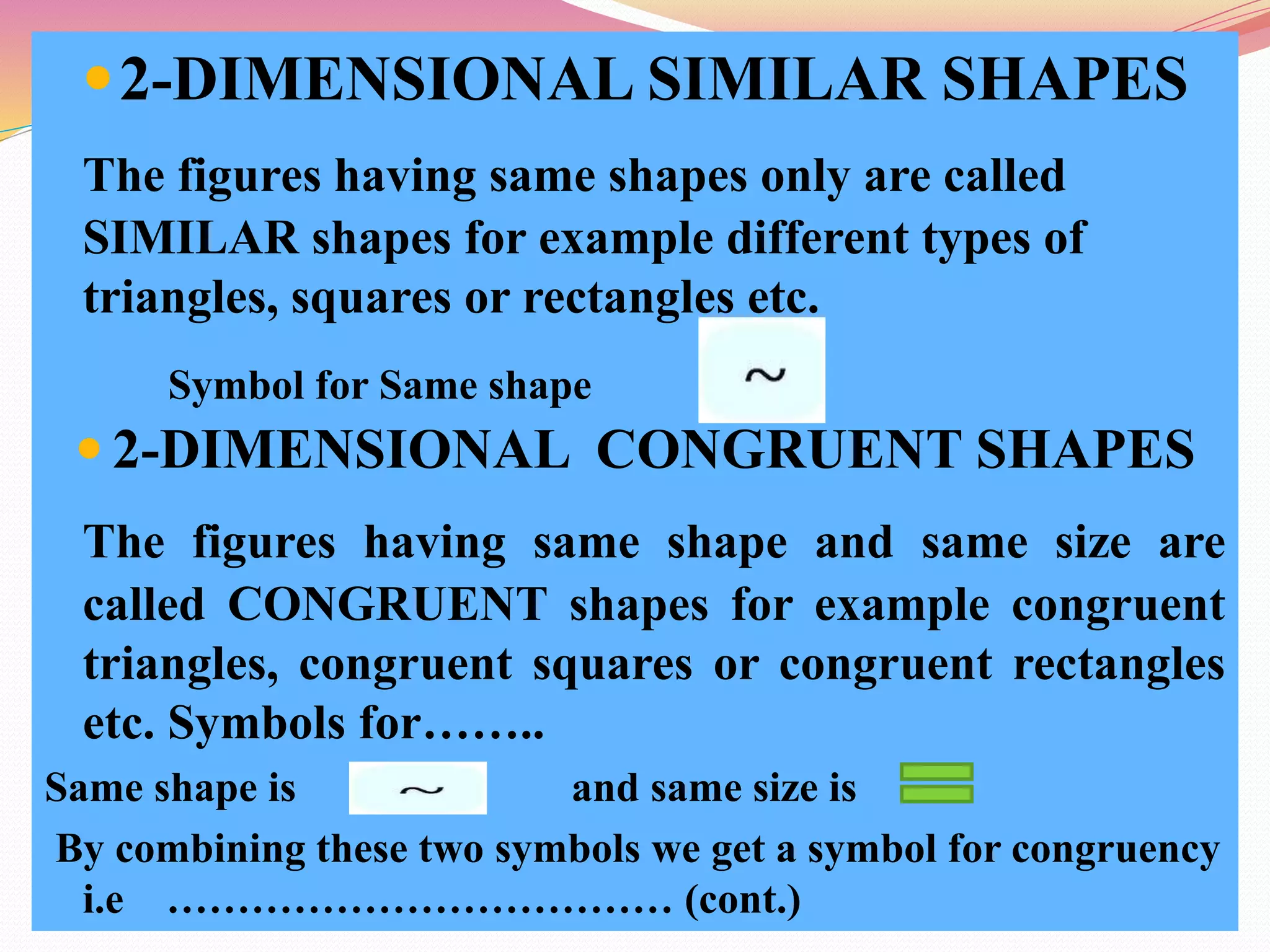
Symbol for Same shape
 2-DIMENSIONAL CONGRUENT SHAPES
The figures having same shape and same size are
called CONGRUENT shapes for example congruent
triangles, congruent squares or congruent rectangles
etc. Symbols for……..
Same shape is and same size is
By combining these two symbols we get a symbol for congruency
i.e ……………………………… (cont.)
Symbol for congruency
It is the combination of two symbols (similarity and equality)
Similar Shapes i.e
(same shapes)
Congruent Shapes i.e
(Same shape and same size)
ACTIVITY
ABOUT CONGRUENCY OF SHAPES
• 3-DIMENSIONAL
Now we let the point to move in another completely different
directions and we have length ,breadth and height i.e three
dimensions.
Spheres, cubes, cylinders etc. are 3-dimensional or "3D” shapes .
We also call them solid shapes.
• The world we live in is a 3-Dimensional.
• Our body is a 3-Dimensional
LENGTH
HEIGHT
BREADTH
3-D SHAPES
DEFINITION
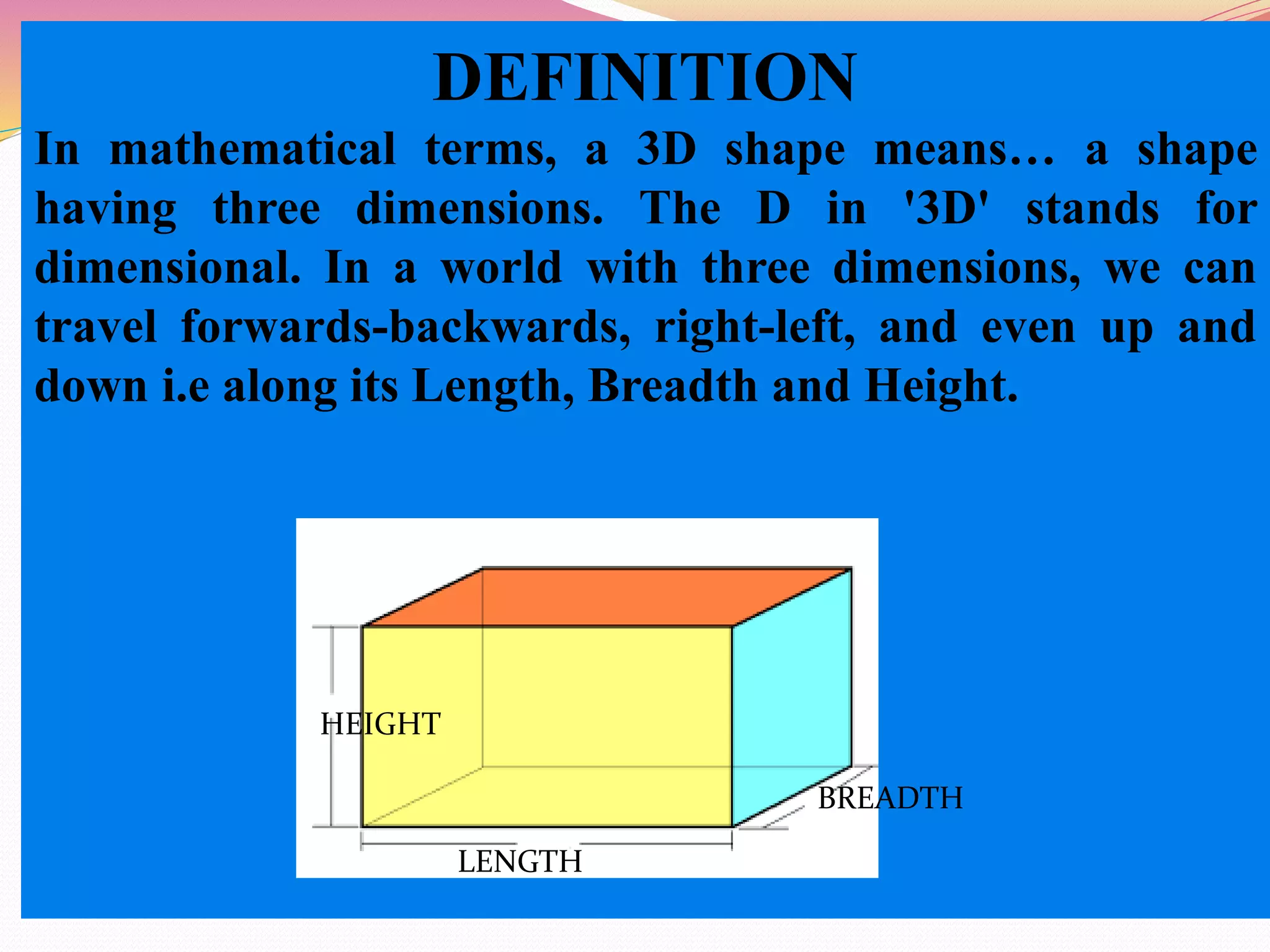
In mathematical terms, a 3D shape means… a shape
having three dimensions. The D in '3D' stands for
dimensional. In a world with three dimensions, we can
travel forwards-backwards, right-left, and even up and
down i.e along its Length, Breadth and Height.
HEIGHT
LENGTH
BREADTH
FACES, EDGES &
VERTICES
OF 3-D SHAPES
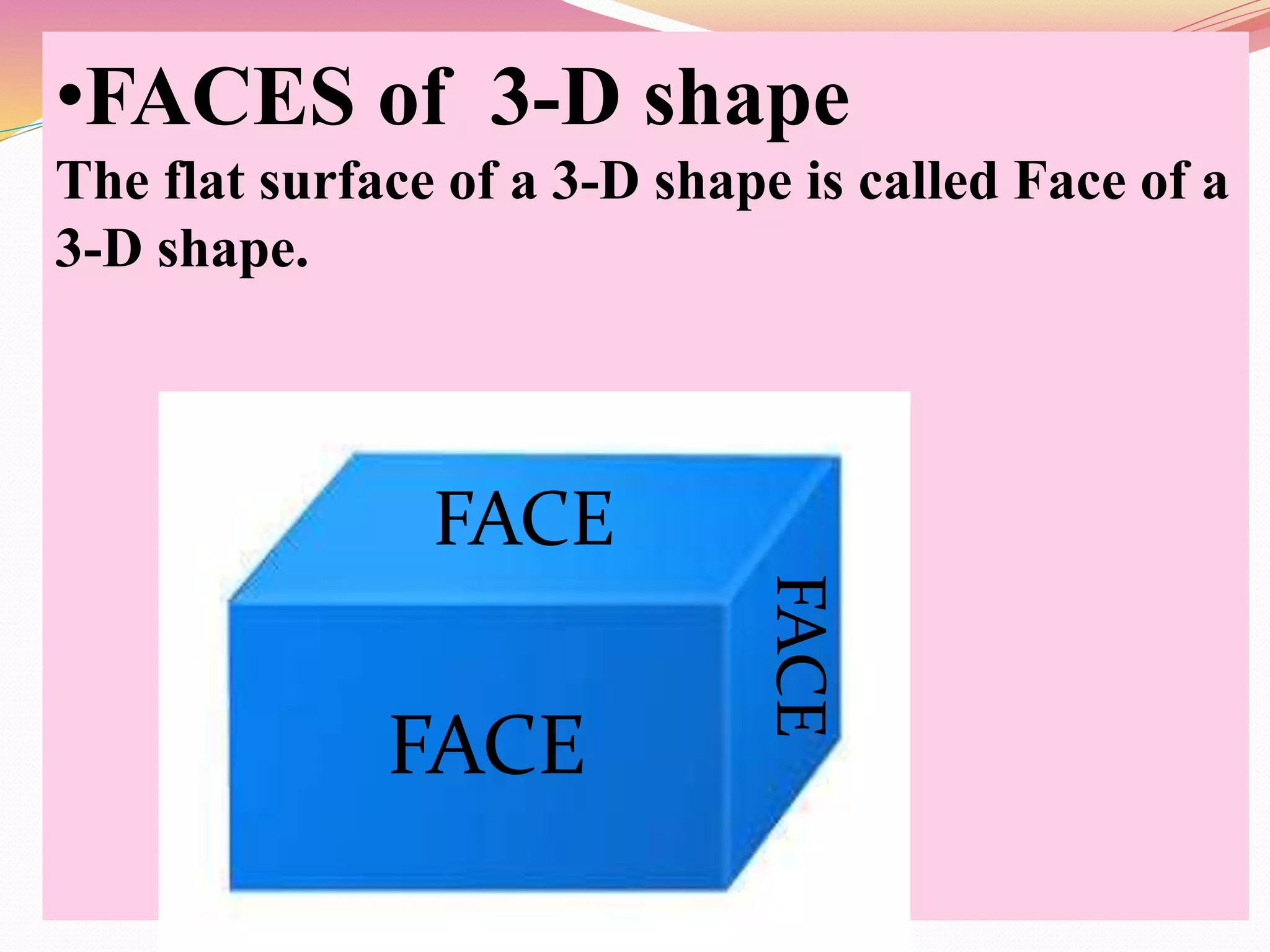
•FACES of 3-D shape
The flat surface of a 3-D shape is called Face of a
3-D shape.
FACE FACE
FACE
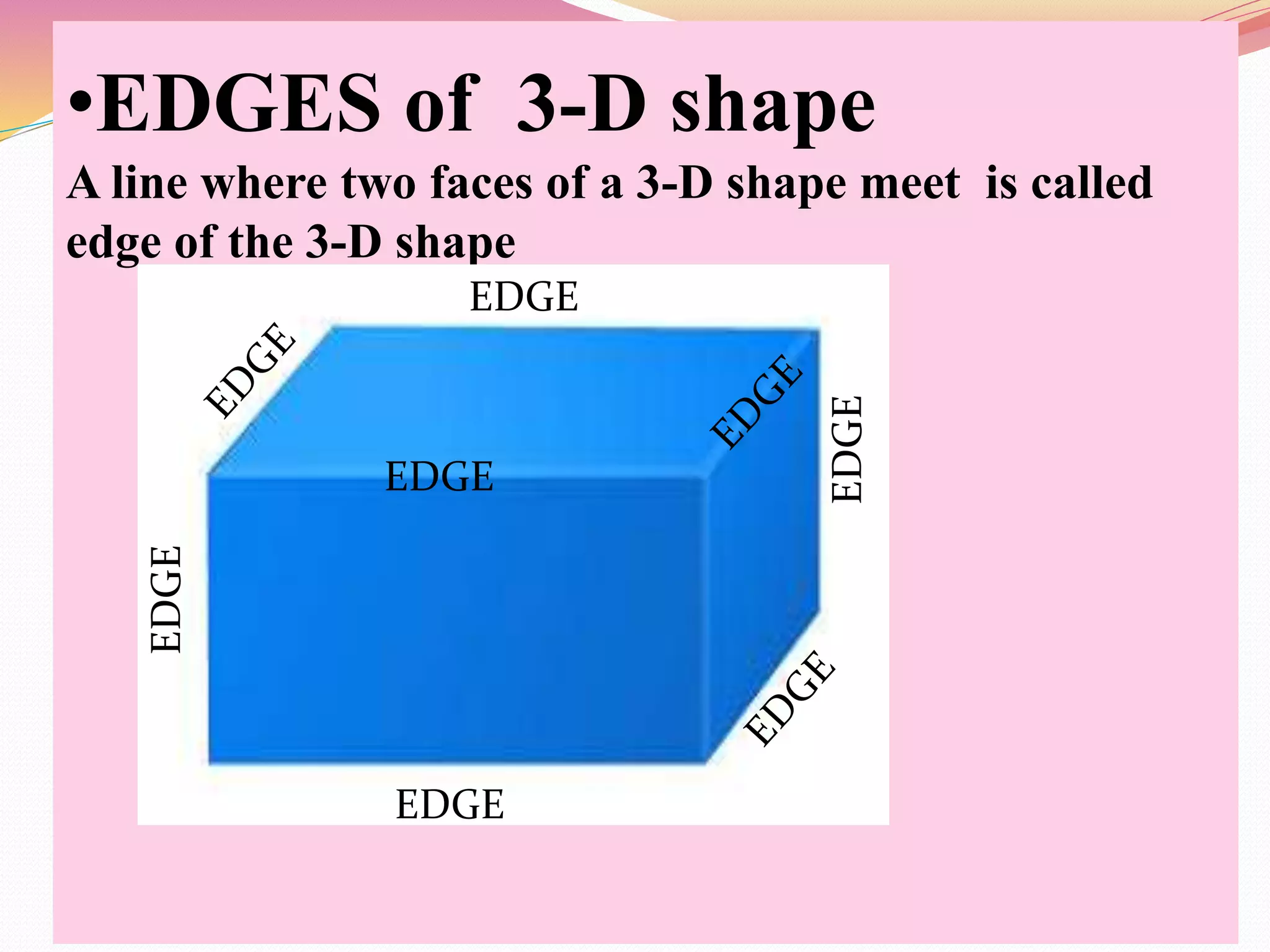
•EDGES of 3-D shape
A line where two faces of a 3-D shape meet is called
edge of the 3-D shape
EDGE
EDGE
EDGE
EDGE
EDGE
•VERTICES of a 3-D shape
The point where three faces meet each other is called
vertex (plural vertices) or corner of a 3-D shape
.vertex
.vertex
.vertex
.vertex .vertex
.vertex
DESCRIPTION OF 3-D
SHAPES
• CUBE
• CUBOID
• CONE
• CYLINDER
• SPHERE
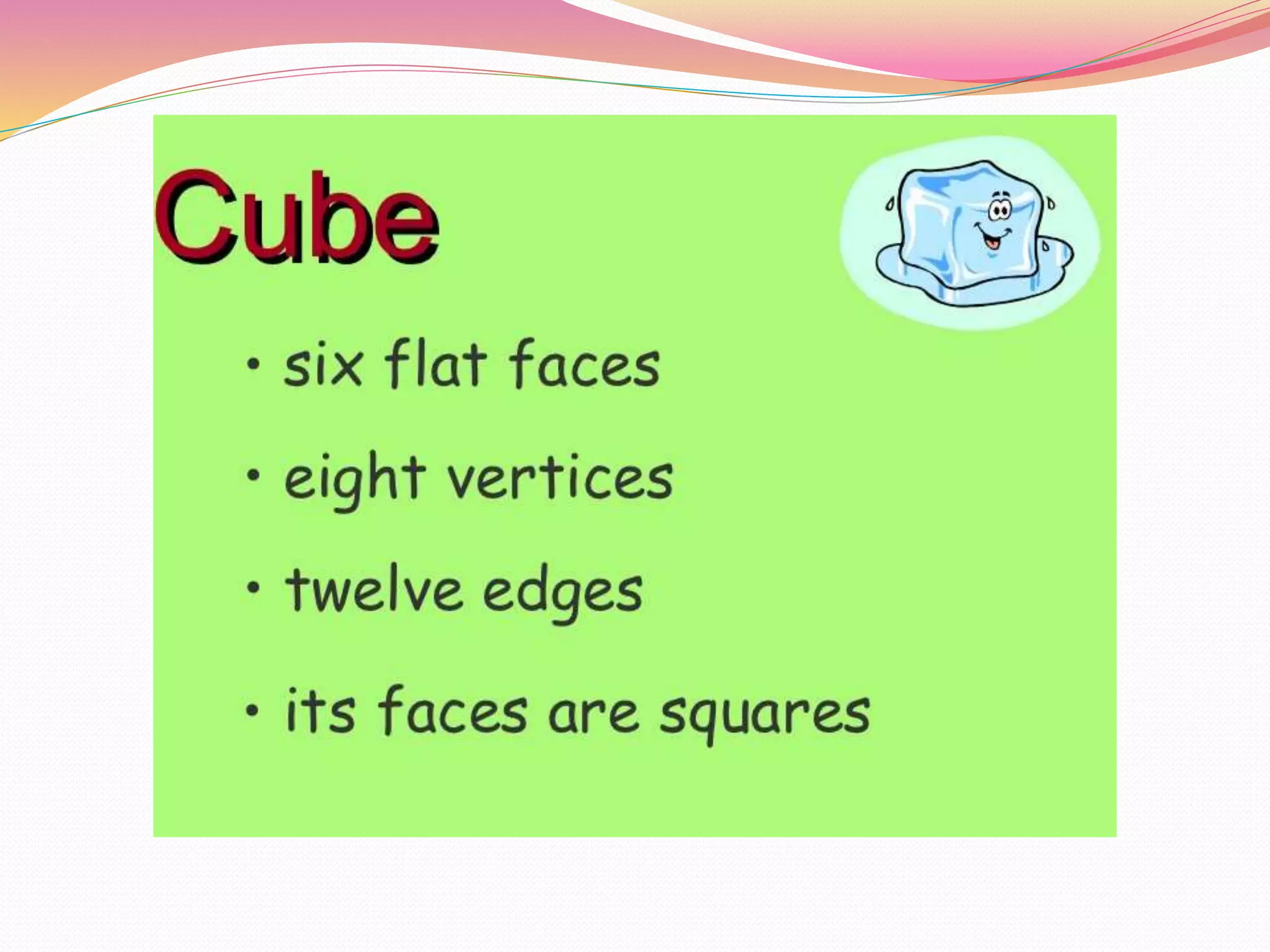
•CUBE
In geometry, a cube is a three-dimensional solid
object bounded by six square faces, or sides i.e
same in measurements meeting at each vertex. It
has 12 edges, 6 faces and 8 vertices.
•6 ………… FACES
•12…………. EDGES
•8 …………. VERTICES
•All the edges are
same in measurement
•CUBOID
In geometry, a cuboid is a three-dimensional solid
object bounded by six Rectangular faces, or sides i.e
not same in measurements meeting at each vertex. It
has 12 edges, 6 faces and 8 vertices.
•6 ………… FACES
•12…………. EDGES
•8 …………. VERTICES
•All the edges are not
same in measurement
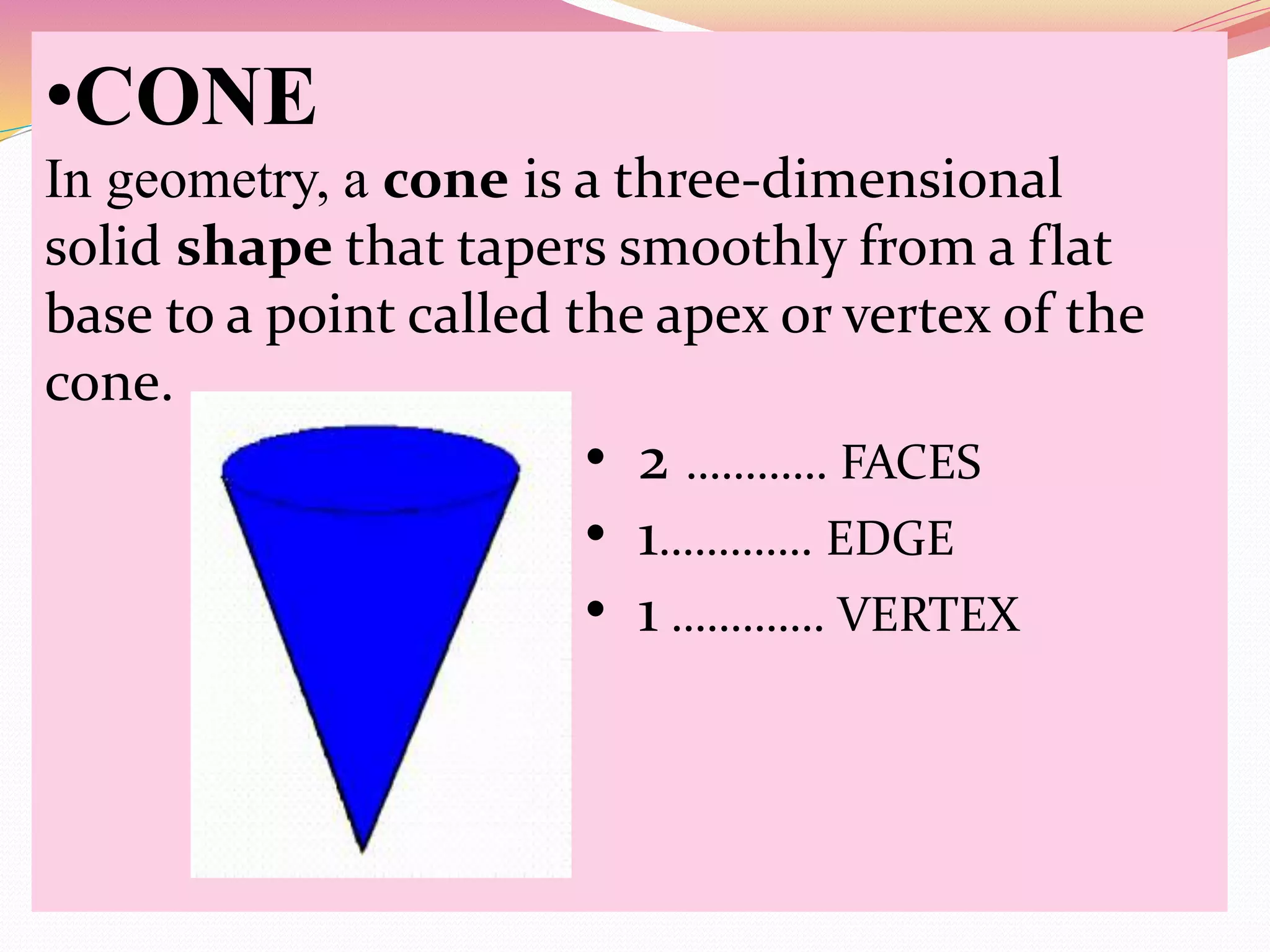
•CONE
In geometry, a cone is a three-dimensional
solid shape that tapers smoothly from a flat
base to a point called the apex or vertex of the
cone.
• 2 ………… FACES
• 1…………. EDGE
• 1 …………. VERTEX
•CYLINDER
In geometry, a cylinder is a three-dimensional
solid shape having 3 faces in which 2 are circular
and one is a rectangular. It has 2 edges and no
vertices (no corners).
• 3 ………… FACES
• 2…………. EDGES
• 0 ………….VERTEX
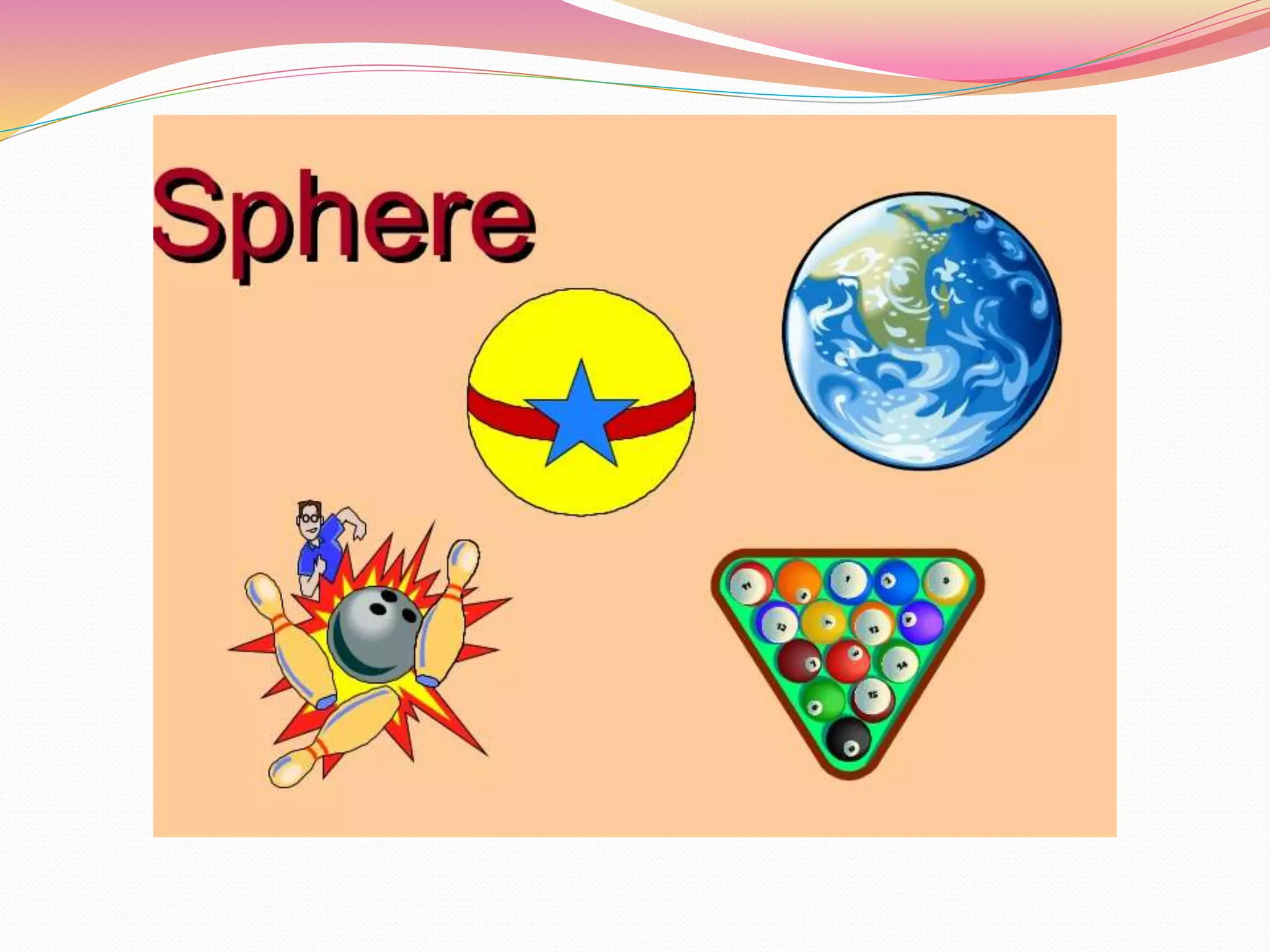
•SPHERE
In geometry, a sphere is a three-dimensional
solid shape having no faces, no edges, no vertices.
actually it is a curved three-dimensional geometric
figure.
• 1………… FACES(Curved)
• 0 …………. EDGES
• 0..……. VERTICES
IMPORTANCE OF 3-D
SHAPES
(STUDENTS LEARNING OUTCOMES)
Geometry
is a good
training
ground for
the
students
to understand the wonders of the
world’s shapes and appreciate it.
to apply and understand the
relationship between shapes and sizes
to think with visual abilities about any
of the shape.
to understand creative thinking of ones
for the construction about any of the
shape.
to apply and understand the
relationship between shapes and sizes
to make use of concrete materials and
activities.
QUESTION# 1
QUESTION# 2
QUESTION# 3
QUESTION# 4
QUESTION# 5
3-D Shapes Song
3D SHAPES.pptx
3D SHAPES.pptx

3D SHAPES.pptx

  • 2.
    ABDUL RAUF LEGHARI (TUGT) PAECINTER SCIENCE COLLEGE DERA GHAZI KHAN
  • 3.
  • 4.
    REVIEW  Before discussing3-D shapes ………. Let us review some important related terms to understand 3-D shapes i.e  What is meant by DIMENSIONAL  What is meant by NO DIMENSIONAL  What is meant by ONE-DIMENSIONAL  What is meant by 2-DIMENSIONAL  What is meant by 3-DIMENSIOAL  Definition of 3-D shape  What is meant by Face, Edge and Vertex in A 3-D shape (In 3-D shapes these are very important to know)
  • 5.
    DIMENSIONAL The definition ofdimensional is something a shape that can be measured. In Geometry we can have different dimensions. An example of dimensional is a physical object with length, width and depth. The number of dimensions is…. how many values are needed to locate points on a shape.
  • 6.
    • NO DIMENSIONAL •POINT: A point has no dimension. •A point really has no size at all! But we show them as dots so we can see where they are. • ONE DIMENSIONAL •LINE : Now let's allow the point to move in one direction i.e (right or left), (forward or backward). We get a line. We need just one value to find a point on that line. So we have one dimension. A line is one- dimensional.
  • 7.
    • 2- DIMENSIONAL •Now lets allow the point to move in a two directions i.e (forward or backward) & (up and down) , and we get a shape called plane having length and breadth only. Here we need two values to find a point on that plane. So we have two dimensions i.e "2D". Circles, triangles, squares etc. are examples of plane shapes LENGTH BREADTH
  • 8.
  • 9.
    2-DIMENSIONAL SIMILAR SHAPES Thefigures having same shapes only are called SIMILAR shapes for example different types of triangles, squares or rectangles etc. Symbol for Same shape  2-DIMENSIONAL CONGRUENT SHAPES The figures having same shape and same size are called CONGRUENT shapes for example congruent triangles, congruent squares or congruent rectangles etc. Symbols for…….. Same shape is and same size is By combining these two symbols we get a symbol for congruency i.e ……………………………… (cont.)
  • 10.
    Symbol for congruency Itis the combination of two symbols (similarity and equality)
  • 11.
    Similar Shapes i.e (sameshapes) Congruent Shapes i.e (Same shape and same size)
  • 12.
  • 13.
    • 3-DIMENSIONAL Now welet the point to move in another completely different directions and we have length ,breadth and height i.e three dimensions. Spheres, cubes, cylinders etc. are 3-dimensional or "3D” shapes . We also call them solid shapes. • The world we live in is a 3-Dimensional. • Our body is a 3-Dimensional LENGTH HEIGHT BREADTH
  • 14.
  • 15.
    DEFINITION In mathematical terms,a 3D shape means… a shape having three dimensions. The D in '3D' stands for dimensional. In a world with three dimensions, we can travel forwards-backwards, right-left, and even up and down i.e along its Length, Breadth and Height. HEIGHT LENGTH BREADTH
  • 16.
  • 17.
    •FACES of 3-Dshape The flat surface of a 3-D shape is called Face of a 3-D shape. FACE FACE FACE
  • 18.
    •EDGES of 3-Dshape A line where two faces of a 3-D shape meet is called edge of the 3-D shape EDGE EDGE EDGE EDGE EDGE
  • 19.
    •VERTICES of a3-D shape The point where three faces meet each other is called vertex (plural vertices) or corner of a 3-D shape .vertex .vertex .vertex .vertex .vertex .vertex
  • 20.
    DESCRIPTION OF 3-D SHAPES •CUBE • CUBOID • CONE • CYLINDER • SPHERE
  • 21.
    •CUBE In geometry, acube is a three-dimensional solid object bounded by six square faces, or sides i.e same in measurements meeting at each vertex. It has 12 edges, 6 faces and 8 vertices. •6 ………… FACES •12…………. EDGES •8 …………. VERTICES •All the edges are same in measurement
  • 22.
    •CUBOID In geometry, acuboid is a three-dimensional solid object bounded by six Rectangular faces, or sides i.e not same in measurements meeting at each vertex. It has 12 edges, 6 faces and 8 vertices. •6 ………… FACES •12…………. EDGES •8 …………. VERTICES •All the edges are not same in measurement
  • 23.
    •CONE In geometry, acone is a three-dimensional solid shape that tapers smoothly from a flat base to a point called the apex or vertex of the cone. • 2 ………… FACES • 1…………. EDGE • 1 …………. VERTEX
  • 24.
    •CYLINDER In geometry, acylinder is a three-dimensional solid shape having 3 faces in which 2 are circular and one is a rectangular. It has 2 edges and no vertices (no corners). • 3 ………… FACES • 2…………. EDGES • 0 ………….VERTEX
  • 25.
    •SPHERE In geometry, asphere is a three-dimensional solid shape having no faces, no edges, no vertices. actually it is a curved three-dimensional geometric figure. • 1………… FACES(Curved) • 0 …………. EDGES • 0..……. VERTICES
  • 26.
  • 27.
    Geometry is a good training groundfor the students to understand the wonders of the world’s shapes and appreciate it. to apply and understand the relationship between shapes and sizes to think with visual abilities about any of the shape. to understand creative thinking of ones for the construction about any of the shape. to apply and understand the relationship between shapes and sizes to make use of concrete materials and activities.
  • 46.
  • 48.
  • 50.
  • 52.
  • 54.
  • 56.