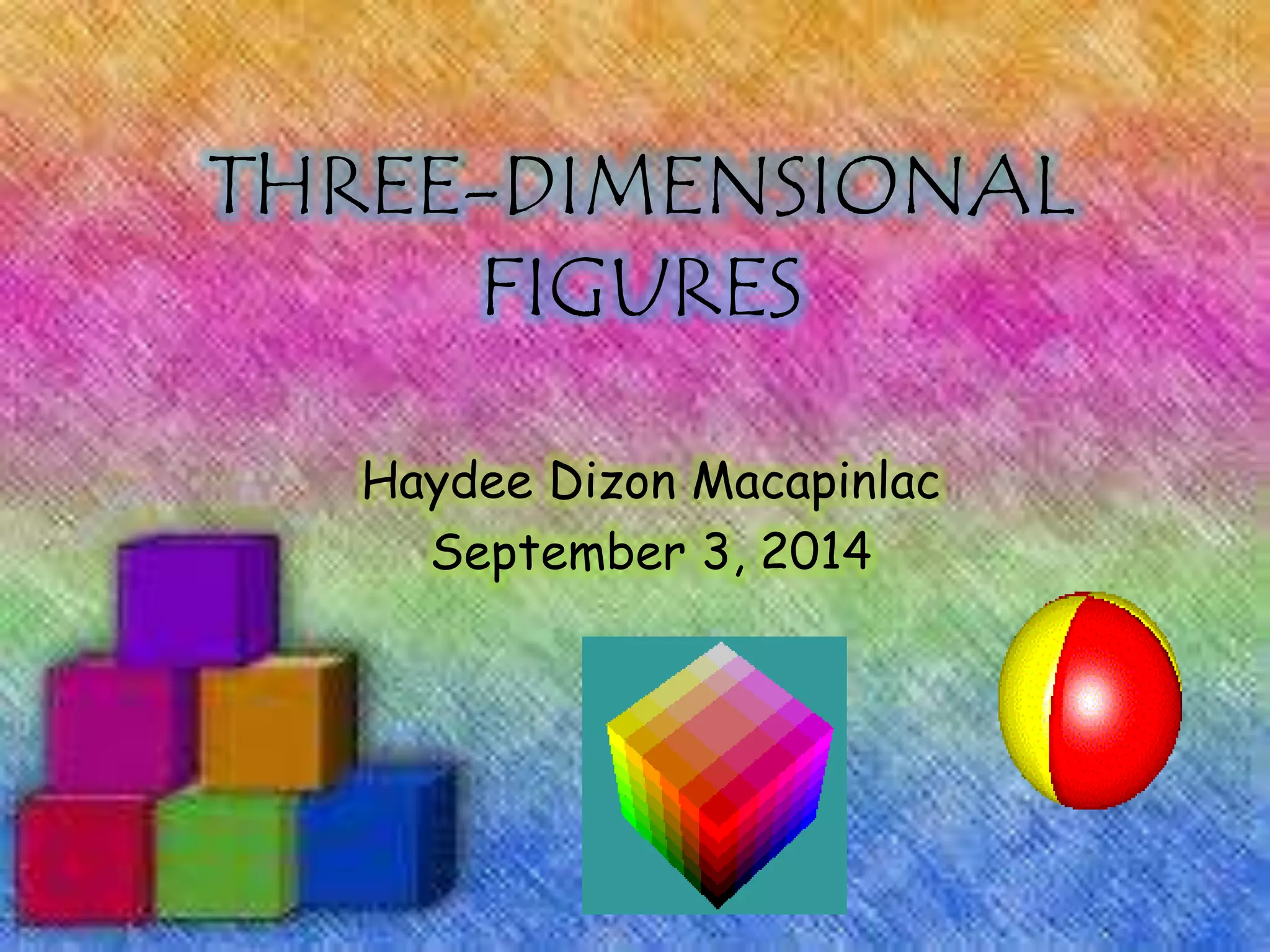
THREE-DIMENSIONAL 
FIGURES 
Haydee Dizon Macapinlac 
September 3, 2014
Objectives: 
 Define three-dimensional figures 
 Identify the parts of a 3D figure 
 Identify and describe attributes of three-dimensional 
shapes including prisms, pyramids, 
spheres, cones, and cylinders using appropriate 
vocabulary.
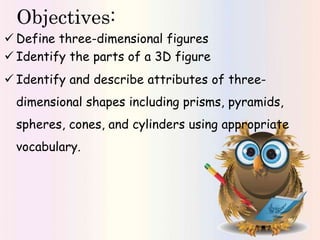
What are three-dimensional figures? 
 These figures are solid or hollow, you 
could hold them in your hand. 
 They have length, width, 
and height. 
 They are also called 
solid geometric figures.
Solid Figures can have: 
Surface 
Face 
Base 
Edge 
Corner 
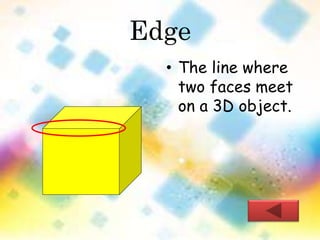
Edge
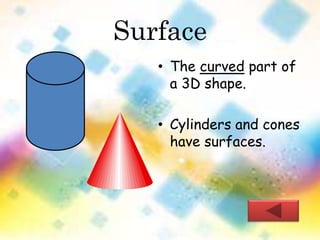
Surface 
• The curved part of 
a 3D shape. 
• Cylinders and cones 
have surfaces.
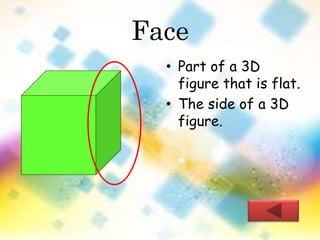
Face 
• Part of a 3D 
figure that is flat. 
• The side of a 3D 
figure.
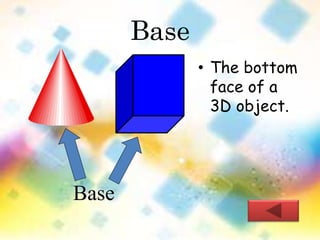
Base 
• The bottom 
face of a 
3D object. 
Base
Edge 
• The line where 
two faces meet 
on a 3D object.
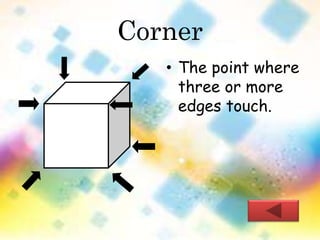
Corner 
• The point where 
three or more 
edges touch.
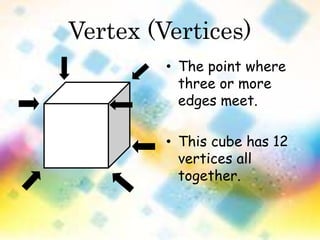
Vertex (Vertices) 
• The point where 
three or more 
edges meet. 
• This cube has 12 
vertices all 
together.
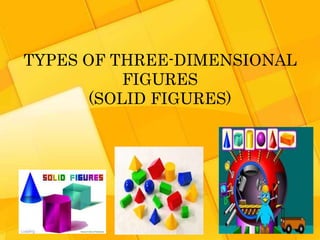
TYPES OF THREE-DIMENSIONAL 
FIGURES 
(SOLID FIGURES)
Cube 
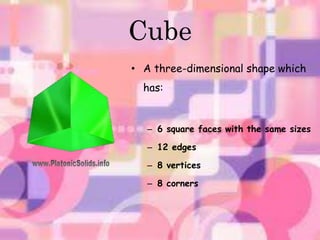
• A three-dimensional shape which 
has: 
– 6 square faces with the same sizes 
– 12 edges 
– 8 vertices 
– 8 corners
Cube 
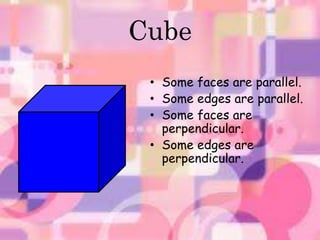
• Some faces are parallel. 
• Some edges are parallel. 
• Some faces are 
perpendicular. 
• Some edges are 
perpendicular.
Cube 
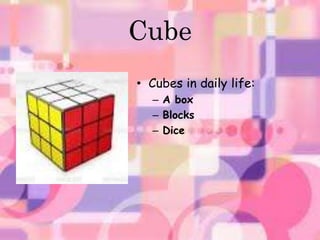
• Cubes in daily life: 
– A box 
– Blocks 
– Dice
Sphere 
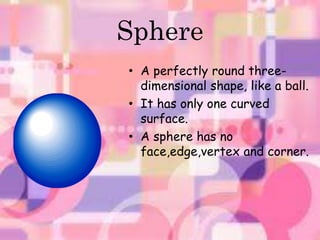
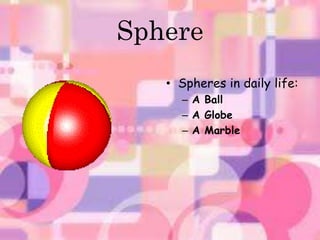
• A perfectly round three-dimensional 
shape, like a ball. 
• It has only one curved 
surface. 
• A sphere has no 
face,edge,vertex and corner.
Sphere 
• Spheres in daily life: 
– A Ball 
– A Globe 
– A Marble
Cone 
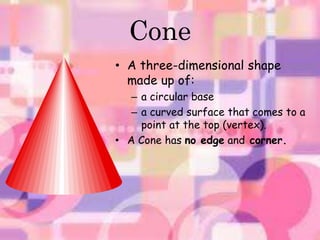
• A three-dimensional shape 
made up of: 
– a circular base 
– a curved surface that comes to a 
point at the top (vertex). 
• A Cone has no edge and corner.
Cone 
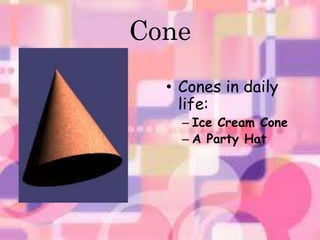
• Cones in daily 
life: 
– Ice Cream Cone 
– A Party Hat
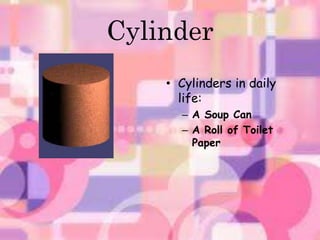
Cylinder 
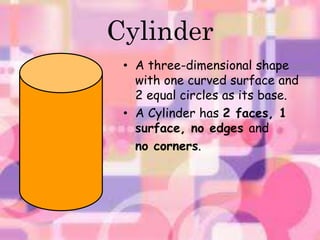
• A three-dimensional shape 
with one curved surface and 
2 equal circles as its base. 
• A Cylinder has 2 faces, 1 
surface, no edges and 
no corners.
Cylinder 
• Cylinders in daily 
life: 
– A Soup Can 
– A Roll of Toilet 
Paper
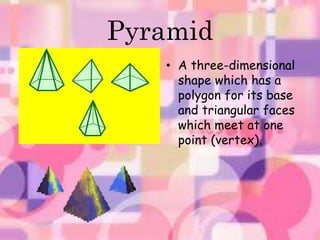
Pyramid 
• A three-dimensional 
shape which has a 
polygon for its base 
and triangular faces 
which meet at one 
point (vertex).
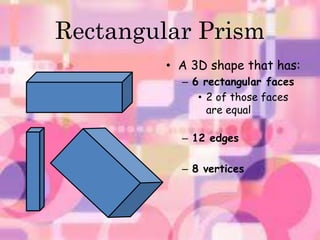
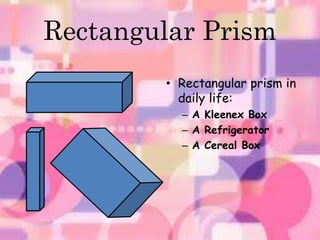
Rectangular Prism 
• A 3D shape that has: 
– 6 rectangular faces 
• 2 of those faces 
are equal 
– 12 edges 
– 8 vertices
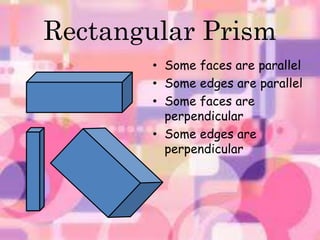
Rectangular Prism 
• Some faces are parallel 
• Some edges are parallel 
• Some faces are 
perpendicular 
• Some edges are 
perpendicular
Rectangular Prism 
• Rectangular prism in 
daily life: 
– A Kleenex Box 
– A Refrigerator 
– A Cereal Box
References: 
• Plane and Solid Mensuration, A simplified 
Approach by Earnhart and Bejasa 
• Simplified Engineering Mathematics by JAS 
Tordillo 
• www.google.com 
• www.slideshare.com

Three dimensional figures

  • 1.
    THREE-DIMENSIONAL FIGURES HaydeeDizon Macapinlac September 3, 2014
  • 2.
    Objectives:  Definethree-dimensional figures  Identify the parts of a 3D figure  Identify and describe attributes of three-dimensional shapes including prisms, pyramids, spheres, cones, and cylinders using appropriate vocabulary.
  • 3.
    What are three-dimensionalfigures?  These figures are solid or hollow, you could hold them in your hand.  They have length, width, and height.  They are also called solid geometric figures.
  • 4.
    Solid Figures canhave: Surface Face Base Edge Corner Edge
  • 5.
    Surface • Thecurved part of a 3D shape. • Cylinders and cones have surfaces.
  • 6.
    Face • Partof a 3D figure that is flat. • The side of a 3D figure.
  • 7.
    Base • Thebottom face of a 3D object. Base
  • 8.
    Edge • Theline where two faces meet on a 3D object.
  • 9.
    Corner • Thepoint where three or more edges touch.
  • 10.
    Vertex (Vertices) •The point where three or more edges meet. • This cube has 12 vertices all together.
  • 11.
    TYPES OF THREE-DIMENSIONAL FIGURES (SOLID FIGURES)
  • 12.
    Cube • Athree-dimensional shape which has: – 6 square faces with the same sizes – 12 edges – 8 vertices – 8 corners
  • 13.
    Cube • Somefaces are parallel. • Some edges are parallel. • Some faces are perpendicular. • Some edges are perpendicular.
  • 14.
    Cube • Cubesin daily life: – A box – Blocks – Dice
  • 15.
    Sphere • Aperfectly round three-dimensional shape, like a ball. • It has only one curved surface. • A sphere has no face,edge,vertex and corner.
  • 16.
    Sphere • Spheresin daily life: – A Ball – A Globe – A Marble
  • 17.
    Cone • Athree-dimensional shape made up of: – a circular base – a curved surface that comes to a point at the top (vertex). • A Cone has no edge and corner.
  • 18.
    Cone • Conesin daily life: – Ice Cream Cone – A Party Hat
  • 19.
    Cylinder • Athree-dimensional shape with one curved surface and 2 equal circles as its base. • A Cylinder has 2 faces, 1 surface, no edges and no corners.
  • 20.
    Cylinder • Cylindersin daily life: – A Soup Can – A Roll of Toilet Paper
  • 21.
    Pyramid • Athree-dimensional shape which has a polygon for its base and triangular faces which meet at one point (vertex).
  • 22.
    Rectangular Prism •A 3D shape that has: – 6 rectangular faces • 2 of those faces are equal – 12 edges – 8 vertices
  • 23.
    Rectangular Prism •Some faces are parallel • Some edges are parallel • Some faces are perpendicular • Some edges are perpendicular
  • 24.
    Rectangular Prism •Rectangular prism in daily life: – A Kleenex Box – A Refrigerator – A Cereal Box
  • 25.
    References: • Planeand Solid Mensuration, A simplified Approach by Earnhart and Bejasa • Simplified Engineering Mathematics by JAS Tordillo • www.google.com • www.slideshare.com