TODAY
1)
2)
3)
4)
5)
6)

Checking in
Some of your design task
submissions
The Tagging Assignment/what the
“point” is
A little brainstorming time
Some Brochure working time with
our full data sheet in-hand
Homework
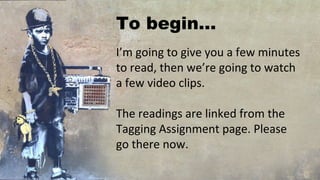
To begin…
I’m going to give you a few minutes
to read, then we’re going to watch
a few video clips.
The readings are linked from the
Tagging Assignment page. Please
go there now.
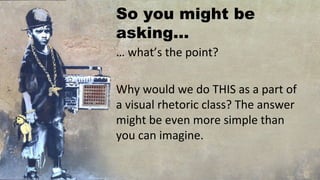
So you might be
asking…
… what’s the point?
Why would we do THIS as a part of
a visual rhetoric class? The answer
might be even more simple than
you can imagine.
PUBLIC RHETORICS.
That is… rhetoric for a
clearly defined public
audience. Rhetorical
moves that “say
something” to society
or a particular culture.
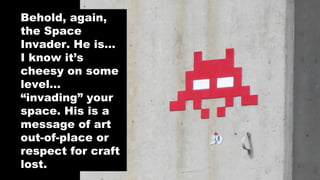
Behold, again,
the Space
Invader. He is…
I know it’s
cheesy on some
level…
“invading” your
space. His is a
message of art
out-of-place or
respect for craft
lost.
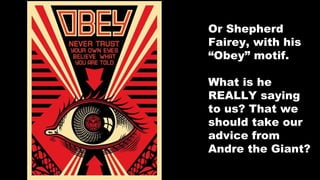
Or Shepherd
Fairey, with his
“Obey” motif.
What is he
REALLY saying
to us? That we
should take our
advice from
Andre the Giant?
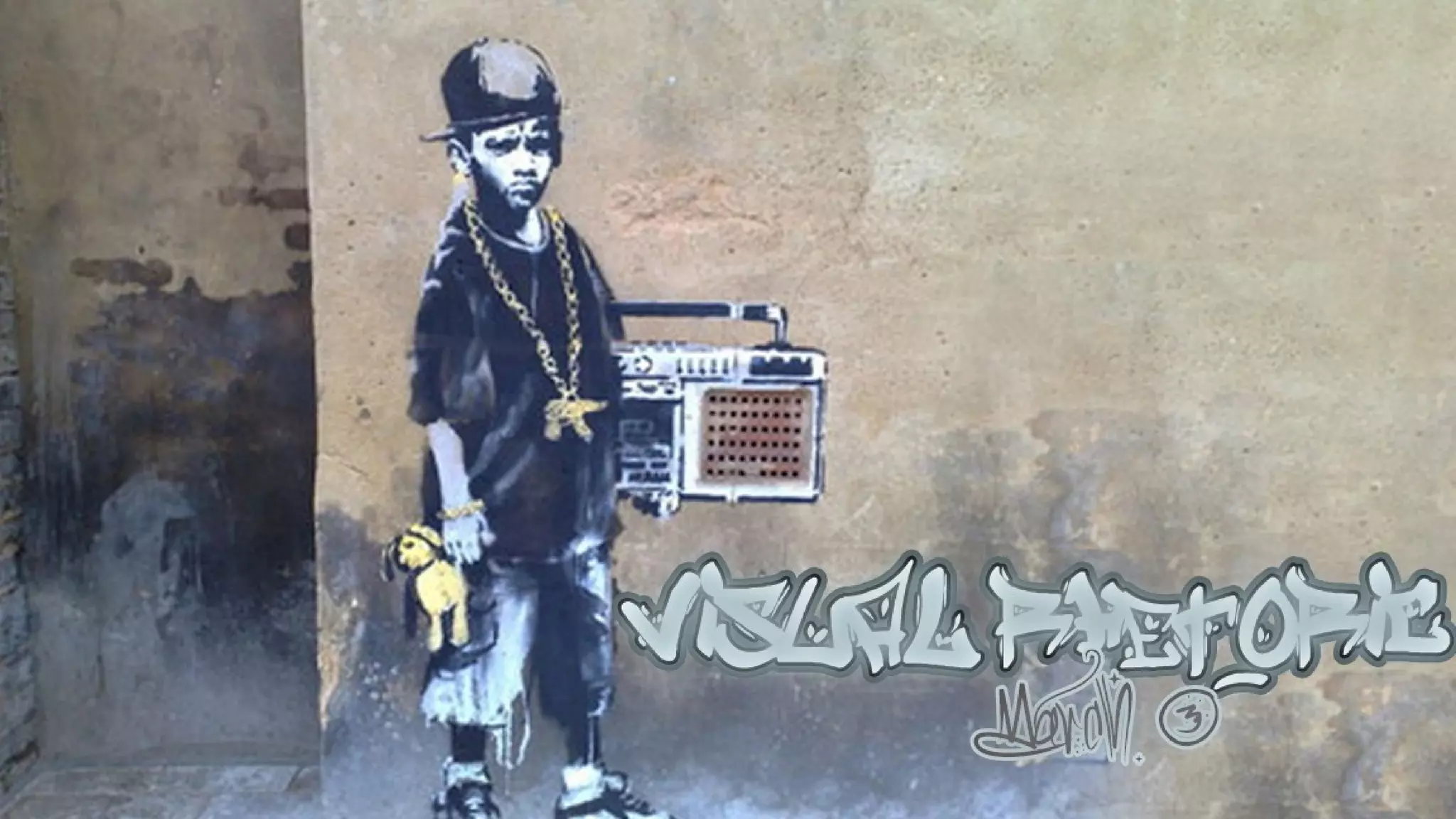
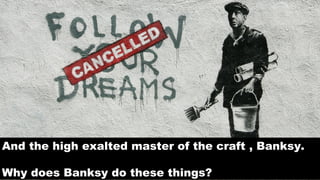
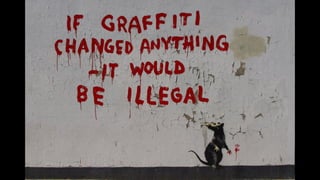
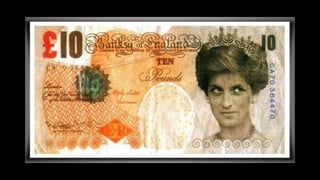
And the high exalted master of the craft , Banksy.
Why does Banksy do these things?
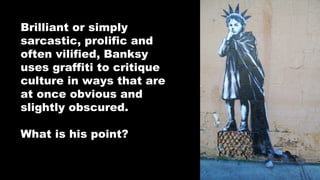
Brilliant or simply
sarcastic, prolific and
often vilified, Banksy
uses graffiti to critique
culture in ways that are
at once obvious and
slightly obscured.
What is his point?
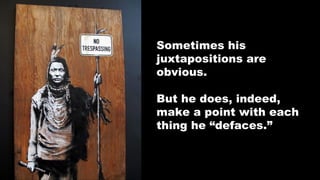
Sometimes his
juxtapositions are
obvious.
But he does, indeed,
make a point with each
thing he “defaces.”
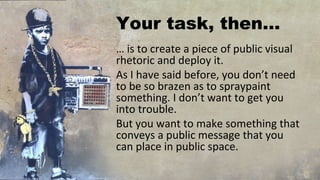
Your task, then…
… is to create a piece of public visual
rhetoric and deploy it.
As I have said before, you don’t need
to be so brazen as to spraypaint
something. I don’t want to get you
into trouble.
But you want to make something that
conveys a public message that you
can place in public space.
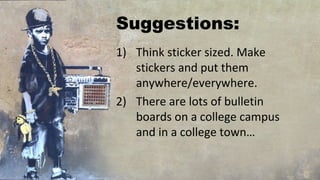
Suggestions:
1) Think sticker sized. Make
stickers and put them
anywhere/everywhere.
2) There are lots of bulletin
boards on a college campus
and in a college town…
3. We have an internet full of public
space and references.
4. This is still publicity work; it’s just a
little off-of-center. So use the same
sorts of strategies we’ve used so far.
5. Customize the medium to your
message: what do YOU want to say?
Brainstorming! For each prompt, write
for as long as I give you (about 5
minutes), or sketch, or whatever helps
you.

Prompt 1: What are things
that matter to you, issues
you have something very
specific to say about?
Prompt 2: Remember that
this is visual rhetoric, so
this needs to be an
argument that is more
about the visual than the
text. What images work
with your chosen message?
Prompt 3: Think about
places where your message
could best be heard. What
can you put there? How
difficult would it be? How
legal would it be?
Prompt 4: Think about the
power of memory. How will
you get your message to
“stick” to the audience?
Why will they remember it a
day later? A week?
Prompt 5: What can you use
in this space to make this
point? Where can you
access the materials? Is it
cost effective?
Prompt 6: What are the
risks of doing this and can
you afford to risk it? If the
answer is no, return to
prompt 1. 
Armed with these responses, go to a
computer and spend some time
roughing out a general plan for what
you want to create and how you want
to deploy it.
You can also get started on the
actual design if you can get that
far.
This is due April 7 th .
If you look on the website, you will see
that I’ve created a nifty collection of all
our notes about the Literary London
brochure on the assignment sheet.
Let’s go over the expectations
one more time.
Then we’ll spend the rest of class
working in our teams to start
fleshing out our plans for the
For next Monday:
Read all about web stuff. There
are links on the schedule. Design
task six is to make a meme using
the software at quickmeme.com.
Pay attention to the nuances of
how it works; next week’s design
task will be to create a NEW
meme from scratch.

Monday Night, March 3rd, Visual Rhetoric

  • 2.
    TODAY 1) 2) 3) 4) 5) 6) Checking in Some ofyour design task submissions The Tagging Assignment/what the “point” is A little brainstorming time Some Brochure working time with our full data sheet in-hand Homework
  • 16.
    To begin… I’m goingto give you a few minutes to read, then we’re going to watch a few video clips. The readings are linked from the Tagging Assignment page. Please go there now.
  • 17.
    So you mightbe asking… … what’s the point? Why would we do THIS as a part of a visual rhetoric class? The answer might be even more simple than you can imagine.
  • 18.
  • 19.
    That is… rhetoricfor a clearly defined public audience. Rhetorical moves that “say something” to society or a particular culture.
  • 20.
    Behold, again, the Space Invader.He is… I know it’s cheesy on some level… “invading” your space. His is a message of art out-of-place or respect for craft lost.
  • 21.
    Or Shepherd Fairey, withhis “Obey” motif. What is he REALLY saying to us? That we should take our advice from Andre the Giant?
  • 22.
    And the highexalted master of the craft , Banksy. Why does Banksy do these things?
  • 24.
    Brilliant or simply sarcastic,prolific and often vilified, Banksy uses graffiti to critique culture in ways that are at once obvious and slightly obscured. What is his point?
  • 26.
    Sometimes his juxtapositions are obvious. Buthe does, indeed, make a point with each thing he “defaces.”
  • 27.
    Your task, then… …is to create a piece of public visual rhetoric and deploy it. As I have said before, you don’t need to be so brazen as to spraypaint something. I don’t want to get you into trouble. But you want to make something that conveys a public message that you can place in public space.
  • 28.
    Suggestions: 1) Think stickersized. Make stickers and put them anywhere/everywhere. 2) There are lots of bulletin boards on a college campus and in a college town…
  • 29.
    3. We havean internet full of public space and references. 4. This is still publicity work; it’s just a little off-of-center. So use the same sorts of strategies we’ve used so far. 5. Customize the medium to your message: what do YOU want to say?
  • 30.
    Brainstorming! For eachprompt, write for as long as I give you (about 5 minutes), or sketch, or whatever helps you. Prompt 1: What are things that matter to you, issues you have something very specific to say about?
  • 31.
    Prompt 2: Rememberthat this is visual rhetoric, so this needs to be an argument that is more about the visual than the text. What images work with your chosen message?
  • 32.
    Prompt 3: Thinkabout places where your message could best be heard. What can you put there? How difficult would it be? How legal would it be?
  • 33.
    Prompt 4: Thinkabout the power of memory. How will you get your message to “stick” to the audience? Why will they remember it a day later? A week?
  • 34.
    Prompt 5: Whatcan you use in this space to make this point? Where can you access the materials? Is it cost effective?
  • 35.
    Prompt 6: Whatare the risks of doing this and can you afford to risk it? If the answer is no, return to prompt 1. 
  • 36.
    Armed with theseresponses, go to a computer and spend some time roughing out a general plan for what you want to create and how you want to deploy it. You can also get started on the actual design if you can get that far. This is due April 7 th .
  • 37.
    If you lookon the website, you will see that I’ve created a nifty collection of all our notes about the Literary London brochure on the assignment sheet. Let’s go over the expectations one more time. Then we’ll spend the rest of class working in our teams to start fleshing out our plans for the
  • 38.
    For next Monday: Readall about web stuff. There are links on the schedule. Design task six is to make a meme using the software at quickmeme.com. Pay attention to the nuances of how it works; next week’s design task will be to create a NEW meme from scratch.