Lines
                        
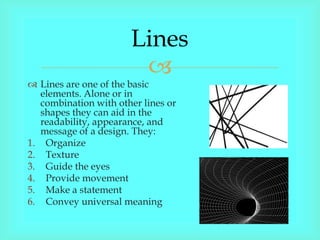
 Lines are one of the basic
   elements. Alone or in
   combination with other lines or
   shapes they can aid in the
   readability, appearance, and
   message of a design. They:
1. Organize
2. Texture
3. Guide the eyes
4. Provide movement
5. Make a statement
6. Convey universal meaning
Shape (2D)
    
 Shape is one of the basic
  elements of design.
  Alone or in combination
  with other shapes or lines
  they can convey
  universal meanings as
  well as guide the eye or
  organize information.
  The three basic types of
  shapes are geometric,
  natural, and abstract.
Form (3D)
   
     Form is the three-
      dimensionality of an
      object. Shape is only
      two-dimensional; form is
      three dimensional. You
      can hold a form; walk
      around a form and in
      some case walk inside a
      form.
Color
                       
 Color affects us emotionally,
   with different colors evoking
   different emotions
1. Hue: refers to the names of
    primary colors, red green,
    blue.
2. Value: lightness and darkness
    of the color
3. Intensity :the purity or
    saturation of the color
4. Monochromatic color: uses of
    one color where only value of
    the color changes.
Texture
         
 Texture is always a part of
  our designs whether
  intentional or not. It is the
  visual or tactile surface
  characteristics of a piece.
 Visual textures through the
  arrangements of lines and
  shapes or the use of
  photographic images of
  specific surfaces.
Depth (Perspective)
                 
 The allusion of depth:
1. Size and vertical location- closer objects being larger and
   smaller objects being smaller, also we perceive objects
   that are higher on the page and smaller as being further
   away.
2. Overlapping- when objects are partially obscured by
   other objects in front of them.
3. Detail(aerial or atmospheric perspective)- uses color
   value contrasts to show depth.
4. Linear perspective (converging lines)- all lines will
   converge on a common point on the horizon called the
   vanishing point.
Light
                          
 When light from a single
  direction hits an object is in
  shadow. Light and dark
  areas within an image
  provide contrast that can
  suggest volume. Factors
  that can affect our feelings
  towards an image include
  the direction of the light
  source, from above or
  below, and the gentleness
  or abruptness of the half
  tones.
Direction (motion)
        
          To show direction we
           use:
         1. Anticipated
            movement
         2. Fuzzy outlines
         3. Multiple images
         4. Optical movement
         5. Optical illusions
         6. Rhythm and
            movement
Mass (Visual Weight)
         
         Everything has physical mass.
          The physical mass or size is
          the actual dimensions of the
          piece:
        1. Height
        2. Width
        3. thickness/weight
        4. Depth( of 3D objects)
Tone (Black and White)
           
 Tone can be regarded as
   value both terms refer to
   the various degrees of
   lightness or darkness.
1. Shade: a color (hue) with
     black added.
2. Tint: a color (hue) with
     white added
3. Tone : a color (hue) with
     grey added
4. Value: the degree of
     lightness or darkness in
     colors.
Value
   refers to
 Vales
  the relative
  lightness or
  darkness of a
  certain area.
  Value can be
  used for
  emphasis.
  Variations in
  values are
  used to create
  a focal point
  for the design
  of a picture.
Space (Positive and
              Negative)
                             
 Space is the area provided for
  a particular purpose. It may
  have two dimensions or three
  dimensions. There are two
  type of space: positive and
  negative space. Positive space
  refers to the space of a shape
  representing the subject
  matter. Negative space refers
  to space around and between
  the subject matter.
Balance
  
   Symmetrical: balance is
    easiest to see in perfectly
    centered compositions or
    those with mirror images.
   Asymmetrical: design is
    typically off-center or
    created with an odd or
    mismatched number of
    different elements.
   Redial: designs the elements
    radiate from or swirl around
    in a circular or spiral path.
Emphasis
                    
 Emphasis in design provides the focal point for the piece.
  It is a way of making the element the most important
  stand out in the design.
Proportion (Scale)
                
 Proportion refers to the
  relative size and scale of
  the various elements in a
  design. The issue is the
  relationship between
  objects, or parts, of a
  whole. This means that it
  is necessary to discuss
  proportion in terms of the
  context or standard used
  to determine proportions.
Repetition
(Rhythm/Pattern)
       
         Newsletters, magazines,
          brochures, annual
          reports, and book often
          have many visual
          elements: columns of
          text, headlines, photos,
          illustrations, pull-quotes,
          etc. Grids allow the
          designer to build page-
          to-page consistency into
          these documents.
Unity
     
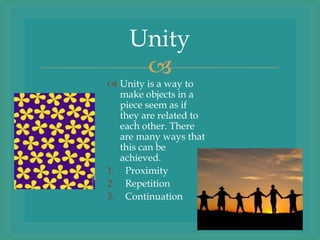
 Unity is a way to
   make objects in a
   piece seem as if
   they are related to
   each other. There
   are many ways that
   this can be
   achieved.
1. Proximity
2. Repetition
3. Continuation
Contrast
                        
 Contrast occurs when two
  elements are different. The
  grater the different the grater
  the contrast. The key to
  working with contrast is to
  make sure the different are
  obvious. Four common
  methods of creating contrast
  are by using differences in
  size, value, color, and type.
Harmony
   
    Harmony is painting is
     visually satisfying effect of
     combining similar, related
     elements, e.g. adjacent
     colors on the color wheel,
     similar shapes etc.
    The principle of design
     concerned with combining
     similar art element to create
     a pleasing image.
Proximity
   
    One of the easiest ways to
     create a visual structure and
     give your piece an organized
     feel is to space items according
     to their relation to one another.
     This is called the rule of
     proximity, and it simply
     means that related items
     should appear closer together
     then items that are not related.
Variety
                         
 Variety means “ to change the
   character” of an element, to make it
   different. Varying the elements
   creates variety. Ways to vary
   element include:
1. Lines-thinness, value, color,
    angle, length.
2. Shape-size, color, orientation and
    texture type.
3. Color- hue, value, saturation.
4. Value-darkness, lightness, high-
    key, low-key, value contrast.
5. Texture-rough, smooth.

Visual composition slideshow -darlene dechambre

  • 1.
    Lines   Lines are one of the basic elements. Alone or in combination with other lines or shapes they can aid in the readability, appearance, and message of a design. They: 1. Organize 2. Texture 3. Guide the eyes 4. Provide movement 5. Make a statement 6. Convey universal meaning
  • 2.
    Shape (2D)   Shape is one of the basic elements of design. Alone or in combination with other shapes or lines they can convey universal meanings as well as guide the eye or organize information. The three basic types of shapes are geometric, natural, and abstract.
  • 3.
    Form (3D)   Form is the three- dimensionality of an object. Shape is only two-dimensional; form is three dimensional. You can hold a form; walk around a form and in some case walk inside a form.
  • 4.
    Color   Color affects us emotionally, with different colors evoking different emotions 1. Hue: refers to the names of primary colors, red green, blue. 2. Value: lightness and darkness of the color 3. Intensity :the purity or saturation of the color 4. Monochromatic color: uses of one color where only value of the color changes.
  • 5.
    Texture   Texture is always a part of our designs whether intentional or not. It is the visual or tactile surface characteristics of a piece.  Visual textures through the arrangements of lines and shapes or the use of photographic images of specific surfaces.
  • 6.
    Depth (Perspective)   The allusion of depth: 1. Size and vertical location- closer objects being larger and smaller objects being smaller, also we perceive objects that are higher on the page and smaller as being further away. 2. Overlapping- when objects are partially obscured by other objects in front of them. 3. Detail(aerial or atmospheric perspective)- uses color value contrasts to show depth. 4. Linear perspective (converging lines)- all lines will converge on a common point on the horizon called the vanishing point.
  • 7.
    Light   When light from a single direction hits an object is in shadow. Light and dark areas within an image provide contrast that can suggest volume. Factors that can affect our feelings towards an image include the direction of the light source, from above or below, and the gentleness or abruptness of the half tones.
  • 8.
    Direction (motion)   To show direction we use: 1. Anticipated movement 2. Fuzzy outlines 3. Multiple images 4. Optical movement 5. Optical illusions 6. Rhythm and movement
  • 9.
    Mass (Visual Weight)   Everything has physical mass. The physical mass or size is the actual dimensions of the piece: 1. Height 2. Width 3. thickness/weight 4. Depth( of 3D objects)
  • 10.
    Tone (Black andWhite)   Tone can be regarded as value both terms refer to the various degrees of lightness or darkness. 1. Shade: a color (hue) with black added. 2. Tint: a color (hue) with white added 3. Tone : a color (hue) with grey added 4. Value: the degree of lightness or darkness in colors.
  • 11.
    Value refers to  Vales the relative lightness or darkness of a certain area. Value can be used for emphasis. Variations in values are used to create a focal point for the design of a picture.
  • 12.
    Space (Positive and Negative)   Space is the area provided for a particular purpose. It may have two dimensions or three dimensions. There are two type of space: positive and negative space. Positive space refers to the space of a shape representing the subject matter. Negative space refers to space around and between the subject matter.
  • 13.
    Balance   Symmetrical: balance is easiest to see in perfectly centered compositions or those with mirror images.  Asymmetrical: design is typically off-center or created with an odd or mismatched number of different elements.  Redial: designs the elements radiate from or swirl around in a circular or spiral path.
  • 14.
    Emphasis   Emphasis in design provides the focal point for the piece. It is a way of making the element the most important stand out in the design.
  • 15.
    Proportion (Scale)   Proportion refers to the relative size and scale of the various elements in a design. The issue is the relationship between objects, or parts, of a whole. This means that it is necessary to discuss proportion in terms of the context or standard used to determine proportions.
  • 16.
    Repetition (Rhythm/Pattern)   Newsletters, magazines, brochures, annual reports, and book often have many visual elements: columns of text, headlines, photos, illustrations, pull-quotes, etc. Grids allow the designer to build page- to-page consistency into these documents.
  • 17.
    Unity   Unity is a way to make objects in a piece seem as if they are related to each other. There are many ways that this can be achieved. 1. Proximity 2. Repetition 3. Continuation
  • 18.
    Contrast   Contrast occurs when two elements are different. The grater the different the grater the contrast. The key to working with contrast is to make sure the different are obvious. Four common methods of creating contrast are by using differences in size, value, color, and type.
  • 19.
    Harmony   Harmony is painting is visually satisfying effect of combining similar, related elements, e.g. adjacent colors on the color wheel, similar shapes etc.  The principle of design concerned with combining similar art element to create a pleasing image.
  • 20.
    Proximity   One of the easiest ways to create a visual structure and give your piece an organized feel is to space items according to their relation to one another. This is called the rule of proximity, and it simply means that related items should appear closer together then items that are not related.
  • 21.
    Variety   Variety means “ to change the character” of an element, to make it different. Varying the elements creates variety. Ways to vary element include: 1. Lines-thinness, value, color, angle, length. 2. Shape-size, color, orientation and texture type. 3. Color- hue, value, saturation. 4. Value-darkness, lightness, high- key, low-key, value contrast. 5. Texture-rough, smooth.