HELLO WORLD!
HELLO “BEAUTIFUL” WORLD!
Visual Design
“Design is all about
visually telling your story
    to someone else.”
W do we need a Visual design?
        hy
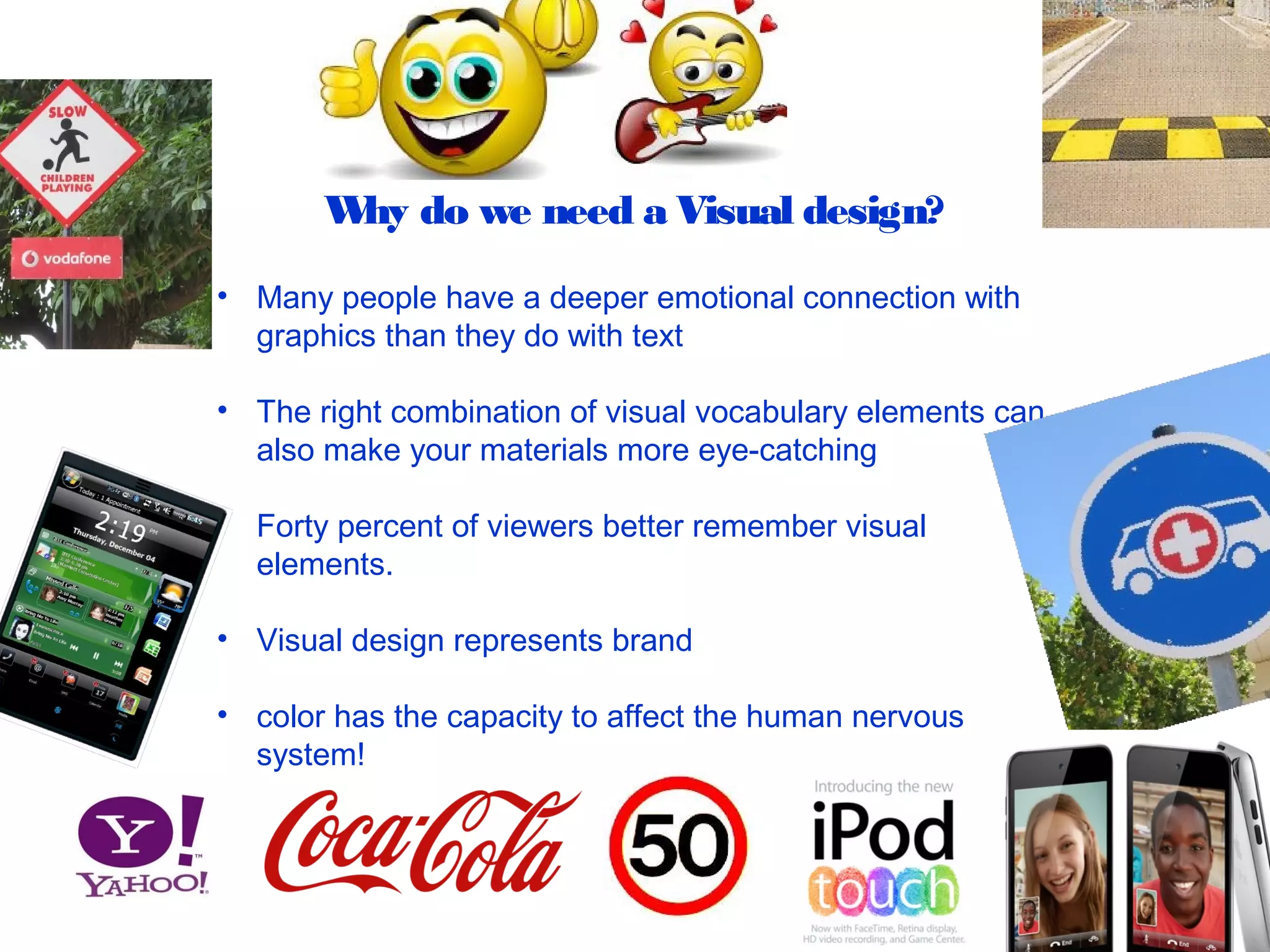
• Many people have a deeper emotional connection with
  graphics than they do with text

• The right combination of visual vocabulary elements can
  also make your materials more eye-catching

• Forty percent of viewers better remember visual
  elements.

• Visual design represents brand

• color has the capacity to affect the human nervous
  system!
Visual design in the
  process of UX.
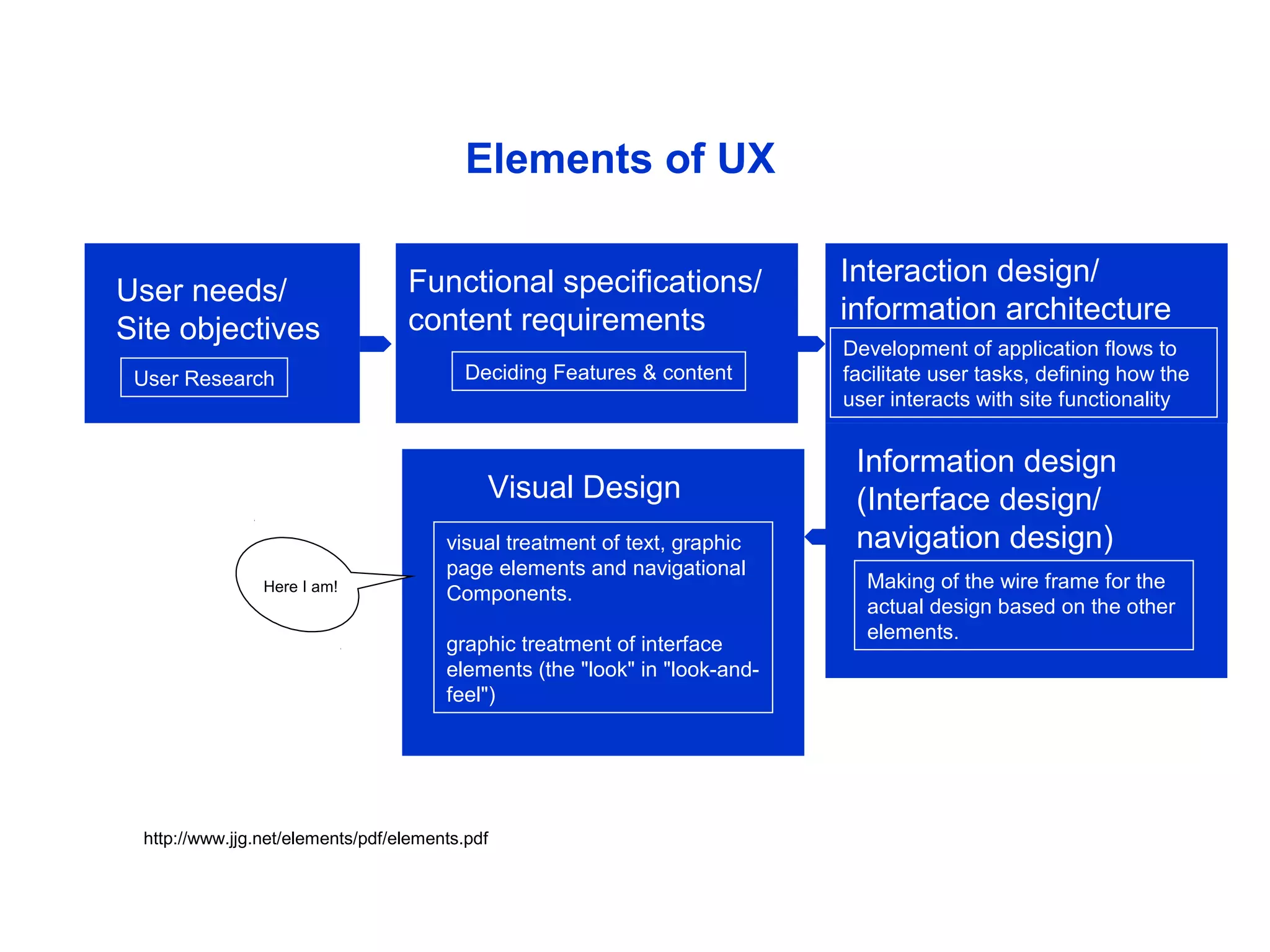
Elements of UX

                                   Functional specifications/                Interaction design/
User needs/
                                   content requirements                      information architecture
Site objectives
                                                                             Development of application flows to
 User Research                             Deciding Features & content       facilitate user tasks, defining how the
                                                                             user interacts with site functionality


                                                                              Information design
                                             Visual Design                    (Interface design/
                                        visual treatment of text, graphic     navigation design)
                                        page elements and navigational
                 Here I am!                                                    Making of the wire frame for the
                                        Components.
                                                                               actual design based on the other
                                                                               elements.
                                        graphic treatment of interface
                                        elements (the "look" in "look-and-
                                        feel")


  http://www.jjg.net/elements/pdf/elements.pdf
Elements of Visual design
                        •Line
                        •Shape
                        •Form –light & Dark
                        •Color
                        •Texture
                        •Composition
                        •Unity
                        •Dominance & Subordination
                        •Coherence
                        •Balance
                        •Positive and Negative Space
                        •Rhythm
                        •Proportion—Golden ratio & rule of thirds
                        •Chaos – Simplicity Vs Complexity


http://photoinf.com/General/Robert_Berdan/Composition_and_the_Elements_of_Visual_Design.htm
Line                                           Shape                                            Form –light & Dark


A line represents a "path" between two         Shapes are the result of closed lines. Some      Form refers to the three-dimensional quality
points. A line can be straight, curved,        primary shapes include circles, squares,         of an object, which is due in part to light,
vertical, horizontal, diagonal, or zigzag.     triangles and hexagons all of which appear       and dark areas. When light from a single
Lines imply motion and suggest direction or    in nature in some form or another.               direction (e.g. our sun) hits an object, part of
orientation                                                                                     the object is in shadow. Light and dark
                                                                                                areas within an image provide contrast that
                                                                                                can suggest volume


Color                                          Texture                                          Composition


Color affects us emotionally, with different   Texture refers to the surface quality or         Organizing the various elements within the
colors evoking different emotions. In short    "feel" of an object - smooth, rough, soft, etc   frame
color has the capacity to affect the human
nervous system.
Dominance & Subordination
                                                                                                  Coherence
Unity                   Unity in design is
                        achieved primarily
                        through placement
                        in your layout. But it
                        can also be
                        achieved through
                        margin and padding       Making an element dominant can be done
                        changes to the           through size and color. Large objects
                        elements.                dominate smaller ones and warm colored
Unity refers to an ordering of all elements in   objects dominate cooler pale colored
an image so that each contributes to a           objects                                          Coherence refers to the belonging together
                                                                                                  or the various parts of the artwork. In reality
unified aesthetic effect so that the image is
seen as a whole.
                                                  Positive and                                    these parts may be unrelated, but within the
                                                  Negative Space                                  confines of the image their color, shapes,
                                                                                                  and size form a sense of unity. Visual
                                                                                                  coherence can be achieved through the use
                                                                                                  of analogous color and color tonality.
Balance

                                                   Positive space is where shapes and forms
                                                   exist; negative space is the empty space
                                                   around shapes and forms                        Proportion—
                                                                                                  Golden ratio & rule of thirds

Balance implies that the visual elements          Rhythm
within the frame have a sense of weight.
Large objects generally weigh more than
small objects and dark objects weigh more
than light colored objects. The position of
the elements is also critical.
                                                                                                  Proportion refers the size relationship of
                                                                                                  visual elements to each other and to the
http://www.google.com/logos/logos00-1.html
                                                                                                  whole picture.
                                                   Rhythm refers to the regular repeating
                                                   occurrence of elements in the scene just as
                                                   in music it refers to the regular occurrence
                                                   of certain musical notes over time.
And Typography
And Icons
Where can you feel the role
   of a Visual designer?

•Websites
•Music players
•Mailers
•Cell phones/ PDAs
•Internet browsers
•OS
•Tools used for coding and documentation
What does a typical visual designer do?

•Design logos, icons, graphics, website layouts,
animations, add special fx, branding.
•Anything related to the colors, lines and shapes, font etc.
•Illustrates the world of imagination
•Brings product and branding together.

 “A web/ software application without involvement of a
 visual designer is like a dish without salt.”
Design tools

Raster   Adobe Photoshop
Vector   Illustrator
Vector   Flash
Vector   Corel Draw
Vector   MS Expression Design/ Blend
Vector   Gimp (Freeware)
         InkScape
         MS Paint
         PowerPoint
         Etc.
Why use Design tools?

   Visual Studio 2010


             Click me


•Visual treatment of text, graphic page elements and
navigational components.

•Graphic treatment of interface elements (the "look" in
"look-and-feel")
Popular image file formats
JPEG (Joint Photographic Experts
Group)
•Big images
•photographs
•Doesn’t support transparency
•Doesn’t support animation


GIF (Graphics Interchange Format)
•Small images
•Supports animations
•Interlace
•Less colors
•Less file size
•Supports transparency


PNG (Portable Network Graphics format)
•Doesn’t support animation
•Interlace
•Big file size
•Best for transparent images.
Types of font


         Serif                  Sans serif

Times New Roman, Georgia,   Arial, Verdana, Tahoma etc
Garamond, etc


    I am                        I am
    Serif                       Sans
                                serif
These things
        make the
        difference.


I am
Serif
Grid

•   A pattern of regularly spaced horizontal and vertical
    lines

•   Grid helps us to create a structured and professional
    page and to place the elements in an order

•   If we follow grid system, our design/ layout
    automatically looks good, clean and appealing
Photoshop
• Adobe Photoshop is a graphics editing program developed and published by
  Adobe Systems Incorporated.
• Photographers, Graphic designers, web designers, 3D artists, animators, Video
  editors etc. are the main users of the Photoshop.
• Latest version of Photoshop is Adobe CS5
Toolbar
Layers
Why do we use Photoshop (or any other design tool)?


      • To create rich graphics

      • To visualize the things

      • To format pictures, crop and size them and
        balance the tone and color.

      • Because it has
        number of tools.
What do we do in Photoshop?


      • We take the advantage
        of gradiances, filters,
        FX, blending options,
        styles, predefined
        shapes etc to create or
        enhance the
Some online resources for Photoshop lovers


         •   psd.tutplus.com
         •   smashingmagazine.com
         •   webdesignerdepot.com
         •   basicphotoshop.com/basicps.htm

Elements of Visual Design

  • 1.
  • 2.
  • 3.
  • 4.
    “Design is allabout visually telling your story to someone else.”
  • 5.
    W do weneed a Visual design? hy • Many people have a deeper emotional connection with graphics than they do with text • The right combination of visual vocabulary elements can also make your materials more eye-catching • Forty percent of viewers better remember visual elements. • Visual design represents brand • color has the capacity to affect the human nervous system!
  • 6.
    Visual design inthe process of UX.
  • 7.
    Elements of UX Functional specifications/ Interaction design/ User needs/ content requirements information architecture Site objectives Development of application flows to User Research Deciding Features & content facilitate user tasks, defining how the user interacts with site functionality Information design Visual Design (Interface design/ visual treatment of text, graphic navigation design) page elements and navigational Here I am! Making of the wire frame for the Components. actual design based on the other elements. graphic treatment of interface elements (the "look" in "look-and- feel") http://www.jjg.net/elements/pdf/elements.pdf
  • 8.
    Elements of Visualdesign •Line •Shape •Form –light & Dark •Color •Texture •Composition •Unity •Dominance & Subordination •Coherence •Balance •Positive and Negative Space •Rhythm •Proportion—Golden ratio & rule of thirds •Chaos – Simplicity Vs Complexity http://photoinf.com/General/Robert_Berdan/Composition_and_the_Elements_of_Visual_Design.htm
  • 9.
    Line Shape Form –light & Dark A line represents a "path" between two Shapes are the result of closed lines. Some Form refers to the three-dimensional quality points. A line can be straight, curved, primary shapes include circles, squares, of an object, which is due in part to light, vertical, horizontal, diagonal, or zigzag. triangles and hexagons all of which appear and dark areas. When light from a single Lines imply motion and suggest direction or in nature in some form or another. direction (e.g. our sun) hits an object, part of orientation the object is in shadow. Light and dark areas within an image provide contrast that can suggest volume Color Texture Composition Color affects us emotionally, with different Texture refers to the surface quality or Organizing the various elements within the colors evoking different emotions. In short "feel" of an object - smooth, rough, soft, etc frame color has the capacity to affect the human nervous system.
  • 10.
    Dominance & Subordination Coherence Unity Unity in design is achieved primarily through placement in your layout. But it can also be achieved through margin and padding Making an element dominant can be done changes to the through size and color. Large objects elements. dominate smaller ones and warm colored Unity refers to an ordering of all elements in objects dominate cooler pale colored an image so that each contributes to a objects Coherence refers to the belonging together or the various parts of the artwork. In reality unified aesthetic effect so that the image is seen as a whole. Positive and these parts may be unrelated, but within the Negative Space confines of the image their color, shapes, and size form a sense of unity. Visual coherence can be achieved through the use of analogous color and color tonality. Balance Positive space is where shapes and forms exist; negative space is the empty space around shapes and forms Proportion— Golden ratio & rule of thirds Balance implies that the visual elements Rhythm within the frame have a sense of weight. Large objects generally weigh more than small objects and dark objects weigh more than light colored objects. The position of the elements is also critical. Proportion refers the size relationship of visual elements to each other and to the http://www.google.com/logos/logos00-1.html whole picture. Rhythm refers to the regular repeating occurrence of elements in the scene just as in music it refers to the regular occurrence of certain musical notes over time.
  • 11.
  • 12.
  • 13.
    Where can youfeel the role of a Visual designer? •Websites •Music players •Mailers •Cell phones/ PDAs •Internet browsers •OS •Tools used for coding and documentation
  • 14.
    What does atypical visual designer do? •Design logos, icons, graphics, website layouts, animations, add special fx, branding. •Anything related to the colors, lines and shapes, font etc. •Illustrates the world of imagination •Brings product and branding together. “A web/ software application without involvement of a visual designer is like a dish without salt.”
  • 15.
    Design tools Raster Adobe Photoshop Vector Illustrator Vector Flash Vector Corel Draw Vector MS Expression Design/ Blend Vector Gimp (Freeware) InkScape MS Paint PowerPoint Etc.
  • 16.
    Why use Designtools? Visual Studio 2010 Click me •Visual treatment of text, graphic page elements and navigational components. •Graphic treatment of interface elements (the "look" in "look-and-feel")
  • 17.
    Popular image fileformats JPEG (Joint Photographic Experts Group) •Big images •photographs •Doesn’t support transparency •Doesn’t support animation GIF (Graphics Interchange Format) •Small images •Supports animations •Interlace •Less colors •Less file size •Supports transparency PNG (Portable Network Graphics format) •Doesn’t support animation •Interlace •Big file size •Best for transparent images.
  • 18.
    Types of font Serif Sans serif Times New Roman, Georgia, Arial, Verdana, Tahoma etc Garamond, etc I am I am Serif Sans serif
  • 19.
    These things make the difference. I am Serif
  • 20.
    Grid • A pattern of regularly spaced horizontal and vertical lines • Grid helps us to create a structured and professional page and to place the elements in an order • If we follow grid system, our design/ layout automatically looks good, clean and appealing
  • 22.
    Photoshop • Adobe Photoshopis a graphics editing program developed and published by Adobe Systems Incorporated. • Photographers, Graphic designers, web designers, 3D artists, animators, Video editors etc. are the main users of the Photoshop. • Latest version of Photoshop is Adobe CS5
  • 24.
  • 25.
  • 33.
    Why do weuse Photoshop (or any other design tool)? • To create rich graphics • To visualize the things • To format pictures, crop and size them and balance the tone and color. • Because it has number of tools.
  • 34.
    What do wedo in Photoshop? • We take the advantage of gradiances, filters, FX, blending options, styles, predefined shapes etc to create or enhance the
  • 35.
    Some online resourcesfor Photoshop lovers • psd.tutplus.com • smashingmagazine.com • webdesignerdepot.com • basicphotoshop.com/basicps.htm