UNIT 1
FORMAL
ELEMENTS
OF IMAGES
0 - INTRODUCTION
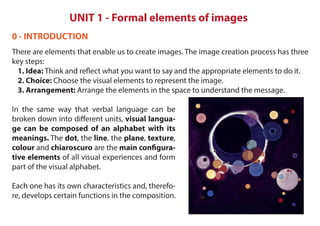
There are elements that enable us to create images. The image creation process has three
key steps:
1. Idea: Think and reflect what you want to say and the appropriate elements to do it.
2. Choice: Choose the visual elements to represent the image.
3. Arrangement: Arrange the elements in the space to understand the message.
In the same way that verbal language can be
broken down into different units, visual langua-
ge can be composed of an alphabet with its
meanings. The dot, the line, the plane, texture,
colour and chiaroscuro are the main configura-
tive elements of all visual experiences and form
part of the visual alphabet.
Each one has its own characteristics and, therefo-
re, develops certain functions in the composition.
UNIT 1 - Formal elements of images
1 - DOTS
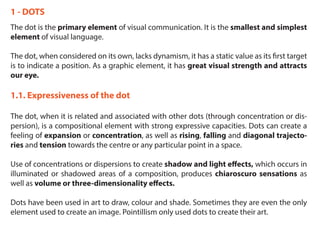
The dot is the primary element of visual communication. It is the smallest and simplest
element of visual language.
The dot, when considered on its own, lacks dynamism, it has a static value as its first target
is to indicate a position. As a graphic element, it has great visual strength and attracts
our eye.
1.1. Expressiveness of the dot
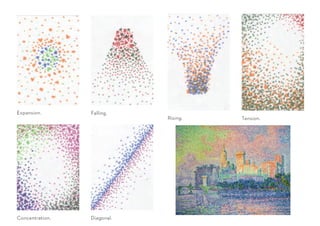
The dot, when it is related and associated with other dots (through concentration or dis-
persion), is a compositional element with strong expressive capacities. Dots can create a
feeling of expansion or concentration, as well as rising, falling and diagonal trajecto-
ries and tension towards the centre or any particular point in a space.
Use of concentrations or dispersions to create shadow and light effects, which occurs in
illuminated or shadowed areas of a composition, produces chiaroscuro sensations as
well as volume or three-dimensionality effects.
Dots have been used in art to draw, colour and shade. Sometimes they are even the only
element used to create an image. Pointillism only used dots to create their art.
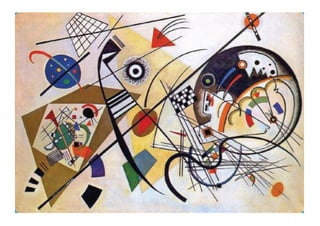
2 - LINE
The line is defined as the moving dot, as the link between dots, or the story of the moving
dot. Indeed, it represents the change from repose to movement. It is never static. It repre-
sents the basic visual element of the sketch or outline. It has one dimension, which is
length.
2.1. Line functions
The line is considered to be the basis of a drawing, so many artists use only this element in
making their images. The most important function of a line is the visual meaning that it
provides thanks to:
• Direction: Every line works as a vector of direction; lines give images dynamism and de-
termine their reading direction.
• Spatial distribution: Lines separate planes and spaces, giving every surface different
graphic qualities.
• Volume: The modulation of a line’s tone and thickness gives tension to shapes and ob-
jects. Shadowing allows us to create a sense of three dimensional volume in two dimensio-
nal spaces.
• Depth: The line gives a scene depth when it is placed on a diagonal direction.
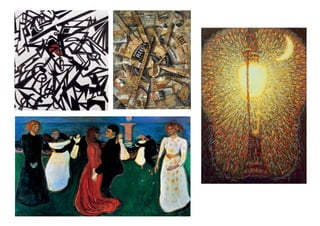
2.2. Line expressiveness
The line has the expressive and symbolic power to transmit concepts and sensations such
as spirituality, elegance, relaxation, stability, movement and dynamism.
• Straight: They suggest rigidity, precision and constancy.
• Vertical: They represent the link between the sky (above) and the ground (below). They
express spirituality and elegance.
• Horizontal: These lines show fidelity to things on Earth; if parallel to the ground, they
transmit repose and stability.
• Inclined: These denote movement, decision and willingness. If the direction goes down
from left to right, it indicates descent. If it goes down from right to left, it means a fall or a
tragedy.
• Curved: These lines produce a feeling of movement, action and dynamism because they
continuously change direction.
• Radial: These suggest light, explosion, and luminosity.
• Broken: These lines have a zigzag shape and sharply change direction, transmitting im-
balance, chaos and lack of organisation. They give a sense of contradiction and pain.
• Convergent: All the lines go towards a point or area of maximum attention. They force us
to look directly at this area and create a focal point of tension. Concentric lines and spirals
convey concentration.
3 - SHAPE
Shape is a two-dimension (length and width) area or mass which defines objects in
space. These objects can be defined by colour contrast, by different textures or they can
be delimited by contour lines. In this last case shape is the area of a surface within a closed
line.
3.1. Types of the shape
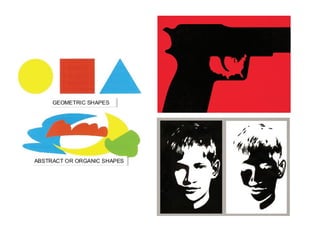
Geometric: shapes which parts follow a mathematical order, law or pattern.They can
transmit strong visual sensations of order and stability.
Organic: shapes that have irregular profile.They give a visual sensation of more dynamism
than geometric forms.
Open shapes: shapes that are not completely enclosed by a line. Usually the content of
these shapes comes out to get mixed with other elements or the background.
Closed shapes: shapes that are completely enclosed by a line or unbroken contour.
Positive shapes: the objects or figure on which the viewer focuses.
Negative shapes: the empty space (or the space filled with other imagery) left over in
the art work.
3.2. Shape´s uses
To create the sensation of tridimensional space by suggesting visual sensation of distance
and closeness by:
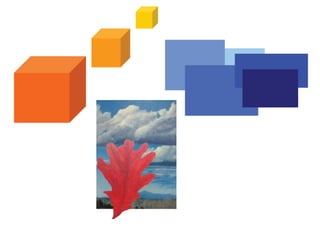
• Changing shape´s size
The increase or decrease of the size of one shape to another, simulates a spatial distance
between them.
• Overlapping shapes
When a shape overlaps partially to another it seems to be forward.
• Contrasting coloured shapes
Warm colors tend to come closer and cold colors seem more distant in space.
3.3. Shape expressiveness
Shapes can transmit and produce a variety of visual sensations. We can distribute ithem
either horizontally, vertically or diagonally. Sensations or visual effects can therefore be ob-
tained of calm, stillness, rising vertical tension or a certain degree of dynamism and move-
ment and possibly imbalance.
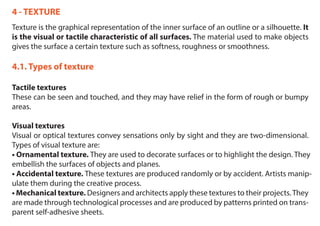
4 - TEXTURE
Texture is the graphical representation of the inner surface of an outline or a silhouette. It
is the visual or tactile characteristic of all surfaces. The material used to make objects
gives the surface a certain texture such as softness, roughness or smoothness.
4.1. Types of texture
Tactile textures
These can be seen and touched, and they may have relief in the form of rough or bumpy
areas.
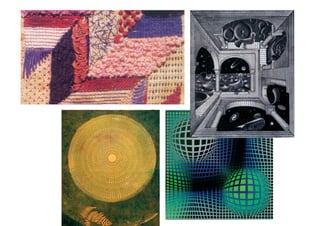
Visual textures
Visual or optical textures convey sensations only by sight and they are two-dimensional.
Types of visual texture are:
• Ornamental texture. They are used to decorate surfaces or to highlight the design. They
embellish the surfaces of objects and planes.
• Accidental texture. These textures are produced randomly or by accident. Artists manip-
ulate them during the creative process.
• Mechanical texture. Designers and architects apply these textures to their projects.They
are made through technological processes and are produced by patterns printed on trans-
parent self-adhesive sheets.
Formal elements of images

Formal elements of images

  • 1.
  • 2.
    0 - INTRODUCTION Thereare elements that enable us to create images. The image creation process has three key steps: 1. Idea: Think and reflect what you want to say and the appropriate elements to do it. 2. Choice: Choose the visual elements to represent the image. 3. Arrangement: Arrange the elements in the space to understand the message. In the same way that verbal language can be broken down into different units, visual langua- ge can be composed of an alphabet with its meanings. The dot, the line, the plane, texture, colour and chiaroscuro are the main configura- tive elements of all visual experiences and form part of the visual alphabet. Each one has its own characteristics and, therefo- re, develops certain functions in the composition. UNIT 1 - Formal elements of images
  • 3.
    1 - DOTS Thedot is the primary element of visual communication. It is the smallest and simplest element of visual language. The dot, when considered on its own, lacks dynamism, it has a static value as its first target is to indicate a position. As a graphic element, it has great visual strength and attracts our eye. 1.1. Expressiveness of the dot The dot, when it is related and associated with other dots (through concentration or dis- persion), is a compositional element with strong expressive capacities. Dots can create a feeling of expansion or concentration, as well as rising, falling and diagonal trajecto- ries and tension towards the centre or any particular point in a space. Use of concentrations or dispersions to create shadow and light effects, which occurs in illuminated or shadowed areas of a composition, produces chiaroscuro sensations as well as volume or three-dimensionality effects. Dots have been used in art to draw, colour and shade. Sometimes they are even the only element used to create an image. Pointillism only used dots to create their art.
  • 5.
    2 - LINE Theline is defined as the moving dot, as the link between dots, or the story of the moving dot. Indeed, it represents the change from repose to movement. It is never static. It repre- sents the basic visual element of the sketch or outline. It has one dimension, which is length. 2.1. Line functions The line is considered to be the basis of a drawing, so many artists use only this element in making their images. The most important function of a line is the visual meaning that it provides thanks to: • Direction: Every line works as a vector of direction; lines give images dynamism and de- termine their reading direction. • Spatial distribution: Lines separate planes and spaces, giving every surface different graphic qualities. • Volume: The modulation of a line’s tone and thickness gives tension to shapes and ob- jects. Shadowing allows us to create a sense of three dimensional volume in two dimensio- nal spaces. • Depth: The line gives a scene depth when it is placed on a diagonal direction.
  • 7.
    2.2. Line expressiveness Theline has the expressive and symbolic power to transmit concepts and sensations such as spirituality, elegance, relaxation, stability, movement and dynamism. • Straight: They suggest rigidity, precision and constancy. • Vertical: They represent the link between the sky (above) and the ground (below). They express spirituality and elegance. • Horizontal: These lines show fidelity to things on Earth; if parallel to the ground, they transmit repose and stability. • Inclined: These denote movement, decision and willingness. If the direction goes down from left to right, it indicates descent. If it goes down from right to left, it means a fall or a tragedy. • Curved: These lines produce a feeling of movement, action and dynamism because they continuously change direction. • Radial: These suggest light, explosion, and luminosity. • Broken: These lines have a zigzag shape and sharply change direction, transmitting im- balance, chaos and lack of organisation. They give a sense of contradiction and pain. • Convergent: All the lines go towards a point or area of maximum attention. They force us to look directly at this area and create a focal point of tension. Concentric lines and spirals convey concentration.
  • 9.
    3 - SHAPE Shapeis a two-dimension (length and width) area or mass which defines objects in space. These objects can be defined by colour contrast, by different textures or they can be delimited by contour lines. In this last case shape is the area of a surface within a closed line. 3.1. Types of the shape Geometric: shapes which parts follow a mathematical order, law or pattern.They can transmit strong visual sensations of order and stability. Organic: shapes that have irregular profile.They give a visual sensation of more dynamism than geometric forms. Open shapes: shapes that are not completely enclosed by a line. Usually the content of these shapes comes out to get mixed with other elements or the background. Closed shapes: shapes that are completely enclosed by a line or unbroken contour. Positive shapes: the objects or figure on which the viewer focuses. Negative shapes: the empty space (or the space filled with other imagery) left over in the art work.
  • 11.
    3.2. Shape´s uses Tocreate the sensation of tridimensional space by suggesting visual sensation of distance and closeness by: • Changing shape´s size The increase or decrease of the size of one shape to another, simulates a spatial distance between them. • Overlapping shapes When a shape overlaps partially to another it seems to be forward. • Contrasting coloured shapes Warm colors tend to come closer and cold colors seem more distant in space. 3.3. Shape expressiveness Shapes can transmit and produce a variety of visual sensations. We can distribute ithem either horizontally, vertically or diagonally. Sensations or visual effects can therefore be ob- tained of calm, stillness, rising vertical tension or a certain degree of dynamism and move- ment and possibly imbalance.
  • 13.
    4 - TEXTURE Textureis the graphical representation of the inner surface of an outline or a silhouette. It is the visual or tactile characteristic of all surfaces. The material used to make objects gives the surface a certain texture such as softness, roughness or smoothness. 4.1. Types of texture Tactile textures These can be seen and touched, and they may have relief in the form of rough or bumpy areas. Visual textures Visual or optical textures convey sensations only by sight and they are two-dimensional. Types of visual texture are: • Ornamental texture. They are used to decorate surfaces or to highlight the design. They embellish the surfaces of objects and planes. • Accidental texture. These textures are produced randomly or by accident. Artists manip- ulate them during the creative process. • Mechanical texture. Designers and architects apply these textures to their projects.They are made through technological processes and are produced by patterns printed on trans- parent self-adhesive sheets.