A GIS-based approach to
characterize urbanization at the
sub-watershed scale
in Mill Creek,OH
Jaleann M. Matos-Mc
Clurg
Talk Outline
 Purpose
 Data and Scales of Analysis
 Study Area
 Research Framework
 Research Questions
 Data Sources
 GIS Data Manipulation
 Maps
 Metadata Discussion
 LULC Reclassification Strategy
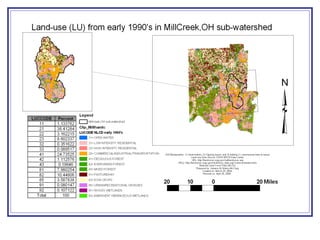
 More Maps
 Remote Sensing & GIS
 Future Work
Purpose
 To characterize urbanization growth with
two landscape-based indicators:
 (1) Population density (people/mi2
)
 (2) Land-use/Land-cover (LULC)
Data and Scales of Analysis
 Sub-watershed scale
 Population density by census tracts
 Land-cover (County & Sub-watershed scale)
 LULC- “crude classification” without user changes
 LULC data – Reclassification*
 LC change“stats” & display*
* Sub-watershed scale only
Research Framework
 Goal: Characterize urbanization.
 Increase of average population at sub-
watershed scale since 1920’s from cities
and townships.
 LULC changes could trigger disturbance of
hydrological flows and pathways.
 Temporal growth of impervious surface
areas (ISAs) as urbanization expands.
Research Questions
 (1) What is the spatial-temporal dynamic of
urbanization at the sub-watershed and county
scales?
 (2) Does a population density or land-cover
based approach help describe urban change?
 (3) How does the spatial-temporal
characterization of urbanization at the sub-
watershed scale relate to changes in the
hydrological flow regime? (Master Thesis Main RQ)
Data Sources
 Census Tract Data (1970-2000)-Geolytics, Inc.
 Land-use/Land-cover (LULC)
 Data
 USGS EROS Data Center (EDC)
 Historical LULC derived from 1970’s and 1980’s
aerial photography.
 National Land-cover Dataset (NLCD) derived from
early 1990’s using Landsat TM satellite images.
 USGS EDC
 NALC triplicates – Landsat MSS satellite data.
GIS Data Manipulation
Geo-processing
Operations
“Clipping”
Calculate
& Recalculate
Area using
Xtools
Export
Data to Excel
Import Utility 71
(.e00)
Arc Toolbox: Define
PCS and GCS
“if undefined”
Reproject Data
Raster Calculator
Operations
Attribute Data
Manipulation
& Use of
display “rules”
Vectorization
Add summarized
“stats” to layout
Spatial Analyst:Reclassify
Maps
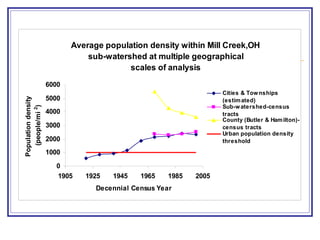
Average population density within Mill Creek,OH
sub-watershed at multiple geographical
scales of analysis
0
1000
2000
3000
4000
5000
6000
1905 1925 1945 1965 1985 2005
Decennial Census Year
Populationdensity
(people/mi2
)
Cities & Townships
(estimated)
Sub-watershed-census
tracts
County (Butler & Hamilton)-
census tracts
Urban population density
threshold
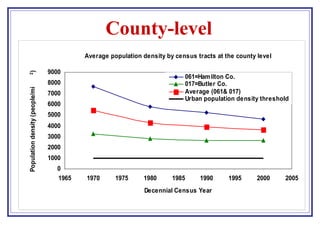
County-level
Average population density by census tracts at the county level
0
1000
2000
3000
4000
5000
6000
7000
8000
9000
1965 1970 1975 1980 1985 1990 1995 2000 2005
Decennial Census Year
Populationdensity(people/mi2)
061=Hamilton Co.
017=Butler Co.
Average (061& 017)
Urban population density threshold
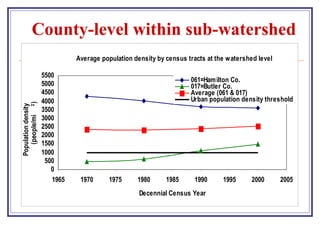
County-level within sub-watershed
Average population density by census tracts at the watershed level
0
500
1000
1500
2000
2500
3000
3500
4000
4500
5000
5500
1965 1970 1975 1980 1985 1990 1995 2000 2005
Decennial Census Year
Populationdensity
(people/mi2)
061=Hamilton Co.
017=Butler Co.
Average (061 & 017)
Urban population density threshold
Metadata Discussion
 Useful to get information about spatial data
in general.
 For example …PCS, GCS, data quality,
intended applications, etc.
 Often, LULC data has different LULC
classification schemes.
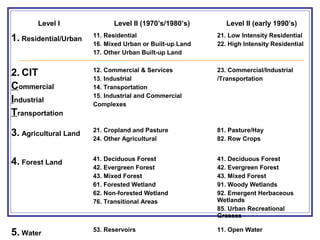
 I compiled a “summary table” from LULC
and NLCD classification schemes.
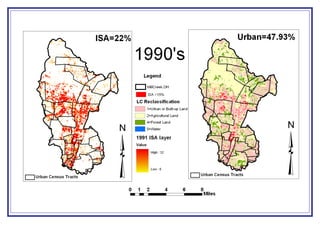
LULC Reclassification
Strategy
Goal: Translate LULC into more
“condensed” LULC classes
Level I Level II (1970’s/1980’s) Level II (early 1990’s)
1. Residential/Urban
11. Residential
16. Mixed Urban or Built-up Land
17. Other Urban Built-up Land
21. Low Intensity Residential
22. High Intensity Residential
2. CIT
Commercial
Industrial
Transportation
12. Commercial & Services
13. Industrial
14. Transportation
15. Industrial and Commercial
Complexes
23. Commercial/Industrial
/Transportation
3. Agricultural Land
21. Cropland and Pasture
24. Other Agricultural
81. Pasture/Hay
82. Row Crops
4. Forest Land
41. Deciduous Forest
42. Evergreen Forest
43. Mixed Forest
61. Forested Wetland
62. Non-forested Wetland
76. Transitional Areas
41. Deciduous Forest
42. Evergreen Forest
43. Mixed Forest
91. Woody Wetlands
92. Emergent Herbaceous
Wetlands
85. Urban Recreational
Grasses
5. Water
53. Reservoirs 11. Open Water
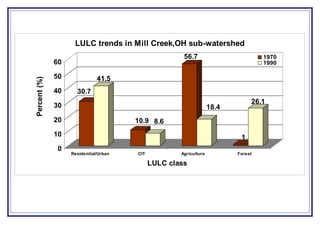
30.7
41.5
10.9 8.6
56.7
18.4
1
26.1
0
10
20
30
40
50
60
Percent(%)
Residential/Urban CIT Agriculture Forest
LULC class
LULC trends in Mill Creek,OH sub-watershed
1970
1990
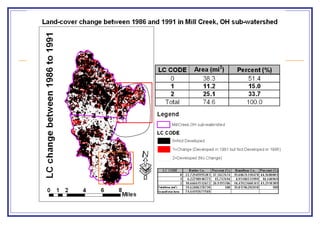
Remote Sensing & GIS
1994 DOQQ’s
(Ancillary Data)
Unsupervised
Classification
w/ 30 classes
Classify to generate
“Binary Masks”
0=Undeveloped
1=Developed
Model Builder:
1991_bm+1986_bm=LC CHANGE 86-91
Remote
Sensing
GIS: Characterize LC change
Raster Calculator
1991_bm+1986_bm
= LC Change 86-91
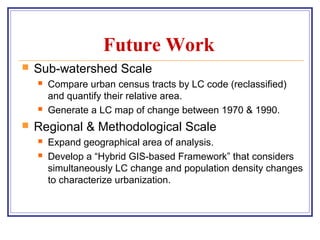
Future Work
 Sub-watershed Scale
 Compare urban census tracts by LC code (reclassified)
and quantify their relative area.
 Generate a LC map of change between 1970 & 1990.
 Regional & Methodological Scale
 Expand geographical area of analysis.
 Develop a “Hybrid GIS-based Framework” that considers
simultaneously LC change and population density changes
to characterize urbanization.
Questions/Suggestions?

Visual analysis and pattern recognition using gis and remote sensing techniques presentation skills

  • 1.
    A GIS-based approachto characterize urbanization at the sub-watershed scale in Mill Creek,OH Jaleann M. Matos-Mc Clurg
  • 2.
    Talk Outline  Purpose Data and Scales of Analysis  Study Area  Research Framework  Research Questions  Data Sources  GIS Data Manipulation  Maps  Metadata Discussion  LULC Reclassification Strategy  More Maps  Remote Sensing & GIS  Future Work
  • 3.
    Purpose  To characterizeurbanization growth with two landscape-based indicators:  (1) Population density (people/mi2 )  (2) Land-use/Land-cover (LULC)
  • 4.
    Data and Scalesof Analysis  Sub-watershed scale  Population density by census tracts  Land-cover (County & Sub-watershed scale)  LULC- “crude classification” without user changes  LULC data – Reclassification*  LC change“stats” & display* * Sub-watershed scale only
  • 6.
    Research Framework  Goal:Characterize urbanization.  Increase of average population at sub- watershed scale since 1920’s from cities and townships.  LULC changes could trigger disturbance of hydrological flows and pathways.  Temporal growth of impervious surface areas (ISAs) as urbanization expands.
  • 7.
    Research Questions  (1)What is the spatial-temporal dynamic of urbanization at the sub-watershed and county scales?  (2) Does a population density or land-cover based approach help describe urban change?  (3) How does the spatial-temporal characterization of urbanization at the sub- watershed scale relate to changes in the hydrological flow regime? (Master Thesis Main RQ)
  • 8.
    Data Sources  CensusTract Data (1970-2000)-Geolytics, Inc.  Land-use/Land-cover (LULC)  Data  USGS EROS Data Center (EDC)  Historical LULC derived from 1970’s and 1980’s aerial photography.  National Land-cover Dataset (NLCD) derived from early 1990’s using Landsat TM satellite images.  USGS EDC  NALC triplicates – Landsat MSS satellite data.
  • 9.
    GIS Data Manipulation Geo-processing Operations “Clipping” Calculate &Recalculate Area using Xtools Export Data to Excel Import Utility 71 (.e00) Arc Toolbox: Define PCS and GCS “if undefined” Reproject Data Raster Calculator Operations Attribute Data Manipulation & Use of display “rules” Vectorization Add summarized “stats” to layout Spatial Analyst:Reclassify
  • 10.
  • 12.
    Average population densitywithin Mill Creek,OH sub-watershed at multiple geographical scales of analysis 0 1000 2000 3000 4000 5000 6000 1905 1925 1945 1965 1985 2005 Decennial Census Year Populationdensity (people/mi2 ) Cities & Townships (estimated) Sub-watershed-census tracts County (Butler & Hamilton)- census tracts Urban population density threshold
  • 13.
    County-level Average population densityby census tracts at the county level 0 1000 2000 3000 4000 5000 6000 7000 8000 9000 1965 1970 1975 1980 1985 1990 1995 2000 2005 Decennial Census Year Populationdensity(people/mi2) 061=Hamilton Co. 017=Butler Co. Average (061& 017) Urban population density threshold
  • 14.
    County-level within sub-watershed Averagepopulation density by census tracts at the watershed level 0 500 1000 1500 2000 2500 3000 3500 4000 4500 5000 5500 1965 1970 1975 1980 1985 1990 1995 2000 2005 Decennial Census Year Populationdensity (people/mi2) 061=Hamilton Co. 017=Butler Co. Average (061 & 017) Urban population density threshold
  • 17.
    Metadata Discussion  Usefulto get information about spatial data in general.  For example …PCS, GCS, data quality, intended applications, etc.  Often, LULC data has different LULC classification schemes.  I compiled a “summary table” from LULC and NLCD classification schemes.
  • 18.
    LULC Reclassification Strategy Goal: TranslateLULC into more “condensed” LULC classes
  • 19.
    Level I LevelII (1970’s/1980’s) Level II (early 1990’s) 1. Residential/Urban 11. Residential 16. Mixed Urban or Built-up Land 17. Other Urban Built-up Land 21. Low Intensity Residential 22. High Intensity Residential 2. CIT Commercial Industrial Transportation 12. Commercial & Services 13. Industrial 14. Transportation 15. Industrial and Commercial Complexes 23. Commercial/Industrial /Transportation 3. Agricultural Land 21. Cropland and Pasture 24. Other Agricultural 81. Pasture/Hay 82. Row Crops 4. Forest Land 41. Deciduous Forest 42. Evergreen Forest 43. Mixed Forest 61. Forested Wetland 62. Non-forested Wetland 76. Transitional Areas 41. Deciduous Forest 42. Evergreen Forest 43. Mixed Forest 91. Woody Wetlands 92. Emergent Herbaceous Wetlands 85. Urban Recreational Grasses 5. Water 53. Reservoirs 11. Open Water
  • 22.
    30.7 41.5 10.9 8.6 56.7 18.4 1 26.1 0 10 20 30 40 50 60 Percent(%) Residential/Urban CITAgriculture Forest LULC class LULC trends in Mill Creek,OH sub-watershed 1970 1990
  • 24.
    Remote Sensing &GIS 1994 DOQQ’s (Ancillary Data) Unsupervised Classification w/ 30 classes Classify to generate “Binary Masks” 0=Undeveloped 1=Developed Model Builder: 1991_bm+1986_bm=LC CHANGE 86-91 Remote Sensing GIS: Characterize LC change Raster Calculator 1991_bm+1986_bm = LC Change 86-91
  • 26.
    Future Work  Sub-watershedScale  Compare urban census tracts by LC code (reclassified) and quantify their relative area.  Generate a LC map of change between 1970 & 1990.  Regional & Methodological Scale  Expand geographical area of analysis.  Develop a “Hybrid GIS-based Framework” that considers simultaneously LC change and population density changes to characterize urbanization.
  • 27.