VISIBILITY GRAPHS
Gaurav Gupta (11907272)
Advanced Topics in Robotics (ME769A)
IIT Kanpur
Visibility Graphs : Introduction
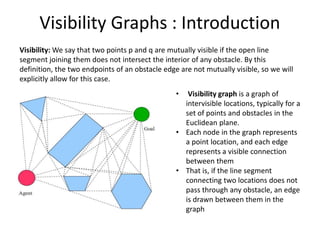
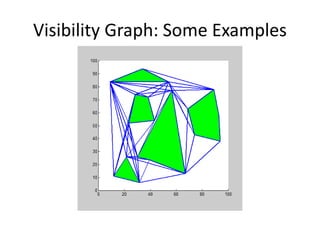
• Visibility graph is a graph of
intervisible locations, typically for a
set of points and obstacles in the
Euclidean plane.
• Each node in the graph represents
a point location, and each edge
represents a visible connection
between them
• That is, if the line segment
connecting two locations does not
pass through any obstacle, an edge
is drawn between them in the
graph
Visibility: We say that two points p and q are mutually visible if the open line
segment joining them does not intersect the interior of any obstacle. By this
definition, the two endpoints of an obstacle edge are not mutually visible, so we will
explicitly allow for this case.
Why Visibility Graphs?
Problem - We are given a set of n disjoint polygonal obstacles in the plane,
and two points s and t that lie outside of the obstacles. The problem is to
determine the shortest path from s to t that avoids the interiors of the
obstacles.
Claim - The shortest path between any two points that avoids a set of
polygonal obstacles is a polygonal curve, whose vertices are either vertices of
the obstacles or the points s and t.
Why Visibility Graphs?
Proof by contradiction
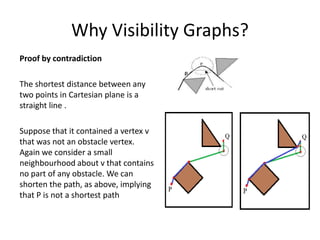
The shortest distance between any
two points in Cartesian plane is a
straight line .
Suppose that it contained a vertex v
that was not an obstacle vertex.
Again we consider a small
neighbourhood about v that contains
no part of any obstacle. We can
shorten the path, as above, implying
that P is not a shortest path
Visibility Graph Construction
• To construct the visibility graph we must determine which vertices are visible from
a vertex v , for every v.
• Naïve algorithm*:
Input – a set of vertices ni , whose edges do not intersect (N in number)
1. Join the given vertex ng to all other vertices nj . (total of N-1)
2. Check if the line segment ngnj intersects the given edges(total of N )
3. Repeat the procedure for every vertex (total of N)
Altogether the algorithm is O(n3)
• Rotational Plane Sweep Algorithm : O(n2log(n))
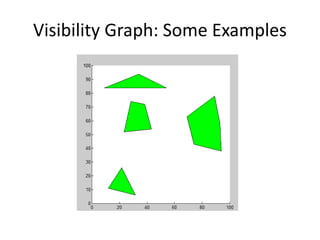
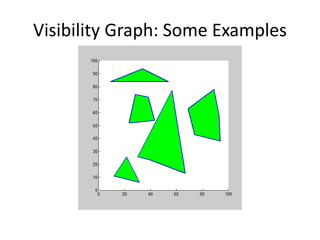
Visibility Graph: Some Examples
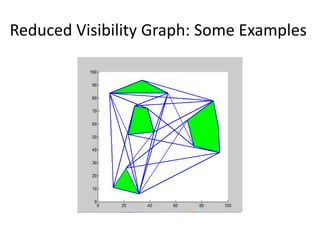
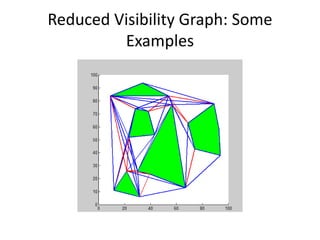
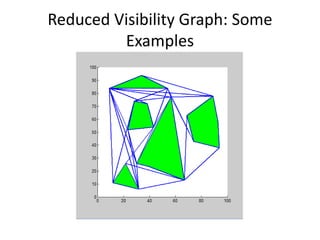
Reduced Visibility Graph
• The standard visibility graph has many
needless edges which are not going to
be used in any case.
• These are the ones that are going
towards to the obstacles
• The lines that are useful for path
planning are the ones going around
the obstacles, or passing through the
vertices that are extremes around the
obstacles.
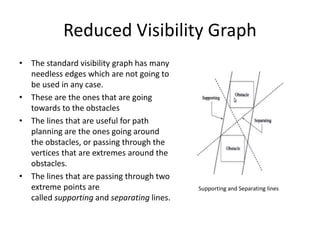
• The lines that are passing through two
extreme points are
called supporting and separating lines.
Supporting and Separating lines
Reduced Visibility Graph: Some Examples
Reduced Visibility Graph: Some
Examples
Reduced Visibility Graph: Some
Examples
References
1. https://en.wikipedia.org/wiki/Visibility_graph
2. http://cs.smith.edu/~streinu/Teaching/Courses/274/Spring98/Projects/Philip/fp/vi
sibility.htm
3. http://www.cs.wustl.edu/~pless/546/lectures/l22.html
4. Choset, Howie M. Principles of robot motion: theory, algorithms, and
implementation. MIT press, 2005.
THANK YOU

Visibility graphs

  • 1.
    VISIBILITY GRAPHS Gaurav Gupta(11907272) Advanced Topics in Robotics (ME769A) IIT Kanpur
  • 2.
    Visibility Graphs :Introduction • Visibility graph is a graph of intervisible locations, typically for a set of points and obstacles in the Euclidean plane. • Each node in the graph represents a point location, and each edge represents a visible connection between them • That is, if the line segment connecting two locations does not pass through any obstacle, an edge is drawn between them in the graph Visibility: We say that two points p and q are mutually visible if the open line segment joining them does not intersect the interior of any obstacle. By this definition, the two endpoints of an obstacle edge are not mutually visible, so we will explicitly allow for this case.
  • 3.
    Why Visibility Graphs? Problem- We are given a set of n disjoint polygonal obstacles in the plane, and two points s and t that lie outside of the obstacles. The problem is to determine the shortest path from s to t that avoids the interiors of the obstacles. Claim - The shortest path between any two points that avoids a set of polygonal obstacles is a polygonal curve, whose vertices are either vertices of the obstacles or the points s and t.
  • 4.
    Why Visibility Graphs? Proofby contradiction The shortest distance between any two points in Cartesian plane is a straight line . Suppose that it contained a vertex v that was not an obstacle vertex. Again we consider a small neighbourhood about v that contains no part of any obstacle. We can shorten the path, as above, implying that P is not a shortest path
  • 5.
    Visibility Graph Construction •To construct the visibility graph we must determine which vertices are visible from a vertex v , for every v. • Naïve algorithm*: Input – a set of vertices ni , whose edges do not intersect (N in number) 1. Join the given vertex ng to all other vertices nj . (total of N-1) 2. Check if the line segment ngnj intersects the given edges(total of N ) 3. Repeat the procedure for every vertex (total of N) Altogether the algorithm is O(n3) • Rotational Plane Sweep Algorithm : O(n2log(n))
  • 6.
  • 7.
  • 8.
  • 9.
  • 10.
    Reduced Visibility Graph •The standard visibility graph has many needless edges which are not going to be used in any case. • These are the ones that are going towards to the obstacles • The lines that are useful for path planning are the ones going around the obstacles, or passing through the vertices that are extremes around the obstacles. • The lines that are passing through two extreme points are called supporting and separating lines. Supporting and Separating lines
  • 11.
  • 12.
  • 13.
  • 14.
  • 15.
    References 1. https://en.wikipedia.org/wiki/Visibility_graph 2. http://cs.smith.edu/~streinu/Teaching/Courses/274/Spring98/Projects/Philip/fp/vi sibility.htm 3.http://www.cs.wustl.edu/~pless/546/lectures/l22.html 4. Choset, Howie M. Principles of robot motion: theory, algorithms, and implementation. MIT press, 2005.
  • 16.