Robotics
UNIT-2
End Effectors
ROBOT DRIVE SYSTEMS AND END
EFFECTORS
 Pneumatic Drives-Hydraulic Drives-Mechanical Drives-Electrical
Drives-D.C. Servo Motors, Stepper Motors, A.C. Servo Motors-
Salient Features, Applications and Comparison of all these
Drives, End Effectors-Grippers-Mechanical Grippers, Pneumatic
and Hydraulic- Grippers, Magnetic Grippers, Vacuum Grippers;
Two Fingered and Three Fingered Grippers; Internal Grippers
and External Grippers; Selection and Design Considerations.
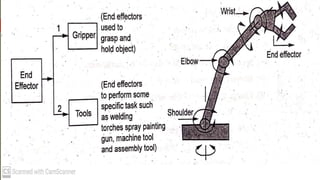
End Effectors
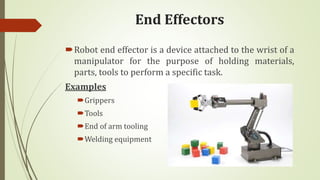
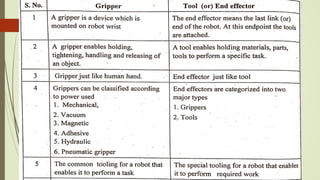
Robot end effector is a device attached to the wrist of a
manipulator for the purpose of holding materials,
parts, tools to perform a specific task.
Examples
Grippers
Tools
End of arm tooling
Welding equipment
Classification of End of arm tooling
 According to method used to hold part in the gripper
 According to special purpose process tools incorporated in final
gripper design
 According to multiple function capability of gripper
According to method used to hold part in
the gripper
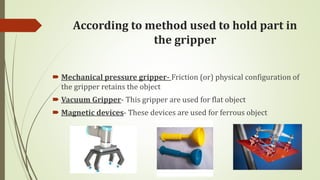
 Mechanical pressure gripper- Friction (or) physical configuration of
the gripper retains the object
 Vacuum Gripper- This gripper are used for flat object
 Magnetic devices- These devices are used for ferrous object
According to special purpose process
tools incorporated in final gripper design
 Drills
 Grinders
 Polisher
 Paint sprayers
 Welding guns and torches
According to multiple function capability
of gripper
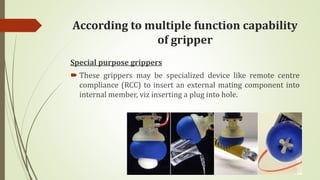
Special purpose grippers
 These grippers may be specialized device like remote centre
compliance (RCC) to insert an external mating component into
internal member, viz inserting a plug into hole.
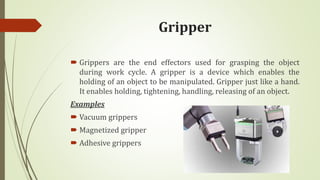
Gripper
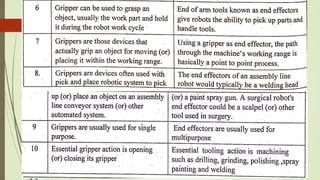
 Grippers are the end effectors used for grasping the object
during work cycle. A gripper is a device which enables the
holding of an object to be manipulated. Gripper just like a hand.
It enables holding, tightening, handling, releasing of an object.
Examples
 Vacuum grippers
 Magnetized gripper
 Adhesive grippers
Requirements of an effective gripper
 Parts (or) items must be grasped and held without damage
 Parts must be positioned firmly (or) rigidly while being operated on
 Hands (or) grippers must accommodate parts of differing sizes (or) even
of varying sizes
 Self aligning jaws are required to ensure that the load stays centred in
the jaws
 Gripping (or) end effectors must not damage the part being handed
 Jaws (or) Grippers must make contact at a minimum of two pints to
ensure that the part does not rotate while being positioned
Application of grippers
 Material handling
 Palletizing and depalletizing
 Arranging parts on to pallets
 Machine loading and unloading
 Picking and placing of parts on conveyor
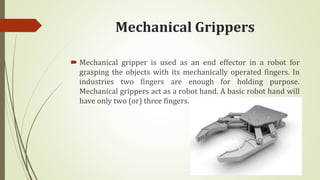
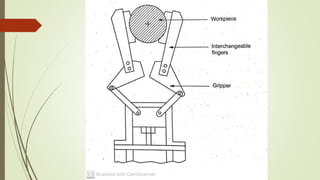
Mechanical Grippers
 Mechanical gripper is used as an end effector in a robot for
grasping the objects with its mechanically operated fingers. In
industries two fingers are enough for holding purpose.
Mechanical grippers act as a robot hand. A basic robot hand will
have only two (or) three fingers.
Features of Mechanical Grippers
 Simple to use
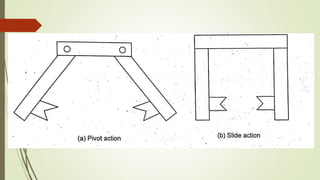
 Grip using pivoting, linear (or) translation movement
 Pneumatic control is cost effective and simple to maintain
 Servo controls can be used where precise controlled gripper
movement is required
Advantages of Mechanical Grippers
 Palletizing
 Rotating objects
 Moving small objects
 Moving non uniformly shaped objects
 No need for compressed air (or) other supplementary materials
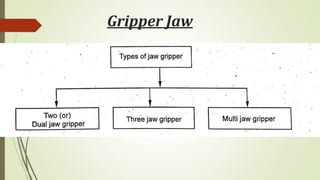
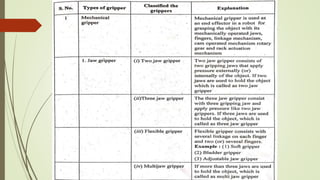
Gripper Jaw
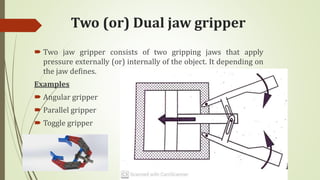
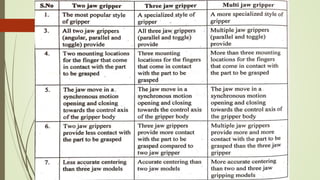
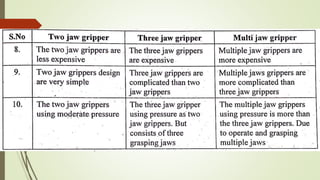
Two (or) Dual jaw gripper
 Two jaw gripper consists of two gripping jaws that apply
pressure externally (or) internally of the object. It depending on
the jaw defines.
Examples
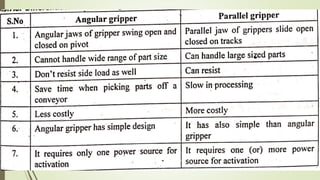
 Angular gripper
 Parallel gripper
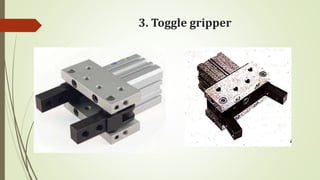
 Toggle gripper
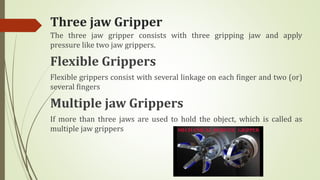
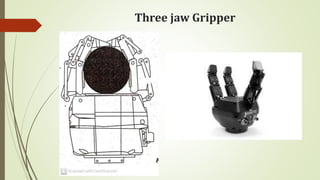
Three jaw Gripper
The three jaw gripper consists with three gripping jaw and apply
pressure like two jaw grippers.
Flexible Grippers
Flexible grippers consist with several linkage on each finger and two (or)
several fingers
Multiple jaw Grippers
If more than three jaws are used to hold the object, which is called as
multiple jaw grippers
Three jaw Gripper
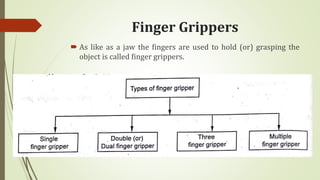
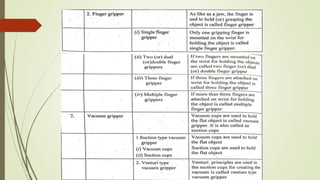
Finger Grippers
 As like as a jaw the fingers are used to hold (or) grasping the
object is called finger grippers.
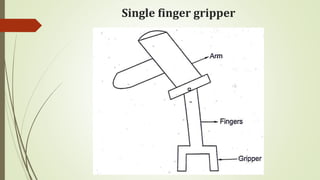
Single finger gripper
 Only one gripping fingers is mounted on the wrist for holding the
objects is called single finger gripper.
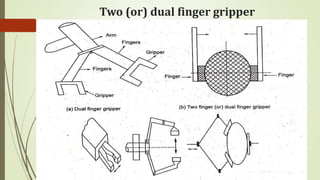
Two (or) dual finger gripper
 Two fingers are mounted on the wrist for holding the objects are called
two finger (or) dual fingers
Types of two finger gripper
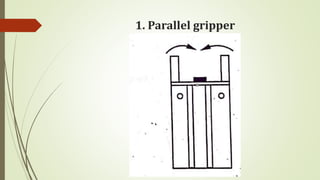
 Parallel gripper
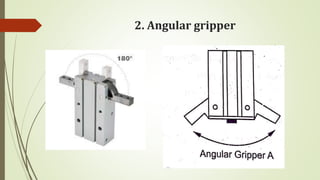
 Angular gripper
 Toggle gripper
Single finger gripper
Two (or) dual finger gripper
1. Parallel gripper
2. Angular gripper
3. Toggle gripper
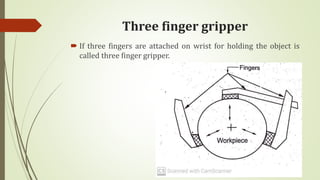
Three finger gripper
 If three fingers are attached on wrist for holding the object is
called three finger gripper.
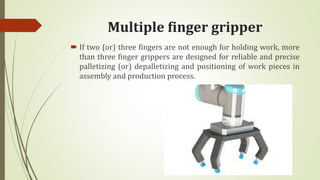
Multiple finger gripper
 If two (or) three fingers are not enough for holding work, more
than three finger grippers are designed for reliable and precise
palletizing (or) depalletizing and positioning of work pieces in
assembly and production process.
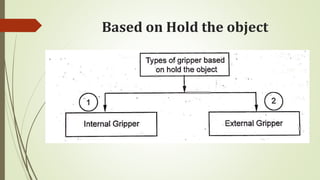
Based on Hold the object
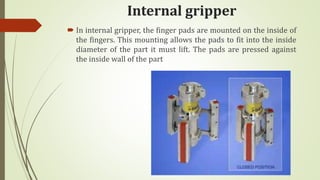
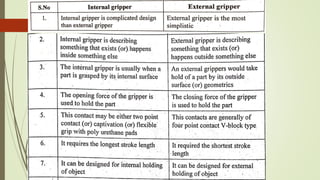
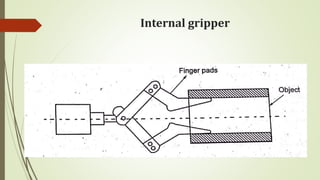
Internal gripper
 In internal gripper, the finger pads are mounted on the inside of
the fingers. This mounting allows the pads to fit into the inside
diameter of the part it must lift. The pads are pressed against
the inside wall of the part
Internal gripper
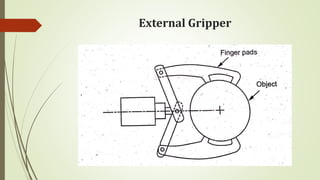
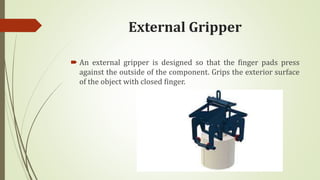
External Gripper
 An external gripper is designed so that the finger pads press
against the outside of the component. Grips the exterior surface
of the object with closed finger.
External Gripper
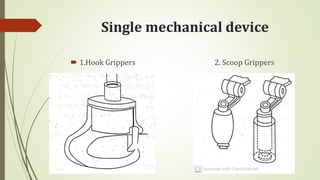
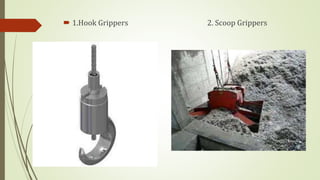
Single mechanical device
 1.Hook Grippers 2. Scoop Grippers
Mechanical gripper based on contact
1. Unilateral gripper
Only one point (or) surface is touching (or) contact the object to be handled
is called unilateral gripper.
Example
i) Vacuum pad gripper
ii) Electro magnetic gripper
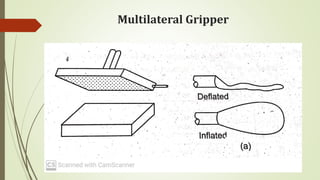
2. Multilateral Gripper
More than two points (or) surfaces touching (or) contact the components
to be handled is called as multilateral gripper
Multilateral Gripper
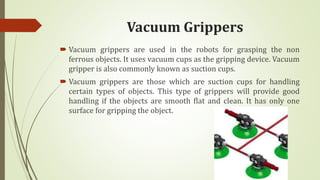
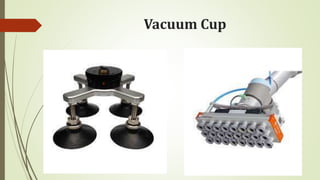
Vacuum Grippers
 Vacuum grippers are used in the robots for grasping the non
ferrous objects. It uses vacuum cups as the gripping device. Vacuum
gripper is also commonly known as suction cups.
 Vacuum grippers are those which are suction cups for handling
certain types of objects. This type of grippers will provide good
handling if the objects are smooth flat and clean. It has only one
surface for gripping the object.
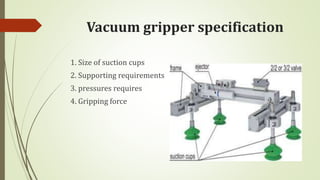
Vacuum gripper specification
1. Size of suction cups
2. Supporting requirements
3. pressures requires
4. Gripping force
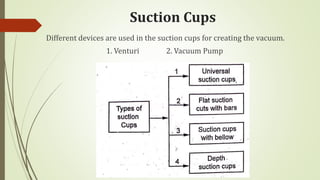
Suction Cups
Different devices are used in the suction cups for creating the vacuum.
1. Venturi 2. Vacuum Pump
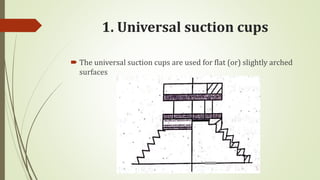
1. Universal suction cups
 The universal suction cups are used for flat (or) slightly arched
surfaces
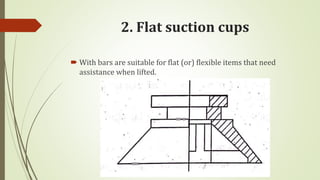
2. Flat suction cups
 With bars are suitable for flat (or) flexible items that need
assistance when lifted.
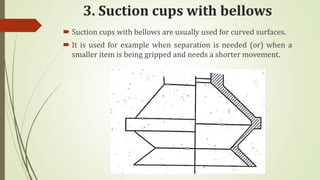
3. Suction cups with bellows
 Suction cups with bellows are usually used for curved surfaces.
 It is used for example when separation is needed (or) when a
smaller item is being gripped and needs a shorter movement.
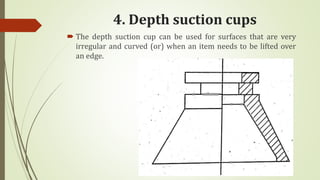
4. Depth suction cups
 The depth suction cup can be used for surfaces that are very
irregular and curved (or) when an item needs to be lifted over
an edge.
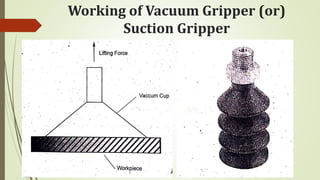
Working of Vacuum Gripper (or)
Suction Gripper
Vacuum Cup
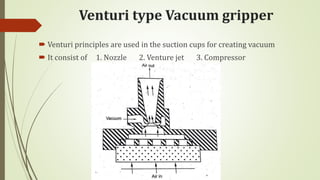
Venturi type Vacuum gripper
 Venturi principles are used in the suction cups for creating vacuum
 It consist of 1. Nozzle 2. Venture jet 3. Compressor
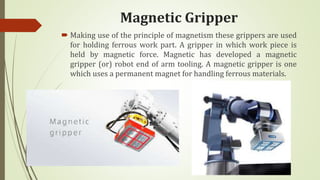
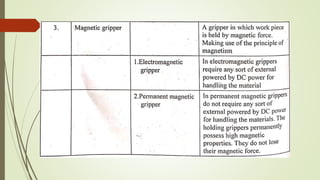
Magnetic Gripper
 Making use of the principle of magnetism these grippers are used
for holding ferrous work part. A gripper in which work piece is
held by magnetic force. Magnetic has developed a magnetic
gripper (or) robot end of arm tooling. A magnetic gripper is one
which uses a permanent magnet for handling ferrous materials.
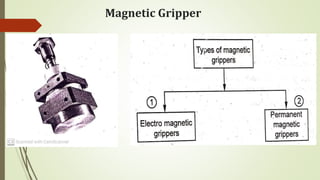
Magnetic Gripper
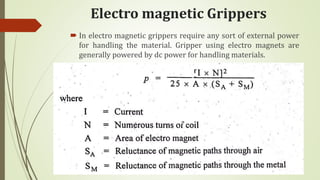
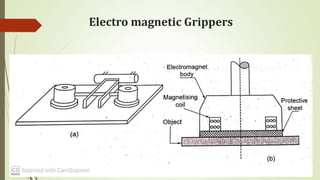
Electro magnetic Grippers
 In electro magnetic grippers require any sort of external power
for handling the material. Gripper using electro magnets are
generally powered by dc power for handling materials.
Electro magnetic Grippers
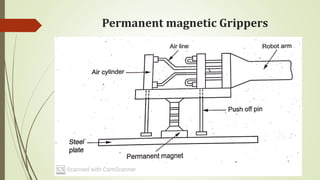
Permanent magnetic Grippers
 In permanent magnetic grippers do not require any sort of
external powered by DC power for handling the materials. The
holding grippers permanently possess high magnetic properties.
They do not lose their magnetic force.
Permanent magnetic Grippers
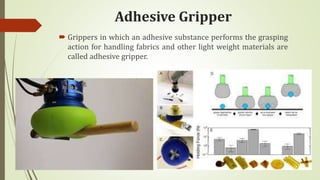
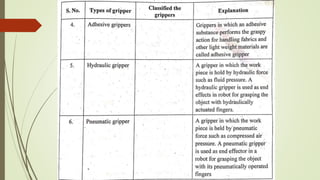
Adhesive Gripper
 Grippers in which an adhesive substance performs the grasping
action for handling fabrics and other light weight materials are
called adhesive gripper.
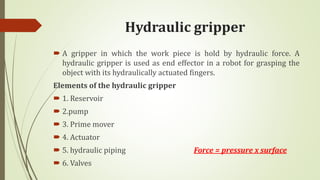
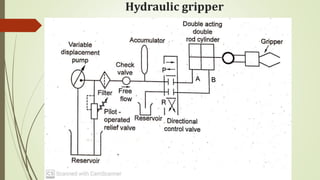
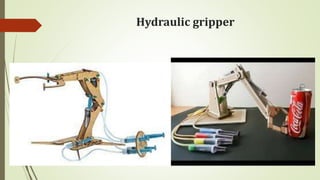
Hydraulic gripper
 A gripper in which the work piece is hold by hydraulic force. A
hydraulic gripper is used as end effector in a robot for grasping the
object with its hydraulically actuated fingers.
Elements of the hydraulic gripper
 1. Reservoir
 2.pump
 3. Prime mover
 4. Actuator
 5. hydraulic piping Force = pressure x surface
 6. Valves
Hydraulic gripper
Hydraulic gripper
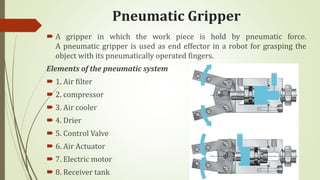
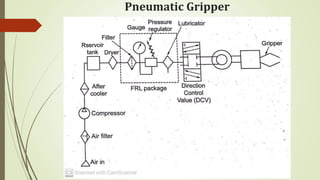
Pneumatic Gripper
 A gripper in which the work piece is hold by pneumatic force.
A pneumatic gripper is used as end effector in a robot for grasping the
object with its pneumatically operated fingers.
Elements of the pneumatic system
 1. Air filter
 2. compressor
 3. Air cooler
 4. Drier
 5. Control Valve
 6. Air Actuator
 7. Electric motor
 8. Receiver tank
Pneumatic Gripper
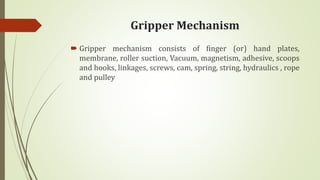
Gripper Mechanism
 Gripper mechanism consists of finger (or) hand plates,
membrane, roller suction, Vacuum, magnetism, adhesive, scoops
and hooks, linkages, screws, cam, spring, string, hydraulics , rope
and pulley
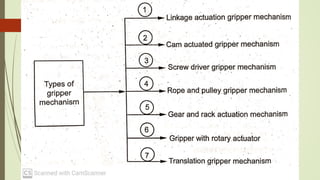
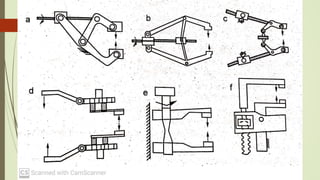
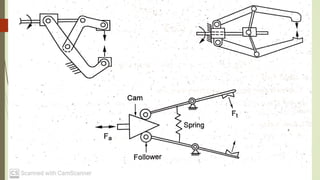
Linkage actuation gripper mechanism
 Linkage actuation gripper mechanism is no cam, screw and gear.
There is movement only because of links attached to input and output.
 There must be perfect design of mechanism such that input actuator
motion is transformed into the gripping action at the output.
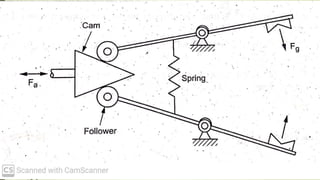
CAM actuated gripper mechanism
 A cam actuated gripper with spring loaded follower can be used to
provide open and close actions of fingers.
 The spring function is to force the gripper to close if the cam is moved
in open direction, while the movement of cam on the other direction
causes the gripper to open
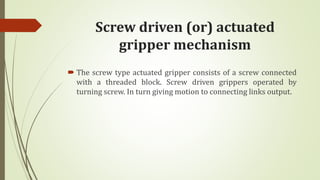
Screw driven (or) actuated
gripper mechanism
 The screw type actuated gripper consists of a screw connected
with a threaded block. Screw driven grippers operated by
turning screw. In turn giving motion to connecting links output.
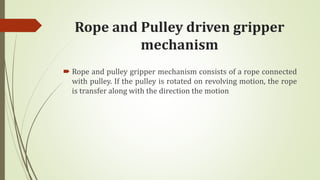
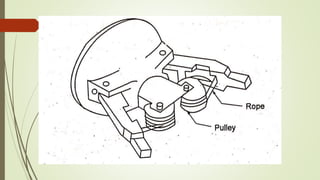
Rope and Pulley driven gripper
mechanism
 Rope and pulley gripper mechanism consists of a rope connected
with pulley. If the pulley is rotated on revolving motion, the rope
is transfer along with the direction the motion
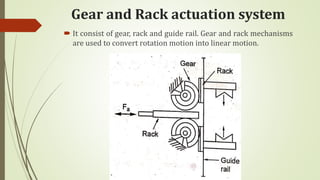
Gear and Rack actuation system
 It consist of gear, rack and guide rail. Gear and rack mechanisms
are used to convert rotation motion into linear motion.
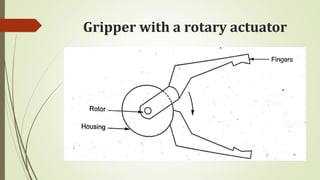
Gripper with a rotary actuator
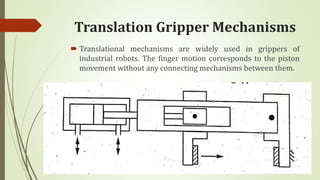
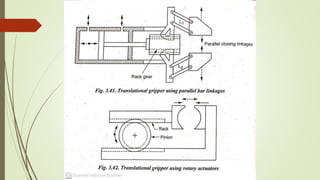
Translation Gripper Mechanisms
 Translational mechanisms are widely used in grippers of
industrial robots. The finger motion corresponds to the piston
movement without any connecting mechanisms between them.
Types of tools
 1. Machine tool
 2. Measuring instrument
 3. Welding torches
 4. Spray painting gun
 5. Assembly tool
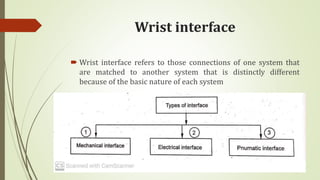
Wrist interface
 Wrist interface refers to those connections of one system that
are matched to another system that is distinctly different
because of the basic nature of each system
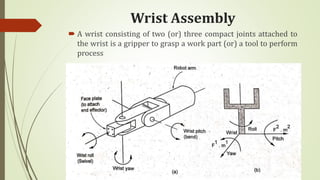
Wrist Assembly
 A wrist consisting of two (or) three compact joints attached to
the wrist is a gripper to grasp a work part (or) a tool to perform
process
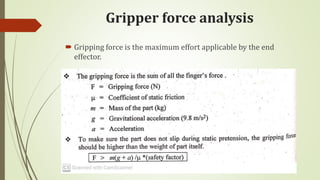
Gripper force analysis
 Gripping force is the maximum effort applicable by the end
effector.
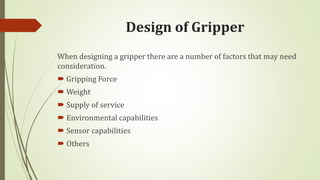
Design of Gripper
When designing a gripper there are a number of factors that may need
consideration.
 Gripping Force
 Weight
 Supply of service
 Environmental capabilities
 Sensor capabilities
 Others
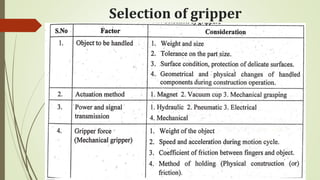
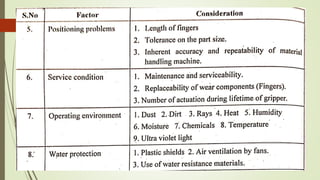
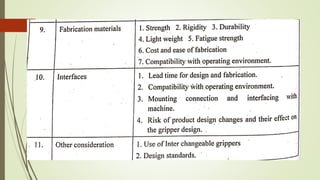
Selection of gripper
Robotics - unit-2 - End effector

Robotics - unit-2 - End effector

  • 1.
  • 2.
    ROBOT DRIVE SYSTEMSAND END EFFECTORS  Pneumatic Drives-Hydraulic Drives-Mechanical Drives-Electrical Drives-D.C. Servo Motors, Stepper Motors, A.C. Servo Motors- Salient Features, Applications and Comparison of all these Drives, End Effectors-Grippers-Mechanical Grippers, Pneumatic and Hydraulic- Grippers, Magnetic Grippers, Vacuum Grippers; Two Fingered and Three Fingered Grippers; Internal Grippers and External Grippers; Selection and Design Considerations.
  • 3.
    End Effectors Robot endeffector is a device attached to the wrist of a manipulator for the purpose of holding materials, parts, tools to perform a specific task. Examples Grippers Tools End of arm tooling Welding equipment
  • 5.
    Classification of Endof arm tooling  According to method used to hold part in the gripper  According to special purpose process tools incorporated in final gripper design  According to multiple function capability of gripper
  • 6.
    According to methodused to hold part in the gripper  Mechanical pressure gripper- Friction (or) physical configuration of the gripper retains the object  Vacuum Gripper- This gripper are used for flat object  Magnetic devices- These devices are used for ferrous object
  • 7.
    According to specialpurpose process tools incorporated in final gripper design  Drills  Grinders  Polisher  Paint sprayers  Welding guns and torches
  • 8.
    According to multiplefunction capability of gripper Special purpose grippers  These grippers may be specialized device like remote centre compliance (RCC) to insert an external mating component into internal member, viz inserting a plug into hole.
  • 9.
    Gripper  Grippers arethe end effectors used for grasping the object during work cycle. A gripper is a device which enables the holding of an object to be manipulated. Gripper just like a hand. It enables holding, tightening, handling, releasing of an object. Examples  Vacuum grippers  Magnetized gripper  Adhesive grippers
  • 10.
    Requirements of aneffective gripper  Parts (or) items must be grasped and held without damage  Parts must be positioned firmly (or) rigidly while being operated on  Hands (or) grippers must accommodate parts of differing sizes (or) even of varying sizes  Self aligning jaws are required to ensure that the load stays centred in the jaws  Gripping (or) end effectors must not damage the part being handed  Jaws (or) Grippers must make contact at a minimum of two pints to ensure that the part does not rotate while being positioned
  • 11.
    Application of grippers Material handling  Palletizing and depalletizing  Arranging parts on to pallets  Machine loading and unloading  Picking and placing of parts on conveyor
  • 14.
    Mechanical Grippers  Mechanicalgripper is used as an end effector in a robot for grasping the objects with its mechanically operated fingers. In industries two fingers are enough for holding purpose. Mechanical grippers act as a robot hand. A basic robot hand will have only two (or) three fingers.
  • 17.
    Features of MechanicalGrippers  Simple to use  Grip using pivoting, linear (or) translation movement  Pneumatic control is cost effective and simple to maintain  Servo controls can be used where precise controlled gripper movement is required
  • 18.
    Advantages of MechanicalGrippers  Palletizing  Rotating objects  Moving small objects  Moving non uniformly shaped objects  No need for compressed air (or) other supplementary materials
  • 19.
  • 20.
    Two (or) Dualjaw gripper  Two jaw gripper consists of two gripping jaws that apply pressure externally (or) internally of the object. It depending on the jaw defines. Examples  Angular gripper  Parallel gripper  Toggle gripper
  • 21.
    Three jaw Gripper Thethree jaw gripper consists with three gripping jaw and apply pressure like two jaw grippers. Flexible Grippers Flexible grippers consist with several linkage on each finger and two (or) several fingers Multiple jaw Grippers If more than three jaws are used to hold the object, which is called as multiple jaw grippers
  • 22.
  • 23.
    Finger Grippers  Aslike as a jaw the fingers are used to hold (or) grasping the object is called finger grippers.
  • 24.
    Single finger gripper Only one gripping fingers is mounted on the wrist for holding the objects is called single finger gripper. Two (or) dual finger gripper  Two fingers are mounted on the wrist for holding the objects are called two finger (or) dual fingers Types of two finger gripper  Parallel gripper  Angular gripper  Toggle gripper
  • 25.
  • 26.
    Two (or) dualfinger gripper
  • 27.
  • 28.
  • 29.
  • 31.
    Three finger gripper If three fingers are attached on wrist for holding the object is called three finger gripper.
  • 32.
    Multiple finger gripper If two (or) three fingers are not enough for holding work, more than three finger grippers are designed for reliable and precise palletizing (or) depalletizing and positioning of work pieces in assembly and production process.
  • 35.
    Based on Holdthe object
  • 36.
    Internal gripper  Ininternal gripper, the finger pads are mounted on the inside of the fingers. This mounting allows the pads to fit into the inside diameter of the part it must lift. The pads are pressed against the inside wall of the part
  • 37.
  • 38.
    External Gripper  Anexternal gripper is designed so that the finger pads press against the outside of the component. Grips the exterior surface of the object with closed finger.
  • 39.
  • 41.
    Single mechanical device 1.Hook Grippers 2. Scoop Grippers
  • 42.
     1.Hook Grippers2. Scoop Grippers
  • 43.
    Mechanical gripper basedon contact 1. Unilateral gripper Only one point (or) surface is touching (or) contact the object to be handled is called unilateral gripper. Example i) Vacuum pad gripper ii) Electro magnetic gripper 2. Multilateral Gripper More than two points (or) surfaces touching (or) contact the components to be handled is called as multilateral gripper
  • 44.
  • 45.
    Vacuum Grippers  Vacuumgrippers are used in the robots for grasping the non ferrous objects. It uses vacuum cups as the gripping device. Vacuum gripper is also commonly known as suction cups.  Vacuum grippers are those which are suction cups for handling certain types of objects. This type of grippers will provide good handling if the objects are smooth flat and clean. It has only one surface for gripping the object.
  • 46.
    Vacuum gripper specification 1.Size of suction cups 2. Supporting requirements 3. pressures requires 4. Gripping force
  • 47.
    Suction Cups Different devicesare used in the suction cups for creating the vacuum. 1. Venturi 2. Vacuum Pump
  • 48.
    1. Universal suctioncups  The universal suction cups are used for flat (or) slightly arched surfaces
  • 49.
    2. Flat suctioncups  With bars are suitable for flat (or) flexible items that need assistance when lifted.
  • 50.
    3. Suction cupswith bellows  Suction cups with bellows are usually used for curved surfaces.  It is used for example when separation is needed (or) when a smaller item is being gripped and needs a shorter movement.
  • 51.
    4. Depth suctioncups  The depth suction cup can be used for surfaces that are very irregular and curved (or) when an item needs to be lifted over an edge.
  • 52.
    Working of VacuumGripper (or) Suction Gripper
  • 53.
  • 54.
    Venturi type Vacuumgripper  Venturi principles are used in the suction cups for creating vacuum  It consist of 1. Nozzle 2. Venture jet 3. Compressor
  • 55.
    Magnetic Gripper  Makinguse of the principle of magnetism these grippers are used for holding ferrous work part. A gripper in which work piece is held by magnetic force. Magnetic has developed a magnetic gripper (or) robot end of arm tooling. A magnetic gripper is one which uses a permanent magnet for handling ferrous materials.
  • 56.
  • 57.
    Electro magnetic Grippers In electro magnetic grippers require any sort of external power for handling the material. Gripper using electro magnets are generally powered by dc power for handling materials.
  • 58.
  • 59.
    Permanent magnetic Grippers In permanent magnetic grippers do not require any sort of external powered by DC power for handling the materials. The holding grippers permanently possess high magnetic properties. They do not lose their magnetic force.
  • 60.
  • 61.
    Adhesive Gripper  Grippersin which an adhesive substance performs the grasping action for handling fabrics and other light weight materials are called adhesive gripper.
  • 62.
    Hydraulic gripper  Agripper in which the work piece is hold by hydraulic force. A hydraulic gripper is used as end effector in a robot for grasping the object with its hydraulically actuated fingers. Elements of the hydraulic gripper  1. Reservoir  2.pump  3. Prime mover  4. Actuator  5. hydraulic piping Force = pressure x surface  6. Valves
  • 63.
  • 64.
  • 65.
    Pneumatic Gripper  Agripper in which the work piece is hold by pneumatic force. A pneumatic gripper is used as end effector in a robot for grasping the object with its pneumatically operated fingers. Elements of the pneumatic system  1. Air filter  2. compressor  3. Air cooler  4. Drier  5. Control Valve  6. Air Actuator  7. Electric motor  8. Receiver tank
  • 66.
  • 71.
    Gripper Mechanism  Grippermechanism consists of finger (or) hand plates, membrane, roller suction, Vacuum, magnetism, adhesive, scoops and hooks, linkages, screws, cam, spring, string, hydraulics , rope and pulley
  • 73.
    Linkage actuation grippermechanism  Linkage actuation gripper mechanism is no cam, screw and gear. There is movement only because of links attached to input and output.  There must be perfect design of mechanism such that input actuator motion is transformed into the gripping action at the output.
  • 75.
    CAM actuated grippermechanism  A cam actuated gripper with spring loaded follower can be used to provide open and close actions of fingers.  The spring function is to force the gripper to close if the cam is moved in open direction, while the movement of cam on the other direction causes the gripper to open
  • 77.
    Screw driven (or)actuated gripper mechanism  The screw type actuated gripper consists of a screw connected with a threaded block. Screw driven grippers operated by turning screw. In turn giving motion to connecting links output.
  • 79.
    Rope and Pulleydriven gripper mechanism  Rope and pulley gripper mechanism consists of a rope connected with pulley. If the pulley is rotated on revolving motion, the rope is transfer along with the direction the motion
  • 81.
    Gear and Rackactuation system  It consist of gear, rack and guide rail. Gear and rack mechanisms are used to convert rotation motion into linear motion.
  • 82.
    Gripper with arotary actuator
  • 83.
    Translation Gripper Mechanisms Translational mechanisms are widely used in grippers of industrial robots. The finger motion corresponds to the piston movement without any connecting mechanisms between them.
  • 85.
    Types of tools 1. Machine tool  2. Measuring instrument  3. Welding torches  4. Spray painting gun  5. Assembly tool
  • 86.
    Wrist interface  Wristinterface refers to those connections of one system that are matched to another system that is distinctly different because of the basic nature of each system
  • 87.
    Wrist Assembly  Awrist consisting of two (or) three compact joints attached to the wrist is a gripper to grasp a work part (or) a tool to perform process
  • 88.
    Gripper force analysis Gripping force is the maximum effort applicable by the end effector.
  • 89.
    Design of Gripper Whendesigning a gripper there are a number of factors that may need consideration.  Gripping Force  Weight  Supply of service  Environmental capabilities  Sensor capabilities  Others
  • 90.