BY 
P.MANIKANDAN 
Ist M.Sc(AGRI)ENTOMOLOGY 
Chairman:Dr.R.Kannan 
Annamalaiuniversity
 Biorational Insecticides 
An active ingredient or formulation that 
effectively controls pests and is derived 
from biological or natural origins. 
 What is a biorational pesticide? 
These terms are derived from two words, 
biological and rational, referring to 
pesticides of natural origin that have limited 
or no adverse effects on the environment or 
beneficial organisms
 Better control than conventional insecticides 
 Broader spectrum of activity 
 Minimal effect on beneficial insects 
 Short pre-harvest interval
 Cheaper 
 Required for certified organic production 
 Less toxic to workers or consumers 
 Low phytotoxicity 
 Safer for the environment 
 Fast action and breakdown so low environmental 
impact;
 Naturally occurring substances; 
 Substances of plant origin (botanicals); 
 Substances of animal origin; 
 Microorganisms-based bio-pesticides; 
Insect growth regulators; 
Semiochemicals.
 Plants oils: Mint, pine and caraway (Carum carvi ) 
linseed, hempseed, cottonseed, rapeseed (colza), castor 
bean (Ricinus communis), coconut, soybean, palm, corn... 
 Substances of animal origin: beeswax, gelatine, 
hyrolysed proteins… 
 Animal fats: Whale, fish (cod, herring, menhaden, 
sardine), degras (wool grease), lard, neatsfoot… 
 Substances used in traps and/or dispensers: 
Diammonium phosphate, metaldehyde, pheromones, 
pyrethroids (Deltamethrin and Lambda-Cyhalothrin) 
 Others: Paraffin and mineral oils, K-permanganate
Algae, 1 
2% 
Plants, 36 
62% 
Crustaceans, 
1 
2% 
Microorga-nisms, 
20 
34%
 Source: Neem tree, Azadirachta indica ; 
 Family: Meliacae; 
 Natural Habitat : South Asia, in particular 
India 
 Extracted from seeds (Kernels);
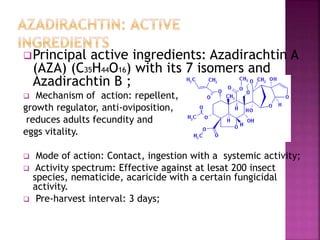
Principal active ingredients: Azadirachtin A 
(AZA) (C35H44O16) with its 7 isomers and 
Azadirachtin B ; 
 Mechanism of action: repellent, 
growth regulator, anti-oviposition, 
reduces adults fecundity and 
eggs vitality. 
 Mode of action: Contact, ingestion with a systemic activity; 
 Activity spectrum: Effective against at lesat 200 insect 
species, nematicide, acaricide with a certain fungicidal 
activity. 
 Pre-harvest interval: 3 days;
 Plants : Derris elliptica , mistica and malaccensis; 
 Lonchocarpus utilis, urucu, nicou and chrysophyllus; 
 Tephrosia macropoda, toxicaria, vogelii and virginiana; 
 Family: Leguminosae; 
 Extracted from roots; 
Derris elliptica
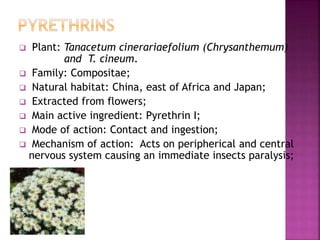
 Plant: Tanacetum cinerariaefolium (Chrysanthemum) 
and T. cineum. 
 Family: Compositae; 
 Natural habitat: China, east of Africa and Japan; 
 Extracted from flowers; 
 Main active ingredient: Pyrethrin I; 
 Mode of action: Contact and ingestion; 
 Mechanism of action: Acts on peripherical and central 
nervous system causing an immediate insects paralysis;
Semiochemicals: Reppelents, attractants and 
sex, alarm, and aggregation pheromones.
 Males locate and subsequently mate with females by following 
the trail or pheromone emitted by virgin females. 
 The indiscriminate application of high levels of sex 
pheromone in traps and dispensers interferes with this natural 
process since a constant exposure to high levels of pheromone 
makes trail following impossible (habituation/adaptation 
phenomenon). 
 The use of discrete source of sex pheromone released over 
time presents the male a false trail to follow (sexual 
confusion/ mating disruption). 
 Control is subsequently achieved through the prevention of 
mating and consequently the laying of fertile eggs. 
 Sex pheromone are species-specific.
 Alarm pheromones are released under natural 
conditions when the population in threatened or being 
attacked by a predator. 
 The result of this release in an increase in the activity 
of phytophagous insects with the subsequent higher 
exposure to a co-applied pesticide. 
 Alarm pheromones are often mixed with conventional 
pesticides (especially acaricide) and show an increase 
in the mortality of pests (mites). 
 The alarmed pests (e.g. spider mites) feed less than 
undisturbed ones.
 Repellent pheromones are emitted naturally by some 
insect pests (e.g. beetles) when they reach a critical 
density in order to repel additional insects and, thereby 
to protect the food supply needed by these insects and 
their offspring. 
 A slight chemical alteration can change an attractant to 
a repellent (e.g., Seudenol which is an attractant of 
douglas fir and spruce beetles was transformed into 3- 
methyl-cyclohex-2-en-1-one which is a repellent of the 
same species). 
 The use of repellent pheromone on healthy trees can be 
combined with the use of aggregation pheromone on 
dead or dying trees.
 Bacteria 
 Fungi 
 Viruses 
 Nematodes 
 Protozoa
 Viral diseases have been found in 13 insect orders and 
most likely occur in all orders. Viruses that are 
primarily or exclusively found in insects are currently 
placed in 12 families (Miller, 1998): 
 DNA Viruses: Baculoviruses (Nuclear polyhedrosis 
viruses- NPV and Granuloviruses-GV), Ascoviruses, 
Iridoviruses, Parvoviruses, Polydnaviruses and 
Poxviruses. 
 RNA Viruses: Reoviruses (Cytoplasmic polyhedrosis 
viruses), Nodaviruses, Picorna-like viruses and 
Tetraviruses.
 Out of above groups only 3 are safe: 
-Nuclear Polyhedrosis Virus (NPV) 
-Granulosis virus (GV) 
-Cytoplasmic Polyhedrosis Virus (CPV) 
 Species Specific 
 Need to be ingested
 They can be divided into two broad 
categories, non-spore-forming bacteria and 
spore-forming bacteria. 
 Although most of the species isolated from 
diseased insects are non-spore-forming, 
spore-forming bacteria in the genus Bacillus 
are the most important from the standpoint 
of biological control. 
 Bacillus thuringiensis (Bt) spores can be 
formulated as dusts or sprays and have been 
used for years as “natural” insecticides. 
About 100 different Cry proteins have been 
identified and all have some specificity.
Out of all, Bacillus thurigiensis is the most used 
 1921: reported in 
Japan. 
 1940s: Commercial 
prep. Available in 
France 
 39% of 
biopesticides 
 Lep, Dip and Colep 
strains 
Crystals containing poison
 Entomopathogenic fungi are able to invade their insect hosts by 
penetrating directly through the cuticle. 
 The fungal spore first adheres to the cuticle. 
 Under appropriate conditions the spore germinates, penetrates 
the cuticle of the host and enters the hemocoel. 
 Fungal reproduction occurs in the hemocoel of the insect host. 
 As the hemocoel becomes filled with hyphal bodies, the insect 
usually dies and the fungus continues to develop saprophytically. 
 After the body of the dead insect is filled with mycelia, fruiting 
structures emerge from the cadaver and produce infectious 
spores. 
 Dead insect has the consistency of a moist loaf of bread and, 
depending on the colour of the spores or conidia, may appear 
white or some darker colour.
 Tanada and Kaya (1993) listed 8 classes, 13 
orders and 57 genera that contain 
entomopathogenic species of fungi. 
 There are five major groups of fungi: the 
Flagellate fungi or Chytridiomycetes, the 
Oomycetes (also flagellate but also not true 
fungi), the Zygomycetes, the Ascomycetes, 
and the Basidiomycota. 
 The Zygomycota and the Ascomycota contain 
common insect pathogens that are also 
useful in biological control programs.
 Can penetrate cuticle
 Although nematode species in at least 20 families are 
primary or facultative parasites of insects, those in the 
order Rhabditida have been most exploited as biological 
control agents. 
 Species in the genera Steinernema and Heterorhabditis 
(Steinernematidae and Heterorhabditae, respectively), are 
particularly amenable to mass production and application in 
a variety of pest systems. 
 Entomopathogenic nematodes enter the host via natural 
body openings or through the cuticle. 
 Some species utilize an anterior stylet or a tooth to rasp the 
cuticle and gain entrance into the hemocoel. 
 Others ingress by ovipositing on the host food source and 
the eggs hatch in the host midgut. 
 Effects of nematode parasitism on the hosts can be sterility, 
reduced fecundity, reduced mobility and life span, 
behavioural and morphological changes, and death.
 Three important families: 
- Steinenermatidae 
- Heterorhabditidae 
- Mermithidae 
 Useful for soil and bark 
insects
 Insect Growth Regulators (IGR) three main 
types 
Juvenile Hormones 
Precocenes 
Chitin Synthesis Inhibitors 
 Low toxicity for birds, mammals, reptiles but 
effects non-target arthropods and insects. 
 Only immature pests are killed, IGR can also 
effect arthropod eggs and embryogenesis.
 Insect Growth Regulators (IGR) 
JH disruptor analogs - novaluron 
Precocenes – methoprene, pyriproxyfen 
Chitin Synthesis Inhibitors - cyromazine, 
diflubenzuron
Though we know the potentiality of 
biorational pesticides, we are still 
utilizing the commercial insecticides 
formulation, which leads to many pest 
resurgence and resistance development. 
Biorational formulations are helping to 
overcome all these problem together 
even it too have some limitations. 
This field needs further research and lots 
of resources to be spend in this sector to 
make it further stable and sustainable as 
well as farmers awareness towards this.
THANKYOU

Biorationals

  • 2.
    BY P.MANIKANDAN IstM.Sc(AGRI)ENTOMOLOGY Chairman:Dr.R.Kannan Annamalaiuniversity
  • 3.
     Biorational Insecticides An active ingredient or formulation that effectively controls pests and is derived from biological or natural origins.  What is a biorational pesticide? These terms are derived from two words, biological and rational, referring to pesticides of natural origin that have limited or no adverse effects on the environment or beneficial organisms
  • 4.
     Better controlthan conventional insecticides  Broader spectrum of activity  Minimal effect on beneficial insects  Short pre-harvest interval
  • 5.
     Cheaper Required for certified organic production  Less toxic to workers or consumers  Low phytotoxicity  Safer for the environment  Fast action and breakdown so low environmental impact;
  • 6.
     Naturally occurringsubstances;  Substances of plant origin (botanicals);  Substances of animal origin;  Microorganisms-based bio-pesticides; Insect growth regulators; Semiochemicals.
  • 7.
     Plants oils:Mint, pine and caraway (Carum carvi ) linseed, hempseed, cottonseed, rapeseed (colza), castor bean (Ricinus communis), coconut, soybean, palm, corn...  Substances of animal origin: beeswax, gelatine, hyrolysed proteins…  Animal fats: Whale, fish (cod, herring, menhaden, sardine), degras (wool grease), lard, neatsfoot…  Substances used in traps and/or dispensers: Diammonium phosphate, metaldehyde, pheromones, pyrethroids (Deltamethrin and Lambda-Cyhalothrin)  Others: Paraffin and mineral oils, K-permanganate
  • 8.
    Algae, 1 2% Plants, 36 62% Crustaceans, 1 2% Microorga-nisms, 20 34%
  • 9.
     Source: Neemtree, Azadirachta indica ;  Family: Meliacae;  Natural Habitat : South Asia, in particular India  Extracted from seeds (Kernels);
  • 10.
    Principal active ingredients:Azadirachtin A (AZA) (C35H44O16) with its 7 isomers and Azadirachtin B ;  Mechanism of action: repellent, growth regulator, anti-oviposition, reduces adults fecundity and eggs vitality.  Mode of action: Contact, ingestion with a systemic activity;  Activity spectrum: Effective against at lesat 200 insect species, nematicide, acaricide with a certain fungicidal activity.  Pre-harvest interval: 3 days;
  • 11.
     Plants :Derris elliptica , mistica and malaccensis;  Lonchocarpus utilis, urucu, nicou and chrysophyllus;  Tephrosia macropoda, toxicaria, vogelii and virginiana;  Family: Leguminosae;  Extracted from roots; Derris elliptica
  • 12.
     Plant: Tanacetumcinerariaefolium (Chrysanthemum) and T. cineum.  Family: Compositae;  Natural habitat: China, east of Africa and Japan;  Extracted from flowers;  Main active ingredient: Pyrethrin I;  Mode of action: Contact and ingestion;  Mechanism of action: Acts on peripherical and central nervous system causing an immediate insects paralysis;
  • 13.
    Semiochemicals: Reppelents, attractantsand sex, alarm, and aggregation pheromones.
  • 14.
     Males locateand subsequently mate with females by following the trail or pheromone emitted by virgin females.  The indiscriminate application of high levels of sex pheromone in traps and dispensers interferes with this natural process since a constant exposure to high levels of pheromone makes trail following impossible (habituation/adaptation phenomenon).  The use of discrete source of sex pheromone released over time presents the male a false trail to follow (sexual confusion/ mating disruption).  Control is subsequently achieved through the prevention of mating and consequently the laying of fertile eggs.  Sex pheromone are species-specific.
  • 15.
     Alarm pheromonesare released under natural conditions when the population in threatened or being attacked by a predator.  The result of this release in an increase in the activity of phytophagous insects with the subsequent higher exposure to a co-applied pesticide.  Alarm pheromones are often mixed with conventional pesticides (especially acaricide) and show an increase in the mortality of pests (mites).  The alarmed pests (e.g. spider mites) feed less than undisturbed ones.
  • 16.
     Repellent pheromonesare emitted naturally by some insect pests (e.g. beetles) when they reach a critical density in order to repel additional insects and, thereby to protect the food supply needed by these insects and their offspring.  A slight chemical alteration can change an attractant to a repellent (e.g., Seudenol which is an attractant of douglas fir and spruce beetles was transformed into 3- methyl-cyclohex-2-en-1-one which is a repellent of the same species).  The use of repellent pheromone on healthy trees can be combined with the use of aggregation pheromone on dead or dying trees.
  • 17.
     Bacteria Fungi  Viruses  Nematodes  Protozoa
  • 18.
     Viral diseaseshave been found in 13 insect orders and most likely occur in all orders. Viruses that are primarily or exclusively found in insects are currently placed in 12 families (Miller, 1998):  DNA Viruses: Baculoviruses (Nuclear polyhedrosis viruses- NPV and Granuloviruses-GV), Ascoviruses, Iridoviruses, Parvoviruses, Polydnaviruses and Poxviruses.  RNA Viruses: Reoviruses (Cytoplasmic polyhedrosis viruses), Nodaviruses, Picorna-like viruses and Tetraviruses.
  • 19.
     Out ofabove groups only 3 are safe: -Nuclear Polyhedrosis Virus (NPV) -Granulosis virus (GV) -Cytoplasmic Polyhedrosis Virus (CPV)  Species Specific  Need to be ingested
  • 20.
     They canbe divided into two broad categories, non-spore-forming bacteria and spore-forming bacteria.  Although most of the species isolated from diseased insects are non-spore-forming, spore-forming bacteria in the genus Bacillus are the most important from the standpoint of biological control.  Bacillus thuringiensis (Bt) spores can be formulated as dusts or sprays and have been used for years as “natural” insecticides. About 100 different Cry proteins have been identified and all have some specificity.
  • 21.
    Out of all,Bacillus thurigiensis is the most used  1921: reported in Japan.  1940s: Commercial prep. Available in France  39% of biopesticides  Lep, Dip and Colep strains Crystals containing poison
  • 22.
     Entomopathogenic fungiare able to invade their insect hosts by penetrating directly through the cuticle.  The fungal spore first adheres to the cuticle.  Under appropriate conditions the spore germinates, penetrates the cuticle of the host and enters the hemocoel.  Fungal reproduction occurs in the hemocoel of the insect host.  As the hemocoel becomes filled with hyphal bodies, the insect usually dies and the fungus continues to develop saprophytically.  After the body of the dead insect is filled with mycelia, fruiting structures emerge from the cadaver and produce infectious spores.  Dead insect has the consistency of a moist loaf of bread and, depending on the colour of the spores or conidia, may appear white or some darker colour.
  • 23.
     Tanada andKaya (1993) listed 8 classes, 13 orders and 57 genera that contain entomopathogenic species of fungi.  There are five major groups of fungi: the Flagellate fungi or Chytridiomycetes, the Oomycetes (also flagellate but also not true fungi), the Zygomycetes, the Ascomycetes, and the Basidiomycota.  The Zygomycota and the Ascomycota contain common insect pathogens that are also useful in biological control programs.
  • 24.
  • 25.
     Although nematodespecies in at least 20 families are primary or facultative parasites of insects, those in the order Rhabditida have been most exploited as biological control agents.  Species in the genera Steinernema and Heterorhabditis (Steinernematidae and Heterorhabditae, respectively), are particularly amenable to mass production and application in a variety of pest systems.  Entomopathogenic nematodes enter the host via natural body openings or through the cuticle.  Some species utilize an anterior stylet or a tooth to rasp the cuticle and gain entrance into the hemocoel.  Others ingress by ovipositing on the host food source and the eggs hatch in the host midgut.  Effects of nematode parasitism on the hosts can be sterility, reduced fecundity, reduced mobility and life span, behavioural and morphological changes, and death.
  • 26.
     Three importantfamilies: - Steinenermatidae - Heterorhabditidae - Mermithidae  Useful for soil and bark insects
  • 27.
     Insect GrowthRegulators (IGR) three main types Juvenile Hormones Precocenes Chitin Synthesis Inhibitors  Low toxicity for birds, mammals, reptiles but effects non-target arthropods and insects.  Only immature pests are killed, IGR can also effect arthropod eggs and embryogenesis.
  • 28.
     Insect GrowthRegulators (IGR) JH disruptor analogs - novaluron Precocenes – methoprene, pyriproxyfen Chitin Synthesis Inhibitors - cyromazine, diflubenzuron
  • 29.
    Though we knowthe potentiality of biorational pesticides, we are still utilizing the commercial insecticides formulation, which leads to many pest resurgence and resistance development. Biorational formulations are helping to overcome all these problem together even it too have some limitations. This field needs further research and lots of resources to be spend in this sector to make it further stable and sustainable as well as farmers awareness towards this.
  • 30.