Topic:- Difference between Virus and Worms
SHRI VAISHNAV INSTITUTE OF
FORENSIC SCIENCE
Submitted to:
Mr. Dinesh Kamble Sir
SVIFS, Indore
Submitted By:
Arti Raghuvanshi
MSc Forensic Science
SVIFS, Indore
INTRODUCTION
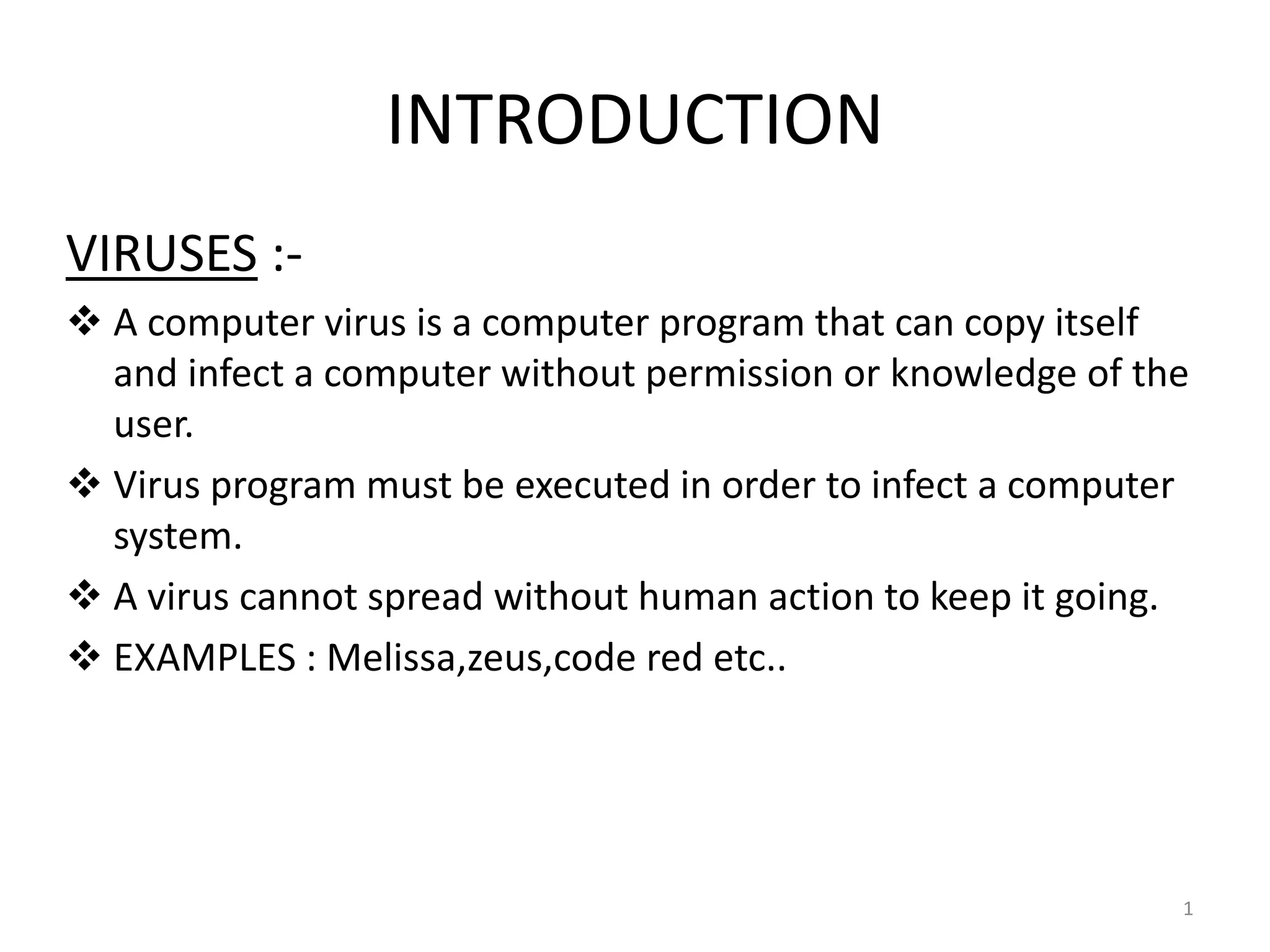
VIRUSES :-
 A computer virus is a computer program that can copy itself
and infect a computer without permission or knowledge of the
user.
 Virus program must be executed in order to infect a computer
system.
 A virus cannot spread without human action to keep it going.
 EXAMPLES : Melissa,zeus,code red etc..
1
HOW VIRUS WORKS
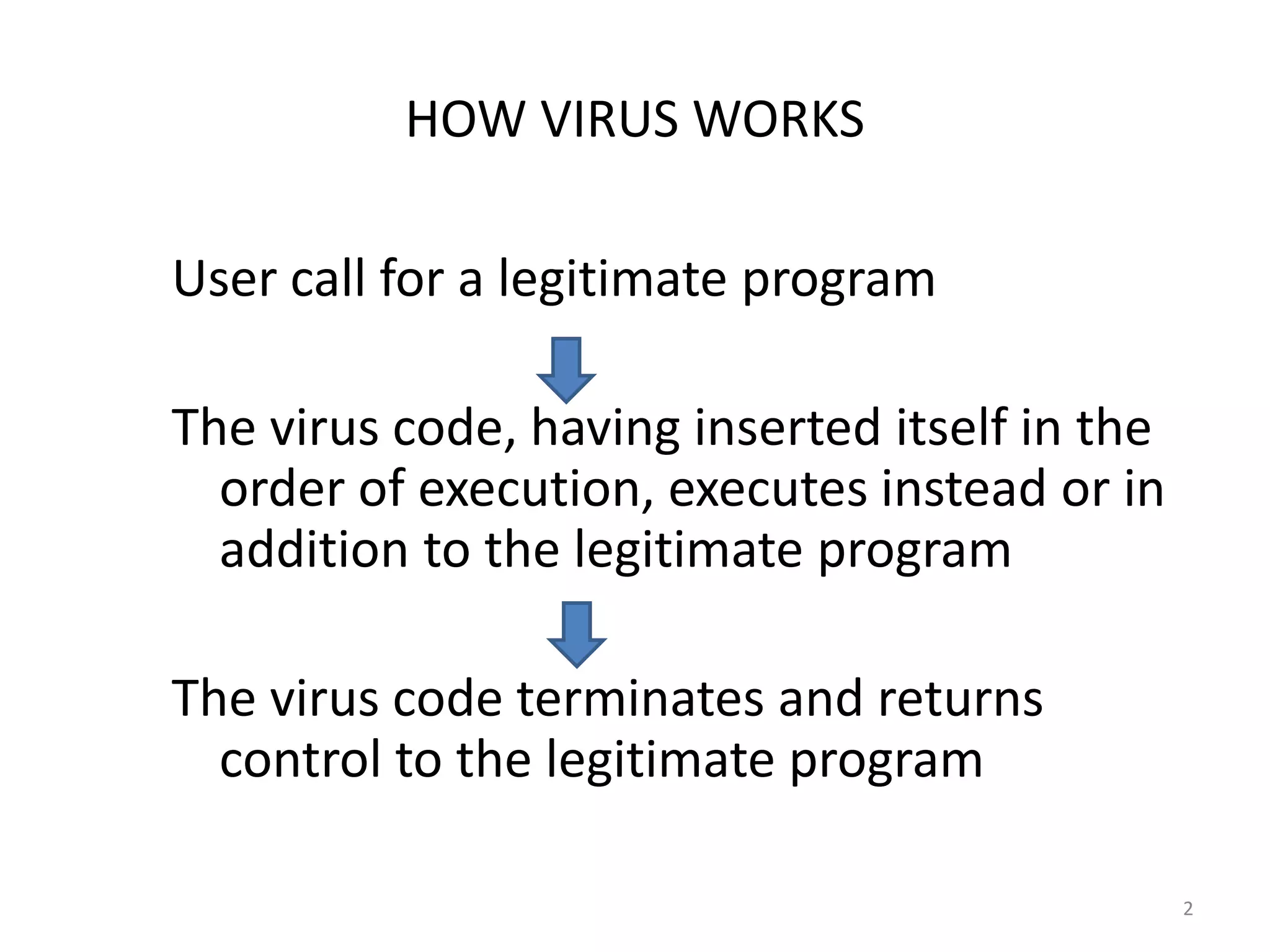
User call for a legitimate program
The virus code, having inserted itself in the
order of execution, executes instead or in
addition to the legitimate program
The virus code terminates and returns
control to the legitimate program
2
3
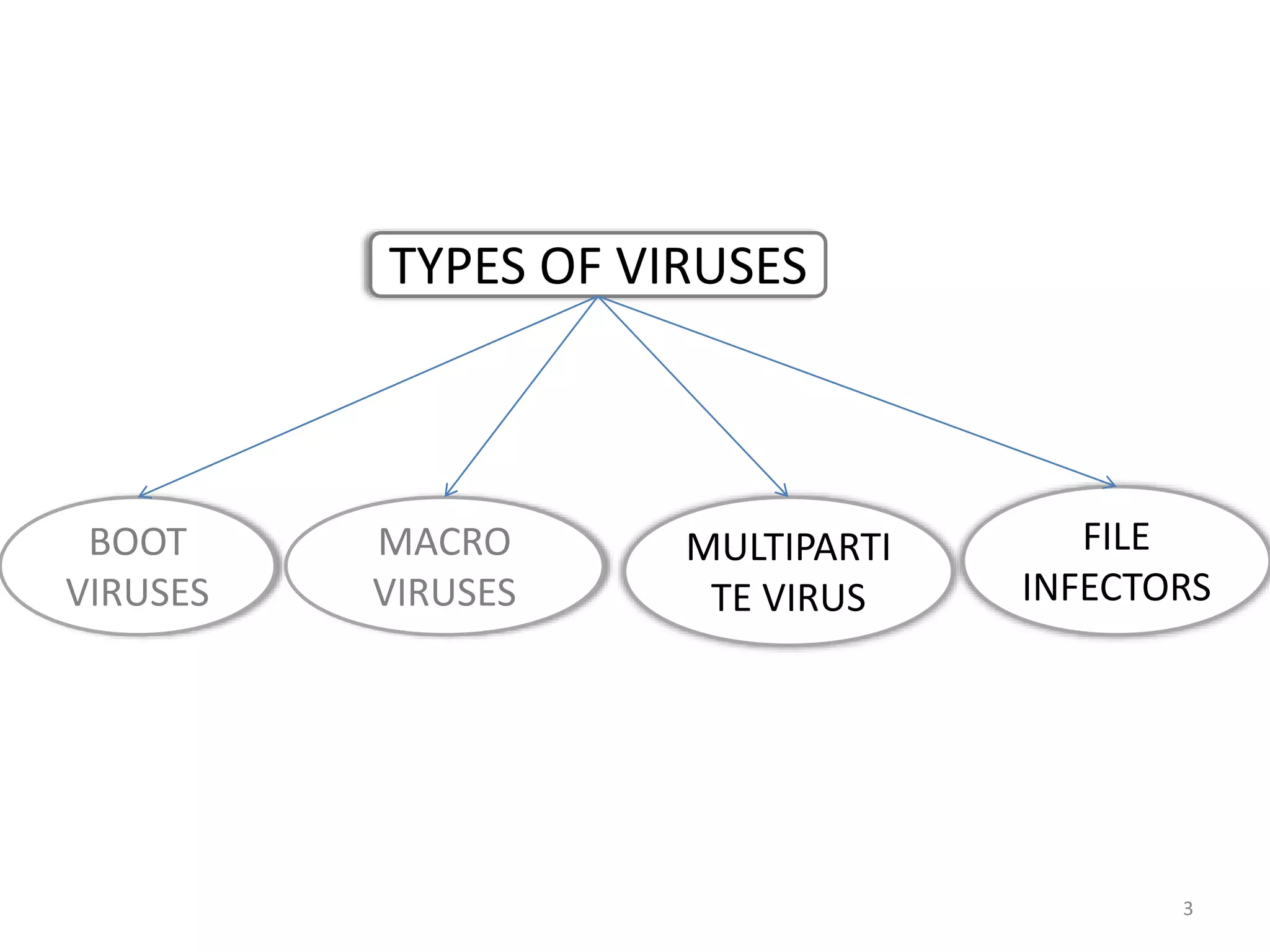
TYPES OF VIRUSES
MULTIPARTI
TE VIRUS
BOOT
VIRUSES
MACRO
VIRUSES
FILE
INFECTORS
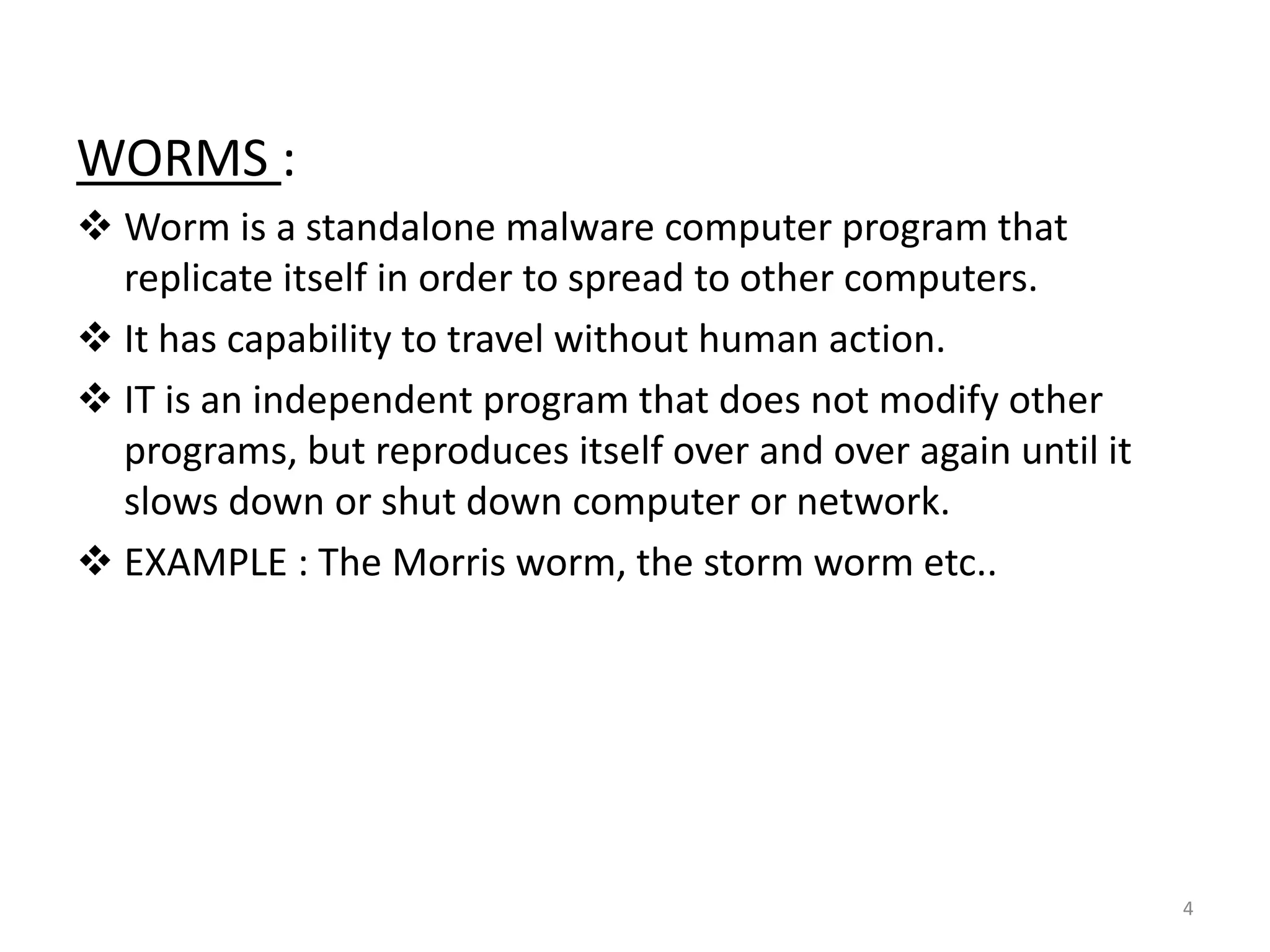
WORMS :
 Worm is a standalone malware computer program that
replicate itself in order to spread to other computers.
 It has capability to travel without human action.
 IT is an independent program that does not modify other
programs, but reproduces itself over and over again until it
slows down or shut down computer or network.
 EXAMPLE : The Morris worm, the storm worm etc..
4
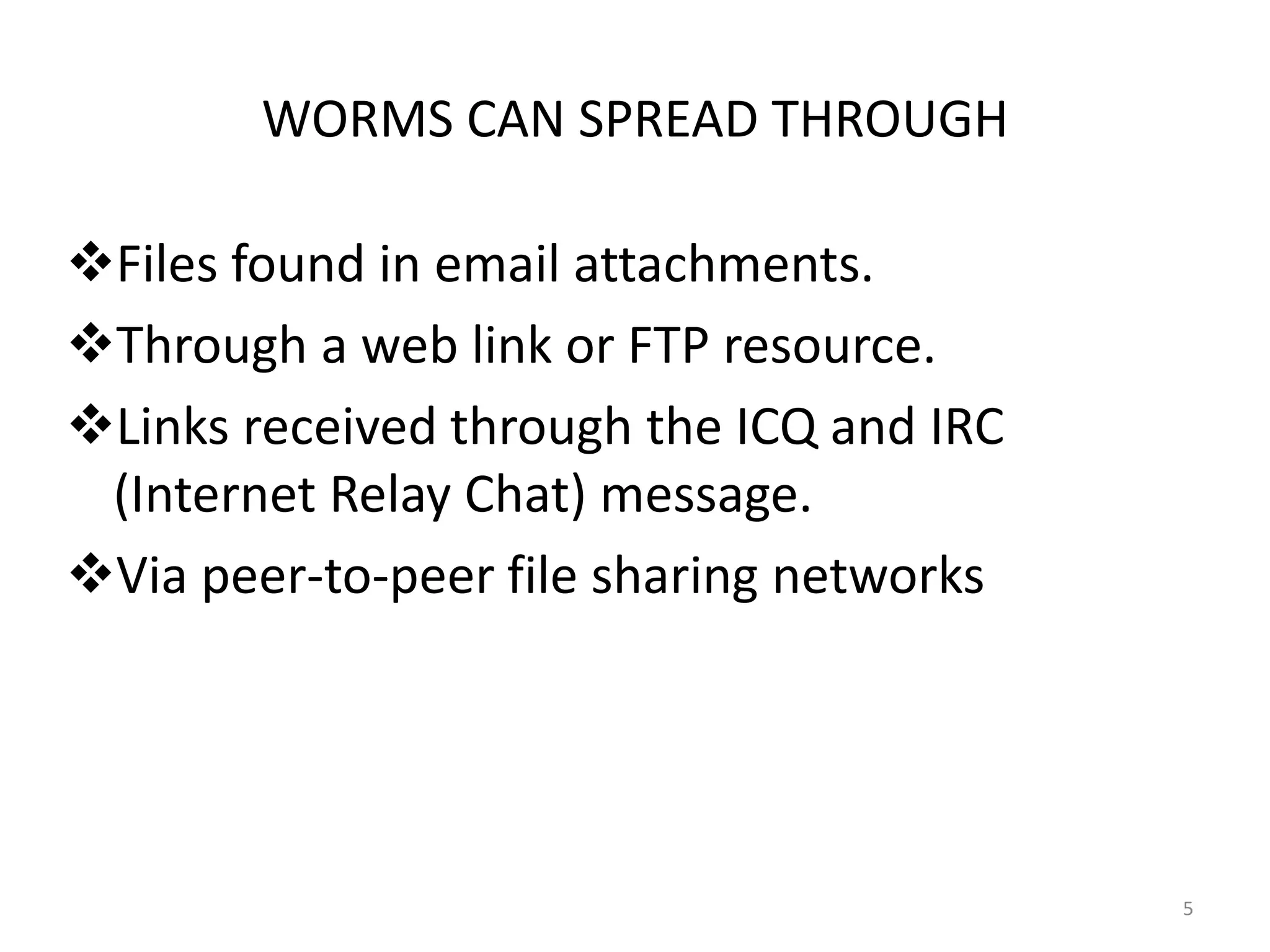
WORMS CAN SPREAD THROUGH
Files found in email attachments.
Through a web link or FTP resource.
Links received through the ICQ and IRC
(Internet Relay Chat) message.
Via peer-to-peer file sharing networks
5
6
TTYPES OF WORMS
EMAIL
WORM
FILE SHARING
NETWORK
WORM
DSINSTANT
MESSAGING
WORM
INTERNET
WORM
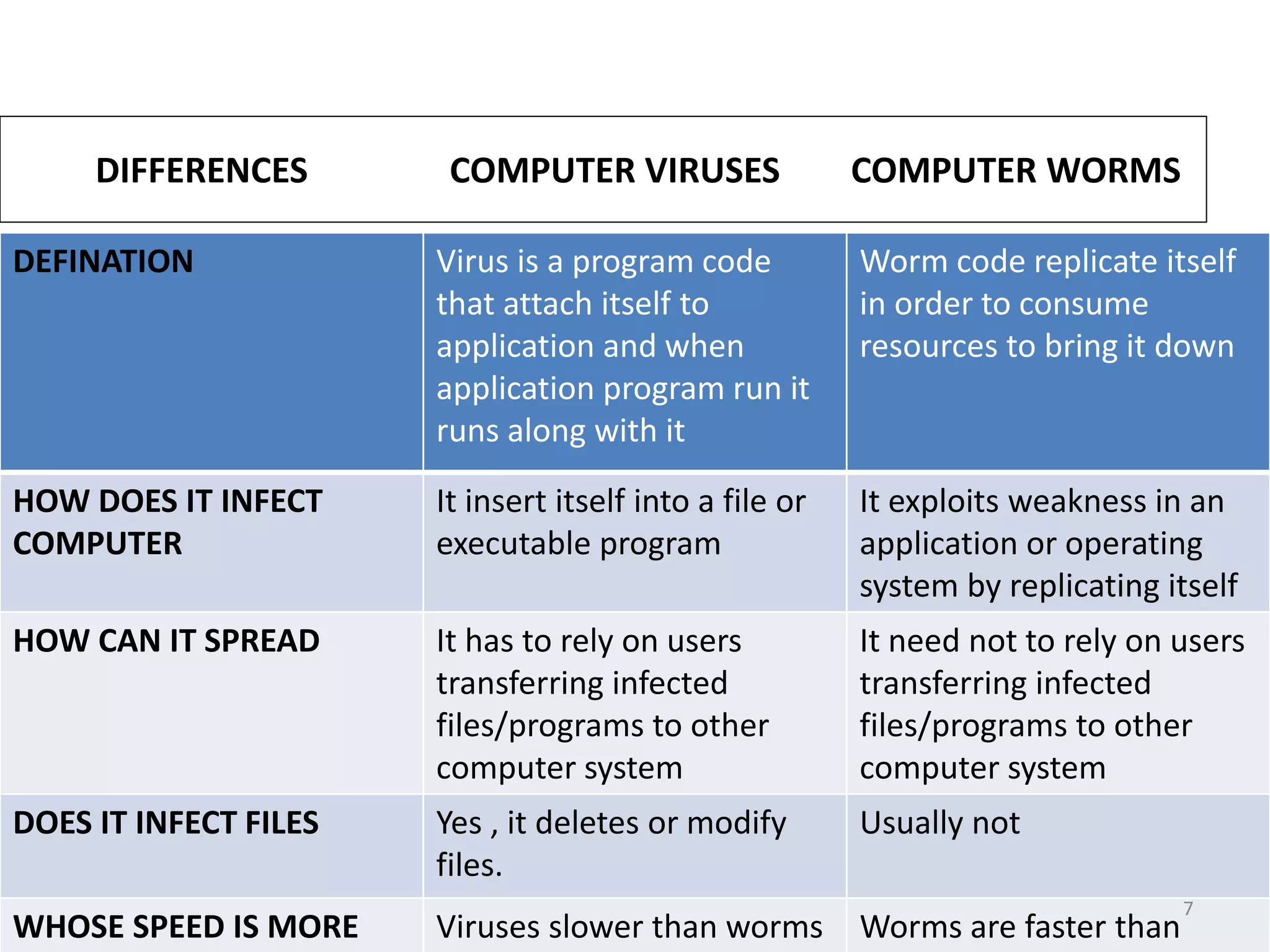
DIFFERENCES COMPUTER VIRUSES COMPUTER WORMS
DEFINATION Virus is a program code
that attach itself to
application and when
application program run it
runs along with it
Worm code replicate itself
in order to consume
resources to bring it down
HOW DOES IT INFECT
COMPUTER
It insert itself into a file or
executable program
It exploits weakness in an
application or operating
system by replicating itself
HOW CAN IT SPREAD It has to rely on users
transferring infected
files/programs to other
computer system
It need not to rely on users
transferring infected
files/programs to other
computer system
DOES IT INFECT FILES Yes , it deletes or modify
files.
Usually not
WHOSE SPEED IS MORE Viruses slower than worms Worms are faster than
7
Top 5 sources of computer viruses and worms
attack
 DOWNLOADABLE PROGAMS
 CRACKED SOFTWARE
 E-MAIL ATTACHMENTS
 INTERNET
 BOOTING OF CD.
8
TROZAN HORSE
 A malicious computer program that can copy itself and infect a computer
without permission of knowledge of the user.
 They cannot replicate automatically.
 MAIN TYPES OF TROZAN HORSES
• Remote access trojans
• Data sending trojans
• Destructive trojans
• Proxy trojans
• File transfer protocol trojans
• Security software disable trojans
• Denial of services attack trojans
9
TRAPDOOR
 A computer trapdoor, also called back door, provides a secret or
undocumented method of gaining access to an application,
operating system or online service.
 Can be used legitimately by programmers to debug and test
programs.
 Trap doors become threat when they are used by unscrupulous
programmers to gain unauthorized access.
 EXAMPLES :
• A video game – like simulation mode and direct interaction with the
artificial intelligence
• Apps/games request in facebook ask us to allow the apps to access
your information
• Emilia attack
10
LOGIC BOMB
 One of the oldest types of malicious software
 Piece of code that executes itself when pre-defined conditions
are met
 Logic bombs that execute on certain days known as time
bombs
 Gets activated when certain conditions are met
- presence/absence of some files
- particular date/time
- particular user
 When triggered typically damages system
- modify/delete files/disks/halt machines etc
11
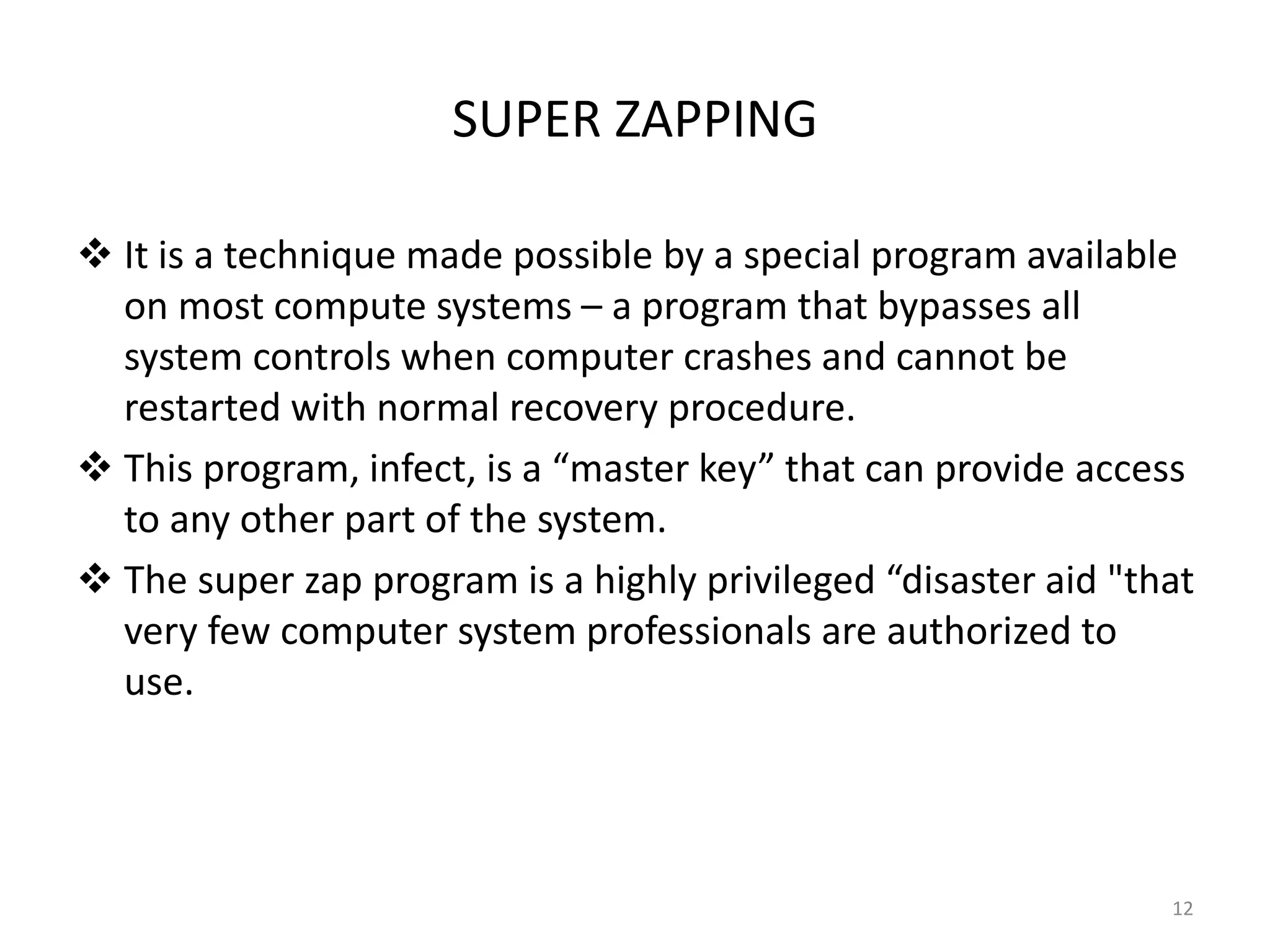
SUPER ZAPPING
 It is a technique made possible by a special program available
on most compute systems – a program that bypasses all
system controls when computer crashes and cannot be
restarted with normal recovery procedure.
 This program, infect, is a “master key” that can provide access
to any other part of the system.
 The super zap program is a highly privileged “disaster aid "that
very few computer system professionals are authorized to
use.
12
PROTECTING YOUR COMPUTER
 To ensure that operating system is up-to-date.
 To have antivirus software and make sure it has capability to
scan e-mail and files .
 Run a full disk scan periodically
 Try avoid downloading and installing software from untrusted
sources.
 Install only registered copies of software in the system.
 Use a firewall.
13
CONCLUSION
 If virus and worms attack on computer it disturb our
system,corrupts data,some times deletes and harm computer.
 Smart surfing is highly recommended.
 Avoiding third party downloads.
 Having a hardware-based firewall .
 Regularly backup for data.
 For better and safe computation Anti-virus software should be
installed
14
THANK YOU
15

Virus and Worms

  • 1.
    Topic:- Difference betweenVirus and Worms SHRI VAISHNAV INSTITUTE OF FORENSIC SCIENCE Submitted to: Mr. Dinesh Kamble Sir SVIFS, Indore Submitted By: Arti Raghuvanshi MSc Forensic Science SVIFS, Indore
  • 2.
    INTRODUCTION VIRUSES :-  Acomputer virus is a computer program that can copy itself and infect a computer without permission or knowledge of the user.  Virus program must be executed in order to infect a computer system.  A virus cannot spread without human action to keep it going.  EXAMPLES : Melissa,zeus,code red etc.. 1
  • 3.
    HOW VIRUS WORKS Usercall for a legitimate program The virus code, having inserted itself in the order of execution, executes instead or in addition to the legitimate program The virus code terminates and returns control to the legitimate program 2
  • 4.
    3 TYPES OF VIRUSES MULTIPARTI TEVIRUS BOOT VIRUSES MACRO VIRUSES FILE INFECTORS
  • 5.
    WORMS :  Wormis a standalone malware computer program that replicate itself in order to spread to other computers.  It has capability to travel without human action.  IT is an independent program that does not modify other programs, but reproduces itself over and over again until it slows down or shut down computer or network.  EXAMPLE : The Morris worm, the storm worm etc.. 4
  • 6.
    WORMS CAN SPREADTHROUGH Files found in email attachments. Through a web link or FTP resource. Links received through the ICQ and IRC (Internet Relay Chat) message. Via peer-to-peer file sharing networks 5
  • 7.
    6 TTYPES OF WORMS EMAIL WORM FILESHARING NETWORK WORM DSINSTANT MESSAGING WORM INTERNET WORM
  • 8.
    DIFFERENCES COMPUTER VIRUSESCOMPUTER WORMS DEFINATION Virus is a program code that attach itself to application and when application program run it runs along with it Worm code replicate itself in order to consume resources to bring it down HOW DOES IT INFECT COMPUTER It insert itself into a file or executable program It exploits weakness in an application or operating system by replicating itself HOW CAN IT SPREAD It has to rely on users transferring infected files/programs to other computer system It need not to rely on users transferring infected files/programs to other computer system DOES IT INFECT FILES Yes , it deletes or modify files. Usually not WHOSE SPEED IS MORE Viruses slower than worms Worms are faster than 7
  • 9.
    Top 5 sourcesof computer viruses and worms attack  DOWNLOADABLE PROGAMS  CRACKED SOFTWARE  E-MAIL ATTACHMENTS  INTERNET  BOOTING OF CD. 8
  • 10.
    TROZAN HORSE  Amalicious computer program that can copy itself and infect a computer without permission of knowledge of the user.  They cannot replicate automatically.  MAIN TYPES OF TROZAN HORSES • Remote access trojans • Data sending trojans • Destructive trojans • Proxy trojans • File transfer protocol trojans • Security software disable trojans • Denial of services attack trojans 9
  • 11.
    TRAPDOOR  A computertrapdoor, also called back door, provides a secret or undocumented method of gaining access to an application, operating system or online service.  Can be used legitimately by programmers to debug and test programs.  Trap doors become threat when they are used by unscrupulous programmers to gain unauthorized access.  EXAMPLES : • A video game – like simulation mode and direct interaction with the artificial intelligence • Apps/games request in facebook ask us to allow the apps to access your information • Emilia attack 10
  • 12.
    LOGIC BOMB  Oneof the oldest types of malicious software  Piece of code that executes itself when pre-defined conditions are met  Logic bombs that execute on certain days known as time bombs  Gets activated when certain conditions are met - presence/absence of some files - particular date/time - particular user  When triggered typically damages system - modify/delete files/disks/halt machines etc 11
  • 13.
    SUPER ZAPPING  Itis a technique made possible by a special program available on most compute systems – a program that bypasses all system controls when computer crashes and cannot be restarted with normal recovery procedure.  This program, infect, is a “master key” that can provide access to any other part of the system.  The super zap program is a highly privileged “disaster aid "that very few computer system professionals are authorized to use. 12
  • 14.
    PROTECTING YOUR COMPUTER To ensure that operating system is up-to-date.  To have antivirus software and make sure it has capability to scan e-mail and files .  Run a full disk scan periodically  Try avoid downloading and installing software from untrusted sources.  Install only registered copies of software in the system.  Use a firewall. 13
  • 15.
    CONCLUSION  If virusand worms attack on computer it disturb our system,corrupts data,some times deletes and harm computer.  Smart surfing is highly recommended.  Avoiding third party downloads.  Having a hardware-based firewall .  Regularly backup for data.  For better and safe computation Anti-virus software should be installed 14
  • 16.