Passwor
d
Cracking
Enrollment No:- 210303145029
Contents
• Introduction
• What is password
• Password cracking techniques
• Defend against password cracking of system
• Conclusion
• Password cracking is a cybersecurity technique used to gain
unauthorized access to computer systems, networks, or online
accounts by attempting to guess or decrypt passwords.
• It is one of the oldest hacking arts. Every system must store
passwords somewhere in order to authenticate users.
• Password crackers use techniques like brute-force attacks, dictionary
attacks, phishing, malware, rainbow tables, and guessing to crack
passwords
Introduction
• A password is a secret sequence of
characters or symbols used to
authenticate a user's identity and grant
access to a computer system, network, or
online account.
• Comprises :
[a-z,A-z,0-9,@,$ etc.]
What is password
(1) Brute Force attack
(2) Dictionary attack
(3) Rainbow-Table attack
(4) Phishing
(5) Keylogging
(6) Guessing etc.
Password cracking techniques
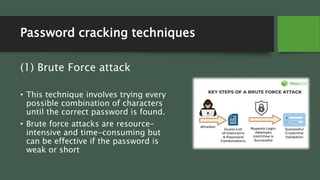
(1) Brute Force attack
• This technique involves trying every
possible combination of characters
until the correct password is found.
• Brute force attacks are resource-
intensive and time-consuming but
can be effective if the password is
weak or short
Password cracking techniques
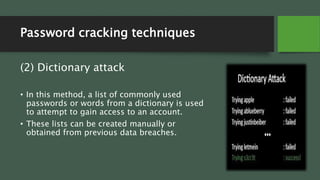
(2) Dictionary attack
• In this method, a list of commonly used
passwords or words from a dictionary is used
to attempt to gain access to an account.
• These lists can be created manually or
obtained from previous data breaches.
Password cracking techniques
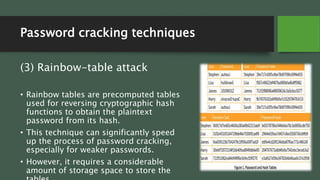
(3) Rainbow-table attack
• Rainbow tables are precomputed tables
used for reversing cryptographic hash
functions to obtain the plaintext
password from its hash.
• This technique can significantly speed
up the process of password cracking,
especially for weaker passwords.
• However, it requires a considerable
amount of storage space to store the
Password cracking techniques
(4) Phishing
• Phishing involves tricking users into
providing their passwords by posing as a
legitimate entity, such as a bank or a social
media platform.
• Phishing attacks often use deceptive
emails, websites, or messages to trick
users into entering their login credentials.
Password cracking techniques
(5) Keylogging
• Keyloggers are malicious software or
hardware that record keystrokes on a
computer or device.
• Attackers can use keyloggers to
capture passwords as users type
them, without their knowledge.
Password cracking techniques
(6) Guessing
• Sometimes, attackers can successfully
guess passwords based on personal
information about the target, such as
their name, birthday, or interests.
• Keyloggers are malicious software or
hardware that record keystrokes on a
computer or device.
Password cracking techniques
Defend against password cracking of
system
• In conclusion, password cracking is a persistent threat, but by
implementing strong security practices and promoting user
awareness, we can significantly reduce its effectiveness and protect
our digital assets.
Conclusion
Cyber Security(Password Cracking Presentation).pptx

Cyber Security(Password Cracking Presentation).pptx

  • 1.
  • 2.
    Contents • Introduction • Whatis password • Password cracking techniques • Defend against password cracking of system • Conclusion
  • 3.
    • Password crackingis a cybersecurity technique used to gain unauthorized access to computer systems, networks, or online accounts by attempting to guess or decrypt passwords. • It is one of the oldest hacking arts. Every system must store passwords somewhere in order to authenticate users. • Password crackers use techniques like brute-force attacks, dictionary attacks, phishing, malware, rainbow tables, and guessing to crack passwords Introduction
  • 4.
    • A passwordis a secret sequence of characters or symbols used to authenticate a user's identity and grant access to a computer system, network, or online account. • Comprises : [a-z,A-z,0-9,@,$ etc.] What is password
  • 5.
    (1) Brute Forceattack (2) Dictionary attack (3) Rainbow-Table attack (4) Phishing (5) Keylogging (6) Guessing etc. Password cracking techniques
  • 6.
    (1) Brute Forceattack • This technique involves trying every possible combination of characters until the correct password is found. • Brute force attacks are resource- intensive and time-consuming but can be effective if the password is weak or short Password cracking techniques
  • 7.
    (2) Dictionary attack •In this method, a list of commonly used passwords or words from a dictionary is used to attempt to gain access to an account. • These lists can be created manually or obtained from previous data breaches. Password cracking techniques
  • 8.
    (3) Rainbow-table attack •Rainbow tables are precomputed tables used for reversing cryptographic hash functions to obtain the plaintext password from its hash. • This technique can significantly speed up the process of password cracking, especially for weaker passwords. • However, it requires a considerable amount of storage space to store the Password cracking techniques
  • 9.
    (4) Phishing • Phishinginvolves tricking users into providing their passwords by posing as a legitimate entity, such as a bank or a social media platform. • Phishing attacks often use deceptive emails, websites, or messages to trick users into entering their login credentials. Password cracking techniques
  • 10.
    (5) Keylogging • Keyloggersare malicious software or hardware that record keystrokes on a computer or device. • Attackers can use keyloggers to capture passwords as users type them, without their knowledge. Password cracking techniques
  • 11.
    (6) Guessing • Sometimes,attackers can successfully guess passwords based on personal information about the target, such as their name, birthday, or interests. • Keyloggers are malicious software or hardware that record keystrokes on a computer or device. Password cracking techniques
  • 12.
    Defend against passwordcracking of system
  • 13.
    • In conclusion,password cracking is a persistent threat, but by implementing strong security practices and promoting user awareness, we can significantly reduce its effectiveness and protect our digital assets. Conclusion