Introduction to Network security
Presented BY
Zunaira Ishtiaq(16201519-079)
Hajra Azam(16201519-093)
Outline
• Introduction to network security
• History
• Method of attack
• Network security objectives
• Elements of a comprehensive security program
• Common security threats and their countermeasures
• Advantages of network security
Network Security
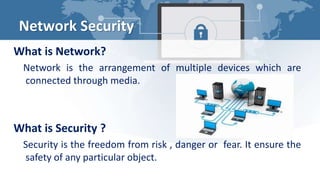
What is Network?
Network is the arrangement of multiple devices which are
connected through media.
What is Security ?
Security is the freedom from risk , danger or fear. It ensure the
safety of any particular object.
Network Security(cont’d)
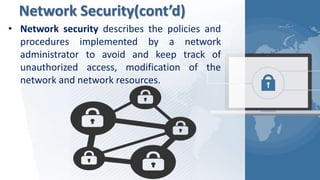
• Network security describes the policies and
procedures implemented by a network
administrator to avoid and keep track of
unauthorized access, modification of the
network and network resources.
History
• Before the 90s, networks were relatively uncommon.
• Internet security has been an issue since the Internet rose to
an international trend.
• By 1996, the Internet already connected 13 million
computers. universities, government and military use
networks to share and store there sensitive data. These
sensitive data require protocols for safety. These protocols
ensure information to be confidential and secure.
History (cont’d)
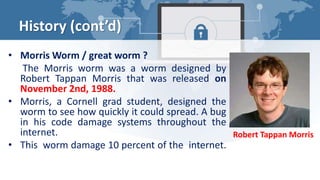
• Morris Worm / great worm ?
The Morris worm was a worm designed by
Robert Tappan Morris that was released on
November 2nd, 1988.
• Morris, a Cornell grad student, designed the
worm to see how quickly it could spread. A bug
in his code damage systems throughout the
internet.
• This worm damage 10 percent of the internet.
Robert Tappan Morris
Method of attack ???
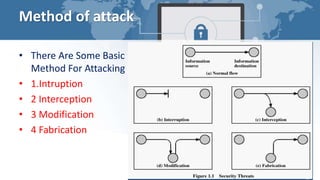
Method of attack
• There Are Some Basic
Method For Attacking
• 1.Intruption
• 2 Interception
• 3 Modification
• 4 Fabrication
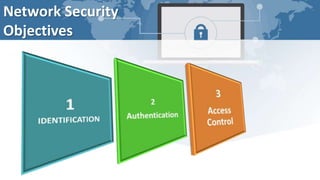
Network Security Objectives ???
Network Security
Objectives
Identification
• Objective of Identification is to uniquely identifies a
user. For example UserID is used to identify user
separately. UserID can be one or combination of the
following.
1. User Name
2. ID Card Number
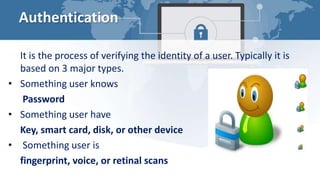
Authentication
It is the process of verifying the identity of a user. Typically it is
based on 3 major types.
• Something user knows
Password
• Something user have
Key, smart card, disk, or other device
• Something user is
fingerprint, voice, or retinal scans
Access controls
It is security features that control who can
access resources in the operating system.
Applications call access control functions to
set who can access specific resources.
Common security threats and
their countermeasures
• Finding a way into network: FIREWALLS
• Develop software bugs : IDS
• Packet sniffing : ENCRYPTION
• Social problems : EDUCATION & PUNISHMENT
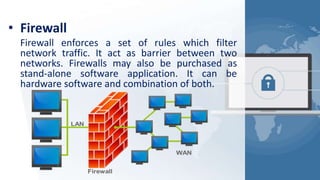
• Firewall
Firewall enforces a set of rules which filter
network traffic. It act as barrier between two
networks. Firewalls may also be purchased as
stand-alone software application. It can be
hardware software and combination of both.
Intrusion Detection System
Intrusion detection system (IDS) is a system that
monitors network traffic for suspicious activity
and issues alerts when such activity is
discovered.
There are network based (NIDS) and host-based
(HIDS) intrusion detection systems.IDS detect
suspicious activities based on specific
parameters.
Packet sniffer
A packet sniffer simply captures all of the packets
of data that pass through a given network
interface.
Encryption
It is the process of transforming plaintext to
encrypted text by using an algorithm (called a
cipher) to make it unreadable to others. The
reverse process to make the encrypted
information readable again, is referred to as
DECRYPTION.
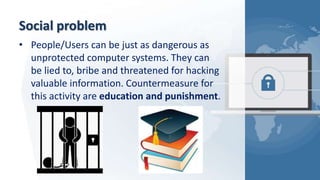
Social problem
• People/Users can be just as dangerous as
unprotected computer systems. They can
be lied to, bribe and threatened for hacking
valuable information. Countermeasure for
this activity are education and punishment.
Elements of a comprehensive
security program
 Have Good Passwords
 Use Good Antiviral Products
 Use Good Cryptography
 Have Good Firewalls
 Have a Backup System
 Audit and Monitor Systems and Networks
 Have Training and Awareness Programs Test
Your Security Frequently
Advantages
• Network Security helps in protecting personal data
of clients existing on network.
• Network Security facilitates protection of
information that is shared between computers on
the network.
• Hacking attempts or virus attacks from the
internet will not be able to harm physical
computers.
• External possible attacks are prevented.
Thank you

Network security

  • 1.
    Introduction to Networksecurity Presented BY Zunaira Ishtiaq(16201519-079) Hajra Azam(16201519-093)
  • 2.
    Outline • Introduction tonetwork security • History • Method of attack • Network security objectives • Elements of a comprehensive security program • Common security threats and their countermeasures • Advantages of network security
  • 3.
    Network Security What isNetwork? Network is the arrangement of multiple devices which are connected through media. What is Security ? Security is the freedom from risk , danger or fear. It ensure the safety of any particular object.
  • 4.
    Network Security(cont’d) • Networksecurity describes the policies and procedures implemented by a network administrator to avoid and keep track of unauthorized access, modification of the network and network resources.
  • 5.
    History • Before the90s, networks were relatively uncommon. • Internet security has been an issue since the Internet rose to an international trend. • By 1996, the Internet already connected 13 million computers. universities, government and military use networks to share and store there sensitive data. These sensitive data require protocols for safety. These protocols ensure information to be confidential and secure.
  • 6.
    History (cont’d) • MorrisWorm / great worm ? The Morris worm was a worm designed by Robert Tappan Morris that was released on November 2nd, 1988. • Morris, a Cornell grad student, designed the worm to see how quickly it could spread. A bug in his code damage systems throughout the internet. • This worm damage 10 percent of the internet. Robert Tappan Morris
  • 7.
  • 8.
    Method of attack •There Are Some Basic Method For Attacking • 1.Intruption • 2 Interception • 3 Modification • 4 Fabrication
  • 9.
  • 10.
  • 11.
    Identification • Objective ofIdentification is to uniquely identifies a user. For example UserID is used to identify user separately. UserID can be one or combination of the following. 1. User Name 2. ID Card Number
  • 12.
    Authentication It is theprocess of verifying the identity of a user. Typically it is based on 3 major types. • Something user knows Password • Something user have Key, smart card, disk, or other device • Something user is fingerprint, voice, or retinal scans
  • 13.
    Access controls It issecurity features that control who can access resources in the operating system. Applications call access control functions to set who can access specific resources.
  • 14.
    Common security threatsand their countermeasures • Finding a way into network: FIREWALLS • Develop software bugs : IDS • Packet sniffing : ENCRYPTION • Social problems : EDUCATION & PUNISHMENT
  • 15.
    • Firewall Firewall enforcesa set of rules which filter network traffic. It act as barrier between two networks. Firewalls may also be purchased as stand-alone software application. It can be hardware software and combination of both.
  • 16.
    Intrusion Detection System Intrusiondetection system (IDS) is a system that monitors network traffic for suspicious activity and issues alerts when such activity is discovered. There are network based (NIDS) and host-based (HIDS) intrusion detection systems.IDS detect suspicious activities based on specific parameters.
  • 17.
    Packet sniffer A packetsniffer simply captures all of the packets of data that pass through a given network interface. Encryption It is the process of transforming plaintext to encrypted text by using an algorithm (called a cipher) to make it unreadable to others. The reverse process to make the encrypted information readable again, is referred to as DECRYPTION.
  • 18.
    Social problem • People/Userscan be just as dangerous as unprotected computer systems. They can be lied to, bribe and threatened for hacking valuable information. Countermeasure for this activity are education and punishment.
  • 19.
    Elements of acomprehensive security program  Have Good Passwords  Use Good Antiviral Products  Use Good Cryptography  Have Good Firewalls  Have a Backup System  Audit and Monitor Systems and Networks  Have Training and Awareness Programs Test Your Security Frequently
  • 20.
    Advantages • Network Securityhelps in protecting personal data of clients existing on network. • Network Security facilitates protection of information that is shared between computers on the network. • Hacking attempts or virus attacks from the internet will not be able to harm physical computers. • External possible attacks are prevented.
  • 21.