1
2
Introduction
What is Computer Virus
Types of Infection
Types of Computer Virus
Difference between Virus and Worm
Signs of a Computer Virus
Preventions
Top Seven Antiviral Program
Conclusion 3
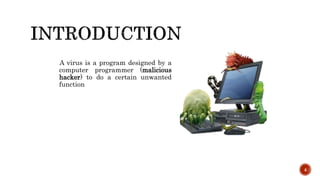
A virus is a program designed by a
computer programmer (malicious
hacker) to do a certain unwanted
function
4
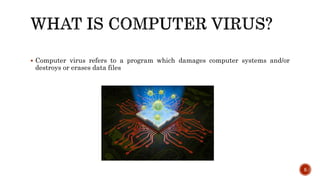
 Computer virus refers to a program which damages computer systems and/or
destroys or erases data files
5
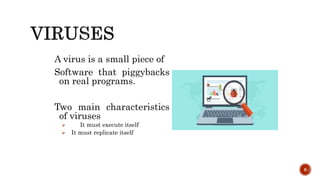
A virus is a small piece of
Software that piggybacks
on real programs.
Two main characteristics
of viruses
 It must execute itself
 It must replicate itself
6
 Moves around in e-mail messages
 It replicate itself by automatically mailing itself to dozens of people
in the victim’s email address book
 Example “MELISSA VIRUS”
 Example “I LOVE YOU VIRUS”
7
Melissa virus spread in Microsoft Word documents sent via e-mail
How it works ?
 Created the virus as word document
 Uploaded to an internet newsgroup
 Anyone who download the document and opened it would trigger the virus
 Send friendly email messages to first 50 people in person’s address book
8
 Melissa Virus was the fastest spreading virus ever seen
 Forced a number of large companies to shut down their e-mail systems
9
 Contained a piece of code as an attachment.
 Double Click on the attachment triggered the code
 Sent copies of itself to everyone in the victim’s address book
 Started corrupting files on the victim’s machine
10
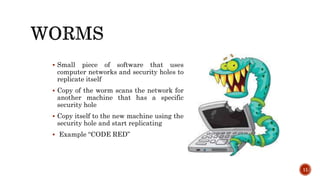
 Small piece of software that uses
computer networks and security holes to
replicate itself
 Copy of the worm scans the network for
another machine that has a specific
security hole
 Copy itself to the new machine using the
security hole and start replicating
 Example “CODE RED”
11
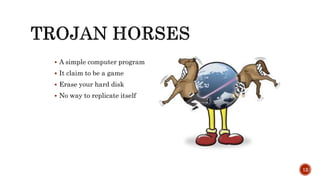
 A simple computer program
 It claim to be a game
 Erase your hard disk
 No way to replicate itself
12
 Time Bomb
A time bomb is a virus program that performs an activity on a particular date
 Logical Bomb
A logical bomb is a destructive program that performs an activity when a certain
action has occurred
13
 Boot Sector Virus
A boot sector virus infects boot sector of computers. During system boot, boot
sector virus is loaded into main memory and destroys data stored in hard disk
14
 Macros Virus
A macro virus is associated with application software like word and excel. When
opening the infected document, macro virus is loaded into main memory and
destroys the data stored in hard disk
15
 The difference between a worm and a virus is that a virus does not have a
propagation vector. i.e. it will only effect one host and does not propagate to other
hosts
 Worms propagate and infect other computers. Majority of threats are actually
worms that propagate to other hosts
16
 Computer viruses cause a huge amount of damage worldwide
 Damages from just one virus (The I Love You Virus) are estimated at $10 billion
dollars.
 It is also estimated that 45 million people worldwide were affected
17
 Computer runs slower then usual
 Computer no longer boots up
 Screen sometimes flicker
 PC speaker beeps periodically
 System crashes for no reason
 Files/directories sometimes disappear
 Denial of Service (DoS)
18
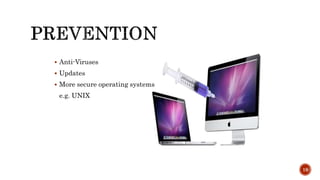
 Anti-Viruses
 Updates
 More secure operating systems
e.g. UNIX
19
 Bitdefender Antivirus
 Norton AntiVirus.
 Kaspersky Anti-Virus
 Trend Micro Antivirus
 Webroot Secure
 Avast antivirus
 Sophos Home
20
 Be aware of the new infections out there.
 Take precaution measures.
 Always backup your data.
 Keep up-to-date on new Anti virus software.
 Simply avoid programs from unknown sources.
21
 www.google.com
 www.wikipedia.com
 www.studymafia.org
22

Computer Virus.pptx

  • 1.
  • 2.
  • 3.
    Introduction What is ComputerVirus Types of Infection Types of Computer Virus Difference between Virus and Worm Signs of a Computer Virus Preventions Top Seven Antiviral Program Conclusion 3
  • 4.
    A virus isa program designed by a computer programmer (malicious hacker) to do a certain unwanted function 4
  • 5.
     Computer virusrefers to a program which damages computer systems and/or destroys or erases data files 5
  • 6.
    A virus isa small piece of Software that piggybacks on real programs. Two main characteristics of viruses  It must execute itself  It must replicate itself 6
  • 7.
     Moves aroundin e-mail messages  It replicate itself by automatically mailing itself to dozens of people in the victim’s email address book  Example “MELISSA VIRUS”  Example “I LOVE YOU VIRUS” 7
  • 8.
    Melissa virus spreadin Microsoft Word documents sent via e-mail How it works ?  Created the virus as word document  Uploaded to an internet newsgroup  Anyone who download the document and opened it would trigger the virus  Send friendly email messages to first 50 people in person’s address book 8
  • 9.
     Melissa Viruswas the fastest spreading virus ever seen  Forced a number of large companies to shut down their e-mail systems 9
  • 10.
     Contained apiece of code as an attachment.  Double Click on the attachment triggered the code  Sent copies of itself to everyone in the victim’s address book  Started corrupting files on the victim’s machine 10
  • 11.
     Small pieceof software that uses computer networks and security holes to replicate itself  Copy of the worm scans the network for another machine that has a specific security hole  Copy itself to the new machine using the security hole and start replicating  Example “CODE RED” 11
  • 12.
     A simplecomputer program  It claim to be a game  Erase your hard disk  No way to replicate itself 12
  • 13.
     Time Bomb Atime bomb is a virus program that performs an activity on a particular date  Logical Bomb A logical bomb is a destructive program that performs an activity when a certain action has occurred 13
  • 14.
     Boot SectorVirus A boot sector virus infects boot sector of computers. During system boot, boot sector virus is loaded into main memory and destroys data stored in hard disk 14
  • 15.
     Macros Virus Amacro virus is associated with application software like word and excel. When opening the infected document, macro virus is loaded into main memory and destroys the data stored in hard disk 15
  • 16.
     The differencebetween a worm and a virus is that a virus does not have a propagation vector. i.e. it will only effect one host and does not propagate to other hosts  Worms propagate and infect other computers. Majority of threats are actually worms that propagate to other hosts 16
  • 17.
     Computer virusescause a huge amount of damage worldwide  Damages from just one virus (The I Love You Virus) are estimated at $10 billion dollars.  It is also estimated that 45 million people worldwide were affected 17
  • 18.
     Computer runsslower then usual  Computer no longer boots up  Screen sometimes flicker  PC speaker beeps periodically  System crashes for no reason  Files/directories sometimes disappear  Denial of Service (DoS) 18
  • 19.
     Anti-Viruses  Updates More secure operating systems e.g. UNIX 19
  • 20.
     Bitdefender Antivirus Norton AntiVirus.  Kaspersky Anti-Virus  Trend Micro Antivirus  Webroot Secure  Avast antivirus  Sophos Home 20
  • 21.
     Be awareof the new infections out there.  Take precaution measures.  Always backup your data.  Keep up-to-date on new Anti virus software.  Simply avoid programs from unknown sources. 21
  • 22.