
Virtual Network System:
Splitting Control and Data Plane
to Optimize IP and Transport Services at Minimum OPEX
Elisa Bellagamba
elisa.bellagamba@ericsson.com
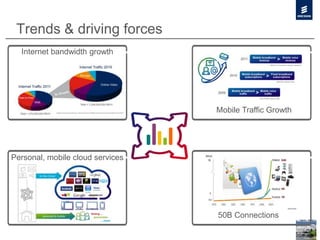
Trends & driving forces
50B Connections
Mobile Traffic Growth
Internet bandwidth growth
Personal, mobile cloud services
MOBILE
CORE
MULTI-SERVICE
EDGE
MOBILE
FIXED
COREDEVICES ACCESS AGGREGATION IP EDGE
TRANSPORT & ROUTINGBACKHAUL & METRO
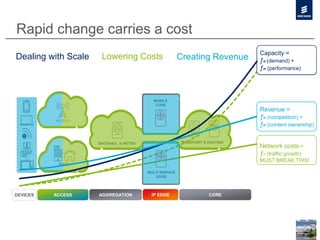
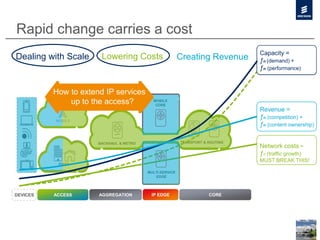
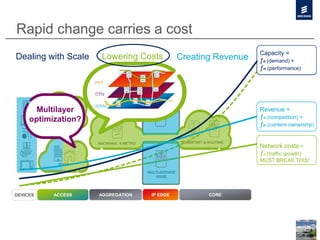
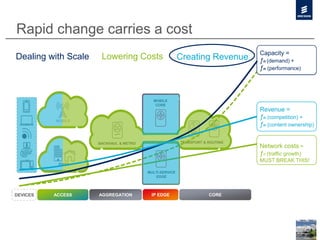
Rapid change carries a cost
Capacity =
ƒn (demand) +
ƒn (performance)
Dealing with Scale Capacity =
ƒn (demand) +
ƒn (performance)
Network costs =
ƒn (traffic growth)
MUST BREAK THIS!
Lowering Costs Capacity =
ƒn (demand) +
ƒn (performance)
Revenue =
ƒn (competition) +
ƒn (content ownership)
Creating Revenue
Capacity =
ƒn (demand) +
ƒn (performance)
MOBILE
CORE
MULTI-SERVICE
EDGE
MOBILE
FIXED
COREDEVICES ACCESS AGGREGATION IP EDGE
TRANSPORT & ROUTINGBACKHAUL & METRO
Rapid change carries a cost
Capacity =
ƒn (demand) +
ƒn (performance)
Dealing with Scale Capacity =
ƒn (demand) +
ƒn (performance)
Network costs =
ƒn (traffic growth)
MUST BREAK THIS!
Lowering Costs Capacity =
ƒn (demand) +
ƒn (performance)
Revenue =
ƒn (competition) +
ƒn (content ownership)
Creating Revenue
Capacity =
ƒn (demand) +
ƒn (performance)
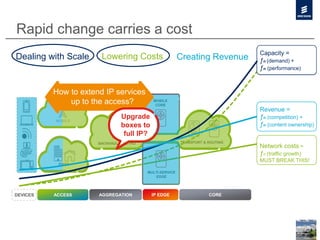
How to extend IP services
up to the access?
MOBILE
CORE
MULTI-SERVICE
EDGE
MOBILE
FIXED
COREDEVICES ACCESS AGGREGATION IP EDGE
TRANSPORT & ROUTINGBACKHAUL & METRO
Rapid change carries a cost
Capacity =
ƒn (demand) +
ƒn (performance)
Dealing with Scale Capacity =
ƒn (demand) +
ƒn (performance)
Network costs =
ƒn (traffic growth)
MUST BREAK THIS!
Lowering Costs Capacity =
ƒn (demand) +
ƒn (performance)
Revenue =
ƒn (competition) +
ƒn (content ownership)
Creating Revenue
Capacity =
ƒn (demand) +
ƒn (performance)
How to extend IP services
up to the access?
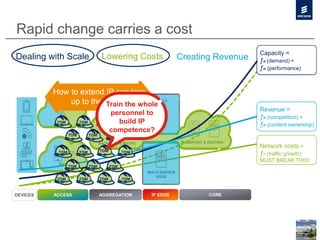
Upgrade
boxes to
full IP?
MOBILE
CORE
MULTI-SERVICE
EDGE
MOBILE
FIXED
COREDEVICES ACCESS AGGREGATION IP EDGE
TRANSPORT & ROUTINGBACKHAUL & METRO
Rapid change carries a cost
Capacity =
ƒn (demand) +
ƒn (performance)
Dealing with Scale Capacity =
ƒn (demand) +
ƒn (performance)
Network costs =
ƒn (traffic growth)
MUST BREAK THIS!
Lowering Costs Capacity =
ƒn (demand) +
ƒn (performance)
Revenue =
ƒn (competition) +
ƒn (content ownership)
Creating Revenue
Capacity =
ƒn (demand) +
ƒn (performance)
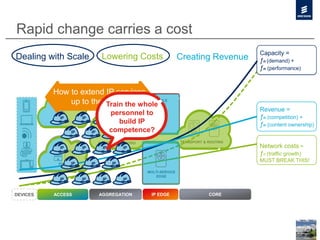
How to extend IP services
up to the access?Train the whole
personnel to
build IP
competence?
TDM TDM
TDMTDM
TDMTDM TDM TDM
TDMTDMTDM
TDMTDM TDM TDM
MOBILE
CORE
MULTI-SERVICE
EDGE
MOBILE
FIXED
COREDEVICES ACCESS AGGREGATION IP EDGE
TRANSPORT & ROUTINGBACKHAUL & METRO
Rapid change carries a cost
Capacity =
ƒn (demand) +
ƒn (performance)
Dealing with Scale Capacity =
ƒn (demand) +
ƒn (performance)
Network costs =
ƒn (traffic growth)
MUST BREAK THIS!
Lowering Costs Capacity =
ƒn (demand) +
ƒn (performance)
Revenue =
ƒn (competition) +
ƒn (content ownership)
Creating Revenue
Capacity =
ƒn (demand) +
ƒn (performance)
How to extend IP services
up to the access?Train the whole
personnel to
build IP
competence?
IP IP
IP
IP IP IP IP
IP IP IP
IP IP IP IP
IP
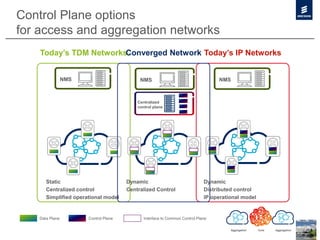
Control Plane options
for access and aggregation networks
Data Plane Control Plane
CoreAggregation Aggregation
Interface to Common Control Plane
Today’s TDM Networks
Static
Centralized control
Simplified operational model
NMS
Today’s IP Networks
NMS
Dynamic
Distributed control
IP operational model
Centralized
control plane
NMS
Dynamic
Centralized Control
Converged Network
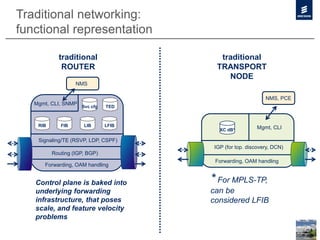
traditional
ROUTER
traditional
TRANSPORT
NODE
Mgmt, CLI, SNMP
Forwarding, OAM handling
Routing (IGP, BGP)
Signaling/TE (RSVP, LDP, CSPF)
Control plane is baked into
underlying forwarding
infrastructure, that poses
scale, and feature velocity
problems
Mgmt, CLI
Forwarding, OAM handling
XC dB*
IGP (for top. discovery, DCN)
NMS, PCE
* For MPLS-TP,
can be
considered LFIB
TED
LIBFIBRIB LFIB
Svc cfg
NMS
Traditional networking:
functional representation
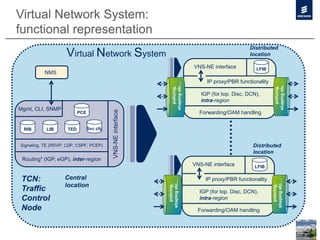
Mgmt, CLI, SNMP
VNS-NEinterface
TEDLIBRIB Svc cfg
NMS
Routing* (IGP, eGP), inter-region
Signaling, TE (RSVP, LDP, CSPF, PCEP)
TCN:
Traffic
Control
Node
PCE
Virtual Network System:
functional representation
Forwarding/OAM handling
LFIB
IP proxy/PBR functionality
IGP (for top. Disc, DCN),
intra-region
VNS-NE interface
Distributed
location
Forwarding/OAM handling
LFIB
IP proxy/PBR functionality
IGP (for top. Disc, DCN),
intra-region
VNS-NE interface
Distributed
locationVirtual Network System
policing,
shapingetc…policing,
shapingetc…
policing,
shapingetc…
policing,
shapingetc…
Central
location
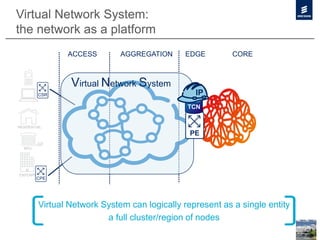
ACCESS AGGREGATION EDGE CORE
ENTERPRISE
MTU
RESIDENTIAL
CPE
CSR
Virtual Network System:
the network as a platform
Virtual Network System can logically represent as a single entity
a full cluster/region of nodes
PE
TCN
Virtual Network System
IP
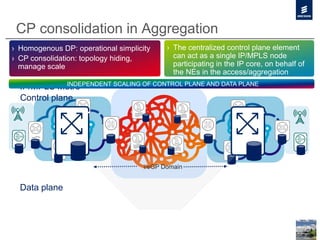
CP consolidation in Aggregation
Data plane
Control plane
› The centralized control plane element
can act as a single IP/MPLS node
participating in the IP core, on behalf of
the NEs in the access/aggregation
i/eGP Domain
› Homogenous DP: operational simplicity
› CP consolidation: topology hiding,
manage scale
IP/MPLS MetroINDEPENDENT SCALING OF CONTROL PLANE AND DATA PLANE
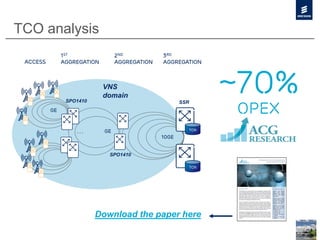
TCO analysis
SSR
2ND
Aggregation
3RD
Aggregation
…
1ST
AggregationAccess
GE
GE
10GE
TCN
TCN
SPO1410
SPO1410
~70%
OPEX
savings
VNS
domain
Download the paper here
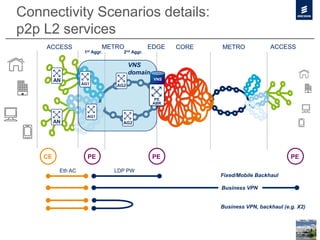
Connectivity Scenarios details:
p2p L2 services
ACCESS
1st Aggr.
EDGE COREMETRO
2nd Aggr.
METRO ACCESS
AN
AN AG2
AG1
AG2AG1
VNS
PE
ABR
LDP PWEth AC
Fixed/Mobile Backhaul
Business VPN, backhaul (e.g. X2)
PE PE PECE
Business VPN
VNS
domain
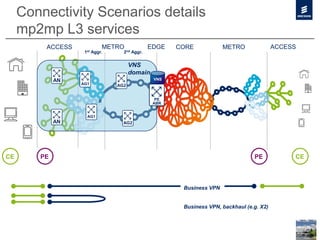
Connectivity Scenarios details
mp2mp L3 services
ACCESS
1st Aggr.
EDGE COREMETRO
2nd Aggr.
METRO ACCESS
AG2
AG1
AG2AG1
VNS
PE
ABR
AN
AN
PECE PE
Business VPN, backhaul (e.g. X2)
Business VPN
CE
VNS
domain
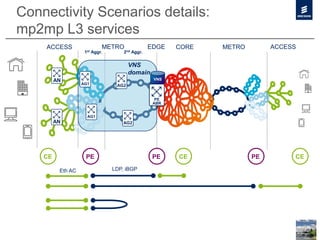
Connectivity Scenarios details:
mp2mp L3 services
ACCESS
1st Aggr.
EDGE COREMETRO
2nd Aggr.
METRO ACCESS
AN
AN AG2
AG1
AG2AG1
VNS
PE
ABR
PE PE
LDP, iBGP
PE
Eth AC
CE CE CE
VNS
domain
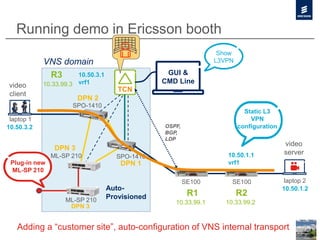
Running demo in Ericsson booth
Configure & prove L3VPN by TCN command line printouts
SE100 SE100 laptop 2
SPO-1410
laptop 1
TCN
OSPF,
BGP,
LDP
SPO-1410ML-SP 210
video
server
video
client
VNS domain
DPN 1
DPN 2
DPN 3
R1 R2
R3
10.50.1.2
10.50.3.2
10.50.3.1
vrf1
10.50.1.1
vrf1
10.33.99.3
10.33.99.1 10.33.99.2
GUI &
CMD Line
Static L3
VPN
configuration
Show
L3VPN
ML-SP 210
Auto-
Provisioned
DPN 3
Plug-in new
ML-SP 210
Adding a “customer site”, auto-configuration of VNS internal transport
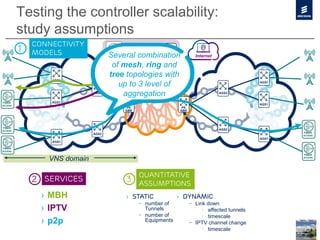
Testing the controller scalability:
study assumptions
› MBH
› IPTV
› p2p
2 SERVICES 3
Quantitative
assumptions
› Static
– number of
Tunnels
– number of
Equipments
› Dynamic
– Link down
› affected tunnels
› timescale
– IPTV channel change
› timescale
FIBER
ACCESS
FIBER
ACCESS
AGS1
AGS1
AGS1
AGS2
AGS2
AGS1
AGS1
AGS2
AGS2
AGS1
PE
ABR
MSER PE
IPTV
server
GGSN
PGW
PE
ABR
Internet
FIBER
ACCESS
FIBER
ACCESS
FIBER
ACCESS
VNS domain
1
CONNECTIVITY
MODELS Several combination
of mesh, ring and
tree topologies with
up to 3 level of
aggregation
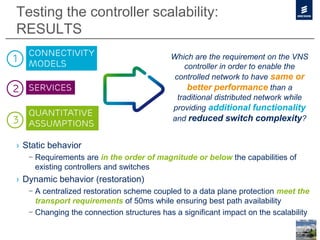
Testing the controller scalability:
RESULTS
1
CONNECTIVITY
MODELS
SERVICES2
Quantitative
assumptions3
Which are the requirement on the VNS
controller in order to enable the
controlled network to have same or
better performance than a
traditional distributed network while
providing additional functionality
and reduced switch complexity?
› Static behavior
– Requirements are in the order of magnitude or below the capabilities of
existing controllers and switches
› Dynamic behavior (restoration)
– A centralized restoration scheme coupled to a data plane protection meet the
transport requirements of 50ms while ensuring best path availability
– Changing the connection structures has a significant impact on the scalability
MOBILE
CORE
MULTI-SERVICE
EDGE
MOBILE
FIXED
COREDEVICES ACCESS AGGREGATION IP EDGE
TRANSPORT & ROUTINGBACKHAUL & METRO
Rapid change carries a cost
Capacity =
ƒn (demand) +
ƒn (performance)
Dealing with Scale Capacity =
ƒn (demand) +
ƒn (performance)
Network costs =
ƒn (traffic growth)
MUST BREAK THIS!
Lowering Costs Capacity =
ƒn (demand) +
ƒn (performance)
Revenue =
ƒn (competition) +
ƒn (content ownership)
Creating Revenue
Capacity =
ƒn (demand) +
ƒn (performance)
Multilayer
optimization?
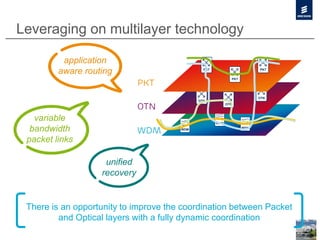
Leveraging on multilayer technology
WDM
WDM
WDM
OTN
OTN
OTN
PKT
PKT
PKT
OTN
WDM
PKT
application
aware routing
variable
bandwidth
packet links
unified
recovery
There is an opportunity to improve the coordination between Packet
and Optical layers with a fully dynamic coordination
MOBILE
CORE
MULTI-SERVICE
EDGE
MOBILE
FIXED
COREDEVICES ACCESS AGGREGATION IP EDGE
TRANSPORT & ROUTINGBACKHAUL & METRO
Rapid change carries a cost
Capacity =
ƒn (demand) +
ƒn (performance)
Dealing with Scale Capacity =
ƒn (demand) +
ƒn (performance)
Network costs =
ƒn (traffic growth)
MUST BREAK THIS!
Lowering Costs Capacity =
ƒn (demand) +
ƒn (performance)
Revenue =
ƒn (competition) +
ƒn (content ownership)
Creating Revenue
Capacity =
ƒn (demand) +
ƒn (performance)
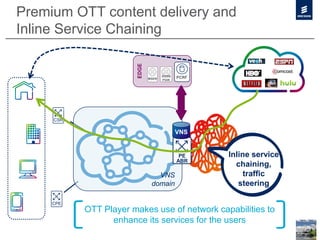
Premium OTT content delivery and
Inline Service Chaining
MSER
GGSN
PGW
EDGE
PCRF
CPE
CSR
PE
ABR
VNS
VNS
domain
OTT Player makes use of network capabilities to
enhance its services for the users
Inline service
chaining,
traffic
steering
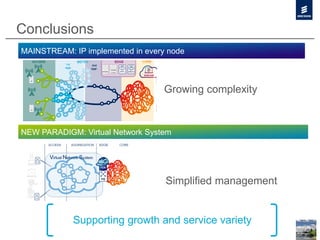
Supporting growth and service variety
Conclusions
NEW PARADIGM: Virtual Network System
MAINSTREAM: IP implemented in every node
Simplified management
Growing complexity
REMINDER:
VNS Demo & Whitepaper at Ericsson Booth
Virtual Network System: Splitting Control and Data Plane to Optimize IP and Transport Services at Minimum OPEX

Virtual Network System: Splitting Control and Data Plane to Optimize IP and Transport Services at Minimum OPEX

  • 1.
    Virtual Network System: SplittingControl and Data Plane to Optimize IP and Transport Services at Minimum OPEX Elisa Bellagamba elisa.bellagamba@ericsson.com
  • 2.
    Trends & drivingforces 50B Connections Mobile Traffic Growth Internet bandwidth growth Personal, mobile cloud services
  • 3.
    MOBILE CORE MULTI-SERVICE EDGE MOBILE FIXED COREDEVICES ACCESS AGGREGATIONIP EDGE TRANSPORT & ROUTINGBACKHAUL & METRO Rapid change carries a cost Capacity = ƒn (demand) + ƒn (performance) Dealing with Scale Capacity = ƒn (demand) + ƒn (performance) Network costs = ƒn (traffic growth) MUST BREAK THIS! Lowering Costs Capacity = ƒn (demand) + ƒn (performance) Revenue = ƒn (competition) + ƒn (content ownership) Creating Revenue Capacity = ƒn (demand) + ƒn (performance)
  • 4.
    MOBILE CORE MULTI-SERVICE EDGE MOBILE FIXED COREDEVICES ACCESS AGGREGATIONIP EDGE TRANSPORT & ROUTINGBACKHAUL & METRO Rapid change carries a cost Capacity = ƒn (demand) + ƒn (performance) Dealing with Scale Capacity = ƒn (demand) + ƒn (performance) Network costs = ƒn (traffic growth) MUST BREAK THIS! Lowering Costs Capacity = ƒn (demand) + ƒn (performance) Revenue = ƒn (competition) + ƒn (content ownership) Creating Revenue Capacity = ƒn (demand) + ƒn (performance) How to extend IP services up to the access?
  • 5.
    MOBILE CORE MULTI-SERVICE EDGE MOBILE FIXED COREDEVICES ACCESS AGGREGATIONIP EDGE TRANSPORT & ROUTINGBACKHAUL & METRO Rapid change carries a cost Capacity = ƒn (demand) + ƒn (performance) Dealing with Scale Capacity = ƒn (demand) + ƒn (performance) Network costs = ƒn (traffic growth) MUST BREAK THIS! Lowering Costs Capacity = ƒn (demand) + ƒn (performance) Revenue = ƒn (competition) + ƒn (content ownership) Creating Revenue Capacity = ƒn (demand) + ƒn (performance) How to extend IP services up to the access? Upgrade boxes to full IP?
  • 6.
    MOBILE CORE MULTI-SERVICE EDGE MOBILE FIXED COREDEVICES ACCESS AGGREGATIONIP EDGE TRANSPORT & ROUTINGBACKHAUL & METRO Rapid change carries a cost Capacity = ƒn (demand) + ƒn (performance) Dealing with Scale Capacity = ƒn (demand) + ƒn (performance) Network costs = ƒn (traffic growth) MUST BREAK THIS! Lowering Costs Capacity = ƒn (demand) + ƒn (performance) Revenue = ƒn (competition) + ƒn (content ownership) Creating Revenue Capacity = ƒn (demand) + ƒn (performance) How to extend IP services up to the access?Train the whole personnel to build IP competence? TDM TDM TDMTDM TDMTDM TDM TDM TDMTDMTDM TDMTDM TDM TDM
  • 7.
    MOBILE CORE MULTI-SERVICE EDGE MOBILE FIXED COREDEVICES ACCESS AGGREGATIONIP EDGE TRANSPORT & ROUTINGBACKHAUL & METRO Rapid change carries a cost Capacity = ƒn (demand) + ƒn (performance) Dealing with Scale Capacity = ƒn (demand) + ƒn (performance) Network costs = ƒn (traffic growth) MUST BREAK THIS! Lowering Costs Capacity = ƒn (demand) + ƒn (performance) Revenue = ƒn (competition) + ƒn (content ownership) Creating Revenue Capacity = ƒn (demand) + ƒn (performance) How to extend IP services up to the access?Train the whole personnel to build IP competence? IP IP IP IP IP IP IP IP IP IP IP IP IP IP IP
  • 8.
    Control Plane options foraccess and aggregation networks Data Plane Control Plane CoreAggregation Aggregation Interface to Common Control Plane Today’s TDM Networks Static Centralized control Simplified operational model NMS Today’s IP Networks NMS Dynamic Distributed control IP operational model Centralized control plane NMS Dynamic Centralized Control Converged Network
  • 9.
    traditional ROUTER traditional TRANSPORT NODE Mgmt, CLI, SNMP Forwarding,OAM handling Routing (IGP, BGP) Signaling/TE (RSVP, LDP, CSPF) Control plane is baked into underlying forwarding infrastructure, that poses scale, and feature velocity problems Mgmt, CLI Forwarding, OAM handling XC dB* IGP (for top. discovery, DCN) NMS, PCE * For MPLS-TP, can be considered LFIB TED LIBFIBRIB LFIB Svc cfg NMS Traditional networking: functional representation
  • 10.
    Mgmt, CLI, SNMP VNS-NEinterface TEDLIBRIBSvc cfg NMS Routing* (IGP, eGP), inter-region Signaling, TE (RSVP, LDP, CSPF, PCEP) TCN: Traffic Control Node PCE Virtual Network System: functional representation Forwarding/OAM handling LFIB IP proxy/PBR functionality IGP (for top. Disc, DCN), intra-region VNS-NE interface Distributed location Forwarding/OAM handling LFIB IP proxy/PBR functionality IGP (for top. Disc, DCN), intra-region VNS-NE interface Distributed locationVirtual Network System policing, shapingetc…policing, shapingetc… policing, shapingetc… policing, shapingetc… Central location
  • 11.
    ACCESS AGGREGATION EDGECORE ENTERPRISE MTU RESIDENTIAL CPE CSR Virtual Network System: the network as a platform Virtual Network System can logically represent as a single entity a full cluster/region of nodes PE TCN Virtual Network System IP
  • 12.
    CP consolidation inAggregation Data plane Control plane › The centralized control plane element can act as a single IP/MPLS node participating in the IP core, on behalf of the NEs in the access/aggregation i/eGP Domain › Homogenous DP: operational simplicity › CP consolidation: topology hiding, manage scale IP/MPLS MetroINDEPENDENT SCALING OF CONTROL PLANE AND DATA PLANE
  • 13.
  • 14.
    Connectivity Scenarios details: p2pL2 services ACCESS 1st Aggr. EDGE COREMETRO 2nd Aggr. METRO ACCESS AN AN AG2 AG1 AG2AG1 VNS PE ABR LDP PWEth AC Fixed/Mobile Backhaul Business VPN, backhaul (e.g. X2) PE PE PECE Business VPN VNS domain
  • 15.
    Connectivity Scenarios details mp2mpL3 services ACCESS 1st Aggr. EDGE COREMETRO 2nd Aggr. METRO ACCESS AG2 AG1 AG2AG1 VNS PE ABR AN AN PECE PE Business VPN, backhaul (e.g. X2) Business VPN CE VNS domain
  • 16.
    Connectivity Scenarios details: mp2mpL3 services ACCESS 1st Aggr. EDGE COREMETRO 2nd Aggr. METRO ACCESS AN AN AG2 AG1 AG2AG1 VNS PE ABR PE PE LDP, iBGP PE Eth AC CE CE CE VNS domain
  • 17.
    Running demo inEricsson booth Configure & prove L3VPN by TCN command line printouts SE100 SE100 laptop 2 SPO-1410 laptop 1 TCN OSPF, BGP, LDP SPO-1410ML-SP 210 video server video client VNS domain DPN 1 DPN 2 DPN 3 R1 R2 R3 10.50.1.2 10.50.3.2 10.50.3.1 vrf1 10.50.1.1 vrf1 10.33.99.3 10.33.99.1 10.33.99.2 GUI & CMD Line Static L3 VPN configuration Show L3VPN ML-SP 210 Auto- Provisioned DPN 3 Plug-in new ML-SP 210 Adding a “customer site”, auto-configuration of VNS internal transport
  • 18.
    Testing the controllerscalability: study assumptions › MBH › IPTV › p2p 2 SERVICES 3 Quantitative assumptions › Static – number of Tunnels – number of Equipments › Dynamic – Link down › affected tunnels › timescale – IPTV channel change › timescale FIBER ACCESS FIBER ACCESS AGS1 AGS1 AGS1 AGS2 AGS2 AGS1 AGS1 AGS2 AGS2 AGS1 PE ABR MSER PE IPTV server GGSN PGW PE ABR Internet FIBER ACCESS FIBER ACCESS FIBER ACCESS VNS domain 1 CONNECTIVITY MODELS Several combination of mesh, ring and tree topologies with up to 3 level of aggregation
  • 19.
    Testing the controllerscalability: RESULTS 1 CONNECTIVITY MODELS SERVICES2 Quantitative assumptions3 Which are the requirement on the VNS controller in order to enable the controlled network to have same or better performance than a traditional distributed network while providing additional functionality and reduced switch complexity? › Static behavior – Requirements are in the order of magnitude or below the capabilities of existing controllers and switches › Dynamic behavior (restoration) – A centralized restoration scheme coupled to a data plane protection meet the transport requirements of 50ms while ensuring best path availability – Changing the connection structures has a significant impact on the scalability
  • 20.
    MOBILE CORE MULTI-SERVICE EDGE MOBILE FIXED COREDEVICES ACCESS AGGREGATIONIP EDGE TRANSPORT & ROUTINGBACKHAUL & METRO Rapid change carries a cost Capacity = ƒn (demand) + ƒn (performance) Dealing with Scale Capacity = ƒn (demand) + ƒn (performance) Network costs = ƒn (traffic growth) MUST BREAK THIS! Lowering Costs Capacity = ƒn (demand) + ƒn (performance) Revenue = ƒn (competition) + ƒn (content ownership) Creating Revenue Capacity = ƒn (demand) + ƒn (performance) Multilayer optimization?
  • 21.
    Leveraging on multilayertechnology WDM WDM WDM OTN OTN OTN PKT PKT PKT OTN WDM PKT application aware routing variable bandwidth packet links unified recovery There is an opportunity to improve the coordination between Packet and Optical layers with a fully dynamic coordination
  • 22.
    MOBILE CORE MULTI-SERVICE EDGE MOBILE FIXED COREDEVICES ACCESS AGGREGATIONIP EDGE TRANSPORT & ROUTINGBACKHAUL & METRO Rapid change carries a cost Capacity = ƒn (demand) + ƒn (performance) Dealing with Scale Capacity = ƒn (demand) + ƒn (performance) Network costs = ƒn (traffic growth) MUST BREAK THIS! Lowering Costs Capacity = ƒn (demand) + ƒn (performance) Revenue = ƒn (competition) + ƒn (content ownership) Creating Revenue Capacity = ƒn (demand) + ƒn (performance)
  • 23.
    Premium OTT contentdelivery and Inline Service Chaining MSER GGSN PGW EDGE PCRF CPE CSR PE ABR VNS VNS domain OTT Player makes use of network capabilities to enhance its services for the users Inline service chaining, traffic steering
  • 24.
    Supporting growth andservice variety Conclusions NEW PARADIGM: Virtual Network System MAINSTREAM: IP implemented in every node Simplified management Growing complexity
  • 25.
    REMINDER: VNS Demo &Whitepaper at Ericsson Booth