Optimizing SCPC
Technologies to
Address the Satellite
Capacity Shortage
Welcome to
Comtech Technology Seminar
SatCom Economics – “Total Cost
of Ownership”
• Costs typically associated with satellite
communications
– Operating expenses
Satellite space segment
Recurring license fees and taxes
Support and maintenance
– Capital (Fixed) expenses
Ground equipment, codec, routers, switching
equipment, modems, converters, RF, HPA, antennas
Site preparation, civil works, one time license fees
• What does a SatCom user want?
– Reduce Operating Expenses (OPEX)
Reduce occupied bandwidth
Reduce transponder power
– Reduce Capital Expenses (CAPEX)
Reduce BUC/HPA size
Reduce antenna size
– Increase availability (margin)
– Increase throughput
2
Operating
Expenses
Capital
Expenses
Network Operations + Depreciation
Total Cost of Ownership
Operations &
Maintenance
Transmission
OPEX
Power
Spares/Support
Training
Site
Rental
Network
Equipment
Site
Equipment
Civil
Works
NRO
Transmission
Equipment
Traditional SatCom Optimization
• Traditionally, you could reduce bandwidth or power,
but not both without significantly increasing the
CAPEX
– Reduce occupied bandwidth
Use higher order modulation
– Increases transponder power utilization
– Increases BUC/HPA size and/or antenna size
– Reduce transponder power utilization
Use lower order modulation
– Increases occupied bandwidth
– Reduces BUC/HPA size and/or antenna size
Without using lower order modulation
– Increase antenna size
3
Revolutionary Forward Error
Correction & Modulation
Low-Density Parity-Check Codes (LDPC)
• At lower code rates (≤ Rate 3/4 ) gives
better performance than Turbo Product
Coding
• Can acquire and track at much lower
values and Eb/No
5
6
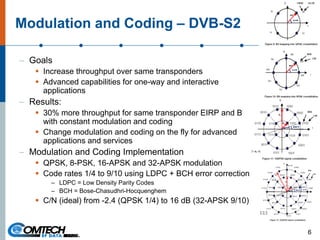
Modulation and Coding – DVB-S2
– Goals
Increase throughput over same transponders
Advanced capabilities for one-way and interactive
applications
– Results:
30% more throughput for same transponder EIRP and BW
with constant modulation and coding
Change modulation and coding on the fly for advanced
applications and services
– Modulation and Coding Implementation
QPSK, 8-PSK, 16-APSK and 32-APSK modulation
Code rates 1/4 to 9/10 using LDPC + BCH error correction
– LDPC = Low Density Parity Codes
– BCH = Bose-Chasudhri-Hocquenghem
C/N (ideal) from -2.4 (QPSK 1/4) to 16 dB (32-APSK 9/10)
6
VersaFEC®
• VersaFEC is a patented (Covered by US Patents
7,353,444 and 7,415,659. System of short-block,
low latency Low Density Parity Check (LDPC)
codes designed to support latency-sensitive
applications, such as cellular backhaul over
satellite.
– VersaFEC was developed by Comtech AHA in
collaboration with Comtech EF Data
• Requires optional expansion card
– Can be field installed by a qualified technician
VersaFEC is a Trademark of Comtech AHA
7
Why VersaFEC ?
• For block codes such as Turbo Products Codes
(TPC) or Low Density Parity Check Codes (LDPC)
the coding gain improves with increased block
size, however increasing the block size leads to
increase in latency.
• So, the 1.0 dB improvement in Eb/No came at the
expen ses of almost 5 fold increase in latency.
• VersaFEC is designed to provide high coding gain
with much lower latency so latency sensitive
applications can take advantage of the improved
gain.
8
VersaFEC Modulation & Code Rates
• VersaFEC supports 12 different modulation and code
rates for ACM and CCM
9
Is FEC Latency Fixed ?
• For block codes such as TPC, LDPC, VersaFEC,
DVB-S2, latency is inversely proportional to the data
rate, if the data rate doubles, the latency is reduced by
50%.
• This is why a low latency FEC is critical for lower data
rate links.
10
Low Latency
• VersaFEC was specifically designed to support low
latency applications while providing superior coding gain
– e.g. Consider a 256 kbps link using 8-QAM, Rate 3/4, needing a
BER of 5.0E-8
In this case, VersaFEC’s Eb/No performance is as good as LDPC
with 76% lower latency and 4% improvement in spectral efficiency
Given the excellent Eb/No performance of VersaFEC, it is
recommended for all supported data rates
11
Adaptive Coding & Modulation
• Satellite users have traditionally relied on worst case link
margin to overcome rain fade and other dynamic
impairments which leads to significant inefficiencies
• A Constant Coding and Modulation (CCM) link is generally
over provisioned by many dBs of margin throughout the
year, just to get through a few hours of excessive
degradation.
• CCM Link – Modulation and FEC Rate are set manually
and remain unchanged until changed by the.
16
Adaptive Coding & Modulation
• Adaptive Coding and Modulation (ACM) is a technique
that allows for automatic change in Modulation and FEC
Code Rate in response to changing link conditions.
• Adaptive Coding & Modulation (ACM) converts the fade
margin into increased capacity – average throughput
gain of 100% (or more) is possible, compared to
traditional CCM
– This is accomplished by automatically adapting the modulation type
and FEC code rate to give highest possible throughput.
• ACM maximizes throughput under all conditions – rain
fade, inclined orbit satellite operation, antenna
mispointing, noise, interference and other impairments.
17
DoubleTalk
Carrier-in-Carrier
Bandwidth
Compression
DoubleTalk® Carrier-in-Carrier®
• Based on patented “Adaptive Cancellation”, Carrier-in-
Carrier (CnC) allows carriers in a Duplex satellite link
to occupy the same transponder space
Without DoubleTalk Carrier-in-Carrier With DoubleTalk Carrier-in-Carrier
Carrier-in-Carrier is a Registered Trademark of Comtech EF Data
DoubleTalk is a Registered Trademark of Applied Signal Technology, Inc.
19
Use Spreading When Traditional Link
is Balanced OR Power Limited
20
Multi Dimensional Optimization
• DoubleTalk Carrier-in-Carrier is a bandwidth compression
solution based on patented “Adaptive Cancellation” technique
that allows satellite carriers to share spectrum
• DoubleTalk Carrier-in-Carrier combined with proper Modulation
and FEC, makes it possible to optimize satellite communications
like never before
– Reduce OPEX
Occupied Bandwidth & Transponder Power
– Reduce CAPEX
BUC/HPA Size and/or Antenna Size
– Increase throughput
– Increase link availability
– Or a combination to meet different objectives
21
Carrier-in-Carrier
• CDM-625 has the most advanced Carrier-in-Carrier
implementation
• Significant Performance Enhancements
– Improved Eb/No Performance
– Ability to handle higher asymmetry
– Improved Doppler performance
– Additional optimization options when combined with LDPC/TPC
and VersaFEC
• Power ratio based on Power Spectral Density and not
absolute power
– PSD Ratio Spec (Interferer to Desired): -7 dB to +11 dB
22
Upgrading Balanced Link
(Using CDM-625)
• IS-905
– C-Band (EH)
• Earth Station
– 7.2 m to 3.8 m (Africa)
23
Upgrading Asymmetric Antenna Link
(Using CDM-625)
• IS-1002, C-Band (SEZ)
• Earth Station
– 9.0 m to 2.4 m (Africa)
• Option 1 - Using different Modulation and FEC rate to
keep PSD Ratio within specification
• Power Spectral Density Ratio ~ ±5.5 dB (well within spec)
24
Upgrading Asymmetric Antenna Link
(Using CDM-625)
• Option 2 – Using same FEC and Modulation in each
direction, but increasing Transmit EIRP of the smaller
Antenna (if possible) to achieve similar PSD Ratio
• Increasing Remote’s TX EIRP by 1 dB, allows similar Power
Spectral Density Ratio as previous example
25
Upgrading Asymmetric Data Rate Link
(Using CDM-625)
• IS-905, C-Band (Global Beam)
• Earth Station
– 9.5 m to 3.8 m (Middle East/Africa)
26
CDM-625 Advanced Satellite Modem
• CDM-625 Advanced Satellite Modem builds on Comtech
EF Data’s legacy of providing the most bandwidth efficient
satellite modems
– First modem to support DoubleTalk® Carrier-in-Carrier® with LDPC
and VersaFECTM (short block LDPC) FEC
Provides significant OPEX and CAPEX savings compared to any other
modem
27
Carrier-in-Carrier + VersaFEC/ACM
• The CDM 625 Modem is the Most
Spectral Efficient satellite modem on
the market today
– VersaFEC/ACM can deliver more then
100% traffic throughput increase
– Carrier-in-Carrier can reduce satellite
Power and/or Bandwidth resources by 50%
28
TPC / LDPC FEC
+ Carrier-in-Carrier
Savings
Compared to DVB-S2
CDM-625 Value Proposition
• Combination of DoubleTalk Carrier-in-Carrier and
LDPC
– Additional reduction in Transponder Power
– Additional increase in Margin (availability)
– Further reduction in BUC/HPA and/or Antenna
• CDM-625 can handle higher asymmetry
– No restriction on symbol rate of the 2 carriers
– Power Spectral Density Ratio limit as opposed to Total
Power Ratio
Recent Customer
Savings Examples
• New Network in South Asia
– 175 MHz (Traditional) vs. 125 MHz (CnC)
Annual Savings ~ $600,000 (@ $1,000 / MHz / Month)
• Existing Network in Africa
– 40% potential saving on 1st transponder (36 MHz)
Annual Savings ~ $520,000 (@ $3,000 / MHz / Month)
– 44% potential saving on 2nd transponder (54 MHz)
Annual Savings ~ $800,000 (@ $2,800 / MHz / Month)
• Existing Network in Latin America
– 38% potential saving on 1st transponder (41 MHz)
Annual Savings ~ $486,000 (@ $2,600 / MHz / Month)
35
WAN Link
Optimization
CDM-570/L-IP
• Enables bandwidth efficient IP connectivity over satellite
– Managed Switch capability for simplified set up
– Static IP routing for unicast and multicast
– Options for improving bandwidth efficiency
Header Compression
Payload Compression
– Quality of Service (QoS) Option
DiffServ
Max/Priority
Min/max
– 3xDES data encryption option
– Manageable via CLI, SNMP, web interface or telnet
• Optional integration with Vipersat Management System (VMS)
VLAN Support
(CDM-570/L-IP)
• Native and Tagged Mode
• Ingress/Egress processing based on user
configuration
– Up to 32 VLANs can be specified
• VLAN QoS
– Priority based with option to limit maximum
Header & Payload Compression
(CDM-570/L-IP)
• Header Compression
– Reduces the Layer 2/3/4 header to
a few bytes
E.g., in case of Voice over IP
(VoIP) bandwidth required can be
reduced by as much as 60%
– Configurable on a per route basis
– Ethernet headers are compressed
in easyConnect Mode
• Payload Compression
– Can reduce payload size by 40%
or more
– Configurable on a per route basis
Supported Ethernet Headers (Header Comp.)
Ethernet 2.0
Ethernet 2.0 + VLAN-tag
Ethernet 2.0 + MPLS
802.3-raw
802.3-raw + VLAN-tag
802.3 + 802.2
802.3 + 802.2 + VLAN-tag
802.3 + 802.2 + SNAP
802.3 + 802.2 + SNAP + VLAN-tag
802.3 + 802.2 + SNAP + MPLS
Supported Layer 3&4 Headers (Header Comp.)
IP
TCP
UDP
RTP (Codec Independent)
Quality of Service (QoS)
(CDM-570/L-IP)
• Minimizes jitter and latency for real time traffic
• Provides priority treatment to mission critical applications
• Allows non-critical traffic to use the remaining bandwidth
• Modes
– DiffServ
Allows Differentiated Services in accordance with Industry standards
– Max/Priority
Assign maximum bandwidth that any traffic flow can utilize
Establish up to 8 levels of prioritization
– Min/Max
Set the minimum and maximum bandwidth for user-defined classes of
traffic
Ensures that a certain level of bandwidth is always applied
WAN Adaptation
• WAN adaptation capability reduces the satellite
bandwidth required to carry an E1 bearer when used
for cellular backhaul
• Cellular protocols were originally designed to use
entire E1 bearer(s) irrespective of actual traffic
• WAN Adaptation reduces the bits that need to be
transmitted, significantly reducing the transmission
bandwidth
– Possible savings of 30% or more depending on traffic profile
42
Modem Configuration
• WAN Adaptation feature allows users to control
savings and link quality
• Terrestrial Input
– E1 Balanced/Unbalanced
– Select up to 16 Time Slots carrying traffic
• WAN (Satellite) Output
– Configure Modem Tx Data Rate
The Modem Tx Data Rate can be as low as 0.5 x N x 64 kbps,
where N is the number of selected traffic Time Slots
E.g. if user selects 8 Time Slots as input, the Tx Data Rate can
be selected from 256 kbps (50%) to 512 kbps (100%)
43
Adaptation Ratio & Savings
• Adaptation Ratio is the ratio of the Modem Tx Data
Rate and the Data Rate of the selected Time Slots
– E.g. if 10 Time Slots are selected and Modem Tx Data Rate
is set to 448 kbps
Adaptation Ratio = 448/ (10 x 64) = 0.7
• % BW Savings = (1 – Adaptation Ratio) x 100
– E.g., in previous case,
Savings = (1 – 0.7) x 100 = 30%
44
WAN Adaptation Savings
46
WAN Utilization
47
Link Congestion/Quality
48
Availability & Ordering
• WAN Adaptation is available on E1/T1 capable
CDM-570/L and CDM-570/L-IP
• Plug-in hardware module
– Can be installed in existing modems (that are E1/T1
capable) by a qualified technician
Also requires firmware upgrade to 1.7.0 (or later)
– Uses the Reed Solomon slot in the modem
i.e. Reed Solomon cannot be ordered/used with WAN Adaptation
• No software options/FAST required
49

Comtech sspi vsat_day_2009

  • 1.
    Optimizing SCPC Technologies to Addressthe Satellite Capacity Shortage Welcome to Comtech Technology Seminar
  • 2.
    SatCom Economics –“Total Cost of Ownership” • Costs typically associated with satellite communications – Operating expenses Satellite space segment Recurring license fees and taxes Support and maintenance – Capital (Fixed) expenses Ground equipment, codec, routers, switching equipment, modems, converters, RF, HPA, antennas Site preparation, civil works, one time license fees • What does a SatCom user want? – Reduce Operating Expenses (OPEX) Reduce occupied bandwidth Reduce transponder power – Reduce Capital Expenses (CAPEX) Reduce BUC/HPA size Reduce antenna size – Increase availability (margin) – Increase throughput 2 Operating Expenses Capital Expenses Network Operations + Depreciation Total Cost of Ownership Operations & Maintenance Transmission OPEX Power Spares/Support Training Site Rental Network Equipment Site Equipment Civil Works NRO Transmission Equipment
  • 3.
    Traditional SatCom Optimization •Traditionally, you could reduce bandwidth or power, but not both without significantly increasing the CAPEX – Reduce occupied bandwidth Use higher order modulation – Increases transponder power utilization – Increases BUC/HPA size and/or antenna size – Reduce transponder power utilization Use lower order modulation – Increases occupied bandwidth – Reduces BUC/HPA size and/or antenna size Without using lower order modulation – Increase antenna size 3
  • 4.
    Revolutionary Forward Error Correction& Modulation Low-Density Parity-Check Codes (LDPC) • At lower code rates (≤ Rate 3/4 ) gives better performance than Turbo Product Coding • Can acquire and track at much lower values and Eb/No 5
  • 5.
    6 Modulation and Coding– DVB-S2 – Goals Increase throughput over same transponders Advanced capabilities for one-way and interactive applications – Results: 30% more throughput for same transponder EIRP and BW with constant modulation and coding Change modulation and coding on the fly for advanced applications and services – Modulation and Coding Implementation QPSK, 8-PSK, 16-APSK and 32-APSK modulation Code rates 1/4 to 9/10 using LDPC + BCH error correction – LDPC = Low Density Parity Codes – BCH = Bose-Chasudhri-Hocquenghem C/N (ideal) from -2.4 (QPSK 1/4) to 16 dB (32-APSK 9/10) 6
  • 6.
    VersaFEC® • VersaFEC isa patented (Covered by US Patents 7,353,444 and 7,415,659. System of short-block, low latency Low Density Parity Check (LDPC) codes designed to support latency-sensitive applications, such as cellular backhaul over satellite. – VersaFEC was developed by Comtech AHA in collaboration with Comtech EF Data • Requires optional expansion card – Can be field installed by a qualified technician VersaFEC is a Trademark of Comtech AHA 7
  • 7.
    Why VersaFEC ? •For block codes such as Turbo Products Codes (TPC) or Low Density Parity Check Codes (LDPC) the coding gain improves with increased block size, however increasing the block size leads to increase in latency. • So, the 1.0 dB improvement in Eb/No came at the expen ses of almost 5 fold increase in latency. • VersaFEC is designed to provide high coding gain with much lower latency so latency sensitive applications can take advantage of the improved gain. 8
  • 8.
    VersaFEC Modulation &Code Rates • VersaFEC supports 12 different modulation and code rates for ACM and CCM 9
  • 9.
    Is FEC LatencyFixed ? • For block codes such as TPC, LDPC, VersaFEC, DVB-S2, latency is inversely proportional to the data rate, if the data rate doubles, the latency is reduced by 50%. • This is why a low latency FEC is critical for lower data rate links. 10
  • 10.
    Low Latency • VersaFECwas specifically designed to support low latency applications while providing superior coding gain – e.g. Consider a 256 kbps link using 8-QAM, Rate 3/4, needing a BER of 5.0E-8 In this case, VersaFEC’s Eb/No performance is as good as LDPC with 76% lower latency and 4% improvement in spectral efficiency Given the excellent Eb/No performance of VersaFEC, it is recommended for all supported data rates 11
  • 11.
    Adaptive Coding &Modulation • Satellite users have traditionally relied on worst case link margin to overcome rain fade and other dynamic impairments which leads to significant inefficiencies • A Constant Coding and Modulation (CCM) link is generally over provisioned by many dBs of margin throughout the year, just to get through a few hours of excessive degradation. • CCM Link – Modulation and FEC Rate are set manually and remain unchanged until changed by the. 16
  • 12.
    Adaptive Coding &Modulation • Adaptive Coding and Modulation (ACM) is a technique that allows for automatic change in Modulation and FEC Code Rate in response to changing link conditions. • Adaptive Coding & Modulation (ACM) converts the fade margin into increased capacity – average throughput gain of 100% (or more) is possible, compared to traditional CCM – This is accomplished by automatically adapting the modulation type and FEC code rate to give highest possible throughput. • ACM maximizes throughput under all conditions – rain fade, inclined orbit satellite operation, antenna mispointing, noise, interference and other impairments. 17
  • 13.
  • 14.
    DoubleTalk® Carrier-in-Carrier® • Basedon patented “Adaptive Cancellation”, Carrier-in- Carrier (CnC) allows carriers in a Duplex satellite link to occupy the same transponder space Without DoubleTalk Carrier-in-Carrier With DoubleTalk Carrier-in-Carrier Carrier-in-Carrier is a Registered Trademark of Comtech EF Data DoubleTalk is a Registered Trademark of Applied Signal Technology, Inc. 19
  • 15.
    Use Spreading WhenTraditional Link is Balanced OR Power Limited 20
  • 16.
    Multi Dimensional Optimization •DoubleTalk Carrier-in-Carrier is a bandwidth compression solution based on patented “Adaptive Cancellation” technique that allows satellite carriers to share spectrum • DoubleTalk Carrier-in-Carrier combined with proper Modulation and FEC, makes it possible to optimize satellite communications like never before – Reduce OPEX Occupied Bandwidth & Transponder Power – Reduce CAPEX BUC/HPA Size and/or Antenna Size – Increase throughput – Increase link availability – Or a combination to meet different objectives 21
  • 17.
    Carrier-in-Carrier • CDM-625 hasthe most advanced Carrier-in-Carrier implementation • Significant Performance Enhancements – Improved Eb/No Performance – Ability to handle higher asymmetry – Improved Doppler performance – Additional optimization options when combined with LDPC/TPC and VersaFEC • Power ratio based on Power Spectral Density and not absolute power – PSD Ratio Spec (Interferer to Desired): -7 dB to +11 dB 22
  • 18.
    Upgrading Balanced Link (UsingCDM-625) • IS-905 – C-Band (EH) • Earth Station – 7.2 m to 3.8 m (Africa) 23
  • 19.
    Upgrading Asymmetric AntennaLink (Using CDM-625) • IS-1002, C-Band (SEZ) • Earth Station – 9.0 m to 2.4 m (Africa) • Option 1 - Using different Modulation and FEC rate to keep PSD Ratio within specification • Power Spectral Density Ratio ~ ±5.5 dB (well within spec) 24
  • 20.
    Upgrading Asymmetric AntennaLink (Using CDM-625) • Option 2 – Using same FEC and Modulation in each direction, but increasing Transmit EIRP of the smaller Antenna (if possible) to achieve similar PSD Ratio • Increasing Remote’s TX EIRP by 1 dB, allows similar Power Spectral Density Ratio as previous example 25
  • 21.
    Upgrading Asymmetric DataRate Link (Using CDM-625) • IS-905, C-Band (Global Beam) • Earth Station – 9.5 m to 3.8 m (Middle East/Africa) 26
  • 22.
    CDM-625 Advanced SatelliteModem • CDM-625 Advanced Satellite Modem builds on Comtech EF Data’s legacy of providing the most bandwidth efficient satellite modems – First modem to support DoubleTalk® Carrier-in-Carrier® with LDPC and VersaFECTM (short block LDPC) FEC Provides significant OPEX and CAPEX savings compared to any other modem 27
  • 23.
    Carrier-in-Carrier + VersaFEC/ACM •The CDM 625 Modem is the Most Spectral Efficient satellite modem on the market today – VersaFEC/ACM can deliver more then 100% traffic throughput increase – Carrier-in-Carrier can reduce satellite Power and/or Bandwidth resources by 50% 28
  • 24.
    TPC / LDPCFEC + Carrier-in-Carrier Savings Compared to DVB-S2
  • 25.
    CDM-625 Value Proposition •Combination of DoubleTalk Carrier-in-Carrier and LDPC – Additional reduction in Transponder Power – Additional increase in Margin (availability) – Further reduction in BUC/HPA and/or Antenna • CDM-625 can handle higher asymmetry – No restriction on symbol rate of the 2 carriers – Power Spectral Density Ratio limit as opposed to Total Power Ratio
  • 30.
    Recent Customer Savings Examples •New Network in South Asia – 175 MHz (Traditional) vs. 125 MHz (CnC) Annual Savings ~ $600,000 (@ $1,000 / MHz / Month) • Existing Network in Africa – 40% potential saving on 1st transponder (36 MHz) Annual Savings ~ $520,000 (@ $3,000 / MHz / Month) – 44% potential saving on 2nd transponder (54 MHz) Annual Savings ~ $800,000 (@ $2,800 / MHz / Month) • Existing Network in Latin America – 38% potential saving on 1st transponder (41 MHz) Annual Savings ~ $486,000 (@ $2,600 / MHz / Month) 35
  • 31.
  • 32.
    CDM-570/L-IP • Enables bandwidthefficient IP connectivity over satellite – Managed Switch capability for simplified set up – Static IP routing for unicast and multicast – Options for improving bandwidth efficiency Header Compression Payload Compression – Quality of Service (QoS) Option DiffServ Max/Priority Min/max – 3xDES data encryption option – Manageable via CLI, SNMP, web interface or telnet • Optional integration with Vipersat Management System (VMS)
  • 33.
    VLAN Support (CDM-570/L-IP) • Nativeand Tagged Mode • Ingress/Egress processing based on user configuration – Up to 32 VLANs can be specified • VLAN QoS – Priority based with option to limit maximum
  • 34.
    Header & PayloadCompression (CDM-570/L-IP) • Header Compression – Reduces the Layer 2/3/4 header to a few bytes E.g., in case of Voice over IP (VoIP) bandwidth required can be reduced by as much as 60% – Configurable on a per route basis – Ethernet headers are compressed in easyConnect Mode • Payload Compression – Can reduce payload size by 40% or more – Configurable on a per route basis Supported Ethernet Headers (Header Comp.) Ethernet 2.0 Ethernet 2.0 + VLAN-tag Ethernet 2.0 + MPLS 802.3-raw 802.3-raw + VLAN-tag 802.3 + 802.2 802.3 + 802.2 + VLAN-tag 802.3 + 802.2 + SNAP 802.3 + 802.2 + SNAP + VLAN-tag 802.3 + 802.2 + SNAP + MPLS Supported Layer 3&4 Headers (Header Comp.) IP TCP UDP RTP (Codec Independent)
  • 35.
    Quality of Service(QoS) (CDM-570/L-IP) • Minimizes jitter and latency for real time traffic • Provides priority treatment to mission critical applications • Allows non-critical traffic to use the remaining bandwidth • Modes – DiffServ Allows Differentiated Services in accordance with Industry standards – Max/Priority Assign maximum bandwidth that any traffic flow can utilize Establish up to 8 levels of prioritization – Min/Max Set the minimum and maximum bandwidth for user-defined classes of traffic Ensures that a certain level of bandwidth is always applied
  • 36.
    WAN Adaptation • WANadaptation capability reduces the satellite bandwidth required to carry an E1 bearer when used for cellular backhaul • Cellular protocols were originally designed to use entire E1 bearer(s) irrespective of actual traffic • WAN Adaptation reduces the bits that need to be transmitted, significantly reducing the transmission bandwidth – Possible savings of 30% or more depending on traffic profile 42
  • 37.
    Modem Configuration • WANAdaptation feature allows users to control savings and link quality • Terrestrial Input – E1 Balanced/Unbalanced – Select up to 16 Time Slots carrying traffic • WAN (Satellite) Output – Configure Modem Tx Data Rate The Modem Tx Data Rate can be as low as 0.5 x N x 64 kbps, where N is the number of selected traffic Time Slots E.g. if user selects 8 Time Slots as input, the Tx Data Rate can be selected from 256 kbps (50%) to 512 kbps (100%) 43
  • 38.
    Adaptation Ratio &Savings • Adaptation Ratio is the ratio of the Modem Tx Data Rate and the Data Rate of the selected Time Slots – E.g. if 10 Time Slots are selected and Modem Tx Data Rate is set to 448 kbps Adaptation Ratio = 448/ (10 x 64) = 0.7 • % BW Savings = (1 – Adaptation Ratio) x 100 – E.g., in previous case, Savings = (1 – 0.7) x 100 = 30% 44
  • 39.
  • 40.
  • 41.
  • 42.
    Availability & Ordering •WAN Adaptation is available on E1/T1 capable CDM-570/L and CDM-570/L-IP • Plug-in hardware module – Can be installed in existing modems (that are E1/T1 capable) by a qualified technician Also requires firmware upgrade to 1.7.0 (or later) – Uses the Reed Solomon slot in the modem i.e. Reed Solomon cannot be ordered/used with WAN Adaptation • No software options/FAST required 49