Envisioning the Network
Cloud
Will Charnock – APRICOT 2018
Kathmandu, Nepal
About Me
• Board member of NANOG
• Co-founder of PacketFabric – a next-generation cloud
carrier platform
• Spent 13 years running Network Engineering &
Operations for SoftLayer (an IBM company) – a global
cloud computing platform
• General all around good guy (trust me)!
Cloud Networking?
• Based on several premises
– Cloud computing has fundamentally changed customer attitudes about
traditional infrastructure services
• On-demand compute service model works for both the provider as well as the
customer
• Customers will pay a premium for only the resources they need and consume
– Networking service models need to change to align with new customer
attitudes and needs
• A new service model requires new operating models as well
• Traditional services are not dead – but the customers who buy them are fewer and
shrinking
Building the Cloud – A History
• 15 years ago, on-demand compute was something
nobody had really considered
– Technology barriers
– Financial barriers
– Operational barriers
What changed?
• Technology barriers lowered
– Hypervisors allowed for better utilization of compute resources
– Advanced orchestration capabilities allowed for easy provisioning and workload
management
• Financial barriers lowered
– Market validation (Amazon) resulted in investment activity into the space – putting capital
to work and resulting in large cloud buildouts
– Business plans at web startups required cloud-first infrastructure strategies. Investors
wanted to put money in the product, not into routers, servers, etc.
• Operational barriers lowered
– Customers now able to manage infrastructure simply through web interfaces or
programmatically through API’s
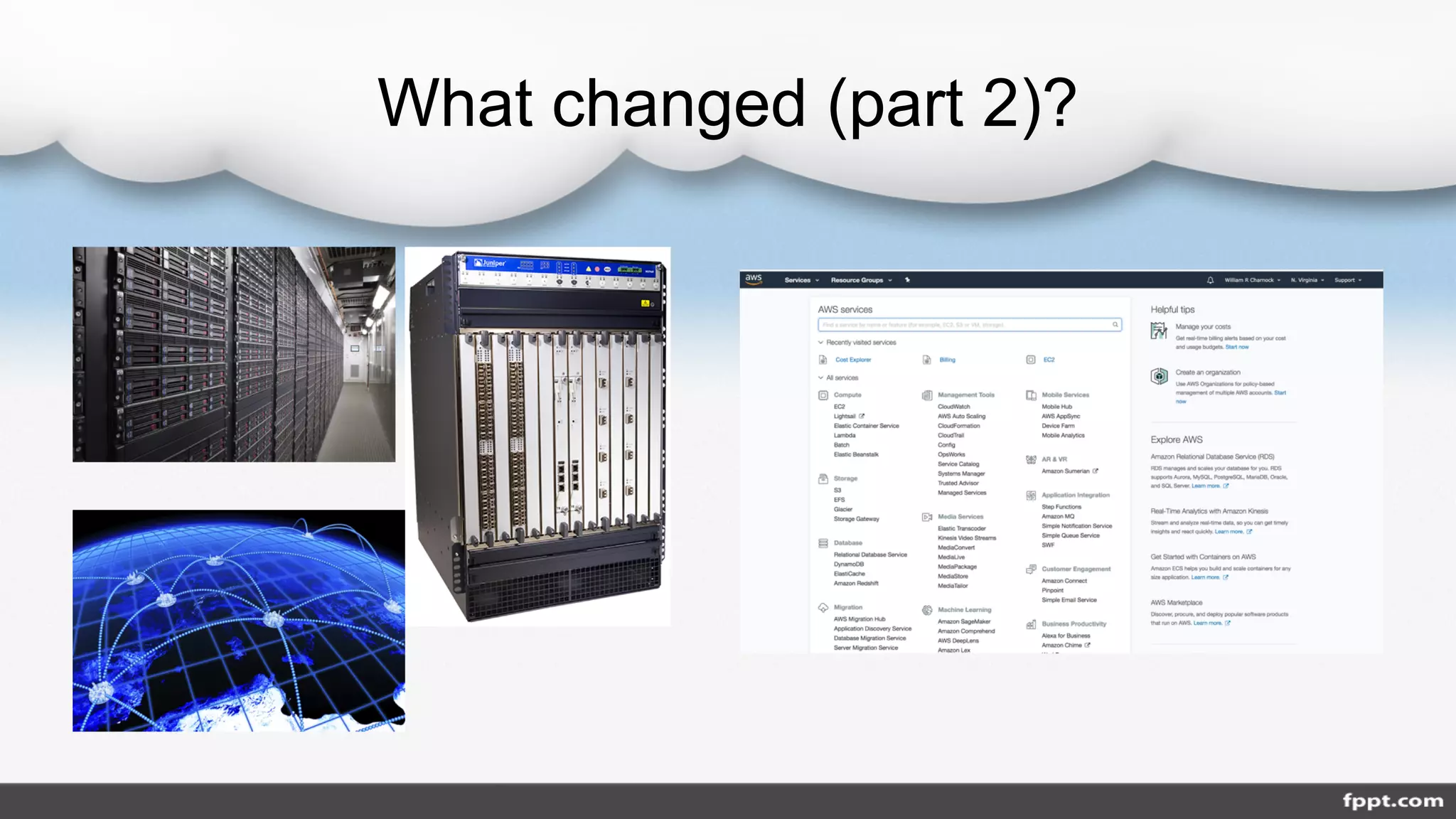
What changed (part 2)?
Adoption = Validation
• The cloud model has been widely embraced and many enterprises have
embraced the ”cloud-first” philosophy for their business applications as well
as their infrastructure requirements
• The difficult tasks of managing infrastructure (procurement, capacity
planning, deployment, operations, etc) have shifted from the customers to the
cloud providers
• Opportunities remain
– Hybrid IT solutions are more and more the norm – with many enterprises maintaining
some level of infrastructure as an in-house solution but leveraging cloud solutions to
augment their applications and infrastructure
– Connectivity to their cloud providers is more critical than ever for performance and
security (and other) reasons
– Consumers have been conditioned to a new model for services – enter Cloud Networking
So What is Cloud Networking?
• We’ve established a baseline for what ”cloud” means
– Infrastructure delivered as a service
– Simple ordering, through portal or API, near real-time
provisioning of services
– Ability to modify your services on the fly to match your needs
– Heavy lifting of backend operations managed by CSP
• Cloud networking capabilities should match what
customers expect in cloud computing services
Networking as a Service
• SDN exposed the hardware in ways that enable a much
more sophisticated level of orchestration on the network
– Service creation can now be fully automated in a way that’s
much more reliable than traditional scripted methods
• Better analytics capabilities (stream vs. poll) allow service
providers to provide near real-time visibility into the
network’s performance and more robust billing capabilities
– Time based or usage based billing models are much easier to
implement
Networking as a Service
• New protocols allow the service provider to run a
traditional underlay network for backbone connectivity and
easily provision overlay networks per customer quickly
and simply – providing real-time topology reconfiguration
– VXLAN + EVPN, Segment routing(?)
Capacity Management
• Because the burden of capacity management has shifted
to the service provider, customers have an expectation
that the services they order will be available immediately
– Providers must have tight inventory controls in place
– Pre-building and cabling coupled with this new inventory engine
allow for instantaneous provisioning of services
• Accurate LOA delivered in seconds
• Physical cross-connect in the datacenter becomes the obstacle to
services being delivered
Service Options
• Usage (cloud) based models now allow the customer to provision
edge capacity based on their peak loads, but only pay for their
average load
– Pay for what you use – no stranded or idle capacity
• Dynamically reconfigure your topology and speeds to match your
needs – all via portal or API
• On-demand interconnection capabilities
– Establish direct virtual interconnections to other customers on the platform
only when needed and tear them down when done – secure
interconnection (finance, etc)
Operations Considerations
• The integration of software and hardware in the networking space has
changed the role of the network engineer dramatically in the last few years
• Skills not just at protocol levels, but in coding are essential for engineers to
succeed
• Having proper tooling to do forward looking capacity planning is essential
• Inventory and network deployment management are more critical tasks than
ever – you can’t sell an on-demand service if there is no capacity
• Last mile access is still a roadblock – but there are ways to deal
– Hybrid networking using SD-WAN as a last-mile overlay to your onramps
Opportunity is huge
• Cloud service adoption is still in it’s infancy
• Connectivity is the missing piece for all these services –
it’s called the cloud because it lives in the ether – and you
need to be able to access these services to take
advantage of all the things they provide
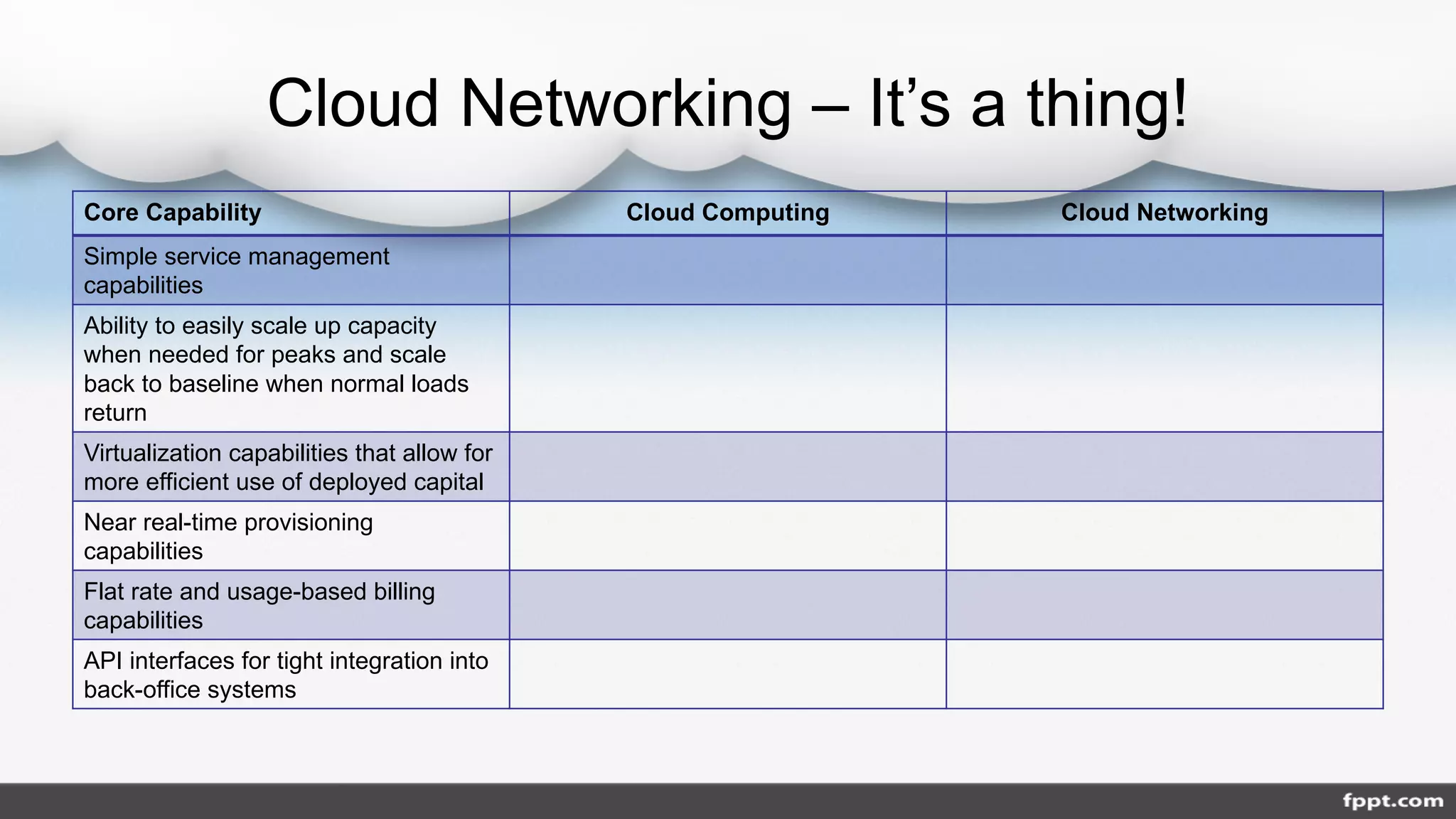
Cloud Networking – It’s a thing!
Core Capability Cloud Computing Cloud Networking
Simple service management
capabilities
Ability to easily scale up capacity
when needed for peaks and scale
back to baseline when normal loads
return
Virtualization capabilities that allow for
more efficient use of deployed capital
Near real-time provisioning
capabilities
Flat rate and usage-based billing
capabilities
API interfaces for tight integration into
back-office systems
Thank you!
• Questions?
• wcharnock@gmail.com

Envisioning the Network Cloud

  • 1.
    Envisioning the Network Cloud WillCharnock – APRICOT 2018 Kathmandu, Nepal
  • 2.
    About Me • Boardmember of NANOG • Co-founder of PacketFabric – a next-generation cloud carrier platform • Spent 13 years running Network Engineering & Operations for SoftLayer (an IBM company) – a global cloud computing platform • General all around good guy (trust me)!
  • 3.
    Cloud Networking? • Basedon several premises – Cloud computing has fundamentally changed customer attitudes about traditional infrastructure services • On-demand compute service model works for both the provider as well as the customer • Customers will pay a premium for only the resources they need and consume – Networking service models need to change to align with new customer attitudes and needs • A new service model requires new operating models as well • Traditional services are not dead – but the customers who buy them are fewer and shrinking
  • 4.
    Building the Cloud– A History • 15 years ago, on-demand compute was something nobody had really considered – Technology barriers – Financial barriers – Operational barriers
  • 5.
    What changed? • Technologybarriers lowered – Hypervisors allowed for better utilization of compute resources – Advanced orchestration capabilities allowed for easy provisioning and workload management • Financial barriers lowered – Market validation (Amazon) resulted in investment activity into the space – putting capital to work and resulting in large cloud buildouts – Business plans at web startups required cloud-first infrastructure strategies. Investors wanted to put money in the product, not into routers, servers, etc. • Operational barriers lowered – Customers now able to manage infrastructure simply through web interfaces or programmatically through API’s
  • 6.
  • 7.
    Adoption = Validation •The cloud model has been widely embraced and many enterprises have embraced the ”cloud-first” philosophy for their business applications as well as their infrastructure requirements • The difficult tasks of managing infrastructure (procurement, capacity planning, deployment, operations, etc) have shifted from the customers to the cloud providers • Opportunities remain – Hybrid IT solutions are more and more the norm – with many enterprises maintaining some level of infrastructure as an in-house solution but leveraging cloud solutions to augment their applications and infrastructure – Connectivity to their cloud providers is more critical than ever for performance and security (and other) reasons – Consumers have been conditioned to a new model for services – enter Cloud Networking
  • 8.
    So What isCloud Networking? • We’ve established a baseline for what ”cloud” means – Infrastructure delivered as a service – Simple ordering, through portal or API, near real-time provisioning of services – Ability to modify your services on the fly to match your needs – Heavy lifting of backend operations managed by CSP • Cloud networking capabilities should match what customers expect in cloud computing services
  • 9.
    Networking as aService • SDN exposed the hardware in ways that enable a much more sophisticated level of orchestration on the network – Service creation can now be fully automated in a way that’s much more reliable than traditional scripted methods • Better analytics capabilities (stream vs. poll) allow service providers to provide near real-time visibility into the network’s performance and more robust billing capabilities – Time based or usage based billing models are much easier to implement
  • 10.
    Networking as aService • New protocols allow the service provider to run a traditional underlay network for backbone connectivity and easily provision overlay networks per customer quickly and simply – providing real-time topology reconfiguration – VXLAN + EVPN, Segment routing(?)
  • 11.
    Capacity Management • Becausethe burden of capacity management has shifted to the service provider, customers have an expectation that the services they order will be available immediately – Providers must have tight inventory controls in place – Pre-building and cabling coupled with this new inventory engine allow for instantaneous provisioning of services • Accurate LOA delivered in seconds • Physical cross-connect in the datacenter becomes the obstacle to services being delivered
  • 12.
    Service Options • Usage(cloud) based models now allow the customer to provision edge capacity based on their peak loads, but only pay for their average load – Pay for what you use – no stranded or idle capacity • Dynamically reconfigure your topology and speeds to match your needs – all via portal or API • On-demand interconnection capabilities – Establish direct virtual interconnections to other customers on the platform only when needed and tear them down when done – secure interconnection (finance, etc)
  • 13.
    Operations Considerations • Theintegration of software and hardware in the networking space has changed the role of the network engineer dramatically in the last few years • Skills not just at protocol levels, but in coding are essential for engineers to succeed • Having proper tooling to do forward looking capacity planning is essential • Inventory and network deployment management are more critical tasks than ever – you can’t sell an on-demand service if there is no capacity • Last mile access is still a roadblock – but there are ways to deal – Hybrid networking using SD-WAN as a last-mile overlay to your onramps
  • 14.
    Opportunity is huge •Cloud service adoption is still in it’s infancy • Connectivity is the missing piece for all these services – it’s called the cloud because it lives in the ether – and you need to be able to access these services to take advantage of all the things they provide
  • 15.
    Cloud Networking –It’s a thing! Core Capability Cloud Computing Cloud Networking Simple service management capabilities Ability to easily scale up capacity when needed for peaks and scale back to baseline when normal loads return Virtualization capabilities that allow for more efficient use of deployed capital Near real-time provisioning capabilities Flat rate and usage-based billing capabilities API interfaces for tight integration into back-office systems
  • 16.
    Thank you! • Questions? •wcharnock@gmail.com