Content-Centric
Networking (CCN)
CS4482 High Performance Networking
Dilum Bandara
Dilum.Bandara@uom.lk
Outline
 V. Jacobson, D. K. Smetters, J. D. Thornton, M.
Plass, N. Briggs, and R. Braynard, “Networking
Named Content,” In Proc ACM CoNext ‘09, Dec.
2009.
 What?
 Why?
 How?
2
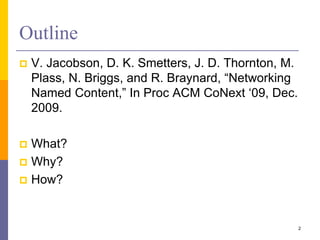
Motivation
 60’s & 70’s
 Internet was designed to
share resources
 2 end points talking to each
other
 Today
 Content is the key
 Location is irrelevant
 Content name  End point
 Use network to reach the
end point
3
Motivation (Cont.)
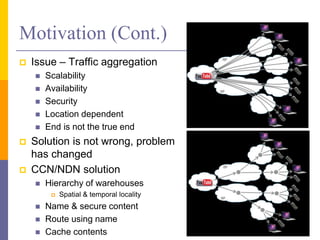
 Issue – Traffic aggregation
 Scalability
 Availability
 Security
 Location dependent
 End is not the true end
 Solution is not wrong, problem
has changed
 CCN/NDN solution
 Hierarchy of warehouses
 Spatial & temporal locality
 Name & secure content
 Route using name
 Cache contents
4
Incentives
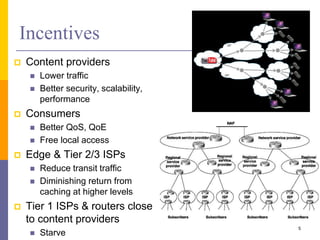
 Content providers
 Lower traffic
 Better security, scalability,
performance
 Consumers
 Better QoS, QoE
 Free local access
 Edge & Tier 2/3 ISPs
 Reduce transit traffic
 Diminishing return from
caching at higher levels
 Tier 1 ISPs & routers close
to content providers
 Starve
5
CCN Applications
 Content Delivery Networks (CDN)
 Streaming
 IPTV, Video on Demand (VoD)
 VoIP, teleconferencing
 Gathering sensor data & streaming
 Controlling actuators
 Light control
6
CCN Features
 In-network caching
 Unicast, multicast, broadcast
 Flow control
 No routing loops – nonce
 Ability to name non-existing data
 Enable them to be routed to potential data sources
 Security
 Mobility
 Incremental deployment
 Route symmetry
 Performance measuring, security
 Fine grained control of FIB entries & policies
 No need for DNS
7
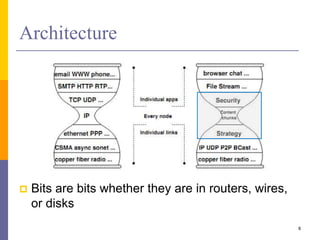
Architecture
 Bits are bits whether they are in routers, wires,
or disks
8
Packet Format
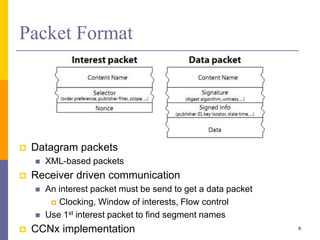
 Datagram packets
 XML-based packets
 Receiver driven communication
 An interest packet must be send to get a data packet
 Clocking, Window of interests, Flow control
 Use 1st interest packet to find segment names
 CCNx implementation 9
Naming Content
10
Naming Content (Cont.)
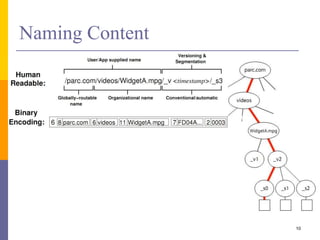
 Unique names
 Binary or human readable
 Favor hierarchical names
 Large content is segmented
 Can invoke remote methods & pass data
 /seti.org/resources/update/check_status
 /seti.org/resources/update/node102/free_CPU_90
 Name unavailable contents
 /nws.org/radar9/data_x1_x2_y1_y2/
11
Node Architecture
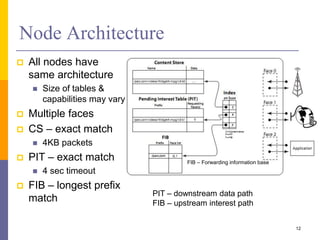
 All nodes have
same architecture
 Size of tables &
capabilities may vary
 Multiple faces
 CS – exact match
 4KB packets
 PIT – exact match
 4 sec timeout
 FIB – longest prefix
match
12
PIT – downstream data path
FIB – upstream interest path
FIB – Forwarding information base
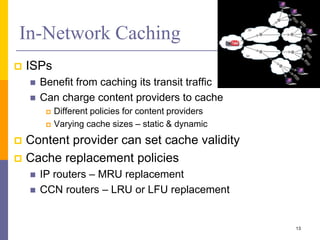
In-Network Caching
 ISPs
 Benefit from caching its transit traffic
 Can charge content providers to cache
 Different policies for content providers
 Varying cache sizes – static & dynamic
 Content provider can set cache validity
 Cache replacement policies
 IP routers – MRU replacement
 CCN routers – LRU or LFU replacement
13
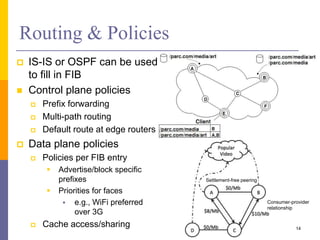
Routing & Policies
 IS-IS or OSPF can be used
to fill in FIB
 Control plane policies
 Prefix forwarding
 Multi-path routing
 Default route at edge routers
 Data plane policies
 Policies per FIB entry
 Advertise/block specific
prefixes
 Priorities for faces
 e.g., WiFi preferred
over 3G
 Cache access/sharing 14
Settlement-free peering
Consumer-provider
relationship
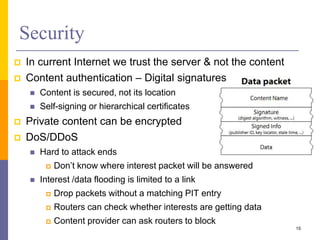
Security
 In current Internet we trust the server & not the content
 Content authentication – Digital signatures
 Content is secured, not its location
 Self-signing or hierarchical certificates
 Private content can be encrypted
 DoS/DDoS
 Hard to attack ends
 Don’t know where interest packet will be answered
 Interest /data flooding is limited to a link
 Drop packets without a matching PIT entry
 Routers can check whether interests are getting data
 Content provider can ask routers to block
15
Issues
 Size of CS, PIT, & FIB
 CCN name not just a TV but its components
 Billions of domains, contents, & chunks
 State full routers
 Solutions – IP Tunneling, CCN interest tagged with IP
 Doesn’t support asynchronous communication
 1 message in IP  2/4 CCN messages
 Block m-to-1 communication
 No TTL  no constrained flooding
 Packets are not modified
 When should PIT time out?
 No clear boundaries
 Hard to separate issues in node architecture, naming, & security
16

Content-Centric Networking (CCN)

  • 1.
    Content-Centric Networking (CCN) CS4482 HighPerformance Networking Dilum Bandara Dilum.Bandara@uom.lk
  • 2.
    Outline  V. Jacobson,D. K. Smetters, J. D. Thornton, M. Plass, N. Briggs, and R. Braynard, “Networking Named Content,” In Proc ACM CoNext ‘09, Dec. 2009.  What?  Why?  How? 2
  • 3.
    Motivation  60’s &70’s  Internet was designed to share resources  2 end points talking to each other  Today  Content is the key  Location is irrelevant  Content name  End point  Use network to reach the end point 3
  • 4.
    Motivation (Cont.)  Issue– Traffic aggregation  Scalability  Availability  Security  Location dependent  End is not the true end  Solution is not wrong, problem has changed  CCN/NDN solution  Hierarchy of warehouses  Spatial & temporal locality  Name & secure content  Route using name  Cache contents 4
  • 5.
    Incentives  Content providers Lower traffic  Better security, scalability, performance  Consumers  Better QoS, QoE  Free local access  Edge & Tier 2/3 ISPs  Reduce transit traffic  Diminishing return from caching at higher levels  Tier 1 ISPs & routers close to content providers  Starve 5
  • 6.
    CCN Applications  ContentDelivery Networks (CDN)  Streaming  IPTV, Video on Demand (VoD)  VoIP, teleconferencing  Gathering sensor data & streaming  Controlling actuators  Light control 6
  • 7.
    CCN Features  In-networkcaching  Unicast, multicast, broadcast  Flow control  No routing loops – nonce  Ability to name non-existing data  Enable them to be routed to potential data sources  Security  Mobility  Incremental deployment  Route symmetry  Performance measuring, security  Fine grained control of FIB entries & policies  No need for DNS 7
  • 8.
    Architecture  Bits arebits whether they are in routers, wires, or disks 8
  • 9.
    Packet Format  Datagrampackets  XML-based packets  Receiver driven communication  An interest packet must be send to get a data packet  Clocking, Window of interests, Flow control  Use 1st interest packet to find segment names  CCNx implementation 9
  • 10.
  • 11.
    Naming Content (Cont.) Unique names  Binary or human readable  Favor hierarchical names  Large content is segmented  Can invoke remote methods & pass data  /seti.org/resources/update/check_status  /seti.org/resources/update/node102/free_CPU_90  Name unavailable contents  /nws.org/radar9/data_x1_x2_y1_y2/ 11
  • 12.
    Node Architecture  Allnodes have same architecture  Size of tables & capabilities may vary  Multiple faces  CS – exact match  4KB packets  PIT – exact match  4 sec timeout  FIB – longest prefix match 12 PIT – downstream data path FIB – upstream interest path FIB – Forwarding information base
  • 13.
    In-Network Caching  ISPs Benefit from caching its transit traffic  Can charge content providers to cache  Different policies for content providers  Varying cache sizes – static & dynamic  Content provider can set cache validity  Cache replacement policies  IP routers – MRU replacement  CCN routers – LRU or LFU replacement 13
  • 14.
    Routing & Policies IS-IS or OSPF can be used to fill in FIB  Control plane policies  Prefix forwarding  Multi-path routing  Default route at edge routers  Data plane policies  Policies per FIB entry  Advertise/block specific prefixes  Priorities for faces  e.g., WiFi preferred over 3G  Cache access/sharing 14 Settlement-free peering Consumer-provider relationship
  • 15.
    Security  In currentInternet we trust the server & not the content  Content authentication – Digital signatures  Content is secured, not its location  Self-signing or hierarchical certificates  Private content can be encrypted  DoS/DDoS  Hard to attack ends  Don’t know where interest packet will be answered  Interest /data flooding is limited to a link  Drop packets without a matching PIT entry  Routers can check whether interests are getting data  Content provider can ask routers to block 15
  • 16.
    Issues  Size ofCS, PIT, & FIB  CCN name not just a TV but its components  Billions of domains, contents, & chunks  State full routers  Solutions – IP Tunneling, CCN interest tagged with IP  Doesn’t support asynchronous communication  1 message in IP  2/4 CCN messages  Block m-to-1 communication  No TTL  no constrained flooding  Packets are not modified  When should PIT time out?  No clear boundaries  Hard to separate issues in node architecture, naming, & security 16

Editor's Notes

  • #6 NSP – Network access point
  • #8 Motes without IP support IP routes are not symetric
  • #9 Strategy layer define – forwarding preferences, which face to select based on performance, retransmission after loss, window size
  • #11 Local names are also possible
  • #13 PIT – suppress duplicate packets
  • #14 A1 – less skewed A2 – More skewed
  • #15 1 circle – IP routers 2 circles – IP + CCN routers