Downloaded 10 times
![WhiletheadvancedfeaturesofUICCmodules
continuetoprovideconsiderablevalueinmobile
phoneapplications,mostofthemaresuperfluous
inIoTapplications.Inlightofthis,theindustry
isworkingtofindalesssophisticatedsolution
thatismoreappropriateforapplicationsthat
requiremassivenumbersofdevicesinprice-
sensitiveenvironments.Industryalignmenton
suchasolutionisexpectedtobeachallengingand
time-consumingprocess,however,duetothefact
thattheIoTareaisfragmentedintomanydifferent
verticals,applicationareasandusecases.
Ericssonisfullycommittedtosupportingthe
long-term,industry-alignedsolution.Inthemeantime,
however,itisvitaltofindworkaroundstoensure
thatthecostofUICCsdoesnotstifleIoTgrowth.
Whilethedefinitivesolutiontothequestionof
whatshouldreplacetheUICCishardtopredict,
twomid-termworkaroundsareclear:thecomplexity
ofusingUICCsandleveragingtheirexcesscapacity
togenerateadditionalvalue.
ReducingthecomplexityofusingUICCs
There are three main approaches to reducing the
complexity of using UICCs in IoT applications:
optimization, usage of 3GPP standardized
certificate-based authentication, and
virtualization.
Optimization
A typical operator profile on a 3GPP consumer
mobile phone is up to tens of kilobytes; the average
IoT sensor only requires 200-300 bytes. And of all
the functionality that a UICC can provide, an IoT
device only really needs the Universal Subscriber
Identity Module application and the remote SIM
provisioning (RSP) application, which allows
remote provisioning of subscriber credentials
(also known as operator profiles).
Onegoodwaytosignificantlyreducethefootprint
oftheUICCistooptimizetheoperatorprofileand
thenecessarysoftwareenvironmentwithinthe
UICCmodule.Doingsonotonlysavesstorageinthe
devicebutalsoreducesenergyconsumptionduring
over-the-airdownload.Furthersizereduction
ofthedevicemaybeachievedwhentheUICCis
completelyintegratedintothebasebandmodem
orapplicationprocessor(integratedUICCor
iUICC[2]).Thissimplifiedandintegratedsolution
couldworkeffectivelyforusecasesthatrequire
low-cost,simple,secureandlow-powerIoTdevices
inhighvolumes.
TheuseofaniUICCrequiresaneffective
RSPprotocol[3,4]thatmakesitpossibleto
changesubscriptioncredentials.CurrentRSP
standardsaretoocomplexforiUICCsformany
reasons,includingtheiruseofHTTPS
Definition of key terms
Identity describes the link between the identifier of an entity and the credentials that it uses to prove
that it is the rightful owner of the identity.
First used in Finland in 1991, the original subscriber identity module (SIM) was a smart card with
a protected file system that stored cellular network parameters. It was designed to connect
expensive user equipment – mobile phones – with expensive subscriptions to the cellular network.
When it became clear that smart cards did not have the capacity to provide an adequate level of security
in next-generation cellular networks, they were replaced with universal integrated circuit cards (UICCs)
– minicomputers equipped with general microprocessors, memory and strong cryptographic
co-processors [1].
UICC MODULES AND THE IoT ✱
3APRIL 14, 2020 ✱ ERICSSON TECHNOLOGY REVIEW](https://image.slidesharecdn.com/uicc-modules-and-the-iot-200414084920/75/Ericsson-Technology-Review-Optimizing-UICC-modules-for-IoT-applications-3-2048.jpg)
![(HypertextTransferProtocolSecure)andreliance
onSMSsupport.HTTPSistypicallynotpartofthe
protocolstackofconstrainedlow-powerIoTdevices.
Instead,thesedevicesuseastackwithConstrained
ApplicationProtocol(CoAP),DatagramTransport
LayerSecurity(DTLS)andUserDatagram
Protocol.Insomecases,theLightweightMachine-
to-Machine(LwM2M)protocolisusedontopof
CoAPfordeviceandapplicationdatamanagement.
Theuseofonlyonestackkeepsthecostofthe
devicedown.
Ericssonproposesutilizingthesameprotocol
stackforprofiledownloadandprofilemanagement
asisusedfordeviceandapplicationdata
management.Figure1illustrateshowtoachieve
thisbyadaptingtheGSMAembedded-SIM
solutionforconsumerdevicesforusewithIoT
devices.Inthissolution,thelocalprofileassistant
(LPA)issplitintotwoparts.Toreducedevice
footprint,themainpartoftheLPA(includingthe
useofHTTPS)ismovedfromthedevicetoadevice
orconnectivitymanagementserver.Thedevice
managementprotocolstack(OpenMobileAlliance
(OMA)LwM2M[1],forexample)handlesthe
communicationbetweenthetwoLPAparts.
Profileprotectionisstillend-to-endbetween
theiUICC/embedded-UICC(eUICC)andthe
provisioningserver(SubscriptionManager-Data
Preparation–SM-DP+).
Usageof3GPPstandardized
certificate-basedauthentication
Another way to reduce the need for a UICC
is to use a network authentication mechanism
different to the classical 3GPP Authentication
and Key Agreement (AKA). The use of certificates
is a classic solution used in the internet that may
easily fit into the existing network architecture
of an enterprise/service provider. In public
5G networks, authenticating with certificates
is possible as a secondary authentication for a
service using AKA, but only after primary network
Figure 1 Remote provisioning using IoT-optimized technology
SIM alliance profile
LPA split
IoT
platform
HTTPS
Internet
Device owner/user
LwM2M-based
secure communication
IoT device with
cellular module
Provisioning
server
(SM-DP+)
Mobile
network
operator
LPAprLPAdv
✱ UICC MODULES AND THE IoT
4 ERICSSON TECHNOLOGY REVIEW ✱ APRIL 14, 2020](https://image.slidesharecdn.com/uicc-modules-and-the-iot-200414084920/75/Ericsson-Technology-Review-Optimizing-UICC-modules-for-IoT-applications-4-2048.jpg)
![authentication has been performed. According to
the 3GPP, authentication in private networks
such as Industry 4.0 solutions may rely entirely
on certificate-based solutions such as Extensible
Authentication Protocol over Transport Layer
Security. Without a UICC for securely storing
and operating on secret long-term credentials
for network access authentication, another
secure environment with secure storage
solution is needed.
Forcertainapplicationsalowerlevelofsecurity
mightbeaccepted.Thevalueofthedatathatthe
IoTdeviceprovidesorhandles,inrelationtothe
costoftheIoTdevice,determinestherequired
securitylevelofthesecureenvironmentforprotecting
networkaccessauthenticationcredentials.Inthe
caseofaUICCbeingused,itdeterminesthe
realizationoftheUICCfunctionality.Forsome
low-costconstrainedIoTdevices,arealization
usingahardware-isolation-basedtrustedexecution
environmentmaybeacceptable.Asthereisno
universalandperfectsolution,operatorsmust
decidewhichsolutionismostsuitableforanygiven
application.ItislikelythattheUICCsandeUICC-
basedsolutionswillremainthetechnologyofchoice
inpublicnetworksforthenextfewyears.
Virtualization
Virtualizing the UICC is yet another alternative
that addresses the cost issue associated with
UICC technology. One way to do this is to run
a UICC environment in a virtual machine
(or at least on a separated processor core) inside
the application processor or the baseband modem.
Another approach is to store the operator profiles
in the security zone of the application processor,
then download them to empty physical UICC
hardware on demand.
Thebiggestadvantagesofthesevirtualization
solutionsisflexibilityandbetterutilizationof
existinghardwareresources,whileatthesametime
maintainingmanyoftheadvantagesofcurrent
technology.Thesemethodsareparticularlyeffective
whenanIoTdeviceneedstomanagemultiple
operatorprofiles–acircumstancethatwillbecome
increasinglycommon,accordingtoananalysis
carriedoutbytheGSMA[5].
Thedisadvantagesofvirtualizationaresimilarto
thoseofcertification-basedsolutions.Mostnotably,
certificationisharderwhenatrustedenvironment
isintegratedwiththerestofthedevicecompared
withusinganisolatedUICCoreUICC.
GeneratingadditionalvaluefromtheUICC
Experience shows that it is significantly less
expensive to limit a protected and certified
manufacturing environment to a dedicated
hardware module such as a UICC than to ensure
that all the software running in the mobile
equipmentcanbetrusted.Inlightofthis,webelieve
thatcommunicationserviceproviderswillcontinue
usingUICCmodulesforatleastthenext5-10years.
During this period, it makes sense to exploit the
potential of the UICCs to better support IoT
applications by creating value-added services
for operators and enterprises. Three examples of
this are using the UICC as cryptographic storage,
using it to run higher-layer protocolstacks,
andusingitasasupervisoryentity.
UsingtheUICCascryptographicstorage
UICC modules were designed to serve as
cryptographic storage and are used today mainly
for the storage of security credentials for 3GPP
connectivity. We propose, in accordance with
GSMA IoT SAFE [1], that the UICC itself should
also be used as a crypto-safe for the IoT platform,
providing support to establish encrypted
connection of the applications.
OPERATORSMUST
DECIDEWHICHSOLUTION
ISMOSTSUITABLEFOR
ANYGIVENAPPLICATION
UICC MODULES AND THE IoT ✱
5APRIL 14, 2020 ✱ ERICSSON TECHNOLOGY REVIEW](https://image.slidesharecdn.com/uicc-modules-and-the-iot-200414084920/75/Ericsson-Technology-Review-Optimizing-UICC-modules-for-IoT-applications-5-2048.jpg)
![AgenericIoTdevicehasmultipleidentitiesforuse
inmultiplesecuritydomains.Everyidentityhasat
leastoneidentifierandcredential,allofwhichmust
bestoredsomewhere.Althoughtherearemultiple
options,ahardwareelementthatispowerfulenough
toplaytheroleoftherootoftrustisdefinitelyneeded.
TheUICCisperfectforthisrole,asitisalreadyused
asanidentityfor3GPPnetworks,storingInternational
MobileSubscriberIdentity,intensifiedcharge-
coupleddevice,Wi-FiandOMALwM2M[6]
credentialsalongwithdozensofotheridentifiers.
Thenecessarytrustedandcertifiedenvironment
andinfrastructurearealreadyavailabletomanufacture
themodule,downloadandupdateitscontentand
carryoutremotemanagementaswell.
Tocovereveryaspect,UICC-basedsolutions
requirecooperationbetweentheUICCecosystem
andtheIoTdevicesecuritysubsystem(ARMTrust
Zone[7],forexample).IDandcredentialmanagement
itselfisdevice-independent,whichsavesdevelopment
costandincreasesthesecuritylevel.Additional
advantagesofusingUICCasarootoftrustare:
❭ it has its own local processor
❭ it is usually equipped with powerful
cryptographic co-processors
❭ it comes with a powerful, standardized remote
management subsystem (RMS)
❭ it is handled through a separate logistics chain.
The UICC can generate key-pairs and store
private keys for multiple security domains
effectively and securely. Effectiveness comes
from its powerful cryptographic co-processors,
while security is provided by the combination of
the standardized RMS and the UICC’s ability to
run cryptography processes inside the module.
This means that the keys never leave the hardware
and therefore they cannot be exposed to the
application. Not only does this architecture
provide security, it can also securely tie
the 3GPP connectivity credentials and other
IoT certificates to each other.
TherecentlyreleasedGSMAIoTSAFE[8]offers
asolutionwheretheUICCisutilizedasarootof
trustforIoTsecurity.Here,anappletontheUICC/
eUICCprovidescryptographicsupportandstorage
ofcredentialsforestablishingsecurecommunication
(forexample,usingDTLS)toanIoTservice.The
existingUICCmanagementsystem(UICCOTA
mechanism)isusedbytheoperatortoestablish
trustedcredentialsbetweenthedeviceandtheIoT
service.TheGSMAIoTSAFEdefinesanapplication
programminginterfaceforinteroperabilitybetween
SIMappletsfromdifferentoperators.
UsingtheUICCtorun
higher-layerprotocolstacks
In addition to providing security and encryption
functions, UICC modules could also serve as
main application processors. Today, a low-cost,
sensor-like IoT device usually has at least three
processors on board: one is on the UICC module,
another runs inside the baseband modem, and a
third – the application processor itself (sometimes
combined) – collects data and hosts higher level
communication stacks such as LwM2M, CoAP
or MQ Telemetry Transport.
Shiftingthehigher-levelcommunicationstack
fromtheapplicationprocessortotheUICC
modulecanleadtocheaperhardwareandlower
developmentcosts,aswellasprovidingaunique
approachtointeroperability.Asaresult,some
modemmanufacturershaveimplementedthese
protocolsinsidethemodem,runningacomplete
OMALwM2Mprotocolstackinthebasebandchip,
forexample.Whilethismayfreeupanexternal
applicationprocessorandspeedupdevice
development,thissolutionisratherinflexible.
EFFECTIVENESS
COMESFROMITS POWER-
FULCRYPTOGRAPHIC
CO-PROCESSORS
✱ UICC MODULES AND THE IoT
6 ERICSSON TECHNOLOGY REVIEW ✱ APRIL 14, 2020](https://image.slidesharecdn.com/uicc-modules-and-the-iot-200414084920/75/Ericsson-Technology-Review-Optimizing-UICC-modules-for-IoT-applications-6-2048.jpg)
![Sincemodemfirmwareisaclosedenvironment,
itisdifficulttoupgradeandtocustomizeitsprotocol
stacks(extendingthemwithproprietaryadded
values).Inaddition,asmallsecurityholeinthe
protocolstackcanbeenoughforahackertotake
controlofthewholemodem.
Alternatively,thesehigher-layerprotocolstacks
canbemovedtotheUICC.Figure2depictsablock
diagramofadevice,wheretheOMALwM2M
clientrunsontheUICCmoduleandusesanon-IP
datadelivery(NIDD)protocolconnectiontosend
informationtothedevicemanagementsystem.
Runninghigher-levelprotocolsintheUICC
modulecanimprovesecurityinseveralways.
Forexample,itispossibletoruntheLwM2M
stackoveraNIDDconnection[9]andeventoallow
thiscodetoexecuteontheUICCmoduleinstead
ofonthedeviceprocessor.Inthisscenario,
command/controlisneverexposedonthe
IPlayerbecauseitisrunninginthesignaling
networkoftheoperator.Anadditionaladvantage
ofthisapproachisthatitincreasesinteroperability.
Thereisastandardizedwayofupgradingthe
communicationstackintheUICC–itiseven
possibletoinsertthecommunicationstackinto
theoperatorprofile.Thisdoesnotcompletely
solvecompatibilityandinterfacingproblems,
butacertifiedoperatorcanhandletheseissues
onahighersecurityleveltoprovidewider
solutionmatching.
InthesimplestIoTdevices,itmightevenbe
possibletoruntheactualIoTapplicationonthe
UICCmodule.Thiswouldopenforedge-computing
solutionsinwhichsimpletasksareexecutedonthe
device–datafilteringtoreducetheamountofdata
beingsentovertheair,forexample.Securitycanalso
beimprovedifthebinaryisstoredontheUICC
insteadofonthedeviceapplicationprocessor.
Figure 2 IoT device with LwM2M client running on the UICC module, using NIDD
Application
Operator
profile
PSK
IMEI
BIP
Sensor data
IoT device
UICC
PSK
NIDD/SMS/USSD
NIDD/SMS
/USSD
Dev. ID
SCEF
Radio modem
LwM2M
client
Device and
data
management
(LwM2M
server)
SIMtoolkit
UICC MODULES AND THE IoT ✱
7APRIL 14, 2020 ✱ ERICSSON TECHNOLOGY REVIEW](https://image.slidesharecdn.com/uicc-modules-and-the-iot-200414084920/75/Ericsson-Technology-Review-Optimizing-UICC-modules-for-IoT-applications-7-2048.jpg)
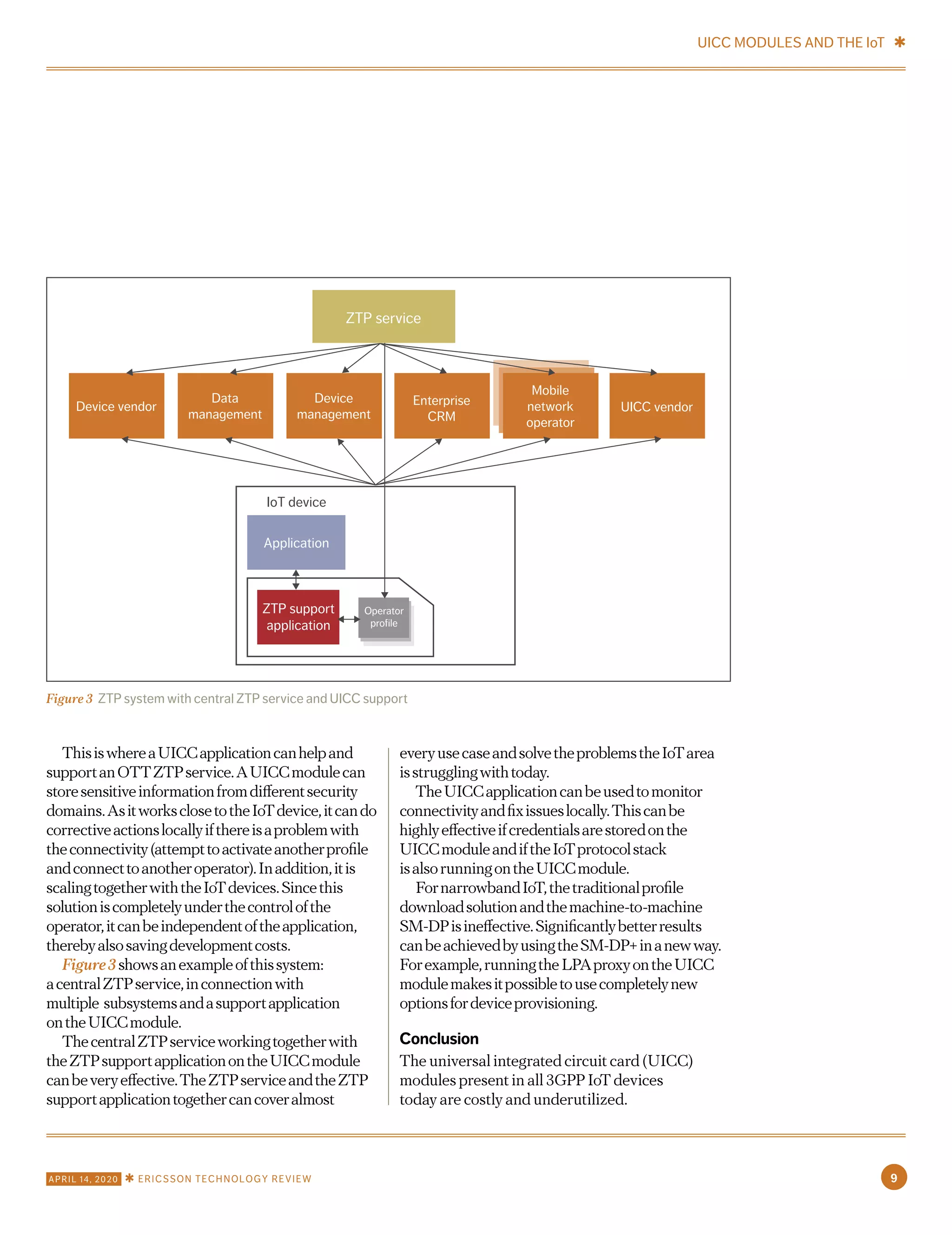


The document discusses the optimization of UICC modules for IoT applications, highlighting the challenges posed by their complexity and cost in the context of diverse IoT use cases. It outlines three main strategies for reducing complexity: optimization of operator profiles, usage of certificate-based authentication, and virtualization of UICC functionalities to enhance cost-effectiveness and functionality. Furthermore, it explores the potential for UICCs to generate additional value in IoT by serving as cryptographic storage and running higher-level protocol stacks without compromising security.


![[Webinar] Why Security Certification is Crucial for IoT Success](https://cdn.slidesharecdn.com/ss_thumbnails/webinarwhysecuritycertificationiscrucialforiotsuccess-170722001838-thumbnail.jpg?width=640&height=640&fit=bounds)


![Vibe Coding vs. Spec-Driven Development [Free Meetup]](https://cdn.slidesharecdn.com/ss_thumbnails/vibecodingvsspecdrivendevelopment-251209105622-43f455e7-thumbnail.jpg?width=640&height=640&fit=bounds)


